Mar 20, 2018

Interstellar asteroid, 'Oumuamua, likely came from a binary star system

This is an artist's impression of 'Oumuamua.
New research finds that 'Oumuamua, the rocky object identified as the first confirmed interstellar asteroid, very likely came from a binary star system.

"It's remarkable that we've now seen for the first time a physical object from outside our Solar System," says lead author Dr Alan Jackson, a postdoc at the Centre for Planetary Sciences at the University of Toronto Scarborough in Ontario, Canada.

A binary star system, unlike our Sun, is one with two stars orbiting a common centre.

For the new study, published in the journal Monthly Notices of the Royal Astronomical Society, Jackson and his co-authors set about testing how efficient binary star systems are at ejecting objects. They also looked at how common these star systems are in the Galaxy.

They found that rocky objects like 'Oumuamua are far more likely to come from binary than single star systems. They were also able to determine that rocky objects are ejected from binary systems in comparable numbers to icy objects.

"It's really odd that the first object we would see from outside our system would be an asteroid, because a comet would be a lot easier to spot and the Solar System ejects many more comets than asteroids," says Jackson, who specializes in planet and solar system formation.

Once they determined that binary systems are very efficient at ejecting rocky objects, and that a sufficient number of them exist, they were satisfied that 'Oumuamua very likely came from a binary system. They also concluded that it probably came from a system with a relatively hot, high mass star since such a system would have a greater number of rocky objects closer in.

The team suggest that the asteroid was very likely to have been ejected from its binary system sometime during the formation of planets.

'Oumuamua, which is Hawaiian for 'scout', was first spotted by the Haleakala Observatory in Hawaii on 19 October 2017. With a radius of 200 metres and travelling at a blistering speed of 30 kilometres per second, at its closest it was about 33,000,000 km from Earth.

When it was first discovered researchers initially assumed the object was a comet, one of countless icy objects that release gas when they warm up on approaching the Sun. But it didn't show any comet-like activity as it neared the Sun, and was quickly reclassified as an asteroid, meaning it was rocky.

Researchers were also fairly sure it was from outside our Solar System, based on its trajectory and speed. An eccentricity of 1.2 -- which classifies its path as an open-ended hyperbolic orbit -- and such a high speed meant it was not bound by the gravity of the Sun.

In fact, as Jackson points out, 'Oumuamua's orbit has the highest eccentricity ever observed in an object passing through our Solar System.

Major questions about 'Oumuamua remain. For planetary scientists like Jackson, being able to observe objects like these may yield important clues about how planet formation works in other star systems.

Read more at Science Daily

Mar 19, 2018

Hormone imbalance may explain higher diabetes rates in sleep-deprived men

Studies have found an association between insufficient sleep and the development of insulin resistance, one of the factors that cause type 2 diabetes, and now researchers have discovered a biological reason for this relationship, at least in men: an imbalance between their testosterone and cortisol hormones. The study results will be presented Sunday at ENDO 2018, the Endocrine Society's 100th annual meeting in Chicago, Ill.

"Our highly controlled sleep study showed that even one night of restricted sleep can cause insulin resistance and that we can dampen this effect by controlling levels of these two important hormones," said senior investigator Peter Y. Liu, M.B.B.S., Ph.D., a professor of medicine with the Los Angeles Biomedical (LA BioMed) Research Institute at Harbor-UCLA Medical Center, Torrance, Calif.

Insulin resistance occurs when the body does not properly use the hormone insulin. Testosterone is the main anabolic, or muscle-building, hormone, whereas cortisol -- often called the "stress hormone" -- helps catabolism, or breaking down energy and fat stores for use, Liu explained. Past research shows that sleep loss reduces a man's testosterone levels and increases cortisol levels.

Liu and his fellow researchers conducted five nights of sleep studies in 34 healthy men with an average age of 33. They controlled what the subjects ate and how much they slept, giving them 10 hours of sleep the first night and restricting them to four hours of sleep the remaining nights. The study received funding from the National Institutes of Health and the Clinical and Translational Research Center at LA BioMed.

In this "crossover" study, the men served as their own controls. In one series of sleep studies, they received three medications: ketoconazole, which switches off the body's production of testosterone and cortisol; testosterone gel; and oral hydrocortisone, a synthetic form of cortisol. The doses of testosterone and hydrocortisone were in the midrange of levels that the body normally produces, according to Liu. This arm of the study was called a dual "clamp" because it stopped the body's production of these two hormones and then gave them a fixed amount of the hormones, thus clamping levels in a normal hormonal balance, he said.

In another set of experiments, the men received inactive placebos that matched the medications. The order of when they received the clamp and the placebo was random, with a two-week interval between the study conditions. The morning after the first and last nights of each part of the study, all men took the oral glucose tolerance test, in which they gave blood samples while fasting and again after drinking a sugary drink. This test result allowed the researchers to calculate each man's insulin resistance using standard measures, including the Matsuda Index.

After sleep restriction, this index reportedly showed greater insulin resistance with both the clamp and the placebo. However, Liu said this increase was significantly dampened, or less severe, with the dual-clamp, demonstrating that testosterone and cortisol reduced the negative effects of sustained sleep restriction on insulin resistance.

Read more at Science Daily

New diabetes drug may help people with obesity lose weight

Diet pills.
A compound that mimics a naturally occurring hormone that regulates appetite may help people who have obesity but not diabetes to lose weight, a new study suggests. The research will be presented Sunday, March 18, at ENDO 2018, the Endocrine Society's 100th annual meeting in Chicago, Ill.

The compound, semaglutide, has a chemical structure that is very similar to the hormone glucagon-like peptide 1 (GLP-1), which regulates both insulin secretion and appetite. In December, the U.S. Food and Drug Administration approved the semaglutide injection Ozempic as a once-weekly adjunct to diet and exercise to improve glycemic control in adults with type 2 diabetes.

"This randomized study of weight loss induced with semaglutide in people with obesity but without diabetes has shown the highest weight reductions yet seen for any pharmaceutical intervention," said lead author Patrick M. O'Neil, Ph.D., Director of the Weight Management Center and Professor of Psychiatry and Behavioral Sciences at the Medical University of South Carolina in Charleston, S.C.

The new study included 957 participants, 35 percent of whom were male. All participants had a body mass index (BMI) of at least 30, but did not have diabetes. They were randomly assigned to seven different groups. Five groups received different doses of semaglutide (between 0.05 mg and 0.4 mg) via injection once daily; a sixth group received a placebo, and a seventh group received 3 mg of the diabetes drug liraglutide. All participants received monthly diet and exercise counseling.

After one year, all participants receiving semaglutide had lost significantly more weight than those receiving placebo. The higher the dose participants received, the greater their average weight loss. Participants who received 0.05 mg of semaglutide daily lost an average of 6.0 percent of their body weight; the 0.1 mg group lost an average of 8.6 percent; the 0.3 mg group lost an average of 11.2 percent; and those receiving a daily dose of 0.4 mg lost an average of 13.8 percent. Those receiving liraglutide lost an average of 7.8 percent of their body weight, while those in the placebo group lost only 2.3 percent on average.

Sixty five percent of participants who received 0.4 mg of semaglutide per day lost at least 10 percent of their body weight, compared with 10 percent of those in the placebo group and 34 percent of the liraglutide group.

Read more at Science Daily

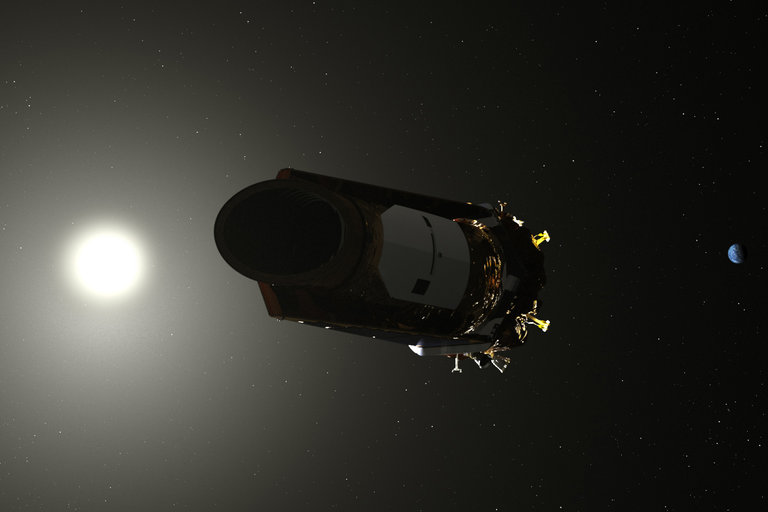
NASA’s Kepler Space Telescope Is Nearing the End as Its Fuel Supply Runs Low

The Kepler mission, which launched in 2009, has transformed our understanding of our place in the galaxy, giving us hope that we aren’t alone. The venerable spacecraft has proved adept at reinventing itself when things go wrong. But engineers monitoring Kepler announced that the mission will soon come to an end because the spacecraft is running out of fuel.

“We’ve always known that Kepler’s lifetime would be limited by the amount of fuel in the tank,” said Thomas Barclay, a former senior research scientist with the Kepler and K2 missions.  “It looks like it’s going happen at some point in the next few months, although we still don’t know exactly when.”

Barclay said the timing of when the thruster fuel tank will be empty is somewhat difficult to estimate.

“We can’t actually measure how much fuel is left,” he told Seeker in a phone call. “The engineers have to measure how much pressure there is when the thrusters are fired. So it is a bit of an art to working out how much fuel there is and how long it will last. Even with the last little bit of fuel you don’t know if it will be useable or if it will be stuck in the bottom of the tank.”

Although the spacecraft team has long known about the fuel situation, Charlie Sobeck, a system engineer for Kepler made the announcement this week.

“The Kepler space telescope has survived many potential knock-outs during its nine years in flight, from mechanical failures to being blasted by cosmic rays,” Sobeck wrote. “At this rate, the hardy spacecraft may reach its finish line in a manner we will consider a wonderful success. But with nary a gas station to be found in deep space, the spacecraft is going to run out of fuel.”

But, Sobeck added: “We’ve been surprised by its performance before.”

Kepler revolutionized what we know about the amount of exoplanets in our galaxy.  The space-based telescope has detected 2,245 exoplanets with another 2,342 waiting to be confirmed.

Statistical analysis of data from the planet-hunting spacecraft reveals mind-boggling numbers: Our galaxy has at least 100 billion planets, and about 17 percent of stars have an Earth-sized planet. That means there are at least 17 billion Earth-sized worlds out there.

Kepler detected planetary candidates using the transit method, watching for a planet to cross its star and create a mini-eclipse that dims the star slightly. To do this in its Earth-trailing orbit 94 million miles away, Kepler needed to have precise pointing to constantly view a 100-square-degree portion of the sky — equivalent in size to two side-by-side “bowls” of the Big Dipper — in a star-filled region located between the constellations Cygnus and Lyra. 

The mission was a spectacular success, making the announcements of spectacular worlds orbiting other stars become almost routine.

But in May of 2013, a second of Kepler’s four reaction wheels failed. These gyroscope-like devices kept the spacecraft stable, and Kepler needed at least three to be able to point accurately enough to hunt for exoplanets.

But the spacecraft wasn’t dead yet. Engineers came up with a plan to use solar radiation pressure — the photons from the sun that can be used to power solar sails — to help stabilize that spacecraft.  While the telescope’s aim wasn’t as precise as it used to be, it was close. It remained a great telescope in space, and it just needed a new mission. So a group of scientists came up with a plan called K2, which Barclay described as a spectacular success in its own right.

“While the Kepler mission entailed a very focused science goal of finding exoplanets, K2 is a completely different beast,” he said. “We’re not just Kepler slightly worse at pointing; we were a revolutionary new mission.”

K2 has been run by the community of scientists around the world, one of the few NASA missions to lack a particular science goal.  Instead, a panel of scientists decides how the spacecraft will be used, choosing from submitted proposals.

Proposed missions are based on the 83-day region of sky where Kepler can point. 

Barclay led the K2 “guest observer” program that looked at everything from giant black holes to planets in our own solar system to supernovas in distant galaxies.

Kepler's thrusters are powered by hydrazine fuel, which has been used as a propellent since the early days of space flight. It's the same fuel that powered the Cassini spacecraft, a mission that came to an end in September 2017 when the probe ran out of fuel.

When Kepler launched, it had with 12 kilograms, or a little over 3 gallons of fuel onboard. The primary mission was planned to be three and a half years, with outside goal of operating the spacecraft for six years. Engineers said based on the amount of fuel that has been used over the course of its nine years in flight, they estimated that 2018 would be the year when the spacecraft’s fuel supplies would run out.

“We have been maintaining a close watch on the fuel estimates so that we can be prepared to bring the last batch of scientific data back to Earth and retire the spacecraft,” the team wrote.

Read more at Seeker

Environmental Change Forced Early Humans in East Africa to Innovate

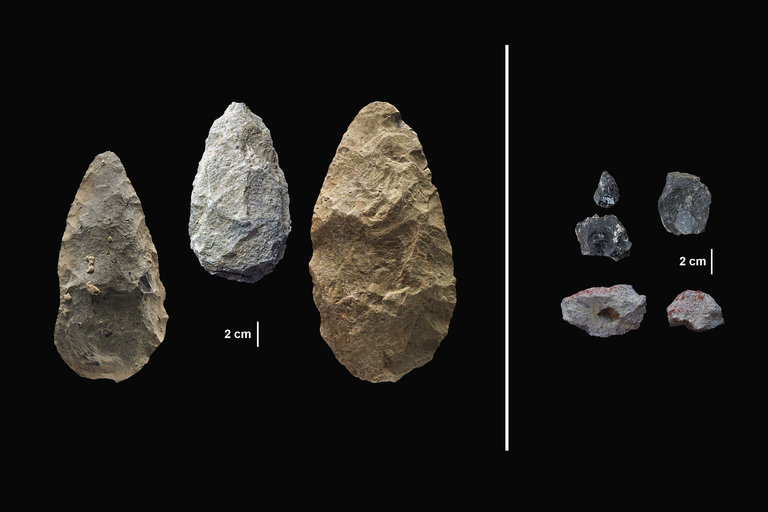
Early stone-cutting tools called hand-axes (left) and later more sophisticated tools (right) designed to be attached to a shaft and potentially used as projectile weapons. Others were shaped as scrapers or awls. The National Museums of Kenya loaned the artifacts pictured above to conduct the analyses published in Science.
Stone Age tools were built to last, and many of their related technologies hold present day value. For example, the discovery around 320,000 years ago that obsidian, a type of glasslike volcanic rock, can produce ultra-sharp cutting edges is still a benefit today. Surgeons around the world often use obsidian scalpels, which are capable of cutting with greater precision than those made of steel.

Obsidian also revolutionized the creation of other tools, including weapons. The hefty hand-axes associated with the Acheulean industries, which began over a million years ago, were gradually replaced with lighter-weight, razor-edged triangular points that could be hafted to wood or bone and projected through the air.

"The world has never been the same since," Richard Potts, director of the National Museum of Natural History's human origins program, told Seeker. Potts has been leading the program's research in the Olorgesailie Basin of southern Kenya for 34 years in collaboration with the National Museums of Kenya.

In three new studies published in the journal Science, he and his colleagues report evidence from this region of not only major technological changes, like the usage of obsidian, but also environmental and ecological changes that were also taking place before and during the period when Homo sapiens emerged.

The changes coincide with the oldest known fossil record for our species in Africa, suggesting that the events were all driving forces in the evolution of Homo sapiens.

The findings counter a popular theory about human evolution, which holds that our species gradually changed in response to environmental pressures caused by expanding, arid grasslands in Africa. The so-called savanna hypothesis suggests that our ancestors transitioned from an arboreal to a bipedal lifestyle and evolved in other key ways due to living in this type of relatively stable environment.

Potts several years ago instead formulated a human evolution theory around "variability selection," which he explained "is a process linking adaptive change to large degrees of environment variability."

In the first of the three new studies, Potts and his team report that the Olorgesailie Basin — where hominids lived starting by at least 1.2 million years ago — was mostly floodplains until around 800,000 years ago. For the next several thousand years, an increasing pace of environmental change is seen in the geological record, such as through sediments and carbon isotopes of soil samples.

"The region went from being a stable system to one with significant tectonic activity, land-lake oscillations, fire-reddened zones, and intense wet-dry fluctuations," Potts said. "These would have resulted in unpredictable food and water supplies that, in turn, would have led to populations attempting to expand their geographical range in search of resources."
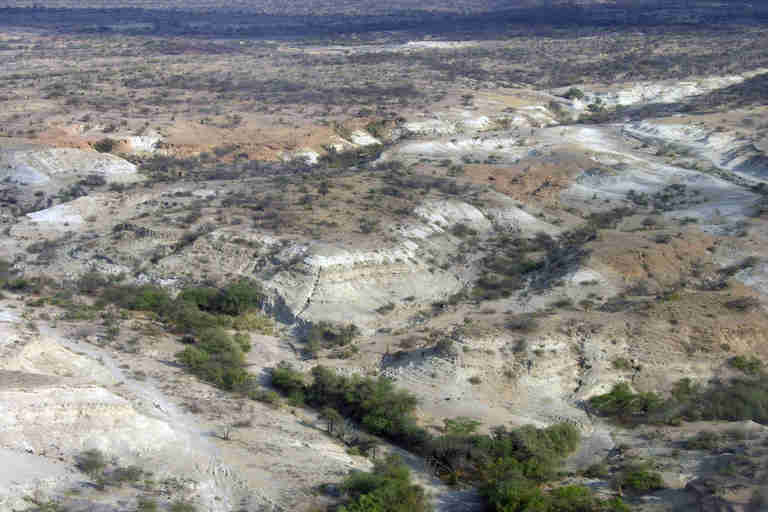
A bird's eye view of the Olorgesailie Basin in southern Kenya, which holds an archaeological record of early human life spanning more than a million years.
Some animals did not survive the period of instability. Many large-bodied grazing specialists, including some elephant and horse species, went extinct.

"I refer to them as the 'large lawn mowers' of the time,'" Potts said, adding that a baboon, a big hippo, a zebra, some large wild pigs, and other animals also went extinct following the environmental changes.

Absent those large creatures, related taxa with smaller body sizes emerged. The authors say this is another sign of climate variability.

As for hominids, they could no longer stay in one place for a long time, which was a problem because of their reliance on bulky stone tools for survival.

"What we see is the emergence of smaller and lighter tools, capable of easier transport," Potts said. "These gradually replaced the big, clunky Acheulean toolkit."

This technological shift, marking the beginning of the Middle Stone Age, was previously thought to have happened around 280,000 years ago. While hominid populations throughout much of Africa appear to have held on to their Acheulean tools until that time, those in East Africa made the transition by at least 320,000 years ago. At this time, about 42 percent of the more refined tools were crafted from obsidian.
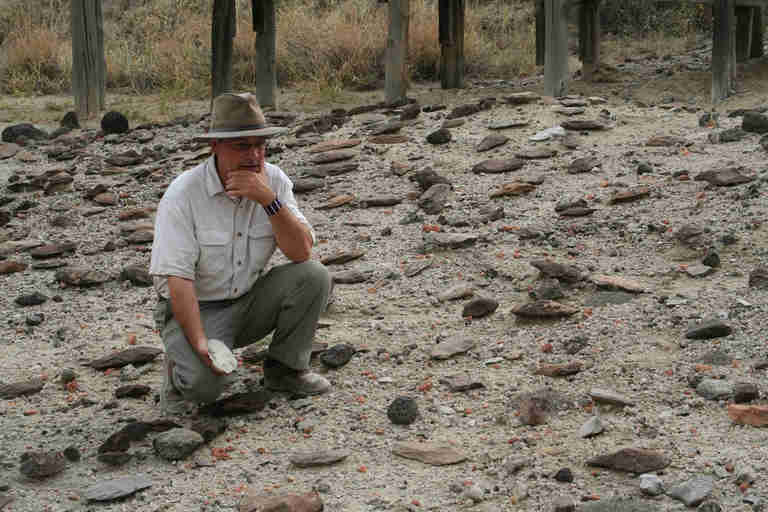
Richard Potts surveys an assortment of Early Stone Age hand-axes discovered in the Olorgesailie Basin, Kenya.
The second study, led by anthropologist Alison Brooks of George Washington University's Center for the Advanced Study of Human Paleobiology, provides more detail on the human-made artifacts excavated from the Olorgesailie Basin.

She and her team surprisingly found that there is no local source there for obsidian, which means individuals must have traveled from around 16 to over 62 miles to obtain this coveted material. The shortest distance would have required scaling a mountain, Brooks said, making the trip all the more arduous.

"Other people were also living where the obsidian was, so the travelers could not just take and grab it," Brooks told Seeker. "Instead, the humans of the Olorgesailie Basin must have made distant contacts, with whom they might have engaged in trade."

"People at the time did not have money or animals to trade," she continued. "Friends were the real money in the bank."

Before around 320,000 years ago, these populations were not yet Homo sapiens, the researchers believe. It is likely that they were Homo heidelbergensis, a species of our genus that once lived in not only Africa but also in Europe and western Asia.

Fossils for Homo sapiens start to appear in Morocco around 315,000 years ago. A skull for Homo sapiens from Ethiopia dates to around 200,000 years ago, while a jawbone from our species excavated in Israel dates to about 180,000 years ago.

As more fossils are found, it is likely that more will date closer to 320,000 years ago, coinciding with the environmental and technological changes that were also occurring at this time. As Brooks indicated, social changes were occurring too, and there are clues for this in the fossil record.

Brooks and her team report the discovery of two lumps of ochre that had been manipulated by humans. It looks as though someone ground portions of the ochre, which would have produced a bright red powder.

"This powder could be mixed with anything — sweat, oil, water, fat — and produced a nice pigment," Brooks said.

Black and red rocks containing manganese and ocher were excavated at the Olorgesailie Basin, along with evidence that the rocks had been processed for use as coloring material.
The early humans also appear to have created black (manganese), brown, green, and white pigments, and perforated a piece of ochre on opposite sides in order to possibly wear or carry the colorful rock. By 77,000–80,000 years ago, there is evidence that humans were wearing beads with ochre on them. Neanderthals also appear to have used red ochre pigments by at least 250,000 years ago.

Early humans could have applied color to signify their social networks. Potts pointed out that this still occurs today with flags, tattoos, hats, university t-shirts, and other visual signs of affiliation.

"Placing color on skin, hair, and other parts of the body can be a symbolic behavior," Potts explained. "It can communicate, 'I'm part of a group that you know and you like us.'"

Conflicts occur among hunter-gatherers, but since smaller populations were spread over vast distances in Africa, the researchers believe that warfare during these earlier periods of human history would have been inherently kept in check.

This is not to say that the different hunter-gatherer groups did not have arguments. Spoken language cannot be preserved in the fossil record, save for evidence that a hominid possessed anatomy capable of speech. The researchers, however, suspect that the emergence of more complex social networks over longer distances and resulting symbolic behaviors would have advanced language evolution. 

Humans in Africa probably did not talk much about killing large animals for sustenance. With many big animal species extinct and replaced by smaller taxa, people appear to have relied more on small game.

Read more at Seeker

Mar 18, 2018

Marine ecologists study the effects of giant kelp on groups of organisms in the underwater forest ecosystem

When British naturalist Charles Darwin traveled to the Galapagos Islands in 1835, he took notice of the giant kelp forests ringing the islands. He believed that if those forests were destroyed, a significant number of species would be lost. These underwater ecosystems, Darwin believed, could be even more important than forests on land.

Since then, much scientific research has focused on the presence of giant kelp and the range of biodiversity it supports. Many marine biologists think of the world's biggest alga as the keystone species of its ecosystem, not only in terms of its structure -- a huge forestlike environment under the sea -- but also in terms of its tremendous productivity in supplying food for the near-shore ecosystem.

New analysis by UC Santa Barbara researchers has found that the kelp's structure may be more important than the food it provides. Using over a decade's worth of data from the Santa Barbara Coastal Long Term Ecological Research project, supported by the National Science Foundation, the investigators examined the effects of kelp on groups of organisms in the kelp forest ecosystem. Their results appear in the journal Proceedings of the Royal Society B.

"We posited that giant kelp fed herbivores in the system and provided structure and habitat for predators, and that it was fed upon by sea urchins and affected the understory communities of algae and sessile invertebrates in the kelp forest," said lead author Robert Miller, a research biologist in UCSB's Marine Science Institute (MSI). "We found that the giant kelp affected some of these groups more than others. Predator diversity was increased by it, but understory algae decreased as expected because the giant seaweed shades the bottom and prevents other algal species from doing well. In turn, giant kelp positively affected the sessile invertebrates -- sponges and sea squirts -- that live on the bottom but can often be outcompeted for space by algae."

The marine biologists built a structural equation model to examine the association between different variables all at once. This enabled them to hypothesize specific paths -- this type of modeling is also called path analysis -- and create a more powerful model.

The data showed that although sea urchins negatively affected giant kelp by grazing on it, no direct link between kelp and other herbivores existed. In reality, herbivores eat varied diets, which means they aren't necessarily affected when giant kelp abundance declines. In fact, the majority of kelp production is exported out of the forest rather than consumed by animals living there.

In other research, Miller and fellow MSI research biologist Mark Page used stable isotopes to determine that suspension-feeding sessile organisms subsist on phytoplankton rather than kelp detritus. This finding is contrary to the view held by many in the scientific community that kelp detritus is an important food source for these invertebrates.

"Our modeling results suggest that the physical aspects of the kelp -- its sheer size and its presence, the shade that it casts, its effect on flow and the habitat it provides for predators -- affect the reef ecosystem more than its productivity," Miller said. "Although kelp is clearly important as a food resource to some organisms on the reef, its structural effects are important and far reaching."

Apparently, Darwin was right.

Read more at Science Daily

Space radiation more hazardous: Implication sfor astronauts and satellites

It might sound like something from a science fiction plot -- astronauts traveling into deep space being bombarded by cosmic rays -- but radiation exposure is science fact. As future missions look to travel back to the moon or even to Mars, new research from the University of New Hampshire's Space Science Center cautions that the exposure to radiation is much higher than previously thought and could have serious implications on both astronauts and satellite technology.

"The radiation dose rates from measurements obtained over the last four years exceeded trends from previous solar cycles by at least 30 percent, showing that the radiation environment is getting far more intense," said Nathan Schwadron, professor of physics and lead author of the study. "These particle radiation conditions present important environmental factors for space travel and space weather, and must be carefully studied and accounted for in the planning and design of future missions to the moon, Mars, asteroids and beyond."

In their study, recently published in the journal Space Weather, the researchers found that large fluxes in Galactic Cosmic Rays (GCR) are rising faster and are on path to exceed any other recorded time in the space age. They also point out that one of the most significant Solar Energetic Particle (SEP) events happened in September 2017 releasing large doses of radiation that could pose significant risk to both humans and satellites. Unshielded astronauts could experience acute effects like radiation sickness or more serious long-term health issues like cancer and organ damage, including to the heart, brain, and central nervous system.

In 2014, Schwadron and his team predicted around a 20 percent increase in radiation dose rates from one solar minimum to the next. Four years later, their newest research shows current conditions exceed their predictions by about 10 percent, showing the radiation environment is worsening even more than expected. "We now know that the radiation environment of deep space that we could send human crews into at this point is quite different compared to that of previous crewed missions to the moon," says Schwadron.

The authors used data from CRaTER on NASA's Lunar Reconnaissance Orbiter (LRO). Lunar observations (and other space-based observations) show that GCR radiation doses are rising faster than previously thought. Researchers point to the abnormally long period of the recent quieting of solar activity. In contrast, an active sun has frequent sunspots, which can intensify the sun's magnetic field. That magnetic field is then dragged out through the solar system by the solar wind and deflects galactic cosmic rays away from the solar system -- and from any astronauts in transit.

For most of the space age, the sun's activity ebbed and flowed like clockwork in 11-year cycles, with six- to eight-year lulls in activity, called solar minimum, followed by two- to three-year periods when the sun is more active. However, starting around 2006, scientists observed the longest solar minimum and weakest solar activity observed during the space age.

Read more at Science Daily

Mar 17, 2018

Scientists take multi-coloured images with a lensless camera

NTU ground glass camera can take images in multispectrum, with potential uses in chemical sensing and food safety.
A new camera technology developed by scientists from Nanyang Technological University, Singapore (NTU Singapore) can take sharp, colour images without using a lens and colour filters.

Using only a piece of ground glass and a monochrome sensor, the scientists created multi-coloured images by 'reverse engineering' the light that is scattered by the translucent matt surface of the ground glass, thus obtaining the original image that was projected on to it.

Since different wavelengths of light are scattered differently by the ground glass, the NTU scientists created an algorithm to reconstruct the image. To do this they created a library of 'speckle patterns' linked to each wavelength of light, including those in the infrared and ultraviolet spectrums which are not visible to the naked eye.

In a conventional camera, optics made from glass or plastic lenses capture light and guide it onto the colour filters and camera sensor to obtain sharp colour images. These lenses are usually bulky in size and expensive due to the precision manufacturing required.

By removing the need for a lens and colour filters and replacing them with ground glass, this innovation could potentially be applied to compact cameras and smart phones to make them slimmer.

Assistant Professor Steve Cuong Dang from the NTU School of Electrical and Electronic Engineering who led the research, said their new imaging technique could help to improve imaging applications in biomedical and scientific applications as well as opening new doors for other industries.

"Our technology can also reconstruct images in other multiple wavelengths invisible to the naked eye, like infrared and ultraviolet, which are used in imaging purposes for medicine, surveillance and astrophysics. It can also reconstruct images taken at the microscopic scale," explained Prof Dang.

"Our multispectral imaging technique uses a monochromic (black and white) camera coupled with a simple piece of ground glass, making it very cost-effective compared to existing multispectral cameras on the market.

"The unique feature of our camera is that it can capture any range of light spectrum, unlike existing cameras on the market which are pre-fixed. It is also less affected by optical alignment issues like conventional cameras, because there are no moving parts and no focusing optics."

An interdisciplinary research project

Professor Yoon Soon Fatt, Chair of NTU's School of Electrical and Electronic Engineering said the innovation was the result of interdisciplinary research involving both physics and photonics engineering.

"How light interacts with objects change with varying wavelengths, so our scientists had to think out of the box, in order to design a camera not limited by the typical red, green and blue spectrums. This research is an example of how advanced photonics research can lead to potential improvements to diagnostics, sensing and surveillance technologies." Prof Yoon said.

This interdisciplinary project took Prof Dang and his researchers Dr Sujit Kumar Sahoo, and Dr Tang Dongliang, over a year of research and development.

"There are other potential areas of application where our technique could be useful. For instance, it could be used for food safety, where one can take a photo of fruits or meat in particular spectra to look for spots that are associated with chemicals or bacterial activity leading to spoilage," said Dr Sahoo, who is the first author of the paper.

The research team used their technique to distinguish between two different apple juices which look identical to the naked eye, but have different colour spectrums signalling their difference in ingredient or freshness, for instance.

It could also be used for forensics, as the camera could be tuned to capture a wide spectrum, including near infrared and ultraviolet, to reveal clues or evidence invisible under normal circumstances.

With only a snapshot picture and a computational algorithm, this multispectral imaging technique combines the strengths of vision technology and spectroscopy to do multiple analysis at very high speeds.

A patent has been filed for this new technology by NTU's innovation and enterprise arm, NTUitive, and the research team will be engaging industry partners to see how they can adapt their technology for real-world applications.

Read more at Science Daily

The absence of ants: Entomologist confirms first Saharan farming 10,000 years ago

A Takarkori rock shelter.
By analysing a prehistoric site in the Libyan desert, a team of researchers from the universities of Huddersfield, Rome and Modena & Reggio Emilia has been able to establish that people in Saharan Africa were cultivating and storing wild cereals 10,000 years ago. In addition to revelations about early agricultural practices, there could be a lesson for the future, if global warming leads to a necessity for alternative crops.

The importance of find came together through a well-established official collaboration between the University of Huddersfield and the University of Modena & Reggio Emilia.

The team has been investigating findings from an ancient rock shelter at a site named Takarkori in south-western Libya. It is desert now, but in the Holocene age, some 10,000 years ago, it was part of the "green Sahara" and wild cereals grew there. More than 200,000 seeds -- in small circular concentrations -- were discovered at Takarkori, which showed that hunter-gatherers developed an early form of agriculture by harvesting and storing crops.

But an alternative possibility was that ants, which are capable of moving seeds, had been responsible for the concentrations. Dr Stefano Vanin, the University of Huddersfield's Reader in Forensic Biology and a leading entomologist in the forensic and archaeological fields, analysed a large number of samples, now stored at the University of Modena & Reggio Emilia. His observations enabled him to demonstrate that insects were not responsible and this supports the hypothesis of human activity in collection and storage of the seeds

The investigation at Takarkori provided the first-known evidence of storage and cultivation of cereal seeds in Africa. The site has yielded other key discoveries, including the vestiges of a basket, woven from roots, that could have been used to gather the seeds. Also, chemical analysis of pottery from the site demonstrates that cereal soup and cheese were being produced.

A new article that describes the latest findings and the lessons to be learned appears in the journal Nature Plants. Titled Plant behaviour from human imprints and the cultivation of wild cereals in Holocene Sahara, it is co-authored by Anna Maria Mercuri, Rita Fornaciari, Marina Gallinaro, Savino di Lernia and Dr Vanin.

One of the article's conclusions is that although the wild cereals, harvested by the people of the Holocene Sahara, are defined as "weeds" in modern agricultural terms, they could be an important food of the future.

"The same behaviour that allowed these plants to survive in a changing environment in a remote past makes them some of the most likely possible candidates as staple resources in a coming future of global warming. They continue to be successfully exploited and cultivated in Africa today and are attracting the interest of scientists searching for new food resources," state the authors.

Read more at Science Daily

Mar 16, 2018

Brain genes related to innovation revealed in birds

This is a Barbados bullfinch innovation in the wild: opening sugar packets.
Wild birds that are more clever than others at foraging for food have different levels of a neurotransmitter receptor that has been linked with intelligence in humans, according to a study led by McGill University researchers. The findings could provide insight into the evolutionary mechanisms affecting cognitive traits in a range of animals.

The study, published in Science Advances, was conducted by McGill biologists Jean-Nicolas Audet and Louis Lefebvre, in collaboration with researchers from Duke and Harvard universities.

Barbados birds

The researchers caught bullfinches and black-faced grassquits near McGill's Bellairs Research Institute in Barbados. Bullfinches are bold, opportunistic and innovative, while grassquits are shy and conservative. They are each other's closest relative in Barbados and are cousins of Darwin's finches from the Galápagos islands.

In captivity, the problem-solving skills of the two species differed considerably in lab tests. Most of the bullfinches quickly figured out how to lift the lid off a jar of food, for example, while all the grassquits were stumped by the challenge. These performances were in line with the differences in the birds' innovativeness in the wild -- a trait that can help animals survive in changing environments.

New tools for the study of wild behavior

The researchers then compared the expression of all genes in six parts of the brain of the two bird species using state-of-the-art molecular techniques, including next-generation sequencing -- the first time these tools have been used to find brain properties related to innovation and problem-solving in wild birds.

A family of genes stood out: glutamate neurotransmitter receptors, especially in the part of the bird brain that corresponds to humans' prefrontal cortex. Glutamate receptors are known to be involved in a variety of cognitive traits in humans and other mammals. In particular a receptor known as GRIN2B, when boosted in transgenic mice, makes them better learners. Levels of that receptor were higher in the Barbados bullfinch than in the grassquit, the researchers found.

Read more at Science Daily