After the British tourist returned from a vacation in Peru earlier this year, she started experiencing headaches, shooting pains down the side of her face and an unexplained discharge from one ear.
Those symptoms, plus the bizarre scratching sounds she continued hearing, prompted Harris to visit a doctor soon after her return to England.
Though doctors at first dismissed the symptoms as nothing more than an ear infection, specialists soon made a startling discovery: Harris' ear was filled with flesh-eating worms, according to the Daily Mail.
The worms that Harris, 27, was hosting were the larvae of the New World screwworm fly (Cochliomyia hominivorax). The fly is a notorious livestock pest that also seeks out pets, zoo animals and occasionally humans as hosts.
A pregnant female screwworm fly seeks an open wound on the skin of a warm-blooded animal to lay her eggs. Within 24 hours, the eggs hatch into tiny larvae that feed on living tissue and bodily fluids, according to the Food and Agriculture Organization of the United Nations.
The screwworm fly was, after many years of eradication efforts, eliminated from the United States in 1959 by a program that introduced sterile males into the population. The fly, however, continues to plague livestock in parts of Central and South America.
A close relative, the secondary screwworm fly (Cochliomyia macellaria), feeds on dead or diseased flesh. The larvae of this fly have been used successfully in "maggot therapy" to clean infected wounds and promote healing after surgery.
Harris was apparently infected after a swarm of flies pestered her while hiking in Peru; one flew into her ear, but after she shooed the insect away, she thought nothing more of it.
Read more at Discovery News
Showing posts with label Freaky Deaky. Show all posts
Jul 17, 2013
May 8, 2013
Psychic Claimed Amanda Berry Was Dead
Amanda Berry, a 16-year-old girl when she went missing in 2003, was rescued from an unassuming house in Cleveland Monday night, where she and others are believed to have been abducted and held captive for up to a decade.
Tragically, a high-profile psychic told Berry's mother in 2004 that she was dead, a phenomenon all too common when it comes to missing persons — psychics seem to have all the answers though they typically turn out to be completely wrong.
For nearly two years after her disappearance Amanda Berry's mother, Louwana Miller, held out hope that her daughter would be found alive and returned to her: Maybe Amanda ran away from home and would come back some day, or was in an accident and somehow lost her memory. Miller endured the terrible limbo of not knowing, holding out hope against the odds but not wanting to believe the worst.
Berry reportedly broke through a door where she had been held captive and called for help; two other missing women, Gina DeJesus and Michele Knight, were also rescued from the home. The home's owner, Ariel Castro, and his two brothers have been arrested in connection with the case.
But before the seeming miracle ending, "Plain Dealer" writer Stephan Hudak noted, "Desperate for any clue as to Amanda Berry's whereabouts, and tired of unanswered questions from authorities, Miller turned to a psychic on Montel Williams' nationally syndicated television show. The psychic said what the FBI, police and Miller hadn't. 'She's not alive, honey,' Sylvia Browne told her matter-of-factly. 'Your daughter's not the kind who wouldn't call.' With those blunt words, Browne persuaded Miller to accept a grim probability that has become more likely with each passing day."
Miller returned home devastated, and she died two years later, believing that her daughter was dead.
Self-proclaimed psychic Sylvia Browne was horribly wrong, telling a grieving mother that her child was dead when she was not. And it's not the first time: In an eerily similar situationin 2002, Browne told the parents of missing child Shawn Hornbeck that their son was dead, also on Montel Williams' show. His body, she said, would be found in a wooded area near two large boulders, adding that he had been kidnapped by a very tall, "dark-skinned man" with dreadlocks.
In fact, Hornbeck and another boy were found very much alive five years later on Jan. 16, 2007, in the home of a Caucasian, non-dreadlocked Missouri man named Michael Devlin who had kidnapped them.Every detail of Browne's psychic vision was wrong, including the most important: that Shawn was dead.
This horrific case also has many similarities to Jaycee Dugard, the girl abducted at the age of 11 in 1991 and discovered living in a virtual prison in the backyard of a couple's home in Antioch, Calif., 18 years later. She had been confined and horrifically abused, and raped, even giving birth to her captor's children. They were kept prisoners and were completely isolated, never having attended school or seen a doctor.
Read more at Discovery News
Tragically, a high-profile psychic told Berry's mother in 2004 that she was dead, a phenomenon all too common when it comes to missing persons — psychics seem to have all the answers though they typically turn out to be completely wrong.
For nearly two years after her disappearance Amanda Berry's mother, Louwana Miller, held out hope that her daughter would be found alive and returned to her: Maybe Amanda ran away from home and would come back some day, or was in an accident and somehow lost her memory. Miller endured the terrible limbo of not knowing, holding out hope against the odds but not wanting to believe the worst.
Berry reportedly broke through a door where she had been held captive and called for help; two other missing women, Gina DeJesus and Michele Knight, were also rescued from the home. The home's owner, Ariel Castro, and his two brothers have been arrested in connection with the case.
But before the seeming miracle ending, "Plain Dealer" writer Stephan Hudak noted, "Desperate for any clue as to Amanda Berry's whereabouts, and tired of unanswered questions from authorities, Miller turned to a psychic on Montel Williams' nationally syndicated television show. The psychic said what the FBI, police and Miller hadn't. 'She's not alive, honey,' Sylvia Browne told her matter-of-factly. 'Your daughter's not the kind who wouldn't call.' With those blunt words, Browne persuaded Miller to accept a grim probability that has become more likely with each passing day."
Miller returned home devastated, and she died two years later, believing that her daughter was dead.
Self-proclaimed psychic Sylvia Browne was horribly wrong, telling a grieving mother that her child was dead when she was not. And it's not the first time: In an eerily similar situationin 2002, Browne told the parents of missing child Shawn Hornbeck that their son was dead, also on Montel Williams' show. His body, she said, would be found in a wooded area near two large boulders, adding that he had been kidnapped by a very tall, "dark-skinned man" with dreadlocks.
In fact, Hornbeck and another boy were found very much alive five years later on Jan. 16, 2007, in the home of a Caucasian, non-dreadlocked Missouri man named Michael Devlin who had kidnapped them.Every detail of Browne's psychic vision was wrong, including the most important: that Shawn was dead.
This horrific case also has many similarities to Jaycee Dugard, the girl abducted at the age of 11 in 1991 and discovered living in a virtual prison in the backyard of a couple's home in Antioch, Calif., 18 years later. She had been confined and horrifically abused, and raped, even giving birth to her captor's children. They were kept prisoners and were completely isolated, never having attended school or seen a doctor.
Read more at Discovery News
May 1, 2013
Alien-Looking Skeleton Poses Medical Mystery
A teensy skeleton with a squashed alien-like head may have earthly origins, but the remains, found in the Atacama Desert a decade ago, do make for quite a medical mystery.
Apparently when the mummified specimen was discovered, some had suggested the possibility it was an alien that had somehow landed on Earth, though the researchers involved never suggested this otherworldly origin.
Now, DNA and other tests suggest the individual was a human and was 6 to 8 years of age when he or she died. Even so, the remains were just 6 inches (15 centimeters) long.
"While the jury is out regarding the mutations that cause the deformity, and there is a real discrepancy in how we account for the apparent age of the bones … every nucleotide I've been able to look at is human," researcher Garry Nolan, professor of microbiology and immunology at Stanford School of Medicine, told LiveScience. "I've only scratched the surface in the analysis. But there is nothing that jumps out so far as to scream 'nonhuman.'"
Analyzing the tiny human
Nolan and his colleagues analyzed the specimen in the fall of 2012 with high-resolution photography, X-rays and computed tomography scans, as well as DNA sequencing. The researchers wanted to find out whether some rare disorder could explain the anomalous skeleton -- for instance it had just 10 ribs as opposed to 12 in a healthy human -- the age the organism died, as its size suggested a preterm fetus, stillborn or a deformed child, and whether it was human or perhaps a South American nonhuman primate.
The remains also showed skull deformities and mild underdevelopment of the mid-face and jaw, the researchers found. The skull also showed signs of turricephaly, or high-head syndrome, a birth defect in which the top of the skull is cone-shaped.
The genome sequencing suggested the creature was human, though 9 percent of the genes didn't match up with the reference human genome; the mismatches may be due to various factors, including degradation, artifacts from lab preparation of the specimen or insufficient data.
The team also looked at mitochondrial DNA, or the DNA inside the cells' energy-making structures that gets passed down from mothers to offspring. The so-called allele frequency of the mitochondrial DNA suggested the individual came from the Atacama, particularly from the B2 haplotype group. A haplotype is a long segment of ancestral DNA that stays the same over several generations and can pinpoint a group who share a common ancestor way back in time. In this case the B2 haplotype is found on the west coast of South America.
The data from the mitochondrial DNA alleles point toward "the mother being an indigenous woman from the Chilean area of South America," Nolan wrote in an email.
More mystery
The jury is still out on the mutations that caused the deformities, and the researchers aren't certain how old the bones are, though they estimate the individual died at least a few decades ago. In addition, they didn't find any of the mutations commonly associated with primordial dwarfism or other forms of dwarfism. If there is a genetic basis for the deformities, it is "not apparent at this level of resolution and at this stage of the analysis," Nolan wrote in a summary of his work.
In addition, even if they found those mutations, they may not explain the anomalies seen in the skeleton. "There is no known form of dwarfism that accounts for all of the anomalies seen in this specimen," Dr. Ralph Lachman, professor emeritus, UCLA School of Medicine, and clinical professor at Stanford University, wrote in a report to Nolan.
This wouldn't be the first time alien-looking remains have been brought to the attention of science. The alienlike skulls of children were discovered in a 1,000-year-old cemetery in Mexico. Researchers who examined the skulls said they had been deliberately warped and illustrated a practice of skull deformation that was common at the time in Central America.
Read more at Discovery News
Apparently when the mummified specimen was discovered, some had suggested the possibility it was an alien that had somehow landed on Earth, though the researchers involved never suggested this otherworldly origin.
Now, DNA and other tests suggest the individual was a human and was 6 to 8 years of age when he or she died. Even so, the remains were just 6 inches (15 centimeters) long.
"While the jury is out regarding the mutations that cause the deformity, and there is a real discrepancy in how we account for the apparent age of the bones … every nucleotide I've been able to look at is human," researcher Garry Nolan, professor of microbiology and immunology at Stanford School of Medicine, told LiveScience. "I've only scratched the surface in the analysis. But there is nothing that jumps out so far as to scream 'nonhuman.'"
Analyzing the tiny human
Nolan and his colleagues analyzed the specimen in the fall of 2012 with high-resolution photography, X-rays and computed tomography scans, as well as DNA sequencing. The researchers wanted to find out whether some rare disorder could explain the anomalous skeleton -- for instance it had just 10 ribs as opposed to 12 in a healthy human -- the age the organism died, as its size suggested a preterm fetus, stillborn or a deformed child, and whether it was human or perhaps a South American nonhuman primate.
The remains also showed skull deformities and mild underdevelopment of the mid-face and jaw, the researchers found. The skull also showed signs of turricephaly, or high-head syndrome, a birth defect in which the top of the skull is cone-shaped.
The genome sequencing suggested the creature was human, though 9 percent of the genes didn't match up with the reference human genome; the mismatches may be due to various factors, including degradation, artifacts from lab preparation of the specimen or insufficient data.
The team also looked at mitochondrial DNA, or the DNA inside the cells' energy-making structures that gets passed down from mothers to offspring. The so-called allele frequency of the mitochondrial DNA suggested the individual came from the Atacama, particularly from the B2 haplotype group. A haplotype is a long segment of ancestral DNA that stays the same over several generations and can pinpoint a group who share a common ancestor way back in time. In this case the B2 haplotype is found on the west coast of South America.
The data from the mitochondrial DNA alleles point toward "the mother being an indigenous woman from the Chilean area of South America," Nolan wrote in an email.
More mystery
The jury is still out on the mutations that caused the deformities, and the researchers aren't certain how old the bones are, though they estimate the individual died at least a few decades ago. In addition, they didn't find any of the mutations commonly associated with primordial dwarfism or other forms of dwarfism. If there is a genetic basis for the deformities, it is "not apparent at this level of resolution and at this stage of the analysis," Nolan wrote in a summary of his work.
In addition, even if they found those mutations, they may not explain the anomalies seen in the skeleton. "There is no known form of dwarfism that accounts for all of the anomalies seen in this specimen," Dr. Ralph Lachman, professor emeritus, UCLA School of Medicine, and clinical professor at Stanford University, wrote in a report to Nolan.
This wouldn't be the first time alien-looking remains have been brought to the attention of science. The alienlike skulls of children were discovered in a 1,000-year-old cemetery in Mexico. Researchers who examined the skulls said they had been deliberately warped and illustrated a practice of skull deformation that was common at the time in Central America.
Read more at Discovery News
Jan 25, 2013
Giant Squid: Still a Deep Mystery
The recent unprecedented video footage of a giant squid filmed in its deep ocean habitat has renewed interest in the enormous -- and yet still mysterious -- species.
It's believed that giant squid (genus Architeuthis) can grow up to 55 feet long. The individual captured on video via a small submarine located in the North Pacific Ocean was about 30 feet long and silver and gold in color, marine biologist Edie Widder, who helped to shoot the footage, said. Her colleague Tsunemi Kubodera added that the squid was missing its two longest tentacles.
Cephalopod experts are intrigued by the world record footage.
"It was really thrilling to see the press releases concerning the filming of a living giant squid with a manned submersible," William Gilly, a professor of biology at Stanford University and the Hopkins Marine Station, told Discovery News.
Gilly previously examined a 7-foot-long giant squid that weighed 300 pounds. It was found floating dead in Monterey Bay, Calif.
"It was missing the tentacles and its stomach had been removed through a hole in its body," he said. "Something strange must like to eat those parts, I guess!"
He also noted that the color-changing system, which functions using organelles called chromatophores that contain pigment and reflect light, was present very deep inside the giant squid's body cavity. In smaller species, this system is arranged only on the body’s outer surface.
In recent months, researchers have also learned more about giant squid eyes. The diameter of these eyes measures two to three times that of any other animal.
Read more at Discovery News
It's believed that giant squid (genus Architeuthis) can grow up to 55 feet long. The individual captured on video via a small submarine located in the North Pacific Ocean was about 30 feet long and silver and gold in color, marine biologist Edie Widder, who helped to shoot the footage, said. Her colleague Tsunemi Kubodera added that the squid was missing its two longest tentacles.
Cephalopod experts are intrigued by the world record footage.
"It was really thrilling to see the press releases concerning the filming of a living giant squid with a manned submersible," William Gilly, a professor of biology at Stanford University and the Hopkins Marine Station, told Discovery News.
Gilly previously examined a 7-foot-long giant squid that weighed 300 pounds. It was found floating dead in Monterey Bay, Calif.
"It was missing the tentacles and its stomach had been removed through a hole in its body," he said. "Something strange must like to eat those parts, I guess!"
He also noted that the color-changing system, which functions using organelles called chromatophores that contain pigment and reflect light, was present very deep inside the giant squid's body cavity. In smaller species, this system is arranged only on the body’s outer surface.
In recent months, researchers have also learned more about giant squid eyes. The diameter of these eyes measures two to three times that of any other animal.
Read more at Discovery News
Nov 28, 2012
Bizarre Insectlike Creatures Found in Spanish Cave
Three bizarre-looking springtails, tiny insectlike creatures, have been discovered in a Spanish cave.
Springtails are amongst the most ancient and widespread animals on the planet. Like insects, they have six legs, but are small, more primitive and lack wings. They usually have a furca, or a tail used to spring away from danger, hence the name "springtails." Many cannot be seen with the naked eye; the largest species is about 0.24 inches long (6 millimeters).
The three species — dubbed Pygmarrhopalites maestrazgoensis, P. cantavetulae and Oncopodura fadriquei — are very different from one another. But each of the new species has the requisite springy tails and hairy, tiny bodies, resembling Lilliputian monsters. One of them, O. fadriquei, lacks eyes.
They were found by researchers from Spain's University of Navarra in the isolated Maestrazgo caves in the Teruel region of Spain, at elevations up to 6,560 feet (2,000 meters). Outside the isolated caves, winter temperatures drop to minus 40 degrees Fahrenheit (minus 40 degrees Celsius). Inside, however, temperatures stay between 41 and 54 F (5 to 11 C).
The scientists plan to study how these creatures adapt to the cold, wet and lightless conditions in the cave, according to a release from the Spanish Foundation for Science and Technology.
"Like other cave-adapted animals, the [springtails] require greater chemical sensitivity as they cannot use their sight in the absence of light," said University of Navarra researcher Enrique Baquero in the statement.
Read more at Discovery News
Springtails are amongst the most ancient and widespread animals on the planet. Like insects, they have six legs, but are small, more primitive and lack wings. They usually have a furca, or a tail used to spring away from danger, hence the name "springtails." Many cannot be seen with the naked eye; the largest species is about 0.24 inches long (6 millimeters).
The three species — dubbed Pygmarrhopalites maestrazgoensis, P. cantavetulae and Oncopodura fadriquei — are very different from one another. But each of the new species has the requisite springy tails and hairy, tiny bodies, resembling Lilliputian monsters. One of them, O. fadriquei, lacks eyes.
They were found by researchers from Spain's University of Navarra in the isolated Maestrazgo caves in the Teruel region of Spain, at elevations up to 6,560 feet (2,000 meters). Outside the isolated caves, winter temperatures drop to minus 40 degrees Fahrenheit (minus 40 degrees Celsius). Inside, however, temperatures stay between 41 and 54 F (5 to 11 C).
The scientists plan to study how these creatures adapt to the cold, wet and lightless conditions in the cave, according to a release from the Spanish Foundation for Science and Technology.
"Like other cave-adapted animals, the [springtails] require greater chemical sensitivity as they cannot use their sight in the absence of light," said University of Navarra researcher Enrique Baquero in the statement.
Read more at Discovery News
Sep 27, 2012
Woman Survives Rare Internal Decapitation
Rachel Bailey did not lose her head over temporarily losing her head. The 23-year-old Phoenix resident is making a miraculous recovery after a car accident fully separated her skull from her spine, a rarely seen and even more rarely survived injury called an internal decapitation.
"I just thought, 'I'm not going to let this beat me, I'm not going to let this define me,'" Bailey told Arizona TV station 3TV of the injury that put her in an intensive care unit for a month after the car crash in September 2011.
After six surgeries and extensive physical therapy, Bailey recovered her ability to walk and talk, and on Monday (Sept. 24) she had dinner with the Phoenix firefighters whose speedy work saved her from paralysis, according to 3TV.
Internal decapitation, or atlanto-occipital dislocation, occurs when head trauma separates the skull from the spinal column while leaving the exterior of the neck intact. According to a 2006 study in the Canadian Journal of Emergency Medicine, the sensation of instability that results when part or all of the spinal column is severed in a still-conscious person "may cause patients to experience the sensation that their 'head is falling off.'"
Read more at Discovery News
"I just thought, 'I'm not going to let this beat me, I'm not going to let this define me,'" Bailey told Arizona TV station 3TV of the injury that put her in an intensive care unit for a month after the car crash in September 2011.
After six surgeries and extensive physical therapy, Bailey recovered her ability to walk and talk, and on Monday (Sept. 24) she had dinner with the Phoenix firefighters whose speedy work saved her from paralysis, according to 3TV.
Internal decapitation, or atlanto-occipital dislocation, occurs when head trauma separates the skull from the spinal column while leaving the exterior of the neck intact. According to a 2006 study in the Canadian Journal of Emergency Medicine, the sensation of instability that results when part or all of the spinal column is severed in a still-conscious person "may cause patients to experience the sensation that their 'head is falling off.'"
Read more at Discovery News
Apr 17, 2012
Humans Still Eating Humans
The recent arrest of three people in Brazil suspected of making empanadas out of human flesh (and then selling them) reminds us that though human cannibalism is rare in the modern world, it still persists.
Brazil, in particular, has been linked to cannibalism in recent years. The Lancet journal reported in 1994 “that eating human remains” was common among 250 people who lived in an Olinda slum. “Poverty and a lack of compliance with laws” were blamed, since the starving individuals were eating human body parts that they found in the Brazilian city’s garbage dump.
“Cannibalism is an ethologic behavior widespread among human primates and non-human primates,” Isabel Cáceres, a paleoecologist at the Universitat Rovira i Virgili, told Discovery News. Cáceres has studied the phenomenon -- going back up to 780,000 years ago in our ancestors.
“Probably, the practice of cannibalism in the genus Homo appears due to lack of resources and competition for territory in critical moments,” she added.
The recent case was apparently a cruel twist on that strategy. The suspects confessed to murdering at least two women, eating parts of their bodies, and using the rest to make meat pies sold in the town of Garanhuns near Sao Paulo.
One quote from one of the suspects also points to other factors. Fifty-one-year old Jorge Beltrao Negroponte told SBT Television, “I did certain things for purification, to protect people and deliver them to God.”
“Up until the late 18th century, the human body was a widely accepted therapeutic agent," said Richard Sugg, a member of the Centre for Seventeenth-Century Studies at Durham University. "The most popular treatments involved flesh, bone, or blood, along with a variety of moss sometimes found on human skills.”
In a paper for the Lancet, Sugg shared how a Franciscan monk in the 17th century made marmalade out of human blood, and even wrote a recipe for it. The instructions, in part, read: “stir it to a batter with a knife…pound it…through a sieve of finest silk.”
Sugg also mentioned how the word “mummy” in early-modern texts frequently refers to flesh from mummified human bodies, which were “applied topically or mixed into drinks,” since “this was a common remedy for bruising in the period.” The French King Francis (1494-1547) even carried mummified human flesh “in his purse,” according to Sugg, as a sort of good luck charm.
Opponents of this so-called “corpse medicine” began to emerge in the 16th century. By the late 18th century, hostility toward it became widespread and effective. The folklore about it, however, may persist in certain cultures, and not just due to health reasons.
“Thinking like past humans, without our present day tabu and social behavior that does not allow us to eat other humans and see this as a disgusting action, cannibalism could be observed as a clever strategy,” Yolanda Fernandez-Jalvo, a paleobiologist at the Museo National de Ciencia Naturales, told Discovery News. She studied cannibalism that occurred some 12,000 years ago at a site called Gough’s Cave in what is now Somerset, England.
“Think that if a member of your group dies (of natural causes), the body can give one day off from hunting, which was always dangerous at the time,” she added. And it could prove to be a “good solution” for disposing of the body “that may attract other dangerous carnivores that may attack the group.”
Read more at Discovery News
Brazil, in particular, has been linked to cannibalism in recent years. The Lancet journal reported in 1994 “that eating human remains” was common among 250 people who lived in an Olinda slum. “Poverty and a lack of compliance with laws” were blamed, since the starving individuals were eating human body parts that they found in the Brazilian city’s garbage dump.
“Cannibalism is an ethologic behavior widespread among human primates and non-human primates,” Isabel Cáceres, a paleoecologist at the Universitat Rovira i Virgili, told Discovery News. Cáceres has studied the phenomenon -- going back up to 780,000 years ago in our ancestors.
“Probably, the practice of cannibalism in the genus Homo appears due to lack of resources and competition for territory in critical moments,” she added.
The recent case was apparently a cruel twist on that strategy. The suspects confessed to murdering at least two women, eating parts of their bodies, and using the rest to make meat pies sold in the town of Garanhuns near Sao Paulo.
One quote from one of the suspects also points to other factors. Fifty-one-year old Jorge Beltrao Negroponte told SBT Television, “I did certain things for purification, to protect people and deliver them to God.”
“Up until the late 18th century, the human body was a widely accepted therapeutic agent," said Richard Sugg, a member of the Centre for Seventeenth-Century Studies at Durham University. "The most popular treatments involved flesh, bone, or blood, along with a variety of moss sometimes found on human skills.”
In a paper for the Lancet, Sugg shared how a Franciscan monk in the 17th century made marmalade out of human blood, and even wrote a recipe for it. The instructions, in part, read: “stir it to a batter with a knife…pound it…through a sieve of finest silk.”
Sugg also mentioned how the word “mummy” in early-modern texts frequently refers to flesh from mummified human bodies, which were “applied topically or mixed into drinks,” since “this was a common remedy for bruising in the period.” The French King Francis (1494-1547) even carried mummified human flesh “in his purse,” according to Sugg, as a sort of good luck charm.
Opponents of this so-called “corpse medicine” began to emerge in the 16th century. By the late 18th century, hostility toward it became widespread and effective. The folklore about it, however, may persist in certain cultures, and not just due to health reasons.
“Thinking like past humans, without our present day tabu and social behavior that does not allow us to eat other humans and see this as a disgusting action, cannibalism could be observed as a clever strategy,” Yolanda Fernandez-Jalvo, a paleobiologist at the Museo National de Ciencia Naturales, told Discovery News. She studied cannibalism that occurred some 12,000 years ago at a site called Gough’s Cave in what is now Somerset, England.
“Think that if a member of your group dies (of natural causes), the body can give one day off from hunting, which was always dangerous at the time,” she added. And it could prove to be a “good solution” for disposing of the body “that may attract other dangerous carnivores that may attack the group.”
Read more at Discovery News
Apr 11, 2012
Tennessee’s Anti-Science Bill Becomes Law
After the US Supreme Court’s 1987 decision forbidding the teaching of creationism in science classes, those who objected to the teaching of evolution modified their ideas slightly. They relabeled these ideas “Intelligent Design.” In the wake of that tactic’s defeat in the courts, the opponents of science education retooled again.
This time, they targeted a number of state legislatures with two categories of bills that shared nearly identical wording. This tactic saw success in Louisiana, although a number of similar bills were considered in other states. They’ve now achieved their second success — the passage of a law in Tennessee.
One approach to diluting science education was a series of bills that allowed schools to use supplementary materials in science classes; conveniently, the anti-evolution Discovery Institute published a supplementary text at about the same time.
An alternate approach has appeared in a number of bills (again, all with nearly identical language) that would protect teachers who present the “strengths and weaknesses” of scientific theories, although the bills single out evolution, climate change, and a couple of topics that aren’t even theories. Again, the goal seems to be to use neutral language that will allow teachers to reiterate many of the spurious arguments against the widely accepted scientific understandings. Tennessee’s House and Senate had passed a bill that took precisely this approach.
The state’s governor, saying the bill doesn’t “bring clarity,” has decided not to sign it. But he’s decided not to veto it either, which will allow it to become law.
Read more at Wired Science
This time, they targeted a number of state legislatures with two categories of bills that shared nearly identical wording. This tactic saw success in Louisiana, although a number of similar bills were considered in other states. They’ve now achieved their second success — the passage of a law in Tennessee.
One approach to diluting science education was a series of bills that allowed schools to use supplementary materials in science classes; conveniently, the anti-evolution Discovery Institute published a supplementary text at about the same time.
An alternate approach has appeared in a number of bills (again, all with nearly identical language) that would protect teachers who present the “strengths and weaknesses” of scientific theories, although the bills single out evolution, climate change, and a couple of topics that aren’t even theories. Again, the goal seems to be to use neutral language that will allow teachers to reiterate many of the spurious arguments against the widely accepted scientific understandings. Tennessee’s House and Senate had passed a bill that took precisely this approach.
The state’s governor, saying the bill doesn’t “bring clarity,” has decided not to sign it. But he’s decided not to veto it either, which will allow it to become law.
Read more at Wired Science
Mar 25, 2012
Monster Hailstone Drops On Hawaii
A grapefruit-size hailstone that pummeled Oahu during a hailstorm this month has now been confirmed as the largest on record for the state of Hawaii, announced officials with the National Oceanic and Atmospheric Administration (NOAA).
A final measurement of the hailstone, which dropped from the skies on March 9, places it at 4.25 inches long, 2.25 inches tall and 2 inches wide (10.8 by 5.7 by 5 centimeters).
"According to hail report records for Hawaii kept back to 1950, the previous state record hailstone was 1 inch in diameter," Michael Cantin, warning coordination meteorologist at NOAA's National Weather Service (NWS) in Honolulu, said in a statement. The NWS, along with NOAA's State Climate Extremes Committee confirmed the new state record.
The record-setting hailstone was dropped by a so-called supercell thunderstorm on the windward side of Oahu that also produced large hail in Kaneohe and Kailua. Perhaps the most violent of all thunderstorm types, supercell thunderstorms can generate damaging winds large hail, and even tornadoes, according to NOAA. They are most common during the spring across the central United States.
NOAA received several reports of hail with diameters of 2 to 3 in. (5 to 7.6 cm) and greater in Hawaii during the storm. One such report, the new record breaker, came from a resident in the Aikahi neighborhood of Kailua, who reported a hailstone larger than 3 inches in diameter. Inspection by the NWS revealed the chunk was much larger, and has now been confirmed the largest on record.
In fact, since records began, there have been no reports of hail larger than an inch in diameter; penny-size (just under an inch) or quarter-size (1 inch in diameter) hailstones, have been reported just eight times in Hawaii. Conditions needed to produce supercell thunderstorms, and thus to form large hailstones, the size of golf balls and baseballs, are rare in Hawaii.
To form, supercells need warm, most air to rise, forming progressively colder and drier air; at the same time, winds that change direction and increase in speed with increasing height off the ground are needed. Both sets of conditions existed on March 9, an ideal day for a supercell storm, it seems.
Read more at Discovery News
A final measurement of the hailstone, which dropped from the skies on March 9, places it at 4.25 inches long, 2.25 inches tall and 2 inches wide (10.8 by 5.7 by 5 centimeters).
"According to hail report records for Hawaii kept back to 1950, the previous state record hailstone was 1 inch in diameter," Michael Cantin, warning coordination meteorologist at NOAA's National Weather Service (NWS) in Honolulu, said in a statement. The NWS, along with NOAA's State Climate Extremes Committee confirmed the new state record.
The record-setting hailstone was dropped by a so-called supercell thunderstorm on the windward side of Oahu that also produced large hail in Kaneohe and Kailua. Perhaps the most violent of all thunderstorm types, supercell thunderstorms can generate damaging winds large hail, and even tornadoes, according to NOAA. They are most common during the spring across the central United States.
NOAA received several reports of hail with diameters of 2 to 3 in. (5 to 7.6 cm) and greater in Hawaii during the storm. One such report, the new record breaker, came from a resident in the Aikahi neighborhood of Kailua, who reported a hailstone larger than 3 inches in diameter. Inspection by the NWS revealed the chunk was much larger, and has now been confirmed the largest on record.
In fact, since records began, there have been no reports of hail larger than an inch in diameter; penny-size (just under an inch) or quarter-size (1 inch in diameter) hailstones, have been reported just eight times in Hawaii. Conditions needed to produce supercell thunderstorms, and thus to form large hailstones, the size of golf balls and baseballs, are rare in Hawaii.
To form, supercells need warm, most air to rise, forming progressively colder and drier air; at the same time, winds that change direction and increase in speed with increasing height off the ground are needed. Both sets of conditions existed on March 9, an ideal day for a supercell storm, it seems.
Read more at Discovery News
Mar 22, 2012
Mysterious Booms Plague Wisconsin Town
The small town of Clintonville, Wis., can hardly be called a boom town -- until recently.
On the evening of Sunday, March 18, five loud, mysterious booms thundered through the town at approximately two-hour intervals starting at around 8 p.m. They occurred again the following night, and, much to the sleepless residents' relief, finally stopped Tuesday night. The town thought it was over, but then it started again Wednesday night.
Police, after receiving nearly 100 concerned calls about the sounds, investigated and found nothing. There were no known gas or sewer explosions, no landslides. It was not a military exercise, nor mining explosions. Some think it might be related to sonic booms, groundwater, or earth settling -- though no earthquakes have been recorded.
Some thought it might be a clandestine meth house exploding -- at least the first time, probably not over and over again. Others suspect pranksters with powerful fireworks or dynamite.
Authorities have assured the town that they will continue to search for the source of the booms, though residents are frustrated at the lack of progress. In theory, it should not be difficult for well-equipped technicians to locate the source of a loud boom. After all, you just listen for the sound and go in the direction you hear it, right?
Investigating Sounds
Not so fast. We know from physics that sound travels in waves, and identifying the source of a sound can be very difficult in urban areas where concrete, glass, and buildings can reflect, change, and amplify sound waves.
Those nearest the sound will, in theory, hear it the loudest. However there are confounding factors; for example people farther away may hear it more loudly than people living closer but who have large buildings in between them and the source of the sound that dampen the volume.
Furthermore, without some objective measure of how loud the sound is, witnesses may have difficultly describing variation in volume: was it "loud" or "really loud?" (To most people awakened in their beds very early in the morning by the boom, the most likely response would be an annoyed "too damn loud.")
The first step to locating the source of the sounds would be to place a dozen or more carefully calibrated audio recorders on a grid system throughout (and surrounding) the town. The next time a mysterious boom is recorded, scientists can collect data from all the recorders, determine which microphones recorded the highest volume, and triangulate the location from that information.
Read more at Discovery News
On the evening of Sunday, March 18, five loud, mysterious booms thundered through the town at approximately two-hour intervals starting at around 8 p.m. They occurred again the following night, and, much to the sleepless residents' relief, finally stopped Tuesday night. The town thought it was over, but then it started again Wednesday night.
Police, after receiving nearly 100 concerned calls about the sounds, investigated and found nothing. There were no known gas or sewer explosions, no landslides. It was not a military exercise, nor mining explosions. Some think it might be related to sonic booms, groundwater, or earth settling -- though no earthquakes have been recorded.
Some thought it might be a clandestine meth house exploding -- at least the first time, probably not over and over again. Others suspect pranksters with powerful fireworks or dynamite.
Authorities have assured the town that they will continue to search for the source of the booms, though residents are frustrated at the lack of progress. In theory, it should not be difficult for well-equipped technicians to locate the source of a loud boom. After all, you just listen for the sound and go in the direction you hear it, right?
Investigating Sounds
Not so fast. We know from physics that sound travels in waves, and identifying the source of a sound can be very difficult in urban areas where concrete, glass, and buildings can reflect, change, and amplify sound waves.
Those nearest the sound will, in theory, hear it the loudest. However there are confounding factors; for example people farther away may hear it more loudly than people living closer but who have large buildings in between them and the source of the sound that dampen the volume.
Furthermore, without some objective measure of how loud the sound is, witnesses may have difficultly describing variation in volume: was it "loud" or "really loud?" (To most people awakened in their beds very early in the morning by the boom, the most likely response would be an annoyed "too damn loud.")
The first step to locating the source of the sounds would be to place a dozen or more carefully calibrated audio recorders on a grid system throughout (and surrounding) the town. The next time a mysterious boom is recorded, scientists can collect data from all the recorders, determine which microphones recorded the highest volume, and triangulate the location from that information.
Read more at Discovery News
Mar 9, 2012
Storm of Spider Silk Drapes Wagga Wagga
A story that went viral this week about spider webs blanketing an Australian city is not entirely accurate.
What the spiders were doing was creating a line of silk not webs, an entomologist has told Discovery News. The arachnid at the root of the story, a wolf spider, doesn't even make webs.
So, what these images show are massive amounts of dragline silk released by the normally solitary spiders as they ran for their lives to escape rising floodwaters. According to Reuters, flooding forced more than 8000 human residents from their homes in the city of Wagga Wagga, New South Wales.
And the spider residents were equally affected too.
“Wolf spiders would rather be hiding somewhere, trying to escape birds and other predators, but when land gets so flooded the spiders are forced to flee into trees and other high things,” Steve Heydon, senior museum scientist at the Bohart Museum of Entomology, University of California at Davis, told Discovery News.
“These spiders leave behind a dragline of silk, so the spiders at these places in Australia must be nervously running into each other, marching around in search of food,” he added. “There is clearly a lot of spider activity, as evidenced by the massive amounts of silk.”
Owen Seeman, an arachnid expert at Queensland Museum, identified the spider in question as “a type of wolf spider.” These are common spiders throughout the world, with 130 species documented in Australia alone.
Wolf spiders do not make webs, which many other spiders use to capture prey.
“Wolf spiders are instead like mini tigers that run and pounce on prey at night,” Heydon said.
In some of the news stories about the Australian spider silk “storm,” at least one expert, the Australian Museum’s entomology collections manager Graham Milledge, has been quoted as saying that the spiders were “ballooning.” Andy Reynolds, a scientist at Rothamsted Research, has studied this phenomenon before.
Reynolds explained that spiders “could use ballooning to cover long distances.” Each spider casts a thread of silk into the breeze and rides wind currents away from danger or parachutes into new areas.
Reynolds said the silk “can contort and twist with turbulence, affecting its aerodynamic properties and carrying its rider unpredictable distances.”
Heydon believes it is possible that some of the images showing the spider silk after the Australian flood could indeed be evidence of ballooning. But for wolf spiders, he said, this happens more often among younger, smaller individuals.
“Ballooning is a useful technique in the spider toolkit,” he said. “Some spiders can go to the end of a blade of grass or other starting point and release silk into the air so much that wind lifts it and carries the spider off.”
Spiders “balloon” all across the United States, but many of us probably miss the activity. Heydon, however, notices it all of the time, and even at his university’s sporting events.
“At night, if you look at the big lights in our athletic fields, you can sometimes see long streamers of silk from ballooning spiders flying high into the air,” he explained.
Clearly certain parts of Australia are inundated with such spiders, resulting in the dramatic photos showing everything from a farm to a family dog covered in spider silk after the flood.
Read more at Discovery News
What the spiders were doing was creating a line of silk not webs, an entomologist has told Discovery News. The arachnid at the root of the story, a wolf spider, doesn't even make webs.
So, what these images show are massive amounts of dragline silk released by the normally solitary spiders as they ran for their lives to escape rising floodwaters. According to Reuters, flooding forced more than 8000 human residents from their homes in the city of Wagga Wagga, New South Wales.
And the spider residents were equally affected too.
“Wolf spiders would rather be hiding somewhere, trying to escape birds and other predators, but when land gets so flooded the spiders are forced to flee into trees and other high things,” Steve Heydon, senior museum scientist at the Bohart Museum of Entomology, University of California at Davis, told Discovery News.
“These spiders leave behind a dragline of silk, so the spiders at these places in Australia must be nervously running into each other, marching around in search of food,” he added. “There is clearly a lot of spider activity, as evidenced by the massive amounts of silk.”
Owen Seeman, an arachnid expert at Queensland Museum, identified the spider in question as “a type of wolf spider.” These are common spiders throughout the world, with 130 species documented in Australia alone.
Wolf spiders do not make webs, which many other spiders use to capture prey.
“Wolf spiders are instead like mini tigers that run and pounce on prey at night,” Heydon said.
In some of the news stories about the Australian spider silk “storm,” at least one expert, the Australian Museum’s entomology collections manager Graham Milledge, has been quoted as saying that the spiders were “ballooning.” Andy Reynolds, a scientist at Rothamsted Research, has studied this phenomenon before.
Reynolds explained that spiders “could use ballooning to cover long distances.” Each spider casts a thread of silk into the breeze and rides wind currents away from danger or parachutes into new areas.
Reynolds said the silk “can contort and twist with turbulence, affecting its aerodynamic properties and carrying its rider unpredictable distances.”
Heydon believes it is possible that some of the images showing the spider silk after the Australian flood could indeed be evidence of ballooning. But for wolf spiders, he said, this happens more often among younger, smaller individuals.
“Ballooning is a useful technique in the spider toolkit,” he said. “Some spiders can go to the end of a blade of grass or other starting point and release silk into the air so much that wind lifts it and carries the spider off.”
Spiders “balloon” all across the United States, but many of us probably miss the activity. Heydon, however, notices it all of the time, and even at his university’s sporting events.
“At night, if you look at the big lights in our athletic fields, you can sometimes see long streamers of silk from ballooning spiders flying high into the air,” he explained.
Clearly certain parts of Australia are inundated with such spiders, resulting in the dramatic photos showing everything from a farm to a family dog covered in spider silk after the flood.
Read more at Discovery News
Jan 17, 2012
Scientific Doomsday: Ways the World Could Actually End
2012 is sure to be filled with too many end-of-the-world jokes, and probably a fair amount of genuine fear as well.
But assuming the Mayans were wrong and doomsday isn't on Dec. 21 this year, you may be wondering how the world as we know it might really end. We've collected several scientifically valid scenarios for you to worry about.
Supervolcano
The chances of an earthquake unzipping the world’s fault system are negligible, says seismologist Thorne Lay of the University of California, Santa Cruz.
This is because the energy released by a quake is related to the length of the fault that is ruptured during the event. For example, the 2004 magnitude 9.1 Sumatra quake that triggered the Indian Ocean tsunami and killed nearly 300,000 people, ruptured around 900 miles of a subduction zone fault, the longest ever recorded for a single quake. But the major fault zones that mark boundaries between tectonic plates are not continuous, and irregularities like changes in the type of faulting and the existence of smaller plates with shorter boundaries stop ruptures short of apocalyptic lengths.
But other geologic hazards may have more potential for doom.
“It’s more plausible that you have a truly mammoth eruption,” like an eruption of the supervolcano that lies beneath the Yellowstone National Park area, Lay said. Yellowstone has experienced colossal volcanic explosions in the past, most recently 2 million and 640,000 years ago. Another such mega eruption would be devastating for much of North America, he says.
Giant eruptions have contributed to mass extinctions, including the one that killed off the dinosaurs around 65 million years ago. At that time, volcanoes spewed out a roughly 2,000-foot-deep layer of lava to form part of the 10,000-foot-thick Deccan Traps of India, the world’s largest lava beds, geophysicist Anne-Lise Chenet of the Paris Geophysical Institute wrote in an email. And scientists have also shown that a Siberian volcano may have precipitated the largest extinction on record about 250 million years ago. These blazing behemoths belched out so much sulfur, carbon dioxide and ash that they may have altered the climate enough to collapse the food chain, Lay says.
Yellowstone's giant volcanic crater has risen about 10 inches in the last decade, suggesting molten rock may be building up underneath. During its lifetime, the megavolcano has probably experienced more than a dozen giant eruptions, Lay says. Lately, it’s been blowing off steam through little vents, but it’s unclear whether it’s gearing up for another Earth-shattering blast.
Asteroid Accident
Asteroids typically top the list of extraterrestrial objects that could hit Earth. A 9-mile wide asteroid that crashed into what is now Mexico’s Yucatan Peninsula was partly responsible for the dinosaurs' extinction about 65 million years ago.
The 2004 announcement that 900-foot long Apophis had more than a 2 percent chance of colliding with Earth in 2029 revved up research on asteroid detection and defense, when scientists recalculated the odds down to 1 in 250,000.
Luckily, nothing of that size is in Earth’s path currently, so “we may be safe for at least a few million years,” said planetary scientist Jay Melosh of Purdue University.
But smaller threats may be looming.
NASA expects that roughly every 100 years, an asteroid larger than 55 yards wide will strike. The impact could cause local catastrophes like massive floods, destruction of entire cities and agricultural collapse. Around once every few 100,000 years, chunks of rock more than three-fifths of a mile wide — the equivalent of about 12 New York City blocks — could come tumbling through the atmosphere causing much more serious problems, on a global scale. Acid rain would kill crops, debris would shield Earth from sunlight, and firestorms would ensue, according to NASA’s Near Earth Object Program.
To understand our cosmic risks, scientists are inspecting the solar system to find asteroids that may be heading our way, said UCSC planetary scientist Erik Asphaug. They’ve discovered about 900 of an estimated 1,000 asteroids wider than three-fifths of a mile thought to have an Earth-crossing orbit. None appears to have Earth as its target.
“The plain vanilla odds are very low” that anything already discovered of that size will strike in the near future, Asphaug said. But that doesn’t mean Earth is 100 percent safe.
It’s close to impossible to find every asteroid that could be a threat to Earth.
“There’s always some uncertainty that we’re going to have to live with,” he said. “Or die with.”
Read more at Wired Science
But assuming the Mayans were wrong and doomsday isn't on Dec. 21 this year, you may be wondering how the world as we know it might really end. We've collected several scientifically valid scenarios for you to worry about.
Supervolcano
The chances of an earthquake unzipping the world’s fault system are negligible, says seismologist Thorne Lay of the University of California, Santa Cruz.
This is because the energy released by a quake is related to the length of the fault that is ruptured during the event. For example, the 2004 magnitude 9.1 Sumatra quake that triggered the Indian Ocean tsunami and killed nearly 300,000 people, ruptured around 900 miles of a subduction zone fault, the longest ever recorded for a single quake. But the major fault zones that mark boundaries between tectonic plates are not continuous, and irregularities like changes in the type of faulting and the existence of smaller plates with shorter boundaries stop ruptures short of apocalyptic lengths.
But other geologic hazards may have more potential for doom.
“It’s more plausible that you have a truly mammoth eruption,” like an eruption of the supervolcano that lies beneath the Yellowstone National Park area, Lay said. Yellowstone has experienced colossal volcanic explosions in the past, most recently 2 million and 640,000 years ago. Another such mega eruption would be devastating for much of North America, he says.
Giant eruptions have contributed to mass extinctions, including the one that killed off the dinosaurs around 65 million years ago. At that time, volcanoes spewed out a roughly 2,000-foot-deep layer of lava to form part of the 10,000-foot-thick Deccan Traps of India, the world’s largest lava beds, geophysicist Anne-Lise Chenet of the Paris Geophysical Institute wrote in an email. And scientists have also shown that a Siberian volcano may have precipitated the largest extinction on record about 250 million years ago. These blazing behemoths belched out so much sulfur, carbon dioxide and ash that they may have altered the climate enough to collapse the food chain, Lay says.
Yellowstone's giant volcanic crater has risen about 10 inches in the last decade, suggesting molten rock may be building up underneath. During its lifetime, the megavolcano has probably experienced more than a dozen giant eruptions, Lay says. Lately, it’s been blowing off steam through little vents, but it’s unclear whether it’s gearing up for another Earth-shattering blast.
Asteroid Accident
Asteroids typically top the list of extraterrestrial objects that could hit Earth. A 9-mile wide asteroid that crashed into what is now Mexico’s Yucatan Peninsula was partly responsible for the dinosaurs' extinction about 65 million years ago.
The 2004 announcement that 900-foot long Apophis had more than a 2 percent chance of colliding with Earth in 2029 revved up research on asteroid detection and defense, when scientists recalculated the odds down to 1 in 250,000.
Luckily, nothing of that size is in Earth’s path currently, so “we may be safe for at least a few million years,” said planetary scientist Jay Melosh of Purdue University.
But smaller threats may be looming.
NASA expects that roughly every 100 years, an asteroid larger than 55 yards wide will strike. The impact could cause local catastrophes like massive floods, destruction of entire cities and agricultural collapse. Around once every few 100,000 years, chunks of rock more than three-fifths of a mile wide — the equivalent of about 12 New York City blocks — could come tumbling through the atmosphere causing much more serious problems, on a global scale. Acid rain would kill crops, debris would shield Earth from sunlight, and firestorms would ensue, according to NASA’s Near Earth Object Program.
To understand our cosmic risks, scientists are inspecting the solar system to find asteroids that may be heading our way, said UCSC planetary scientist Erik Asphaug. They’ve discovered about 900 of an estimated 1,000 asteroids wider than three-fifths of a mile thought to have an Earth-crossing orbit. None appears to have Earth as its target.
“The plain vanilla odds are very low” that anything already discovered of that size will strike in the near future, Asphaug said. But that doesn’t mean Earth is 100 percent safe.
It’s close to impossible to find every asteroid that could be a threat to Earth.
“There’s always some uncertainty that we’re going to have to live with,” he said. “Or die with.”
Read more at Wired Science
Dec 30, 2011
Glowing Scorpion Exoskeletons May Be Giant Eyes
Scorpion bodies are studded with eyes, sometimes as many as twelve — and scientists may have found one more.
A scorpion’s entire exoskeleton may act as one giant light receptor, a full-body proto-eye that detects shadows cast by moonlight and starlight.
That’s still just a hypothesis, but it would help explain why they glow so brilliantly under ultraviolet light.
“It might be a sort of alarm that’s always going off until the scorpion finds shelter,” said biologist Douglas Gaffin of the University of Oklahoma. “Shade might turn down the alarm on that part of their body, so they preferentially move in that direction.”
No matter their color in daylight, be it jet-black or translucent, ultraviolet light makes pigments embedded in their exoskeletons emit photons.
That property is called fluorescence, and nobody knows quite why scorpions possess it. Suggested explanations include mating signals or evolutionary leftovers of natural sunscreen needed before they became nocturnal. Whatever the case, 430 million-year-old fossils of scorpion relatives called eurypterids suggest their fluorescence has been around for a very long time.
Gaffin, leader of a study published Dec. 19 in Animal Behavior, noticed during scorpion collection expeditions that one desert grassland species, called Paruroctonus utahensis, always seemed to scurry under something, even in total darkness.
“You eventually wonder, “how do they find that one blade of grass and stay under it?” he said.
Gaffin wasn’t the first to wonder if fluorescence played a part, perhaps by converting ultraviolet sunlight and moonlight into a color visible to scorpion eyes, which are attuned to greenish wavelengths.
One researcher bleached fluorescent pigments from scorpions, covered their eyes and showed they could no longer discern shelter from open space. Another study showed nerves in their tails fired when green light (the same color of fluorescence) was shined on the body part.
Taking the research a step further, Gaffin and his colleagues recorded the behavior of more than 100 scorpions under UV, green light and longer wavelengths their eyes couldn’t see. The researchers completely blocked some scorpions’ eyes with foil to determine whether exoskeletons alone could “see” anything.
They found that eyes-blocked scorpions moved just as erratically under UV light as their unblinkered brethren.
“Maybe they’re collecting stray UV light, maybe starlight, and pigments turn it to green, and that’s what their nervous system is picking up on,” Gaffin said. “How do they do this? I don’t know.”
Read more at Wired Science
A scorpion’s entire exoskeleton may act as one giant light receptor, a full-body proto-eye that detects shadows cast by moonlight and starlight.
That’s still just a hypothesis, but it would help explain why they glow so brilliantly under ultraviolet light.
“It might be a sort of alarm that’s always going off until the scorpion finds shelter,” said biologist Douglas Gaffin of the University of Oklahoma. “Shade might turn down the alarm on that part of their body, so they preferentially move in that direction.”
No matter their color in daylight, be it jet-black or translucent, ultraviolet light makes pigments embedded in their exoskeletons emit photons.
That property is called fluorescence, and nobody knows quite why scorpions possess it. Suggested explanations include mating signals or evolutionary leftovers of natural sunscreen needed before they became nocturnal. Whatever the case, 430 million-year-old fossils of scorpion relatives called eurypterids suggest their fluorescence has been around for a very long time.
Gaffin, leader of a study published Dec. 19 in Animal Behavior, noticed during scorpion collection expeditions that one desert grassland species, called Paruroctonus utahensis, always seemed to scurry under something, even in total darkness.
“You eventually wonder, “how do they find that one blade of grass and stay under it?” he said.
Gaffin wasn’t the first to wonder if fluorescence played a part, perhaps by converting ultraviolet sunlight and moonlight into a color visible to scorpion eyes, which are attuned to greenish wavelengths.
One researcher bleached fluorescent pigments from scorpions, covered their eyes and showed they could no longer discern shelter from open space. Another study showed nerves in their tails fired when green light (the same color of fluorescence) was shined on the body part.
Taking the research a step further, Gaffin and his colleagues recorded the behavior of more than 100 scorpions under UV, green light and longer wavelengths their eyes couldn’t see. The researchers completely blocked some scorpions’ eyes with foil to determine whether exoskeletons alone could “see” anything.
They found that eyes-blocked scorpions moved just as erratically under UV light as their unblinkered brethren.
“Maybe they’re collecting stray UV light, maybe starlight, and pigments turn it to green, and that’s what their nervous system is picking up on,” Gaffin said. “How do they do this? I don’t know.”
Read more at Wired Science
Nov 1, 2011
Face discovered in testicular tumour
When "faces" are discovered in unexpected locations they are often hailed as miracles, for example the mysterious appearance of Jesus in a frying pan or - even more improbably - on a toilet door in Glasgow.
But rather than attempting to load their find with religious significance the urologists who discovered it followed good scientific practise and sent it away to be peer reviewed.
The image of the man's face, seemingly in some distress, was sent to Urology, the International Society of Urology's official journal, and was published in the journal's September volume.
G. Gregory Roberts and Naji J. Touma, from Queen's University in Ontario, Canada, had conducted the ultrasound to examine an unusual mass in the testicle of a 45-year-old patient.
Writing in the journal, they said: "The residents and staff alike were amazed to see the outline of a man’s face staring up out of the image, his mouth agape as if the face seen on the ultrasound scan itself was also experiencing severe epididymo-orchitis,” wrote the authors, referring to an inflammatory condition.
“A brief debate ensued on whether the image could have been a sign from a deity (perhaps ‘Min,’ the Egyptian god of male virility); however, the consensus deemed it a mere coincidental occurrence rather than a divine proclamation.”
The testicle was removed and the mass was discovered to be harmless.
Taken from The Telegraph
But rather than attempting to load their find with religious significance the urologists who discovered it followed good scientific practise and sent it away to be peer reviewed.
The image of the man's face, seemingly in some distress, was sent to Urology, the International Society of Urology's official journal, and was published in the journal's September volume.
G. Gregory Roberts and Naji J. Touma, from Queen's University in Ontario, Canada, had conducted the ultrasound to examine an unusual mass in the testicle of a 45-year-old patient.
Writing in the journal, they said: "The residents and staff alike were amazed to see the outline of a man’s face staring up out of the image, his mouth agape as if the face seen on the ultrasound scan itself was also experiencing severe epididymo-orchitis,” wrote the authors, referring to an inflammatory condition.
“A brief debate ensued on whether the image could have been a sign from a deity (perhaps ‘Min,’ the Egyptian god of male virility); however, the consensus deemed it a mere coincidental occurrence rather than a divine proclamation.”
The testicle was removed and the mass was discovered to be harmless.
Taken from The Telegraph
Oct 21, 2011
Glow-In-The-Dark Surf Explained
Red tide at night is a sailor's delight. Red tide in morning, sailors take warning. That's not exactly how the mariner rhyme goes, but it should. Often along the California coastline as well as elsewhere in places where conditions encourage plankton blooms from single-celled dinoflagellates the sea turns brownish-red during the day, but at night becomes an ocean of bioluminescent beauty.
Scientists have long known that this type of bioluminescence occurs when billions of dinoflagellates get jostled. In 2005, the Naval Research Laboratory identified the first satellite image of bioluminescence spanning hundreds of miles - confirming ancient mariner lore of sailing on glowing seas for nights at time.
But a scientific explanation for how the tiny plankton glow in the dark has remained elusive.
Until now.
The key to the dinoflagellate process is the existence of voltage-gated or voltage-sensitive proton channels. These channels form in the membranes that separate one compartment of a cell from another, but it takes certain chemicals or electrical signals to open them. Researchers long assumed that these channels probably existed in dinoflagellates, but this week biologists reported in the Proceedings of the National Academy of Sciences successful identification and testing of dinoflagellate genes similar to the genes for voltage-sensitive proton channels known previously in humans, mice and sea squirts.
Read more and see video at Discovery News
Scientists have long known that this type of bioluminescence occurs when billions of dinoflagellates get jostled. In 2005, the Naval Research Laboratory identified the first satellite image of bioluminescence spanning hundreds of miles - confirming ancient mariner lore of sailing on glowing seas for nights at time.
But a scientific explanation for how the tiny plankton glow in the dark has remained elusive.
Until now.
The key to the dinoflagellate process is the existence of voltage-gated or voltage-sensitive proton channels. These channels form in the membranes that separate one compartment of a cell from another, but it takes certain chemicals or electrical signals to open them. Researchers long assumed that these channels probably existed in dinoflagellates, but this week biologists reported in the Proceedings of the National Academy of Sciences successful identification and testing of dinoflagellate genes similar to the genes for voltage-sensitive proton channels known previously in humans, mice and sea squirts.
Read more and see video at Discovery News
Oct 18, 2011
Cyclops Shark & Other Cryptic Creatures Make October Creepy
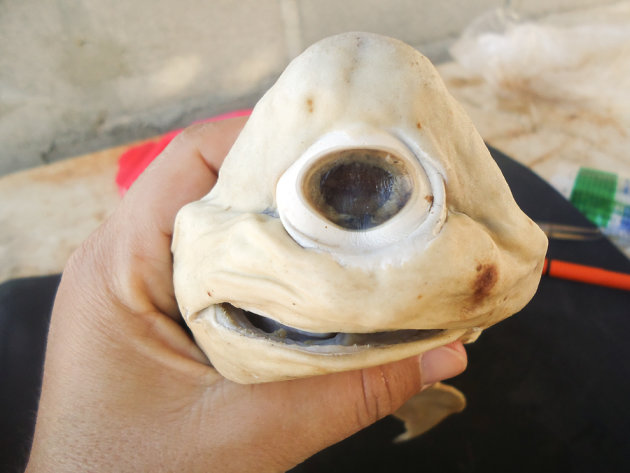
In this world of Photoshop and online scams, it pays to have a hearty dose of skepticism at reports of something strange — including an albino fetal shark with one eye smack in the middle of its nose like a Cyclops.
But the Cyclops shark, sliced from the belly of a pregnant mama dusky shark caught by a commercial fisherman in the Gulf of California earlier this summer, is by all reports the real thing. Shark researchers have examined the preserved creature and found that its single eye is made of functional optical tissue, they said last week. It's unlikely, however, that the malformed creature would have survived outside the womb.
"This is extremely rare," shark expert Felipe Galvan Magana of Mexico's Centro Interdisciplinario de Ciencias del Mar told the Pisces Fleet Sportfishing blog in July. "As far as I know, less than 50 examples of an abnormality like this have been recorded." [See photos of the one-eyed "Cyclops" shark]
Pisces Fleet, a sportfishing company, rocketed the Cyclops shark to viral status online this summer with their photos of the creepy-cute creature. But this isn't the first time that reports of a mythical-seeming creature have spurred media sensations — last week alone, Russian officials announced "proof" of a Yeti, and paleontologists spun a theory about an ancient Kraken-like squid. Few reports of mythical beasts, however, come with proof.
Cyclops shark
The Cyclops shark is an exception. While rare, "cyclopia" is a real developmental anomaly in which only one eye develops. Human fetuses are sometimes affected, as in a 1982 case in Israel reported in 1985 in the British Journal of Ophthalmology. In that case, a baby girl was born seven weeks early with no nose and only one eye in the center of her face. The infant, who lived only 30 minutes after birth, also had severe brain abnormalities.
In 2006, a kitten born with one eye and no nose (a rare condition called holoprosencephaly), created a stir online as news organizations and bloggers tried to determine if the bizarre photos of the animal were real. A veterinarian confirmed the kitten's condition; "Cy," as the cat was known, lived only a day. The remains were sold to the creationist Lost World Museum.
The fisherman who discovered the Cyclops shark is reportedly hanging on to the preserved remains, news outlets reported. But scientists have recently examined and X-rayed the fish, authenticating the catch. According to Seth Romans, a spokesman for Pisces Fleet, Galvan Magana and his colleagues will publish a scientific paper about the find within the next several weeks.
Romans told LiveScience that the fisherman who caught the strange shark is "amazed and fascinated" by the attention his catch has drawn.
It's not the first strange shark fetus Galvan Magana has found; he and his colleagues discovered two-headed shark embryos in two different female blue sharks. It's possible that one embryo started to split into twins, but failed to completely separate because of crowding in the womb, the researchers reported in January 2011 in the journal Marine Biodiversity Records.
Lair of the kraken?
Another recent report of a cryptic creature comes without the benefit of photographic evidence. Nor do the monster-hunters in this scenario have a body to display.
That's because the discovery is of an alleged "kraken's lair," a spot where 200-million-year-old ichthyosaur bones mingle in odd patterns. Paleontologist Mark McMenamin reads these patterns as evidence of a giant, ancient squid-like creature playing with its food, and he said as much on Oct. 10 at the annual meeting of the Geological Society of America. Supporting his claim, he said, is the fact that even today Pacific octopus, which are also cephalopods like the ancient "kraken," have been seen taking down sharks.
Other researchers responded that McMenamin was seeing what he wanted to see in the patterns.
"To my mind, this hypothesis is like looking at clouds — being able to see what you desire," Glenn Storrs, the curator of vertebrate paleontology at the Cincinnati Museum Center, told LiveScience.
Mythical krakens are now thought of as giant squid or octopuses, capable of bringing down a ship with their tentacled arms. But many of the earliest kraken reports were of creatures so enormous that they grew vegetation on their backs like islands. These krakens dragged down anchored ships or swamped them by surfacing suddenly. [Read Get Kraken: Why Scientists Should Study Sea Monsters]
The 1816 "Universal Dictionary of the Arts, Sciences Literature, Etc.," (advertised as "intended to supersede the use of other books of reference") defines the kraken as "a most amazing large sea animal," said to be "of a crab-like form."
"Its back or upper part, which seems an English mile and a half (some have affirmed more), looks at first like a number of small islands, surrounded with something that floats like seaweeds," the dictionary author writes. "At last several bright points of horns appear, which grow thicker the higher they emerge, and sometimes stand up as high and large as the masts of middle-sized vessels. In a short time, it slowly sinks, which is thought as dangerous as its rising; as it causes such a swell and whirlpool as draws everything down with it."
Read more at Yahoo! News
But the Cyclops shark, sliced from the belly of a pregnant mama dusky shark caught by a commercial fisherman in the Gulf of California earlier this summer, is by all reports the real thing. Shark researchers have examined the preserved creature and found that its single eye is made of functional optical tissue, they said last week. It's unlikely, however, that the malformed creature would have survived outside the womb.
"This is extremely rare," shark expert Felipe Galvan Magana of Mexico's Centro Interdisciplinario de Ciencias del Mar told the Pisces Fleet Sportfishing blog in July. "As far as I know, less than 50 examples of an abnormality like this have been recorded." [See photos of the one-eyed "Cyclops" shark]
Pisces Fleet, a sportfishing company, rocketed the Cyclops shark to viral status online this summer with their photos of the creepy-cute creature. But this isn't the first time that reports of a mythical-seeming creature have spurred media sensations — last week alone, Russian officials announced "proof" of a Yeti, and paleontologists spun a theory about an ancient Kraken-like squid. Few reports of mythical beasts, however, come with proof.
Cyclops shark
The Cyclops shark is an exception. While rare, "cyclopia" is a real developmental anomaly in which only one eye develops. Human fetuses are sometimes affected, as in a 1982 case in Israel reported in 1985 in the British Journal of Ophthalmology. In that case, a baby girl was born seven weeks early with no nose and only one eye in the center of her face. The infant, who lived only 30 minutes after birth, also had severe brain abnormalities.
In 2006, a kitten born with one eye and no nose (a rare condition called holoprosencephaly), created a stir online as news organizations and bloggers tried to determine if the bizarre photos of the animal were real. A veterinarian confirmed the kitten's condition; "Cy," as the cat was known, lived only a day. The remains were sold to the creationist Lost World Museum.
The fisherman who discovered the Cyclops shark is reportedly hanging on to the preserved remains, news outlets reported. But scientists have recently examined and X-rayed the fish, authenticating the catch. According to Seth Romans, a spokesman for Pisces Fleet, Galvan Magana and his colleagues will publish a scientific paper about the find within the next several weeks.
Romans told LiveScience that the fisherman who caught the strange shark is "amazed and fascinated" by the attention his catch has drawn.
It's not the first strange shark fetus Galvan Magana has found; he and his colleagues discovered two-headed shark embryos in two different female blue sharks. It's possible that one embryo started to split into twins, but failed to completely separate because of crowding in the womb, the researchers reported in January 2011 in the journal Marine Biodiversity Records.
Lair of the kraken?
Another recent report of a cryptic creature comes without the benefit of photographic evidence. Nor do the monster-hunters in this scenario have a body to display.
That's because the discovery is of an alleged "kraken's lair," a spot where 200-million-year-old ichthyosaur bones mingle in odd patterns. Paleontologist Mark McMenamin reads these patterns as evidence of a giant, ancient squid-like creature playing with its food, and he said as much on Oct. 10 at the annual meeting of the Geological Society of America. Supporting his claim, he said, is the fact that even today Pacific octopus, which are also cephalopods like the ancient "kraken," have been seen taking down sharks.
Other researchers responded that McMenamin was seeing what he wanted to see in the patterns.
"To my mind, this hypothesis is like looking at clouds — being able to see what you desire," Glenn Storrs, the curator of vertebrate paleontology at the Cincinnati Museum Center, told LiveScience.
Mythical krakens are now thought of as giant squid or octopuses, capable of bringing down a ship with their tentacled arms. But many of the earliest kraken reports were of creatures so enormous that they grew vegetation on their backs like islands. These krakens dragged down anchored ships or swamped them by surfacing suddenly. [Read Get Kraken: Why Scientists Should Study Sea Monsters]
The 1816 "Universal Dictionary of the Arts, Sciences Literature, Etc.," (advertised as "intended to supersede the use of other books of reference") defines the kraken as "a most amazing large sea animal," said to be "of a crab-like form."
"Its back or upper part, which seems an English mile and a half (some have affirmed more), looks at first like a number of small islands, surrounded with something that floats like seaweeds," the dictionary author writes. "At last several bright points of horns appear, which grow thicker the higher they emerge, and sometimes stand up as high and large as the masts of middle-sized vessels. In a short time, it slowly sinks, which is thought as dangerous as its rising; as it causes such a swell and whirlpool as draws everything down with it."
Read more at Yahoo! News
Oct 3, 2011
Beetles Die During Sex With Beer Bottles
Besotted beetles are dying while trying to get it on with discarded brown beer bottles, according to research conducted by Darryl Gwynne, a University of Toronto Mississauga professor.
It's a case of mistaken attraction, because the beer bottles happen to possess all of the features that drive male Australian jewel beetles wild. They're big and orangey brown in color, with a slightly dimpled surface near the bottom (designed to prevent the bottle from slipping out of one's grasp) that reflects light in much the same way as female wing covers.
As a result, the beer bottles are irresistible to the male insects, which will die trying to mate with them in the hot Australian sun.
Gwynne made these observations with colleague David Rentz. This week they were awarded with an Ig Nobel Prize at Harvard University.
The Ig Nobel Prizes, a parody of the Nobel Prizes, are awarded annually by the scientific humor magazine Annals of Improbable Research to first make people laugh and then make them think." The prizes are intended to celebrate the unusual, honor the imaginative and spur people's interest in science, medicine and technology.
"I'm honored, I think," Gwynne, who is a professor of biology, was quoted as saying in a press release. "Really, we've been sitting here by the phone for the past 20 plus years waiting for the call. Why did it take them so long?"
Gwynne and Rentz were conducting field work in Western Australia when they noticed something unusual along the side of the road.
He explained, "We were walking along a dirt road with the usual scattering of beer cans and bottles when we saw about six bottles with beetles on top or crawling up the side. It was clear the beetles were trying to mate with the bottles."
The bottles –- stubbies as they are known in Australia, Canada and a few other countries –- resemble a "super female" jewel beetle. Male beetles are so captivated by the bottles that they will gird their loins and go through the expected motions, refusing to leave until they fry to death, are consumed by hungry ants, or are physically removed by the researchers.
The male beetles are very particular about the bottles. Beer cans or wine bottles do nothing for them. It's all about the shape, color, and texture, and doesn't have anything to do with booze. As the researchers wrote, "Not only do western Australians never dispose of a beer bottle with beer still in it, but many of the bottles had sand and detritus accumulated over many months."
Read more at Discovery News
It's a case of mistaken attraction, because the beer bottles happen to possess all of the features that drive male Australian jewel beetles wild. They're big and orangey brown in color, with a slightly dimpled surface near the bottom (designed to prevent the bottle from slipping out of one's grasp) that reflects light in much the same way as female wing covers.
As a result, the beer bottles are irresistible to the male insects, which will die trying to mate with them in the hot Australian sun.
Gwynne made these observations with colleague David Rentz. This week they were awarded with an Ig Nobel Prize at Harvard University.
The Ig Nobel Prizes, a parody of the Nobel Prizes, are awarded annually by the scientific humor magazine Annals of Improbable Research to first make people laugh and then make them think." The prizes are intended to celebrate the unusual, honor the imaginative and spur people's interest in science, medicine and technology.
"I'm honored, I think," Gwynne, who is a professor of biology, was quoted as saying in a press release. "Really, we've been sitting here by the phone for the past 20 plus years waiting for the call. Why did it take them so long?"
Gwynne and Rentz were conducting field work in Western Australia when they noticed something unusual along the side of the road.
He explained, "We were walking along a dirt road with the usual scattering of beer cans and bottles when we saw about six bottles with beetles on top or crawling up the side. It was clear the beetles were trying to mate with the bottles."
The bottles –- stubbies as they are known in Australia, Canada and a few other countries –- resemble a "super female" jewel beetle. Male beetles are so captivated by the bottles that they will gird their loins and go through the expected motions, refusing to leave until they fry to death, are consumed by hungry ants, or are physically removed by the researchers.
The male beetles are very particular about the bottles. Beer cans or wine bottles do nothing for them. It's all about the shape, color, and texture, and doesn't have anything to do with booze. As the researchers wrote, "Not only do western Australians never dispose of a beer bottle with beer still in it, but many of the bottles had sand and detritus accumulated over many months."
Read more at Discovery News
Sep 30, 2011
Self-Claimed Vampire-Werewolf Accused of Murder
A teen connected to a homicide is claiming she's a vampire-werewolf, and that's not likely to serve as much of a defense. According to a CBS News story,
A Florida teenager is behind bars as an accessory to the brutal murder of 16-year-old Jacob Hendershot. But that may not be the most shocking part of the crime -- Stephanie Pistey says she believes she's part vampire and part werewolf. Florida police say that, in July, Pistey's friends lured Hendershot to a house, killed him, and then left his body in a storm drain.
Pistey told a local TV station "I know this is going to be crazy, but I believe that I'm a vampire and part werewolf." She claims she drank blood from her fiancé and co-defendant William Chase.
The fact that Pistey claims to be a vampire is not, by itself, that unusual. Many people are interested in vampires, and they are everywhere, from "Twilight" to "True Blood" and "Fright Night." In the mainstream media and pop culture, vampires are very alluring, with elements of power, romance, eroticism and immortality.
It's not surprising that many people identify with vampires and some even claim to be them. But it's usually done in the context of goth-inspired role-playing.
As strange as the case is, it's also not the first time that a person claimed to be a vampire/werewolf hybrid.
In 2007 a 19-year-old Pennsylvania man named Kristian Carl came to believe he was a werewolf (partly because he has prominent canine teeth). According to police, Carl convinced his new girlfriend that he was a vampire-werewolf before having sex with her. Apparently intrigued at the prospect of sleeping with both a werewolf and a vampire at the same time, the real-life Bella Swan agreed.
However, supernatural hybrid or not, Carl's girlfriend was 15 at the time and he was charged with statutory rape in February 2008.
Most vampire enthusiasts engage in harmless role-playing, though now and then criminals with a vampire fascination make the news. Just last month a Texas man named Lyle Bensley allegedly broke into a woman's apartment and bit her on the neck. He claimed to be a vampire needing blood to survive; his victim was unsympathetic and called police. In 1996 (coincidentally also in Florida) five teenagers accused of killing two people were said to be part of a "vampire cult."
Already there is talk about a "vampire cult" in this case, and as often happens, entertainment media is blamed. The news media loves stories like this, but the fact is that 99.9 percent of kids -- even those fascinated by vampires -- have a pretty good grasp on reality.
Typically it's not the occult subject matter that is the problem; troubled individuals will always find some avenue for their issues. There were about 15,000 homicides last year, virtually none of them connected with vampires, Satanists, or the occult. It's only troubled kids with a sensational angle who make the news.
Read more at Discovery News
A Florida teenager is behind bars as an accessory to the brutal murder of 16-year-old Jacob Hendershot. But that may not be the most shocking part of the crime -- Stephanie Pistey says she believes she's part vampire and part werewolf. Florida police say that, in July, Pistey's friends lured Hendershot to a house, killed him, and then left his body in a storm drain.
Pistey told a local TV station "I know this is going to be crazy, but I believe that I'm a vampire and part werewolf." She claims she drank blood from her fiancé and co-defendant William Chase.
The fact that Pistey claims to be a vampire is not, by itself, that unusual. Many people are interested in vampires, and they are everywhere, from "Twilight" to "True Blood" and "Fright Night." In the mainstream media and pop culture, vampires are very alluring, with elements of power, romance, eroticism and immortality.
It's not surprising that many people identify with vampires and some even claim to be them. But it's usually done in the context of goth-inspired role-playing.
As strange as the case is, it's also not the first time that a person claimed to be a vampire/werewolf hybrid.
In 2007 a 19-year-old Pennsylvania man named Kristian Carl came to believe he was a werewolf (partly because he has prominent canine teeth). According to police, Carl convinced his new girlfriend that he was a vampire-werewolf before having sex with her. Apparently intrigued at the prospect of sleeping with both a werewolf and a vampire at the same time, the real-life Bella Swan agreed.
However, supernatural hybrid or not, Carl's girlfriend was 15 at the time and he was charged with statutory rape in February 2008.
Most vampire enthusiasts engage in harmless role-playing, though now and then criminals with a vampire fascination make the news. Just last month a Texas man named Lyle Bensley allegedly broke into a woman's apartment and bit her on the neck. He claimed to be a vampire needing blood to survive; his victim was unsympathetic and called police. In 1996 (coincidentally also in Florida) five teenagers accused of killing two people were said to be part of a "vampire cult."
Already there is talk about a "vampire cult" in this case, and as often happens, entertainment media is blamed. The news media loves stories like this, but the fact is that 99.9 percent of kids -- even those fascinated by vampires -- have a pretty good grasp on reality.
Typically it's not the occult subject matter that is the problem; troubled individuals will always find some avenue for their issues. There were about 15,000 homicides last year, virtually none of them connected with vampires, Satanists, or the occult. It's only troubled kids with a sensational angle who make the news.
Read more at Discovery News
Aug 14, 2011
How Butterflies Copy Their Neighbors to Fool Birds
The mystery of how a butterfly has changed its wing patterns to mimic neighbouring species and avoid being eaten by birds has been solved by a team of European scientists. The study is published August 14, 2011 in the journal Nature.
The greatest evolutionary thinkers, including Wallace, Bates and Darwin, have all wondered how butterflies that taste bad to birds have evolved the same patterns of warning colouration. Now for the first time, researchers led by the CNRS (Muséum National d'Histoire Naturelle, Paris) and the University of Exeter (UK) have shown how butterflies perform this amazing trick, known as 'Müllerian mimicry'.
Funded by the Biotechnology and Biological Sciences Research Council (BBSRC), the study focused on the Amazonian species Heliconius numata, which mimics several other butterfly species at a single site in the rainforest. One population of Heliconius numata can therefore feature many distinct wing colour patterns resembling those of other butterflies, such as the Monarch's relatives Melinaea, which are unpalatable to birds. This acts as a disguise, protecting them against predators.
The researchers located and sequenced the chromosomal region responsible for the wing patterns in H. numata. The butterfly's wing-pattern variation is controlled by a single region on a single chromosome, containing several genes which control the different elements of the pattern. Known as a 'supergene', this clustering allows genetic combinations that are favoured for their mimetic resemblance to be maintained, while preventing combinations that produce non-mimetic patterns from arising. Supergenes are responsible for a wide range of what we see in nature: from the shape of primrose flowers to the colour and pattern of snail shells.
The researchers found that three versions of the same chromosome coexist in this species, each version controlling distinct wing-pattern forms. This has resulted in butterflies that look completely different from one another, despite having the same DNA.
"We were blown away by what we found," said Dr Mathieu Joron of the Muséum National d'Histoire Naturelle, who led the research. "These butterflies are the 'transformers' of the insect world. But instead of being able to turn from a car into a robot with the flick of switch, a single genetic switch allows these insects to morph into several different mimetic forms -- it is amazing and the stuff of science fiction. Now we are starting to understand how this switch can have such a pervasive effect."
Professor Richard ffrench-Constant of the University of Exeter added: "This phenomenon has puzzled scientists for centuries -- including Darwin himself. Indeed, it was the original observations of mimicry that helped frame the concept of natural selection. Now that we have the right tools we are able to understand the reason for this amazing transformation: by changing just one gene, the butterfly is able to fool its predators by mimicking a range of different butterflies that taste bad."
This single supergene also appears important in melanism in other species, including moths. In April 2011, a team led by Liverpool University explained in the journal Science how the Peppered Moth developed its black wings in nineteenth-century Britain's sooty industrial environment.
Read more at Science Daily
The greatest evolutionary thinkers, including Wallace, Bates and Darwin, have all wondered how butterflies that taste bad to birds have evolved the same patterns of warning colouration. Now for the first time, researchers led by the CNRS (Muséum National d'Histoire Naturelle, Paris) and the University of Exeter (UK) have shown how butterflies perform this amazing trick, known as 'Müllerian mimicry'.
Funded by the Biotechnology and Biological Sciences Research Council (BBSRC), the study focused on the Amazonian species Heliconius numata, which mimics several other butterfly species at a single site in the rainforest. One population of Heliconius numata can therefore feature many distinct wing colour patterns resembling those of other butterflies, such as the Monarch's relatives Melinaea, which are unpalatable to birds. This acts as a disguise, protecting them against predators.
The researchers located and sequenced the chromosomal region responsible for the wing patterns in H. numata. The butterfly's wing-pattern variation is controlled by a single region on a single chromosome, containing several genes which control the different elements of the pattern. Known as a 'supergene', this clustering allows genetic combinations that are favoured for their mimetic resemblance to be maintained, while preventing combinations that produce non-mimetic patterns from arising. Supergenes are responsible for a wide range of what we see in nature: from the shape of primrose flowers to the colour and pattern of snail shells.
The researchers found that three versions of the same chromosome coexist in this species, each version controlling distinct wing-pattern forms. This has resulted in butterflies that look completely different from one another, despite having the same DNA.
"We were blown away by what we found," said Dr Mathieu Joron of the Muséum National d'Histoire Naturelle, who led the research. "These butterflies are the 'transformers' of the insect world. But instead of being able to turn from a car into a robot with the flick of switch, a single genetic switch allows these insects to morph into several different mimetic forms -- it is amazing and the stuff of science fiction. Now we are starting to understand how this switch can have such a pervasive effect."
Professor Richard ffrench-Constant of the University of Exeter added: "This phenomenon has puzzled scientists for centuries -- including Darwin himself. Indeed, it was the original observations of mimicry that helped frame the concept of natural selection. Now that we have the right tools we are able to understand the reason for this amazing transformation: by changing just one gene, the butterfly is able to fool its predators by mimicking a range of different butterflies that taste bad."
This single supergene also appears important in melanism in other species, including moths. In April 2011, a team led by Liverpool University explained in the journal Science how the Peppered Moth developed its black wings in nineteenth-century Britain's sooty industrial environment.
Read more at Science Daily
Aug 2, 2011
South Korean Scientists Create Glowing Dog – pics
On Wednesday, Scientists from Seoul National University in South Korea announced that they have created a glowing dog while utilising a cloning technique designed to find cures for diseases such as Alzheimer’s and Parkinson’s. Pictured is the team’s genetically modified female beagle, Tegon, which was born in 2009 and was found to glow in a fluorescent green colour while under ultraviolet light.After two years of testing, the research team has found that the glowing ability is triggered by a doxycycline antibiotic and can be turned on or off by adding or removing certain drugs to the dog’s food.
“The creation of Tegon opens new horizons since the gene injected to make the dog glow can be substituted with genes that trigger fatal human diseases,” explained lead researcher Lee Byeong-chun. He went on to state that humans and dogs have 268 common diseases, and that creating dogs with artificial symptoms could help in the treatment of these deadly diseases that affect humans.
Full story and pics at Toms Guide
“The creation of Tegon opens new horizons since the gene injected to make the dog glow can be substituted with genes that trigger fatal human diseases,” explained lead researcher Lee Byeong-chun. He went on to state that humans and dogs have 268 common diseases, and that creating dogs with artificial symptoms could help in the treatment of these deadly diseases that affect humans.
Full story and pics at Toms Guide
Subscribe to:
Posts (Atom)