Showing posts with label Medieval. Show all posts

Dec 4, 2023

'Bone biographies' reveal lives of medieval England's common people -- and illuminate early benefits system

A series of 'bone biographies' created by a major research project tell the stories of medieval Cambridge residents as recorded on their skeletons, illuminating everyday lives during the era of Black Death and its aftermath.

The work is published alongside a new study investigating medieval poverty by examining remains from the cemetery of a former hospital that housed the poor and infirm.

University of Cambridge archaeologists analysed close to 500 skeletal remains excavated from burial grounds across the city, dating between the 11th and 15th centuries. Samples came from a range of digs dating back to the 1970s.

The latest techniques were used to investigate diets, DNA, activities, and bodily traumas of townsfolk, scholars, friars and merchants. Researchers focused on sixteen of the most revealing remains that are representative of various "social types."

The full "osteobiographies" are available on a new website launched by the After the Plague project at Cambridge University.

"An osteobiography uses all available evidence to reconstruct an ancient person's life," said lead researcher Prof John Robb from Cambridge's Department of Archaeology. "Our team used techniques familiar from studies such as Richard III's skeleton, but this time to reveal details of unknown lives -- people we would never learn about in any other way."

"The importance of using osteobiography on ordinary folk rather than elites, who are documented in historical sources, is that they represent the majority of the population but are those that we know least about," said After the Plague researcher Dr Sarah Inskip (now at University of Leicester).

The project used a statistical analysis of likely names drawn from written records of the period to give pseudonyms to the people studied.

"Journalists report anonymous sources using fictitious names. Death and time ensure anonymity for our sources, but we wanted to them to feel relatable," said Robb.

Meet 92 ('Wat'), who survived the plague, eventually dying as an older man with cancer in the city's charitable hospital, and 335 ('Anne'), whose life was beset by repeated injuries, leaving her to hobble on a shortened right leg.

Meet 730 ('Edmund'), who suffered from leprosy but -- contrary to stereotypes -- lived among ordinary people, and was buried in a rare wooden coffin. And 522 ('Eudes'), the poor boy who grew into a square-jawed friar with a hearty diet, living long despite painful gout.

Inside the medieval benefits system

The website coincides with a study from the team published in the journal Antiquity, which investigates the inhabitants of the hospital of St. John the Evangelist.

Founded around 1195, this institution helped the "poor and infirm," housing a dozen or so inmates at any one time. It lasted for some 300 years before being replaced by St. John's College in 1511. The site was excavated in 2010.

"Like all medieval towns, Cambridge was a sea of need," said Robb. "A few of the luckier poor people got bed and board in the hospital for life. Selection criteria would have been a mix of material want, local politics, and spiritual merit."

The study gives an inside look at how a "medieval benefits system" operated. "We know that lepers, pregnant women and the insane were prohibited, while piety was a must," said Robb. Inmates were required to pray for the souls of hospital benefactors, to speed them through purgatory. "A hospital was a prayer factory."

Molecular, bone and DNA data from over 400 remains in the hospital's main cemetery shows inmates to be an inch shorter on average than townsfolk. They were more likely to die younger, and show signs of tuberculosis.

Inmates were more likely to bear traces on their bones of childhoods blighted by hunger and disease. However, they also had lower rates of bodily trauma, suggesting life in the hospital reduced physical hardship or risk.

Children buried in the hospital were small for their age by up to five years' worth of growth. "Hospital children were probably orphans," said Robb. Signs of anaemia and injury were common, and about a third had rib lesions denoting respiratory diseases such as TB.

As well as the long-term poor, up to eight hospital residents had isotope levels indicating a lower-quality diet in older age, and may be examples of the "shame-faced poor": those fallen from comfort into destitution, perhaps after they became unable to work.

"Theological doctrines encouraged aid for the shame-faced poor, who threatened the moral order by showing that you could live virtuously and prosperously but still fall victim to twists of fortune," said Robb.

The researchers suggest that the variety of people within the hospital -- from orphans and pious scholars to the formerly prosperous -- may have helped appeal to a range of donors.

Finding the university scholars

The researchers were also able to identify some skeletons as probably those of early university scholars. The clue was in the arm bones.

Almost all townsmen had asymmetric arm bones, with their right humerus (upper arm bone) built more strongly than their left one, reflecting tough working regimes, particularly in early adulthood.

However, about ten men from the hospital had symmetrical humeri, yet they had no signs of a poor upbringing, limited growth, or chronic illness. Most dated from the later 14th and 15th century.

"These men did not habitually do manual labour or craft, and they lived in good health with decent nutrition, normally to an older age. It seems likely they were early scholars of the University of Cambridge," said Robb.

"University clerics did not have the novice-to-grave support of clergy in religious orders. Most scholars were supported by family money, earnings from teaching, or charitable patronage.

"Less well-off scholars risked poverty once illness or infirmity took hold. As the university grew, more scholars would have ended up in hospital cemeteries."

Isotope work suggests the first Cambridge students came mainly from eastern England, with some from the dioceses of Lincoln and York.

Cambridge and the Black Death

Most remains for this study came from three sites. In addition to the Hospital, an overhaul of the University's New Museums Site in 2015 yielded remains from a former Augustinian Friary, and the project also used skeletons excavated in the 1970s from the grounds of a medieval parish church: 'All Saints by the Castle'.

The team laid out each skeleton to do an inventory, then took samples for radiocarbon dating and DNA analysis. "We had to keep track of hundreds of bone samples zooming all over the place," said Robb

In 1348-9 the bubonic plague -- Black Death -- hit Cambridge, killing between 40-60% of the population. Most of the dead were buried in town cemeteries or plague pits such as one on Bene't Street next to the former friary.

However, the team have used the World Health Organization's methods of calculating "Disease Adjusted Life Years" -- the years of human life and life quality a disease costs a population -- to show that bubonic plague may have only come in tenth or twelfth on the risk rundown of serious health problems facing medieval Europeans.

"Everyday diseases, such as measles, whooping cough and gastrointestinal infections, ultimately took a far greater toll on medieval populations," said Robb.

Read more at Science Daily

Apr 6, 2023

The unexpected contribution of medieval monks to volcanology

By observing the night sky, medieval monks unwittingly recorded some of history's largest volcanic eruptions. An international team of researchers, led by the University of Geneva (UNIGE), drew on readings of 12th and 13th century European and Middle Eastern chronicles, along with ice core and tree ring data, to accurately date some of the biggest volcanic eruptions the world has ever seen. Their results, reported in the journal Nature, uncover new information about one of the most volcanically active periods in Earth's history, which some think helped to trigger the Little Ice Age, a long interval of cooling that saw the advance of European glaciers.

It took the researchers almost five years to examine hundreds of annals and chronicles from across Europe and the Middle East, in search of references to total lunar eclipses and their colouration. Total lunar eclipses occur when the moon passes into the Earth's shadow. Typically, the moon remains visible as a reddish orb because it is still bathed in sunlight bent round the Earth by its atmosphere. But after a very large volcanic eruption, there can be so much dust in the stratosphere -- the middle part of the atmosphere starting roughly where commercial aircraft fly -- that the eclipsed moon almost disappears.

Medieval chroniclers recorded and described all kinds of historical events, including the deeds of kings and popes, important battles, and natural disasters and famines. Just as noteworthy were the celestial phenomena that might foretell such calamities. Mindful of the Book of Revelation, a vision of the end times that speaks of a blood-red moon, the monks were especially careful to take note of the moon's coloration. Of the 64 total lunar eclipses that occurred in Europe between 1100 and 1300, the chroniclers had faithfully documented 51. In five of these cases, they also reported that the moon was exceptionally dark.

The contribution of Japanese scribes

Asked what made him connect the monks' records of the brightness and colour of the eclipsed moon with volcanic gloom, the lead author of the work, Sébastien Guillet, senior research associate at the Institute for environmental sciences at the UNIGE, said: "I was listening to Pink Floyd's Dark Side of the Moon album when I realised that the darkest lunar eclipses all occurred within a year or so of major volcanic eruptions. Since we know the exact days of the eclipses, it opened the possibility of using the sightings to narrow down when the eruptions must have happened."

The researchers found that scribes in Japan took equal note of lunar eclipses. One of the best known, Fujiwara no Teika, wrote of an unprecedented dark eclipse observed on 2 December 1229: 'the old folk had never seen it like this time, with the location of the disk of the Moon not visible, just as if it had disappeared during the eclipse... It was truly something to fear.' The stratospheric dust from large volcanic eruptions was not only responsible for the vanishing moon. It also cooled summer temperatures by limiting the sunlight reaching the Earth's surface. This in turn could bring ruin to agricultural crops.

Cross-checking text and data

"We know from previous work that strong tropical eruptions can induce global cooling on the order of roughly 1°C over a few years," said Markus Stoffel, full professor at the Institute for environmental sciences at the UNIGE and last author of the study, a specialist in converting measurements of tree rings into climate data, who co-designed the study. "They can also lead to rainfall anomalies with droughts in one place and floods in another."

Despite these effects, people at the time could not have imagined that the poor harvests or the unusual lunar eclipses had anything to do with volcanoes -- the eruptions themselves were all but one undocumented. "We only knew about these eruptions because they left traces in the ice of Antarctica and Greenland," said co-author Clive Oppenheimer, professor at the Department of Geography at the University of Cambridge. "By putting together the information from ice cores and the descriptions from medieval texts we can now make better estimates of when and where some of the biggest eruptions of this period occurred."

Climate and society affected

To make the most of this integration, Sébastien Guillet worked with climate modellers to compute the most likely timing of the eruptions. "Knowing the season when the volcanoes erupted is essential, as it influences the spread of the volcanic dust and the cooling and other climate anomalies associated with these eruptions," he said.

Read more at Science Daily

Aug 22, 2022

Medieval monks were 'riddled with parasites'

A new analysis of remains from medieval Cambridge shows that local Augustinian friars were almost twice as likely as the city's general population to be infected by intestinal parasites.

This is despite most Augustinian monasteries of the period having latrine blocks and hand-washing facilities, unlike the houses of ordinary working people.

Researchers from the University of Cambridge's Department of Archaeology say the difference in parasitic infection may be down to monks manuring crops in friary gardens with their own faeces, or purchasing fertiliser containing human or pig excrement.

The study, published today in the International Journal of Paleopathology, is the first to compare parasite prevalence in people from the same medieval community who were living different lifestyles, and so might have differed in their infection risk.

The population of medieval Cambridge consisted of residents of monasteries, friaries and nunneries of various major Christian orders, along with merchants, traders, craftsmen, labourers, farmers, and staff and students at the early university.

Cambridge archaeologists investigated samples of soil taken from around the pelvises of adult remains from the former cemetery of All Saints by the Castle parish church, as well as from the grounds where the city's Augustinian Friary once stood.

Most of the parish church burials date from the 12-14th century, and those interred within were primarily of a lower socio-economic status, mainly agricultural workers.

The Augustinian friary in Cambridge was an international study house, known as a studium generale, where clergy from across Britain and Europe would come to read manuscripts. It was founded in the 1280s and lasted until 1538 before suffering the fate of most English monasteries: closed or destroyed as part of Henry VIII's break with the Roman Church.

The researchers tested 19 monks from the friary grounds and 25 locals from All Saints cemetery, and found that 11 of the friars (58%) were infected by worms, compared with just eight of the general townspeople (32%).

They say these rates are likely the minimum, and that actual numbers of infections would have been higher, but some traces of worm eggs in the pelvic sediment would have been destroyed over time by fungi and insects.

The 32% prevalence of parasites among townspeople is in line with studies of medieval burials in other European countries, suggesting this is not particularly low -- but rather the infection rates in the monastery were remarkably high.

"The friars of medieval Cambridge appear to have been riddled with parasites," said study lead author Dr Piers Mitchell from Cambridge's Department of Archaeology. "This is the first time anyone has attempted to work out how common parasites were in people following different lifestyles in the same medieval town."

Cambridge researcher Tianyi Wang, who did the microscopy to spot the parasite eggs, said: "Roundworm was the most common infection, but we found evidence for whipworm infection as well. These are both spread by poor sanitation."

Standard sanitation in medieval towns relied on the cesspit toilet: holes in the ground used for faeces and household waste. In monasteries, however, running water systems were a common feature -- including to rinse out the latrine -- although that has yet to be confirmed at the Cambridge site, which is only partly excavated.

Not all people buried in Augustinian friaries were actually clergy, as wealthy people from the town could pay to be interred there. However, the team could tell which graves belonged to friars from the remains of their clothing.

"The friars were buried wearing the belts they wore as standard clothing of the order, and we could see the metal buckles at excavation," said co-author Craig Cessford of the Cambridge Archaeological Unit.

As roundworm and whipworm are spread by poor sanitation, researchers argue that the difference in infection rates between the friars and the general population must have been due to how each group dealt with their human waste.

"One possibility is that the friars manured their vegetable gardens with human faeces, not unusual in the medieval period, and this may have led to repeated infection with the worms," said Mitchell.

Medieval records reveal how Cambridge residents may have understood parasites such as roundworm and whipworm. John Stockton, a medical practitioner in Cambridge who died in 1361, left a manuscript to Peterhouse college that included a section on De Lumbricis ('on worms').

It notes that intestinal worms are generated by excess of various kinds of phlegm: "Long round worms form from an excess of salt phlegm, short round worms from sour phlegm, while short and broad worms came from natural or sweet phlegm."

The text prescribes "bitter medicinal plants" such as aloe and wormwood, but recommends they are disguised with "honey or other sweet things" to help the medicine go down.

Another text -- Tabula medicine -- found favour with leading Cambridge doctors of the 15th century, and suggests remedies as recommended by individual Franciscan monks, such as Symon Welles, who advocated mixing a powder made from moles into a curative drink.

Read more at Science Daily

Mar 23, 2022

Rewriting the history books: Why the Vikings left Greenland

One of the great mysteries of late medieval history is why did the Norse, who had established successful settlements in southern Greenland in 985, abandon them in the early 15th century? The consensus view has long been that colder temperatures, associated with the Little Ice Age, helped make the colonies unsustainable. However, new research, led by the University of Massachusetts Amherst and published recently in Science Advances, upends that old theory. It wasn't dropping temperatures that helped drive the Norse from Greenland, but drought.

When the Norse settled in Greenland on what they called the Eastern Settlement in 985, they thrived by clearing the land of shrubs and planting grass as pasture for their livestock. The population of the Eastern Settlement peaked at around 2,000 inhabitants, but collapsed fairly quickly about 400 years later. For decades, anthropologists, historians and scientists have thought the Eastern Settlement's demise was due to the onset of the Little Ice Age, a period of exceptionally cold weather, particularly in the North Atlantic, that made agricultural life in Greenland untenable.

However, as Raymond Bradley, University Distinguished Professor of geosciences at UMass Amherst and one of the paper's co- author, points out, "before this study, there was no data from the actual site of the Viking settlements. And that's a problem." Instead, the ice core data that previous studies had used to reconstruct historical temperatures in Greenland was taken from a location that was over 1,000 kilometers to the north and over 2,000 meters higher in elevation. "We wanted to study how climate had varied close to the Norse farms themselves," says Bradley. And when they did, the results were surprising.

Bradley and his colleagues traveled to a lake called Lake 578, which is adjacent to a former Norse farm and close to one of the largest groups of farms in the Eastern Settlement. There, they spent three years gathering sediment samples from the lake, which represented a continuous record for the past 2,000 years. "Nobody has actually studied this location before," says Boyang Zhao, the study's lead author who conducted this research for his Ph.D. in geosciences at UMass Amherst and is currently a postdoctoral research associate at Brown University.

They then analyzed that 2,000 year sample for two different markers: the first, a lipid, known as BrGDGT, can be used to reconstruct temperature. "If you have a complete enough record, you can directly link the changing structures of the lipids to changing temperature," says Isla Castañeda, professor of geosciences at UMass Amherst and one of the paper's co-authors. A second marker, derived from the waxy coating on plant leaves, can be used to determine the rates at which the grasses and other livestock-sustaining plants lost water due to evaporation. It is therefore an indicator of how dry conditions were.

"What we discovered," says Zhao, "is that, while the temperature barely changed over the course of the Norse settlement of southern Greenland, it became steadily drier over time."

Norse farmers had to overwinter their livestock on stored fodder, and even in a good year the animals were often so weak that they had to be carried to the fields once the snow finally melted in the spring. Under conditions like that, the consequences of drought would have been severe. An extended drought, on top of other economic and social pressures, may have tipped the balance just enough to make the Eastern Settlement unsustainable.

Read more at Science Daily

Jan 10, 2022

Medieval warhorses were surprisingly small in stature

Medieval warhorses are often depicted as massive and powerful beasts, but in reality many were no more than pony-sized by modern standards, a new study shows.

Horses during the period were often below 14.2 hands high, but size was clearly not everything, as historical records indicate huge sums were spent on developing and maintaining networks for the breeding, training and keeping of horses used in combat.

A team of archaeologists and historians searching for the truth about the Great Horse have found they were not always bred for size, but for success in a wide range of different functions -- including tournaments and long-distance raiding campaigns.

Researchers analysed the largest dataset of English horse bones dating between AD 300 and 1650, found at 171 separate archaeological sites.

The study, published in the International Journal of Osteoarchaeology, shows that breeding and training of warhorses was influenced by a combination of biological and cultural factors, as well as behavioural characteristics of the horses themselves such as temperament.

Depictions of medieval warhorses in films and popular media frequently portray massive mounts on the scale of Shire horses, some 17 to 18 hands high. However, the evidence suggests that horses of 16 and even 15 hands were very rare indeed, even at the height of the royal stud network during the 13th and 14th centuries, and that animals of this size would have been seen as very large by medieval people.

Researcher Helene Benkert, from the University of Exeter, said: "Neither size, nor limb bone robusticity alone, are enough to confidently identify warhorses in the archaeological record. Historic records don't give the specific criteria which defined a warhorse; it is much more likely that throughout the medieval period, at different times, different conformations of horses were desirable in response to changing battlefield tactics and cultural preferences."

The tallest Norman horse recorded was found at Trowbridge Castle, Wiltshire, estimated to be about 15hh, similar to the size of small modern light riding horses. The high medieval period (1200-1350 AD) sees the first emergence of horses of around 16hh, although it is not until the post-medieval period (1500-1650 AD) that the average height of horses becomes significantly larger, finally approaching the sizes of modern warmblood and draft horses.

Professor Alan Outram, from the University of Exeter, said: "High medieval destriers may have been relatively large for the time period, but were clearly still much smaller than we might expect for equivalent functions today. Selection and breeding practices in the Royal studs may have focused as much on temperament and the correct physical characteristics for warfare as they did on raw size."

Professor Oliver Creighton, the Principal Investigator for the project, commented: "The warhorse is central to our understanding of medieval English society and culture as both a symbol of status closely associated with the development of aristocratic identity and as a weapon of war famed for its mobility and shock value, changing the face of battle."

Read more at Science Daily

Jun 11, 2020

Tropical disease in medieval Europe revises the history of a pathogen related to syphilis

Mass burials are common remnants of the many plague outbreaks that ravaged Medieval Europe. A number of these graveyards are well documented in historical sources, but the locations of most, and the victims they contain, have been lost to the pages of time. In Vilnius, Lithuania, one such cemetery was found in a typical way: accidental discovery during a routine city construction project.

A new study published in the journal Scientific Reports details the findings of genomic analyses on these medieval skeletons, with important implications for the history of syphilis in Europe.

Just another plague pit?

"Historical information on this Vilnius graveyard is unavailable, but the burial context, along with its location outside of the medieval city limits, pointed to plague, or some other major infectious disease outbreak," comments Rimantas Jankauskas, Professor of the Faculty of Medicine, Vilnius University. "To be certain, we needed confirmation through DNA analysis."

Kirsten Bos, a group leader for Molecular Palaeopathology at the Max Planck Institute for the Science of Human History (MPI-SHH) in Jena, Germany, is frequently contacted by archaeologists requesting such analyses.

"Plague was a common disease at the time, and the information we get from all the ancient DNA work can tell us a lot about how it was spreading," says Bos, a specialist in ancient pathogen DNA recovery who led the current study.

Working in Bos's team, doctoral candidate Karen Giffin took on DNA analysis of the putative plague victims and quickly identified the pathogen's DNA in the teeth of several individuals.

"I was happy to have identified them as victims of medieval plague," says Giffin, "but we wanted to see if the new techniques we were developing in molecular detection of pathogens could allow us to learn anything more about the health of this population."

More than just plague

"The typical method for pathogen detection in archaeological bone requires that you have some idea of what you're looking for," explains Alexander Herbig, group leader of Computational Pathogenomics at the MPI-SHH. "In this case we applied a relatively new hypothesis-free DNA screening approach to search for any other pathogens we might be able to identify at the molecular level."

This process unlocked a second secret of the 15th century graveyard. One of the four plague victims, a young woman, also showed a weak signal of something that seemed related to modern syphilis.

"It was impressive to find traces of such a disease in an historical skeleton because their molecular preservation in ancient bone is known to be problematic," comments Bos.

Diseases in the syphilis family, known as the treponemal diseases, are assumed to have had a long history with humans, though their inferred history in Europe is laden with controversy. The prevailing opinion holds that the first outbreak of syphilis in Europe coincided with Charles VIII's 1495 siege of Naples, where a debilitating disease erupted amongst his infantry and quickly spread around Europe. Since this outbreak happened just after the return of Columbus and his crew from their first trans-Atlantic voyage, most discussants believe syphilis was a newcomer to Europe that originated in the New World. But support is growing for a different theory. An increasing number of specialists in bone pathology believe they have properly identified examples of pre-1493 syphilis in Europe, which has ignited on-going debates about models of its evolution.

"We were able to reconstruct an impressively well-preserved genome that, to our surprise, fell within the diversity of modern yaws," comments Giffin. Yaws is a lesser-known treponemal disease primarily of the skin that affects both humans and other primates in warm, tropical environments. "Finding it in northern Europe in the mid-15th century was unexpected," she adds.

Yaws seems much younger than we thought
Since yaws infects both humans and non-human primates, some believe it to be a very old disease, having been with humans before the massive Pleistocene migrations that spread us around the globe.

"To our surprise, the yaws genome we reconstructed was just a few genetic steps away from the ancestor of all yaws varieties known in humans and non-human primates," says Bos. "Given the age of our medieval skeletons, it seems that all strains of yaws that we know today appeared on the scene only about 1000 years ago."

"This has important implications for the history of treponemal disease in Europe," Bos adds. "We can now confirm that yaws was circulating in medieval Europe, and given its similarity to syphilis and its recent emergence, it's possible that yaws contributed in some way to the famous late 15th to 16th century outbreak that we normally ascribe only to syphilis."

One possibility is that yaws emerged in either humans or other primates in West Africa within the last millennium and made its way to Europe in the mid-15th century. European presence in West Africa increased in the 15th century, as did the forced relocations of Africans to Europe through establishment of the transatlantic slave trade. These activities would have rapidly disseminated a new and highly contagious disease such as yaws.

Read more at Science Daily

Jan 12, 2019

Illuminating women's role in the creation of medieval manuscripts

This is dental calculus on the lower jaw a medieval woman entrapped lapis lazuli pigment.
During the European Middle Ages, literacy and written texts were largely the province of religious institutions. Richly illustrated manuscripts were created in monasteries for use by members of religious institutions and by the nobility. Some of these illuminated manuscripts were embellished with luxurious paints and pigments, including gold leaf and ultramarine, a rare and expensive blue pigment made from lapis lazuli stone.

In a study published in Science Advances, an international team of researchers led by the Max Planck Institute for the Science of Human History and the University of York shed light on the role of women in the creation of such manuscripts with a surprising discovery -- the identification of lapis lazuli pigment embedded in the calcified dental plaque of a middle-aged woman buried at a small women's monastery in Germany around 1100 AD. Their analysis suggests that the woman was likely a painter of richly illuminated religious texts.

A quiet monastery in central Germany

As part of a study analyzing dental calculus -- tooth tartar or dental plaque that fossilizes on the teeth during life -- researchers examined the remains of individuals who were buried in a medieval cemetery associated with a women's monastery at the site of Dalheim in Germany. Few records remain of the monastery and its exact founding date is not known, although a women's community may have formed there as early as the 10th century AD. The earliest known written records from the monastery date to 1244 AD. The monastery is believed to have housed approximately 14 religious women from its founding until its destruction by fire following a series of 14th century battles.

One woman in the cemetery was found to have numerous flecks of blue pigment embedded within her dental calculus. She was 45-60 years old when she died around 1000-1200 AD. She had no particular skeletal pathologies, nor evidence of trauma or infection. The only remarkable aspect to her remains was the blue particles found in her teeth. "It came as a complete surprise -- as the calculus dissolved, it released hundreds of tiny blue particles," recalls co-first author Anita Radini of the University of York. Careful analysis using a number of different spectrographic methods -- including energy dispersive X-ray spectroscopy (SEM-EDS) and micro-Raman spectroscopy -- revealed the blue pigment to be made from lapis lazuli.

A pigment as rare and expensive as gold

"We examined many scenarios for how this mineral could have become embedded in the calculus on this woman's teeth," explains Radini. "Based on the distribution of the pigment in her mouth, we concluded that the most likely scenario was that she was herself painting with the pigment and licking the end of the brush while painting," states co-first author Monica Tromp of the Max Planck Institute for the Science of Human History.

The use of ultramarine pigment made from lapis lazuli was reserved, along with gold and silver, for the most luxurious manuscripts. "Only scribes and painters of exceptional skill would have been entrusted with its use," says Alison Beach of Ohio State University, a historian on the project.

The unexpected discovery of such a valuable pigment so early and in the mouth of an 11th century woman in rural Germany is unprecedented. While Germany is known to have been an active center of book production during this period, identifying the contributions of women has been particularly difficult. As a sign of humility, many medieval scribes and painters did not sign their work, a practice that especially applied to women. The low visibility of women's labor in manuscript production has led many modern scholars to assume that women played little part in it.

The findings of this study not only challenge long-held beliefs in the field, they also uncover an individual life history. The woman's remains were originally a relatively unremarkable find from a relatively unremarkable place, or so it seemed. But by using these techniques, the researchers were able to uncover a truly remarkable life history.

"She was plugged into a vast global commercial network stretching from the mines of Afghanistan to her community in medieval Germany through the trading metropolises of Islamic Egypt and Byzantine Constantinople. The growing economy of 11th century Europe fired demand for the precious and exquisite pigment that traveled thousands of miles via merchant caravan and ships to serve this woman artist's creative ambition," explains historian and co-author Michael McCormick of Harvard University.

Read more at Science Daily

Sep 6, 2018

DNA of early medieval Alemannic warriors and their entourage decoded

Comb with etui.
In 1962, an Alemannic burial site containing human skeletal remains was discovered in Niederstotzingen (Baden-Württemberg, Germany). Researchers at the Eurac Research Centre in Bozen-Bolzano, Italy, and at the Max Planck Institute for the Science of Human History in Jena, Germany, have now examined the DNA of these skeletal remains.

This has enabled them to determine not only the sex and the degree of kinship of those people but also their ancestral origins, which provides new insights into societal structures in the Early Middle Ages. The results of this study demonstrate that genetic research can complement research made by archaeologists and anthropologists through more conventional methods. The research was featured on the front cover of the academic journal Science Advances.

Archaeologists recovered thirteen human skeletons, the remains of three horses and some excellently preserved grave goods of diverse origin. This burial, which was discovered near a Roman road not far from Ulm, is considered one of the most important Alemannic gravesites in Germany. The site consists of individual and multiple graves, from which it was hypothesised that the individuals had not all been buried at the same time. The molecular genetic investigations have now brought new details to light about the individuals and their final resting place in this high-ranking warrior type burial.

Using DNA analysis the researchers were able to reconstruct maternal as well as paternal kinship. On the basis of tooth samples the scientists could ascertain that five of the individuals were either first- or second-degree relatives. In addition, the deceased displayed a variety of patterns of genetic origin, indicating Mediterranean and northern European roots. "These results prove the existence of remarkable transregional contacts. The fact that they were buried together also indicates a link between the families and their entourage which went beyond death," explains Niall O'Sullivan, who did his doctorate at Eurac Research and carried out some of the analyses at the Max Planck Institute for the Science of Human History in Jena.

In this context the grave goods, with which the multiple graves were adorned and which are of Frankish, Lombard and Byzantine origin, are also very interesting. Their diverse origin in combination with the new genetic data indicates a cultural openness and demonstrates how members of the same family were receptive to different cultures.

In addition to the kinship analysis the researchers also determined the sex of the individuals using molecular testing. One of the skeletons had a gracile physique and thus could not be clearly classified as male or female. "Anthropologists determine the sex of skeletal remains by using specific physical sexual characteristics, but if the bones of certain body areas are missing, then this will make gender determination much more difficult. DNA-analyses open new paths in this respect -- and in this specific case we were able to identify the young individual molecularly as a male, and thus exclude the possibility that we were dealing with an early medieval female warrior," explains Frank Maixner, microbiologist at the Institute for Mummies and the Iceman at Eurac Research.

Read more at Science Daily

Aug 8, 2018

Lost Norse of Greenland fueled the medieval ivory trade, ancient walrus DNA suggests

This is an example of an elaborately-carved ecclesiastical walrus ivory plaque from the beginning of the medieval walrus ivory trade, featuring the figure of Christ, together with St Mary and St Peter, and believed to date from the 10th or 11th century. Found in North Elmham, Norfolk, UK, in the 19th century, and currently exhibited in the University of Cambridge's Museum of Archaeology and Anthropology.
The Icelandic Sagas tell of Erik the Red: exiled for murder in the late 10th century he fled to southwest Greenland, establishing its first Norse settlement.

The colony took root, and by the mid-12th century there were two major settlements with a population of thousands. Greenland even gained its own bishop.

By the end of the 15th century, however, the Norse of Greenland had vanished -- leaving only abandoned ruins and an enduring mystery.

Past theories as to why these communities collapsed include a change in climate and a hubristic adherence to failing farming techniques.

Some have suggested that trading commodities -- most notably walrus tusks -- with Europe may have been vital to sustaining the Greenlanders. Ornate items including crucifixes and chess pieces were fashioned from walrus ivory by craftsmen of the age. However, the source of this ivory has never been empirically established.

Now, researchers from the universities of Cambridge and Oslo have studied ancient DNA from offcuts of tusks and skulls, most found on the sites of former ivory workshops across Europe, in order to trace the origin of the animals used in the medieval trade.

In doing so they have discovered an evolutionary split in the walrus, and revealed that the Greenland colonies may have had a "near monopoly" on the supply of ivory to Western Europe for over two hundred years.

For the latest study, published today in the journal Proceedings of the Royal Society B, the research team analysed walrus samples found in several medieval trading centres -- Trondheim, Bergen, Oslo, Dublin, London, Schleswig and Sigtuna -- mostly dating between 900 and 1400 CE.

The DNA showed that, during the last Ice Age, the Atlantic walrus divided into two ancestral lines, which researchers term "eastern" and "western." Walruses of the eastern lineage are widespread across much of the Arctic, including Scandinavia. Those of the western, however, are unique to the waters between western Greenland and Canada.

Finds from the early years of the ivory trade were mostly from the eastern lineage. Yet as demand grew from the 12th century onwards, the research team discovered that Europe's ivory supply shifted almost exclusively to tusks from the western lineage.

They say that ivory from western linage walruses must have been supplied by the Norse Greenlanders -- by hunting and perhaps also by trade with the indigenous peoples of Arctic North America.

"The results suggest that by the 1100s Greenland had become the main supplier of walrus ivory to Western Europe -- a near monopoly even," said Dr James H. Barrett, study co-author from the University of Cambridge's Department of Archaeology.

"The change in the ivory trade coincides with the flourishing of the Norse settlements on Greenland. The populations grew and elaborate churches were constructed.

"Later Icelandic accounts suggest that in the 1120s, Greenlanders used walrus ivory to secure the right to their own bishopric from the king of Norway. Tusks were also used to pay tithes to the church," said Barrett.

He points out that the 11th to 13th centuries were a time of demographic and economic boom in Europe, with growing demand from urban centres and the elite served by transporting commodities from increasingly distant sources.

"The demands for luxury goods produced from ivory may have helped the far-flung Norse communities in Greenland survive for centuries," said Barrett.

Co-author Dr Sanne Boessenkool of the University of Oslo said: "We knew from the start that analysing ancient DNA would have the potential for new historical insights, but the findings proved to be particularly spectacular."

The new study tells us less about the end of the Greenland colonies, say Barrett and colleagues. However, they note that it is hard to find evidence of walrus ivory imports to Europe that date after 1400.

Elephant ivory eventually became the material of choice for Europe's artisans. "Changing tastes could have led to a decline in the walrus ivory market of the Middle Ages," said Barrett.

Ivory exports from Greenland could have stalled for other reasons: over-hunting can cause walrus populations to abandon their coastal "haulouts"; the "Little Ice Age" -- a sustained period of lower temperatures -- began in the 14th century; the Black Death ravaged Europe.

Whatever caused the cessation of Europe's trade in walrus ivory, it must have been significant for the end of the Norse Greenlanders," said Barrett. "An overreliance on a single commodity, the very thing which gave the society its initial resilience, may have also contained the seeds of its vulnerability."

The heyday of the walrus ivory trade saw the material used for exquisitely carved items during Europe's Romanesque art period. The church produced much of this, with major ivory workshops in ecclesiastical centres such as Canterbury, UK.

Ivory games were also popular. The Viking board game hnefatafl was often played with walrus ivory pieces, as was chess, with the famous Lewis chessmen among the most stunning examples of Norse carved ivory.

Tusks were exported still attached to the walrus skull and snout, which formed a neat protective package that was broken up at workshops for ivory removal. These remains allowed the study to take place, as DNA extraction from carved artefacts would be far too damaging.

Co-author Dr Bastiaan Star of the University of Oslo said: "Until now, there was no quantitative data to support the story about walrus ivory from Greenland. Walruses could have been hunted in the north of Russia, and perhaps even in Arctic Norway at that time. Our research now proves beyond doubt that much of the ivory traded to Europe during the Middle Ages really did come from Greenland."

Read more at Science Dialy

Jul 20, 2018

Evidence of Salmonella Paratyphi C found for the first time in medieval northern Europe

This is the face reconstruction of the young woman.
Genome research conducted by the University of Warwick suggests that enteric fever, a potentially lethal disease more commonly found in hot countries, was present in medieval Europe.

Salmonella Paratyphi C causes enteric fever, a life-threatening infection, and has been detected in a 800 year old human skeleton discovered in Trondheim, Norway.

Now scientists are speculating that the evolution of enteric fever could be linked to the domestication of pigs across northern Europe.

The research was conducted by a team of international collaborators led by Professor Mark Achtman of the University's Warwick Medical School and their paper Pan-genome Analysis of Ancient and Modern Salmonella enterica Demonstrates Genomic Stability of the Invasive Para C Lineage for Millennia has been published in the journal Current Biology.

He and his team analysed bacterial DNA found in the teeth and bones of the skeleton of a young woman who is believed to have migrated to Trondheim from the northernmost areas of Scandinavia or Northwest Russia by her early teens only to die there around the age of 19-24 years.

They reconstructed a genome of Salmonella Paratyphi C which causes enteric fever in areas of poor sanitation and lack of clean drinking water. Their discovery indicates that the young Norwegian died of this disease and suggests that these bacteria have long caused enteric fever across northern Europe,

Prof Achtman said: "Paratyphi C is very rare today in Europe and North America except for occasional travellers from South and East Asia or Africa, where the disease is more common. This is the first time that any Salmonella have been found in old human remains in Europe, which is surprising because other Salmonella are more common today, including Salmonella causing typhoid fever, called Typhi, and Salmonella causing food poisoning. Earlier this year, Vågene and co-authors described related Paratyphi C from skeletons in Mexico, who died in 1545 CE, and speculated the Paratyphi C entered the Americas together with Europeans."

The new results included comparative analyses of the Paratyphi C genome found in the skeleton against modern Salmonella genome sequences from EnteroBase, an online database developed at the University of Warwick and used internationally. This revealed that Paratyphi C represents the evolutionary descendants of a common ancestor, or clade, within the Para C lineage. The Para C Lineage includes Choleraesuis, which causes septicaemia in pigs and boar and Typhisuis which causes epidemic swine salmonellosis (chronic paratyphoid) in domestic pigs. These different host specificities likely evolved in Europe over the last 4,000 years and coincide with the timing of pig domestication in Europe.

According to historical records, humans have long been afflicted by bacterial infections, yet genomic analyses of living bacterial pathogens routinely estimate a date for the most recent common ancestor of no more than a few centuries. In general, evolutionary trees contain a stem group, which may include lineages that are now rare or extinct, as well as the crown group of living organisms. Historical reconstructions based only on the crown group ignore the older sub-lineages in the stem group and thereby provide an incomplete picture of the older evolutionary history of the pathogen. In contrast, analyses of ancient DNA such as the Paratyphi C genome can shed light on additional millennia of bacterial pathogen evolution that occurred prior to the origin of the crown group.

Professor Achtman added: "Using EnteroBase we were able to define the Para C lineage from 50,000 modern Salmonella enterica genomes and find that over its 3,000 year history only a few genomic changes occurred within the Para C lineage.

Read more at Science Daily

Jun 3, 2018

Earliest European evidence of lead pollution uncovered in the Balkans

Blacksmith fire with resilient carbons, grill.
New research from Northumbria University has revealed that metal-related pollution began in the Balkans more than 500 years before it appeared in western Europe, and persisted throughout the Dark Ages and Medieval Period, meaning the region played a far bigger role in mineral exploitation than previously believed.

The study provides a new perspective on both the timing and extent of metallurgy -- the technique of extracting metal from ores prior to heating or working with metals to give them a desired shape -- in the Balkans, and the associated economic change this brought to the region, such as the inception of the Metal Ages.

The findings are published in the journal Proceedings of the National Academy of Sciences (PNAS) today (Monday 28 May 2018).

The exploitation of mineral resources has a broad range of environmental impacts, including metal-contaminated wastewater and the release of microscopic chemical particles into the atmosphere from mining and smelting. As these particles settle on to the surface of a peat bog, an environment in which the sediment develops year on year, a clear history of the bog's development may be established.

Samples recovered from the Crveni Potok peat bog, located on the Serbia/Montenegro border, were geochemically examined by researchers from Northumbria's Department of Geography and Environmental Sciences alongside colleagues from the University of Montpellier and the Romanian Academy. They found the first clear evidence of metal pollution originating from lead in the region dating back to approximately 3600 BC.

The evidence is supported by a concurrent rise in charcoal concentration, which suggests an increase in biomass burning which is potentially related to a broad range of economic activities, including fuel production for metal smelting.

Previously, the oldest European environmental pollution dating to circa 3000 BC had been found in southern Spain, but the new data from Crveni Potok show that metal pollution was evident in this region of eastern Europe more than 500 years earlier. This evidence is the earliest documented in European environmental records and indicates environmental pollution from metallurgy at a time when Britons were still in the Stone Age. This confirms that the Balkans were not only the birthplace of metallurgy in Europe, but also of metallic pollution.

Furthermore, levels of lead pollution decreased dramatically in western Europe after the collapse of the Roman Empire, a feature not observed in this Balkan record. This suggests that the region -- which is metal rich -- should be considered more of a major player in environmental metal pollution through Dark and Middle Ages than previously thought.

This contrast between eastern and western Europe indicates that while western Europe was in the 'Dark Ages' there was significant economic development in the Balkan area with high levels of metal environmental pollution throughout the Medieval period. This confirms the large extent and size of the metalworking industry in the Balkans during this era.

As part of his PhD research Jack Longman uncovered these findings supervised by Dr Vasile Ersek, Senior Lecturer in Physical Geography in the University's Department of Geography and Environmental Sciences.

Dr Ersek explained: "Much of the focus in determining sources of ancient pollution has been on established sources such as the Romans or ancient Greeks, but these findings highlight the crucial role that the Balkan metallurgy has played in the economic development of the area.

"Metallurgy and mining is intimately linked to socioeconomic development, therefore improving our knowledge of how these resources were exploited in the past can help us understand better how societies developed over time. In this respect, the peat bog record from Crveni Potok provides a fascinating history of pollution from the early Bronze Age through to the Industrial Revolution."

Read more at Science Daily

Mar 13, 2018

New insights into the origin of elongated heads in early medieval Germany

These are strong, intermediate, and non-deformed skulls (from left to right) from the Early Medieval sites Altenerding and Straubing in Bavaria, Germany.
The transition from Late Antiquity to the Middle Ages in Europe is marked by two key events in European history, i.e., the fall of the Western Roman Empire and the migration into this Empire by various barbarian tribes such as the Goths, Alemanni, Franks, and Lombards. This resulted in a profound cultural and socioeconomic transformation throughout the continent, and many settlements from this epoch would subsequently develop into the villages and towns we still know today. An international team led by anthropologist Dr. Michaela Harbeck from the Bavarian State Collection for Anthropology and Palaeoanatomy (SAPM) and population geneticist Professor Joachim Burger of Johannes Gutenberg University Mainz (JGU) has now performed the first genomic analysis of populations that lived on the former territory of the Roman Empire in Bavaria, Germany, from around 500 AD and provided the first direct look at the complex population dynamics of what has popularly been known as the Migration Period, or "Völkerwanderung" in German. In addition to anthropologists from Mainz and Munich, the team also includes Dr. Krishna Veeramah, a population geneticist from Stony Brook University in the US, as well as colleagues from the United Kingdom and Switzerland.

In an interdisciplinary study funded by the Volkswagen Foundation, the international research team analyzed the ancient genomes of almost 40 early medieval people from southern Germany. While most of the ancient Bavarians looked genetically like Central and Northern Europeans, one group of individuals had a very different and diverse genetic profile. Members of this group were particularly notable in that they were women whose skulls had been artificially deformed at birth. Such enigmatic deformations give the skull a characteristic tower shape and have been found in past populations from across the world and from different periods of time. "Parents wrapped their children's heads with bandages for a few months after birth in order to achieve the desired head shape," explained Dr. Michaela Harbeck. "It is difficult to answer why they carried out this elaborate process, but it was probably used to emulate a certain ideal of beauty or perhaps to indicate a group affiliation." So far, scholars have only speculated about origins of the practice in medieval Europe. "The presence of these elongated skulls in parts of eastern Europe is most commonly attributed to the nomadic Huns, led by Atilla, during their invasion of the Roman Empire from Asia, but the appearance of these skulls in western Europe is more mysterious, as this was very much the fringes of their territory," said Dr. Krishna Veeramah, first author of the study.

By analyzing DNA obtained from these elongated skulls, Professor Joachim Burger's team revealed that these women likely migrated to early Bavarian settlements from eastern Europe. "Although there is evidence that there was some genetic contribution from Central Asia, the genomic analysis points to the fact that women with deformed skulls in this region are genetically most similar to today's south eastern Europeans, and that the Huns likely played only a minor role in directly transmitting this tradition to Bavaria," Burger noted. Besides their deformed skulls, these women also tended to have darker hair and eye color than the other Bavarians they were buried and probably lived with, who primarily had fair hair and blue eyes.

But the migration of females to Bavaria did not only involve those possessing elongated skulls. Only a little later, two women can be identified who most closely resemble modern Greeks and Turks. In contrast, there was no evidence of men with drastically different genetic profiles. "Most of these foreign women are found with grave goods that look unremarkable compared to the rest of the buried population," added Veeramah. "These cases of female migration would have been invisible from the material culture alone."

"This is an example of long-range female mobility that bridges larger cultural spaces and may have been a way for distant groups to form new strategic alliances during this time of great political upheaval in the absence of a previous Roman hegemony," stated Burger. "We must expect that many more unprecedented population-dynamic phenomena have contributed to the genesis of our early cities and villages."

Read more at Science Daily

Nov 16, 2017

Archaeology: Medieval treasure unearthed at the Abbey of Cluny

(1) Knotted tanned hide bundle before extraction of contents; (2) & (4) gold dinars; (3) signet ring with intaglio; (5) contents of knotted tanned hide bundle.
In mid-September, a large treasure was unearthed during a dig at the Abbey of Cluny, in the French department of Saône-et-Loire: 2,200 silver deniers and oboles, 21 Islamic gold dinars, a signet ring,1 and other objects made of gold. Never before has such a large cache of silver deniers been discovered. Nor have gold coins from Arab lands, silver deniers, and a signet ring ever been found hoarded together within a single, enclosed complex.

Anne Baud, an academic at the Université Lumière Lyon 2, and Anne Flammin, a CNRS engineer -- both from the Laboratoire Archéologie et Archéométrie (CNRS / Université Lumière Lyon 2 / Claude Bernard Lyon 1 University) -- led the archaeological investigation, in collaboration with a team of 9 students from the Université Lumière Lyon 2 and researchers from the Maison de l'Orient et de la Méditerranée Jean Pouilloux (CNRS / Université Lumière Lyon 2).

The excavation campaign, authorized by the Bourgogne-Franche-Comté Regional Department of Cultural Affairs (DRAC), began in mid-September and ended in late October. It is part of a vast research program focused on the Abbey of Cluny. Students in the Master of Archaeology and Archaeological Science program at the Université Lumière Lyon 2 have been participating in archaeological digs at the Abbey of Cluny since 2015. This experience in the field complements their academic training and gives them an insight into professional archaeology.

At the site, the team led by Anne Baud et Anne Flammin, including the students from the Université Lumière Lyon 2, discovered a treasure consisting of

§ more than 2,200 silver deniers and oboles -- mostly minted by the Abbey of Cluny and probably dating to the first half of the 12th century -- in a cloth bag, traces of which remain on some of the coins

§ a tanned hide bundle, found among the silver coins, fastened with a knot, and enclosing

o 21 Islamic gold dinars struck between 1121 and 1131 in Spain and Morocco, under the reign of Ali ibn Yusuf (1106-1143), who belonged to the Berber Almoravid dynasty.

o a gold signet ring with a red intaglio depicting the bust of a god and an inscription possibly dating the ring back to the first half of the 12th century

o a folded sheet of gold foil weighing 24 g and stored in a case

o a small circular object made of gold

Vincent Borrel, a PhD student at the Archaeology and Philology of East and West (CNRS / ENS) research unit -- AOROC for short -- is currently studying the treasure in more detail to identify and date the various pieces with greater precision.

A precious find . . .

This is an exceptional find for a monastic setting and especially that of Cluny, which was one of the largest abbeys of Western Europe during the Middle Ages. The treasure was buried in fill where it seems to have stayed for 850 years.

It includes items of remarkable value: 21 gold dinars and a signet ring, a very expensive piece of jewelry that few could own during the Middle Ages. At that time, Western currency was mostly dominated by the silver denier. Gold coins were reserved for rare transactions. The 2,200 or so silver deniers, struck at Cluny or nearby, would have been for everyday purchases. This is the largest stash of such coins ever found.

The fact that Arab currency, silver deniers, and a signet ring were enclosed together makes this discovery all the more interesting.

. . . opening new avenues of research into the history of the Abbey of Cluny

This discovery will breathe new life into research delving into the past of the abbey, a historic site open to the public and managed by the Centre des Monuments Nationaux (CMN). It also raises new questions worth answering:

ð Who owned the treasure? Was it a monk, a church dignitary, or a rich layman?

ð What can the coins teach us? Where were the silver deniers of Cluny struck? Where did they circulate? How did Islamic dinars minted in Spain and Morocco end up at Cluny?

Read more at Science Daily

Sep 22, 2017

Porpoise Burial by Medieval Monks Creates Puzzling Grave Mystery

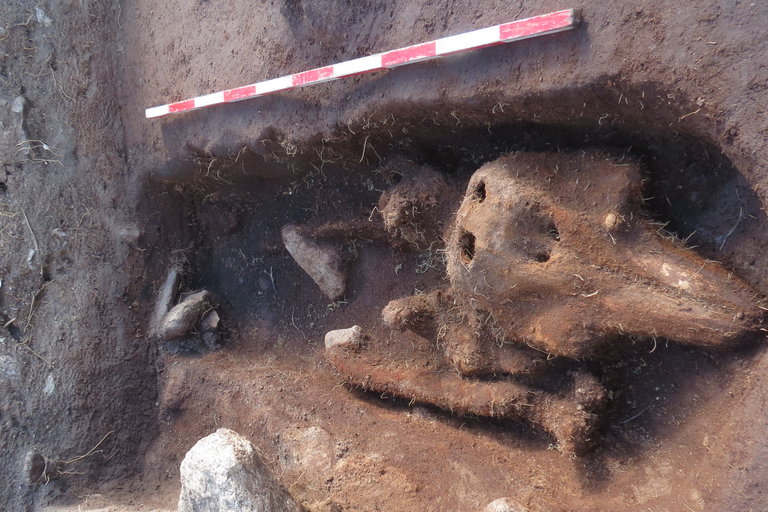
A porpoise from the medieval period was found buried in what appears to be a formal grave on the island of Chapelle dom Hue in the English Channel.
Folklore holds that the little island of Chapelle Dom Hue, in the English Channel west of Guernsey, was the location of a scenic retreat for medieval monks from the Benedictine priory of Lihou, which is a slightly larger island just to the south. Guernsey archaeologist Philip de Jersey and his colleagues are currently excavating the site to determine, in part, what the monks might have left there.

Recently, de Jersey and his team spotted the outline of a feature in the soil that looked like a grave.

“It certainly resembled medieval graves we have excavated in several sites on the island, and it was only a little way off the east-west orientation, as one would usually expect,” de Jersey told Seeker from the site.

A few days later, he and his team started to excavate the feature and uncovered a skull, which he initially thought was the top of a human skull. While dirt was removed, however, the skull grew ever larger in appearance.

As it turns out, the skull and other remains belonged, not to a human, but to a porpoise. The discovery is the world’s only known porpoise burial from the medieval era or earlier.

The archaeologists were astonished.

“It was entirely consistent with a human burial, which is one of the most puzzling aspects,” de Jersey said. “The grave cut has been dug very carefully, with vertical sides and a flat base cut into the underlying bedrock. This has taken some considerable care and effort.”

The buried porpoise as it was first being uncovered.
Like the beginning of a great murder mystery — the porpoise does appear to have been killed — there is a collection of clues and other information, some of which may have nothing to do with the burial.

So far, de Jersey and his team on the island have uncovered the ruins of a building there erected on an east-west alignment, which supports a religious function, according to the researchers.

“It was quite a substantial structure, small in size, but with thick walls,” de Jersey said.

He added that they have also found a lot of old pottery known as Normandy gritty ware, which was imported to the Channel Islands between the late 10th and early-15th centuries. A priory on Lihou was in use from the mid 12th to the early 14th or early-15th century, but the Chapelle Dom Hue pottery suggests that this smaller island was only occupied by the monks for a relatively short time, probably in the later-14th century.

A photo taken from west of the site, with the medieval building at Chapelle Dom Hue visible in the foreground
Evidence for an even earlier occupation of Chapelle Dom Hue was also found, with flint tools going back to the Neolithic Period (15,200 BC–2,000 BC). The porpoise burial, though, is at the medieval level of the site.

The researchers suspect that the animal was butchered before it was put into the ground.

“The bone preservation, apart from the skull, is very poor in our acidic soul, but it appears as though there are various articulated portions in the grave, not in the association one would expect if it was a complete body,” de Jersey explained.

The monks may therefore have viewed the porpoise more as food than as a revered, sentient being.

“One possibility we have considered is that the ‘grave’ is not a grave at all, but a pit carefully cut in which the butchered porpoise was buried in salt, in order to preserve portions of it,” de Jersey said. “There is contemporary literary evidence of porpoises, or parts of porpoise, being around for longer than it would have been fresh, therefore it must have been preserved somehow, whether through drying or salting.”

Researchers excavating at Chapelle Dom Hue, with Guernsey in the distance
Salting of fish and other edible marine life at the time was normally done in barrels, though. The researchers wonder if the large size of the porpoise might have necessitated a different approach for preparing it.

“If that’s true, then obviously it was never recovered, for some reason — or perhaps it just didn’t work as a technique, so they left it in the ground,” de Jersey said.

Medieval cookbooks do include dishes with porpoise as an ingredient. The late-14th century chef’s tome Forme of Cury, for example, contains such a recipe.

Read more at Seeker

Apr 4, 2017

Medieval Villagers Hacked Their Dead to Pieces in Fear of Zombie Apocalypse

Composite diagram showing distribution of cut marks in the remains.
Researchers may have uncovered the first scientific evidence of a “zombie madness” that obsessed medieval England, according to a study of 137 human bones that were excavated from a deserted English village.

Dating from the 11th to 14th centuries, the skeletal remains were reduced to chopped, smashed, and burnt fragments in an apparent attempt to forestall revenants rising from the grave.

The bones were recovered in the 1960s from a pit at the site of Wharram Percy, a long-abandoned village in rural Yorkshire, but were never examined closely until now.

Gruesome evidence of extensive human activity was immediately clear.

“Some of the bones showed sharp force marks, signs of burning and perimortem breakage,” Simon Mays, human skeletal biologist at Historic England, Alistair Pike, professor of archaeological sciences at the University of Southampton, and their colleagues wrote in the Journal of Archaeological Science: Reports.

While they considered starvation cannibalism as a possible cause, the researchers said they had ruled out a scenario in which the remains were cannibalized by villagers who were enduring one of the 12 known famines that occurred in England between 1066 and 1300.

“The patterns of breakage and cut marks on the bones are not consistent with the removal of flesh for eating,” Pike told Seeker.

Rather than indicate starvation cannibalism, the breakage, burning, and knife and chop marks on the skeletal remains appear to be consistent with dismemberment and decapitation, which would reflect the dark side of medieval beliefs.

The most likely explanation, according to Mays, is that the bones are “the remains of corpses burnt and dismembered to stop them walking from their graves.”

“Belief in revenants was widespread in Medieval northern and western Europe. Revenants were usually malevolent, spreading disease and physically assaulting the living,” the researchers wrote. “Methods of dealing with the undead involved physical and/or spiritual means, with an emphasis on the former. The most usual way was to dig up the body and subject it to mutilation (particularly decapitation) and burning.”

Osteological examination of the 137 bones revealed that they belonged to at least 10 individuals, ranging in age from two to 50 years old.

Monastic documents describe the behavior of the restless undead and detail how to treat a body to prevent it from rising again.

The most common way was to dig up the corpse, which was mutilated and decapitated to destroy its integrity and burned, rendering it unrecognizable.

“Our research is the first archaeological evidence for such treatment in the UK,” Pike said. “It tells us that the fear of revenant corpses was real. People really did believe that corpses can rise from the dead.”

The Wharram Percy bones show a total of 76 sharp-force marks, mainly knife-marks, on the upper body parts. The marks were made “with a fine knife drawn across the bone,” the researchers noted.

“The knife marks can be interpreted in terms of dismemberment or other mutilation of the body, and those in the head and neck area may be associated with decapitation,” they wrote.
 
They added that at least 17 bones show evidence for low-temperature burning, while six long bones feature breakage that occurred at or sometime after death.

Why these 10 individuals would have been treated by the villagers in this way, or elicited such fear, remains a mystery.

“We don't know,” Pike said. “We have historical accounts of how the dead who may have been killed suddenly, or wronged in some way, come back to life and cause trouble.”

He added that no frightening diseases were detected from the bones.

“We found just a few cases of joint disease, but with a similar frequency to the individuals buried in the nearby graveyard, so there is no reason to believe these individuals were unusual,” he remarked.

Strontium isotopic analyses in the teeth suggest that the people whose corpses were mutilated likely grew up in an area close to where they were buried, possibly in the village.

“This was surprising to us, as we first wondered if the unusual treatment of the bodies might relate to their being from further afield,” Pike said.

Read more at Discovery News

Nov 15, 2016

'Siberian Robin Hood' Found Buried With Arrows, Quiver

The burial of a medieval archer has been unearthed in the Altai mountains, complete with arrows, quiver and a wooden sarcophagus.

The man, called a "Siberian Robin Hood" by the local press, was likely a warrior of Mongolian origin who lived between 1200 and 1300 AD. The way he was buried suggests he was held in high respect.

According to the Siberian Times, the burial was found by local residents in a cliff near Kokorya, in the remote Altai Republic.

Wedged into a hole, the grave contained "the bones of an adult man, his birch bark quiver, arrow shafts and iron arrow heads, intricate ornaments and utensils made from the roots of trees, as well as the remnants of silk ribbons," the Siberian Times wrote.

The items are very well preserved due to the Siberian cold. The burial also contained birch bark linings for a saddle, the remains of a leather strap possibly used for attaching the quiver to the belt, and abundance of iron arrowheads and wooden arrow shafts.

"I can't say he was a 'Siberian Robin Hood.' Arrows are ordinary findings for medieval burials in the Altai. Almost all men used bows for hunting and battles," Nikita Konstantinov, head of the Museum of Gorno-Altaisk State University, told Seeker.

"The burial is interesting because of the decorated quiver," he added.

Made of two layers of birch bark — internal and external — the quiver had separate pockets for different types of arrows.

Although the bottom and other details aren't preserved, the quiver is unique. It features elaborate bone decorations with patterns that were popular in the territory of the Golden Horde, a division of the Mongol Empire which flourished from the mid-13th century to the end of the 14th century.

"There are no such quivers in the Altai, this one is unique," Konstantinov said.

Read more at Discovery News

Nov 2, 2016

'Cursed' Medieval Well Found in England

A Medieval well that was once believed to wash away sins, while healing eye and skin diseases has been recovered in England. Legend has it that the well was also cursed and records indicate a strange death occurred there.

St. Anne's Well was found on the lands of a private farm on the border between the townships of Rainhill and Sutton St Helens, near Liverpool, UK.

According to Historic England Heritage, which commissioned the excavation, "the well had become completely filled with earth due to ploughing."

"When we first got to the well we found that there was very little indication of it on the surface, but after excavation it was found to be in reasonable condition," Jamie Quartermaine, an archaeologist who supervised the dig, told Discovery News.

The well was built of local sandstone blocks and consisted of a shallow square basin with two steps leading down into the bottom.

"The fabric of the well is consistent with a Medieval date," Quartermaine said.

The archaeologist noted that St. Anne is quite commonly associated with holy wells.

"This well was probably a late Medieval foundation as the cult of St. Anne did not become widespread in England until after the end of the 14th century," Quartermaine said.

The dating is important. Alexandra Walsham, professor of modern history at Cambridge's Trinity College, told Seeker that "a Medieval past for many healing wells was assumed or even invented by later antiquaries, especially in the 19th century."

After descending the steps, pilgrims submerged themselves in the pool, which was about 4 feet deep. Water seeped in from below the floor, while a stone conduit, now lost, took water from the overflow of the well, which measures 6.5 feet by 6.5 feet.

According to Historic England Heritage, local legend suggests St. Anne's Well was associated with a nearby priory of about 12 monks, which was lost during Henry VIII's draconian dissolution of the monasteries.

The legend said the priory held an extensive estate from which the monks had an income. The story goes that St. Anne had bathed in the well, which was reputed to have healing powers for eye and skin afflictions.

"The well attracted numbers of pilgrims, necessitating the building of a small three-roomed structure around the well and the custodianship of two of the monks," Quartermaine said.

According to local folklore, a dispute rose in the 16th century about boundaries and access to the well between the prior, Father Delwaney, and Hugh Darcy, the estate manager of the neighboring landowner.

One day, when the two stood nearby the well, Darcy predicted the prior would not be in position for much longer. Two days later the king's commissioners arrived and took possession of the priory and the well.

Father Delwaney promptly understood Darcy's role in the action as he was clearly known to the commissioners.

"With teeth tightly clenched, and his face white with suppressed passion," the prior hissed out his curse, according to a 1877 report on local legends in the St. Helens Leader.

Darcy would be dead within a year and a day, Delwaney predicted. He then collapsed and died himself.

A series of disgraces fell on Darcy: three months after the curse, his only son died of a mysterious illness. He suffered financial losses and "plunged recklessly into dissipation," according to the St. Helens Leader.

Read more at Discovery News