Showing posts with label Radio Astronomy. Show all posts

Jun 7, 2023

Not your average space explosion: Very long baseline array finds classical novae are anything but simple

While studying classical novae using the National Radio Astronomy Observatory's Very Long Baseline Array (VLBA), a graduate researcher uncovered evidence the objects may have been erroneously typecast as simple. The new observations, which detected non-thermal emission from a classical nova with a dwarf companion, were presented today at a press conference during the 242nd proceedings of the American Astronomical Society in Albuquerque, New Mexico.

V1674 Herculis is a classical nova hosted by a white dwarf and dwarf companion and is currently the fastest classical nova on record. While studying V1674Her with the VLBA, Montana Williams, a graduate student at New Mexico Tech who is leading the investigation into the VLBA properties of this nova, confirmed the unexpected: non-thermal emission coming from it. This data is important because it tells Williams and her collaborators a lot about what's happening in the system. What the team has found is anything but the simple heat-induced explosions scientists previously expected from classical novae.

"Classical novae have historically been considered simple explosions, emitting mostly thermal energy," said Williams. "However, based on recent observations with the Fermi Large Area Telescope, this simple model is not entirely correct. Instead, it seems they're a bit more complicated. Using the VLBA, we were able to get a very detailed picture of one of the main complications, the non-thermal emission."

Very long baseline interferometry (VLBI) detections of classical novae with dwarf companions like V1674Her are rare. They're so rare, in fact, that this same type of detection, with resolved radio synchrotron components, has been reported just one other time to date. That's partly because of the assumed nature of classical novae.

"VLBI detections of novae are only recently becoming possible because of improvements to VLBI techniques, most notably the sensitivity of the instruments and the increasing bandwidth or the amount of frequencies we can record at a given time," said Williams. "Additionally, because of the previous theory of classical novae they weren't thought to be ideal targets for VLBI studies. We now know this isn't true because of multi-wavelength observations which indicate a more complex scenario."

That rarity makes the team's new observations an important step in understanding the hidden lives of classical novae and what ultimately leads to their explosive behavior.

"By studying images from the VLBA and comparing them to other observations from the Very Large Array (VLA), Fermi-LAT, NuSTAR, and NASA-Swift, we can determine what might be the cause of the emission and also make adjustments to the previous simple model," said Williams. "Right now, we're trying to determine if the non-thermal energy is coming from clumps of gas running into other clumped gas which produces shocks, or something else."

Because Fermi-LAT and Nu-Star observations had already indicated that there might be non-thermal emission coming from V1674Her, that made the classical nova an ideal candidate for study because Williams and her collaborators are on a mission to either confirm or deny those types of findings. It was also more interesting, or cute, as Williams puts it, because of its hyper-fast evolution, and because, unlike supernovae, the host system isn't destroyed during that evolution, but rather, remains almost completely intact and unchanged after the explosion. "Many astronomical sources don't change much over the course of a year or even 100 years. But this nova got 10,000 times brighter in a single day, then faded back to its normal state in just about 100 days," she said. "Because the host systems of classical novae remain intact they can be recurrent, which means we might see this one erupt, or cutely explode, again and again, giving us more opportunities to understand why and how it does."

Read more at Science Daily

Jul 20, 2021

Dark heart of the nearest radio galaxy

An international team anchored by the Event Horizon Telescope (EHT) Collaboration, which is known for capturing the first image of a black hole in the galaxy Messier 87, has now imaged the heart of the nearby radio galaxy Centaurus A in unprecedented detail. The astronomers pinpoint the location of the central supermassive black hole and reveal how a gigantic jet is being born. Most remarkably, only the outer edges of the jet seem to emit radiation, which challenges our theoretical models of jets. This work, led by Michael Janssen from the Max Planck Institute for Radio Astronomy in Bonn and Radboud University Nijmegen is published in Nature Astronomy on July 19th.

At radio wavelengths, Centaurus A emerges as one of the largest and brightest objects in the night sky. After it was identified as one of the first known extragalactic radio sources in 1949, Centaurus A has been studied extensively across the entire electromagnetic spectrum by a variety of radio, infrared, optical, X-ray, and gamma-ray observatories. At the center of Centaurus A lies a black hole with the mass of 55 million suns, which is right between the mass scales of the Messier 87 black hole (six and a half billion suns) and the one in the center of our own galaxy (about four million suns).

In a new paper in Nature Astronomy, data from the 2017 EHT observations have been analyzed to image Centaurus A in unprecedented detail. "This allows us for the first time to see and study an extragalactic radio jet on scales smaller than the distance light travels in one day. We see up close and personally how a monstrously gigantic jet launched by a supermassive black hole is being born," says astronomer Michael Janssen.

Compared to all previous high-resolution observations, the jet launched in Centaurus A is imaged at a tenfold higher frequency and sixteen times sharper resolution. With the resolving power of the EHT, we can now link the vast scales of the source, which are as big as 16 times the angular diameter of the Moon on the sky, to their origin near the black hole in a region of merely the width of an apple on the Moon when projected on the sky. That is a magnification factor of one billion.

Understanding jets

Supermassive black holes residing in the center of galaxies like Centaurus A are feeding off gas and dust that is attracted by their enormous gravitational pull. This process releases massive amounts of energy and the galaxy is said to become 'active'. Most matter lying close to the edge of the black hole falls in. However, some of the surrounding particles escape moments before capture and are blown far out into space: Jets -- one of the most mysterious and energetic features of galaxies -- are born.

Astronomers have relied on different models of how matter behaves near the black hole to better understand this process. But they still do not know exactly how jets are launched from its central region and how they can extend over scales that are larger than their host galaxies without dispersing out. The EHT aims to resolve this mystery.

Read more at Science Daily

Nov 19, 2020

Newborn jets in distant galaxies

 Astronomers using data from the ongoing VLA Sky Survey (VLASS) have found a number of distant galaxies with supermassive black holes at their cores that have launched powerful, radio-emitting jets of material within the past two decades or so. The scientists compared data from VLASS with data from an earlier survey that also used the National Science Foundation's Karl G. Jansky Very Large Array (VLA) to reach their conclusion.

"We found galaxies that showed no evidence of jets before but now show clear indications of having young, compact jets," said Dr. Kristina Nyland, who is an NRC postdoctoral fellow in residence at the Naval Research Laboratory.

"Jets like these can strongly affect the growth and evolution of their galaxies, but we still don't understand all of the details. Catching newborn jets with surveys like VLASS provides a measure of the role of powerful radio jets in shaping the lives of the galaxies over billions of years," Nyland said.

VLASS is a project that will survey the sky visible from the VLA -- about 80 percent of the entire sky -- three times over seven years. The observations began in 2017 and the first of the three scans now is complete. Nyland and her colleagues compared data from this scan with data from the FIRST survey that used the VLA to observe a smaller portion of the sky between 1993 and 2011.

They found about 2,000 objects that appear in the VLASS images, but were not detected in the earlier FIRST survey. From these, they selected 26 objects that previously were categorized as galaxies with active nuclei -- powered by supermassive black holes -- by optical and infrared observations. The FIRST observations of the 26 objects had been made between 1994 and 2001. The VLASS observations were made in 2019. The intervals between observations of the objects thus ranged from 18 to 25 years.

They chose 14 of these galaxies for more detailed observations with the VLA. These observations provided higher-resolution images and also were done at multiple radio frequencies to get a more complete understanding of the objects' characteristics.

"The data from these detailed observations tell us that the most likely cause of the difference in radio brightness between the FIRST and the VLASS observations is that the 'engines' at the cores of these galaxies have launched new jets since the FIRST observations were made," explained Dillon Dong, from Caltech.

The black holes at the cores of galaxies are known to interact with the galaxies themselves, and the two evolve together. The jets launched from the regions near the black holes can affect the amount of star formation within the galaxy.

"Radio jets provide natural laboratories for learning about the extreme physics of supermassive black holes, whose formation and growth are believed to be intrinsically linked to that of the galaxy centers in which they reside," said Pallavi Patil, of the University of Virginia.

"Jets as young as the ones discovered in our study can provide us with a rare opportunity to gain new insights on how these interactions between the jets and their surroundings work," Nyland said.

"VLASS has proven to be a key tool for discovering such jets, and we eagerly await the results of its next two observing epochs," said Mark Lacy, of the National Radio Astronomy Observatory.

Read more at Science Daily

Aug 31, 2020

Can a black hole fire up the cold heart of the Phoenix Galaxy Cluster?

 Radio astronomers have detected jets of hot gas blasted out by a black hole in the galaxy at the heart of the Phoenix Galaxy Cluster, located 5.9 billion light-years away in the constellation Phoenix. This is an important result for understanding the coevolution of galaxies, gas, and black holes in galaxy clusters.

Galaxies are not distributed randomly in space. Through mutual gravitational attraction, galaxies gather together to form collections known as clusters. The space between galaxies is not entirely empty. There is very dilute gas throughout a cluster which can be detected by X-ray observations.

If this intra-cluster gas cooled, it would condense under its own gravity to form stars at the center of the cluster. However, cooled gas and stars are not usually observed in the hearts of nearby clusters, indicating that some mechanism must be heating the intra-cluster gas and preventing star formation. One potential candidate for the heat source is jets of high-speed gas accelerated by a super-massive black hole in the central galaxy.

The Phoenix Cluster is unusual in that it does show signs of dense cooled gas and massive star formation around the central galaxy. This raises the question, "does the central galaxy have black hole jets as well?"

A team led by Takaya Akahori at the National Astronomical Observatory of Japan used the Australia Telescope Compact Array (ATCA) to search for black hole jets in the Phoenix Galaxy Cluster with the highest resolution to date. They detected matching structures extending out from opposite sides of the central galaxy. Comparing with observations of the region taken from the Chandra X-ray Observatory archive data shows that the structures detected by ATCA correspond to cavities of less dense gas, indicating that they are a pair of bipolar jets emitted by a black hole in the galaxy. Therefore, the team discovered the first example, in which intra-cluster gas cooling and black hole jets coexist, in the distant Universe.

Further details of the galaxy and jets could be elucidated through higher-resolution observations with next generation observational facilities, such as the Square Kilometre Array scheduled to start observations in the late 2020s.

From Science Daily

Feb 21, 2020

How newborn stars prepare for the birth of planets

VANDAM survey: ALMA and the VLA observed more than 300 protostars and their young protoplanetary disks in Orion. This image shows a subset of stars, including a few binaries. The ALMA and VLA data compliment each other: ALMA sees the outer disk structure (visualized in blue), and the VLA observes the inner disks and star cores (orange).
An international team of astronomers used two of the most powerful radio telescopes in the world to create more than three hundred images of planet-forming disks around very young stars in the Orion Clouds. These images reveal new details about the birthplaces of planets and the earliest stages of star formation.

Most of the stars in the universe are accompanied by planets. These planets are born in rings of dust and gas, called protoplanetary disks. Even very young stars are surrounded by these disks. Astronomers want to know exactly when these disks start to form, and what they look like. But young stars are very faint, and there are dense clouds of dust and gas surrounding them in stellar nurseries. Only highly sensitive radio telescope arrays can spot the tiny disks around these infant stars amidst the densely packed material in these clouds.

For this new research, astronomers pointed both the National Science Foundation's Karl G. Jansky Very Large Array (VLA) and the Atacama Large Millimeter/submillimeter Array (ALMA) to a region in space where many stars are born: the Orion Molecular Clouds. This survey, called VLA/ALMA Nascent Disk and Multiplicity (VANDAM), is the largest survey of young stars and their disks to date.

Very young stars, also called protostars, form in clouds of gas and dust in space. The first step in the formation of a star is when these dense clouds collapse due to gravity. As the cloud collapses, it begins to spin -- forming a flattened disk around the protostar. Material from the disk continues to feed the star and make it grow. Eventually, the left-over material in the disk is expected to form planets.

Many aspects about these first stages of star formation, and how the disk forms, are still unclear. But this new survey provides some missing clues as the VLA and ALMA peered through the dense clouds and observed hundreds of protostars and their disks in various stages of their formation.

Young planet-forming disks

"This survey revealed the average mass and size of these very young protoplanetary disks," said John Tobin of the National Radio Astronomy Observatory (NRAO) in Charlottesville, Virginia, and leader of the survey team. "We can now compare them to older disks that have been studied intensively with ALMA as well."

What Tobin and his team found, is that very young disks can be similar in size, but are on average much more massive than older disks. "When a star grows, it eats away more and more material from the disk. This means that younger disks have a lot more raw material from which planets could form. Possibly bigger planets already start to form around very young stars."

Four special protostars

Among hundreds of survey images, four protostars looked different than the rest and caught the scientists' attention. "These newborn stars looked very irregular and blobby," said team member Nicole Karnath of the University of Toledo, Ohio (now at SOFIA Science Center). "We think that they are in one of the earliest stages of star formation and some may not even have formed into protostars yet."

It is special that the scientists found four of these objects. "We rarely find more than one such irregular object in one observation," added Karnath, who used these four infant stars to propose a schematic pathway for the earliest stages of star formation. "We are not entirely sure how old they are, but they are probably younger than ten thousand years."

To be defined as a typical (class 0) protostar, stars should not only have a flattened rotating disk surrounding them, but also an outflow -- spewing away material in opposite directions -- that clears the dense cloud surrounding the stars and makes them optically visible. This outflow is important, because it prevents stars from spinning out of control while they grow. But when exactly these outflows start to happen, is an open question in astronomy.

One of the infant stars in this study, called HOPS 404, has an outflow of only two kilometers (1.2 miles) per second (a typical protostar-outflow of 10-100 km/s or 6-62 miles/s). "It is a big puffy sun that is still gathering a lot of mass, but just started its outflow to lose angular momentum to be able to keep growing," explained Karnath. "This is one of the smallest outflows that we have seen and it supports our theory of what the first step in forming a protostar looks like."

Combining ALMA and VLA

The exquisite resolution and sensitivity provided by both ALMA and the VLA were crucial to understand both the outer and inner regions of protostars and their disks in this survey. While ALMA can examine the dense dusty material around protostars in great detail, the images from the VLA made at longer wavelengths were essential to understand the inner structures of the youngest protostars at scales smaller than our solar system.

"The combined use of ALMA and the VLA has given us the best of both worlds," said Tobin. "Thanks to these telescopes, we start to understand how planet formation begins."

Read more at Science Daily

Feb 19, 2020

Scientists pioneer new way to study exoplanets

A team of scientists using the Low Frequency Array (LOFAR) radio telescope in the Netherlands has observed radio waves that carry the distinct signatures of aurorae, caused by the interaction between a star's magnetic field and a planet in orbit around it.

Radio emission from a star-planet interaction has been long predicted, but this is the first time astronomers have been able to detect and decipher these signals. The discovery paves the way for a novel and unique way to probe the environment around exoplanets -- planets that orbit stars in other solar systems -- and to determine their habitability.

Notably, follow-up observations with the HARPS-N telescope in Spain ruled out the alternate possibility that the interacting companion is another star as opposed to an exoplanet.

The work appears in articles in Nature Astronomy and Astrophysical Journal Letters (ApJL).

The breakthrough centered on red dwarfs, which are the most abundant type of star in our Milky Way -- but much smaller and cooler than our own Sun. This means for a planet to be habitable, it has to be significantly closer to its star than the Earth is to the Sun.

Red dwarfs also have much stronger magnetic fields than the Sun, which means that a habitable planet around a red dwarf is exposed to intense magnetic activity. This can heat the planet and even erode its atmosphere. The radio emissions associated with this process are one of the only tools available to probe the interaction between such planets and their stars.

"The motion of the planet through a red dwarf's strong magnetic field acts like an electric engine much in the same way a bicycle dynamo works," says Harish Vedantham, the lead author of the Nature Astronomy study and a Netherlands Institute for Radio Astronomy (ASTRON) staff scientist. "This generates a huge current that powers aurorae and radio emission on the star."

Thanks to the Sun's weak magnetic field and the larger distance to the planets, similar currents are not generated in the solar system. However, the interaction of Jupiter's moon Io with Jupiter's magnetic field generates a similarly bright radio emission, even outshining the Sun at sufficiently low frequencies.

"We adapted the knowledge from decades of radio observations of Jupiter to the case of this star," says Joe Callingham, ASTRON postdoctoral fellow and co-author of the Nature Astronomy paper. "A scaled-up version of Jupiter-Io has long been predicted to exist in star-planet systems, and the emission we observed fits the theory very well."

To be sure, the astronomers had to rule out an alternate possibility -- that the interacting bodies are two stars in a close binary system instead of a star and its exoplanet. The team searched for the signature of a companion star using the HARPS-N instrument (High Accuracy Radial Velocity Planet Searcher) on the Italian Telescopio Nazionale Galileo on La Palma, Spain.

"Interacting binary stars can also emit radio waves," notes Benjamin Pope, NASA Sagan Fellow at New York University and lead author of the ApJL paper. "Using optical observations to follow up, we searched for evidence of a stellar companion masquerading as an exoplanet in the radio data. We ruled this scenario out very strongly, so we think the most likely possibility is an Earth-sized planet too small to detect with our optical instruments."

The group is now concentrating on finding similar emission from other stars.

"We now know that nearly every red dwarf hosts terrestrial planets, so there must be other stars showing similar emission," observes Callingham, also a co-author of the ApJL paper. "We want to know how this impacts our search for another Earth around another star."

"If we find that most red dwarf planets are blasted by intense stellar winds, this is bad news for their habitability," Pope, part of NYU's Department of Physics and Center for Data Science and a co-author of the Nature Astronomy paper.

The group expects this new method of detecting exoplanets will open up a new way of understanding the habitat of exoplanets.

Read more at Science Daily

Jul 12, 2019

Moon-forming disk discovered around distant planet

Gas and dust around exoplanet concept
Using Earth's most powerful array of radio telescopes, astronomers have made the first observations of a circumplanetary disk of gas and dust like the one that is believed to have birthed the moons of Jupiter.

The find, reported online today in Astrophysical Journal Letters, adds to the intriguing story of planet PDS 70 c, a still-forming gas giant about 370 light years from Earth that was first revealed last month in visible light images.

Using the massive 66-antenna Atacama Large Millimeter/submillimeter Array (ALMA) in Chile, Rice University astronomer Andrea Isella and colleagues collected millimeter wave radio signals that revealed the presence of dust grains throughout the star system where PDS 70 c and its sister planet, PDS 70 b, are still forming.

"Planets form from disks of gas and dust around newly forming stars, and if a planet is large enough, it can form its own disk as it gathers material in its orbit around the star," Isella said. "Jupiter and its moons are a little planetary system within our solar system, for example, and it's believed Jupiter's moons formed from a circumplanetary disk when Jupiter was very young."

But most models of planet formation show that circumplanetary disks disappear within about 10 million years, which means circumplanetary disks haven't existed in our solar system for more than 4 billion years. To look for them elsewhere and gather observational evidence to test theories of planet formation, Isella and colleagues search for very young star systems where they can directly observe disks and the planets still forming inside them. In the new study, Isella and colleagues analyzed observations made by ALMA in 2017.

"There are a handful of candidate planets that have been detected in disks, but this is a very new field, and they are all still debated," Isella said. "(PDS 70 b and PDS 70 c) are among the most robust because there have been independent observations with different instruments and techniques."

PDS 70 is a dwarf star about three-quarters the mass of the sun. Both of its planets are 5-10 times larger than Jupiter, and the innermost, PDS 70 b, orbits about 1.8 billion miles from the star, roughly the distance from the sun to Uranus. PDS 70 c is a billion miles further out, in an orbit about the size of Neptune's.

PDS 70 b was first revealed in 2018 in infrared light images from a planet-hunting instrument called SPHERE at the European Southern Observatory's Very Large Telescope (VLT). In June, astronomers used another VLT instrument called MUSE to observe a visible wavelength of light known as H-alpha, which is emitted when hydrogen falls onto a star or planet and becomes ionized.

"H-alpha gives us more confidence that these are planets because it suggests they are still drawing in gas and dust and growing," Isella said.

The millimeter wavelength observations from ALMA provide even more evidence.

"It's complementary to the optical data and provides completely independent confirmation that there is something there," he said.

Isella said direct observation of planets with circumplanetary disks could allow astronomers to test theories of planet formation.

"There's much that we don't understand about how planets form, and we now finally have the instruments to make direct observations and begin answering questions about how our solar system formed and how other planets might form."

Read more at Science Daily

Jun 20, 2019

Astronomers uncover first polarized radio signals from gamma-ray burst

An international team of astronomers has captured the first-ever polarized radio waves from a distant cosmic explosion.

This explosive event (known as gamma-ray burst GRB 190114C) is part of a class of the most energetic explosions in the universe. It was produced when a star -- much more massive than our sun -- collapsed to form a black hole.

Gamma ray bursts produce powerful jets that travel close to the speed of light and shine with the incredible luminosity of more than a billion suns combined. Astronomers have struggled to understand how these jets are formed and why they seem to appear only in gamma ray bursts -- but not other explosions, such as ordinary supernovae.

Because these jets are extremely bright at radio wavelengths, the discovery of polarized radio signals may offer new clues to help solve this mystery. Polarization is a property of light that indicates how a magnetic field is organized and structured in a jet.

"We know that only a very tiny fraction (less than 1%) of massive stars form jets when they collapse," said Northwestern University's Raffaella Margutti, who contributed to the study. "But we have not known how they manage to launch these outflows with such extreme properties, and we don't know why only a few stars do this."

"This measurement opens a new window into gamma-ray burst science and the studies of energetic astrophysical jets," said Tanmoy Laskar, a postdoctoral researcher at the University of Bath in the U.K. and lead author of the study. "We would like to understand whether the low level of polarization measured in this event is characteristic of all gamma-ray bursts and, if so, what this could tell us about the magnetic structures in gamma-ray burst jets and the role of magnetic fields in powering jets throughout the universe."

The paper was published last week in the Astrophysical Journal Letters.

The international team included three astrophysicists from Northwestern's Weinberg College of Arts and Sciences: Kate Alexander, Wen-fai Fong and Margutti. All are members of Northwestern's Center for Interdisciplinary and Exploratory Research in Astrophysics (CIERA).

Astronomers have hypothesized that cosmic magnetic fields might flow through the jets, helping them form and providing structural support. The physical extent of these magnetic fields, which have implications for the jet launching mechanism, however, had never before been measured.

To obtain these measurements, the international team employed a novel trick. They observed the jets in linearly polarized light, which is sensitive to the size of magnetic field patches. Larger magnetic field patches, for example, produce more polarized light.

On January 14, 2019, a flash of gamma rays triggered NASA's Swift satellite, which alerted astronomers of the burst's location in the direction of the constellation Fornax. The astronomers then used the Atacama Large Millimeter/Submillimeter Array (ALMA) telescope in Chile to search for radio waves from the explosion, which occurred more than 4.5 billion years ago in a galaxy 7 billion light-years away.

"Magnetic fields are ubiquitous but notoriously difficult to constrain in our universe," said Fong, an assistant professor of astrophysics. "The fact that we have been able to detect their presence -- let alone in the fastest jets we know of -- is an incredible and storied feat of observation."

The team detected a subtle, but revealing, polarization signal of 0.8%, implying magnetic field patches about the size of our solar system. Next, the researchers will combine this new information with data from X-ray and visible light telescopes.

"The lower frequency data from the Very Large Array (VLA) in New Mexico helped confirm that we were seeing the light from the jet itself rather than from the interaction of the jet with its environment," said Alexander, a NASA Einstein Fellow who led the VLA observations.

Read more at Science Daily

Apr 10, 2019

Working together as a 'virtual telescope,' observatories around the world produce first direct images of a black hole

The Event Horizon Telescope (EHT) -- a planet-scale array of eight ground-based radio telescopes forged through international collaboration -- was designed to capture images of a black hole. In coordinated press conferences across the globe, EHT researchers revealed that they succeeded, unveiling the first direct visual evidence of the supermassive black hole in the centre of Messier 87 and its shadow.
An international team of over 200 astronomers, including scientists from MIT's Haystack Observatory, has captured the first direct images of a black hole. They accomplished this remarkable feat by coordinating the power of eight major radio observatories on four continents, to work together as a virtual, Earth-sized telescope.

In a series of papers published today in a special issue of Astrophysical Journal Letters (https://iopscience.iop.org/issue/2041-8205/875/1), the team has revealed four images of the supermassive black hole at the heart of Messier 87, or M87, a galaxy within the Virgo galaxy cluster, 55 million light years from Earth.

All four images show a central dark region surrounded by a ring of light that appears lopsided -- brighter on one side than the other.

Albert Einstein, in his theory of general relativity, predicted the existence of black holes, in the form of infinitely dense, compact regions in space, where gravity is so extreme that nothing, not even light, can escape from within. By definition, black holes are invisible. But if a black hole is surrounded by light-emitting material such as plasma, Einstein's equations predict that some of this material should create a "shadow," or an outline of the black hole and its boundary, also known as its event horizon.

Based on the new images of M87, the scientists believe they are seeing a black hole's shadow for the first time, in the form of the dark region at the center of each image.

Relativity predicts that the immense gravitational field will cause light to bend around the black hole, forming a bright ring around its silhouette, and will also cause the surrounding material to orbit around the object at close to light speed. The bright, lopsided ring in the new images offers visual confirmation of these effects: The material headed toward our vantage point as it rotates around appears brighter than the other side.

From these images, theorists and modelers on the team have determined that the black hole is about 6.5 billion times as massive as our sun. Slight differences between each of the four images suggest that material is zipping around the black hole at lightning speed.

"This black hole is much bigger than the orbit of Neptune, and Neptune takes 200 years to go around the sun," says Geoffrey Crew, a research scientist at Haystack Observatory. "With the M87 black hole being so massive, an orbiting planet would go around it within a week and be traveling at close to the speed of light."

"People tend to view the sky as something static, that things don't change in the heavens, or if they do, it's on timescales that are longer than a human lifetime," says Vincent Fish, a research scientist at Haystack Observatory. "But what we find for M87 is, at the very fine detail we have, objects change on the timescale of days. In the future, we can perhaps produce movies of these sources. Today we're seeing the starting frames."

"These remarkable new images of the M87 black hole prove that Einstein was right yet again," says Maria Zuber, MIT's vice president for research and the E.A. Griswold Professor of Geophysics in the Department of Earth, Atmospheric and Planetary Sciences. "The discovery was enabled by advances in digital systems at which Haystack engineers have long excelled."

"Nature was kind"

The images were taken by the Event Horizon Telescope, or EHT, a planet-scale array comprising eight radio telescopes, each in a remote, high-altitude environment, including the mountaintops of Hawaii, Spain's Sierra Nevada, the Chilean desert, and the Antarctic ice sheet.

On any given day, each telescope operates independently, observing astrophysical objects that emit faint radio waves. However, a black hole is infinitely smaller and darker than any other radio source in the sky. To see it clearly, astronomers need to use very short wavelengths -- in this case, 1.3 millimeters -- that can cut through the clouds of material between a black hole and the Earth.

Making a picture of a black hole also requires a magnification, or "angular resolution," equivalent to reading a text on a phone in New York from a sidewalk café in Paris. A telescope's angular resolution increases with the size of its receiving dish. However, even the largest radio telescopes on Earth are nowhere near big enough to see a black hole.

But when multiple radio telescopes, separated by very large distances, are synchronized and focused on a single source in the sky, they can operate as one very large radio dish, through a technique known as very long baseline interferometry, or VLBI. Their combined angular resolution as a result can be vastly improved.

For EHT, the eight participating telescopes summed up to a virtual radio dish as big as the Earth, with the ability to resolve an object down to 20 micro-arcseconds -- about 3 million times sharper than 20/20 vision. By a happy coincidence, that's about the precision required to view a black hole, according to Einstein's equations.

"Nature was kind to us, and gave us something just big enough to see by using state-of-the-art equipment and techniques," says Crew, co-leader of the EHT correlation working group and the ALMA Observatory VLBI team.

"Gobs of data"


On April 5, 2017, the EHT began observing M87. After consulting numerous weather forecasts, astronomers identified four nights that would produce clear conditions for all eight observatories -- a rare opportunity, during which they could work as one collective dish to observe the black hole.

In radio astronomy, telescopes detect radio waves, at frequencies that register incoming photons as a wave, with an amplitude and phase that's measured as a voltage. As they observed M87, every telescope took in streams of data in the form of voltages, represented as digital numbers.

"We're recording gobs of data -- petabytes of data for each station," Crew says.

In total, each telescope took in about one petabyte of data, equal to 1 million gigabytes. Each station recorded this enormous influx that onto several Mark6 units -- ultrafast data recorders that were originally developed at Haystack Observatory.

After the observing run ended, researchers at each station packed up the stack of hard drives and flew them via FedEx to Haystack Observatory, in Massachusetts, and Max Planck Institute for Radio Astronomy, in Germany. (Air transport was much faster than transmitting the data electronically.) At both locations, the data were played back into a highly specialized supercomputer called a correlator, which processed the data two streams at a time.

As each telescope occupies a different location on the EHT's virtual radio dish, it has a slightly different view of the object of interest -- in this case, M87. The data received by two separate telescopes may encode a similar signal of the black hole but also contain noise that's specific to the respective telescopes.

The correlator lines up data from every possible pair of the EHT's eight telescopes. From these comparisons, it mathematically weeds out the noise and picks out the black hole's signal. High-precision atomic clocks installed at every telescope time-stamp incoming data, enabling analysts to match up data streams after the fact.

"Precisely lining up the data streams and accounting for all kinds of subtle perturbations to the timing is one of the things that Haystack specializes in," says Colin Lonsdale, Haystack director and vice chair of the EHT directing board.

Teams at both Haystack and Max Planck then began the painstaking process of "correlating" the data, identifying a range of problems at the different telescopes, fixing them, and rerunning the correlation, until the data could be rigorously verified. Only then were the data released to four separate teams around the world, each tasked with generating an image from the data using independent techniques.

"It was the second week of June, and I remember I didn't sleep the night before the data was released, to be sure I was prepared," says Kazunori Akiyama, co-leader of the EHT imaging group and a postdoc working at Haystack.

All four imaging teams previously tested their algorithms on other astrophysical objects, making sure that their techniques would produce an accurate visual representation of the radio data. When the files were released, Akiyama and his colleagues immediately ran the data through their respective algorithms. Importantly, each team did so independently of the others, to avoid any group bias in the results.

"The first image our group produced was slightly messy, but we saw this ring-like emission, and I was so excited at that moment," Akiyama remembers. "But simultaneously I was worried that maybe I was the only person getting that black hole image."

His concern was short-lived. Soon afterward all four teams met at the Black Hole Initiative at Harvard University to compare images, and found, with some relief, and much cheering and applause, that they all produced the same, lopsided, ring-like structure -- the first direct images of a black hole.

"There have been ways to find signatures of black holes in astronomy, but this is the first time anyone's ever taken a picture of one," Crew says. "This is a watershed moment."

"A new era"

The idea for the EHT was conceived in the early 2000s by Sheperd Doeleman, who was leading a pioneering VLBI program at Haystack Observatory and now directs the EHT project as an astronomer at the Harvard-Smithsonian Center for Astrophysics. At the time, Haystack engineers were developing the digital back-ends, recorders, and correlator that could process the enormous datastreams that an array of disparate telescopes would receive.

"The concept of imaging a black hole has been around for decades," Lonsdale says. "But it was really the development of modern digital systems that got people thinking about radio astronomy as a way of actually doing it. More telescopes on mountaintops were being built, and the realization gradually came along that, hey, [imaging a black hole] isn't absolutely crazy."

In 2007, Doeleman's team put the EHT concept to the test, installing Haystack's recorders on three widely scattered radio telescopes and aiming them together at Sagittarius A*, the black hole at the center of our own galaxy.

"We didn't have enough dishes to make an image," recalls Fish, co-leader of the EHT science operations working group. "But we could see there was something there that's about the right size."

Today, the EHT has grown to an array of 11 observatories: ALMA, APEX, the Greenland Telescope, the IRAM 30-meter Telescope, the IRAM NOEMA Observatory, the Kitt Peak Telescope, the James Clerk Maxwell Telescope, the Large Millimeter Telescope Alfonso Serrano, the Submillimeter Array, the Submillimeter Telescope, and the South Pole Telescope.

Coordinating observations and analysis has involved over 200 scientists from around the world who make up the EHT collaboration, with 13 main institutions, including Haystack Observatory. Key funding was provided by the National Science Foundation, the European Research Council, and funding agencies in East Asia, including the Japan Society for the Promotion of Science. The telescopes contributing to this result were ALMA, APEX, the IRAM 30-meter telescope, the James Clerk Maxwell Telescope, the Large Millimeter Telescope Alfonso Serrano, the Submillimeter Array, the Submillimeter Telescope, and the South Pole Telescope.

More observatories are scheduled to join the EHT array, to sharpen the image of M87 as well as attempt to see through the dense material that lies between Earth and the center of our own galaxy, to the heart of Sagittarius A*.

"We've demonstrated that the EHT is the observatory to see a black hole on an event horizon scale," Akiyama says. "This is the dawn of a new era of black hole astrophysics."

Read more at Science Daily

Mar 8, 2019

Listening to quantum radio

This quantum chip (1x1 cm big) allows the researchers to listen to the smallest radio signal allowed by quantum mechanics.
Researchers at Delft University of Technology have created a quantum circuit that enables them to listen to the weakest radio signal allowed by quantum mechanics. This new quantum circuit opens the door to possible future applications in areas such as radio astronomy and medicine (MRI). It also enables researchers to do experiments that can shed light on the interplay between quantum mechanics and gravity.

We have all been annoyed by weak radio signals at some point in our lives: our favourite song in the car turning to noise, being too far away from our wifi router to check our email. Our usual solution is to make the signal bigger, for instance by picking a different radio station or by moving to the other side of the living room. What if, however, we could just listen more carefully?

Weak radio signals are not just a challenge for people trying to find their favourite radio station, but also for magnetic resonance imaging (MRI) scanners at hospitals, as well as for the telescopes scientists use to peer into space.

In a quantum 'leap' in radio frequency detection, researchers in the group of Prof. Gary Steele in Delft demonstrated the detection of photons or quanta of energy, the weakest signals allowed by the theory of quantum mechanics.

Quantum chunks

One of the strange predictions of quantum mechanics is that energy comes in tiny little chunks called 'quanta'. What does this mean? "Say I am pushing a kid on a swing," lead researcher Mario Gely said. "In the classical theory of physics, if I want the kid to go a little bit faster I can give them a small push, giving them more speed and more energy. Quantum mechanics says something different: I can only increase the kid's energy one 'quantum step' at a time. Pushing by half of that amount is not possible."

For a kid on a swing these 'quantum steps' are so tiny that they are too small to notice. Until recently, the same was true for radio waves. However, the research team in Delft developed a circuit that can actually detect these chunks of energy in radio frequency signals, opening up the potential for sensing radio waves at the quantum level.

From quantum radio to quantum gravity?

Beyond applications in quantum sensing, the group in Delft is interested in taking quantum mechanics to the next level: mass. While the theory of quantum electromagnetism was developed nearly 100 years ago, physicists are still puzzled today on how to fit gravity into quantum mechanics.

Read more at Science Daily

Oct 11, 2018

New telescope almost doubles known number of mysterious 'fast radio bursts'

These are antennas of CSIRO's Australian SKA Pathfinder with the Milky Way overhead.
Australian researchers using a CSIRO radio telescope in Western Australia have nearly doubled the known number of 'fast radio bursts' -- powerful flashes of radio waves from deep space.

The team's discoveries include the closest and brightest fast radio bursts ever detected.

Their findings were reported today in the journal Nature.

Fast radio bursts come from all over the sky and last for just milliseconds.

Scientists don't know what causes them but it must involve incredible energy -- equivalent to the amount released by the Sun in 80 years.

"We've found 20 fast radio bursts in a year, almost doubling the number detected worldwide since they were discovered in 2007," said lead author Dr Ryan Shannon, from Swinburne University of Technology and the OzGrav ARC Centre of Excellence.

"Using the new technology of the Australia Square Kilometre Array Pathfinder (ASKAP), we've also proved that fast radio bursts are coming from the other side of the Universe rather than from our own galactic neighbourhood."

Co-author Dr Jean-Pierre Macquart, from the Curtin University node of the International Centre for Radio Astronomy Research (ICRAR), said bursts travel for billions of years and occasionally pass through clouds of gas.

"Each time this happens, the different wavelengths that make up a burst are slowed by different amounts," he said.

"Eventually, the burst reaches Earth with its spread of wavelengths arriving at the telescope at slightly different times, like swimmers at a finish line.

"Timing the arrival of the different wavelengths tells us how much material the burst has travelled through on its journey.

"And because we've shown that fast radio bursts come from far away, we can use them to detect all the missing matter located in the space between galaxies -- which is a really exciting discovery."

CSIRO's Dr Keith Bannister, who engineered the systems that detected the bursts, said ASKAP's phenomenal discovery rate is down to two things.

"The telescope has a whopping field of view of 30 square degrees, 100 times larger than the full Moon," he said.

"And, by using the telescope's dish antennas in a radical way, with each pointing at a different part of the sky, we observed 240 square degrees all at once -- about a thousand times the area of the full Moon.

"ASKAP is astoundingly good for this work."

Dr Shannon said we now know that fast radio bursts originate from about halfway across the Universe but we still don't know what causes them or which galaxies they come from.

The team's next challenge is to pinpoint the locations of bursts on the sky.

"We'll be able to localise the bursts to better than a thousandth of a degree," Dr Shannon said.

"That's about the width of a human hair seen ten metres away, and good enough to tie each burst to a particular galaxy."

ASKAP is located at CSIRO's Murchison Radio-astronomy Observatory (MRO) in Western Australia and is a precursor for the future Square Kilometre Array (SKA) telescope.

The SKA could observe large numbers of fast radio bursts, giving astronomers a way to study the early Universe in detail.

Read more at Science Daily

Feb 28, 2018

Within 180 million years of the Big Bang, stars were born

A timeline of the universe, updated to show when the first stars emerged. This updated timeline of the universe reflects the recent discovery that the first stars emerged by 180 million years after the Big Bang. The research behind this timeline was conducted by Judd Bowman of Arizona State University and his colleagues, with funding from the National Science Foundation.
Long ago, about 400,000 years after the beginning of the universe (the Big Bang), the universe was dark. There were no stars or galaxies, and the universe was filled primarily with neutral hydrogen gas.

Then, for the next 50-100 million years, gravity slowly pulled the densest regions of gas together until ultimately the gas collapsed in some places to form the first stars.

What were those first stars like and when did they form? How did they affect the rest of the universe? These are questions astronomers and astrophysicists have long pondered.

Now, after 12 years of experimental effort, a team of scientists, led by ASU School of Earth and Space Exploration astronomer Judd Bowman, has detected the fingerprints of the earliest stars in the universe. Using radio signals, the detection provides the first evidence for the oldest ancestors in our cosmic family tree, born by a mere 180 million years after the universe began.

"There was a great technical challenge to making this detection, as sources of noise can be a thousand times brighter than the signal -- it's like being in the middle of a hurricane and trying to hear the flap of a hummingbird's wing." says Peter Kurczynski, the National Science Foundation program officer who supported this study. "These researchers with a small radio antenna in the desert have seen farther than the most powerful space telescopes, opening a new window on the early universe."

Radio Astronomy

To find these fingerprints, Bowman's team used a ground-based instrument called a radio spectrometer, located at the Australia's national science agency (CSIRO) Murchison Radio-astronomy Observatory (MRO) in Western Australia. Through their Experiment to Detect the Global EoR Signature (EDGES), the team measured the average radio spectrum of all the astronomical signals received across most of the southern-hemisphere sky and looked for small changes in power as a function of wavelength (or frequency).

As radio waves enter the ground-based antenna, they are amplified by a receiver, and then digitized and recorded by computer, similar to how FM radio receivers and TV receivers work. The difference is that the instrument is very precisely calibrated and designed to perform as uniformly as possible across many radio wavelengths.

The signals detected by the radio spectrometer in this study came from primordial hydrogen gas that filled the young universe and existed between all the stars and galaxies. These signals hold a wealth of information that opens a new window on how early stars -- and later, black holes, and galaxies -- formed and evolved.

"It is unlikely that we'll be able to see any earlier into the history of stars in our lifetimes," says Bowman. "This project shows that a promising new technique can work and has paved the way for decades of new astrophysical discoveries."

This detection highlights the exceptional radio quietness of the MRO, particularly as the feature found by EDGES overlaps the frequency range used by FM radio stations. Australian national legislation limits the use of radio transmitters within 161.5 miles (260 km) of the site, substantially reducing interference which could otherwise drown out sensitive astronomy observations.

The results of this study have been recently published in Nature by Bowman, with co-authors Alan Rogers of the Massachusetts Institute of Technology's Haystack Observatory, Raul Monsalve of the University of Colorado, and Thomas Mozdzen and Nivedita Mahesh also of ASU's School of Earth and Space Exploration.

Unexpected results

The results of this experiment confirm the general theoretical expectations of when the first stars formed and the most basic properties of early stars.

"What's happening in this period," says co-author Rogers of MIT's Haystack Observatory, "is that some of the radiation from the very first stars is starting to allow hydrogen to be seen. It's causing hydrogen to start absorbing the background radiation, so you start seeing it in silhouette, at particular radio frequencies. This is the first real signal that stars are starting to form, and starting to affect the medium around them."

The team originally tuned their instrument to look later in cosmic time, but in 2015 decided to extend their search. "As soon as we switched our system to this lower range, we started seeing things that we felt might be a real signature," Rogers says. "We see this dip most strongly at about 78 megahertz, and that frequency corresponds to roughly 180 million years after the Big Bang," Rogers says. "In terms of a direct detection of a signal from the hydrogen gas itself, this has got to be the earliest."

The study also revealed that gas in the universe was probably much colder than expected (less than half the expected temperature). This suggests that either astrophysicists' theoretical efforts have overlooked something significant or that this may be the first evidence of non-standard physics: Specifically, that baryons (normal matter) may have interacted with dark matter and slowly lost energy to dark matter in the early universe, a concept that was originally proposed by Rennan Barkana of Tel Aviv University.

"If Barkana's idea is confirmed," says Bowman, "then we've learned something new and fundamental about the mysterious dark matter that makes up 85 percent of the matter in the universe, providing the first glimpse of physics beyond the standard model."

The next steps in this line of research are for another instrument to confirm this team's detection and to keep improving the performance of the instruments, so that more can be learned about the properties of early stars. "We worked very hard over the last two years to validate the detection," says Bowman, "but having another group confirm it independently is a critical part of the scientific process."

Bowman would also like to see an acceleration of efforts to bring on new radio telescopes like the Hydrogen Epoch of Reionization Array (HERA) and the Owens Valley Long Wavelength Array (OVRO-LWA).

"Now that we know this signal exists," says Bowman, "we need to rapidly bring online new radio telescopes that will be able to mine the signal much more deeply."

Read more at Science Daily

Dec 21, 2017

Radio observations point to likely explanation for neutron-star merger phenomena

A hidden or 'choked' jet (white) powering a radio-emitting 'cocoon' (pink) is the best explanation for the radio waves, gamma rays and X-rays the astronomers observed.
Three months of observations with the National Science Foundation's Karl G. Jansky Very Large Array (VLA) have allowed astronomers to zero in on the most likely explanation for what happened in the aftermath of the violent collision of a pair of neutron stars in a galaxy 130 million light-years from Earth. What they learned means that astronomers will be able to see and study many more such collisions.

On August 17, 2017, the LIGO and VIRGO gravitational-wave observatories combined to locate the faint ripples in spacetime caused by the merger of two superdense neutron stars. It was the first confirmed detection of such a merger and only the fifth direct detection ever of gravitational waves, predicted more than a century ago by Albert Einstein.

The gravitational waves were followed by outbursts of gamma rays, X-rays, and visible light from the event. The VLA detected the first radio waves coming from the event on September 2. This was the first time any astronomical object had been seen with both gravitational waves and electromagnetic waves.

The timing and strength of the electromagnetic radiation at different wavelengths provided scientists with clues about the nature of the phenomena created by the initial neutron-star collision. Prior to the August event, theorists had proposed several ideas -- theoretical models -- about these phenomena. As the first such collision to be positively identified, the August event provided the first opportunity to compare predictions of the models to actual observations.

Astronomers using the VLA, along with the Australia Telescope Compact Array and the Giant Metrewave Radio Telescope in India, regularly observed the object from September onward. The radio telescopes showed the radio emission steadily gaining strength. Based on this, the astronomers identified the most likely scenario for the merger's aftermath.

"The gradual brightening of the radio signal indicates we are seeing a wide-angle outflow of material, traveling at speeds comparable to the speed of light, from the neutron star merger," said Kunal Mooley, now a National Radio Astronomy Observatory (NRAO) Jansky Postdoctoral Fellow hosted by Caltech.

The observed measurements are helping the astronomers figure out the sequence of events triggered by the collision of the neutron stars.

The initial merger of the two superdense objects caused an explosion, called a kilonova, that propelled a spherical shell of debris outward. The neutron stars collapsed into a remnant, possibly a black hole, whose powerful gravity began pulling material toward it. That material formed a rapidly-spinning disk that generated a pair of narrow, superfast jets of material flowing outward from its poles.

If one of the jets were pointed directly toward Earth, we would have seen a short-duration gamma-ray burst, like many seen before, the scientists said.

"That clearly was not the case," Mooley said.

Some of the early measurements of the August event suggested instead that one of the jets may have been pointed slightly away from Earth. This model would explain the fact that the radio and X-ray emission were seen only some time after the collision.

"That simple model -- of a jet with no structure (a so-called top-hat jet) seen off-axis -- would have the radio and X-ray emission slowly getting weaker. As we watched the radio emission strengthening, we realized that the explanation required a different model," said Alessandra Corsi, of Texas Tech University.

The astronomers looked to a model published in October by Mansi Kasliwal of Caltech, and colleagues, and further developed by Ore Gottlieb, of Tel Aviv University, and his colleagues. In that model, the jet does not make its way out of the sphere of explosion debris. Instead, it gathers up surrounding material as it moves outward, producing a broad "cocoon" that absorbs the jet's energy.

The astronomers favored this scenario based on the information they gathered from using the radio telescopes. Soon after the initial observations of the merger site, the Earth's annual trip around the Sun placed the object too close to the Sun in the sky for X-ray and visible-light telescopes to observe. For weeks, the radio telescopes were the only way to continue gathering data about the event.

"If the radio waves and X-rays both are coming from an expanding cocoon, we realized that our radio measurements meant that, when NASA's Chandra X-ray Observatory could observe once again, it would find the X-rays, like the radio waves, had increased in strength," Corsi said.

Mooley and his colleagues posted a paper with their radio measurements, their favored scenario for the event, and this prediction online on November 30. Chandra was scheduled to observe the object on December 2 and 6.

"On December 7, the Chandra results came out, and the X-ray emission had brightened just as we predicted," said Gregg Hallinan, of Caltech.

"The agreement between the radio and X-ray data suggests that the X-rays are originating from the same outflow that's producing the radio waves," Mooley said.

Read more at Science Daily

Oct 31, 2016

Monster Chinese Telescope to Join Tabby's Star Alien Hunt

The world's largest single-dish radio telescope will join the hunt for intelligent aliens that could be building a "megastructure" around the star KIC 8462852 — otherwise known as "Tabby's Star."

The recently completed Five-hundred-meter Aperture Spherical radio Telescope, or "FAST," occupies a valley in the southwestern Guizhou province of China. With a diameter of 500 meters, this monstrous telescope is almost 200 meters wider than the famous Arecibo Observatory in Puerto Rico. And now FAST will join the Breakthrough Listen SETI project to "listen in" on the strange star.

Though the likelihood of actually finding any chatty aliens around the star is slim, great mystery still surrounds the cause of some dramatic dimming events. NASA's Kepler space telescope recorded these events as transits that caused the star to dip in brightness of up to 22%. Kepler looks for exoplanets by detecting their transits (i.e. as a planet orbiting another star passes in front, blocking a tiny fraction of starlight). Typically, these transit events block a fraction of one percent of starlight.

Add to these unprecedented transit events the fact the star has apparently been dimming for over a century, and astronomers have been presented with a quandary: what is blocking the light from Tabby's Star?

One hypothesis put forward is that the dramatic transits were caused by a cloud of comets, but that explanation has fallen short of proving the source of the anomaly. Most likely is that Tabby's Star's weirdness is being caused by some overlooked phenomenon, or a completely new natural phenomenon that has yet to be understood.

But say if the cause isn't natural? What if there's an advanced alien civilization building some kind of "Dyson Sphere"-like structure — basically a star-enshrouding solar array that is designed to harness all the star's energy? Unlikely as it may sound and, as Occam's Razor dictates, aliens are the least likely explanation, Breakthrough Listen will study the star and it now has a powerful new tool to add to its growing arsenal of radio antennae.

It was announced that FAST would be joining Breakthrough Listen earlier this month, and now it looks like hopes are high that it will be committed specifically to the monitoring of Tabby's Star despite a busy observing schedule.

"The FAST telescope will be absolutely incredible for conducting extremely sensitive searches of Tabby's star for evidence of technologically produced radio emissions," Andrew Siemion, director of the Berkeley SETI Research Center and co-director of Breakthrough Listen, told the South China Morning Post. "We are very excited to work with our colleagues in China on conducting SETI observations with FAST, including of Tabby's star. Within its frequency range, FAST is the most sensitive telescope in the world capable of conducting SETI observations of Tabby's star, and will be able to detect the weakest signals."

Read more at Discovery News

Oct 27, 2016

This Is Our Amazing Technicolor Cosmos

We observe the universe in many different wavelengths of the electromagnetic spectrum (and now, the gravitational wave spectrum) to see different objects radiating at different energies. Seeing the universe in infrared light, for example, can help us see baby stars forming inside their dusty stellar nurseries, whereas X-ray observatories can pick out some of the most energetic phenomena like the flares produced by black holes consuming stars.

However, as these wavelengths are often beyond the visible spectrum (i.e. light that the human eye can see), astronomers will assign familiar colors to these otherwise invisible wavelengths to give them meaning.

And so, in a stunning portrait created by data from the Murchison Widefield Array (MWA) located in the West Australian outback, a beautiful technicolor display has been produced of our radio wave view of the cosmos.

"The human eye sees by comparing brightness in three different primary colors — red, green and blue," said Natasha Hurley-Walker, of Curtin University and the International Center for Radio Astronomy Research (ICRAR), in a Royal Astronomy Society statement. "GLEAM does rather better than that, viewing the sky in each of 20 primary colors. That's much better than we humans can manage, and it even beats the very best in the animal kingdom, the mantis shrimp, which can see 12 different primary colors."

The GaLactic and Extragalactic All-sky MWA — or 'GLEAM' survey — has cataloged 300,000 galaxies observed at frequencies between 70 and 230 MHz and, after assigning a color to the frequency range, a striking picture emerges.

Through the center of the image is the band of the Milky Way, our home galaxy. Beyond our galaxy's emissions are low frequency radio waves (shown in red) to the mid-range frequencies (green) to high frequency radio waves (blue). Some of these radio emissions have traveled for billions of light-years since the early epochs of our universe, whereas the emissions from our galaxy were produced on our cosmic doorstep, but all have a story to tell astronomers.

"Our team are using this survey to find out what happens when clusters of galaxies collide," said Hurley-Walker. "We're also able to see the remnants of explosions from the most ancient stars in our galaxy, and find the first and last gasps of supermassive black holes."

Read more at Discovery News

Oct 26, 2016

Kepler's 'Alien Megastructure' Star to Spill SETI Secrets?

The star KIC 8462852 — informally known as Tabby's Star — has been the focus of the worlds' attention for months now, and for good reason. Its strange behavior could be a sign that there's a super-advanced alien civilization carrying out the mother of all engineering projects in orbit. But the mysterious dips in observed light from the star could alternatively just be a huge swarm of comets or some other as-yet-to-be-understood stellar phenomenon.

Although astronomers are generally skeptical that there really is an extraterrestrial civilization constructing a starlight-blocking megastructure only 1,480 light-years from Earth, the Breakthrough Listen SETI (Search for Extraterrestrial Intelligence) project is committing radio telescope time of one of the most powerful observatories on the planet to at least test the intelligent alien hypothesis.

The project is a part of the $100 million Breakthrough Prize Foundation that's funded by Russian entrepreneur Yuri Milner and backed by British theoretical physicist Stephen Hawking and Facebook founder Mark Zuckerberg.

Starting Wednesday (Oct. 26), a team of astronomers will use the renowned 100-meter Green Bank Telescope (pictured above) that is located deep in a radio-silent corner of West Virginia to study Tabby's Star. For eight hours per night for three nights over the next two months, a special instrument attached to the huge radio telescope will be used to carry out an unprecedented observation campaign of the star.

"The Breakthrough Listen program has the most powerful SETI equipment on the planet, and access to the largest telescopes on the planet," said Andrew Siemion, director of the Berkeley SETI Research Center and co-director of Breakthrough Listen, in a statement. "We can look at it with greater sensitivity and for a wider range of signal types than any other experiment in the world."

Although other projects have tried to eavesdrop on the star before, SETI campaigns have typically been limited by the number of radio frequencies that can be recorded simultaneously and the amount of time committed to just one star in the sky. This new instrument is able to record a huge amount of data across a range of frequencies at the same time, potentially allowing us to detect the radio transmissions from any transmitting intelligent aliens at Tabby's Star.

"The Green Bank Telescope is the largest fully steerable radio telescope on the planet, and it's the largest, most sensitive telescope that's capable of looking at Tabby's star given its position in the sky," said Siemion. "We've deployed a fantastic new SETI instrument that connects to that telescope, that can look at many gigahertz of bandwidth simultaneously and many, many billions of different radio channels all at the same time so we can explore the radio spectrum very, very quickly."

It's estimated that up to one petabyte of data may be collected over the observing run — that's enough data to fill a thousand computer hard drives (assuming each can store one terabyte). The researchers say that it could be over a month before we know whether or not a signal was detected because it will take a long time to process all the observations.

With Siemion, Tabetha Boyajian, from Louisiana State University, and visiting UC Berkeley astronomer Jason Wright will be heading the study. Boyajian was the first to report on KIC 8462852's peculiar light-curve in September 2015, which was initially flagged by citizen scientists participating in the Planet Hunters project. Tabby's Star is so-named in honor of Boyajian.

The project asks for the help of the public to look at candidate exoplanet transits from NASA's Kepler Space Telescope. Kepler has confirmed hundreds of worlds orbiting other stars by detecting the dip in brightness of a star (described by the star's "light-curve") by an exoplanet passing in front — an event known as a "transit." And the transit signal produced by Tabby's star was as dramatic as it was bizarre.

Typically, an exoplanet signal might dim a star's light by around 2%. But several of the irregular transits of Tabby's Star caused the starlight to drop by up to 22%. This means that something very big must be passing in front. What's more, it seems the star's brightness has been dimming for hundreds of years according to historical astronomical records, only adding to the intrigue. Although several ideas have been put forward to explain the signal, the key one being the possibility of a huge cloud of comets drifting in front of the star, all have fallen short of fully explaining the Kepler observation.

Read more at Discovery News

Sep 27, 2016

World's Largest Single-Dish 'Alien Hunter' Is Online

The world's largest radio telescope began operating in southwestern China Sunday, a project Beijing says will help humanity search for alien life.

The Five-hundred-meter Aperture Spherical Radio Telescope (FAST), nestled between hills in the mountainous region of Guizhou, began working around noon, the official Xinhua news agency reported.

Built at a cost of 1.2 billion yuan ($180 million), the telescope dwarfs the Arecibo Observatory in Puerto Rico as the world's largest single-dish radio telescope, with twice the sensitivity and a reflector as large as 30 football fields, it said.

FAST will use its vast dish, made up of 4,450 panels, to search for signs of intelligent life, and to observe distant pulsars -- tiny, rapidly spinning neutron stars that are left over after supernova explosions.

China sees its ambitious military-run, multi-billion-dollar space program as symbolizing the country's progress. It plans a permanent orbiting space station by 2020 and eventually a manned mission to the moon.

Chinese President Xi Jinping celebrated the launch, with reports Sunday that he had sent a congratulatory letter to the scientists and engineers who contributed to its creation.

The telescope represents a leap forward for China's astronomical capabilities and will be one of several "world-class" telescope projects launched in the next decade, said Yan Jun, head of China's National Astronomical Observation (NAO), according to Xinhua.

In a test run before the launch, FAST detected electromagnetic waves emitted by a pulsar more than 1,300 light-years away, state media reported an NAO researcher as saying.

Earlier Xinhua cited Wu Xiangping, director-general of the Chinese Astronomical Society, as saying that the telescope's high degree of sensitivity "will help us to search for intelligent life outside of the galaxy".

Experts have been hunting for alien intelligence for six decades, pointing radio telescopes at stars in the hope of discovering signals from other civilizations, but have not yet found any evidence.

'Wildest Imagination'

Last month a "strong signal" detected by a Russian telescope searching for extraterrestrial signals stirred interest among scientists, but experts said it was far too early to make conclusions about its origin. It is now thought to have been a stray signal from a defunct Soviet-era military satellite.

But the new FAST telescope could "lead to discoveries beyond our wildest imagination," Douglas Vakoch, president of METI, a group seeking to send messages to space in search of alien life, told Xinhua.

Construction of FAST began in 2011, and local officials relocated nearly 10,000 people living within five kilometers (three miles) to create a quieter environment for monitoring. Cell phones in the area must be powered off to maintain radio silence.

Read more at Discovery News

Sep 23, 2016

Protoplanetary Disk Could Reveal Planetary Abortion

TW Hydrae is a young star sporting a beautiful protoplanetary disk that is almost perfectly face-on from our perspective. Within that disk, dark tracks have captivated astronomers who believe they hold clues to the earliest stages of planetary formation. In short, TW Hydrae is a stellar "petri dish," only 175 light-years away, showing us exactly where baby planets come from.

This now-famous observation, captured by the Atacama Large Millimeter/submillimeter Array (ALMA) in Chile, has gone one step further. In March, astronomers studying the emissions from the protoplanetary dust spotted something potentially groundbreaking. Close to the 10 million year-old star was a region lacking dust, possibly evidence for a world being born at roughly the same distance from the star as Earth orbits the sun. Could this be the earliest stages of the birth of an Earth-like planet? If so, the implications would be profound.

However, after carrying out computer simulations of the TW Hydrae protoplanetary disk, an international team of researchers led by Barbara Ercolano of Ludwig-Maximilians-Universität München, Germany, believes there may be another explanation for this innermost empty region and, sadly, it doesn't include a baby "Earth 2.0." In fact, the star may have aborted its birth.

When stars are young, they pump out huge amounts of ionizing radiation and blast out powerful stellar winds, vaporizing any dust that strays too close and blowing away any gases. In the case of a planet-forming disk around a young star, this could mean a region close to the star would be burnt away, leaving a gap.

ALMA observation of the TW Hydrae planet-forming disk, including the suspected Earth-like planet formation region that may, actually, be a region of photoevaporation.
The process, called "photoevaporation," could be ongoing in the TW Hydrae system, directly impacting the innermost region of the disk. The outer rings in the disk, however, are still likely being formed by accreting exoplanets sweeping up material as they orbit, it's just the inner region that is being vaporized.

Although this is obviously bad news for seeing the birth of an Earth-like exoplanent, TW Hydrae is proving an unprecedented opportunity for astronomers to study the destructive nature of a star in its earliest stages of evolution.

From Discovery News

Sep 16, 2016

Black Hole 'Engine' Cloaks Itself in Exhaust Fumes

A supermassive black hole in the core of a galaxy churns up hot gas from its own accretion disk to create a cloaking torus.

Many supermassive black holes in the centers of galaxies possess a thick ring of material known as a torus. Appearing like a supersized doughnut, astronomers have long thought that these features were created by churned-up material from the galactic core itself, falling into the black hole's gravitational well.

However, according to powerful new observations by the the Atacama Large Millimeter/submillimeter Array (ALMA) in Chile, this conventional model is, apparently, far too simple.

While studying the environment surrounding the supermassive black hole in the core of the barred spiral galaxy NGC 1068 47 million light-years away, ALMA was able to track clouds of material being flung outwards by the black hole, creating its own torus rather than material falling in.

"Think of a black hole as an engine," said astronomer Jack Gallimore, of Bucknell University in Lewisburg, Pennsylvania, in a statement. "It's fueled by material falling in on it from a flattened disk of dust and gas. But like any engine, a black hole can also emit exhaust."

Black holes consuming matter possess accretion disks, which are basically flat and hot features that swirl around the black hole's event horizon. The innermost section of the accretion disk is so hot that it generates X-ray and ultraviolet radiation, but further out, the disk is cooler and emits infrared and millimeter wavelength radiation. ALMA is very sensitive to the latter, allowing the observatory to track the motion of the gases in the outermost portion of NGC 1068's accretion disk.

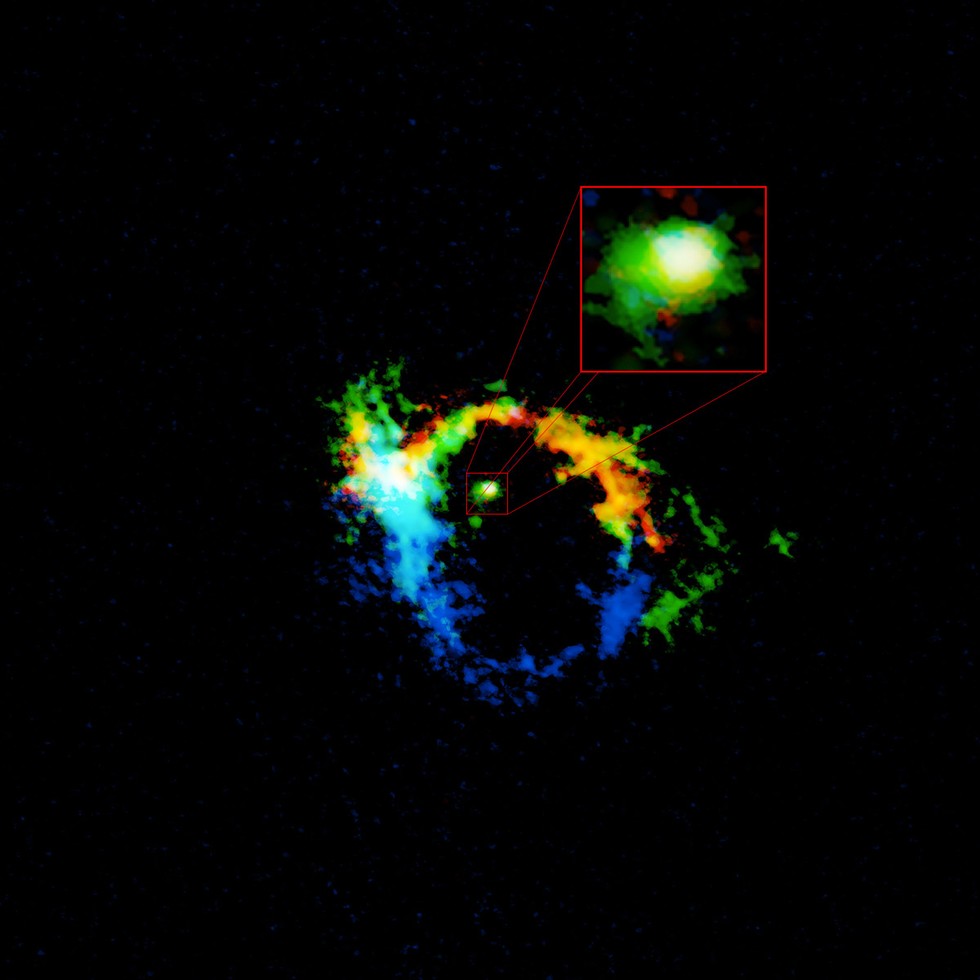
ALMA image of the central region of galaxy NGC 1068. The torus of material harboring the supermassive black hole is highlighted in the pullout box. This region, which is approximately 40 light-years across, is the result of material flung out of the black hole's accretion disk.
While following cool clouds of carbon monoxide gas inside this cooler accretion disk region, Gallimore's team saw the clouds lift off the disk. As they become ionized by the superheated portion of the accretion disk, the clouds started to interact with the black hole's powerful magnetic field. The gas was then flung away from the accretion disk at high speed, far faster than the rotational speed of the disk itself.

"These clouds are traveling so fast that they reach 'escape velocity' and are jettisoned in a cone-like spray from both sides of the disk," said Gallimore. "With ALMA, we can for the first time see that it is the gas that is thrown out that hides the black hole, not the gas falling in."

Read more at Discovery News

Jun 8, 2016

Epic Galactic 'Rainstorm' Feeds Monster Black Hole

It was always assumed that supermassive black holes consumed hot gas slow and steady -- but one black hole is about to binge-eat a massive cold gas dinner.

Supermassive black holes are the most massive objects in the universe and they are known to occupy the cores of most galaxies. They can "weigh in" at millions or even billions of times the mass of our sun, but it's not entirely clear how they came to be so huge.

But after staring deep in the core of the Abell 2597 galaxy cluster, around one billion light-years away, astronomers using the monster Atacama Large Millimeter/submillimeter Array (ALMA) in Chile had a surprise insight to the eating habits of one particular galaxy, wonderfully named "Abell 2597 Brightest Cluster Galaxy."

ALMA's key advantage is that it can detect the emissions emanating from some of the coldest molecular clouds in the universe. These clouds are key to the birth of stars and, in this case, possibly a key component of a supermassive black hole's diet. While observing this particular galaxy, ALMA detected cold and dense molecular clouds condense out of hot intergalactic gas in the galaxy cluster. Then, like an ultra-violent rain storm, the cold gas down-poured onto the black hole.

"This very, very hot gas can quickly cool, condense, and precipitate in much the same way that warm, humid air in Earth's atmosphere can spawn rain clouds and precipitation," said astronomer Grant Tremblay, of Yale University and lead author on a new paper to be published in the journal Nature on June 9. "The newly condensed clouds then rain in on the galaxy, fueling star formation and feeding its supermassive black hole.

"Although it has been a major theoretical prediction in recent years, this is one of the first unambiguous pieces of observational evidence for a chaotic, cold rain feeding a supermassive black hole," he added. "It's exciting to think we might actually be observing this galaxy-spanning rainstorm feeding a black hole whose mass is about 300 million times that of the sun."

The cosmic weather report, as illustrated in this artist's concept, calls for condensing clouds of cold molecular gas around the Abell 2597 Brightest Cluster Galaxy.
Tremblay's team have detected three separate clumps of material, each with a mass of around a million solar masses, measuring tens of light-years across. They are currently speeding toward the black hole at nearly a million kilometers per hour. These particular clouds could only be detected as they are passing in front of the stars in the core of the galaxies, so ALMA was able to gauge their mass and speed by studying the clouds' shadows.

Follow-up observations by the NSF's Very Long Baseline Array have shown that these clouds are very close to the black hole at a distance of only 300 light-years. If these clouds were a hurricane, it would be about to make landfall.

Read more at Discovery News