Showing posts with label Alien Life. Show all posts

Mar 18, 2024

Protein fragments ID two new 'extremophile' microbes--and may help find alien life

Perfectly adapted microorganisms live in extreme environments from deep-sea trenches to mountaintops. Learning more about how these extremophiles survive in hostile conditions could inform scientists about life on Earth and potential life on other planets. In ACS' Journal of Proteome Research, researchers detail a method for more accurate extremophile identification based on protein fragments instead of genetic material. The study identified two new hardy bacteria from high-altitude lakes in Chile -- an environment like early Mars.

Even though humans tend to avoid settling in extremely hot, cold or high-altitude areas, some microorganisms have adapted to live in such harsh locations.

These extremophile microbes are of interest to astrobiologists who are searching for life on other planets.

Researchers currently use individual gene sequencing to identify Earth-bound microbes, based on their DNA.

However, current methods can't distinguish closely related species of extremophiles.

So, Ralf Moeller and colleagues investigated whether they could identify an extremophile by using its protein signature rather than a gene sequence.

The researchers started their demonstration with water samples from five high-altitude Andean lakes more than 2.3 miles above sea level in the Chilean Altiplano.

(For reference, Denver is about one mile above sea level.) From the samples, the researchers cultivated 66 microbes and then determined which of two methods better identified the microorganisms:

  • Traditional gene sequencing compared the nucleotides of the 16s rRNA gene (a typical gene for sequence-based microbe analysis) from each sample to a database for identification.
  • The newer "proteotyping" technique analyzed protein fragments known as peptides to produce peptide signatures, which the team used to identify microorganisms from proteome databases.


With these methods, the researchers identified 63 of the 66 microorganisms that were cultivated from the high-altitude lake samples.

For the three microorganisms that gene sequencing failed to identify because their genetic information wasn't in the available database, proteotyping identified two potentially new types of extremophile bacteria.

These results suggest proteotyping could be a more complete solution for identifying extremophile microorganisms from small biological samples.

The team says protein profiling could someday help us search for and identify extraterrestrial life and better explore the biodiversity on our own planet.

Read more at Science Daily

Oct 25, 2023

Astrophysicists scan the Galaxy for signs of life

Astrophysicists from Trinity College Dublin are scanning the Universe for "technosignatures" emanating from distant planets that would provide support for the existence of intelligent, alien life.

Using the Irish LOFAR telescope and its counterpart in Onsala, Sweden, the team -- led by Professor Evan Keane, Associate Professor of Radio Astronomy in Trinity's School of Physics, and Head of the Irish LOFAR Telescope -- plans to monitor millions of star systems.

Scientists have been searching for extraterrestrial radio signals for well over 60 years. Many of these have been carried out using single observatories which limits the ability to identify signals from the haze of terrestrial interference on Earth. Much of the effort has focused on frequencies above 1 GHz because the single-dish telescopes employed operate at these frequencies.

Now, a new collaboration led by Trinity College Dublin, with the Breakthrough Listen team and Onsala Space Observatory in Sweden, is perfecting a multi-site, multi-telescope technique that allows them to search at much lower frequencies of 110 -- 190 MHz.

The Breakthrough Listen programme is the most comprehensive search for technologically advanced extraterrestrial life, developing dedicated instruments at the Irish and Swedish LOFAR stations. Using multiple sites has the major benefit that it is much less likely to provide a "false positive" signal; such signals arise due to interference from many human sources on Earth.

The team has just published details of their method and their ongoing search in the Astronomical Journal They have already scanned 1.6 million star systems flagged as interesting targets by the Gaia and TESS space missions, run by ESA and NASA respectively. So far these searches have drawn a blank.

But the search has only just begun...

Prof. Keane said: "In the last 50 years evidence has steadily mounted that the constituents and conditions necessary for life are relatively common in the Universe, which begs one of life's greatest unanswered questions: are we really alone?

"To some people the 'Search for Extra-terrestrial Intelligence, or SETI' might seem like something from a movie, but it has been a scientific pursuit for decades, and for a host of very good reasons. With this project we are basing our search on the common assumption that civilisations elsewhere in the Universe may employ similar technologies to those developed on Earth. As a result radio frequencies are a logical domain for conducting SETI surveys due to the widespread use of telecommunications and radar and our access to next-gen radio telescopes offers a great chance for a deep dive into the Universe."

Owen Johnson, PhD Candidate in Trinity's School of Physics, is the first author of the journal article, and the first Irish person to ever undertake a PhD on the topic of SETI. He added:

"What makes surveys like this one truly captivating is the fact that we're pushing these telescopes to their absolute limits, directing them towards substantial portions of the sky. As a result, we have the exciting possibility of discovering all sorts of wild and wondrous phenomena during this process and if we're very fortunate, even encountering our cosmic neighbours.

"LOFAR is soon to undergo a staged series of upgrades across all stations in the array across Europe, which will allow an even broader SETI at ranges of 15 -- 240 MHz. We have billions of star systems to explore and will be relying on some machine learning techniques to sift through the immense volume of data.

Read more at Science Daily

May 24, 2022

Planets of binary stars as possible homes for alien life

Nearly half of Sun-size stars are binary. According to University of Copenhagen research, planetary systems around binary stars may be very different from those around single stars. This points to new targets in the search for extraterrestrial life forms.

Since the only known planet with life, the Earth, orbits the Sun, planetary systems around stars of similar size are obvious targets for astronomers trying to locate extraterrestrial life. Nearly every second star in that category is a binary star. A new result from research at University of Copenhagen indicate that planetary systems are formed in a very different way around binary stars than around single stars such as the Sun.

"The result is exciting since the search for extraterrestrial life will be equipped with several new, extremely powerful instruments within the coming years. This enhances the significance of understanding how planets are formed around different types of stars. Such results may pinpoint places which would be especially interesting to probe for the existence of life," says Professor Jes Kristian Jørgensen, Niels Bohr Institute, University of Copenhagen, heading the project.

The results from the project, which also has participation of astronomers from Taiwan and USA, are published in the journal Nature.

Bursts shape the planetary system

The new discovery has been made based on observations made by the ALMA telescopes in Chile of a young binary star about 1,000 lightyears from Earth. The binary star system, NGC 1333-IRAS2A, is surrounded by a disc consisting of gas and dust. The observations can only provide researchers with a snapshot from a point in the evolution of the binary star system. However, the team has complemented the observations with computer simulations reaching both backwards and forwards in time.

"The observations allow us to zoom in on the stars and study how dust and gas move towards the disc. The simulations will tell us which physics are at play, and how the stars have evolved up till the snapshot we observe, and their future evolution," explains Postdoc Rajika L. Kuruwita, Niels Bohr Institute, second author of the Nature article.

Notably, the movement of gas and dust does not follow a continuous pattern. At some points in time -- typically for relatively shorts periods of ten to one hundred years every thousand years -- the movement becomes very strong. The binary star becomes ten to one hundred times brighter, until it returns to its regular state.

Presumably, the cyclic pattern can be explained by the duality of the binary star. The two stars encircle each other, and at given intervals their joint gravity will affect the surrounding gas and dust disc in a way which causes huge amounts of material to fall towards the star.

"The falling material will trigger a significant heating. The heat will make the star much brighter than usual," says Rajika L. Kuruwita, adding:

"These bursts will tear the gas and dust disc apart. While the disc will build up again, the bursts may still influence the structure of the later planetary system."

Comets carry building blocks for life

The observed stellar system is still too young for planets to have formed. The team hopes to obtain more observational time at ALMA, allowing to investigate the formation of planetary systems.

Not only planets but also comets will be in focus:

"Comets are likely to play a key role in creating possibilities for life to evolve. Comets often have a high content of ice with presence of organic molecules. It can well be imagined that the organic molecules are preserved in comets during epochs where a planet is barren, and that later comet impacts will introduce the molecules to the planet's surface," says Jes Kristian Jørgensen.

Understanding the role of the bursts is important in this context:

"The heating caused by the bursts will trigger evaporation of dust grains and the ice surrounding them. This may alter the chemical composition of the material from which planets are formed."

Thus, chemistry is a part of the research scope:

"The wavelengths covered by ALMA allow us to see quite complex organic molecules, so molecules with 9-12 atoms and containing carbon. Such molecules can be building blocks for more complex molecules which are key to life as we know it. For example, amino acids which have been fund in comets."

Powerful tools join the search for life in space

ALMA (Atacama Large Millimeter/submillimeter Array) is not a single instrument but 66 telescopes operating in coordination. This allows for a much better resolution than could have been obtained by a single telescope.

Very soon the new James Webb Space Telescope (JWST) will join the search for extraterrestrial life. Near the end of the decade, JWST will be complemented by the ELT (European Large Telescope) and the extremely powerful SKA (Square Kilometer Array) both planned to begin observing in 2027. The ELT will with its 39-meter mirror be the biggest optical telescope in the world and will be poised to observe the atmospheric conditions of exoplanets (planets outside the Solar System, ed.). SKA will consist of thousands of telescopes in South Africa and in Australia working in coordination and will have longer wavelengths than ALMA.

Read more at Science Daily

Mar 24, 2022

On Jupiter's moon Europa, 'chaos terrains' could be shuttling oxygen to ocean

Salt water within the icy shell of Jupiter's moon Europa could be transporting oxygen into an ice-covered ocean of liquid water where it could potentially help sustain alien life, according to a team of researchers led by The University of Texas at Austin.

This theory has been proposed by others, but the researchers put it to the test by building the world's first physics-based computer simulation of the process, with oxygen hitching a ride on salt water under the moon's "chaos terrains," landscapes made up of cracks, ridges and ice blocks that cover a quarter of the icy world.

The results show that not only is the transport possible, but that the amount of oxygen brought into Europa's ocean could be on a par with the quantity of oxygen in Earth's oceans today.

"Our research puts this process into the realm of the possible," said lead researcher Marc Hesse, a professor at the UT Jackson School of Geosciences Department of Geological Sciences. "It provides a solution to what is considered one of the outstanding problems of the habitability of the Europa subsurface ocean."

The study was recently published in the journal Geophysical Research Letters.

Europa is a top spot to look for alien life because scientists have detected signs of oxygen and water, along with chemicals that could serve as nutrients. However, the moon's ice shell -- which is estimated to be about 15 miles thick -- serves as a barrier between water and oxygen, which is generated by sunlight and charged particles from Jupiter striking the icy surface.

If life as we know it exists in the ocean, there needs to be a way for oxygen to get to it. According to Hesse, the most plausible scenario based on the available evidence is for the oxygen to be carried by salt water, or brine.

Scientists think that chaos terrains form above regions where Europa's ice shell partially melts to form brine, which can mix with oxygen from the surface. The computer model created by the researchers showed what happens to the brine after the formation of the chaos terrain.

The model showed the brine draining in a distinct manner, taking the form of a "porosity wave" that causes pores in the ice to momentarily widen -- allowing the brine to pass through before sealing back up. Hesse compares the process to the classic cartoon gag of a bulge of water making its way down a garden hose.

This mode of transport appears to be an effective way to bring oxygen through the ice, with 86% of the oxygen taken up at the surface riding the wave all the way to the ocean. But the available data allows for a wide range of oxygen levels delivered to Europa's ocean over its history -- with estimates ranging by a factor of 10,000.

According to co-author Steven Vance, a research scientist at NASA's Jet Propulsion Laboratory (JPL) and the supervisor of its Planetary Interiors and Geophysics Group, the highest estimate would make the oxygen levels in Europa's ocean similar to those in Earth's oceans -- which raises hope about the potential for that oxygen to support life in the hidden sea.

"It's enticing to think of some kind of aerobic organisms living just under the ice," he said.

Vance said that NASA's upcoming 2024 Europa Clipper mission may help improve estimates for oxygen and other ingredients for life on the icy moon.

Kevin Hand, a scientist focused on Europa research at NASA JPL who was not part of the study, said that the study presents a compelling explanation for oxygen transport on Europa.

"We know that Europa has useful compounds like oxygen on its surface, but do those make it down into the ocean below, where life can use them?" he said. "In the work by Hesse and his collaborators, the answer seems to be yes."

Read more at Science Daily

Mar 1, 2022

Scaling laws in enzymes may help predict life ‘as we don’t know it'

The only references we have for "life" are the forms we know on Earth. Astrobiologists suspect that the search for alien life, and even for the origins of life on Earth, may require a broader scope. A NASA-funded team of researchers is developing tools to predict the features of life as we don't know it. In a new study published in the Proceedings of the National Academy of Sciences, the team identifies universal patterns in the chemistry of life that do not appear to depend on specific molecules.

"We want to have new tools for identifying and even predicting features of life as we don't know it," says Santa Fe Institute External Professor Sara Imari Walker (Arizona State University), a co-author on the paper. "To do so, we are aiming to identify the universal laws that should apply to any biochemical system. This includes developing quantitative theory for the origins of life, and using theory and statistics to guide our search for life on other planets."

On Earth, life emerges from the interplay of hundreds of chemical compounds and reactions. Some of these compounds and reactions are found universally across Earth's organisms. Using the Integrated Microbial Genomes and Microbiomes database, the team investigated the enzymes -- the functional drivers of biochemistry -- found in bacteria, archaea, and eukarya to reveal a new kind of biochemical universality.

Enzymes can be categorized into a taxonomy of broad functional classes -- groups designated by what they do, from using water molecules to break chemical bonds (hydrolases) to rearranging molecular structures (isomerases) to joining large molecules together (ligases). The team compared how the abundance of enzymes in each of these functional categories changed in relation to the overall abundance of enzymes in an organism. They discovered various scaling laws -- almost algorithmic relationships -- between the number of enzymes in different enzyme classes and the size of an organism's genome. They also found that these laws don't depend on the particularenzymes in those classes.

"Here we find that you get these scaling relationships without needing to conserve exact membership. You need a certain number of transferases, but not particular transferases," says SFI Professor Chris Kempes, a co-author on the paper. "There are a lot 'synonyms,' and those synonyms scale in systematic ways."

On Earth, organisms use DNA and, through RNA, create proteins. But will the macromolecules of DNA, RNA, and proteins help us identify life across the universe, understand the origins of life on Earth, or develop synthetic biology? "As a team, we think that's not likely," says Kempes. The functions those macromolecules serve, however, and the metabolic scaling relationships observed in organic, Earth-based life, just might be. "Even if life elsewhere used really different molecules, these sort of functional categories and scaling laws might be conserved throughout the universe," says Kempes.

Read more at Science Daily

May 19, 2020

New study estimates the odds of life and intelligence emerging beyond our planet

Alien planet illustration
Humans have been wondering whether we alone in the universe since antiquity.

We know from the geological record that life started relatively quickly, as soon our planet's environment was stable enough to support it. We also know that the first multicellular organism, which eventually produced today's technological civilization, took far longer to evolve, approximately 4 billion years.

But despite knowing when life first appeared on Earth, scientists still do not understand how life occurred, which has important implications for the likelihood of finding life elsewhere in the universe.

In a new paper published in the Proceeding of the National Academy of Sciences today, David Kipping, an assistant professor in Columbia's Department of Astronomy, shows how an analysis using a statistical technique called Bayesian inference could shed light on how complex extraterrestrial life might evolve in alien worlds.

"The rapid emergence of life and the late evolution of humanity, in the context of the timeline of evolution, are certainly suggestive," Kipping said. "But in this study it's possible to actually quantify what the facts tell us."

To conduct his analysis, Kipping used the chronology of the earliest evidence for life and the evolution of humanity. He asked how often we would expect life and intelligence to re-emerge if Earth's history were to repeat, re-running the clock over and over again.

He framed the problem in terms of four possible answers: Life is common and often develops intelligence, life is rare but often develops intelligence, life is common and rarely develops intelligence and, finally, life is rare and rarely develops intelligence.

This method of Bayesian statistical inference -- used to update the probability for a hypothesis as evidence or information becomes available -- states prior beliefs about the system being modeled, which are then combined with data to cast probabilities of outcomes.

"The technique is akin to betting odds," Kipping said. "It encourages the repeated testing of new evidence against your position, in essence a positive feedback loop of refining your estimates of likelihood of an event."

From these four hypotheses, Kipping used Bayesian mathematical formulas to weigh the models against one another. "In Bayesian inference, prior probability distributions always need to be selected," Kipping said. "But a key result here is that when one compares the rare-life versus common-life scenarios, the common-life scenario is always at least nine times more likely than the rare one."

The analysis is based on evidence that life emerged within 300 million years of the formation of the Earth's oceans as found in carbon-13-depleted zircon deposits, a very fast start in the context of Earth's lifetime. Kipping emphasizes that the ratio is at least 9:1 or higher, depending on the true value of how often intelligence develops.

Kipping's conclusion is that if planets with similar conditions and evolutionary time lines to Earth are common, then the analysis suggests that life should have little problem spontaneously emerging on other planets. And what are the odds that these extraterrestrial lives could be complex, differentiated and intelligent? Here, Kipping's inquiry is less assured, finding just 3:2 odds in favor of intelligent life.

This result stems from humanity's relatively late appearance in Earth's habitable window, suggesting that its development was neither an easy nor ensured process. "If we played Earth's history again, the emergence of intelligence is actually somewhat unlikely," he said.

Kipping points out that the odds in the study aren't overwhelming, being quite close to 50:50, and the findings should be treated as no more than a gentle nudge toward a hypothesis.

Read more at Science Daily

Sep 12, 2019

Water detected on an exoplanet located in its star's habitable zone

Exoplanet illustration
Ever since the discovery of the first exoplanet in the 1990s, astronomers have made steady progress towards finding and probing planets located in the habitable zone of their stars, where conditions can lead to the formation of liquid water and the proliferation of life.

Results from the Kepler satellite mission, which discovered nearly 2/3 of all known exoplanets to date, indicate that 5 to 20% of Earths and super-Earths are located in the habitable zone of their stars. However, despite this abundance, probing the conditions and atmospheric properties on any of these habitable zone planets is extremely difficult and has remained elusive... until now.

A new study by Professor Björn Benneke of the Institute for Research on Exoplanets at the Université de Montréal, his doctoral student Caroline Piaulet and several of their collaborators reports the detection of water vapour and perhaps even liquid water clouds in the atmosphere of the planet K2-18b. This exoplanet is about nine times more massive than our Earth and is found in the habitable zone of the star it orbits. This M-type star is smaller and cooler than our Sun, but due to K2-18b's close proximity to its star, the planet receives almost the same total amount of energy from its star as our Earth receives from the Sun.

The similarities between the exoplanet K2-18b and the Earth suggest to astronomers that the exoplanet may potentially have a water cycle possibly allowing water to condense into clouds and liquid water rain to fall. This detection was made possible by combining eight transit observations -- the moment when an exoplanet passes in front of its star -- taken by the Hubble Space Telescope.

The Université de Montréal is no stranger to the K2-18 system located 111 light years away. The existence of K2-18b was first confirmed by Prof. Benneke and his team in a 2016 paper using data from the Spitzer Space Telescope. The mass and radius of the planet were then determined by former Université de Montréal and University of Toronto PhD student Ryan Cloutier. These promising initial results encouraged the iREx team to collect follow-up observations of the intriguing world."

Scientists currently believe that the thick gaseous envelope of K2-18b likely prevents life as we know it from existing on the planet's surface. However, the study shows that even these planets of relatively low mass which are therefore more difficult to study can be explored using astronomical instruments developed in recent years. By studying these planets which are in the habitable zone of their star and have the right conditions for liquid water, astronomers are one step closer to directly detecting signs of life beyond our Solar System.

Read more at Science Daily

Oct 2, 2018

New tool helps scientists better target the search for alien life

Schematic view of the Milky Way showing six isotropic extraterrestrial emission processes forming spherical shells filled by radio signals. The outer radii of the spherical shells are proportional to the time at which the signals were first emitted, while the thicknesses are proportional to the duration of the emissions. In this example, the Earth is illuminated by one of these signals.
Could there be another planet out there with a society at the same stage of technological advancement as ours? To help find out, EPFL scientist Claudio Grimaldi, working in association with the University of California, Berkeley, has developed a statistical model that gives researchers a new tool in the search for the kind of signals that an extraterrestrial society might emit. His method -- described in an article appearing today in Proceedings of the National Academy of Sciences -- could also make the search cheaper and more efficient.

Atrophysics initially wasn't Grimaldi's thing; he was interested more in the physics of condensed matter. Working at EPFL's Laboratory of Physics of Complex Matter, his research involved calculating the probabilities of carbon nanotubes exchanging electrons. But then he wondered: if the nanotubes were stars and the electrons were signals generated by extraterrestrial societies, could we calculate the probability of detecting those signals more accurately?

This is not pie-in-the-sky research -- scientists have been studying this possibility for nearly 60 years. Several research projects concerning the search for extraterrestrial intelligence (SETI) have been launched since the late 1950s, mainly in the United States. The idea is that an advanced civilization on another planet could be generating electromagnetic signals, and scientists on Earth might be able to pick up those signals using the latest high-performance radio telescopes.

Renewed interest

Despite considerable advances in radio astronomy and the increase in computing power since then, none of those projects has led to anything concrete. Some signals without identifiable origin have well been recorded, like the Wow! signal in 1977, but none of them has been repeated or seems credible enough to be attributable to alien life.

But that doesn't mean scientists have given up. On the contrary, SETI has seen renewed interest following the discovery of the many exoplanets orbiting the billions of suns in our galaxy. Researchers have designed sophisticated new instruments -- like the Square Kilometre Array, a giant radio telescope being built in South Africa and Australia with a total collecting area of one square kilometer -- that could pave the way to promising breakthroughs. And Russian entrepreneur Yuri Milner recently announced an ambitious program called Breakthrough Listen, which aims to cover 10 times more sky than previous searches and scan a much wider band of frequencies. Milner intends to fund his initiative with 100 million dollars over 10 years.

"In reality, expanding the search to these magnitudes only increases our chances of finding something by very little. And if we still don't detect any signals, we can't necessarily conclude with much more certainty that there is no life out there," says Grimaldi.

Still a ways to go

The advantage of Grimaldi's statistical model is that it lets scientists interpret both the success and failure to detect signals at varying distances from Earth. His model employs Bayes' theorem to calculate the remaining probability of detecting a signal within a given radius around our planet.

For example, even if no signal is detected within a radius of 1,000 light years, there is still an over 10% chance that Earth is within range of hundreds of similar signals from elsewhere in the galaxy, but that our radio telescopes are currently not powerful enough to detect them. However, that probability rises to nearly 100% if even just one signal is detected within the 1,000-light-year radius. In that case, we could be almost certain that our galaxy is full of alien life.

After factoring in other parameters like the size of the galaxy and how closely packed its stars are, Grimaldi estimates that the probability of detecting a signal becomes very slight only at a radius of 40,000 light years. In other words, if no signals are detected at this distance from Earth, we could reasonably conclude that no other civilization at the same level of technological development as ours is detectable in the galaxy. But so far, scientists have been able to search for signals within a radius of "just" 40 light years.

Read more at Science Daily

Sep 28, 2018

Where are they? Cosmologists search Andromeda for signs of alien life

"Are we alone in the universe?" The question has fascinated, tantalized and even disconcerted humans for as long as we can remember.

So far, it would seem that intelligent extraterrestrial life -- at least as fits our narrow definition of it -- is nowhere to be found. Theories and assumptions abound as to why we have neither made contact with nor seen evidence of advanced extraterrestrial civilizations despite decades-long efforts to make our presence known and to communicate with them.

Meanwhile, a steady stream of discoveries are demonstrating the presence of Earth analogues -- planets that, like our own, exist at a "Goldilocks zone" distance from their own respective stars, in which conditions are "just right" for liquid water (and thus life) to exist. Perhaps even more mind-blowing is the idea that there are, on average, as many planets as there are stars.

"That is, I think, one of the amazing discoveries of the last century or so -- that planets are common," said Philip Lubin, an experimental cosmologist and professor of physics at UC Santa Barbara. Given that, and the assumption that planets provide the conditions for life, the question for Lubin's group has become: Are we looking hard enough for these extraterrestrials?

That is the driver behind the Trillion Planet Survey, a project of Lubin's student researchers. The ambitious experiment, run almost entirely by students, uses a suite of telescopes near and far aimed at the nearby galaxy of Andromeda as well as other galaxies including our own, a "pipeline" of software to process images and a little bit of game theory.

"First and foremost, we are assuming there is a civilization out there of similar or higher class than ours trying to broadcast their presence using an optical beam, perhaps of the 'directed energy' arrayed-type currently being developed here on Earth," said lead researcher Andrew Stewart, who is a student at Emory University and a member of Lubin's group. "Second, we assume the transmission wavelength of this beam to be one that we can detect. Lastly, we assume that this beacon has been left on long enough for the light to be detected by us. If these requirements are met and the extraterrestrial intelligence's beam power and diameter are consistent with an Earth-type civilization class, our system will detect this signal."

From Radio Waves to Light Waves

For the last half-century, the dominant broadcast from Earth has taken the form of radio, TV and radar signals, and seekers of alien life, such as the scientists at the Search for Extraterrestrial Intelligence (SETI) Institute, have been using powerful radio telescopes to look for those signals from other civilizations. Recently however, and thanks to the exponentially accelerating progress of photonic technology, optical and infrared wavelengths are offering opportunities to search via optical signals that allow for vastly longer range detection for comparable systems.

In a paper published in 2016 called "The Search for Directed Intelligence" or SDI, Lubin outlined the fundamental detection and game theory of a "blind-blind" system where neither we, nor the extraterrestrial civilization are aware of each other but wish to find each other. That paper was based on the application of photonics developed at UC Santa Barbara in Lubin's group for the propulsion of small spacecraft through space at relativistic speeds (i.e. a significant fraction of the speed of light) to enable the first interstellar missions. That ongoing project is funded by NASA's Starlight and billionaire Yuri Milner's Breakthrough Starshot programs, both of which use the technology developed at UCSB. The 2016 paper shows that the technology we are developing today would be the brightest light in the universe and thus capable of being seen across the entire universe.

Of course, not everyone is comfortable with advertising our presence to other, potentially advanced, extraterrestrial civilizations.

"Broadcasting our presence to the universe, believe it or not, turns out to be a very controversial topic," Stewart said, citing bureaucratic issues that arise whenever beaconing is discussed, as well as the difficulty in obtaining the necessary technology of the scale required. Consequently, only a few, tentative signals have ever been sent in a directed fashion, including the famous Voyager 1 probe with its message-in-a-bottle-like golden record.

Tipping the concept on its head, the researchers asked, 'What if there are other civilizations out there that are less shy about broadcasting their presence?'

"At the moment, we're assuming that they're not using gravity waves or neutrinos or something that's very difficult for us to detect," Lubin said. But optical signals could be detected by small (meter class) diameter telescopes such as those at the Las Cumbres Observatory's robotically controlled global network.

"In no way are we suggesting that radio SETI should be abandoned in favor of optical SETI," Stewart added. "We just think the optical bands should be explored as well."

Searching the Stars

"We're in the process of surveying (Andromeda) right now and getting what's called 'the pipeline' up and running," said researcher Alex Polanski, a UC Santa Barbara undergraduate in Lubin's group. A set of photos taken by the telescopes, each of which takes a 1/30th slice of Andromeda, will be knit together to create a single image, he explained. That one photograph will then be compared to a more pristine image in which there are no known transient signals -- interfering signals from, say, satellites or spacecraft -- in addition to the optical signals emanating from the stellar systems themselves. The survey photo would be expected to have the same signal values as the pristine "control" photo, leading to a difference of zero. But a difference greater than zero could indicate a transient signal source, Polanski explained. Those transient signals would then be further processed in the software pipeline developed by Stewart to kick out false positives. In the future the team plans to use simultaneous multiple color imaging to will help remove false positives as well.

"One of the things the software checks for is, say, a satellite that did go through our image," said Kyle Friedman, a senior from Granada Hills High School in Los Angeles, who is conducting research in Lubin's group. "It wouldn't be small; it would be pretty big, and if that were to happen the software would immediately recognize it and throw out that image before we actually even process it."

Other vagaries, according to the researchers, include sky conditions, which is why it's important to have several telescopes monitoring Andromeda during their data run.

Thanks to the efforts of Santa Barbara-based computer engineer Kelley Winters and the guidance of Lubin group project scientist Jatila van der Veen, the data is in good hands. Winters' cloud-based Linux server provides a flexible, highly connected platform for the data pipeline software to perform its image analysis, while van der Veen will apply her digital image processing expertise to bring this project to future experimental cosmologists.

For Laguna Blanca School senior and future physicist Caitlin Gainey, who joins the UCSB physics freshman class this year, the project is a unique opportunity.

"In the Trillion Planet Survey especially, we experience something very inspiring: We have the opportunity to look out of our earthly bubble at entire galaxies, which could potentially have other beings looking right back at us," she said. "The mere possibility of extraterrestrial intelligence is something very new and incredibly intriguing, so I'm excited to really delve into the search this coming year."

The search, for any SETI-watcher, is an exercise in patience and optimism. Andromeda is 2.5 million light-years away, van der Veen pointed out, so any signal detected now would have been sent at least 2.5 million years ago -- more than long enough for the civilization that sent it to have died out by the time the light reaches us.

"That does not mean we should not look," van der Veen said. "After all, we look for archaeological relics and fossils, which tell us about the history of Earth. Finding ancient signals will definitely give us information about the history of evolution of life in the cosmos, and that would be amazing."

While the data run and processing time for this particular project could occur in a span of weeks, according to the researchers this sequence could be repeated indefinitely. Theoretically, like all the sunrise and sunset watchers, and stargazers before us, we could look at the sky forever.

"I think if you were to take someone outside and you were to point at some random star in the night sky and see that is where life is, I think you would be hard pressed to find anyone who would not look at that star and just feel something very deep within themselves," Polanski said. "Some very deep connection to whatever is up there or some kind of solace, I think, knowing that we're not alone."

Read more at Science Daily

Feb 16, 2018

Soft tissue fossil clues could help search for ancient life on Earth and other planets

The fossil Waptia from the Burgess Shale, Canada. New Oxford University research suggests that the mineralogy of the surrounding earth is key to conserving soft parts of organisms, and finding more exceptional fossils like the Waptia.
Fossils that preserve entire organisms (including both hard and soft body parts) are critical to our understanding of evolution and ancient life on Earth. However, these exceptional deposits are extremely rare. The fossil record is heavily biased towards the preservation of harder parts of organisms, such as shells, teeth and bones, as soft parts such as internal organs, eyes, or even completely soft organisms, like worms, tend to decay before they can be fossilised. Little is known about the environmental conditions which stop this process soon enough for the organism to be fossilised.

New Oxford University research suggests that the mineralogy of the surrounding earth is key to conserving soft parts of organisms, and finding more exceptional fossils. Part-funded by NASA, the work could potentially support the Mars Rover Curiosity in its sample analysis, and speed up the search for traces of life on other planets.

Perhaps the most iconic of all exceptional fossil deposits is the Burgess Shale of Canada, popularised by Stephen J. Gould's Wonderful Life. Dating to around 500 million years ago, the deposit preserves exceptional fossils from the Cambrian Explosion, an event which saw the rapid diversification of early animal life from simpler single-celled ancestors. Burgess Shale-type fossil localities are now known across the globe and without them roughly 80% of Cambrian organisms (those that have no hard skeleton or shell) would be unknown, distorting our picture of early animal evolution.

Published in Geology, the study, conducted by researchers from Oxford's Department of Earth Sciences, Yale University, and Pomona College, builds on their previous research which revealed that certain clay minerals are toxic to bacteria that decay marine animals. This time around, the team set out to find geological evidence that rocks composed of the same clay minerals are the hosts of Burgess Shale-type fossils.

The team examined more than 200 Cambrian rock samples using powder X-ray diffraction analysis to determine their mineralogical composition, comparing rocks with Burgess Shale-type fossils with those with only fossilised shells and bones. Nicholas Tosca, Associate Professor of Sedimentary Geology at Oxford, said: 'The number of samples required for this study was made possible because the diffractometer at Oxford collects mineralogical data 250 times faster than a conventional instrument.'

The findings reveals that soft tissue fossils are generally found in rocks rich in the mineral berthierine, one of the main clay minerals identified by the previous study as being toxic to decay bacteria. Ross Anderson, lead author and fellow at All Souls College, Oxford, explains: 'Berthierine is an interesting mineral because it forms in tropical settings when the sediments contain elevated concentrations of iron. This means that Burgess Shale-type fossils are likely confined to rocks which were formed at tropical latitudes and which come from locations or time periods that have enhanced iron. This observation is exciting because it means for the first time we can more accurately interpret the geographic and temporal distribution of these iconic fossils, crucial if we want to understand their biology and ecology.'

The study provides a mineralogical signature which can be used to find the more elusive sites that are home to these extraordinary fossils. 'The mineralogical associations we identified mean that for a given Cambrian sedimentary mudrock we can predict with around 80% accuracy whether it is likely to contain Burgess Shale-type fossils,' explains Anderson.

Of the project's wider applications, potentially supporting the search for life beyond our own planet, Anderson adds: 'For the vast majority of Earth's history, life has not possessed hard shells or skeletons. This means that if we want to look for fossil evidence of life on other planets like Mars, the chances are we probably need to find fossils of entirely soft organisms, and Burgess Shale-type fossilisation provides a way. NASA's Curiosity rover has the ability to record mineralogy on the Martian surface, so it could potentially look for the types of rocks which might be most conducive to preserving these fossils.'

Read more at Science Daily

Jul 31, 2017

Finding Life on Other Planets May Be Less Likely Than Scientists Thought

A hand out image made available by the European Southern Observatory on August 24 2016, shows an artist's impression of a view of the surface of the planet Proxima b orbiting the red dwarf star Proxima Centauri, the closest star to the Solar System. The double star Alpha Centauri AB also appears in the image to the upper-right of Proxima itself. Proxima b is a little more massive than the Earth and orbits in the habitable zone around Proxima Centauri, where the temperature is suitable for liquid water to exist on its surface. Scientists on August 24, 2016 announced the discovery of an Earth-sized planet orbiting the star nearest our Sun, opening up the glittering prospect of a habitable world that may one day be explored by robots. Named Proxima b, the planet is in a 'temperate' zone compatible with the presence of liquid water -- a key ingredient for life.
Scientists dealt a blow Monday to the quest for organisms inhabiting worlds besides Earth, saying our planet was unusual in its ability to host liquid water — the key ingredient for life.

It was thought likely that distant worlds orbiting stars similar to our Sun would go through water-rich phases.

This would happen when the young, dim star of an icy, lifeless planet — such as early Earth — starts warming, becomes Sun-like, and melts the ice on planets orbiting it at just the right distance — the so-called "Goldilocks" zone.

Icy orbs in our own Solar System, including Jupiter's moon Europa and Saturn's Enceladus, or "exoplanets" in other star systems, may become habitable in this way, the theory goes.

But a team wrote in the journal Nature Geoscience on Monday that this was unlikelier than had been imagined.

Jun Yang of Peking University in China and a team used climate models to simulate the evolution of icy planets.

Without atmospheric greenhouse gases — a feature of Earth — the energy required to thaw an icy planet would be so high that it would transit from frozen to inferno without an intermediate, liveable phase, they found.

"We find that the stellar fluxes that are required to overcome a planet’s initial snowball state are so large that they lead to significant water loss and preclude a habitable planet," the team wrote.

Some icy bodies, they suggested, may therefore never pass through a habitable Earth-like state.

Among these, Europa and Enceladus will likely morph from iceballs into fireballs by the time the Sun reaches it's super-hot red giant phase heat in billions of years from now, said the team.

Earth was an example of an icy world that thawed just enough, some 600-800 million years ago, thanks to planet-warming atmospheric greenhouse gases emitted by volcanic eruptions during its snowball phase, the team said.

This meant that less solar heat would have been required for the ice to melt, enabling our planet to achieve a temperate middle ground.

Greenhouse gases, which are naturally present in the atmosphere but also released by humans burning coal, oil, and gas, are what has kept our planet warm enough for humans, animals, and plants to inhabit.

Read more at Seeker

Jul 27, 2017

DNA Analysis Reveals Why ‘Water Bears’ Are the World’s Toughest Animal

Scanning electron microscope image of Ramazzottius varieornatus
Tardigrades, also known as water bears, are less than a fraction of an inch in length, yet they are believed to be Earth’s toughest, hardiest animals. They are virtually indestructible. Tardigrades have the ability to withstand complete dehydration. Once desiccated, they have been frozen in blocks of ice, exposed to radiation, and sent into the vacuum of space, and yet they still usually spring back to life when water becomes available again.

New genetic research, published in the journal PLOS Biology, reveals how tardigrades achieve such resurrections after drying to a crisp. The authors now even believe that alien life forms could possess this remarkable ability.

“If life exists on other planets, and it is water-based, then those organisms that live out of water will evolve to resist extreme events, including the threat of drying out,” said co-author Mark Blaxter of the University of Edinburgh’s Institute of Evolutionary Biology.

He added that the ability to undergo anhydrobiosis — the desiccated, dormant state — “has evolved multiple times on Earth, so I am sure it will have evolved on other living planets.”

Blaxter and his colleagues took a clever approach to unravel the scientific secrets behind anhydrobiosis in tardigrades.

Muscles of the tardigrade H. dujardini labeled with a fluorescent stain. Each muscle is a single cell.
The scientists re-sequenced and reassembled the genome of Hypsibius dujardini, a tardigrade that can only undergo desiccation after extensive pre-exposure to drying conditions. They then compared the tiny animal’s DNA with that of Ramazzottius varieornatus, a related species with tolerance to rapid desiccation.

The researchers then looked at a particular set of genes, the so-called HOX genes, which establish the nose-to-tail pattern in embryos. There are usually about ten different HOX genes in animals, but tardigrades are missing five. Nematodes (roundworms) lack these same five genes.

“This could be because they share a common ancestor with tardigrades, and the loss happened in this ancestor,” Blaxter said. “Alternatively, it could be that the loss is associated with both groups becoming miniaturized, and these ‘middle’ HOX genes are the ones that are the easiest to lose.”

He added that the shared genetic loss could also simply be due to independent evolution. Because of these remaining questions, scientists continue to debate whether or not tardigrades are more closely related to nematodes or to arthropods — insects, spiders, and crustaceans.

Underside of a tardigrade, showing its claws.
By asking which genes were turned on during tardigrade anhydrobiosis, the scientists could identify sets of proteins, which appear to replace the water that tardigrade cells lose, thus helping to preserve the microscopic structures until water is available again.

Arakawa explained that all cells contain around 60–80 percent water when they are active, including human cells.

The key proteins that they identified are highly soluble. They dissolve in water that, due to surface tension, clings to and surrounds intracellular molecules within tardigrades. Like a microscopic protective coating, they prevent the cells from denaturing when the animal otherwise desiccates. 

Arakawa added that tardigrades also possess additional genes that protect their DNA from damage. Because these small animals lack stress-sensing pathways, their cells do not usually die out when damaged. Instead, the identified proteins try to make repairs, and are often successful in doing so.

Due to these abilities, scientific consensus holds that tardigrades could be Earth’s last survivors. Such resilience is unexpected in a tiny creature that seems to exist in the slow lane.

“Tardigrades are slow walkers, and are not really aggressive animals,” Arakawa explained. “Therefore, they tend to lose competitions for food, or can become prey in a diversified ecosystem. But tardigrades fled to their own niche, where only tardigrades can survive, so paradoxically, tardigrades presumably acquired their extreme survival abilities due to their ecological incompetence.”

Arakawa and his colleagues can envision a day when enzymes, vaccines, human organs, tissues, and cells could be preserved in a state of anhydrobiosis instead of by liquid-nitrogen-based freezing.

“Some people have suggested that tardigrades could somehow travel through space to seed other planets with Earth-derived life,” Baxter said. “That obviously didn’t happen on Earth, as only some tardigrades are able to do anhydrobiosis, and tardigrades are derived from other, more ancient forms.”

Read more at Seeker

Jul 25, 2017

Detecting Alien Life Will Likely Be a Protracted Process, Not a Eureka Moment

Would it be easy to determine if the source of a mysterious radio signal was aliens? Probably not. A new paper argues that contact with extraterrestrials will likely be discovered through a prolonged, incremental process rather than an instantaneous eureka-like moment. Eureka — what the ancient Greek mathematician Archimedes allegedly said when he cracked a tough science problem about water displacement — tends to be the exception in science rather than the rule.

Attributing scientific progress to eureka moments is popular because it is easy to understand, argues Milan Cirkovic, a senior research associate at the Astronomical Observatory of Belgrade and an assistant physics professor at the University of Novi Sad in Serbia and Montenegro. But, he writes in the journal Space Policy, "It puts too big an emphasis on the 'origin myths' and the role of great personalities, key moments, events, and circumstances in any historical process.”

Cirkovic said in an email that the community involved in the search for extraterrestrial intelligence (SETI) should instead be prepared for a process that would take a very long time. It may take decades as the SETI community looks at all the reasons aliens might not be the source of a mysterious signal.

"I have only tried to point out that both history of science and logic and common sense suggest — on a descriptive level — that contact will be a protracted affair, probably not recognizable as such over timescales of years or decades," Cirkovic said. He was careful not to say how contact might proceed, but that it would take a long time and repeated observations.

Think about the protracted debate concerning "Tabby's star," which is showing strange brightening and dimming. Some say it's due to a possible "alien megastructure," while others are pointing to various natural processes, such as exocomets.

"More structure is obviously necessary, as far as signals are concerned," Cirkovic said. "The example often quoted (first due to Nikola Tesla, who was somewhat forgotten as a SETI pioneer) is the presence of prime numbers 2, 3, 5, 7, 11, ... etc. in the signal."

Prime numbers are a non-natural process that are considered by SETI scholars an indication of possible life.

"However," Cirkovic added, "this is the classic understanding of the first contact which I actually intend to undermine in the present paper. I argue — after some of the SETI ‘founding fathers,’ notably Nikolai Kardashev — that we are more likely to detect an anomalous astrophysical phenomenon, which would be a signpost of massive engineering effort by extraterrestrial intelligence.”

He added that in recent years the SETI community has said it expects contact to come through detecting one of these engineering signatures rather than through a radio signal. Cirkovic and some other experts call this "Dysonian SETI", after a 2011 paper that Cirkovic co-authored and was led by Robert Bradbury of the Astronomical Observatory of Belgrade.

Read more at Seeker

Jul 11, 2017

Finding Extraterrestrial Life May Rely on Identifying Traces Rather Than Aliens

The surface of Mars.
When the famous 15th-century inventor and scientist Leonardo da Vinci examined petrified shells with borings in them long ago, he had a remarkable insight. The strange fossilized formations, he determined, were likely left behind by ancient organisms.

Half a millennium later, this perspective is potentially useful in our search for alien life, argues a new paper that appears in Earth-Science Reviews, whose findings were recently presented at the European Astrobiology Network Association congress in the Netherlands.

Astronomers have been weighing options for how to identify the existence of life on other planets and moons in our solar system. There are a range of possibilities. Mars could be host to ancient or current life, depending on how much water flows on the surface and how salty it is. There are also many icy moons (some with water geysers) in the outer regions of our solar system — among them Saturn’s Titan and Enceladus, and Jupiter’s Europa and Ganymede.

“Leonardo understood the biological nature of borings based on their shape, not their biochemistry,” said Andrea Baucon, the lead researcher. Baucon is an ichnologist, a type of scientist that studies life’s traces through burrows, borings and trails. He previously studied da Vinci’s work and is a researcher at the University of Modena and UNESCO Geopark Naturtejo.

“This observation appears to be trivial,” he went on, “but it potentially allows [us] to detect extra-terrestrial life that differs from known life.”

A major limitation of this kind of study, however, is that animal traces and alterations by geology can sometimes appear very similar. For example, researchers have identified what they say are more than four-billion-year-old fossils in formations in northern Quebec, Canada. This finding was announced earlier this year; in 2016, a separate team claimed to find 3.7-billion-year-old microbial mats in Greenland.

But given that the Earth is about 4.5 billion years old, critics of these discoveries argue, the changes in Earth’s geology over billions of years can sometimes mimic the appearances of lifeforms. Microbiologists therefore need to prove that the older lifeforms did indeed exist by comparing the older fossils to much younger and better-verified examples of life. Researchers must also attempt to verify markings by life against the chemistry in the rocks, although again this can be altered by rock deformation over time.

Baucon is a member of ROSAE, an Italian acronym that in English stands for Organism-Sediment Relationships in Extreme Environments. It’s a scientific project that looks at how organisms and sediments interact in so-called “extreme environments,” such as the deep sea.

In this latest study, Baucon and his colleagues attempt to explain the best way to find extra-terrestrial traces. One method could be looking for “meandering” trails and burrows, which is an efficient way for microorganisms to look for food. Rather than making straight lines in an environment or repeatedly crossing a surface, the meandering allows a creature to search for food without exerting too much energy.

Read more at Seeker

May 16, 2017

‘Styrofoam’ Planet Discovery Will Help Us Find Habitable Planets and Alien Life

An artist's rendering of KELT-11b, an exoplanet with Styrofoam-like density.
Since the largest exoplanets are the easiest to spot and study, it makes sense that distant worlds with large “puffy” atmospheres would provide the best and most abundant information about the envelope of gases surrounding these faraway planets. But the challenge comes in finding planets with such large atmospheres. 

Enter KELT-11b. 

According to researchers at Lehigh University, KELT-11b has by far the largest atmospheric scale height of any ever studied, including our own solar system. Scale height describes the height at which an atmosphere “hugs” a planet, and while the scale height of Saturn’s atmosphere is about 60 km (37 miles) and Earth’s is about 8 km (5 miles), KELT-11b’s is a whopping 2,763 km (1,716 miles).

And the oddities of KELT-11b don’t stop there. The planet itself is one of the most puffy and inflated planets in the known universe, with the density of a Styrofoam ball — the kind that students use to simulate planetary bodies in classroom presentations.

“It is highly inflated, so that while it's only a fifth as massive as Jupiter, it is nearly 40 percent larger, making it about as dense as Styrofoam, with an extraordinarily large atmosphere,” said Joshua Pepper, astronomer and assistant professor of physics at Lehigh University, who led the study. 

Pepper called KELT-11b an “extreme” version of a gas planet. It is orbiting very close to its host star, circling it in less than five days. The star, KELT-11, has started using up its nuclear fuel and is evolving into a red giant, so the planet will eventually be engulfed by its star and not survive the next hundred million years.

But this star is extremely bright — the brightest known transiting exoplanet host that can be seen from the southern hemisphere — and is the sixth brightest transit host to date. Such a bright star allows for precise measurements of the planet's atmosphere.

The team wrote in their paper that all “these attributes make the KELT-11 system a valuable target for follow-up and atmospheric characterization and it promises to become one of the benchmark systems for the study of inflated exoplanets.”

Pepper also said that KELT-11b is “an excellent testbed for measuring the atmospheres of other planets,” and that it will help astronomers develop the best tools to see the types of gases in atmospheres, specifically for assessing habitability or possible life on distant exoplanets.

“We don't know of any real Earth-like planets or stars for which we can measure their atmospheres, though we expect to discover more in future years,” Pepper said. “These [giant gas] planets are the gold standards or testbeds for learning how to measure the atmospheres of planets.”

Another unique aspect of this exoplanet is that it was found with the help of citizen scientists. In fact, 40 amateur scientists from 10 countries contributed directly to the discovery of KELT-11b and are listed as co-authors on the paper.

The KELT (Kilodegree Extremely Little Telescope) survey uses two small robotic telescopes in Arizona and in South Africa. The telescopes scan the sky every night, measuring the brightness of about five million stars. Like the exoplanet-finding “champion,” the Kepler space telescope, KELT looks for stars that seem to dim slightly at regular intervals, which can indicate a planet is orbiting that star and eclipsing it, called a transit.

But most of the planets found by Kepler orbit faint stars, making it difficult to measure the planets' properties precisely.

“The KELT project is specifically designed to discover a few scientifically valuable planets orbiting very bright stars, and KELT-11b is a prime example of that,” Pepper said.

KELT specifically looks for gas giant planets orbiting bright stars, but the team didn’t expect to find planets with such low mass and large sizes.

 ”We were very surprised by the amazingly low density of this planet,” Pepper said. “It's extremely big for its mass. It's got a fifth of the mass of Jupiter but is puffed up into this really underdense planet.”

They hope that further study of this world by the Hubble and Spitzer space telescopes will provide additional information about the mechanism that causes inflated planets.

Read more at Discovery News

Feb 22, 2017

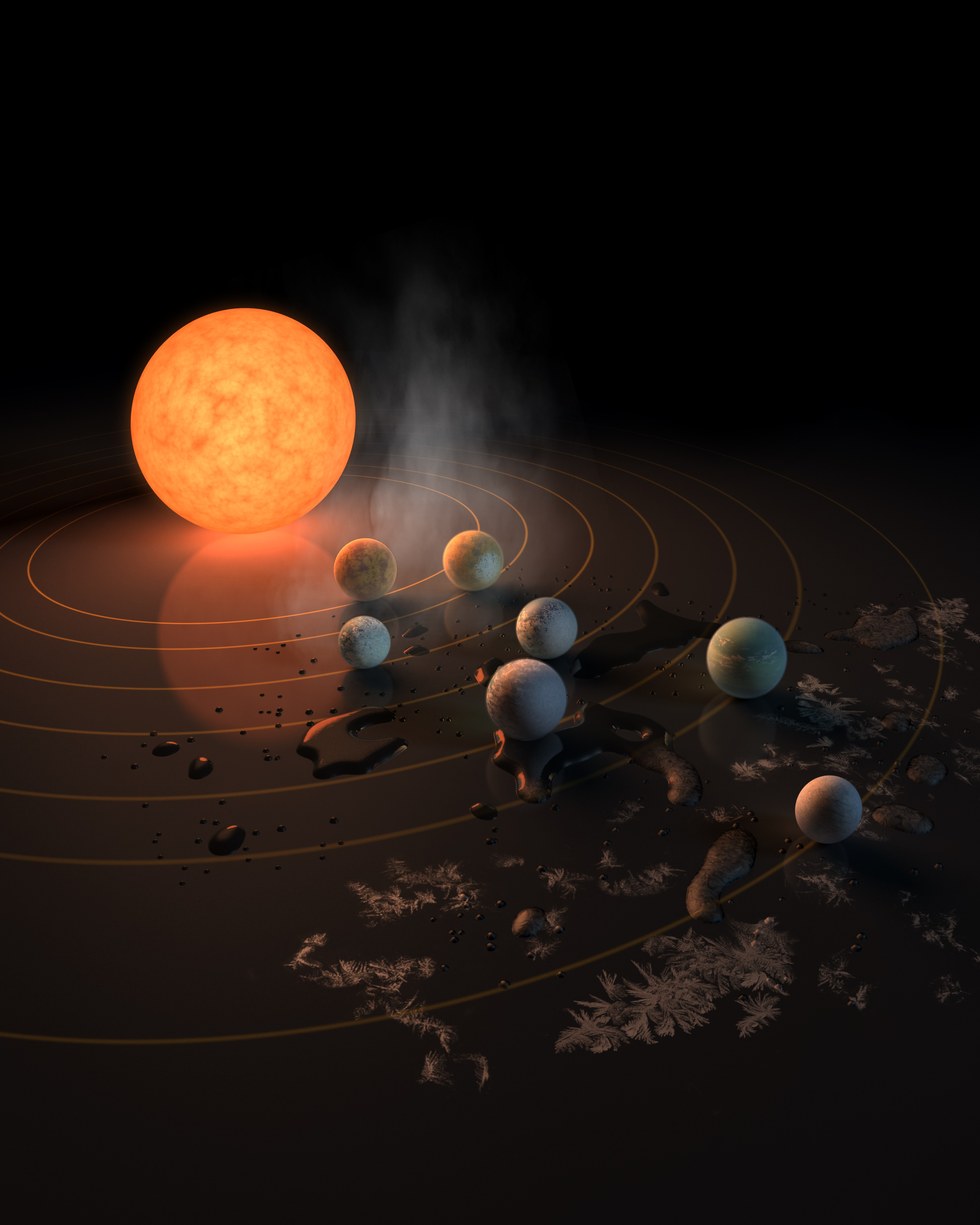
A Nearby Star Has 7 Earth-Sized Planets — and 3 Could Be Habitable

A little star located a neighborly 40 light-years away has at least seven planets in its clutches, all about the size of Earth.

Three of the seven planets orbit in the star's so-called "habitable zone," where temperatures are suitable for water, if any exists, to pool on their surfaces.

"They could have some liquid water and maybe life," said lead researcher Michael Gillon, with the University of Liege in Belgium.

The discovery, reported Wednesday in the journal Nature, puts the planets orbiting the star TRAPPIST-1 at the top of astronomers' list of places to look for life beyond the solar system.

"I think that we've made a crucial step towards finding if there is life out there. I don't think that before we had the right planets to discover… if there was [life]. Here, if life managed to thrive and releases gases similar to that that we have on Earth, then we will know," said University of Cambridge astronomer Amaury Triaud.

Scanning the planets for methane, water, ozone and other chemicals tied to life will take another generation of telescopes, including the James Webb Space Telescope, which is scheduled to launch next year.

Scientists reported last year that TRAPPIST-1 had three planets in orbit. Follow-up studies with ground telescopes and NASA's infrared Spitzer space telescope revealed at least four more sister words, all orbiting closer to their parent star than Mercury orbits the sun.

"It would be really fun if there were more," Triaud wrote in an email to Seeker.

In a related essay in Nature, astronomer Ignas Snellen, with Leiden Observatory in The Netherlands, noted that even if the TRAPPIST-1 planets are lifeless now, they have lots of time for it to evolve.

"In a few billion years, when the Sun has run out of fuel and the solar system has ceased to exist, TRAPPIST-1 will still be only an infant star. It burns hydrogen so slowly that it will live for another 10 trillion years more than 700 times longer than the Universe has existed so far, which is arguably enough time for life to evolve," Snellen wrote.

Read more at Discovery News

Feb 16, 2017

Organic Material Discovery Suggests Life Could Exist on Dwarf Planet Ceres

Scientists looking for life beyond Earth have a new target relatively close to home.

The dwarf planet Ceres, which orbits in the Main Asteroid Belt between Mars and Jupiter, has organic compounds on its surface, a paper published in this week's Science shows.

The discovery, made with NASA's orbiting Dawn spacecraft, follows earlier findings that the 590-mile wide Ceres may have an ocean beneath its frozen surface.

"There are speculations about a subsurface ocean on Ceres, similar to Europa or Enceladus," planetary scientist Michael Kuppers, with the European Space Astronomy Center in Madrid, told Seeker.

Europa, a moon of Jupiter, and Enceladus, a moon circling Saturn, are two prime targets in the search for life beyond Earth.

"I do think Ceres is a good target for searches for life outside Earth," Kuppers said. "In addition to distance, the radiation environment is more benign than, for example, Europa."

Dawn lead scientist Christopher Russell, with the University of California Los Angeles, said the discovery means that Ceres should be further explored, but noted that these organic molecules "are a long way from microbial life."

"Ceres should be relatively easy to land on and has a benign environment compared to bodies further out in the solar system," Russell wrote in an email to Seeker. "We could take a small chemical lab to Ceres and analyze its soil and exosphere."

Data collected by Dawn's visible and near-infrared imaging spectrometer showed the organic material matches tar-like compounds such as kerite or asphalitite, lead researcher Maria Cristina De Sanctis, with the National Institute for Astrophysics in Rome, Italy, and colleagues write in the Science paper.

A follow-on analysis showed the organics are native to Ceres, most likely formed by hydrothermal activities beneath the surface.

"These compounds are unlikely to have been delivered from an exterior source in an impact… because the extreme heat from an impact would have destroyed these types of compounds," Science wrote in a summary of the research.

The location of the organics also casts doubt that they arrived via a crashing asteroid or comet.

Scientists found the organics on two sites on Ceres, including on a crater rim.

"The simplest explanation is that they were produced inside Ceres," Russell said.

On a bigger picture, the discovery of organics on Ceres, which orbits nearly three times farther away from the sun than Earth, shows that the building blocks for life were present from the start of the solar system some 4.6 billion years ago.

"If we consider Ceres to be typical of the planetesimals forming about 3 million years after day one of the solar system, the discovery indicates that the starting material in the solar system contained the essential elements… for life," Russell said.

Read more at Discovery News

Jan 28, 2017

Finding Alien Life Could Be a Simple Chemistry Test Away

Wouldn't it be great if, when landing a robotic mission on another planet, the lander or rover could just scoop a sample, drop it into a chemical analyzer and get a "positive" or "negative" result for extraterrestrial life?

Well, this chemistry test isn't so far fetched and scientists at NASA's Jet Propulsion Laboratory in Pasadena, Calif., are working on a method that is 10,000 times more sensitive than any other method currently employed by spacecraft.

Focused on the detection of specific types of amino acid tied to life, the researchers propose mixing a liquid sample collected from the surface of an alien world with a chemical known as a liquid reagent. Then, by shining a laser across the mixture, the molecules it contains can be observed moving at different speeds when exposed to an electric field. From this, the different molecules can be identified and the whole thing can be done autonomously, no humans required.

The method known as "capillary electrophoresis" can be used to detect many different types of amino acids simultaneously.

"Our method improves on previous attempts by increasing the number of amino acids that can be detected in a single run," said researcher Jessica Creamer in a statement. "Additionally, it allows us to detect these amino acids at very low concentrations, even in highly salty samples, with a very simple 'mix and analyze' process."

The team has already tested the method on water taken from Mono Lake in California — a mass of salty water with an extreme alkalinity — and simultaneously analyzed 17 different amino acids.

"Using our method, we are able to tell the difference between amino acids that come from non-living sources like meteorites versus amino acids that come from living organisms," said Peter Willis, the project's principal investigator also at JPL.

Molecules like amino acids come in two different "chiralties" that are mirror images of one another. Non-organic sources contain roughly equal "left-" and "right-handed" chirality amino acids, whereas amino acids from living organisms are predominantly left-handed — for life on Earth in any case. This differentiation can be detected by capillary electrophoresis.

This method is exceedingly powerful for several reasons. Currently, NASA is putting great efforts into looking for habitable environments on Mars. We know that the Red Planet used to be a very wet place and there's evidence that suggests very briny sources of liquid water exists to this day. If life has ever taken hold on Mars, and if a future mission can directly sample this salty, toxic water, it's sensitive chemical analyses such as this that will likely track it down.

Read more at Discovery News

Nov 28, 2016

Timing the shadow of a potentially habitable extrasolar planet paves the way to search for alien life

By observing its transit precisely using the next generation of telescopes, scientists expect to be able to search the atmosphere of the planet for molecules related to life, such as oxygen.
A group of researchers from the National Astronomical Observatory of Japan (NAOJ), the University of Tokyo, and the Astrobiology Center among others has observed the transit of a potentially Earth-like extrasolar planet known as K2-3d using the MuSCAT instrument on the Okayama Astrophysical Observatory 188-cm telescope. A transit is a phenomenon in which a planet passes in front of its parent star, blocking a small amount of light from the star, like a shadow of the planet. While transits have previously been observed for thousands of other extrasolar planets, K2-3d is important because there is a possibility that it might harbor extraterrestrial life.

By observing its transit precisely using the next generation of telescopes, such as TMT, scientists expect to be able to search the atmosphere of the planet for molecules related to life, such as oxygen.

With only the previous space telescope observations, however, researchers can't calculate the orbital period of the planet precisely, which makes predicting the exact times of future transits more difficult. This research group has succeeded in measuring the orbital period of the planet with a high precision of about 18 seconds. This greatly improved the forecast accuracy for future transit times. So now researchers will know exactly when to watch for the transits using the next generation of telescopes. This research result is an important step towards the search for extraterrestrial life in the future.

K2-3d

K2-3d is an extrasolar planet about 150 light-years away that was discovered by the NASA K2 mission (the Kepler telescope's "second light") (Note 1). K2-3d's size is 1.5 times the size of the Earth. The planet orbits its host star, which is half the size of the Sun, with a period of about 45 days. Compared to the Earth, the planet orbits close to its host star (about 1/5 of the Earth-Sun distance). But, because the temperature of the host star is lower than that of the Sun, calculations show that this is the right distance for the planet to have a relatively warm climate like the Earth's. There is a possibility that liquid water could exist on the surface of the planet, raising the tantalizing possibility of extraterrestrial life.

K2-3d's orbit is aligned so that as seen from Earth, it transits (passes in front of) its host star. This causes, short, periodic decreases in the star's brightness, as the planet blocks some of the star's light. This alignment enables researchers to probe the atmospheric composition of these planets by precise measurement of the amount of blocked starlight at different wavelengths.

About 30 potentially habitable planets that also have transiting orbits were discovered by the NASA Kepler mission, but most of these planets orbit fainter, more distant stars. Because it is closer to Earth and its host star is brighter, K2-3d is a more interesting candidate for detailed follow-up studies. The brightness decrease of the host star caused by the transit of K2-3d is small, only 0.07%. However, it is expected that the next generation of large telescopes will be able to measure how this brightness decrease varies with wavelength, enabling investigations of the composition of the planet's atmosphere. If extraterrestrial life exists on K2-3d, scientists hope to be able to detect molecules related to it, such as oxygen, in the atmosphere.

MuSCAT Observations and Transit Ephemeris Improvements

The orbital period of K2-3d is about 45 days. Since the K2 mission's survey period is only 80 days for each area of sky, researchers could only measure two transits in the K2 data. This isn't sufficient to measure the planet's orbital period precisely, so when researchers attempt to predict the times of future transits, creating something called a "transit ephemeris," there are uncertainties in the predicted times. These uncertainties grow larger as they try to predict farther into the future. Therefore, early additional transit observations and adjustments to the ephemeris were required before researchers lost track of the transit. Because of the importance of K2-3d, the Spitzer Space Telescope observed two transits soon after the planet's discovery, bringing the total to four transit measurements. However, the addition of even a single transit measurement farther in the future can help to yield a significantly improved ephemeris.

Using the Okayama 188-cm Reflector Telescope and the latest observational instrument MuSCAT, the team observed a transit of K2-3d for the first time with a ground based telescope. Though a 0.07% brightness decrease is near the limit of what can be observed with ground based telescopes, MuSCAT's ability to observe three wavelength bands simultaneously enhanced its ability to detect the transit. By reanalyzing the data from K2 and Spitzer in combination with this new observation, researchers have greatly improved the precision of the ephemeris, determining the orbital period of the planet to within about 18 seconds (1/30 of the original uncertainty). This improved transit ephemeris ensures that when the next generation of large telescopes come online, they will know exactly when to watch for transits. Thus these research results help pave the way for future extraterrestrial life surveys.

Read more at Science Daily
Oct 25, 2016

Some Alien Worlds Could Have 'Too Much' Water for Life

As with everything in life, too much of a good thing can be bad — and that logic now seems to apply to alien life, too.

Since Proxima Centauri b (or just Proxima b) was discovered in August, countless imaginings as to what the small, Earth-sized planet would look like up-close have captivated the media. Is the planet truly Earth-like with mountains, oceans, lush green continents and an atmosphere in just the right proportions to support extraterrestrial life? Or is it actually a dry, barren hellhole being constantly irradiated by its star? It could go either way.

As Proxima b was only detected by its gravitational influence on Proxima Centauri — the small exoplanet's orbit causes the tiny star to wobble — we only know its mass and orbital period. But these two characteristics are exciting. Not only is Proxima b of approximate Earth-mass, it also orbits within the star's habitable zone, the region surrounding a star that is neither too hot or too cold for liquid water to exist on the surface.

On Earth, where there's liquid water, there's life. So if Proxima b has water on its surface, it might also be in a liquid state, so there's certainly some excitement surrounding the possibility that the world may also play host to life. But so far, we have absolutely zero evidence that water is even there, so its life-giving potential is purely speculative.

Now, in new research by astrophysicists at the University of Bern, they've tackled this problem with planetary evolution models and found that red dwarf stars may preferentially host small, rocky worlds. Not only that, these worlds would likely contain large quantities of water.

"Our models succeed in reproducing planets that are similar in terms of mass and period to the ones observed recently," said Yann Alibert, of the Center of Space and Habitability (CSH) at the University of Bern, in a statement. "Interestingly, we find that planets in close-in orbits around these type of stars are of small sizes. Typically, they range between 0.5 and 1.5 Earth radii with a peak at about 1.0 Earth radius. Future discoveries will tell if we are correct!"

From this study, which has been accepted for publication in the journal Astronomy & Astrophysics, these small alien worlds also evolved with huge quantities of water. For 90% of the exoplanets simulated, their total mass consisted of over 10% water. Considering Earth is only 0.02% water, the simulated red dwarf exoplanets are veritable ocean planets!

At first glance, this might seem like an incredible opportunity for advanced life forms to evolve on planets in red dwarf systems. After all, red dwarfs are among the most ancient of stars in our galaxy and have a predicted lifespan of longer than the age of the universe (14 billion years). Life on Earth only sprung into being 3 billion years ago when our sun was young; life on red dwarf worlds could evolve over epic timescales by comparison.

And now it seems that, according to established planetary formation theories, these ancient worlds could have a plentiful supply of water? Well, the mind boggles.

But a huge supply of water on small exoplanets orbiting red dwarfs may not necessarily be a good thing. "While liquid water is generally thought to be an essential ingredient, too much of a good thing may be bad," said study co-author Willy Benz.

Read more at Discovery News