Showing posts with label Terrorism. Show all posts

Sep 11, 2017

Children Exposed to Toxic 9/11 Dust Show Signs of Heart Disease as Young Adults

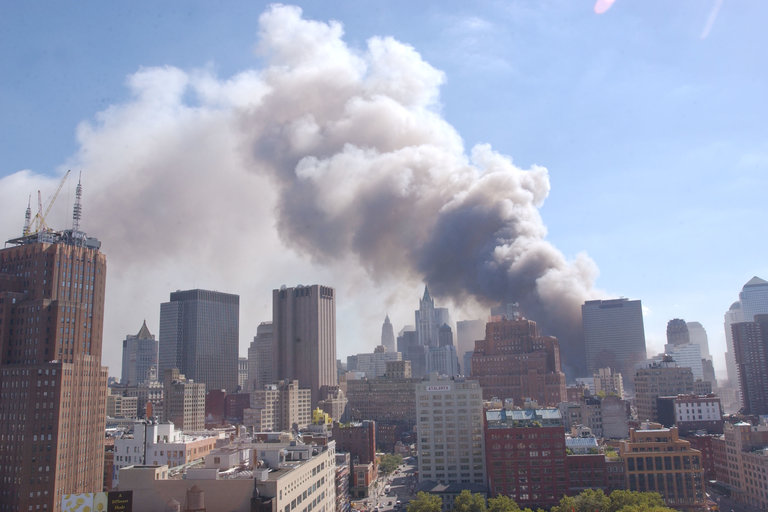
Dust swirls around south Manhattan after a tower of the World Trade Center collapses September 11, 2001 in New York City after two airplanes slammed into the twin towers in a terrorist attack.
Americans still contend year-to-year with the legacy of the 2001 terror attack that destroyed the World Trade Center in New York. According to a recent study, several hundred young adults who were exposed to toxic dust and debris on 9/11 as children are now showing early signs of risk for heart disease.

Researchers at NYU Langone Health examined the blood of 308 people who had either lived or studied in Lower Manhattan as children on the day of the attacks. Nearly half of the participants came into direct contact with dust and debris from ground zero.

The analysis, which was conducted by a team led by Dr. Leonardo Trasande, a health epidemiologist and associate professor at NYU School of Medicine, found that those with higher levels of the chemicals known to be in debris from the World Trade Center also had greater levels of artery-hardening fats in their blood.

Several studies have examined the mental health effects of witnessing the tragedy on 9/11 and studied the toxic impact on the health of first responders, but according to Trasande, this is the first study to look at the long-term cardiovascular health risks of children exposed to chemicals when the World Trade Center was attacked.

“Children are a vulnerable population that was unfortunately exposed to the debris and dust from ground zero on 9/11,” Dr. Trasande told Seeker. “There is still a big gap of research when it comes to the potential risks that may have an impact on their physical health.”

The study participants are part of the World Trade Center Health Registry (WTCHR), which is tracking both the physical and mental health effects of 2,900 children who lived or went to school in Lower Manhattan on 9/11.

Children cover their mouths in the SoHo neighborhood of New York on September 12, 2001. Smoke filled the air all over lower Manhattan in the aftermath of Tuesday's terrorist attack and destruction of the World Trade Center.
In January, a Langone analysis of several WTCHR participants showed that those who were present near ground zero on 9/11 had higher levels of PFAS (perfluoroalkyl substances) in their blood than the participants who were not in the city on that day.

“We found that higher serum levels of PFAS are associated with increased blood lipids,” Trasande said. “Blood lipids are an early marker of cardiovascular risk, and if ignored may lead to adverse outcomes later in life like coronary artery disease or stroke.”

Luckily, these risk factors “can be avoided if identified earlier on,” Trasande noted, explaining that they can be somewhat controlled with diet and exercise.

“Understanding these risks is essential for continuous monitoring and early interventions to prevent adverse cardio-metabolic outcomes in the future,” he said.

The presence of PFAS in the air on the day of the attacks came from the many electronics and furniture that burned in the World Trade Center after terrorists flew airliners into the two towers. PFAS was once widely used in the US to make plastics more flexible but the government discontinued it after learning its many adverse health effects, including lower-than-normal birth weights and brain damage.

“Our study showed that there was an association with PFAS and increased blood lipid levels in children exposed to WTC debris and dust,” Trasande said. “During this unfortunate tragedy it was nearly impossible to avoid the chemicals that were being released into the environment, however, there were various chemical pollutants that were released that day. Further studies are clearly needed to identify which other pollutants or collection of pollutants may have affected physical health.”

Another study from the Journal of Psychiatric Research found that people exposed to dust on 9/11 also had raised blood levels of C-reactive protein (CRP). CRP can cause inflammation and is linked to higher rates of post-traumatic stress disorder. It was discovered that people with high levels of CRP had a 12 percent greater risk of PTSD than people whose CRP was not elevated.

Since the World Trade Center collapse 16 years ago, thousands of firefighters, emergency personnel, and other first responders have suffered illnesses related to 9/11. More than 5,400 people have been diagnosed with cancer caused by breathing in the toxic chemicals in the air during the hours and days after the attacks. On Monday’s anniversary, 32 FDNY firefighters, whose deaths were caused by 9/11-related illnesses, will be added to the list of the fallen.

Payouts by the 9/11 Victim Compensation Fund have reached nearly $3 billion since it was reopened. The VCF was created in 2001 to support families of those injured and killed on 9/11 and paid out $7 billion before it was closed in 2004. Due to the abundance of illnesses related to the attacks, it reopened in 2011 to provide additional financial support for victims and their loved ones.

From Seeker

May 26, 2017

Study of Convicted Terrorists Reveals Deviant Moral Judgment

Nearly all terrorist acts, from the tragic bombing that killed 22 people at the Manchester Arena this month to the cold-blooded murder in 2015 of eight parishioners and a pastor at the Emanuel African Methodist Episcopal Church in Charleston, SC, require calculated steps and some sort of justification — however horrifically evil and skewed — in the mind of the perpetrator.

To better understand this mindset, an international team of experts in psychology and cognitive neuroscience recently studied 66 convicted male terrorists, with an average of 33 victims per subject. Some of the men participated in massacres with death tolls exceeding 600.

The men were all Colombian right-wing paramilitaries who were imprisoned for committing terrorist acts before being freed last year. The researchers put them through a battery of cognitive and psychological tests, the results of which are published in the journal Nature Human Behavior.

Co-author Adolfo García of Favaloro University in Argentina explained that Colombia has one of the world’s highest levels of terrorism.

“Since the late 1990s, roughly 70,000 people in this country have been killed by terrorists, and thousands more have been kidnapped, tortured, or otherwise violated,” he said.

García, lead author Sandra Baez, and their colleagues assessed the moral cognition, IQ, aggressive behavior, and emotion recognition of the 66 convicted terrorists, as well as basic executive skills such as planning, memory, attention, and multitasking. The tests that the researchers administered were given to a control group of 66 people with social and demographic backgrounds that were similar to those of the convicted terrorists, but who never committed any crimes.

The results showed no significant differences in intelligence, verbal skills, or basic cognitive functions between the two study groups. The convicted terrorists did exhibit higher levels of aggression and lower levels of emotion recognition than non-terrorists.

The most striking difference, however, concerned moral judgment. The test results show that the terrorists failed to integrate intentions and outcomes in the way that the control group members did. The terrorist moral code instead prioritizes ends over means.

A 2009 panorama of the Manchester Arena, the site of a deadly terrorist bombing following a concert by the singer Ariana Grande on May 22, 2017.
Consider the following fictional scenario that was included in the tests:

            Grace and her friend are taking a tour of a chemical plant. When
            Grace goes over to the coffee machine to pour some coffee, Grace’s
            friend asks for some sugar in hers. There is white powder in a container
            by the coffee. The white powder is a very toxic one left behind by a
            scientist, and therefore deadly when ingested in any form. The container
            is labelled ‘sugar,’ so Grace believes that the white powder by the coffee
            is sugar left out by the kitchen staff. Grace puts the substance in her
            friend’s coffee. Her friend drinks the coffee and dies.

The researchers then varied this scenario, changing the intentions and outcomes. For example, in one version of the fictional tale, Grace knows that the white powder is toxic, yet she still gives it to her friend.

Time and again, the terrorists judged intentional harm as more permissible and morally just than accidental harm. Terrorist logic holds that the ends, no matter how horrific, justify the means. The test results as a whole, therefore, provide evidence that distorted moral cognition is a hallmark of the terrorist mindset.  

“Terrorists’ outcome-based moral judgments may reflect the conviction that any action is justifiable as long as it favors the accomplishment of an aim,” senior author Agustín Ibáñez of Favaloro University explained. “Sociological studies emphasize such a deviant moral tendency as a prominent trait in terrorists. If the actions of terrorists follow from their underlying moral cognition, that means they will prioritize the results of the outcomes over conventional moral values.”

He noted that terrorists “consider it morally appropriate to do whatever it takes in the pursuit of an aim, even when this aim contradicts normative values.”

The study supports the theory that terrorists suppress instinctive and learned moral constraints — such as empathy, fairness, and pro-sociality — against harming innocent others. This can happen even in individuals with well-above-average IQs.

Intriguingly, there is little evidence that all terrorists are psychopaths. Not all psychopaths are involved in criminal behaviors, for example, and no conclusive evidence links such traits with terrorism.

“Terrorism and radicalism are multi-factorial phenomena molded by group dynamics, biological predispositions, cultural constraints, and socio-psychological factors,” Ibáñez said. “It may even be the case that this abnormal form of moral cognition is the result of participating in terrorist practices.”

A controversial resolution released by an American Psychological Association task force a few years ago suggests that such participation might include playing violent video games, which have been linked to increases in aggressive behavior in some individuals and decreases in empathy and sensitivity to aggression. Adam Lanza, the shooter responsible for the Sandy Hook Elementary School massacre in 2012, frequently played both violent and non-violent video games.

A roadside memorial in Connecticut for the victims of the Sandy Hook Elementary School shooting in 2012.
An opinion piece about the “jihadi state of mind” published in the New York Times following the Manchester bombing argues that certain social changes may also contribute to the rise of a terrorist perspective across different cultures.

“The influence of civil society institutions that help create social bonds, from churches to labor unions, has eroded. So has that of the progressive movements that used to give social grievance a political form,” wrote Kenan Malik, a former research psychologist who studied neurobiology. “Cracks now exist in which are spawned angry individuals, inhabiting a space beyond normal moral boundaries. There, they may find in Islamism or white nationalism the salve for their demons and a warped vindication for their actions.”

The situation in Colombia is particularly challenging because involvement in guerrilla or paramilitary warfare is often forced. Participants frequently come from extreme poverty and have little formal education. Many of the 66 convicted terrorists who participated in the study had experienced or witnessed sexual and childhood abuses.

While certain aspects of the problems in Colombia are unique, such as its political dynamics and the impact of illegal drug trafficking, terrorist acts in that country share similarities in many ways to those of other countries.

“At a global level, the size, timing and other macro-features of violent events of Colombia are comparable with those of countries with similar terrorist levels,” Ibáñez said. “Collective human activities like violence have been shown to exhibit universal-like patterns.”

Because of the determination that terrorists exhibit skewed moral judgments, have high levels of aggression, and possess emotion recognition impairments, the researchers believe that these individuals should be closely monitored after their release from prison — that is, if they ever are released — especially in light of numerous reported relapses, at least among demobilized paramilitaries. Ibáñez and his colleagues do, however, believe that psychological and social-cognitive therapies may benefit such individuals.

Read more at Discovery News

Sep 11, 2016

15 Years After 9/11, Americans Don't Feel Safe

Today marks 15 years since the 9/11 attacks, and memorials will be held around the country in remembrance of the nearly 3,000 lives lost in New York, Washington, D.C. and Pennsylvania that day. Arriving in time for the anniversary are a pair of polls that show that Americans are increasingly concerned about the possibility of a terrorist attack on U.S. soil.

According to a CNN/ORC poll (PDF) released on Friday, half of Americans expressed the feeling that an act of terrorism during the days surrounding Sept. 11 this year is "very" or "somewhat" likely. Five years ago, 39 percent of Americans had the same premonition.

In the last five years, there have been a number of large-scale terrorist attacks both in the United States and internationally, many of which are tied to the rise of ISIS. Within the U.S., the Boston Marathon bombing in 2013, San Benardino shooting last year and the Pulse nightclub massacre earlier this summer were mass-casualty events in the past half decade that increased Americans' sense of unease. In Europe within the last 12 months, terrorists struck in series of coordinated attacks in Paris, airport bombings in Brussels and a truck attack at a Bastille Day event in Nice.

These new attacks are also contributing to the increasing sense of fear and anger Americans feel when reflecting on 9/11, the CNN/ORC polls finds. Forty percent of Americans said they felt fear and around three-quarters anger when looking back to 9/11. Five years ago, those numbers stood at 62 percent and 30 percent, respectively.

A Pew Research Center poll released Wednesday paints a similar picture. Forty percent of Americans says that the ability of terrorists to strike in the United States is greater than it was on Sept. 11, 2001, and 31 percent believes terrorists' ability to launch an attack are about the same.

In Pew's numbers, there is also a sharp partisan divide in terms of how Americans feel about the liklihood of a major terrorist attack, reflecting an increasingly polarized political landscape during an election year.

Nearly 60 percent of Republicans consider the ability of terrorists to attack as greater than at the time of 9/11, Pew finds, while 34 percent of independents and 31 percent of Democrats felt the same.

"Opinions about terrorists' capabilities to attack the U.S. have long been divided along partisan lines," the center writes. "During George W. Bush's presidency, Democrats were often more likely than Republicans to say the ability to terrorists to launch a major strike was greater than at the time of 9/11, while the reverse has been true during Barack Obama's administration."

"But this marks the first time in the past 14 years that a majority in either party has expressed this view," the report continues.

From Discovery News

Jan 5, 2016

ISIS Gone, Archaeologists Return to Key Iraq Sites

As the terrorist group ISIS is pushed out of northern Iraq, archaeologists are resuming work in the region, making new discoveries and figuring out how to conserve archaeological sites and reclaim looted antiquities.

Several discoveries, including new Neanderthal skeletal remains, have been made at Shanidar Cave, a site in Iraqi Kurdistan that was inhabited by Neanderthals more than 40,000 years ago.

Additionally, though ISIS did destroy and loot a great number of sites, there are several ways for archaeologists, scientific institutions, governments and law enforcement agencies in North America and Europe to help save the region's heritage, said Dlshad Marf Zamua, a Kurdish archaeologist and doctoral student at Leiden University in the Netherlands.

He criticized antiquity dealers who are benefiting financially from ISIS' looting and destruction, calling on authorities in North America and Europe to prevent those dealers from selling northern Iraq's heritage. "It was said that war was created for selling weapons, but in the situation of our area, the war was created for selling weapons, oil and antiquity objects," Marf Zamua said.

New research

Before ISIS moved into Iraq in the summer of 2014, scientists with 45 foreign missions from 16 countries were conducting archaeological excavations and surveys in the Kurdistan region of northern Iraq, said Marf Zamua.

Over the past few months, Kurdish forces have gone on the offensive and, with support from allied air strikes, are pushing ISIS out of the region. And archaeologists are returning to the area, including at Shanidar Cave. This cave was originally excavated between 1952 and 1960 by a team led by archaeologist Ralph Solecki from the Smithsonian Institution in Washington, D.C. The archaeologists at that time found several Neanderthal skeletons and pollen remains suggesting that the Neanderthals placed flowers in graves before burial.

In an article recently published in the journal Antiquity, a team that has recently returned to Shanidar Cave reported finding additional Neanderthal bones, "including a hamate [a wrist bone], the distal ends of the right tibia and fibula, and some articulated ankle bones, scattered fragments of two vertebrae, a rib and long bone fragments."

The newfound bones are likely from one of the Neanderthals that archaeologists dug up in the 1950s, said University of Cambridge archaeologist Graeme Barker, who is part of the research team. He said that as excavations continue, new Neanderthal skeletons may be found.

Additionally the team's research is shedding light on the environment in the cave where the Neanderthals lived.

For instance, scientists reporting in another paper published in the journal Review of Palaeobotany and Palynology found that bees were transporting pollen into the cave. This complicates the idea that Neanderthals in the cave buried their dead with flowers, suggesting instead that pollen remains from flowers could have entered the cave through natural means.

Protecting heritage


When ISIS took over parts of northern Iraq, the group began looting and destroying archaeological sites such as ancient Assyrian cities like Nimrud. After bulldozing these cities, but before blasting them, ISIS looted thousands of artifacts from the sites, Marf Zamua said. "Thousands of objects reached the black markets over the world."

Additionally, many unexcavated "Tell" (mound) sites were also bulldozed, looted and blasted. Those sites contained artifacts that have not yet been excavated. There "are hidden treasure [within these mounds], and by losing any of them, we lose an important part of history and civilization of Mesopotamia," Marf Zamua said.

In addition to curtailing the black market, scientific organizations in the West can help train Iraqi, Kurdish and Syrian archaeologists in conservation techniques, Marf Zamua said. "Institutes can offer local archaeologists scholarships in restoration, protecting heritage and museum studies," he said.

Read more at Discovery News

Nov 25, 2015

How Terrorism Can Harm Your Brain

When ISIS terrorists attacked Paris on Nov. 13, they took 130 lives and wounded hundreds more. But their bloody acts may have injured far more people -- both survivors and the countless numbers who experienced the event vicariously through horrific media images -- in an insidious way, by causing potentially harmful changes in their brains.

Indeed, terrorism's effect on the brain is so powerful that those who survive attacks have significantly higher rates of post-traumatic stress disorder than those who make it through accidents or natural disasters. But terrorism also is linked to long-term problems such as anxiety and alcohol abuse in people who only have secondhand exposure to the event by watching it on television.

Recent research shows fear of future terrorist attacks can alter brain chemistry in a way that increases your risk of dying eventually from a heart attack or other ailments that might seem unrelated to the violence.

The latter study, published in 2014 in Proceedings of the National Academy of Sciences, looked at more than 17,000 Israelis, who live in a country where terrorist attacks are a frequent occurrence.

The subjects who had the most fear of terrorism tended to have resting heart rates that were 10 to 20 beats per minute faster than the norm, an indicator of increased risk for heart attacks and strokes. The elevated heart rate was linked to a change in brain chemistry. Blood tests revealed a decline in the function of acetylcholine, a neurotransmitter involved in responses to stress and which acts as a brake to the inflammatory response.

"Our brain reacts to acute stress situations by a rapid burst of acetylcholine release," explained study co-author Hermona Soreq, a professor of molecular neuroscience at the Edmond and Lily Safra Center for Brain Sciences at Hebrew University in Jersusalem.

"The brain sends the acetylcholine to body tissues through the vagus nerve; Since acetylcholine blocks inflammation responses, too much of it weakens the immune system. We found lower prospects to survive in patients after heart attack whose blood tests show weakened capacity to destroy acetylcholine."

Soreq said that terrorism-induced anxiety also causes the production of small molecules called microRNAs, which block the function of numerous other genes, and can alter regulation of the nervous system.

Terrorism triggers mechanisms hard-wired into the nervous system by evolution, which enabled our ancient ancestors to escape from animal predators and rival human clans. The human brain and vision system is fine-tuned to spot things that we should be afraid of, and then react to them in a flash -- even without consciously realizing it.

In a 2012 study, for example, researchers from the University of Edinburgh and New York University trained subjects to fear certain pictures by giving them mild shocks. Some subjects were allowed to look directly at the images, while others only got to glimpse them in one eye while researchers flashed a colorful image in the other eye to interfere with conscious perception.

Even with that hindrance, the subjects who got the one-eyed glimpse actually developed a fear response more quickly.

When a person spots danger -- say, a gunman who bursts into a theater -- the alarm is sounded in the amygdala, a sort of biological alarm system that triggers the body's response. It directs glands to release an array of chemicals such as adrenalin and cortisol, which shift the heart, lungs and muscles into high gear. The senses shift into narrowly focused hyper-awareness of information that might aid in survival.

A study published in Psychological Science in 2009, for example, found that fear made subjects see coarser lines, which help the brain to evaluate movement and distance, more clearly, while they couldn't make out fine lines as well as usual.

After a threat is over, in many cases, a survivor's brain gradually can shift back into normal operating mode. But not always. Studies have shown that between 28 and 33 percent of survivors of mass shootings and 34 percent of bombing survivors develop post-traumatic stress disorder -- far higher rates than people involved in terrifying accidents or natural disasters.

Survivors continue to relive the trauma and often suffer from symptoms such as irritability, difficulty concentrating, hypervigilant watchfulness, and an exaggerated startle response, and sometimes feelings of numbness.

Recent research by German scientists suggests that cortisol, one of the chemicals that the body releases in an effort to survive a terror attack, not only helps burn the event more vividly into a person's memory, but also helps to keep it vivid even after it is retrieved repeatedly.

But it's not only immediate survivors whose brains may be affected by terrorism. A study published in the New England Journal of Medicine in 2001 found that after the 9-11 attacks, 44 percent of U.S. adults and 35 percent experienced one or more substantial symptoms of stress, such as difficulty concentrating, repeated memories or dreams of the event, irritation and angry outbursts. The level of stress that people experienced was linked to the extent that they had watched TV coverage of the attacks.

Those effects sometimes last for years. Another study, published in 2008 in Journal of the American Public Health Association, looked at the effect of 9-11 on the mental health of office workers in Chicago, far away from the actual site of the attacks in New York and Washington.

Read more at Discovery News

Nov 15, 2015

Paris Attacks: The Mental Scars of Terrorism

When terrorists strike, as they did in Paris in a coordinated attack orchestrated by the Islamic State that left at least 128 people dead, the events are felt around the world as images and video of the aftermath pour through mass communications channels.

Terrorists choose their targets not based on military or political importance, but rather emotional and visceral impact, as I note in an earlier post. After extremists strike, there are notable behavioral and psychological changes among both victims and observers of terrorist actions.

Behavioral Impacts of a Terrorist Attack

After a terrorist attack, those affected by the assault covet control, according to a study by Vanderbilt University researchers published in September in the Journal of Consumer Psychology.

The study analyzed the effects of terrorist attacks on consumer behavior, specifically among those affected by extremist actions in Israel. After all, one of the aims of such actions is to disrupt economic and commercial activity and the researchers found that consumers will change their habits in the wake of a terrorist attack, at times drastically.

For example, as suicide attacks often target restaurants, some of the study’s participants chose to sit near the kitchen when they dined out, creating the possibility of an alternative exit in an attack, a subtle change in otherwise normal behavior. Others, however, quit restaurants entirely for fear of a terrorist attack.

The greater the sense of a loss of control a particular victim or observer feels, the more dramatic the changes in behavior to regain a sense of stability, the researchers found.

The Psychological Toll of Terrorism


The immediate impact of a terrorist attack is physical, claiming lives and causing injuries. But psychological damage quickly follows. As Arieh Shalev, an NYU School of Medicine psychiatry professor, explained in “Treating Survivors in the Acute Aftermath of Traumatic Events (PDF)“:

Shortly after exposure, the traumatic event ceases to be a concrete event and starts to become a psychological event. As such, it has to be metabolized and assimilated, that is, become part of the survivor’s inner network of meanings and experiences.

Traumatic events are not only internalized, but repeatedly recalled, reassessed and progressively assimilated. As a result, early intervention is necessary to help recovery, the author writes.

If left unaddressed, particularly among those who deal with long-term exposure to terrorism, the stress can take a physical toll, according to research published last year in the Proceedings of the National Academy of Sciences.

In a study of over 17,000 Israelis, Hebrew University of Jerusalem researchers found that fear of terror was a major contributor to increases in resting heart rate, a predictor of death from cardiovascular disease, stroke and other causes.

Changes in Beliefs

Psychological impacts aren’t limited strictly to victims. A 2013 study published in Procedia – Social and Behavioral Sciences looked at the long-lasting emotional toll of the 2004 Beslan massacre, in which Chechen terrorists took an entire school hostage, a tragedy that ended in the deaths of 385 people.

Victims, relatives and others emotionally connected to an extreme traumatic event suffered severe emotional anguish. In particular, basic beliefs they once held changed. For example, researchers found that among adults, “beliefs in meaningfulness and benevolence of the world were destroyed,” the authors wrote.

Winning the Psychological War?

To the extent that terrorists use violence to elicit a strong emotional and psychological response, they’re effective at the most basic level in inducing mental anguish and affecting some behaviors and beliefs.

Reactions to traumatic events, however, are complicated. Everyone looks to reestablish a sense of security in different ways, and this can often result in affected individuals and observers coming together. Look no further than the global response to the Paris attacks of countries incorporating the colors of the French flag in their landmarks.

On a local level, among those who most closely felt the attack, behavior can sometimes be counterintuitive. Take the example of the reaction of young people in London following the 7/7 bombings in 2005.

According to an article published in the book “Evolutionary Psychology and Terrorism,” attendance at nightclubs in the capital increased that month, a trend not seen elsewhere in the United Kingdom. Rather than locking themselves in their homes to feel secure, young London residents congregated in large numbers in public.

Read more at Discovery News

Nov 14, 2015

Paris Attacks: Inside the Minds of Terrorists

Coordinated terrorist attacks by the Islamic State Friday using a combination of suicide bombs and automatic weapons left at least 128 people dead across Paris.

As the city mourns, ordinary citizens around the world express sympathy for and solidarity with the French capital this weekend. World leaders have condemned the attacks, with French President Francois Hollande calling the assault “an act of war.” European governments have also beefed up security and called for heightened vigilance from the general public, reports Agence France-Presse.

How could something like this happen? It’s a question that security and intelligence officials around the world consider in order to prevent future incidents. Psychologists, social scientists and other researchers have also investigated this subject by studying the minds of terrorists.

Why Do Terrorists Attack Civilian Areas?

Yesterday’s attacks in the French capital targeted restaurants, a soccer game and a concert hall, exactly the kinds of places the average young Parisian or tourist would want to be on a Friday night.

In “Ciottone’s Disaster Medicine (Second Edition)“, which devotes a chapter to the psychology of terrorism, author Robert Ciottone explains:
Terrorists seek to destabilize individuals and societal organizations by undermining the cognitive, affective, and valuative perspectives they have of the physical, interpersonal, and sociocultural aspects of the world. In other words, terrorists seek to reshape the frame of reference by which people know about, have emotional reactions to, and attach relative importance to the world of objects and places, of people and of laws, and of rules, customs, and expectations.

Because of the disparity between the resources available to governments versus terrorist organizations, civilian targets offer terrorists the possibility of a greater return on investment, so to speak. These areas are chosen not because of military or political significance but for other strategic reasons because terrorists strike where populations feel most secure.

How Do Terrorists Choose Their Targets?

Instead of seeking to maximize economic or physical impact, terrorists make decisions based on “emotional and visceral factors,” according to a study published in June in the journal Risk Analysis.

These targets are specifically considered not only to instill fear in a particular demographic but also demonstrate the capability of the organization to bolster support amongst its followers.

In “The logic of terrorism: Terrorist behavior as a product of strategic choice,” author Martha Crenshaw explained that “pectacular humiliation of the government demonstrates strength and will and maintains the morale and enthusiasm of adherents and sympathizers.”

Terrorists of course can never be assumed to be fully rational actors, which explains major flaws in the decision-making, but also makes it more difficult for security analysts to predict their next move, the immediate impact of which is extremists’ chief concern.

The authors of the Risk Analysis study note that “passions and visceral factors influence an agent to behave extremely myopically and to seek immediate rewards, disregarding any detrimental effects.”

Who Are Terrorists Typically?

Aside from being collectively bound to an extreme ideology, terrorists generally have one other demographic connection: They’re often young men, which may be explained by behavioral biology, according to the recently released book “Evolutionary Psychology and Terrorism.”

In early adulthood, young men are more prone to risk-taking behaviors, previous studies have found. They also have higher levels of testosterone. Testosterone “makes them more susceptible to influence by other males, who are usually older,” Jason Roach of the University of Huddersfield said in a statement in September upon the book’s release. “That is why you will find that it is younger males who do the suicide bombing, but the direction comes from older men.”

Suicidal terrorists in particular “seek care and guidance from stronger personality figures,” according to the Risk Analysis study, and crave the attention they get for their extremely violent actions.

Read more at Discovery News

Sep 11, 2015

Last Surviving 9/11 Rescue Dog Gets a Birthday Bash

A female golden retriever named Bretagne is the last living rescue dog that worked in lower Manhattan in the rubble of the fallen Twin Towers after the September 11, 2001 terrorist attacks.

In honor of her 16th birthday, the website BarkPost.com threw her a birthday bash in the Big Apple.

Bretagne's handler and owner Denise Corliss, a member of the Texas Task Force 1 rescue team, worked with Bretagne searching for survivors after the attack. It was Bretagne's first deployment, according to BarkPost, and the pair have been together ever since.

In the BarkPost video above, you can get a front-row seat for Bretagne's trip to New York with Corliss, her party, and even her trip to Times Square.

Happy Birthday, Bretagne! And thanks to Corliss, Texas Task Force 1, and all of the rescue workers out there for all you do!

From Discovery News

No 'Specific or Credible Threats' on 9/11 Anniversary: FBI Chief

The Federal Bureau of Investigation said Thursday that it has picked up no “specific or credible threats” linked to the anniversary of the September 11, 2001 attacks on the United States.

FBI director James Comey said it was closely watching for threats from Al-Qaeda or Islamic State, but told a conference on intelligence “there are not any specific or credible threats tied to tomorrow.”

Friday is the 14th anniversary of the attacks that brought down the World Trade Center in New York and destroyed part of the Pentagon, killing nearly 3,000 people.

The attack by Al-Qaeda militants flying hijacked airliners was the deadliest ever on US soil, and propelled the United States into an era of wars in Afghanistan and Iraq.

Admiral Michael Rogers, head of the National Security Agency, said September 11 was “clearly a date that resonates for a lot of people.”

“You hear groups talking about the significance of that date,” he said at the same conference. “But I wouldn’t say that it is as high as I have seen… in the last 14 years.”

From Discovery News

The Near-Impossible Challenge of Designing the 9/11 Museum

One of the last photos taken of the intact Twin Towers, snapped minutes before they were struck on September 11. It hangs in the new ­museum’s concourse lobby.
You descend into the museum on a long ramp, sloped so gradually that you barely feel your steps gathering momentum. It’s as if you’re gently being pulled into orbit. Then you walk out onto an underground balcony overlooking the museum floor, some 40 feet below, and gaze out into a vast, nearly empty space punctuated by the Last Column—the final piece of steel hauled away from Ground Zero during cleanup. Weighing 60 tons and standing nearly 40 feet high, it’s still covered in spray-painted messages, tributes to the dead left by those who did the work. (“My brothers, you ran into hell,” one reads.) You get an overwhelming sense of absence and awe. There may be no public space more cavernous in New York City, and the vista was designed to preserve the dizzying experience of looking into the gaping pit left when the cleanup was complete in the spring of 2002.

To your left is the Slurry Wall, a 3-foot-thick concrete barrier studded with iron pilings that once girded the foundations of the site and managed to hold even after the towers fell. The wall still seems both immovable and ­fragile. It’s what keeps the Hudson River from drowning this space, which is an unprecedented hybrid of archaeological site, cathedral, and tourist attraction.

As you keep walking downward, the ramp switches back, and you pass by a quote rendered in metal letters 15 inches high and cast from steel recovered from the original Twin Towers: NO DAY SHALL ERASE YOU FROM THE MEMORY OF TIME. It’s a line by Virgil, who, in the Inferno, serves as Dante’s guide through hell. Stepping off the ramp and passing down a flight of stairs and a hallway, you are now 70 feet belowground, standing on the bedrock that rooted the Twin Towers.

Twenty feet above your head hangs a piece of steel more than 35 feet long and weighing nearly 5 tons. It’s positioned vertically on the side of a massive silvery cube that marks the outline of where the North Tower once stood. Twisted like a ribbon blown in the wind, it has a ter­rible beauty. This and a counterpart down the hall are the “impact steel,” the columns hit by the first passenger jet when it slammed into the North Tower almost 13 years ago. You pass under one of the steel pieces and through a pair of plain glass doors to enter the main exhibits of the National September 11 Memorial Museum.


Watch this video on The Scene.

 Historical museums typically serve as a way to tell the official story of something that happened and what it means. This one is different. “It is a story that has no end,” says Paula Grant Berry, a ­museum-­planning-­committee member whose husband died in the South Tower. The events of 9/11 are still raw in our memories and alive in our political and cultural climate.

For the museum’s designers and curators, that tension led to a ­tangle of quandaries: How can you present a lasting memorial to an event whose impact is still unspooling through developments such as the Edward Snowden leaks and the Senate’s torture report? How can you speak to 9/11’s polarizing effects, such as the ­bungled search for WMD, without alienating some significant portion of your audience? How can you create a meaningful tribute that will resonate with every visitor: the school­children who know almost nothing of what happened, survivors who ran from the buildings covered in ash, and all those—more than a billion worldwide—who experienced the attack live on TV? “Conventional narrative wouldn’t cut it,” says Alice Green­wald, director of the museum, which opens in May.

Perhaps the most vexing problem of the project’s design, which incorporates thousands of artifacts, is that it risked becoming one massive trigger for victims and a trauma in its own right for everyone else. “This is not the Disney World of 9/11,” says Green­wald, a petite, dark-haired woman whose room-­filling good cheer belies the material she has absorbed and calibrated. “We weren’t going to immerse ­people in the experience.” As Jake Barton, founder of Local Projects, which helped design the space, says, “That was the first, panicking challenge: How do you rise to the event itself for the ­people who lived it without overwhelming everyone else?” The fear of seeming hasty or naive was almost paralyzing. “Usually, as designers, you try to create meaning. Here there was almost too much of it,” Barton says.

The museum’s creative team ­tackled these emotional and psychological challenges through a combination of sophisticated design and artfully deployed technologies: a data-mining algorithm, onsite digital recording booths, a web-based platform for gathering crowdsourced testimony, touchscreens that let you access remembrances of the dead. The result isn’t so much a record of an event as a testament to how much we’ve all witnessed—no one more so than the survivors and family members, whose experiences are almost impos­sible to imagine until you hear from them yourself.

Foundation Hall | The last column stands wrapped in protective canvas. The installation called timescape is projected on the wall behind it.
 The museum began to take shape eight years ago in a generic office on the 20th floor of One Liberty Plaza. In late 2001, the room, which features a view of Ground Zero, was set aside by the Lower Manhattan Development Corporation as an interim memorial space for the families of victims. The windows and walls were soon papered over with remembrances. To glimpse Ground Zero at all, you had to peer through the narrow spaces between pictures of ­people who had died. Many were small framed photos like the ones you’d see on a nightstand; a few were kids’ drawings with pictures ­stapled to them. At the center of the room was a podium bearing an oversize guest book filled with notes written to the dead. It remains in place today, off-­limits to everyone except families. (A new private family room in the museum will replace this one later in 2014.)

Tom Hennes first visited the room in 2007, soon after his firm, Thinc, won the original museum commission. It felt like a time capsule. Hennes remembers that the notes were written in the present tense; one woman wrote to a relative asking for his approval of her new boyfriend, whom she’d brought with her. “The room tuned us in to what trauma means,” Hennes says. “Time had stood still.”

To the designers, the very rawness and variety of expression suggested an answer to a central challenge: how best to present events when, as William Faulkner once wrote, “the past is never dead. It’s not even past.” Instead of providing its own interpretive explanations, the designers realized, the museum could focus on direct testaments from the ­people who had experienced it. The hope was to avoid a ­single story line and instead allow visitors to reconstruct narratives on their own, using the artifacts on display. “Witnesses are the way into the museum,” Green­wald says.

It was an approach that Barton had been inching toward for more than a decade, influenced by such Anna Deavere Smith plays as Twilight: Los Angeles, 1992. For that meditation on post–­Rodney King racial resentments, Smith conducted more than 300 interviews and then condensed the material into four dozen characters. She portrayed each of them herself, one blending into the next. “It was a lightning bolt,” Barton says. “It was really an exercise in empathy, in trying to find the humanity of everyone involved.” Ever since, Barton has used this as his inspiration in commissions that integrate mul­tiple narrators. For ­example, Local Projects designed the oral history booths for Story­Corps, a project that is collecting thousands of personal stories and archiving them at the Library of Congress.

The Goal: Create A Meaningful Tribute to the Victims without Traumatizing the Visitors.

Voices are the first thing you hear in the museum, in the vestibule that precedes the entrance ramp: 417 ­people completing one another’s sentences. These are not from the victims but ­from people around the world who contributed their own 9/11 recollections via phone, video, or a web-based platform. Their words are mapped to hundreds of cities across the globe and then projected onto a series of staggered panels. As you walk around and stand in front of the screens, the words project around you, enveloping you in their stories.

Visitors are invited to bear witness again as part of Reflecting on 9/11, one of the museum’s signal installations. It consists of videos projected on massive walls and featuring interviews with figures who shaped our responses to 9/11, from the head of the ACLU to then defense secretary Donald Rumsfeld. They answer intentionally broad questions such as, how do you balance national security and personal freedom? Visitors, in turn, can answer the same questions in their own booths next to the installation. The curators can then pick visitor responses to display on the main wall.

But the same intimacy that makes all these voices so powerful can also make them overwhelming. The curators had access to thousands of hours of recordings of witnesses, survivors, and victims—voicemails, 911 calls, even radio call-ins. These posed a dilemma: Experts like Billie Pivnick, a clinical psychologist who worked closely with the designers, warned that hearing victims’ voices in the throes of terror could traumatize listeners. Even for the designers, direct access to the material proved difficult. “It felt like being a war correspondent,” Barton says. He recalls having persistent nightmares about buildings crumbling. Some ­people on Hennes’ team burst into tears at unexpected moments, unable to explain why the material, which seemed so familiar one day, was intolerable the next.

With this in mind, the curators had to decide which recordings were appropriate. For ­example, they opted not to include a 911 call from a woman trapped on a high floor who knew she wasn’t going to survive; the call ends with her simply praying with the operator. They did decide to include a voicemail that 24-year-old Brad Fetchet left for his mother minutes after the first plane hit the North Tower. “Hey, Mom. I’m obviously alive and well but obviously pretty scared … Love you.” Fetchet died in the South Tower. Green­wald admits that these were judgment calls. The choices usually favored the recordings in which ­people, even those who died, seemed most in control.

Chosen Paths

The 9/11 Memorial Museum uses technology and artful curatorial techniques to bring personal testimony to the fore without overwhelming visitors’ emotions. Here’s how the curators pulled it off. —C.K.

Historical Exhibition The bulk of the material lies in a chronological exhibit of media and artifacts about 9/11. 1 | Day of the Attacks Visitors follow the day’s events starting at 8:46 am on September 11, 2001, the moment the first plane hit the North Tower. Alcoves house the most emotionally sensitive material. The toughest exhibit to create was the one that depicts the people who jumped or fell from the towers. To avoid aestheticizing the event, designers stripped the display of nearly all adornment. 2 | Looking Back The museum then turns back the clock to understand the history leading up to 9/11, showcasing artifacts like a laptop used by the FBI as evidence linking the 1993 World Trade Center bombing to al Qaeda and the 2001 attacks. 3 | Aftermath This is where visitors follow the recovery after the attacks, viewing such artifacts as a preserved storefront covered in dust, and steel that was mangled in the burning towers’ collapse. 4 | Reflecting on 9/11 Here visitors can watch key figures such as Eric Holder and Donald Rumsfeld answer questions about how the attacks affected government and society.

Location The National September 11 Memorial’s twin reflecting pools (squares) mark the footprints of the North and South Towers aboveground. The 9/11 Memorial Museum lies below.

Memorial Exhibition The ­people who died on 9/11 and in the 1993 World Trade Center attack are remembered in pictures mounted on the perimeter of the room. Visitors can see and hear materials from an ever-­expanding archive in an inner chamber designed to encourage eye contact among visitors.

Last Column Standing nearly 40 feet high, the Last Column was the final piece of steel removed from Ground Zero. At the museum, touchscreens allow you to pan around images of the entire column so you can read inscriptions alongside annotations of the stories behind them.

Exposed Box Columns The original steel columns, once used to anchor the North Tower to the bedrock, have been sheared to floor level here.

Timescape An algorithm collects headlines related to 9/11 and projects them on a concrete wall, evoking the attacks’ effect on current events.

That element of control is emphasized in the museum’s layout, which allows visitors to decide how much of the most emotionally provocative moments they will experience. The main path through the historical exhibit is dominated by physical artifacts—a storefront preserved from a block adjacent to Ground Zero (complete with dust-­covered blue jeans and sweatshirts emblazoned with American flags), the hand rakes used to sift the site for remains, mangled steel from the building. But the curators ­struggled most with how to present hundreds of more personal audio recordings and visual records. In the end, they decided to put this sensitive material inside alcoves placed off the main pathway through the exhibit. To confront these collections, you have to seek them out.

The most difficult alcove to design was the one dedicated to the ­50 to 200 men and women—the exact number is not known—who, overwhelmed with heat and smoke, jumped or fell from the buildings. “Those ­people were on a ledge and feeling like they had no option but to step into a sky that would not support them,” says Joe Daniels, president of the 9/11 Memorial and Museum. “It is so unbelievable. Maybe you don’t show it.” And yet, after much intense debate, the board overseeing the museum, including Daniels, voted unani­mously to dedi­cate an exhibit to those victims.

Some suggested a ­simple text panel and a statistic printed on the wall, nothing more. Others thought the video footage had to be used. Between these poles of detachment and immediacy, Green­­wald says, was a limit­less range of possibilities. One initial, commonsense idea gathered support: Mount pictures of ­people falling, in ­simple frames. And yet the effect, once tested, was horrifying. “It was the equivalent of a gallery display,” Green­wald says. “It aestheticized the moment. We recoiled from it.” They tried video in turn, and this created a gruesome loop as the event ran to its awful conclusion over and over.

The exhibit that finally emerged after dozens of prototypes is so artful that it seems almost totally undesigned. The entrance is marked by a photo of a small group of ­people on the street, looking up in shock. One woman is gazing just past the camera, covering her mouth. “There were a ­couple of instances when we said, there is no other photo pos­sible,” Green­wald says. “You know from this photograph what they’re looking at.” Once you step into the alcove, you see a ­single picture, mounted on a stout column that dominates the center of the room. Titled “Trapped,” it shows men and women leaning out of the towers’ broken windows, with black smoke streaming out from behind them. On the walls surrounding you are quotes from ­people who witnessed victims jumping or falling:

They were ending their life without a choice, and to turn away from them would have been wrong.

This woman stood there for what seemed like minutes, then she held down her skirt and then stepped off the ledge. I thought, how human, how modest, to hold down her skirt before she jumped.

You won’t see anyone falling unless you make your way around the big column to a nook at the back of the room. There, 3 feet above your head, are projected a series of five still photographs of ­different people falling from the towers. They fade from one to the next, in a slow progression that gathers no rhythm. “We don’t ask the person jumping to repeat the act over and over again,” Green­wald says.

That room, designed by David Layman, made it pos­sible to present potentially explosive imagery without glossing it over or causing offense. But when it came to presenting the ways that 9/11 shapes political debate, current events, and news coverage, the curators resorted to a different tool altogether: an algorithm. “The system lets the curators say they haven’t set an agenda,” Barton says. The algorithm, coded by Local Projects, sifts through the news of the day, finding nuggets relating to 9/11 and extracting connections among them. Its output is projected on a concrete wall as an enormous graph some 34 feet across. Dubbed Times­cape, it is a constantly evolving chart of news ­articles connected to 9/11. At times it looks like a spray of data points charted against two axes: time versus frequency. Each point is labeled according to a topic or theme, from lead hijacker Mohammed Atta to the Snowden leaks. As the display cycles, each theme is unfurled in a new, more detailed chart that reveals the series of headlines that relate to it.

Academic researchers and even the Associated Press have experimented with using similar data-­mining technologies to sift through massive document archives such as the Chelsea Manning leaks. But Local Projects wasn’t sure any of them would work for the museum. Confirmation came suddenly when Dylan Fried, one of the programmers coding the algorithm, was checking the themes and ­articles the machine was culling line by line. Fried, only 11 years old at the time of the 9/11 attacks, came upon a funny acronym and Skyped a colleague: “Who’s this KSM guy?” He was, of course, Khalid Sheikh Mohammed, master­mind of the attacks, and he kept popping up as a detainee at Guantanamo Bay and linked to the 2002 Bali nightclub bombing. “This algorithm showed Dylan a whole world of connections,” says Sundar Raman, Fried’s colleague. In other words, it worked.

The algorithm’s precision offers startlingly sharp insights about the ebb and flow of current affairs. It doesn’t elide what’s there, and it doesn’t overplay or underplay some themes for emphasis, as a curator inevitably would. It simply shows events for what they are, in news headlines. In that way, its effect is akin to the polished black granite of the Vietnam Veterans Memorial, which allows visitors to see their own reflections atop the inscribed names. Architectural critics have given almost metaphysical weight to the fact that the memorial’s ­marble literally mirrors the present day. At the 9/11 Museum, the mirror is a math equation.

Moral philosopher Avishai Margalit, in his meticulously reasoned book The Ethics of Memory, wrote, “We need morality not so much to counter evil as to counter indifference.” By that measure, a museum like this one must aim to shake the familiarity that robs us of our shock and horror, blunting our moral reactions. Tom Hennes, who’s something of a museum radical, echoed that idea from the start. He doesn’t believe museums should be venues for education but rather places of encounter. He offers an ­example: “Natural history museums are lousy at teaching natural history,” he says. “But they can provide a new sense of wonder that changes your next walk in the woods.”

Hennes is proudest of the museum’s memorial, which lies apart from the historical exhibit, in the footprint of the South Tower. He and Barton designed the space, which presents stories and artifacts provided by the fami­lies of victims. The challenge was to somehow satisfy all the families, each of whom may have envisioned a different form of memorial. Hennes and Barton’s solution is not a grand architectural gesture, just a ­simple square room of about 3,000 square feet.

Upon entering, you are surrounded by the faces of those who died, shown in mounted photos arrayed in neat alphabetical rows, from floor to ceiling, on all four walls of the room. In the center are the four walls of another, smaller room of about 700 square feet. In the space between the outer and inner walls there are waist-high tables embedded with touchscreen versions of the portraits on the walls. Touch one and you can see more pictures of that person, audio recordings of their family’s remembrances, and an obituary. (The archive will grow over time as loved ones add more artifacts.) You can then choose to pro­ject or play those items in the inner room.

Impact Steel | These exterior columns bore the blow when flight 11 slammed into the north tower.
As you walk into the inner chamber, the perimeter is lined with benches facing inward. The floor is glass, and below your feet you can see the scarred bedrock that once supported the towers. The recorded material you selected plays across two opposite walls, which are covered in ultrasuede to ­muffle the sound and lend the room a hushed stillness. The entire space is designed for eye contact, like a Quaker meetinghouse: On the perimeter, you meet the gazes of the other visitors. The experience is communal—but also intimate.

It’s hard to miss the resemblance to the original memorial room at One Liberty Plaza overlooking Ground Zero. Just as that room had windows papered over with pictures and a ledger in the center for family remembrances, this new memorial has a perimeter of pictures and an inner chamber for displaying family recollections of the lost. Hennes says the similarity wasn’t strictly intentional, but he allows that the original memorial room may well have exerted an unconscious influence on him and his colleagues.

Read more at Wired Science

Aug 20, 2015

ISIS Beheads Elderly Ex-Antiquities Chief in Syria's Palmyra

The Islamic State group beheaded the 82-year-old retired chief archaeologist of Palmyra after he refused to leave the ancient city, Syria’s antiquities chief said.

A UNESCO World Heritage site famed for well-preserved Greco-Roman ruins, Palmyra was seized from government forces in May, fueling fears the IS jihadists might destroy its priceless heritage as it had done in other parts of Syria and Iraq.

Syrian antiquities chief Maamoun Abdulkarim told AFP he had urged Khaled al-Assaad to leave Palmyra, but he had refused.

“He told us: ‘I am from Palmyra and I will stay here even if they kill me.’”

Abdulkarim said Assaad was murdered execution-style on Tuesday afternoon in Palmyra, in central Homs province.

“Daesh has executed one of Syria’s most important antiquities experts,” he said, using an Arabic acronym for IS.

Photos purporting to show Assaad’s body tied to a post in Palmyra were circulated online by IS supporters.

The killing is one of hundreds that have been carried out by IS in and around Palmyra since they took the city. The United States, France and UNESCO voiced outrage over Assaad’s death.

“He was the head of antiquities in Palmyra for 50 years and had been retired for 13 years,” Abdulkarim said.

He hailed Assaad as a leading expert on the ancient history of the city, which grew from a caravan oasis first mentioned in the second millennium BC.

“He spoke and read Palmyrene, and we would turn to him when we received stolen statues from the police and he would determine if they were real or fake.”

- ‘They’ll never silence history’ -

Abdulkarim said Assaad’s body had been hung in the city’s ancient ruins after being beheaded.

But the photo circulating online showed a body on a median strip of a main road, tied to what appeared to be a lamp post.

A sign attached to the body identified it as that of Assaad.

It accused him of being an apostate and a regime loyalist for representing Syria in conferences abroad with “infidels”, as well as being director of Palmyra’s “idols”.

It also claimed he had been in contact with regime officials.

Abdulkarim said Assaad had been detained by IS last month along with his son Walid, the current antiquities director for Palmyra, who was later released.

He said the jihadists were looking for “stores of gold” in the city.

“I deny wholeheartedly that these stores exist,” Abdulkarim said.

“The whole family is truly remarkable. (Assaad’s) other son Mohammed and his son-in-law Khalil actively participated in the rescue of 400 antiquities as the town was being taken over by the jihadists,” he said.

The Syrian Observatory for Human Rights, a Britain-based monitor, also reported the death, saying Assaad had been killed in a “public square in Palmyra in front of dozens of people”.

UNESCO’S director general, Irina Bokova, said she was “both saddened and outraged to learn of the brutal murder,” adding that “they killed him because he would not betray his deep commitment to Palmyra”.

“His work will live on far beyond the reach of these extremists. They murdered a great man, but they will never silence history.”

The killing also prompted condemnation from French Foreign Minister Laurent Fabius, who said Assaad had worked with numerous French archaeological missions over the years.

“This barbaric murder joins a long list of crimes committed over the past four years in Syria,” he said in a statement, calling for those responsible to be brought to justice.

In Washington, State Department spokesman John Kirby decried the “brutal, gruesome murder”.

IS captured Palmyra on May 21, prompting international concern about the fate of the city’s antiquities.

The IS group’s harsh vision of Islam considers statues and grave markers to be idolatrous, and the group has destroyed antiquities and heritage sites in other territory under its control in Syria and Iraq.

“These attempts to erase Syria’s rich history will ultimately fail,” Kirby said in Washington.

Read more at Discovery News

Jan 11, 2015

Crowds, Leaders Gather for Historic Paris March of Defiance

Hundreds of thousands of people joined by world leaders flooded Paris on Sunday in a historic show of defiance and solidarity against terrorism following this week's Islamist attacks in the French capital.

As France mourned 17 victims of three days of bloodshed that included Jews and a Muslim police officer, the leaders of Israel and the Palestinian Authority were among those attending the mass rally.

Under blue skies, emotions were running high in the shell-shocked City of Light, with many of those gathering from all walks of life already in tears as they came together under the banner of freedom of speech and liberty.

Lassina Traore, a 34-year-old French-born Muslim from the Ivory Coast, gently placed 17 candles at the foot of the monument at the Place de la Republique, heaped with tributes to the dead.

The march is "a real sign of how strong France is. It shows that France is strong when she is united against these people," said the consultant.

"I want to show that we're not scared of the extremists. I want to defend freedom of expression," said 70-year-old Jacqueline Saad-Rouana.

The families of those who died in the shootings that shook France to its core will be at the very front of the march, leading royalty and heads of state.

Security was beefed up, with police snipers stationed on rooftops and plain-clothes officers among the crowd in a city still reeling from the Islamist attacks which left 12 staff and policemen dead at the Charlie Hebdo satirical magazine and claimed four lives at a Jewish supermarket. A policewoman was also killed.

"Today, Paris is the capital of the world," French President Francois Hollande said. "The entire country will rise up," he told ministers.

French Prime Minister Manuel Valls told a poignant rally on Saturday near where a gunman killed four hostages at the kosher store: "I have no doubt that millions of citizens will come to express their love of liberty, their love of fraternity."

In a foretaste of the demonstration, more than 700,000 people poured onto the streets of cities across France on Saturday, many carrying banners reading "Je suis Charlie" (I am Charlie), the tribute to Charlie Hebdo that has been the global rallying point in the wake of the slaughter.

Many brandished pens to symbolize freedom of expression after the magazine was targeted by brothers Said and Cherif Kouachi for publishing cartoons lampooning the Prophet Mohammed.

Along with Israel's Prime Minister Benjamin Netanyahu and Palestinian President Mahmud Abbas, the king and queen of Jordan were present alongside a host of top European leaders, including German Chancellor Angela Merkel and British Prime Minister David Cameron.

US President Barack Obama was represented by Attorney General Eric Holder, who took part in an emergency meeting of interior ministers to discuss the threats from Islamic extremism.

The ministers urged a strengthening of the EU external borders to limit the movement of extremists returning to Europe from the Middle East and said there was an "urgent need" to share European air passenger information.

Speaking on a visit to India, US Secretary of State John Kerry said: "We stand together this morning with the people of France. We stand together not just in anger and outrage but in solidarity and commitment in confronting extremists."

President Hollande, ahead of the march met representatives from the Jewish community who said authorities had agreed to even deploy soldiers to protect Jewish schools and synagogues "if necessary."

The rampage by three gunmen who claimed to be members of the Al-Qaeda and Islamic State extremist groups was followed by a chilling new threat from the Yemen-based Al-Qaeda in the Arabian Peninsula.

AQAP top sharia official Harith al-Nadhari warned France to "stop your aggression against the Muslims" or face further attacks, in comments released by the SITE monitoring group.

German newspaper Bild said the bloodshed in France could signal the start of a wave of attacks in Europe, citing communications by Islamic State leaders intercepted by US intelligence.

France's three days of terror started Wednesday when the Kouachi brothers burst into the Charlie Hebdo offices in central Paris and sprayed bullets into the editorial meeting, killing some of France's best-known cartoonists.

They then slaughtered a Muslim policeman as he lay helpless on the ground before fleeing, sparking a manhunt that lasted more than 48 hours.

A day later, a third gunman, Amedy Coulibaly, shot dead a policewoman in a southern Paris suburb.

In a video posted online Sunday, a man resembling Coulibaly said the gunmen coordinated their efforts and claimed he was a member of Islamic State who was avenging attacks by the international community on the extremist group.

Read more at Discovery News

Jan 9, 2015

Brothers Who Are Murderers: Why So Many?

From genetics to life at home, there appear to be a number of factors that predispose some brothers to violent behavior.

So it may not be a coincidence that two sets of brothers have been identified as terrorist suspects -- Dzhokhar Tsarnaev and his slain brother, Tamerlan Tsarnaev, in the Boston Marathon bombing and, now, brothers Saïd Kouachi and Cherif Kouachi for the killing of 12 people at the offices of the Charlie Hebdo newspaper in Paris.

The Kouachi brothers were killed by police today as the pair held a hostage outside of Paris.

"There are numerous factors" that contribute to terror-related murders, "including neurobiological, personality, social and cultural," neuropsychologist Robert Hanlon of the Northwestern University Feinberg School of Medicine told Discovery News.

He added, "One brother is usually a stronger character and the leader of the two. The other brother is a follower and is influenced by the leader-brother. The follower wants to please the leader and obtain the respect of the leader."

Hanlon added that such siblings tend to be male, with men committing 90 percent of murders annually in the United States alone.

"Due to biological, psychological and socio-developmental differences between the genders, men are far more violent than women," he said.

In addition to terrorist duos, there are also a number of serial killers who are brothers, such as Pete and Pat Bondurant, Larry and Danny Ranes and Reginald and Jonathan Carr, just to name a few.

Terrorism is a subtype of violence that, as Hanlon indicates, can have multiple driving influences.

Neuroscientist Jeremy Richman of The Avielle Foundation added, "All of our behavior has both a genetic and environmental component -- they cannot be separated."

On the "nature" side of nature/nurture, two genes were recently discovered that increase a person's risk for violent behavior 13-fold: MAOA and CDH13. The research was led by Jari Tiihonen, a professor in the Department of Clinical Neuroscience at the Karolinska Institute in Sweden. He points out that men are more likely than women to carry the two genes.

"Since MAOA is located in the X-chromosome, men have only one copy of the gene and women have two copies," Tiihonen said, explaining that women have two X-chromosomes.

"Therefore, females can have one low-activity allele (alternative form of a gene that arises by mutation) and one high- activity allele, but if males have a low activity allele, they cannot have another allele functioning more efficiently because they have only one copy of the gene."

It's then possible that the genes are passed down in families, mostly affecting males. A forthcoming study on twins, which will be published in the journal Biological Psychology, found that some males, even as children, have a measurable "state of low arousal in the brain" that may require riskier, more impulsive and higher excitement activities "to achieve the arousal levels that a normally aroused brain typically experiences."

On the "nurture" side of nature/nurture, several studies have found that the environment in which children are raised can have a profound impact on the way their brains process information.

For example, Michaela Chraid, of the University of Bucharest's Faculty of Psychology and Educational Sciences, found that children who are raised in unstable families, including with abusive individuals, can become desensitized to violence at a subconscious level. They often are unaffected emotionally when witnessing horrific acts, such as beheadings, which otherwise disturb children who empathize with the victims.

A family's religious beliefs, although often mentioned in the media as playing a role in sibling terrorist acts, have been falsely implicated, Hanlon said.

Read more at Discovery News

Jan 7, 2015

Shooting at Paris Satirical Weekly Leaves 12 Dead

At least 12 people were killed when gunmen armed with Kalashnikovs and a rocket-launcher opened fire in the offices of French satirical weekly Charlie Hebdo on Wednesday, said sources close to the investigation.

It was not yet clear how many had been injured.

Deputy Mayor of Paris Bruno Julliard earlier said "six people are seriously injured," including a policeman. It was not clear whether these now figured among the dead.

French President Francois Hollande arrived at the scene of the shooting after rushing there and calling an emergency cabinet meeting, the presidency said.

The government raised its alert level to the highest possible in the greater Paris region.

A source close to the investigation said two men "armed with a Kalashnikov and a rocket-launcher" stormed the building in central Paris and "fire was exchanged with security forces."

The source said a gunman had hijacked a car and knocked over a pedestrian while attempting to speed away.

The publication's cartoonist Renaud Luzier earlier told AFP there were "casualties" after the incident.

The satirical newspaper gained notoriety in February 2006 when it reprinted cartoons of the Prophet Mohammed that had originally appeared in Danish daily Jyllands-Posten, causing fury across the Muslim world.

Its offices were fire-bombed in November 2011 when it published a cartoon of Mohammed and under the title "Charia Hebdo."

Despite being taken to court under anti-racism laws, the weekly continued to publish controversial cartoons of the Muslim prophet.

In September 2012 Charlie Hebdo published cartoons of a naked Mohammed as violent protests were taking place in several countries over a low-budget film, titled "Innocence of Muslims," which was made in the United States and insulted the prophet.

French schools, consulates and cultural centers in 20 Muslim countries were briefly closed along with embassies for fear of retaliatory attacks at the time.

Editor Stephane Charbonnier has received death threats and lives under police protection.

From Discovery News