Showing posts with label Art. Show all posts

Nov 23, 2023

Neanderthals were the world's first artists, research reveals

Recent research has shown that engravings in a cave in La Roche-Cotard (France), which has been sealed for thousands of years, were actually made by Neanderthals. This research was performed by Basel archaeologist Dorota Wojtczak together with a team of researchers from France and Denmark, whose findings reveal that the Neanderthals were in fact the first humans with an appreciation of art.

When the French archaeologist Jean-Claude Marquet entered the La Roche-Cotard cave in the Loire Valley for the first time back in 1974, he suspected that the fine lines on the wall could be of human origin.

He also found scrapers and other retouched pieces known as Mousterian stone artifacts that suggested the cave had been used by Neanderthals.

Were the marks on the wall evidence of early Neanderthal artistic activity?

Posing this question raised the possibility of breaking with the consensus of the time, which largely assumed that Homo neanderthalensis lacked any higher cognitive abilities.

Fearing he would be unable to provide sufficient scientific evidence to prove his hypothesis, Marquet left the cave untouched for almost 40 years.

Marks on the wall produced by human hands

Together with an international team, he made another attempt in 2016.

This time he was accompanied by Dr. Dorota Wojtczak from Integrative Prehistoric and Archaeological Science (IPAS) at the Department of Environmental Sciences of the University of Basel, who specializes in archaeological use-wear analysis.

"Our task was to use modern methods to prove the human origin of these wall engravings," explains Wojtczak in her office at IPAS.

The researchers recently published their findings in the journal PLoS ONE.

First with photos and drawings and later with a 3D scanner, the marks in the tuff rock of the cave wall were meticulously recorded.

In her laboratory in Basel, Wojtczak compared these samples from the cave with tuff she had worked on experimentally with wood, bone and stone tools, as well as with her hands.

"This research clearly showed that the cave marks were not made with tools, but by scratching with human fingers," says Wojtczak.

Cave sealed for over 50,000 years

At the same time, examination of cave sediment by researchers from Denmark showed that the cave must have been sealed off by mud residues from the Loire and soil sediments for over 50,000 years before being rediscovered.

This makes the La Roche-Cotard cave system a very special location -- a veritable "time capsule." "At this time, 50,000 years ago, there were no modern humans in Europe, only Neanderthals," says Wojtczak.

The wall marks and artifacts can therefore only come from these early humans.

While the clear geometric shapes with parallel and triangular lines suggest that these marks were not scribbled on the wall by chance, the researcher does not know what they represent.

"But they could only have been made by someone who proceeded with planning and understanding," she says.

And whether it was "art" as such, or a form of recording-keeping, is a matter of interpretation.

La Roche-Cotard promises further findings


The cave holds many other archaeological secrets. Jean-Claude Marquet also found an object that resembles the face of a human or animal back in 1976, and Wojtczak's use-wear analysis suggests that this object is also man-made.

Another object from the cave appears to be a small oil lamp.

"Specialists are currently investigating whether the object bears any pigments or soot substances that could help to identify the type of fuel used at the time," explains Wojtczak.

The chamber of La Roche-Cotard that has been explored so far is just one part of an entire cave system.

The researcher hopes to gain further insight into the Neanderthals' activities, particularly from Chamber 4, which is still largely covered by sediment.

Wojtczak is convinced that every investigation will help to further the dismantle traditional consensus of Neanderthals as mentally inferior humans, and reinforce the perception of them as more like the cousins of modern humans.

Read more at Science Daily

Apr 25, 2022

Prehistoric people created art by firelight, new research reveals

Our early ancestors probably created intricate artwork by firelight, an examination of 50 engraved stones unearthed in France has revealed.

The stones were incised with artistic designs around 15,000 years ago and have patterns of heat damage which suggests they were carved close to the flickering light of a fire, the new study has found.

The study, by researchers at the Universities of York and Durham, looked at the collection of engraved stones, known as plaquettes, which are now held in the British Museum. They are likely to have been made using stone tools by Magdalenian people, an early hunter-gatherer culture dating from between 23,000 and 14,000 years ago.

The researchers identified patterns of pink heat damage around the edges of some of the stones, providing evidence that they had been placed in close proximity to a fire.

Following their discovery, the researchers have experimented with replicating the stones themselves and used 3D models and virtual reality software to recreate the plaquettes as prehistoric artists would have seen them: under fireside light conditions and with the fresh white lines engravers would have made as they first cut into the rock thousands of years ago.

Lead author of the study, Dr Andy Needham from the Department of Archaeology at the University of York and Co-Director of the York Experimental Archaeology Research Centre said: "It has previously been assumed that the heat damage visible on some plaquettes was likely to have been caused by accident, but experiments with replica plaquettes showed the damage was more consistent with being purposefully positioned close to a fire.

"In the modern day, we might think of art as being created on a blank canvas in daylight or with a fixed light source; but we now know that people 15,000 years ago were creating art around a fire at night, with flickering shapes and shadows."

Working under these conditions would have had a dramatic effect on the way prehistoric people experienced the creation of art, the researchers say. It may have activated an evolutionary capacity designed to protect us from predators called "Pareidolia," where perception imposes a meaningful interpretation such as the form of an animal, a face or a pattern where there is none.

Dr Needham added: "Creating art by firelight would have been a very visceral experience, activating different parts of the human brain. We know that flickering shadows and light enhance our evolutionary capacity to see forms and faces in inanimate objects and this might help explain why it's common to see plaquette designs that have used or integrated natural features in the rock to draw animals or artistic forms."

The Magdalenian era saw a flourishing of early art, from cave art and the decoration of tools and weapons to the engraving of stones and bones.

Co-author of the study, PhD student Izzy Wisher from the Department of Archaeology at the University of Durham, said: "During the Magdalenian period conditions were very cold and the landscape was more exposed. While people were well-adapted to the cold, wearing warm clothing made from animal hides and fur, fire was still really important for keeping warm. Our findings reinforce the theory that the warm glow of the fire would have made it the hub of the community for social gatherings, telling stories and making art.

Read more at Science Daily

Feb 28, 2022

Mystery solved about the origin of the 30,000-year-old Venus of Willendorf

The almost 11 cm high figurine from Willendorf is one of the most important examples of early art in Europe. It is made of a rock called "oolite" which is not found in or around Willendorf. A research team led by the anthropologist Gerhard Weber from the University of Vienna and the two geologists Alexander Lukeneder and Mathias Harzhauser as well as the prehistorian Walpurga Antl-Weiser from the Natural History Museum Vienna have now found out with the help of high-resolution tomographic images that the material from which the Venus was carved likely comes from northern Italy. This sheds new light on the remarkable mobility of the first modern humans south and north of the Alps. The results currently appear in Scientific Reports.

The Venus von Willendorf is not only special in terms of its design, but also in terms of its material. While other Venus figures are usually made of ivory or bone, sometimes also of different stones, oolite was used for the Lower Austrian Venus, which is unique for such cult objects. The figurine found in the Wachau in 1908 and on display in the Natural History Museum in Vienna has so far only been examined from the outside. Now, more than a 100 years later, anthropologist Gerhard Weber from the University of Vienna has used a new method to examine its interior: micro-computed tomography. During several passes, the scientists obtained images with a resolution of up to 11.5 micrometres -- a quality that is otherwise only seen under a microscope. The first insight gained is: "Venus does not look uniform at all on the inside. A special property that could be used to determine its origin," says the anthropologist.

Along with the two geologists Alexander Lukeneder and Mathias Harzhauser from the Natural History Museum in Vienna, who had previously worked with oolites, the team procured comparative samples from Austria and Europe and evaluated them. A complex project: Rock samples from France to eastern Ukraine, from Germany to Sicily were obtained, sawn up and examined under a microscope. The team was supported by the state of Lower Austria, which provided funds for the time-consuming analyses.

The inside also gives information about the outside

The tomographic data from the Venus showed that the sediments were deposited in the rocks in different densities and sizes. In between there were also small remnants of shells and six very dense, larger grains, so-called limonites. The latter explains the previously mysterious hemispherical cavities on the surface of Venus with the same diameter: "The hard limonites probably broke out when the creator of the Venus was carving it," explains Weber: "In the case of the Venus navel, he then apparently made it a virtue out of necessity."

Another finding: The Venus oolite is porous because the cores of the millions of globules (ooides) of which it is comprised had dissolved. This is a great explanation for why the resourceful sculptor chose this material 30,000 years ago: It is much easier to work with. The scientists also identified a tiny shell remnant, just 2.5 millimetres long, and dated it to the Jurassic period. This ruled out all other potential deposits of the rock from the much later Miocene geological era, such as those in the nearby Vienna Basin.

A long way for that time

The research team also analysed the grain sizes of the other samples. Hundreds, sometimes even thousands of grains were marked and measured with image processing programs or even manually. None of the samples within a 200-kilometer radius of Willendorf even remotely matched. The analysis finally showed that the samples from the Venus were statistically indistinguishable from samples from a location in northern Italy near Lake Garda. This is remarkable because it means that the Venus (or at least its material) started a journey from south of the Alps to the Danube north of the Alps.

"People in the Gravettian -- the tool culture of the time -- looked for and inhabited favourable locations. When the climate or the prey situation changed, they moved on, preferably along rivers," explains Gerhard Weber. Such a journey could have taken generations.

One of the two possible routes from the south to the north would lead around the Alps and into the Pannonian Plain and was described in simulations by other researchers a few years ago. The other way to get from Lake Garda to the Wachau would be via the Alps. Whether this was possible more than 30,000 years ago is unclear due to the climate deterioration that began at that time. This would be a rather improbable variant if there had already been continuous glaciers at that time. However, the 730 km long path along the Etsch, the Inn and the Danube had always been below 1,000 meters above sea level, with the exception of 35 kilometres at Lake Reschen.

Possible, but less likely, connection to eastern Ukraine


The statistics clearly point to northern Italy as the origin of the Venus oolite. Nevertheless, there is another interesting place for the origin of the rock. It is in eastern Ukraine, more than 1,600 kilometres linear distance from Willendorf. The samples there do not fit as clearly as those from Italy, but better than all the rest of the sample. An interesting connection here: Venus figures were found in nearby southern Russia, which are somewhat younger, but look very similar to the Venus found in Austria. Genetic results also show that people in Central and Eastern Europe were connected to one another at this time.

Read more at Science Daily

Sep 15, 2021

Creative exploration followed by exploitation can lead to a career’s greatest hits

Before developing his famed "drip technique," abstract artist Jackson Pollock dabbled in drawing, print making and surrealist paintings of humans, animals and nature.

According to a new study from Kellogg School of Management at Northwestern University,this period of exploration followed by exploitation of his new drip technique set up Pollock for a "hot streak," or a burst of high-impact works clustered together in close succession. In Pollock's case, this was a three-year period from 1947 to 1950, during which he created all his drippy, splattered masterpieces that he is still famous for today.

By using artificial intelligence to mine big data related to artists, film directors and scientists, the Northwestern researchers discovered this pattern is not uncommon but, instead, a magical formula. Hot streaks, they found, directly result from years of exploration (studying diverse styles or topics) immediately followed by years of exploitation (focusing on a narrow area to develop deep expertise).

The research will be published on Sept. 13 in the journal Nature Communications.

With this new understanding about what triggers a hot streak, institutions can intentionally create environments that support and facilitate hot streaks in order to help their members thrive.

"Neither exploration nor exploitation alone in isolation is associated with a hot streak. It's the sequence of them together," said Dashun Wang, who led the study. "Although exploration is considered a risk because it might not lead anywhere, it increases the likelihood of stumbling upon a great idea. By contrast, exploitation is typically viewed as a conservative strategy. If you exploit the same type of work over and over for a long period of time, it might stifle creativity. But, interestingly, exploration followed by exploitation appears to show consistent associations with the onset of hot streaks."

Wang is a professor of management and organizations Kellogg School and of industrial engineering and management sciences in Northwestern's McCormick School of Engineering. He also is director of the Center for Science of Science Innovationand a core member of the Northwestern Institute for Complex Systems.

Inspired by Van Gogh

In 2018, Wang and his colleagues published a paper in Nature, characterizing hot streaks in artistic, cultural and scientific careers. After establishing that these hot streaks do occur, Wang was motivated to discover what triggers them. He found a clue while visiting the Van Gogh Museum in Amsterdam.

Van Gogh experienced an artistic breakthrough from 1888-1890, during which he painted his most famous works, including The Starry Night, Sunflowers and Bedroom in Arles. Before that, however, his work was less impressionistic and more realistic. He also tended to use somber earth tones rather than the bright, sweeping colors, for which he is best known today.

"If you look at his production before 1888, it was all over the place," Wang said. "It was full of still-life paintings, pencil drawings and portraits that are much different in character from the work he created during his hot streak."

Mining data from artists, scientists, filmmakers

In the new study, Wang's team developed computational methods using deep-learning algorithms and network science and then applied these methods to large-scale datasets tracing the career outputs of artists, film directors and scientists.

For artists, Wang's team used algorithms for image recognition to mine data from 800,000 visual arts images collected from museums and galleries, which cover the career histories of 2,128 artists, including Pollock and Van Gogh. For film directors, the team collected data sets from the Internet Movie Database (IMDb), which included 79,000 films by 4,337 directors. For scientists, the team analyzed the career histories of 20,040 scientists by combining publication and citation datasets from the Web of Science and Google Scholar.

Wang and his collaborators quantified a hot streak within each career based on the impact of works produced, measured by auction price, IMDB ratings and academic paper citations. Then, they correlated the timing of hot streaks with the creative trajectories of each individual. Looking at careers four years before and after the hot streak, the researchers examined how each individual's work changed around the beginning of a hot streak.

Combination of creative experimentation, implementation is 'powerful'

The team found that when an episode of exploration was not followed by exploitation, the chance for a hot streak was significantly reduced. Similarly, exploitation alone -- that was not preceded by exploration -- also did not guarantee a hot streak. But when exploration was closely followed by exploitation, the researchers noted the probability of a hot streak consistently and significantly increased.

"We were able to identify among the first regularities underlying the onset of hot streaks, which appears universal across diverse creative domains," Wang said. "Our findings suggest that creative strategies that balance experimentation with implementation may be especially powerful."

"This knowledge can help individuals and organizations understand the different types of activities to engage in -- such as exploring new domains or exploiting existing knowledge and competencies -- and the optimal sequence to use in order to achieve the most significant impact," added study co-author Jillian Chown, an assistant professor of management and organizations at Kellogg School.

Read more at Science Daily

Jul 6, 2021

Neanderthal artists? Bones decorated over 50,000 years ago

Since the discovery of the first fossil remains in the 19th century, the image of the Neanderthal has been one of a primitive hominin. People have known for a long time that Neanderthals were able to effectively fashion tools and weapons. But could they also make ornaments, jewellery or even art? A research team led by the University of Göttingen and the Lower Saxony State Office for Heritage has analysed a new find from the Unicorn Cave (Einhornhöhle) in the Harz Mountains. The researchers conclude that, in fact, Neanderthals, genetically the closest relative to modern humans, had remarkable cognitive abilities. The results of the study were published in Nature Ecology and Evolution.

Working with the Unicornu Fossile society, the scientists have been carrying out new excavations at the Unicorn Cave in the Harz Mountains since 2019. For the first time, they succeeded in uncovering well-preserved layers of cultural artefacts from the Neanderthal period in the cave's ruined entrance area. Among the preserved remains from a hunt, an inconspicuous foot bone turned out to be a sensational discovery. After removing the soil sticking to the bone, an angular pattern of six notches was revealed. "We quickly realised that these were not marks made from butchering the animal but were clearly decorative," says the excavation leader Dr Dirk Leder of the Lower Saxony State Office for Heritage. The carved notches could then be analysed with 3D microscopy at the Department of Wood Biology and Wood Products at Göttingen University.

To make a scientific comparison, the team carried out experiments with the foot bones of today's cattle. They showed that the bone probably had to be boiled first in order to carve the pattern into the softened bone surface with stone tools and the work would take about 1.5 hours. The small ancient foot bone that had been discovered was identified as coming from a giant deer (Megaloceros giganteus). "It is probably no coincidence that the Neanderthal chose the bone of an impressive animal with huge antlers for his or her carving," says Professor Antje Schwalb from the Technical University of Braunschweig, who is involved in the project.

The team of Leibniz laboratory at Kiel University dated the carved bone at over 51,000 years using radiocarbon dating technology. This is the first time that anyone has successfully directly dated an object that must have been carved by Neanderthals. Until now, a few ornamental objects from the time of the last Neanderthals in France were known. However, these finds, which are about 40,000 years old, are considered by many to be copies of pendants made by anatomically modern humans because by this time they had already spread to parts of Europe. Decorative objects and small ivory sculptures have survived from cave sites of modern humans on the Swabian Alb in Baden-Württemberg and these were found at about the same time.

"The fact that the new find from the Unicorn Cave dates from so long ago shows that Neanderthals were already able to independently produce patterns on bones and probably also communicate using symbols thousands of years before the arrival of modern humans in Europe," says project leader Professor Thomas Terberger from Göttingen University's Department for Prehistory and Early History, and the Lower Saxony State Office for Heritage. "This means that the creative talents of the Neanderthals must have developed independently. The bone from the Unicorn Cave thus represents the oldest decorated object in Lower Saxony and one of the most important finds from the Neanderthal period in Central Europe."

Read more at Science Daily

Jul 5, 2021

Solving a long-standing mystery about the desert's rock art canvas

Wander around a desert most anywhere in the world, and eventually you'll notice dark-stained rocks, especially where the sun shines most brightly and water trickles down or dew gathers. In some spots, if you're lucky, you might stumble upon ancient art -- petroglyphs -- carved into the stain. For years, however, researchers have understood more about the petroglyphs than the mysterious dark stain, called rock varnish, in which they were drawn.

In particular, science has yet to come to a conclusion about where rock varnish, which is unusually rich in manganese, comes from.

Now, scientists at the California Institute of Technology, the Department of Energy's SLAC National Accelerator Laboratory and elsewhere think they have an answer. According to a recent paper in Proceedings of the National Academy of Sciences, rock varnish is left behind by microbial communities that use manganese to defend against the punishing desert sun.

The mystery of rock varnish is old, said Usha Lingappa, a graduate student at Caltech and the study's lead author. "Charles Darwin wrote about it, Alexander von Humboldt wrote about it," she said, and there is a long-standing debate about whether it has a biological or inorganic origin.

But, Lingappa said, she and her colleagues didn't actually set out to understand where rock varnish comes from. Instead, they were interested in how microbial ecosystems in the desert interact with rock varnish. To do so, they deployed as many techniques as they could come up with: DNA sequencing, mineralogical analyses, electron microscopy, and -- aided by Stanford Synchroton Radiation Lightsource (SSRL) scientist Samuel Webb -- advanced X-ray spectroscopy methods that could map different kinds of manganese and other elements within samples of rock varnish.

"By combining these different perspectives, maybe we could draw a picture of this ecosystem and understand it in new ways," Lingappa said. "That's where we started, and then we just stumbled into this hypothesis" for rock varnish formation.

Among the team's key observations was that, while manganese in desert dust is usually in particle form, it was deposited in more continuous layers in varnish, a fact revealed by X-ray spectroscopy methods at SSRL that can tell not only what chemical compounds make up a sample but also how they are distributed, on a microscopic scale, throughout the sample.

That same analysis showed that the kinds of manganese compounds in varnish were the result of ongoing chemical cycles, rather than being left out in the sun for millennia. That information, combined with the prevalence of bacteria called Chroococcidiopsis that use manganese to combat the oxidative effects of the harsh desert sun, led Lingappa and her team to conclude that rock varnish was left behind by those bacteria.

Read more at Science Daily

Mar 11, 2019

Palaeolithic art featuring birds and humans discovered

Image of the findings with a tracing of the engraved figures on the piece.
It is not very common to find representations of scenes instead of individual figures in Palaeolithic art, but it is even harder for these figures to be birds instead of mammals such as goats, deer or horses. So far, historians have only found three scenes of Palaeolithic art featuring humans and birds in Europe.

Now, an article published in the journal L'Anthropologie tells how University of Barcelona researchers found -in the site of Hort de la Bequera (Margalef de Montsant, Priorat)-, an artistic piece from 12,500 years ago in which humans and birds try to interact in a pictorial scene with exceptional traits: figures seem to star a narration on hunting and motherhood. Regarding the Catalan context in particular, this is an important finding regarding the few pieces of Palaeolithic art in Catalonia and it places this territory within the stream of artistic production of the upper Palaeolithic in the Mediterranean.

The piece they found is a 30-centimeter long limestone which shows two human figures and two birds, which the researchers identified as cranes. Since they found the piece in 2011, they underwent all cleaning, restoration and 3D copying procedures to study it in detail. Those figures were engraved in the stone board with a flint tool so that they created an organized composition compared to the other pieces of the same period.

"This is one of the few found scenes so far which suggest the birth of a narrative art in Europe, and this theme is unique, since it combines an image of hunting and a motherhood one: a birth with its young one," says the first signer of the article, ICREA researcher and lecturer at the UB Inés Domingo. "In the represented scene the birds catch the attention, they are copied or chased by two human figures," continues Domingo. "We do not know the meaning of the scene for prehistoric peoples, but what it says is that not only they were regarded as preys but also as a symbol for European Palaeolithic societies," she continues.

"We do not doubt this is an exceptional milestone in European Palaeolithic rock art due its singularity, its excellent conservation and the chances to study it within a general context of excavation," say the authors of the article; members of the Prehistoric Studies and Research Seminar (SERP). Apart from Domingo, other signers are the UB lecturers of Prehistory Pilar García Argüelles, Jordi Nadal, directors of the excavation in Host de la Boquera, Professor Josep Maria Fullola, director of SERP, and José L. Lerma and the researcher Miriam Cabrelles, from Universitat Politècnica de València, who worked on the 3D reproduction of this piece.

Palaeolithic art in Montsant valley

The other sites in Europe researchers had found so far with human and bird figures are rock paintings in the site of Lascauz, a perforated baton in Abri Mege (Teyjat, Dordogne), and the Great Hunter plaque in the site of Gönnersdorf (Germany).

SERP researchers have been excavating in the valley of Montsant since 1979, an exceptional area regarding findings of this period of the late upper Palaeolithic. In particular, excavations have taken place in Host de la Boquera since 1998 and it provided a great amount of flint tools and structure such as rooms for a fireplace.

The director of the excavation, Pilar García Argüelles notes that "the findings of the engraved scene are exceptional, and proves the importance of the site and the area regarding Palaeolithic art in the peninsular north-east area; where we can find nearby the only Palaeolithic cave engraving in Catalonia, the deer in the cave of Taverna (Margalef de Montsant), and about 40 kilometres away there is Molí del Salt (Vimbodí), with an interesting series of stone blocks with engraved animals and a representation of huts."

Read more at Science Daily

Sep 12, 2018

Discovery of the earliest drawing

This silcrete flake displays a drawing made up of nine lines traced on one of its faces with an ocher implement.
What is a symbol? This is a tough question to answer when tasked with analyzing the earliest graphic productions. What we might today interpret as figurative representations might just be an ancient doodle that had no special purpose. For a long time, archaeologists were convinced the first symbols appeared when Homo sapiens colonized areas of Europe about 40,000 years ago. However, recent archaeological discoveries in Africa, Europe, and Asia suggest the creation and use of symbols emerged much earlier.

For example, the oldest known engraving is a zigzag carved into the shell of a freshwater mussel found in Trinil (Java) within 540,000-year-old archaeological strata. And objects for personal adornment have been unearthed at several archaeological sites in Africa dating back to 70,000 to 120,000 years before the present.

In the new article, the international team that includes scientists from the PACEA (CNRS / University of Bordeaux / French Ministry of Culture) and TRACES (CNRS / University of Toulouse-Jean Jaurès / French Ministry of Culture) research units describe the oldest known abstract drawing made with a piece of ocher used as a pencil. It was identified on the surface of a small piece of siliceous rock (silcrete) while analyzing stone tools collected during an excavation at Blombos Cave in South Africa. The silcrete fragment came from a 73,000-year-old archaeological stratum and bears a crosshatched pattern made up of nine fine lines.

A major methodological challenge was to prove these lines were deliberately drawn by humans. It was primarily tackled by the team's French members, experts in these matters and specialized in the chemical analysis of pigments. First they reproduced the same lines using various techniques: They tried fragments of ocher with a point or an edge and also applied different aqueous dilutions of ocher powder using brushes. Using techniques of microscopic, chemical, and tribological analysis, they then compared their drawings to the ancient original. Their findings confirm the lines were intentionally drawn with a pointed ocher implement on a surface first smoothed by rubbing. The pattern thus constitutes the earliest known drawing, preceding the oldest previously discovered works by at least 30,000 years.

Read more at Science Daily

Jun 5, 2018

Hats on for Easter Island statues

Restored statue platform with standing moai on the south coast of Rapa Nui. Note that one of the moai is adorned with a red scoria pukao.
How do you put a 13-ton hat on a giant statue? That's what a team of researchers is trying to figure out with their study of Easter Island statues and the red hats that sit atop some of them.

"Lots of people have come up with ideas, but we are the first to come up with an idea that uses archaeological evidence," said Sean W. Hixon, graduate student in anthropology, Penn State.

Rapa Nui -- Easter Island, Chile -- sits in the Southern Pacific Ocean more than 2,000 miles from Chile in South America. The island is about 15 miles long and 7.6 miles wide at its widest with an area of about 63 square miles. According to the researchers, the island was first inhabited in the 13th century by Polynesian travelers.

The statues, carved from volcanic tuff, came from one quarry on the island, while the hats, made of red scoria, came from a different quarry 7.5 miles away on the other side of the island.

Previous research by Carl P. Lipo, professor of anthropology, Binghamton University, and Terry Hunt, professor of anthropology and dean of the Honors College, University of Arizona, determined that the statues, which can be up to 33 feet tall and weigh 81 tons, were moved into place along well-prepared roads using a walking/rocking motion, similar to the way a refrigerator is moved.

"The statues were moved in a fashion using simple physics-based processes in a way that was elegant and remarkably effective," said Lipo. Not all statues made it to their final locations, and the fallen and/or broken ones showed that, to move them, the statues were carved so they leaned forward and were later leveled off for final placement.

The hats, with diameters up to 6.5 feet and weighing 13 tons, might have been rolled across the island, but once they arrived at their intended statues, they still needed to be lifted onto the statues' heads. The islanders probably carved the hats cylindrically and rolled them to the statues before further carving the hats to attain the final shapes, which vary from cylindrical to conical and which usually have a smaller cylindrical projection on the top. Chips of red scoria are found in the platform of some of the statue hat combinations.

"We were interested in figuring out the method of hat transport and placement of the hats that best agrees with the archaeological record," said Hixon.

The researchers took multiple photographs of many Rapa Nui hats to see what attributes of the hats were the same throughout. Using photogrammetry and 3-D imaging, they created images of the hats with all their details.

"We assumed they were all transported and placed in the same way," said Hixon. "So we looked for features that were the same on all the hats and all the statues."

The only features they found the same were indentations at the bases of the hats, and these indentations fit the tops of the statues' heads. If the hats had been slid in place on top of the statues, then the soft stone ridges on the margin of the indentations would have been destroyed. So the islanders must have used some other method.

Previous researchers suggested that the statues and the hats were united before they were lifted in place, but the remnants of broken or abandoned statues, and other evidence for walking the statues, indicates this was not the approach used and that the hats were most likely raised to the top of standing statues.

Many of the hats left around the island are much larger than those placed on statues.

"The best explanation for the transport of the pukao (hats) from the quarry is by rolling the raw material to the location of the moai (statues)," said Lipo. "Once at the moai, the pukao were rolled up large ramps to the top of a standing statue using a parbuckling technique." Parbuckling is a simple and efficient technique for rolling objects and is often used to right ships that have capsized. The center of a long rope is fixed to the top of a ramp and the two trailing ends are wrapped around the cylinder to be moved. The rope ends are then brought to the top where workers pull on the ropes to move the cylinder up the ramp.

Besides reducing the force needed to move the hats, this arrangement also makes it easier to stabilize the hat on the trip up because the hat typically will not roll back down the slope. The researchers report in the current issue of the Journal of Archaeological Science, that 15 or fewer workers could move the largest preform hats up the ramps.

Once the hat was at the top of the ramp, it could not simply be pushed into place because of the ridges on the margin of the hat base indentation. Rather, the researchers believe that the hats were tipped up onto the statues.

First the hat would be modified to its final form, some including a second, smaller cylindrical piece on top.

The hats could be rotated 90 degrees and then levered up with small wooden levers to sit on the statue tops, or the ramp could be slightly to the side, so that rotation in the small space at the top of the ramp would be unnecessary. Then the hat would simply be levered and pivoted on edge and into place.

The ramps were then disassembled and became the wings of the platform surrounding the statues.

"This is the first time anyone has systematically explored the evidence for how the giant hats were placed on the top of the heads of the massive statues of Easter Island," said Lipo. "Our work combines cutting-edge 3-D modeling with artifact analysis and models drawn from physics to arrive at the best answer."

Also working on this project were Ben McMorran, associate professor of physics, University of Oregon, and Terry L. Hunt, dean, Honors College, University of Arizona.

Read more at Science Daily

May 14, 2018

How our ancestors with autistic traits led a revolution in Ice Age art

This is a drawing of a horse by Nadia, a gifted autistic child artist (left) and by a typically developing child of the same age (right).
The ability to focus on detail, a common trait among people with autism, allowed realism to flourish in Ice Age art, according to researchers at the University of York.

Around 30,000 years ago realistic art suddenly flourished in Europe. Extremely accurate depictions of bears, bison, horses and lions decorate the walls of Ice Age archaeological sites such as Chauvet Cave in southern France.

Why our ice age ancestors created exceptionally realistic art rather than the very simple or stylised art of earlier modern humans has long perplexed researchers.

Many have argued that psychotropic drugs were behind the detailed illustrations. The popular idea that drugs might make people better at art led to a number of ethically-dubious studies in the 60s where participants were given art materials and LSD.

The authors of the new study discount that theory, arguing instead that individuals with "detail focus," a trait linked to autism, kicked off an artistic movement that led to the proliferation of realistic cave drawings across Europe.

Lead author of the paper, Dr Penny Spikins from the Department of Archaeology at the University of York, said: "Detail focus is what determines whether you can draw realistically; you need it in order to be a talented realistic artist. This trait is found very commonly in people with autism and rarely occurs in people without it.

"We looked at the evidence from studies attempting to identify a link between artistic talent and drug use, and found that drugs can only serve to dis-inhibit individuals with a pre-existing ability. The idea that people with a high degree of detail focus, many of which may have had autism, set a trend for extreme realism in ice age art is a more convincing explanation."

The research adds to a growing body of evidence that people with autistic traits played an important role in human evolution.

Dr Spikins added: "Individuals with this trait -- both those who would be diagnosed with autism in the modern day and those that wouldn't -- likely played an important part in human evolution and survival as we colonised Europe.

Read more at Science Daily

Feb 23, 2018

Neanderthals Painted the World’s Oldest Cave Art

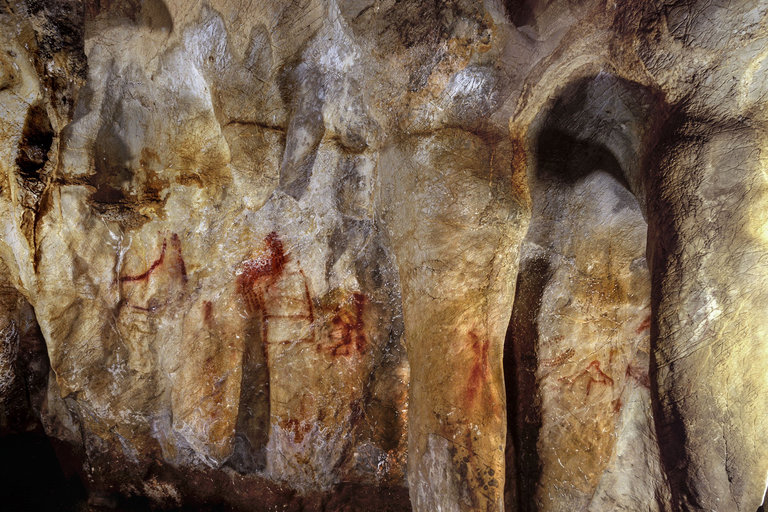
La Pasiega, section C. Cave wall with paintings. The scalariform (ladder shape) composed of red horizontal and vertical lines (centre left) dates to older than 64,000 years and was made by Neanderthals.
The red and black paintings are primitive yet unmistakable: animals, human hands, linear signs, dots, and club shapes. The prehistoric images, created in the depths of Spanish caves, have fascinated anthropologists and tourists alike, who have all marveled at what they thought were examples of the artistic prowess of early humans.

These admirers were wrong, however, according to new research that concludes Neanderthals created the images, whose ages now make them the world's first known cave art. Some of the paintings date to at least 64,800 years ago, according to a paper published in the journal Science — and they are probably much older.

The prior record-holder for oldest cave art is a painting of a pig at Timpuseng cave in Sulawesi, Indonesia. It was dated to a minimum age of 35,400 years old.

"Cave art is amazing in all its forms," lead author Dirk Hoffmann of the Max Planck Institute for Evolutionary Anthropology's Department of Human Evolution told Seeker. "I never had any expectations about how old cave art is or who made it. I simply wanted to contribute to obtaining a robust chronology for cave art. It is certainly impressive to find out that some of the art is older than 64,000 years and still exists on cave walls."
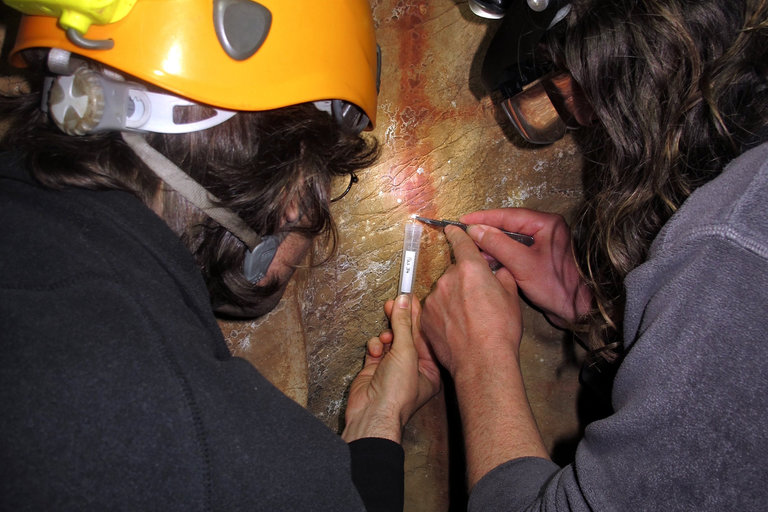
Dirk Hoffmann and Alistair Pike sampling calcite from a calcite crust on top of the red scalariform sign in La Pasiega
Senior author Alistair Pike of the University of Southampton's Department of Archaeology added that the team was very excited upon learning Neanderthals created the paintings. “It's really something to get up close to a hand stencil and to think this is the hand of a Neanderthal who stood on this spot more than 66,000 years ago," he said.

The international team of researchers from Germany, the United Kingdom, France, and Spain utilized a clever method, U-Th dating, to date the art at three sites: La Pasiega in northeastern Spain, Maltravieso in western Spain, and Ardales in southern Spain. The dating technique is based on the radioactive decay of uranium into thorium. It can determine ages up to 500,000 years ago.

Cave art often tends to be covered by carbonate deposits, which form via water precipitating out of the underlying rock over the millennia. These deposits contain traces of the radioactive elements of uranium and thorium.

U-Th dating has been around for years, but it initially required large samples of the carbonate material. Pike explained that he and others faced this challenge in 2003, when using the method to analyze cave art in Creswell Crags, which is located in Derbyshire, England.

Hoffmann, employing state of the art mass spectrometers, improved on the U-Th dating method: Now only a few milligrams of carbonate material are needed. This eliminates the risk of damaging the priceless artwork underneath.

Taking more than 60 samples, the researchers determined that, at minimum, the Spanish cave art was created around 64,800 years ago — 20,000 years before fossil evidence shows anatomically modern humans were in Europe.

"The paintings could be much older," co-author Joao Zilhão of the Catalan Institute for Research and Advanced Studies told Seeker.

He added that stone circles in Bruniquel Cave, southwest France, date to around 175,000 years ago, "which shows that people — in this case Neanderthals — were going underground, 300 meters (984.3 feet) from a cave entrance, to so stuff that required planning, time, lighting, etc., and what for? Were they the first people going into caves for sports? I don't know about others, but I find that hard to believe."
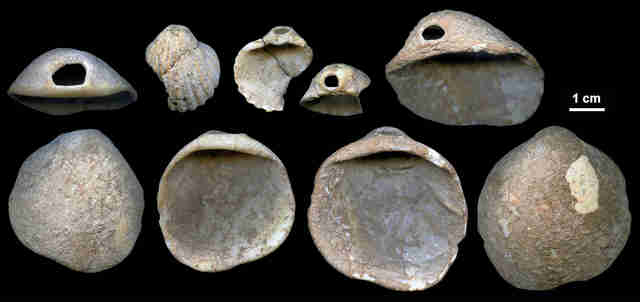
Perforated shells found in sediments in Cueva de los Aviones and date to between 115,000 and 120,000 years
Zilhão is the senior author of a new and related paper published in the journal Science Advances. In it, lead author Hoffmann and other colleagues report the discovery of marine shells from yet another Spanish cave, Cueva de los Aviones in the southeastern part of the country. The shells, dated to 115,000–120,000 years ago, were punctured and colored with mineral pigments.

Early symbolic artifacts from Africa date to about 92,000 years ago.

Given the age of the Spanish decorated shells, again preceding fossil evidence for humans in the region, the evidence suggests that Neanderthals decorated the shells and possessed symbolic material culture. This refers to a collection of cultural and intellectual achievements handed down from generation to generation. So far, it has only been attributed to our own species, Homo sapiens.

Zilhão believes that Neanderthals are actually members of Homo sapiens. This possibility has been debated for decades, with some anthropologists believing that Neanderthals represent an entirely different species, others holding that they are a subspecies of Homo sapiens, and still others referring to them as members of our species, but representing a more archaic form.

If future studies support that Neanderthals did indeed have symbolic material culture, then there are additional important implications.

"Our results show that they were making deliberate decisions about what to create on cave walls," co-author Paul Pettitt of Durham University told Seeker. "Their art was an extension of the body; they used their hands directly to color stalactites at Ardales, to create negative stencils at Maltravieso and to create rectilinear designs with their fingertips at La Pasiega. This probably derived from the decoration — perhaps symbolically — of their bodies, but the interesting issue is why they were extending their body symbolism to cave walls."

"It is difficult not to invoke some kind of ritual behavior from this," Pettitt continued. "Why otherwise take risks for a behavior that has no immediate or obvious benefit to survival?"

By risks, he was referring to the inherent dangers of climbing into dark caves, where fossils for toothy mammal predators have been found and accidents could easily happen.

The first appearances of Neanderthals and "modern" humans in the fossil record predates their known artistic creations, which shows that they probably developed the skills over time. It is possible that each group did this independently. Studies on non-human primates show that individuals are capable of innovation, which can be learned by watching others.

It is thought, for example, that a clever capuchin monkey devised a new, effective way to crack nuts, by using a rock and a log like a hammer and anvil. Now many capuchins are cracking cashews and other nuts this way.

A particularly innovative Neanderthal or anatomically modern human could have invented painting — whether on the body, on shells, or cave walls — with the ability passed down to others.
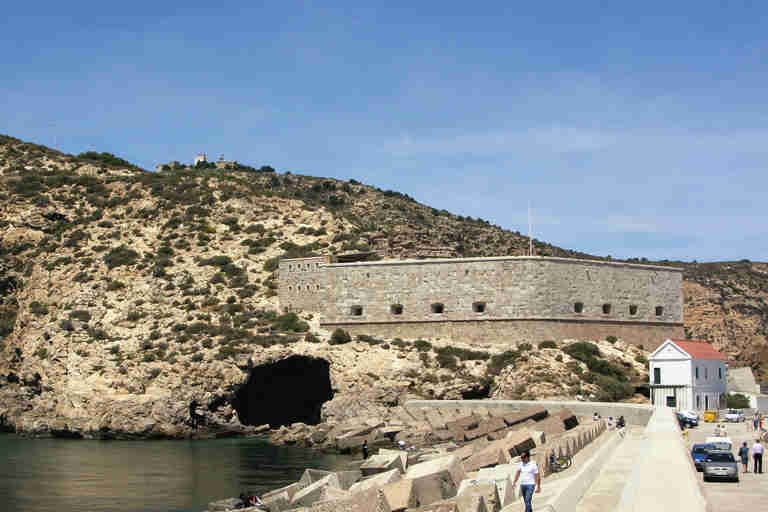
Cueva de los Aviones, seen from the breakwater of Cartagena harbor
As Zilhão said, the mental capacity for this and other skills must predate their actual manifestation. The capacity, he believes, must have been present in the common ancestor of Neanderthals and modern humans. This ancestor is thought to have lived about 500,000 years ago.

The related cognitive hardwiring could even go back to 1.5 million years ago, when fossils suggest that humans were evolving larger brains than their primate ancestors.

"That material culture, archaeologically visible manifestations, only appears after 200,000 years ago probably means that it is at a time when individual and social interactions became so complex that conventions, signs, and symbols became necessary for the transmission of information about status, territory, ethnicity, rights over the resources of land, etc.," Zilhão explained.

Israel Hershkovitz, an expert on early human evolution at Tel Aviv University, notes that the dates of the Spanish cave art coincide with an extensive modern human migration out of Africa. Hershkovitz, who did not work on the new studies, told Seeker, "Members of this group could have reached the Iberian Peninsula through the Gibraltar Straight."

He added, "I am aware that, for the time being, fossil evidence for modern humans (in Spain) is dated to less than 45,000 years ago, but this is for the time being. I would not be surprised if they were there much earlier."

On the other hand, he said that he "would not be surprised" if the cave art and decorated shells were produced by Neanderthals.

"Why not?" he asked. "After all, Neanderthals and modern humans share the same tool technology, and by judging from tool assemblages alone there is no way to know whether a given site was inhabited by Neanderthals or modern humans."

Hoffmann and his team faced somewhat similar challenges in teasing apart the ancient from the more recent paintings in the Spanish caves.

"You need to think about cave walls the same way as you would about the walls of a medieval church," Zilhão explained. "They were painted and repainted over the ages, so it is entirely possible that paintings made 60,000, 40,000, 20,000, or 10,000 years ago co-exist on the same surface, even on the same panel. The only way to constrain the age of a given painting is by dating the calcite found on top, or under it."

Chris Stringer of the Natural History Museum in London is one of the world's leading authorities on human evolution. He suspects that primitive members of both the modern human and Neanderthal lineages could have co-existed in western Asia.

"Could western Asia have been the conduit for exchanges of ideas between more ancient human populations in Africa and Eurasia, in either direction, and could this have included traditions of artistic expression?" he asked.

"From the new evidence, it could even be argued that the Neanderthals taught traditions of cave art to modern humans when they encountered them about 45,000 years ago, and indeed, modern humans could certainly have encountered earlier Neanderthal markings in caves and embellished them," Stringer told Seeker.

He quickly added, however, that the Sulawesi cave art could have been produced by modern humans, who might have brought such skills from their African ancestral homeland.

Read more at Seeker

Feb 21, 2018

Did humans speak through cave art? Ancient drawings and language's origins

Ancient art in the Altai Mountains, Russia. While the world’s best-known cave art exists in France and Spain, examples of it abound throughout the world.
When and where did humans develop language? To find out, look deep inside caves, suggests an MIT professor.

More precisely, some specific features of cave art may provide clues about how our symbolic, multifaceted language capabilities evolved, according to a new paper co-authored by MIT linguist Shigeru Miyagawa.

A key to this idea is that cave art is often located in acoustic "hot spots," where sound echoes strongly, as some scholars have observed. Those drawings are located in deeper, harder-to-access parts of caves, indicating that acoustics was a principal reason for the placement of drawings within caves. The drawings, in turn, may represent the sounds that early humans generated in those spots.

In the new paper, this convergence of sound and drawing is what the authors call a "cross-modality information transfer," a convergence of auditory information and visual art that, the authors write, "allowed early humans to enhance their ability to convey symbolic thinking." The combination of sounds and images is one of the things that characterizes human language today, along with its symbolic aspect and its ability to generate infinite new sentences.

"Cave art was part of the package deal in terms of how homo sapiens came to have this very high-level cognitive processing," says Miyagawa, a professor of linguistics and the Kochi-Manjiro Professor of Japanese Language and Culture at MIT. "You have this very concrete cognitive process that converts an acoustic signal into some mental representation and externalizes it as a visual."

Cave artists were thus not just early-day Monets, drawing impressions of the outdoors at their leisure. Rather, they may have been engaged in a process of communication.

"I think it's very clear that these artists were talking to one another," Miyagawa says. "It's a communal effort."

The paper, "Cross-modality information transfer: A hypothesis about the relationship among prehistoric cave paintings, symbolic thinking, and the emergence of language," is being published in the journal Frontiers in Psychology. The authors are Miyagawa; Cora Lesure, a PhD student in MIT's Department of Linguistics; and Vitor A. Nobrega, a PhD student in linguistics at the University of Sao Paulo, in Brazil.

Re-enactments and rituals?

The advent of language in human history is unclear. Our species is estimated to be about 200,000 years old. Human language is often considered to be at least 100,000 years old.

"It's very difficult to try to understand how human language itself appeared in evolution," Miyagawa says, noting that "we don't know 99.9999 percent of what was going on back then." However, he adds, "There's this idea that language doesn't fossilize, and it's true, but maybe in these artifacts [cave drawings], we can see some of the beginnings of homo sapiens as symbolic beings."

While the world's best-known cave art exists in France and Spain, examples of it exist throughout the world. One form of cave art suggestive of symbolic thinking -- geometric engravings on pieces of ochre, from the Blombos Cave in southern Africa -- has been estimated to be at least 70,000 years old. Such symbolic art indicates a cognitive capacity that humans took with them to the rest of the world.

"Cave art is everywhere," Miyagawa says. "Every major continent inhabited by homo sapiens has cave art. ... You find it in Europe, in the Middle East, in Asia, everywhere, just like human language." In recent years, for instance, scholars have catalogued Indonesian cave art they believe to be roughly 40,000 years old, older than the best-known examples of European cave art.

But what exactly was going on in caves where people made noise and rendered things on walls? Some scholars have suggested that acoustic "hot spots" in caves were used to make noises that replicate hoofbeats, for instance; some 90 percent of cave drawings involve hoofed animals. These drawings could represent stories or the accumulation of knowledge, or they could have been part of rituals.

In any of these scenarios, Miyagawa suggests, cave art displays properties of language in that "you have action, objects, and modification." This parallels some of the universal features of human language -- verbs, nouns, and adjectives -- and Miyagawa suggests that "acoustically based cave art must have had a hand in forming our cognitive symbolic mind."

Future research: More decoding needed

To be sure, the ideas proposed by Miyagawa, Lesure, and Nobrega merely outline a working hypothesis, which is intended to spur additional thinking about language's origins and point toward new research questions.

Regarding the cave art itself, that could mean further scrutiny of the syntax of the visual representations, as it were. "We've got to look at the content" more thoroughly, says Miyagawa. In his view, as a linguist who has looked at images of the famous Lascaux cave art from France, "you see a lot of language in it." But it remains an open question how much a re-interpretation of cave art images would yield in linguistics terms.

The long-term timeline of cave art is also subject to re-evaluation on the basis of any future discoveries. If cave art is implicated in the development of human language, finding and properly dating the oldest known such drawings would help us place the orgins of language in human history -- which may have happened fairly early on in our development.

"What we need is for someone to go and find in Africa cave art that is 120,000 years old," Miyagawa quips.

At a minimum, a further consideration of cave art as part of our cognitive development may reduce our tendency to regard art in terms of our own experience, in which it probably plays a more strictly decorative role for more people.

Read more at Science Daily

Feb 13, 2018

Rock art: Life-sized sculptures of dromedaries found in Saudi Arabia

High relief of standing dromedary on sandstone spur at center of image.
At a remarkable site in northwest Saudi Arabia, a CNRS archaeologist and colleagues from the Saudi Commission for Tourism and National Heritage (SCTH) have discovered camelid sculptures unlike any others in the region. They are thought to date back to the first centuries BC or AD. The find sheds new light on the evolution of rock art in the Arabian Peninsula and is the subject of an article published in Antiquity (February 2018).

Located in the province of Al Jawf in northwest Saudi Arabia, Camel Site, as it is known, was explored in 2016 and 2017 by a Franco-Saudi research team. The sculptures, some incomplete, were executed on three rocky spurs there. Though natural erosion has partly destroyed some of the works, as well as any traces of tools, the researchers were able to identify a dozen or so reliefs of varying depths representing camelids and equids. The life-sized sculpted animals are depicted without harnessing in a natural setting. One scene in particular is unprecedented: it features a dromedary meeting a donkey, an animal rarely represented in rock art. Some of the works are thus thematically very distinct from the representations often found in this region. Technically, they also differ from those discovered at other Saudi sites -- frequently simple engravings of dromedaries without relief -- or the sculpted facades of Al Ḩijr (Madâ'in Şâliḩ). In addition, certain Camel Site sculptures on upper rock faces demonstrate indisputable technical skills. Camel Site can now be considered a major showcase of Saudi rock art in a region especially propitious for archaeological discovery.

Though the site is hard to date, comparison with a relief at Petra (Jordan) leads the researchers to believe the sculptures were completed in the first centuries BC or AD. Its desert setting and proximity to caravan routes suggest Camel Site -- ill suited for permanent settlement -- was a stopover where travelers could rest or a site of worship.

From Science Daily

Sep 25, 2017

Ancient Egyptians Provided a Proper Burial to a Statue of a Revered Deity

Osiris statuette
After years of being washed, perfumed and fed in ancient Egypt, the statue of a revered Egyptian deity was given a proper burial with other "dead" statues more than 2,000 years ago, a new study finds.

Ancient Egyptians buried the statue of the deity Ptah — the god of craftsmen and sculptors — with other revered statues, including those of a sphinx, baboon, cat, Osiris, and Mut, in a pit next to Ptah's temple.

The statue of Ptah had likely sat in the temple for years, but it and the other sacred objects were respectfully buried after they accumulated damage and were declared useless by the ancient Egyptians, the researchers said.

"We can consider that when a new statue was erected in the temple, this one [of Ptah] was set aside in a pit," said study co-researcher Christophe Thiers, director of the French-Egyptian Center for the Study of the Temples of Karnak. "The other artifacts were also previously damaged during their ‘lifetime’ in the temple, and then they were buried with the Ptah statue."

Archaeologists discovered the pit in December 2014 at Karnak, an Egyptian temple precinct, and spent about a month excavating its rich assemblage. The pit held 38 objects, including:

Fourteen statuettes and figurines of Osiris.
Eleven fragments of inlay from statues.
The inlay included that of an iris, a cornea, a false beard, a cap, a strand of hair and an inlay plaque.
Three baboon statuettes (representing the god Thoth).
Two statuettes of the goddess Mut (one with hieroglyphic inscriptions).
Two unidentified statuette bases.
One head and one fragmentary statuette of a cat (Bastet).
One small fragmentary faience stele (a stone slab) recording the name of the god Ptah.
One head of a statuette of a man in gilded limestone.
One lower part of a statue of the seated god Ptah, sawn and repaired.
One sphinx.
One unidentified metal piece.

The favissa contained 38 objects, including (clockwise from top left) a male head made of gilded limestone, the lower part of the limestone statue of the god Ptah, a statuette of Osiris, and a limestone sphinx.
It appeared that the artifacts were buried in a certain order. After digging the pit, also known as a favissa (a cache of sacred objects that are no longer in use), the ancient Egyptians would have put down the lower part of Ptah's limestone statue. The statue was large, and it probably took two to three people to carry it, the researchers said.

Next to the statue, the Egyptians would have placed a wooden effigy of the god Osiris that had metal appliqué, including a beard and two feathers in its crown. Then, the other artifacts would have been distributed around these two artifacts, which were then covered with about 8 inches (20 centimeters) of backfill. This is where the ancient Egyptians placed a statue of a small limestone sphinx.

The pit was then covered with more backfill. At the top, the Egyptians placed a small male head made of gilded limestone, likely for protection, the researchers said.

The objects were made at different times, the researchers found. The statue of Ptah dates to the New Kingdom; the style of the sphinx supports a late Ptolemaic date; and the gilded head dates to the early Ptolemaic period, the researchers said. However, by studying the site's rock layers, the researchers found that the artifacts were buried by the temple's priests during the second half of the Ptolemaic period, between the second century B. and the middle of the first century BC, the researchers wrote in the study.

Read more at Seeker

Aug 22, 2017

X-Ray Reveals Ancient Roman Portrait Covered in Mt. Vesuvius Ash

An iron element map (right) made with new X-ray technology reveals the underlying craftsmanship hidden beneath a damaged portrait of a Roman woman (left).
For centuries, the ancient Roman resort town of Herculaneum was buried under 66 feet of volcanic material. The city on the Italian coast, along with nearby Pompeii, was destroyed during an eruption of Mount Vesuvius in 79 AD. Excavations in the mid-19th century uncovered much of Herculaneum, including its large “House of the Mosaic Atrium,” but an ancient painting in the house went almost unnoticed, until now.

A newly developed portable macro X-ray fluorescence instrument, ELIO by XGLab SRL, revealed the Roman woman in the portrait that has been subjected to molten lava, volcanic ash, grime, salt, and humidity over the years. As if that weren’t rough treatment enough, its exposure since it was excavated 70 years ago has caused much of it to deteriorate.

The portable X-ray instrument was brought directly to the site at Herculaneum, where the noninvasive analysis of the mid-1st century AD painting occurred.

“As far as we know, this is the first study of an ancient Roman wall painting — or any other historical wall painting — in situ, in its original setting,” Eleonora Del Federico, a professor of chemistry at the Pratt Institute who studies artists’ materials and conservation, told Seeker. “The technique is fairly new, and has been used for studies at museums on Rembrandts, Picassos and Van Goghs, among others.”

The ELIO device scanning the Roman portrait within the House of the Mosaic Atrium at Herculaneum.
While ELIO works best at just over a half an inch away from an artwork’s surface, the instrument never actually touches a painting. It is not difficult to operate, but ELIO is not cheap and the data analysis and interpretation of the results it provides require specialized training.

Del Federico, who conducted this latest research in conjunction with the Herculaneum Conservation Project, will present her findings today at the 254th National Meeting & Exposition of the American Chemical Society in Washington, DC.

Her analysis revealed that an artist created a sketch of the young woman with an iron-based pigment, and then put highlighting around the woman’s eyes in the sketch with a lead pigment. High levels of potassium in the woman’s cheeks in the artwork suggest that a green Earth pigment was used as an underpainting to help create a flesh-toned color.

“We were very surprised at the complexity and sophistication of the painting technique, the use of color, mixture of pigments and layering,” Del Federico said.

Images of the early Roman painting showing the various elements revealed by the macro X-ray fluorescence instrument.
She explained that the painting method actually involved two primary techniques. The first, known as fresco, involved applying pigments on a wet surface of lime mortar, which consists of a mixture of calcium hydroxide and sand and/or pumice stone. The second, called secco, involved applying pigments with organic binders to the surface once the lime mortar had set.

Together, these methods were used to contour the portrait and to give realistic-looking volume to the subject’s face, cheeks and nose.

ELIO allowed Del Federico to create an “iron map” highlighting the woman’s primary features.

“When we look at the map of iron atoms, it reveals a beautiful young woman caught in a moment of deep thought,” she said. “You can always feel her presence, talk to her and feel her humanity, at least for me. She was gone by the years of exposure to the elements, and now she is back to life.”

The portrait is not signed, so the artist, for now, remains a mystery. Intriguingly, a similar portrait known as “Saffo” is on exhibit at the National Archaeological Museum of Naples. It is possible that both portraits were created by an artist who was given the honorary title “pictor imaginarius.” Many painters worked in early Roman towns, but the “pictor imaginarius” was among the most skilled, and would be brought in to tackle prominent wall areas requiring greater expertise.

A sketch of the woman in the early Roman painting created with an iron-based pigment.
As for who the woman was in the Herculaneum portrait, she remains a mystery for now, too. Del Federico said that she is possibly wearing a tiara. The House of the Mosaic Atrium “was indeed a well-to-do household, but not necessarily aristocratic.”

Roger Ling, a professor of classical art and archaeology at the University of Manchester, believes that a portrait such as this functioned as “a symbol of aristocratic luxury by which householders liked to surround themselves.”

Del Federico added, “A good quality wall painting was a sign of status.”

Read more at Seeker

Dec 23, 2016

5,000-Year-Old Nativity Scene Found in Egypt

Italian researchers have discovered what might be the oldest nativity scene ever found — 5,000-year-old rock art that depicts a star in the east, a newborn between parents and two animals.

The scene, painted in reddish-brown ochre, was found on the ceiling of a small cavity in the Egyptian Sahara desert, during an expedition to sites between the Nile valley and the Gilf Kebir Plateau.

"It's a very evocative scene which indeed resembles the Christmas nativity. But it predates it by some 3,000 years," geologist Marco Morelli, director of the Museum of Planetary Sciences in Prato, near Florence, Italy, told Seeker.

Morelli found the cave drawing in 2005, but only now his team has decided to reveal the amazing find.

"The discovery has several implications as it raises new questions on the iconography of one of the more powerful Christian symbols," Morelli said.

The scene features a man, a woman missing the head because of a painting detachment, and a baby.

"It could have been interpreted as a normal depiction of a family, with the baby between the parents, but other details make this drawing unique," Morelli said.

He noted the newborn is drawn slightly above, as if raising to the sky. Such position, with the baby not yet between the parents, would have meant a birth or a pregnancy.

"As death was associated to Earth in contemporary rock art from the same area, it is likely that birth was linked to the sky," Morelli said.

The scene becomes more symbolically complex if the other figures, two animals and a small circular feature, are taken into consideration.

Read more at Discovery News

Nov 4, 2016

Flood-Damaged Masterpiece Miraculously Restored

Exactly 50 years ago, on Nov. 4, 1966, the river Arno burst its banks and raced through Florence in the worst flood the city had seen in centuries.

Muddy waters rushed into my family's home as well as into the homes of thousands of Florentines. The flood came with little warning, claiming the lives of 34 people. Raging torrents entered streets, houses, shops, museums, churches and libraries.

Thousands of frescoes, paintings, sculptures and rare books were destroyed or terribly damaged by slime in one of the greatest cultural disasters of modern times.

Such was the devastation that an army of young volunteers — known as "the mud angels" — came from all over Europe and America to help rescue Florence's treasures.

The prompt intervention of restorers and new methods of restoration in the following decades made it possible to salvage almost all of the damaged artworks.

One masterpiece, however, was considered beyond saving. Giorgio Vasari's "Last Supper," a large painting on five wooden panels, remained for four decades in storage, and restorers did not even dare to touch the cracked panels.

Today, Vasari's "Last Supper," the last major flood-damaged artwork that remained untreated, has been returned to public viewing in Santa Croce Church.

"It's a dream that has become reality," Marco Ciatti, head of the renowned restoration center Opificio delle Pietre Dure (OPD) in Florence, said.

More than 8 feet high and 21 feet across, Vasaris' painting was commissioned by the nuns of the Murate convent in Florence. Vasari was best known for writing one of the first great books of art history, "Lives of the Most Excellent Italian Painters, Sculptors." He was also a painter and architect.

The nuns' cloistered rule prohibited male artists from staying in the convent, so Vasari split the painting of Christ and his disciples into five portable poplar panels so he could work on the piece elsewhere and then transport it into the convent in parts. He completed the monumental painting in 1546.

After being moved several times, the "Last Supper" was installed at the museum of Santa Croce Church. When the river flooded, it remained completely immersed in filthy, oily water for at least 12 hours.

In the first hours after the flood, a team of restorers, led by art conservator Umberto Baldini, separated the panels and attached protective sheets of Japanese paper all over them in a desperate attempt to prevent the paint from flaking off.

"We can now say that system has worked. However, the glue used to attach the paper was a very strong acrylic resin which over the decades became an impermeable plate," Ciatti told Seeker.

One of the panels as it appeared 10 years ago.
When Ciatti showed me the panels 10 years ago, on the 40th anniversary of the flood, all I could see was a gray crust. Laying horizontally in the cavernous OPD lab, the panels were a sorry sight. Vasari's painting was totally unviewable under a crust of dried, cracked paper.

Ciatti's team had to face several issues. First, there was the problem of the wood support and the ground layer underneath the painting. Consisting of a binder, chalk and animal glue, this layer was the surface for the paint.

"As the wood panels dried, they shrank, stressing the painting's surface. Meanwhile the chalk and glue, which are soluble in water, degraded dramatically," Ciatti said.

"The contraction of the wood and the decohesion of the ground layer caused the painted surface to detach," he added.

Meanwhile, restorers faced another problem: how to peel the paper and the resin away without removing Vasari's paint.

Ten years ago, Roberto Bellucci, senior painting conservator at the Opificio, figured out how to remove the paper layer and the acrylic resin used as a glue. During my visit at the Opificio, I was lucky to see a bearded St. Peter emerging from the paper crust for the first time in 40 years.

Surprisingly, the blue and yellow of St. Peter's clothes were still vivid and looked much as they did before the flood.

"The color was still there, beneath the dirt, the glue and the paper. Without Baldini's emergency intervention, the painting would have been lost forever," Ciatti said.

Restoration of Giorgio Vasari's Last Supper
When the Getty Foundation and Prada provided a major grant to the OPD, Ciatti's team was able to restore the wood panels and stabilize the artwork in four year's time.

Senior painting conservator Ciro Castelli returned the wood to its original size by taking advantage of the splits that had opened in the waterlogged panels. Tiny slivers of poplar wood were inserted in the gaps to counter the contraction of the wood.

Using special synthetic resins, Bellucci managed to restore adhesion of the flaked paint to the surface, while securing the ground layer.

"The result is amazing. It went beyond my expectations. Our success is due to innovative products and technologies, but most of all to the dexterity of our restorers," Ciatti said.

The "Last Supper" now appears in all its glory of vibrant color, light and shadow.

Ciatti explained that any minor loss of color in the painting was not caused by the flood but likely by previous restoration efforts. He found inscriptions describing at least two interventions on the painting in 1594 and 1718.

Read more at Discovery News

Sep 28, 2016

5,000-Year-Old Swirling Rock Art Remains a Mystery

The Cochno Stone, which dates back to around 3000 B.C., contains a type of artwork called "cup and ring marks."
Archaeologists in Glasgow, Scotland, briefly excavated and then reburied a 5,000-year-old slab of stone that contains incised swirling geometric decorations.

The Cochno Stone, which measures 43 feet by 26 feet, contains swirling decorations, also called "cup and ring marks." The stone and its decorations have been known to people in the area since at least the 19th century. Decorations similar to these swirls have been found at other prehistoric sites around the world; however, the examples incised in the Cochno Stone are considered to comprise "one of the best examples" of such art in Europe, according to a statement by the University of Glasgow, which led the new study.

The stone slab was fully unearthed in West Dunbartonshire by Rev. James Harvey in 1887. By 1965, the stone had been vandalized with graffiti and damaged by the elements, so a team of archaeologists buried it beneath the dirt in order to protect the artwork . This summer's two-week re-excavation allowed archaeologists to use modern-day surveying and photography techniques to better record the artwork.

For instance, digital-scanning and mapping experts from the Factum Foundation used cutting-edge 3D-imaging technology to make a detailed digital record of the site, according to the university statement.

The re-excavation also revealed 19th- and 20th-century graffiti etched alongside the swirls, as well as painted lines intentionally made by an archaeologist named Ludovic Maclellan Mann, who worked at the site in 1937. Mann painted lines on the Cochno Stone to help measure the prehistoric artwork and see if there was a link to astronomical phenomena, such as eclipses.

Mann "was trying to prove that the symbols could predict eclipses and were marking movements of the sun and moon in prehistory," said Kenny Brophy, an archaeologist and senior lecturer at the University of Glasgow, in a video released by the university. He said that Mann's own data ended up disproving the archeologist's theory.

The meaning of the artwork is still unknown, said Brophy, adding that the vast amount of data gathered this summer may, in time, allow archaeologists to better understand the artifact. He said that the graffiti is also of interest and will help archaeologists better understand what people who lived in the local area thought of the artwork during the 19th and 20th centuries and how they incorporated it into their lives.

Read more at Discovery News

May 26, 2016

High altitude archaeology: Prehistoric paintings revealed

The paintings at the Abri Faravel. Two groups of roughly parallel lines, and two animals facing one another. (a) Normal light image; (b) Zoom of paintings -- colours enhanced with DStretch with the YBR matrix.
Archaeologists at the University of York have undertaken pioneering scans of the highest prehistoric paintings of animals in Europe.

Studying the rock paintings of Abri Faravel, a rock shelter in the Southern French Alps 2,133m above sea level, archaeologists used car batteries to power laser and white-light scanners in a logistically complex operation.

Producing virtual models of the archaeological landscape, researchers have now published the scans in Internet Archaeology -- an online, open-access journal.

Abri Faravel was discovered fortuitously in 2010. The rock shelter has seen phases of human activity from the Mesolithic to the medieval period, with its prehistoric rock paintings known to be the highest painted representations of animals (quadrupeds) in Europe.

The study of Abri Faravel and its paintings is part of a wider collaborative project between the University of York and the Centre Camille Jullian, Aix-en-Provence, France. Undertaking research in the Parc National des E?crins, the long-running study investigates the development of human activity over the last 8,000 years at high altitude in the Southern Alps.

Research conducted so far includes the excavation of a series of stone animal enclosures and human dwellings considered some of the most complex high altitude Bronze Age structures. Artefacts found in Abri Faravel also include Mesolithic and Neolithic flint tools, Iron Age hand-thrown pottery, a Roman fibula and some medieval metalwork.

However, the paintings are the most unique feature of the site, revealing a story of human occupation and activity in one of the world's most challenging environments from the Mesolithic to Post-Medieval period.

Dr Kevin Walsh, Senior Lecturer in York's Department of Archaeology and project lead, said: "After years of research in this valley, the day we discovered these paintings was undeniably the highlight of the research programme.

"Whilst we thought that we might discover engravings, such as in the Vallée des Merveilles to the south-east, we never expected to find prehistoric paintings in this exposed area that affords so few natural shelters.

Read more at Science Daily

May 23, 2016

Iconic Art Shows Disease Unknown for a Century

Science's most famous picture, Joseph Wright's "An Experiment on a Bird in the Air Pump," contains the accurate representation of a skin rash that is indicative of a disease recognized more than a century later, according to a new study of the iconic painting.

Depicting an 18th century scientific demonstration of the properties of the vacuum, the 1768 painting may also feature the first ever picture of dermatomyositis. This is a rare inflammatory disease of the muscle, skin and blood vessels that was clinical described in the last decades of the 19th century.

The painting, currently on a National Gallery loan to Tate Britain, is widely recognized as an artistic milestone that reflects the Enlightenment era where modern society's exposure to science had been initiated. It portrays a wizard-Iike scientist, surrounded by spectators, pumping air out of flask containing a poor cockatoo.

The candlelit scene shows the moment when the bird will either die or be allowed to revive by the demonstrator, who looks straight out of the picture and doesn’t appear to be emotionally connected to the dying bird.

“Additionally two young lovers fail to notice the experiment due to their intoxication with each other, whilst a father consoles his two horrified children who cannot bear to experience the death of the bird despite the scientific lesson,” Hutan Ashrafian, a surgeon at Imperial College London, wrote in the journal Clinical Rheumatology.

But aside from containing a prominent metaphor of the role of scientists and the different attitudes around scientific facts, Wright's masterpiece may now be celebrated for its representation of real-life pathology.

“When we look at the painting with much higher detail, it is clear the father character has a skin rash that is consistent with the disease of dermatomyositis,” Ashrafian told Discovery News. “The dermatopathology on the hand is most characteristic of Gottron’s papules, which is indicative of dermatomyositis."

This diagnosis is also consistent with the rash on the subjects other hand and face.

Such red bumps overlying the knuckles of the fingers were first described by German dermatologist Heinrich Adolf Gottron in 1931, some 163 years after Wright's depiction in "The Air Pump."

Dermatomyositis is a systemic inflammatory neuromuscular disorder that was first described a bit earlier, in 1891, by Heinrich Unverricht.

“The depiction of the disease is so clear and accurate in the painting that it must have reflected the actual existence of an underlying disease in the portrayed father character,” Ashrafian said.

The finding remarks Wright's skill in painting exactly what he saw, but also adds a powerful metaphor.

Read more at Discovery News