 |
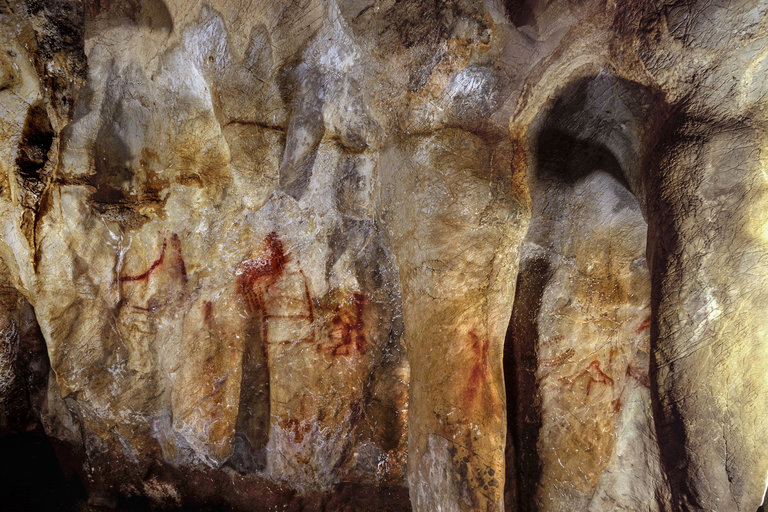
| La Pasiega, section C. Cave wall with
paintings. The scalariform (ladder shape) composed of red horizontal and
vertical lines (centre left) dates to older than 64,000 years and was
made by Neanderthals. |
The red and black paintings are primitive yet unmistakable: animals, human hands, linear signs, dots, and club shapes. The prehistoric images, created in the depths of Spanish caves, have fascinated anthropologists and tourists alike, who have all marveled at what they thought were examples of the artistic prowess of early humans.
These admirers were wrong, however, according to new research that concludes Neanderthals created the images, whose ages now make them the world's first known cave art. Some of the paintings date to at least 64,800 years ago, according to a paper published in the journal Science — and they are probably much older.
The prior record-holder for oldest cave art is a painting of a pig at Timpuseng cave in Sulawesi, Indonesia. It was dated to a minimum age of 35,400 years old.
"Cave art is amazing in all its forms," lead author Dirk Hoffmann of the Max Planck Institute for Evolutionary Anthropology's Department of Human Evolution told Seeker. "I never had any expectations about how old cave art is or who made it. I simply wanted to contribute to obtaining a robust chronology for cave art. It is certainly impressive to find out that some of the art is older than 64,000 years and still exists on cave walls."
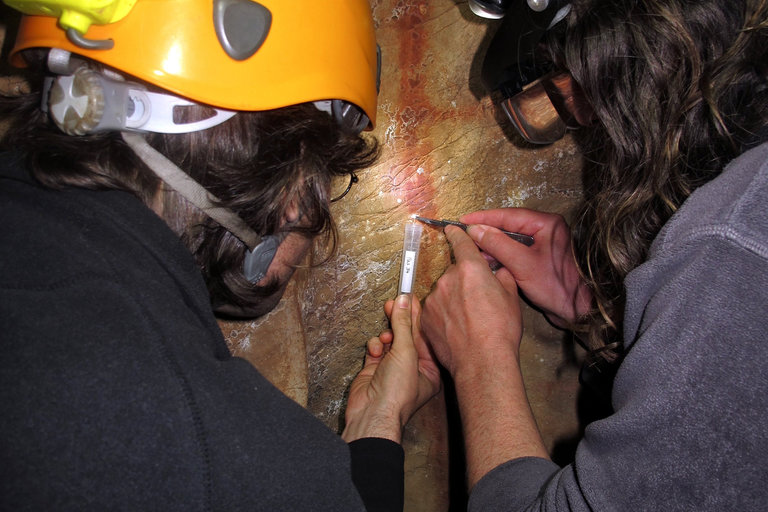 |
| Dirk Hoffmann and Alistair Pike sampling calcite from a calcite crust on top of the red scalariform sign in La Pasiega |
Senior author Alistair Pike of the University of Southampton's Department of Archaeology added that the team was very excited upon learning Neanderthals created the paintings. “It's really something to get up close to a hand stencil and to think this is the hand of a Neanderthal who stood on this spot more than 66,000 years ago," he said.
The international team of researchers from Germany, the United Kingdom, France, and Spain utilized a clever method, U-Th dating, to date the art at three sites: La Pasiega in northeastern Spain, Maltravieso in western Spain, and Ardales in southern Spain. The dating technique is based on the radioactive decay of uranium into thorium. It can determine ages up to 500,000 years ago.
Cave art often tends to be covered by carbonate deposits, which form via water precipitating out of the underlying rock over the millennia. These deposits contain traces of the radioactive elements of uranium and thorium.
U-Th dating has been around for years, but it initially required large samples of the carbonate material. Pike explained that he and others faced this challenge in 2003, when using the method to analyze cave art in Creswell Crags, which is located in Derbyshire, England.
Hoffmann, employing state of the art mass spectrometers, improved on the U-Th dating method: Now only a few milligrams of carbonate material are needed. This eliminates the risk of damaging the priceless artwork underneath.
Taking more than 60 samples, the researchers determined that, at minimum, the Spanish cave art was created around 64,800 years ago — 20,000 years before fossil evidence shows anatomically modern humans were in Europe.
"The paintings could be much older," co-author Joao Zilhão of the Catalan Institute for Research and Advanced Studies told Seeker.
He added that stone circles in Bruniquel Cave, southwest France, date to around 175,000 years ago, "which shows that people — in this case Neanderthals — were going underground, 300 meters (984.3 feet) from a cave entrance, to so stuff that required planning, time, lighting, etc., and what for? Were they the first people going into caves for sports? I don't know about others, but I find that hard to believe."
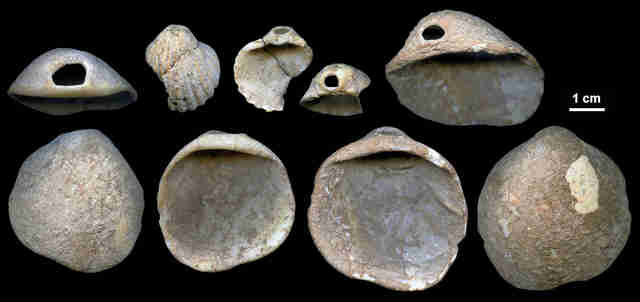 |
| Perforated shells found in sediments in Cueva de los Aviones and date to between 115,000 and 120,000 years |
Zilhão is the senior author of a new and related paper published in the journal Science Advances. In it, lead author Hoffmann and other colleagues report the discovery of marine shells from yet another Spanish cave, Cueva de los Aviones in the southeastern part of the country. The shells, dated to 115,000–120,000 years ago, were punctured and colored with mineral pigments.
Early symbolic artifacts from Africa date to about 92,000 years ago.
Given the age of the Spanish decorated shells, again preceding fossil evidence for humans in the region, the evidence suggests that Neanderthals decorated the shells and possessed symbolic material culture. This refers to a collection of cultural and intellectual achievements handed down from generation to generation. So far, it has only been attributed to our own species, Homo sapiens.
Zilhão believes that Neanderthals are actually members of Homo sapiens. This possibility has been debated for decades, with some anthropologists believing that Neanderthals represent an entirely different species, others holding that they are a subspecies of Homo sapiens, and still others referring to them as members of our species, but representing a more archaic form.
If future studies support that Neanderthals did indeed have symbolic material culture, then there are additional important implications.
"Our results show that they were making deliberate decisions about what to create on cave walls," co-author Paul Pettitt of Durham University told Seeker. "Their art was an extension of the body; they used their hands directly to color stalactites at Ardales, to create negative stencils at Maltravieso and to create rectilinear designs with their fingertips at La Pasiega. This probably derived from the decoration — perhaps symbolically — of their bodies, but the interesting issue is why they were extending their body symbolism to cave walls."
"It is difficult not to invoke some kind of ritual behavior from this," Pettitt continued. "Why otherwise take risks for a behavior that has no immediate or obvious benefit to survival?"
By risks, he was referring to the inherent dangers of climbing into dark caves, where fossils for toothy mammal predators have been found and accidents could easily happen.
The first appearances of Neanderthals and "modern" humans in the fossil record predates their known artistic creations, which shows that they probably developed the skills over time. It is possible that each group did this independently. Studies on non-human primates show that individuals are capable of innovation, which can be learned by watching others.
It is thought, for example, that a clever capuchin monkey devised a new, effective way to crack nuts, by using a rock and a log like a hammer and anvil. Now many capuchins are cracking cashews and other nuts this way.
A particularly innovative Neanderthal or anatomically modern human could have invented painting — whether on the body, on shells, or cave walls — with the ability passed down to others.
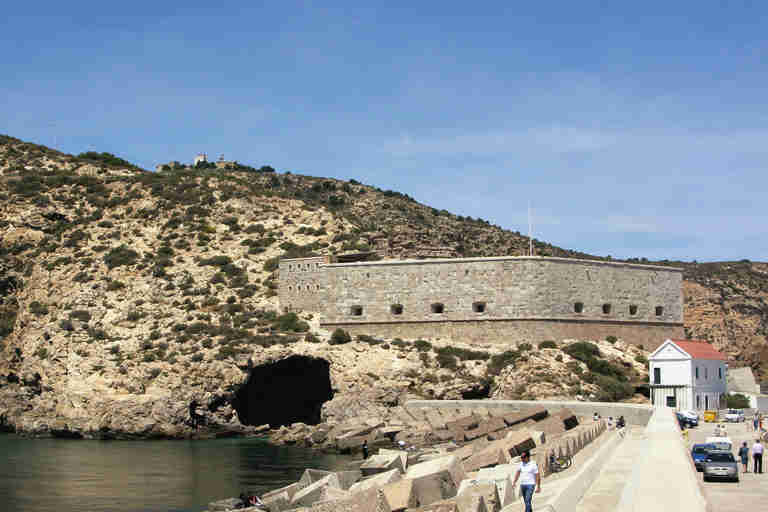 |
| Cueva de los Aviones, seen from the breakwater of Cartagena harbor |
As Zilhão said, the mental capacity for this and other skills must predate their actual manifestation. The capacity, he believes, must have been present in the common ancestor of Neanderthals and modern humans. This ancestor is thought to have lived about 500,000 years ago.
The related cognitive hardwiring could even go back to 1.5 million years ago, when fossils suggest that humans were evolving larger brains than their primate ancestors.
"That material culture, archaeologically visible manifestations, only appears after 200,000 years ago probably means that it is at a time when individual and social interactions became so complex that conventions, signs, and symbols became necessary for the transmission of information about status, territory, ethnicity, rights over the resources of land, etc.," Zilhão explained.
Israel Hershkovitz, an expert on early human evolution at Tel Aviv University, notes that the dates of the Spanish cave art coincide with an extensive modern human migration out of Africa. Hershkovitz, who did not work on the new studies, told Seeker, "Members of this group could have reached the Iberian Peninsula through the Gibraltar Straight."
He added, "I am aware that, for the time being, fossil evidence for modern humans (in Spain) is dated to less than 45,000 years ago, but this is for the time being. I would not be surprised if they were there much earlier."
On the other hand, he said that he "would not be surprised" if the cave art and decorated shells were produced by Neanderthals.
"Why not?" he asked. "After all, Neanderthals and modern humans share the same tool technology, and by judging from tool assemblages alone there is no way to know whether a given site was inhabited by Neanderthals or modern humans."
Hoffmann and his team faced somewhat similar challenges in teasing apart the ancient from the more recent paintings in the Spanish caves.
"You need to think about cave walls the same way as you would about the walls of a medieval church," Zilhão explained. "They were painted and repainted over the ages, so it is entirely possible that paintings made 60,000, 40,000, 20,000, or 10,000 years ago co-exist on the same surface, even on the same panel. The only way to constrain the age of a given painting is by dating the calcite found on top, or under it."
Chris Stringer of the Natural History Museum in London is one of the world's leading authorities on human evolution. He suspects that primitive members of both the modern human and Neanderthal lineages could have co-existed in western Asia.
"Could western Asia have been the conduit for exchanges of ideas between more ancient human populations in Africa and Eurasia, in either direction, and could this have included traditions of artistic expression?" he asked.
"From the new evidence, it could even be argued that the Neanderthals taught traditions of cave art to modern humans when they encountered them about 45,000 years ago, and indeed, modern humans could certainly have encountered earlier Neanderthal markings in caves and embellished them," Stringer told Seeker.
He quickly added, however, that the Sulawesi cave art could have been produced by modern humans, who might have brought such skills from their African ancestral homeland.
Read more at
Seeker


