Showing posts with label Galactic Evolution. Show all posts

May 27, 2023

New study provides novel insights into the cosmic evolution of amino acids

Scientists perform computational simulations for biological molecules detected in meteorites to clarify the origin of life on Earth.

All biological amino acids on Earth appear exclusively in their left-handed form, but the reason underlying this observation is elusive. Recently, scientists from Japan uncovered new clues about the cosmic origin of this asymmetry. Based on the optical properties of amino acids found on the Murchison meteorite, they conducted physics-based simulations, revealing that the precursors to the biological amino acids may have determined the amino acid chirality during the early phase of galactic evolution.

If you look at your hands, you will notice that they are mirror images of each other. However, no matter how hard you try to flip and rotate one hand, you will never be able to superimpose it perfectly over the other. Many molecules have a similar property called "chirality," which means that the "left-handed" (L) version of a molecule cannot be superimposed onto its "right-handed" (D) mirror image version. Even though both versions of a chiral molecule, called "enantiomers," have the same chemical formula, the way they interact with other molecules, especially with other chiral molecules, can vary immensely.

Interestingly, one of the many mysteries surrounding the origin of life as we know it has to do with chirality. It turns out that biological amino acids (AAs) -- the building blocks of proteins -- on Earth appear only in one of their two possible enantiomeric forms, namely the L-form. However, if you synthesize AAs artificially, both L and D forms are produced in equal amounts. This suggests that, at some early point in the past, L-AAs must have come to dominate a hetero-chiral world. This phenomenon is known as "chiral symmetry breaking."

Against this backdrop, a research team led by Assistant Professor Mitsuo Shoji from University of Tsukuba, Japan, conducted a study aimed at solving this mystery. As explained in their paper published in The Journal of Physical Chemistry Letters, the team sought to find evidence supporting the cosmic origin of the homochirality of AAs on Earth, as well as iron out some inconsistencies and contradictions in our previous understanding.

"The idea that homochirality may have originated in space was suggested after AAs were found in the Murchison meteorite that fell in Australia in 1969," explains Dr. Shoji. Curiously enough, in the samples obtained from this meteorite, each of the L-enantiomers was more prevalent than its D-enantiomer counterpart. One popular explanation for this suggests that the asymmetry was induced by ultraviolet circularly polarized light (CPL) in the star-forming regions of our galaxy. Scientists verified that this type of radiation can, indeed, induce asymmetric photochemical reactions that, given enough time, would favor the production of L-AAs over D-AAs. However, the absorption properties of the AA isovaline are opposite to those of the other AAs, meaning that the UV-based explanation alone is either insufficient or incorrect.

Against this backdrop, Dr. Shoji's team pursued an alternate hypothesis. Instead of far-UV radiation, they hypothesized that the chiral asymmetry was, in fact, induced specifically by the CP Lyman-α (Lyα) emission line, a spectral line of hydrogen atom that permeated the early Milky Way. Moreover, instead of focusing only on photoreactions in AAs, the researchers investigated the possibility of the chiral asymmetry starting in the precursors to the AAs, namely amino propanals (APs) and amino nitriles (ANs).

Through quantum mechanical calculations, the team analyzed Lyα-induced reactions for producing AAs along the chemical pathway adopted in Strecker synthesis. They then noted the ratios of L- to D-enantiomers of AAs, APs, and ANs at each step of the process.

The results showed that L-enantiomers of ANs are preferentially formed under right-handed CP (R-CP) Lyα irradiation, with their enantiomeric ratios matching those for the corresponding AAs. "Taken together, our findings suggest that ANs underlie the origin of the homochirality," remarks Dr. Shoji. "More specifically, irradiating AN precursors with R-CP Lyα radiation lead to a higher ratio of L-enantiomers. The subsequent predominance of L-AAs is possible via reactions induced by water molecules and heat."

Read more at Science Daily

May 27, 2022

Supermassive black holes inside of dying galaxies detected in early universe

An international team of astronomers used a database combining observations from the best telescopes in the world, including the Subaru Telescope, to detect the signal from the active supermassive black holes of dying galaxies in the early Universe. The appearance of these active supermassive black holes correlates with changes in the host galaxy, suggesting that a black hole could have far reaching effects on the evolution of its host galaxy.

The Milky Way Galaxy where we live includes stars of various ages, including stars still forming. But in some other galaxies, known as elliptical galaxies, all of the stars are old and about the same age. This indicates that early in their histories elliptical galaxies had a period of prolific star formation that suddenly ended. Why this star formation ceased in some galaxies but not others is not well understood. One possibility is that a supermassive black hole disrupts the gas in some galaxies, creating an environment unsuitable for star formation.

To test this theory, astronomers look at distant galaxies. Due to the finite speed of light, it takes time for light to travel across the void of space. The light we see from an object 10 billion light-years away had to travel for 10 billion years to reach Earth. Thus the light we see today shows us what the galaxy looked like when the light left that galaxy 10 billion years ago. So looking at distant galaxies is like looking back in time. But the intervening distance also means that distant galaxies look fainter, making study difficult.

To overcome these difficulties an international team led by Kei Ito at SOKENDAI in Japan used the Cosmic Evolution Survey (COSMOS) to sample galaxies 9.5-12.5 billion light-years away. COSMOS combines data taken by world leading telescopes, including the Atacama Large Millimeter/submillimeter Array (ALMA) and the Subaru Telescope. COSMOS includes radio wave, infrared light, visible light, and x-ray data.

The team first used optical and infrared data to identify two groups of galaxies: those with ongoing star formation and those where star formation has stopped. The x-ray and radio wave data signal-to-noise ratio was too weak to identify individual galaxies. So the team combined the data for different galaxies to produce higher signal to noise ratio images of "average" galaxies. In the averaged images, the team confirmed both x-ray and radio emissions for the galaxies without star formation. This is the first time such emissions have been detected for distant galaxies more than 10 billion light-years away. Furthermore, the results show that the x-ray and radio emissions are too strong to be explained by the stars in the galaxy alone, indicating the presence of an active supermassive black hole. This black hole activity signal is weaker for galaxies where star formation is ongoing.

Read more at Science Daily

Feb 24, 2022

Astronomers map mysterious element in space

A research team led by Lund University in Sweden has provided an important clue to the origin of the element Ytterbium in the Milky Way, by showing that the element largely originates from supernova explosions. The groundbreaking research also provides new opportunities for studying the evolution of our galaxy. The study is published in Astronomy & Astrophysics.

Ytterbium is one of four elements in the periodic table named after the Ytterby mine in the Stockholm archipelago. The element was first discovered in the black mineral gadolinite, which was first identified in the Ytterby mine in 1787.

Ytterbium is interesting because it may have two different cosmic origins. Researchers believe that one half comes from heavy stars with short lives, while the other half comes from more regular stars, much like the sun, and that they create Ytterbium in the final stages of their relatively long lives.

"By studying stars formed at different times in the Milky Way, we have been able to investigate how fast the Ytterbium content increased in the galaxy. What we have succeeded in doing is adding relatively young stars to the study," says Martin Montelius, astronomy researcher at Lund University at the time of the research, and now at the University of Groningen.

It has been speculated that Ytterbium was thrown into space by supernova explosions, stellar winds and planetary nebulae. There, it accumulated in large space clouds from which new stars formed.

By examining high-quality spectra of about 30 stars in the sun's vicinity, the researchers were able to provide important experimental support for the theory of the cosmic origin of Ytterbium. It seems that Ytterbium largely originates from supernova explosions.

"The instrument we used is a super-sensitive spectrometer that can detect infrared light in high resolution. It was used with two telescopes in the southern United States, one in Arizona and one in Texas," says Martin Montelius.

Since the Ytterbium analysis was done using infrared light, it will now be possible to study large areas of the Milky Way that lie behind impenetrable dust. Infrared light can get through the dust in the same way that red light from a sunset can get through the Earth's atmosphere.

Read more at Science Daily

Feb 4, 2022

Too many disk galaxies than theory allows

The Standard Model of Cosmology describes how the universe came into being according to the view of most physicists. Researchers at the University of Bonn have now studied the evolution of galaxies within this model, finding considerable discrepancies with actual observations. The University of St. Andrews in Scotland and Charles University in the Czech Republic were also involved in the study. The results have now been published in the Astrophysical Journal.

Most galaxies visible from Earth resemble a flat disk with a thickened center. They are therefore similar to the sports equipment of a discus thrower. According to the Standard Model of Cosmology, however, such disks should form rather rarely. This is because in the model, every galaxy is surrounded by a halo of dark matter. This halo is invisible, but exerts a strong gravitational pull on nearby galaxies due to its mass. "That's why we keep seeing galaxies merging with each other in the model universe," explains Prof. Dr. Pavel Kroupa of the Helmholtz Institute for Radiation and Nuclear Physics at the University of Bonn.

This crash has two effects, the physicist explains: "First, the galaxies penetrate in the process, destroying the disk shape. Second, it reduces the angular momentum of the new galaxy created by the merger." Put simply, this greatly decreases its rotational speed. The rotating motion normally ensures that the centrifugal forces acting during this process cause a new disk to form. However, if the angular momentum is too small, a new disk will not form at all.

Large discrepancy between prediction and reality

In the current study, Kroupa's doctoral student, Moritz Haslbauer, led an international research group to investigate the evolution of the universe using the latest supercomputer simulations. The calculations are based on the Standard Model of Cosmology; they show which galaxies should have formed by today if this theory were correct. The researchers then compared their results with what is currently probably the most accurate observational data of the real Universe visible from Earth.

"Here we encountered a significant discrepancy between prediction and reality," Haslbauer says: "There are apparently significantly more flat disk galaxies than can be explained by theory." However, the resolution of the simulations is limited even on today's supercomputers. It may therefore be that the number of disk galaxies that would form in the Standard Model of Cosmology has been underestimated. "However, even if we take this effect into account, there remains a serious difference between theory and observation that cannot be remedied," Haslbauer points out.

The situation is different for an alternative to the Standard Model, which dispenses with dark matter. According to the so-called MOND theory (the acronym stands for "MilgrOmiaN Dynamics), galaxies do not grow by merging with each other. Instead, they are formed from rotating gas clouds that become more and more condensed. In a MOND universe, galaxies also grow by absorbing gas from their surroundings. However, mergers of full-grown galaxies are rare in MOND. "Our research group in Bonn and Prague has uniquely developed the methods to do calculations in this alternative theory," says Kroupa, who is also a member of the Transdisciplinary Research Units "Modelling" and "Matter" at the University of Bonn. "MOND's predictions are consistent with what we actually see."

Read more at Science Daily

Nov 16, 2021

Astronomers team up to create new method to understand galaxy evolution

A husband-and-wife team of astronomers at The University of Toledo joined forces for the first time in their scientific careers during the pandemic to develop a new method to look back in time and change the way we understand the history of galaxies.

Until now forging parallel but separate careers while juggling home life and carpooling to cross country meets, Dr. Rupali Chandar, professor of astronomy, and Dr. J.D. Smith, director of the UToledo Ritter Astrophysical Research Center and professor of astronomy, merged their areas of expertise.

Working along with UToledo alumnus Dr. Adam Smercina who graduated with a bachelor's degree in physics in 2015 and is currently a postdoctoral researcher at the University of Washington, they used NASA's Hubble Space Telescope to focus on a post-starburst galaxy nearly 500 million light years away called S12 that looks like a jellyfish with a host of stars streaming out of the galaxy on one side.

Smercina, the "glue" that brought Smith and Chandar together on this research, worked with Smith as an undergraduate student starting in 2012 on the dust and gas in post-starburst galaxies.

While spiral galaxies like our Milky Way have continued to form stars at a fairly steady rate, post-starburst galaxies experienced an intense burst of star formation sometime in the last half billion years, shutting down their star formation.

The resulting breakthrough research published in the Astrophysical Journal outlines their new method to establish the star formation history of a post-starburst galaxy using its cluster population. The approach uses the age and mass estimates of stellar clusters to determine the strength and speed of the starburst that stopped more stars from forming in the galaxy.

Using this method, the astronomers discovered that S12 experienced two periods of starburst before it stopped forming stars, not one.

"Post-starbursts represent a phase of galaxy evolution that is pretty rare today," Smith said. "We think that nearly half of all galaxies went through this phase at some point in their lives. So far, their star-forming histories have been determined almost exclusively from detailed modeling of their composite starlight."

Smith has studied post-starburst galaxies for more than a decade, and Chandar works on the stellar clusters in galaxies that are typically about three or four times closer than those in Smith's data.

"Clusters are like fossils -- they can be age-dated and give us clues to the past history of galaxies," Chandar said. "Clusters can only be detected in these galaxies with the clear eyed-view of the Hubble Space Telescope. No clusters can be detected in even the highest quality images taken with telescopes on the ground."

Smith has led several large multi-wavelength projects to better understand the evolutionary history of post-starburst galaxies. He discovered, for example, that the raw fuel for star formation -- gas and dust -- is still present in surprising quantities in some of these systems including S12, even though no stars are currently being formed.

"While studying the light from these galaxies at multiple wavelengths has helped establish the time that the burst happened, we hadn't been able to determine how strong and how long the burst that shutoff star formation actually was," Smith said. "And that's important to know to better understand how these galaxies evolve."

The astronomers used well-studied cluster masses and star formation rates in eight nearby galaxies to develop the new method, which could be applied to determine the recent star formation histories for a number of post-starburst systems.

The researchers applied their different approach to S-12, which is short for SDSS 623-52051-207, since it was discovered and catalogued in the Sloan Digitized Sky Survey (SDSS).

"It must have had one of the highest rates of star formation of any galaxy we have ever studied," Chandar said. "S12 is the most distant galaxy I've ever worked on."

The study indicates star formation in S12 shut off 70 million years ago after a short but intense burst formed some of the most massive clusters known, with masses several times higher than similar-age counterparts forming in actively merging galaxies. The method also revealed an earlier burst of star formation that the previous method of composite starlight modeling could not detect.

"These results suggest that S12's unusual history may be even more complicated than expected, with multiple major events compounding to fully shut off star formation," Smith said.

Read more at Science Daily

Sep 10, 2021

Surprise: The Milky Way is not homogeneous

In order to better understand the history and evolution of the Milky Way, astronomers are studying the composition of the gases and metals that make up an important part of our galaxy. Three main elements stand out: the initial gas coming from outside our galaxy, the gas between the stars inside our galaxy -- enriched with chemical elements -, and the dust created by the condensation of the metals present in this gas. Until now, theoretical models assumed that these three elements were homogeneously mixed throughout the Milky Way and reached a level of chemical enrichment similar to the Sun's atmosphere, called the Solar metallicity. Today, a team of astronomers from the University of Geneva (UNIGE) demonstrates that these gases are not mixed as much as previously thought, which has a strong impact on the current understanding of the evolution of galaxies. As a result, simulations of the Milky Way's evolution will have to be modified. These results can be read in the journal Nature.

Galaxies are made up of a collection of stars and are formed by the condensation of the gas of the intergalactic medium composed of mostly hydrogen and a bit of helium. This gas does not contain metals unlike the gas in galaxies -- in astronomy, all chemical elements heavier than helium are collectively called "metals," although they are atoms in gaseous form. "Galaxies are fuelled by 'virgin' gas that falls in from the outside, which rejuvenates them and allows new stars to form," explains Annalisa De Cia, a professor in the Department of Astronomy at the UNIGE Faculty of Science and first author of the study. At the same time, stars burn the hydrogen that constitutes them throughout their life and form other elements through nucleosynthesis. When a star that has reached the end of its life explodes, it expels the metals it has produced, such as iron, zinc, carbon and silicon, feeding these elements into the gas of the galaxy. These atoms can then condense into dust, especially in the colder, denser parts of the galaxy. "Initially, when the Milky Way was formed, more than 10 billion years ago, it had no metals. Then the stars gradually enriched the environment with the metals they produced," continues the researcher. When the amount of metals in this gas reaches the level that is present in the Sun, astronomers speak of Solar metallicity.

A not so homogeneous environment

The environment that makes up the Milky Way thus brings together the metals produced by the stars, the dust particles that have formed from these metals, but also gases from outside the galaxy that regularly enter it. "Until now, theoretical models considered that these three elements were homogeneously mixed and reached the Solar composition everywhere in our galaxy, with a slight increase in metallicity in the centre, where the stars are more numerous," explains Patrick Petitjean, a researcher at the Institut d'Astrophysique de Paris, Sorbonne University. "We wanted to observe this in detail using an Ultraviolet spectrograph on the Hubble Space Telescope."

Spectroscopy allows the light from stars to be separated in its individual colors or frequencies, a bit like a with prism or in a rainbow. In this decomposed light, astronomers are particularly interested in absorption lines: "When we observe a star, the metals that make up the gas between the star and ourselves absorb a very small part of the light in a characteristic way, at a specific frequency, which allows us not only to identify their presence, but also to say which metal it is, and how abundant it is," he continues.

A new method developed to observe the total metallicity

For 25 hours, the team of scientists observed the atmosphere of 25 stars using Hubble and the Very Large Telescope (VLT) in Chile. The problem? The dust cannot be counted with these spectrographs, even though it contains metals. Annalisa De Cia's team has therefore developed a new observational technique. "It involves taking into account the total composition of the gas and dust by simultaneously observing several elements such as iron, zinc, titanium, silicon and oxygen," explains the Geneva researcher. "Then we can trace the quantity of metals present in the dust and add it to that already quantified by the previous observations to get the total."

Thanks to this dual observation technique, the astronomers have found that not only is the Milky Way's environment not homogeneous, but that some of the areas studied reach only 10% of the Solar metallicity. "This discovery plays a key role in the design of theoretical models on the formation and evolution of galaxies," says Jens-Kristian Krogager, researcher at the UNIGE's Department of Astronomy. "From now on, we will have to refine the simulations by increasing the resolution, so that we can include these changes in metallicity at different locations in the Milky Way."

Read more at Science Daily

Aug 10, 2021

New findings on the evolution of galaxies

Emirati national Aisha Al Yazeedi, a research scientist at the NYU Abu Dhabi (NYUAD) Center for Astro, Particle, and Planetary Physics, has published her first research paper, featuring some key findings on the evolution of galaxies.

Galaxies eventually undergo a phase in which they lose most of their gas, which results in a change into their properties over the course of their evolution. Current models for galaxy evolution suggest this should eventually happen to all galaxies, including our own Milky Way; Al Yazeedi and her team are delving into this process.

Commenting on the findings, Al Yazeedi said: "The evolution of galaxies is directly linked to the activity of their central supermassive blackhole (SMBH). However, the connection between the activity of SMBHs and the ejection of gas from the entire galaxy is poorly understood. Observational studies, including our research, are essential to clarify how the central SMBH can influence the evolution of its entire host galaxy and prove key theoretical concepts in the field of astrophysics."

Titled "The impact of low luminosity AGN on their host galaxies: A radio and optical investigation of the kpc-scale outflow in MaNGA 1-166919," the paper has been published in Astronomical Journal. Its findings outline gas ejection mechanisms, outflow properties, and how they are related to the activity of the supermassive blackhole (SMBH) at the center of the host galaxy.

To that end, the paper presents a detailed optical and radio study of the MaNGA 1-166919 galaxy, which appears to have an Active Galactic Nucleus (AGN). Radio morphology shows two lobes (jets) emanating from the center of the galaxy, a clear sign of AGN activity that could be driving the optical outflow. By measuring the outflow properties, the NYUAD researchers documented how the extent of the optical outflow matches the extent of radio emission.

Al Yazeedi is a member of NYUAD's Kawader program, a national capacity-building research fellowship that allows outstanding graduates to gain experience in cutting-edge academic research. The three-year, individually tailored, intensive program is designed for graduates considering a graduate degree or a career in research.

Her paper adds to the growing body of UAE space research and activities. The UAE has sent an Emirati into space, a spacecraft around Mars and recently announced plans to send a robotic rover to the Moon in 2022, ahead of the ultimate goal to build a city on Mars by 2117.

Read more at Science Daily

May 1, 2021

Small galaxies likely played important role in evolution of the Universe

 A new study led by University of Minnesota astrophysicists shows that high-energy light from small galaxies may have played a key role in the early evolution of the Universe. The research gives insight into how the Universe became reionized, a problem that astronomers have been trying to solve for years.

The research is published in The Astrophysical Journal, a peer-reviewed scientific journal of astrophysics and astronomy.

After the Big Bang, when the Universe was formed billions of years ago, it was in an ionized state. This means that the electrons and protons floated freely throughout space. As the Universe expanded and started cooling down, it changed to a neutral state when the protons and electrons combined into atoms, akin to water vapor condensing into a cloud.

Now however, scientists have observed that the Universe is back in an ionized state. A major endeavor in astronomy is figuring out how this happened. Astronomers have theorized that the energy for reionization must have come from galaxies themselves. But, it's incredibly hard for enough high energy light to escape a galaxy due to hydrogen clouds within it that absorb the light, much like clouds in the Earth's atmosphere absorb sunlight on an overcast day.

Astrophysicists from the Minnesota Institute for Astrophysics in the University of Minnesota's College of Science and Engineering may have found the answer to that problem. Using data from the Gemini telescope, the researchers have observed the first ever galaxy in a "blow-away" state, meaning that the hydrogen clouds have been removed, allowing the high energy light to escape. The scientists suspect that the blow-away was caused by many supernovas, or dying stars, exploding in a short period of time.

"The star-formation can be thought of as blowing up the balloon," explained Nathan Eggen, the paper's lead author who recently received his master's degree in astrophysics from the University of Minnesota. "If, however, the star-formation was more intense, then there would be a rupture or hole made in the surface of the balloon to let out some of that energy. In the case of this galaxy, the star-formation was so powerful that the balloon was torn to pieces, completely blown-away."

The galaxy, named Pox 186, is so small that it could fit inside the Milky Way. The researchers suspect that its compact size, coupled with its large population of stars -- which amount to a hundred thousand times the mass of the sun -- made the blow-away possible.

The findings confirm that a blow-away is possible, furthering the idea that small galaxies were primarily responsible for the reionization of the Universe and giving more insight into how the Universe became what it is today.

Read more at Science Daily

Apr 22, 2021

ALMA discovers rotating infant galaxy with help of natural cosmic telescope

Using the Atacama Large Millimeter/submillimeter Array (ALMA), astronomers found a rotating baby galaxy 1/100th the size of the Milky Way at a time when the Universe was only seven percent of its present age. Thanks to assistance by the gravitational lens effect, the team was able to explore for the first time the nature of small and dark "normal galaxies" in the early Universe, representative of the main population of the first galaxies, which greatly advances our understanding of the initial phase of galaxy evolution.

"Many of the galaxies that existed in the early Universe were so small that their brightness is well below the limit of the current largest telescopes on Earth and in Space, making difficult to study their properties and internal structure," says Nicolas Laporte, a Kavli Senior Fellow at the University of Cambridge. "However, the light coming from the galaxy named RXCJ0600-z6, was highly magnified by gravitational lensing, making it an ideal target for studying the properties and structure of a typical baby galaxies."

Gravitational lensing is a natural phenomenon in which light emitted from a distant object is bent by the gravity of a massive body such as a galaxy or a galaxy cluster located in the foreground. The name "gravitational lensing" is derived from the fact that the gravity of the massive object acts like a lens. When we look through a gravitational lens, the light of distant objects is intensified and their shapes are stretched. In other words, it is a "natural telescope" floating in space.

The ALMA Lensing Cluster Survey (ALCS) team used ALMA to search for a large number of galaxies in the early Universe that are enlarged by gravitational lensing. Combining the power of ALMA, with the help of the natural telescopes, the researchers are able to uncover and study fainter galaxies.

Why is it crucial to explore the faintest galaxies in the early Universe? Theory and simulations predict that the majority of galaxies formed few hundred millions years after the Big-Bang are small, and thus faint. Although several galaxies in the early Universe have been previously observed, those studied were limited to the most massive objects, and therefore the less representative galaxies, in the early Universe, because of telescopes capabilities. The only way to understand the standard formation of the first galaxies, and obtain a complete picture of galaxy formation, is to focus on the fainter and more numerous galaxies.

The ALCS team performed a large-scale observation program that took 95 hours, which is a very long time for ALMA observations, to observe the central regions of 33 galaxy clusters that could cause gravitational lensing. One of these clusters, called RXCJ0600-2007, is located in the direction of the constellation of Lepus, and has a mass 1000 trillion times that of the Sun. The team discovered a single distant galaxy that is being affected by the gravitational lens created by this natural telescope. ALMA detected the light from carbon ions and stardust in the galaxy and, together with data taken with the Gemini telescope, determined that the galaxy is seen as it was about 900 million years after the Big Bang (12.9 billion years ago). Further analysis of these data suggested that a part of this source is seen 160 times brighter than it is intrinsically.

By precisely measuring the mass distribution of the cluster of galaxies, it is possible to "undo" the gravitational lensing effect and restore the original appearance of the magnified object. By combining data from Hubble Space Telescope and the European Southern Observatory's Very Large Telescope with a theoretical model, the team succeeded in reconstructing the actual shape of the distant galaxy RXCJ0600-z6. The total mass of this galaxy is about 2 to 3 billion times that of the Sun, which is about 1/100th of the size of our own Milky Way Galaxy.

What astonished the team is that RXCJ0600-z6 is rotating. Traditionally, gas in the young galaxies was thought to have random, chaotic motion. Only recently has ALMA discovered several rotating young galaxies that have challenged the traditional theoretical framework, but these were several orders of magnitude brighter (larger) than RXCJ0600-z6.

"Our study demonstrates, for the first time, that we can directly measure the internal motion of such faint (less massive) galaxies in the early Universe and compare it with the theoretical predictions," says Kotaro Kohno, a professor at the University of Tokyo and the leader of the ALCS team.

Read more at Science Daily

Jan 12, 2021

ALMA captures distant colliding galaxy dying out as it loses the ability to form stars


Atacama Large Millimeter/submillimeter Array (ALMA) in Chile.
Galaxies begin to "die" when they stop forming stars, but until now astronomers had never clearly glimpsed the start of this process in a far-away galaxy. Using the Atacama Large Millimeter/submillimeter Array (ALMA), in which the European Southern Observatory (ESO) is a partner, astronomers have seen a galaxy ejecting nearly half of its star-forming gas. This ejection is happening at a startling rate, equivalent to 10,000 Suns-worth of gas a year -- the galaxy is rapidly losing its fuel to make new stars. The team believes that this spectacular event was triggered by a collision with another galaxy, which could lead astronomers to rethink how galaxies stop bringing new stars to life.

"This is the first time we have observed a typical massive star-forming galaxy in the distant Universe about to 'die' because of a massive cold gas ejection," says Annagrazia Puglisi, lead researcher on the new study, from the Durham University, UK, and the Saclay Nuclear Research Centre (CEA-Saclay), France. The galaxy, ID2299, is distant enough that its light takes some 9 billion years to reach us; we see it when the Universe was just 4.5 billion years old.

The gas ejection is happening at a rate equivalent to 10,000 Suns per year, and is removing an astonishing 46% of the total cold gas from ID2299. Because the galaxy is also forming stars very rapidly, hundreds of times faster than our Milky Way, the remaining gas will be quickly consumed, shutting down ID2299 in just a few tens of million years.

The event responsible for the spectacular gas loss, the team believes, is a collision between two galaxies, which eventually merged to form ID2299. The elusive clue that pointed the scientists towards this scenario was the association of the ejected gas with a "tidal tail." Tidal tails are elongated streams of stars and gas extending into interstellar space that result when two galaxies merge, and they are usually too faint to see in distant galaxies. However, the team managed to observe the relatively bright feature just as it was launching into space, and were able to identify it as a tidal tail.

Most astronomers believe that winds caused by star formation and the activity of black holes at the centres of massive galaxies are responsible for launching star-forming material into space, thus ending galaxies' ability to make new stars. However, the new study published today in Nature Astronomy suggests that galactic mergers can also be responsible for ejecting star-forming fuel into space.

"Our study suggests that gas ejections can be produced by mergers and that winds and tidal tails can appear very similar," says study co-author Emanuele Daddi of CEA-Saclay. Because of this, some of the teams that previously identified winds from distant galaxies could in fact have been observing tidal tails ejecting gas from them. "This might lead us to revise our understanding of how galaxies 'die'," Daddi adds.

Puglisi agrees about the significance of the team's finding, saying: "I was thrilled to discover such an exceptional galaxy! I was eager to learn more about this weird object because I was convinced that there was some important lesson to be learned about how distant galaxies evolve."

This surprising discovery was made by chance, while the team were inspecting a survey of galaxies made with ALMA (https://www.eso.org/public/teles-instr/alma/), designed to study the properties of cold gas in more than 100 far-away galaxies. ID2299 had been observed by ALMA for only a few minutes, but the powerful observatory, located in northern Chile, allowed the team to collect enough data to detect the galaxy and its ejection tail.

"ALMA has shed new light on the mechanisms that can halt the formation of stars in distant galaxies. Witnessing such a massive disruption event adds an important piece to the complex puzzle of galaxy evolution," says Chiara Circosta, a researcher at the University College London, UK, who also contributed to the research.

In the future, the team could use ALMA to make higher-resolution and deeper observations of this galaxy, enabling them to better understand the dynamics of the ejected gas. Observations with the future ESO's Extremely Large Telescope could allow the team to explore the connections between the stars and gas in ID2299, shedding new light on how galaxies evolve.

Read more at Science Daily

Nov 2, 2020

First light on a next-gen astronomical survey toward a new understanding of the cosmos

 The Sloan Digital Sky Survey's fifth generation collected its very first observations of the cosmos at 1:47 a.m. on October 24, 2020. This groundbreaking all-sky survey will bolster our understanding of the formation and evolution of galaxies -- including our own Milky Way -- and the supermassive black holes that lurk at their centers.

The newly-launched SDSS-V will continue the path-breaking tradition set by the survey's previous generations, with a focus on the ever-changing night sky and the physical processes that drive these changes, from flickers and flares of supermassive black holes to the back-and-forth shifts of stars being orbited by distant worlds. SDSS-V will provide the spectroscopic backbone needed to achieve the full science potential of satellites like NASA's TESS, ESA's Gaia, and the latest all-sky X-ray mission, eROSITA.

"In a year when humanity has been challenged across the globe, I am so proud of the worldwide SDSS team for demonstrating -- every day -- the very best of human creativity, ingenuity, improvisation, and resilience. It has been a challenging period for the team, but I'm happy to say that the pandemic may have slowed us, but it has not stopped us" said SDSS-V Director Juna Kollmeier.

As an international consortium, SDSS has always relied heavily on phone and digital communication. But adapting to exclusively virtual communication tactics was a challenge, as was tracking global supply chains and laboratory availability at various university partners while they shifted in and out of lockdown during the final ramp-up to the survey's start. Particularly inspiring were the project's expert observing staff, who worked in even-greater-than-usual isolation to shut down, and then reopen, operations at the survey's mountain-top observatories.

Funded primarily by member institutions, along with grants from the Alfred P. Sloan Foundation, the U.S. National Science Foundation, and the Heising-Simons Foundation, SDSS-V will focus on three primary areas of investigation, each exploring different aspects of the cosmos using different spectroscopic tools. Together these three project pillars -- called "Mappers" -- will observe more than six million objects in the sky, and monitor changes in more than a million of those objects over time.

The survey's Local Volume Mapper will enhance our understanding of galaxy formation and evolution by probing the interactions between the stars that make up galaxies and the interstellar gas and dust that is dispersed between them. The Milky Way Mapper will reveal the physics of stars in our Milky Way, the diverse architectures of its star and planetary systems, and the chemical enrichment of our galaxy since the early universe. The Black Hole Mapper will measure masses and growth over cosmic time of the supermassive black holes that reside in the hearts of galaxies as well as the smaller black holes left behind when stars die.

"We are thrilled to start taking the first data for two of our three Mappers," added SDSS-V Spokesperson Gail Zasowski of the University of Utah. "These early observations are already important for a wide range of science goals. Even these first targets cover goals from mapping the inner regions of supermassive black holes and searching for exotic multiple-black hole systems, to studying nearby stars and their dead cores, to tracing the chemistry of potential planet-hosting stars across the Milky Way."

"SDSS-V will continue to transform astronomy by building on a 20-year legacy of path-breaking science, shedding light on the most fundamental questions about the origins and nature of the universe. It demonstrates all the hallmark characteristics that have made SDSS so successful in the past: open sharing of data, inclusion of diverse scientists, and collaboration across numerous institutions," said Evan Michelson, program director at the Sloan Foundation. "We are so pleased to support Juna Kollmeier and the entire SDSS team, and we are excited for this next phase of discovery."

SDSS-V will operate out of both Apache Point Observatory in New Mexico, home of the survey's original 2.5-meter telescope, and Carnegie's Las Campanas Observatory in Chile, where it uses the 2.5-meter du Pont telescope.

"SDSS V is one of the most important astronomical projects of the decade. It will set new standards not only in astrophysics but also in robotics and big data," said the observatory's Director Leopoldo Infante. "Consequently, to ensure its success, the Las Campanas Observatory is prepared to carry out the project with all the human and technical resources available on the mountain."

SDSS-V's first observations were gathered in New Mexico with existing SDSS instruments, as a necessary change of plans due to the pandemic. As laboratories and workshops around the world navigate safe reopening, SDSS-V's own suite of new innovative hardware is on the horizon -- in particular, systems of automated robots to aim the fiber optic cables used to collect the light from the night sky. These will be installed at both observatories over the next year. New spectrographs and telescopes are also being constructed to enable the Local Volume Mapper observations.

Read more at Science Daily

May 9, 2019

Star formation burst in the Milky Way 2-3 billion years ago

Milky Way galaxy.
A team led by researchers of the Institute of Cosmos Sciences of the University of Barcelona (ICCUB, UB-IEEC) and the Besançon Astronomical Observatory have found, analysing data from the Gaia satellite, that a severe star formation burst occurred in the Milky Way about 2 to 3 billion years ago. In this process, more than 50 percent of the stars that created the galactic disc may have been born. Their results come from the combination of the distances, colors and magnitude of the stars that were measured by Gaia with models that predict their distribution in our Galaxy. The study has been published in the journal Astronomy & Astrophysics.

Just like a flame fades when there is no gas in the cylinder, the rhythm of the stellar formation in the Milky Way, fuelled by the gas that was deposited, should decrease slowly and in a continuous way until it has used up the existing gas. The results of the study show that, although this was the process that took place over the first 4 billion years of the disc formation, a severe star formation burst, or "stellar baby boom" -- as stated in the article published in the Nature Research Highlights --, inverted this trend. The merging with a satellite galaxy of the Milky Way, which was rich in gas, could have added new fuel and reactivated the process of stellar formation, in a similar way to when a gas cylinder is changed. This mechanism would explain the distribution of distances, ages and masses that are estimated from the data taken from the European Space Agency Gaia satellite.

"The time scale of this star formation burst together with the great amount of stellar mass involved in the process, thousands of millions of solar mass, suggests the disc of our Galaxy did not have a steady and paused evolution, it may have suffered an external perturbation that began about five billion years ago," said Roger Mor, ICCUB researcher and first author of the article.

"We have been able to find this out due having -- for the first time -- precise distances for more than three million stars in the solar environment," says Roger Mor. "Thanks to these data, we could discover the mechanisms that controlled the evolution more than 8-10 billion years ago in the disc of our Galaxy, which is not more than the bright band we see in the sky on a dark night and with no light pollution." As in many research fields, these findings have been possible thanks to the availability of the combination of a great amount of unprecedented precision data, and the availability of many hours in computing in the computer facilities funded by the FP7 GENIUS European project (Gaia European Project for Improved data User Services) -in the Center for Scientific and Academic Services of Catalonia (CSUC).

Cosmologic models predict our galaxy would have been growing due the merging with other galaxies, a fact that has been stated by other studies using Gaia data. One of these mergers could be the cause of the severe star formation burst that was detected in this study.

"Actually, the peak of star formation is so clear, unlike what we predicted before having data from Gaia, that we thought necessary to treat its interpretation together with experts on cosmological evolution of external galaxies," notes Francesca Figuerars, lecturer at the Department of Quantum Physics and Astrophysics of the UB, ICCUB member and author of the article.

According to the expert on simulations of galaxies similar to the Milky Way, Santi Roca-Fàbrega -from the Complutense University of Mardid and also author of the article, "the obtained results match with what the current cosmological models predict, and what is more, our Galaxy seen from Gaia's eyes is an excellent cosmological laboratory where we can test and confront models at a bigger scale in the universe."

Gaia mission until 2020

This study has been conducted with the second release of the Gaia mission, which was published a year ago, on April 25, 2018. Xavier Luri, director of ICCUB and also an author of the article states: "The role of scientists and engineers of the UB has been essential so that the scientific community enjoys the excellent quality of data from the Gaia release."

More than 400 scientists and engineers from around Europe are part of the consortium in charge of preparing and validating these data. "Their collective work brought the international scientific community a release that is making us rethink many of the existent scenarios on the origins and evolution of our galaxy," notes Luri.

Read more at Science Daily

Nov 6, 2018

Cosmic fountain offers clues to how galaxies evolve

Artist impression of Abell 2597 showing the central supermassive black hole expelling cold, molecular gas -- like the pump of a giant intergalactic fountain.
Galaxy evolution can be chaotic and messy, but it seems that streams of cold gas spraying out from the region around supermassive black holes may act to calm the storm.

This is according to an international team of scientists who have provided the first clear and compelling evidence of this process in action.

Using the Atacama Large Millimetre/submillimetre Array (ALMA) of telescopes, the team, which includes researchers from Cardiff University, has observed a supermassive black hole acting like a 'monumental fountain' in the middle of a galaxy over a billion light-years from Earth.

At the centre of the galaxy, named Abell 2597, the black hole is drawing in vast stores of cold molecular gas and then spraying them back out again in an ongoing cycle.

The giant elliptical galaxy Abell 2597 lies at the heart of one of the universe's most massive structures and has a sprawling cluster of other galaxies surrounding it.

According to the researchers, this entire system operates via a self-regulating feedback loop. The incoming material provides power for the fountain as it "drains" toward the central black hole, like water entering the pump of a fountain. This gas then causes the black hole to ignite with activity, launching high-velocity jets of super-heated material that shoot out of the galaxy.

As it travels, this material pushes out clumps and streamers of gas into the galaxy's expansive halo, where it eventually rains back in on the black hole, triggering the entire process anew.

By studying the location and motion of molecules of carbon monoxide (CO) with ALMA, which shine brightly in millimetre-wavelength light, the researchers were able to measure the motion of the gas as it falls in toward the black hole.

It is from these plumes of gas that new stars are formed in galaxies, and the researchers believe that the process they have observed could be common across the Universe and, more importantly, could be crucial to the development of massive galaxies like this one.

Dr Timothy Davis, from the School of Physics and Astronomy at Cardiff University, said: "Galaxy evolution can be pretty chaotic, and big galaxies like this tend to live hard and die young. For the first time we have been able to observe the full cycle of a supermassive black hole fountain, that acts to regulate this process, prolonging the life of galaxies."

"The supermassive black hole at the centre of this giant galaxy acts like a mechanical 'pump' in a water fountain," said Grant Tremblay, an astrophysicist at the Harvard-Smithsonian Center for Astrophysics in Cambridge, Massachusetts, and lead author on the paper.

Read more at Science Daily

Jul 25, 2018

Young galaxy's halo offers clues to its growth and evolution

This is an artist's concept showing the gaseous halo surrounding a galaxy, illuminated by a narrow band of ultraviolet light called Lyman alpha emission. BX418's gas halo is about ten times the size of the galaxy itself.
A team of astronomers has discovered a new way to unlock the mysteries of how the first galaxies formed and evolved.

In a study published today in Astrophysical Journal Letters, lead author Dawn Erb of the University of Wisconsin-Milwaukee and her team -- for the very first time -- used new capabilities at W. M. Keck Observatory on Maunakea, Hawaii to examine Q2343-BX418, a small, young galaxy located about 10 billion light years away from Earth.

This distant galaxy is an analog for younger galaxies that are too faint to study in detail, making it an ideal candidate for learning more about what galaxies looked like shortly after the birth of the universe.

BX418 is also attracting astronomers' attention because its gas halo is giving off a special type of light.

"In the last several years, we've learned that the gaseous halos surrounding galaxies glow with a particular ultraviolet wavelength called Lyman alpha emission. There are a lot of different theories about what produces this Lyman alpha emission in the halos of galaxies, but at least some of it is probably due to light that is originally produced by star formation in the galaxy being absorbed and re-emitted by gas in the halo," said Erb.

Erb's team, which includes Charles Steidel and Yuguang Chen of Caltech, used one of the observatory's newest instruments, the Keck Cosmic Web Imager (KCWI), to perform a detailed spectral analysis of BX418's gas halo; its properties could offer clues about the stars forming within the galaxy.

"Most of the ordinary matter in the universe isn't in the form of a star or a planet, but gas. And most of that gas exists not in galaxies, but around and between them," said Erb.

The halo is where gas enters and exits the system. The gas surrounding galaxies can fuel them; gas from within a galaxy can also escape into the halo. This inflow and outflow of gas influences the fate of stars.

"The inflow of new gas accreting into a galaxy provides fuel for new star formation, while outflows of gas limit a galaxy's ability to form stars by removing gas," says Erb.

"So, understanding the complex interactions happening in this gaseous halo is key to finding out how galaxies form stars and evolve."

This study is part of a large ongoing survey that Steidel has been leading for many years. Previously, Steidel's team studied BX418 using other instruments at Keck Observatory.

This most recent study using KCWI adds detail and clarity to the image of the galaxy and its gas halo that was not possible before; the instrument is specifically engineered to study wispy currents of faint gas that connect galaxies, known as the cosmic web.

"Our study was really enabled by the design and sensitivity of this new instrument. It's not just an ordinary spectrograph -- it's an integral field spectrograph, which means that it's a sort of combination camera and spectrograph, where you get a spectrum of every pixel in the image," said Erb.

The power of KCWI, combined with the Keck telescopes' location on Maunakea where viewing conditions are among the most pristine on Earth, provides some of the most detailed glimpses of the cosmos.

Erb's team used KCWI to take spectra of the Lyman alpha emission of BX418's halo. This allowed them to trace the gas, plot its velocity and spatial extent, then create a 3-D map showing the structure of the gas and its behavior.

The team's data suggests that the galaxy is surrounded by a roughly spherical outflow of gas and that there are significant variations in the density and velocity range of this gas.

Erb says this analysis is the first of its kind. Because it has only been tested on one galaxy, other galaxies need to be studied to see if these results are typical.

Now that the team has discovered a new way to learn about the properties of the gaseous halo, the hope is that further analysis of the data they collected and computer simulations modeling the processes will yield additional insights into the characteristics of the first galaxies in our universe.

Read more at Science Daily

Apr 24, 2018

Galaxies grow bigger and puffier as they age

A new international study involving The Australian National University (ANU) and The University of Sydney has found that galaxies grow bigger and puffier as they age.

Co-researcher Professor Matthew Colless from ANU said that stars in a young galaxy moved in an orderly way around the galaxy's disk, much like cars around a racetrack.

"All galaxies look like squashed spheres, but as they grow older they become puffier with stars going around in all directions," said Professor Colless, who is the Director of the ANU Research School of Astronomy and Astrophysics and a Chief Investigator at the ARC Centre of Excellence in All-Sky Astrophysics in 3D (ASTRO 3D).

"Our Milky Way is more than 13 billion years old, so it is not young anymore, but the galaxy still has both a central bulge of old stars and spiral arms of young stars."

To work out a galaxy's shape, the research team measured the movement of stars with an instrument called SAMI on the Anglo-Australian Telescope at the ANU Siding Spring Observatory.

They studied 843 galaxies of all kinds and with a hundred-fold range in mass.

The study, which is published in Nature Astronomy, was funded by ASTRO 3D at ANU and the ARC Centre of Excellence for All Sky Astrophysics (CAASTRO) at The University of Sydney.

Lead author Dr Jesse van de Sande, from The University of Sydney and ASTRO 3D, said that it was not obvious that galaxy shape and age had to be linked, so the connection was surprising and could point to a deep underlying relationship.

"As a galaxy ages, internal changes take place and the galaxy may collide with others," Dr van de Sande said.

"These events disorder the stars' movements."

Co-author Dr Nicholas Scott, from the University of Sydney and ASTRO 3D, said scientists measured a galaxy's age through colour.

"Young, blue stars grow old and turn red," he said.

"When we plotted how ordered the galaxies were against how squashed they were, the relationship with age leapt out. Galaxies that have the same squashed spherical shape, have stars of the same age as well."

Dr van de Sande said scientists had known for a long time that shape and age were linked in very extreme galaxies, that is very flat ones and very round ones.

"This is the first time we've shown shape and age are related for all kinds of galaxies, not just the extremes -- all shapes, all ages, all masses," he said.

University of Sydney co-author Dr Julia Bryant, lead scientist for the SAMI instrument, said the team was still searching for the simple, powerful relationships like shape and age that underlie a lot of the complexity scientists see in galaxies.

"To see those relationships, you need detailed information on large numbers of galaxies," she said.

Read more at Science Daily

Feb 27, 2018

Stars around the Milky Way: Cosmic space invaders or victims of galactic eviction?

The Milky Way galaxy, perturbed by the tidal interaction with a dwarf galaxy, as predicted by N-body simulations. The locations of the observed stars above and below the disk, which are used to test the perturbation scenario, are indicated.
An international team of astronomers led by the Max Planck Institute for Astronomy (MPIA) has made a surprising discovery about the birthplace of groups of stars located in the halo of our Milky Way galaxy.

These halo stars are grouped together in giant structures that orbit the center of our galaxy, above and below the flat disk of the Milky Way. Researchers thought they may have formed from debris left behind by smaller galaxies that invaded the Milky Way in the past.

But in a study published today in the journal Nature, astronomers now have compelling evidence showing that some of these halo structures actually originate from the Milky Way's disk itself, but were kicked out.

"This phenomenon is called galactic eviction," said co-author Judy Cohen, Kate Van Nuys Page Professor of Astronomy at Caltech. "These structures are pushed off the plane of the Milky Way when a massive dwarf galaxy passes through the galactic disk. This passage causes oscillations, or waves, that eject stars from the disk, either above or below it depending on the direction that the perturbing mass is moving."

"The oscillations can be compared to sound waves in a musical instrument," said lead author Maria Bergemann of MPIA. "We call this 'ringing' in the Milky Way galaxy 'galactoseismology,' which has been predicted theoretically decades ago. We now have the clearest evidence for these oscillations in our galaxy's disk obtained so far!"

For the first time, Bergemann's team presented detailed chemical abundance patterns of these halo stars using the W. M. Keck Observatory on Maunakea, Hawaii.

"The analysis of chemical abundances is a very powerful test, which allows, in a way similar to the DNA matching, to identify the parent population of the star. Different parent populations, such as the Milky Way disk or halo, dwarf satellite galaxies or globular clusters, are known to have radically different chemical compositions. So once we know what the stars are made of, we can immediately link them to their parent populations," said Bergemann.

The scientists investigated 14 stars located in two different halo structures -- the Triangulum-Andromeda (Tri-And) and the A13 stellar overdensities. These two structures lie on opposite sides of the Milky Way disk; about 14,000 light years above and below the Galactic plane.

The team obtained spectra of the halo stars using Keck Observatory's High-Resolution Echelle Spectrometer (HIRES).

"The high throughput and high spectral resolution of HIRES were crucial to the success of the observations of the stars in the outer part of the Milky Way," said Cohen. "Another key factor was the smooth operation of Keck Observatory; good pointing and smooth operation allows one to get spectra of more stars in only a few nights of observation. The spectra in this study were obtained in only one night of Keck time, which shows how valuable even a single night can be."

The team also obtained a spectrum of one additional star taken with the European Southern Observatory's Very Large Telescope (VLT) in Chile.

When comparing the chemical compositions of these stars with the ones found in other cosmic structures, the scientists were surprised to find that the chemical compositions are almost identical, both within and between these groups, and closely match the abundance patterns of the Milky Way outer disk stars.

This provides compelling evidence that the halo stars most likely originate from the Galactic thin disk (the younger part of Milky Way, strongly concentrated towards the Galactic plane) itself.

These findings are very exciting because they indicate the Milky Way's disk and its dynamics are significantly more complex than previously thought.

"We showed that it may be fairly common for groups of stars in the disk to be relocated to more distant realms within the Milky Way -- having been 'kicked out' by an invading satellite galaxy. Similar chemical patterns may also be found in other galaxies, indicating a potential galactic universality of this dynamic process," said co-author Allyson Sheffield of LaGuardia Community College/CUNY.

Read more at Science Daily

Feb 22, 2018

No relation between a supermassive black hole and its host galaxy?

Emission from Carbon Monoxide (Left) and Cold Dust (Right) in WISE1029 Observed by ALMA.
Using the Atacama Large Millimeter/submillimeter Array (ALMA) to observe an active galaxy with a strong ionized gas outflow from the galactic center, a team led by Dr. Yoshiki Toba of the Academia Sinica Institute of Astronomy and Astrophysics (ASIAA, Taiwan) has obtained a result making astronomers even more puzzled -- the team clearly detected carbon monoxide (CO) gas that is associated with the galactic disk, yet they have also found that the CO gas which settles in the galaxy is not affected by the strong ionized gas outflow launched from the galactic center.

According to a popular scenario explaining the formation and evolution of galaxies and supermassive black holes, radiation from galactic centers -- where supermassive black holes locate -- can significantly influence the molecular gas (such as CO) and the star formation activities of the galaxies. With an ALMA result showing that the ionized gas outflow driven by the supermassive black hole does not necessarily affect its host galaxy, "it has made the co-evolution of galaxies and supermassive black holes more puzzling," Yoshiki explains, "the next step is looking into more data of this kind of galaxies. That is crucial for understanding the full picture of the formation and evolution of galaxies and supermassive black holes."

Answering the question "How did galaxies form and evolve during the 13.8-billion-year history of the universe?" has been one top issue in modern astronomy. Studies already revealed that almost all massive galaxies harbor a supermassive black hole at their centers. In recent findings, studies further revealed that the masses of black holes are tightly correlated with those of their host galaxies. This correlation suggests that supermassive black holes and their host galaxies have evolved together and closely interacted each other as they grow, also known as the co-evolution of galaxies and supermassive black holes.

The gas outflow driven by a supermassive black hole at the galactic center recently has become the focus of attention as it possibly is playing a key role in the co-evolution of galaxies and black holes. A widely accepted idea has described this phenomenon as: the strong radiation from the galactic center in which the supermassive black hole locates ionizes the surrounding gas and affects even molecular gas that is the ingredient of star formation; the strong radiation activates or suppresses  the star formation of galaxies. However, "we astronomers do not understand the real relation between the activity of supermassive black holes and star formation in galaxies," says Tohru Nagao, Professor at Ehime University. "Therefore, many astronomers including us are eager to observe the real scene of the interaction between the nuclear outflow and the star-forming activities, for revealing the mystery of the co-evolution."

The team has focused on a particular type of objects called Dust-Obscured Galaxy (DOG) that has a prominent feature: despite being very faint in the visible light, it is very bright in the infrared.

Astronomers are believing that DOGs harbor actively growing supermassive black holes in their nuclei. In particular, one DOG (WISE1029+0501, hereafter WISE1029) is outflowing gas ionized by the strong radiation from its supermassive black hole. WISE1029 is known as an extreme case in terms of ionized gas outflow, and this particular factor has motivated the researchers to see what happens to its molecular gas.

By making use of ALMA's outstanding sensitivity which is excellent in investigating properties of molecular gas and star forming activities in galaxies, the team conducted their research by observing the CO and the cold dust of galaxy WISE1029. After detailed analysis, surprisingly they found, there is no sign of significant molecular gas outflow. Furthermore, star forming activity is neither activated nor suppressed. This indicates that a strong ionized gas outflow launched from the supermassive black hole in WISE1029 neither significantly affect the surrounding molecular gas nor the star formation.

There have been many reports saying that the ionized gas outflow driven by the accretion power of a supermassive black hole has a great impact on surrounding molecular gas. However, it is a very rare case that there is no tight interaction between ionized and molecular gas as the researchers are reporting this time. Yoshiki and the team's result suggests that the radiation from a supermassive black hole does not always affect the molecular gas and star formation of its host galaxy.

Read more at Science Daily

Feb 8, 2018

This Is the Most Detailed Simulation of the Universe

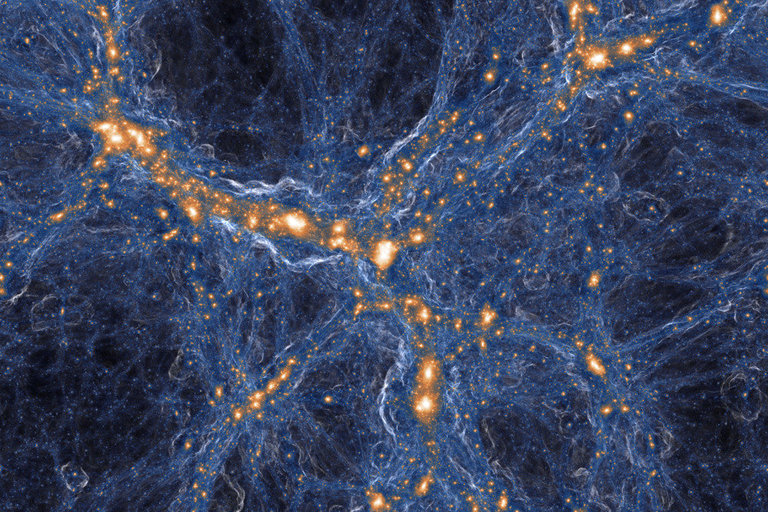
Visualization of the intensity of shock waves in the cosmic gas (blue) around collapsed dark matter structures (orange/white). Similar to a sonic boom, the gas in these shock waves is accelerated with a jolt when impacting on the cosmic filaments and galaxies.
What would you do if you had access to one of the most powerful high-performance computing systems in the world? A group of astrophysicists have used the Hazel Hen machine, Germany's fastest mainframe computer, to create the most detailed simulation ever of the entire universe from almost the beginning of time.

Called Illustris: The Next Generation, or IllustrisTNG, the simulation models a cube-shaped universe that is actually much smaller than our own. But it follows the formation of millions of galaxies in a representative region of a universe that is almost one billion light-years per side. The scale and detail of the simulation allows astronomers to study how galaxies form, evolve, and grow, as stars are born and live out their lives.

"When we observe galaxies using a telescope, we can only measure certain quantities," team member Shy Genel from the Flatiron Institute's Center for Computational Astrophysics said in a statement. "With the simulation, we can track all the properties for all these galaxies. And not just how the galaxy looks now, but its entire formation history."

Astronomers frequently use computer modeling to generate simulations of things like galaxy formation, dark matter, and stellar evolution. But the team says IllustrisTNG pushes these types of simulations to new limits — in size, resolution, and physical fidelity.

The new simulations are the “most information-packed, universe-scale simulation ever produced,” and it builds on the original Illustris simulation, which measured 350 million light years per side, according to the statement. For the new simulations, a team of astronomers from five institutions used more than 24,000 processors over more than two months and produced more than 500 terabytes of simulation data.

"Analyzing this huge mountain of data will keep us busy for years to come,” principal investigator Volker Springel at the Heidelberg Institute for Theoretical Studies said in the statement, “and it promises many exciting new insights into different astrophysical processes."

Other institutions involved were the Max Planck Institutes for Astronomy and Astrophysics, Harvard University, and the Massachusetts Institute of Technology. The team has produced three papers that have been published in the journal Monthly Notices of the Royal Astronomical Society.

Each simulation in IllustrisTNG evolves a large swath of a mock universe from soon after the Big Bang until the present day and takes into account a wide range of physical processes that drive galaxy formation. The simulations can be used to study a broad range of topics about how the universe — and the galaxies within it — evolved over time.

The astrophysicists involved say the new tool provides key insights into things like how black holes influence the distribution of dark matter, how heavy elements are produced and distributed throughout the cosmos, and where magnetic fields originate.

Springel said the simulations from IllustrisTNG demonstrate a high degree of realism, using “hydrodynamic simulations to produce predictions of how galaxies evolve” and how the so-called “cosmic web” — a network of filaments of dark matter that connect galaxies — changes over time and how they may change in the future.

Since the simulation can also look back in time, by mapping out the histories of these modeled galaxies, astronomers should be able to see what our own Milky Way looked like just as Earth was being formed.

Read more at Seeker

Feb 1, 2018

How black holes shape the cosmos

Visualization of the intensity of shock waves in the cosmic gas (blue) around collapsed dark matter structures (orange/white). Similar to a sonic boom, the gas in these shock waves is accelerated with a jolt when impacting on the cosmic filaments and galaxies.
Every galaxy harbours a supermassive black hole at its center. A new computer model now shows how these gravity monsters influence the large-scale structure of our universe. The research team includes scientists from the Heidelberg Institute for Theoretical Studies (HITS), Heidelberg University, the Max-Planck-Institutes for Astronomy (MPIA, Heidelberg) and for Astrophysics (MPA, Garching), US universities Harvard and the Massachusetts Institute of Technology (MIT), as well as the Center for Computational Astrophysics in New York. The project, "Illustris -- The Next Generation" (IllustrisTNG), is the most complete simulation of its kind to date. Based on the basic laws of physics, the simulation shows how our cosmos evolved since the Big Bang. Adding to the predecessor Illustris project, IllustrisTNG includes some of the physical processes which play a crucial role in this evolution for the very first time in such an extensive simulation. First results of the IllustrisTNG project have now been published in three articles in the journal Monthly Notices of the Royal Astronomical Society. These findings should help to answer fundamental questions in cosmology.

A realistic universe out of the computer

At its intersection points, the cosmic web of gas and dark matter predicted by IllustrisTNG hosts galaxies quite similar to the shape and size of real galaxies. For the first time, hydrodynamical simulations could directly compute the detailed clustering pattern of galaxies in space. Comparison with observational data -- including newest large surveys -- demonstrate the high degree of realism of IllustrisTNG. In addition, the simulations predict how the cosmic web changes over time, in particular in relation to the underlying "back bone" of the dark matter cosmos. "It is particularly fascinating that we can accurately predict the influence of supermassive black holes on the distribution of matter out to large scales," says principal investigator Prof. Volker Springel (HITS, MPA, Heidelberg University). "This is crucial for reliably interpreting forthcoming cosmological measurements."

The most important transformation in the life cycle of galaxies

In another study, Dr. Dylan Nelson (MPA) was able to demonstrate the important impact of black holes on galaxies. Star-forming galaxies shine brightly in the blue light of their young stars until a sudden evolutionary shift ends the star formation, such that the galaxy becomes dominated by old, red stars, and joins a graveyard full of "red and dead" galaxies. "The only physical entity capable of extinguishing the star formation in our large elliptical galaxies are the supermassive black holes at their centers," explains Nelson. "The ultrafast outflows of these gravity traps reach velocities up to 10 percent of the speed of light and affect giant stellar systems that are billions of times larger than the comparably small black hole itself."

Where the stars sparkle: New findings for the structures of galaxies

IllustrisTNG also improves researchers´ understanding of the hierarchical structure formation of galaxies. Theorists argue that small galaxies should form first, and then merge into ever larger objects, driven by the relentless pull of gravity. The numerous galaxy collisions literally tear some galaxies apart and scatter their stars onto wide orbits around the newly created large galaxies, which should give them a faint background glow of stellar light. These predicted pale stellar halos are very difficult to observe due to their low surface brightness, but IllustrisTNG was able to simulate exactly what astronomers should be looking for in their data. "Our predictions can now be systematically checked by observers," Dr. Annalisa Pillepich (MPIA) points out, who led a further IllustrisTNG study. "This yields a critical test for the theoretical model of hierarchical galaxy formation."

Read more at Science Daily

Jun 21, 2017

Massive dead disk galaxy challenges theories of galaxy evolution

This artist's concept shows what the young, dead, disk galaxy MACS2129-1, right, would look like when compared with the Milky Way galaxy, left. Although three times as massive as the Milky Way, it is only half the size. MACS2129-1 is also spinning more than twice as fast as the Milky Way. Note that regions of Milky Way are blue from bursts of star formation, while the young, dead galaxy is yellow, signifying an older star population and no new star birth.
By combining the power of a "natural lens" in space with the capability of NASA's Hubble Space Telescope, astronomers made a surprising discovery -- the first example of a compact yet massive, fast-spinning, disk-shaped galaxy that stopped making stars only a few billion years after the big bang.

Finding such a galaxy early in the history of the universe challenges the current understanding of how massive galaxies form and evolve, say researchers.

When Hubble photographed the galaxy, astronomers expected to see a chaotic ball of stars formed through galaxies merging together. Instead, they saw evidence that the stars were born in a pancake-shaped disk.

This is the first direct observational evidence that at least some of the earliest so-called "dead" galaxies -- where star formation stopped -- somehow evolve from a Milky Way-shaped disk into the giant elliptical galaxies we see today.

This is a surprise because elliptical galaxies contain older stars, while spiral galaxies typically contain younger blue stars. At least some of these early "dead" disk galaxies must have gone through major makeovers. They not only changed their structure, but also the motions of their stars to make a shape of an elliptical galaxy.

"This new insight may force us to rethink the whole cosmological context of how galaxies burn out early on and evolve into local elliptical-shaped galaxies," said study leader Sune Toft of the Dark Cosmology Center at the Niels Bohr Institute, University of Copenhagen, Denmark. "Perhaps we have been blind to the fact that early "dead" galaxies could in fact be disks, simply because we haven't been able to resolve them."

Previous studies of distant dead galaxies have assumed that their structure is similar to the local elliptical galaxies they will evolve into. Confirming this assumption in principle requires more powerful space telescopes than are currently available. However, through the phenomenon known as "gravitational lensing," a massive, foreground cluster of galaxies acts as a natural "zoom lens" in space by magnifying and stretching images of far more distant background galaxies. By joining this natural lens with the resolving power of Hubble, scientists were able to see into the center of the dead galaxy.

The remote galaxy is three times as massive as the Milky Way but only half the size. Rotational velocity measurements made with the European Southern Observatory's Very Large Telescope (VLT) showed that the disk galaxy is spinning more than twice as fast as the Milky Way.

Using archival data from the Cluster Lensing And Supernova survey with Hubble (CLASH), Toft and his team were able to determine the stellar mass, star-formation rate, and the ages of the stars.

Why this galaxy stopped forming stars is still unknown. It may be the result of an active galactic nucleus, where energy is gushing from a supermassive black hole. This energy inhibits star formation by heating the gas or expelling it from the galaxy. Or it may be the result of the cold gas streaming onto the galaxy being rapidly compressed and heated up, preventing it from cooling down into star-forming clouds in the galaxy's center.

But how do these young, massive, compact disks evolve into the elliptical galaxies we see in the present-day universe? "Probably through mergers," Toft said. "If these galaxies grow through merging with minor companions, and these minor companions come in large numbers and from all sorts of different angles onto the galaxy, this would eventually randomize the orbits of stars in the galaxies. You could also imagine major mergers. This would definitely also destroy the ordered motion of the stars."

The findings are published in the June 22 issue of the journal Nature. Toft and his team hope to use NASA's upcoming James Webb Space Telescope to look for a larger sample of such galaxies.

The Hubble Space Telescope is a project of international cooperation between NASA and ESA (European Space Agency). NASA's Goddard Space Flight Center in Greenbelt, Maryland, manages the telescope. The Space Telescope Science Institute (STScI) in Baltimore, Maryland, conducts Hubble science operations. STScI is operated for NASA by the Association of Universities for Research in Astronomy, Inc., in Washington, D.C.

Read more at Science Daily