Showing posts with label World Trade Center. Show all posts
Showing posts with label World Trade Center. Show all posts
Sep 11, 2019

Sep 11, 2018
Sep 11, 2017
Children Exposed to Toxic 9/11 Dust Show Signs of Heart Disease as Young Adults
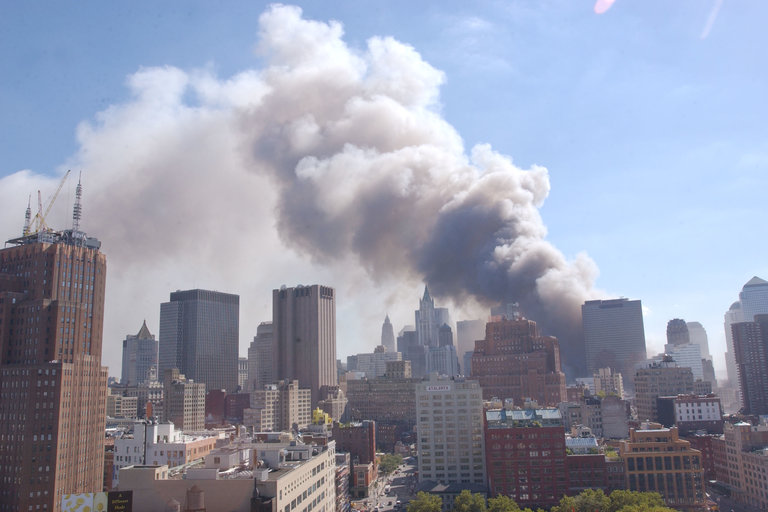 |
| Dust swirls around south Manhattan after a tower of the World Trade Center collapses September 11, 2001 in New York City after two airplanes slammed into the twin towers in a terrorist attack. |
Researchers at NYU Langone Health examined the blood of 308 people who had either lived or studied in Lower Manhattan as children on the day of the attacks. Nearly half of the participants came into direct contact with dust and debris from ground zero.
The analysis, which was conducted by a team led by Dr. Leonardo Trasande, a health epidemiologist and associate professor at NYU School of Medicine, found that those with higher levels of the chemicals known to be in debris from the World Trade Center also had greater levels of artery-hardening fats in their blood.
Several studies have examined the mental health effects of witnessing the tragedy on 9/11 and studied the toxic impact on the health of first responders, but according to Trasande, this is the first study to look at the long-term cardiovascular health risks of children exposed to chemicals when the World Trade Center was attacked.
“Children are a vulnerable population that was unfortunately exposed to the debris and dust from ground zero on 9/11,” Dr. Trasande told Seeker. “There is still a big gap of research when it comes to the potential risks that may have an impact on their physical health.”
The study participants are part of the World Trade Center Health Registry (WTCHR), which is tracking both the physical and mental health effects of 2,900 children who lived or went to school in Lower Manhattan on 9/11.
 |
| Children cover their mouths in the SoHo neighborhood of New York on September 12, 2001. Smoke filled the air all over lower Manhattan in the aftermath of Tuesday's terrorist attack and destruction of the World Trade Center. |
“We found that higher serum levels of PFAS are associated with increased blood lipids,” Trasande said. “Blood lipids are an early marker of cardiovascular risk, and if ignored may lead to adverse outcomes later in life like coronary artery disease or stroke.”
Luckily, these risk factors “can be avoided if identified earlier on,” Trasande noted, explaining that they can be somewhat controlled with diet and exercise.
“Understanding these risks is essential for continuous monitoring and early interventions to prevent adverse cardio-metabolic outcomes in the future,” he said.
The presence of PFAS in the air on the day of the attacks came from the many electronics and furniture that burned in the World Trade Center after terrorists flew airliners into the two towers. PFAS was once widely used in the US to make plastics more flexible but the government discontinued it after learning its many adverse health effects, including lower-than-normal birth weights and brain damage.
“Our study showed that there was an association with PFAS and increased blood lipid levels in children exposed to WTC debris and dust,” Trasande said. “During this unfortunate tragedy it was nearly impossible to avoid the chemicals that were being released into the environment, however, there were various chemical pollutants that were released that day. Further studies are clearly needed to identify which other pollutants or collection of pollutants may have affected physical health.”
Another study from the Journal of Psychiatric Research found that people exposed to dust on 9/11 also had raised blood levels of C-reactive protein (CRP). CRP can cause inflammation and is linked to higher rates of post-traumatic stress disorder. It was discovered that people with high levels of CRP had a 12 percent greater risk of PTSD than people whose CRP was not elevated.
Since the World Trade Center collapse 16 years ago, thousands of firefighters, emergency personnel, and other first responders have suffered illnesses related to 9/11. More than 5,400 people have been diagnosed with cancer caused by breathing in the toxic chemicals in the air during the hours and days after the attacks. On Monday’s anniversary, 32 FDNY firefighters, whose deaths were caused by 9/11-related illnesses, will be added to the list of the fallen.
Payouts by the 9/11 Victim Compensation Fund have reached nearly $3 billion since it was reopened. The VCF was created in 2001 to support families of those injured and killed on 9/11 and paid out $7 billion before it was closed in 2004. Due to the abundance of illnesses related to the attacks, it reopened in 2011 to provide additional financial support for victims and their loved ones.
From Seeker
Sep 11, 2015
The Near-Impossible Challenge of Designing the 9/11 Museum
 |
| One of the last photos taken of the intact Twin Towers, snapped minutes before they were struck on September 11. It hangs in the new museum’s concourse lobby. |
To your left is the Slurry Wall, a 3-foot-thick concrete barrier studded with iron pilings that once girded the foundations of the site and managed to hold even after the towers fell. The wall still seems both immovable and fragile. It’s what keeps the Hudson River from drowning this space, which is an unprecedented hybrid of archaeological site, cathedral, and tourist attraction.
As you keep walking downward, the ramp switches back, and you pass by a quote rendered in metal letters 15 inches high and cast from steel recovered from the original Twin Towers: NO DAY SHALL ERASE YOU FROM THE MEMORY OF TIME. It’s a line by Virgil, who, in the Inferno, serves as Dante’s guide through hell. Stepping off the ramp and passing down a flight of stairs and a hallway, you are now 70 feet belowground, standing on the bedrock that rooted the Twin Towers.
Twenty feet above your head hangs a piece of steel more than 35 feet long and weighing nearly 5 tons. It’s positioned vertically on the side of a massive silvery cube that marks the outline of where the North Tower once stood. Twisted like a ribbon blown in the wind, it has a terrible beauty. This and a counterpart down the hall are the “impact steel,” the columns hit by the first passenger jet when it slammed into the North Tower almost 13 years ago. You pass under one of the steel pieces and through a pair of plain glass doors to enter the main exhibits of the National September 11 Memorial Museum.
Watch this video on The Scene.

Historical museums typically serve as a way to tell the official story of something that happened and what it means. This one is different. “It is a story that has no end,” says Paula Grant Berry, a museum-planning-committee member whose husband died in the South Tower. The events of 9/11 are still raw in our memories and alive in our political and cultural climate.
For the museum’s designers and curators, that tension led to a tangle of quandaries: How can you present a lasting memorial to an event whose impact is still unspooling through developments such as the Edward Snowden leaks and the Senate’s torture report? How can you speak to 9/11’s polarizing effects, such as the bungled search for WMD, without alienating some significant portion of your audience? How can you create a meaningful tribute that will resonate with every visitor: the schoolchildren who know almost nothing of what happened, survivors who ran from the buildings covered in ash, and all those—more than a billion worldwide—who experienced the attack live on TV? “Conventional narrative wouldn’t cut it,” says Alice Greenwald, director of the museum, which opens in May.
Perhaps the most vexing problem of the project’s design, which incorporates thousands of artifacts, is that it risked becoming one massive trigger for victims and a trauma in its own right for everyone else. “This is not the Disney World of 9/11,” says Greenwald, a petite, dark-haired woman whose room-filling good cheer belies the material she has absorbed and calibrated. “We weren’t going to immerse people in the experience.” As Jake Barton, founder of Local Projects, which helped design the space, says, “That was the first, panicking challenge: How do you rise to the event itself for the people who lived it without overwhelming everyone else?” The fear of seeming hasty or naive was almost paralyzing. “Usually, as designers, you try to create meaning. Here there was almost too much of it,” Barton says.
The museum’s creative team tackled these emotional and psychological challenges through a combination of sophisticated design and artfully deployed technologies: a data-mining algorithm, onsite digital recording booths, a web-based platform for gathering crowdsourced testimony, touchscreens that let you access remembrances of the dead. The result isn’t so much a record of an event as a testament to how much we’ve all witnessed—no one more so than the survivors and family members, whose experiences are almost impossible to imagine until you hear from them yourself.
For the museum’s designers and curators, that tension led to a tangle of quandaries: How can you present a lasting memorial to an event whose impact is still unspooling through developments such as the Edward Snowden leaks and the Senate’s torture report? How can you speak to 9/11’s polarizing effects, such as the bungled search for WMD, without alienating some significant portion of your audience? How can you create a meaningful tribute that will resonate with every visitor: the schoolchildren who know almost nothing of what happened, survivors who ran from the buildings covered in ash, and all those—more than a billion worldwide—who experienced the attack live on TV? “Conventional narrative wouldn’t cut it,” says Alice Greenwald, director of the museum, which opens in May.
Perhaps the most vexing problem of the project’s design, which incorporates thousands of artifacts, is that it risked becoming one massive trigger for victims and a trauma in its own right for everyone else. “This is not the Disney World of 9/11,” says Greenwald, a petite, dark-haired woman whose room-filling good cheer belies the material she has absorbed and calibrated. “We weren’t going to immerse people in the experience.” As Jake Barton, founder of Local Projects, which helped design the space, says, “That was the first, panicking challenge: How do you rise to the event itself for the people who lived it without overwhelming everyone else?” The fear of seeming hasty or naive was almost paralyzing. “Usually, as designers, you try to create meaning. Here there was almost too much of it,” Barton says.
The museum’s creative team tackled these emotional and psychological challenges through a combination of sophisticated design and artfully deployed technologies: a data-mining algorithm, onsite digital recording booths, a web-based platform for gathering crowdsourced testimony, touchscreens that let you access remembrances of the dead. The result isn’t so much a record of an event as a testament to how much we’ve all witnessed—no one more so than the survivors and family members, whose experiences are almost impossible to imagine until you hear from them yourself.
 |
| Foundation Hall | The last column stands wrapped in protective canvas. The installation called timescape is projected on the wall behind it. |
The museum began to take shape eight years ago in a generic office on the 20th floor of One Liberty Plaza. In late 2001, the room, which features a view of Ground Zero, was set aside by the Lower Manhattan Development Corporation as an interim memorial space for the families of victims. The windows and walls were soon papered over with remembrances. To glimpse Ground Zero at all, you had to peer through the narrow spaces between pictures of people who had died. Many were small framed photos like the ones you’d see on a nightstand; a few were kids’ drawings with pictures stapled to them. At the center of the room was a podium bearing an oversize guest book filled with notes written to the dead. It remains in place today, off-limits to everyone except families. (A new private family room in the museum will replace this one later in 2014.)
Tom Hennes first visited the room in 2007, soon after his firm, Thinc, won the original museum commission. It felt like a time capsule. Hennes remembers that the notes were written in the present tense; one woman wrote to a relative asking for his approval of her new boyfriend, whom she’d brought with her. “The room tuned us in to what trauma means,” Hennes says. “Time had stood still.”
To the designers, the very rawness and variety of expression suggested an answer to a central challenge: how best to present events when, as William Faulkner once wrote, “the past is never dead. It’s not even past.” Instead of providing its own interpretive explanations, the designers realized, the museum could focus on direct testaments from the people who had experienced it. The hope was to avoid a single story line and instead allow visitors to reconstruct narratives on their own, using the artifacts on display. “Witnesses are the way into the museum,” Greenwald says.
It was an approach that Barton had been inching toward for more than a decade, influenced by such Anna Deavere Smith plays as Twilight: Los Angeles, 1992. For that meditation on post–Rodney King racial resentments, Smith conducted more than 300 interviews and then condensed the material into four dozen characters. She portrayed each of them herself, one blending into the next. “It was a lightning bolt,” Barton says. “It was really an exercise in empathy, in trying to find the humanity of everyone involved.” Ever since, Barton has used this as his inspiration in commissions that integrate multiple narrators. For example, Local Projects designed the oral history booths for StoryCorps, a project that is collecting thousands of personal stories and archiving them at the Library of Congress.
The Goal: Create A Meaningful Tribute to the Victims without Traumatizing the Visitors.
Voices are the first thing you hear in the museum, in the vestibule that precedes the entrance ramp: 417 people completing one another’s sentences. These are not from the victims but from people around the world who contributed their own 9/11 recollections via phone, video, or a web-based platform. Their words are mapped to hundreds of cities across the globe and then projected onto a series of staggered panels. As you walk around and stand in front of the screens, the words project around you, enveloping you in their stories.
Visitors are invited to bear witness again as part of Reflecting on 9/11, one of the museum’s signal installations. It consists of videos projected on massive walls and featuring interviews with figures who shaped our responses to 9/11, from the head of the ACLU to then defense secretary Donald Rumsfeld. They answer intentionally broad questions such as, how do you balance national security and personal freedom? Visitors, in turn, can answer the same questions in their own booths next to the installation. The curators can then pick visitor responses to display on the main wall.
But the same intimacy that makes all these voices so powerful can also make them overwhelming. The curators had access to thousands of hours of recordings of witnesses, survivors, and victims—voicemails, 911 calls, even radio call-ins. These posed a dilemma: Experts like Billie Pivnick, a clinical psychologist who worked closely with the designers, warned that hearing victims’ voices in the throes of terror could traumatize listeners. Even for the designers, direct access to the material proved difficult. “It felt like being a war correspondent,” Barton says. He recalls having persistent nightmares about buildings crumbling. Some people on Hennes’ team burst into tears at unexpected moments, unable to explain why the material, which seemed so familiar one day, was intolerable the next.
With this in mind, the curators had to decide which recordings were appropriate. For example, they opted not to include a 911 call from a woman trapped on a high floor who knew she wasn’t going to survive; the call ends with her simply praying with the operator. They did decide to include a voicemail that 24-year-old Brad Fetchet left for his mother minutes after the first plane hit the North Tower. “Hey, Mom. I’m obviously alive and well but obviously pretty scared … Love you.” Fetchet died in the South Tower. Greenwald admits that these were judgment calls. The choices usually favored the recordings in which people, even those who died, seemed most in control.
Tom Hennes first visited the room in 2007, soon after his firm, Thinc, won the original museum commission. It felt like a time capsule. Hennes remembers that the notes were written in the present tense; one woman wrote to a relative asking for his approval of her new boyfriend, whom she’d brought with her. “The room tuned us in to what trauma means,” Hennes says. “Time had stood still.”
To the designers, the very rawness and variety of expression suggested an answer to a central challenge: how best to present events when, as William Faulkner once wrote, “the past is never dead. It’s not even past.” Instead of providing its own interpretive explanations, the designers realized, the museum could focus on direct testaments from the people who had experienced it. The hope was to avoid a single story line and instead allow visitors to reconstruct narratives on their own, using the artifacts on display. “Witnesses are the way into the museum,” Greenwald says.
It was an approach that Barton had been inching toward for more than a decade, influenced by such Anna Deavere Smith plays as Twilight: Los Angeles, 1992. For that meditation on post–Rodney King racial resentments, Smith conducted more than 300 interviews and then condensed the material into four dozen characters. She portrayed each of them herself, one blending into the next. “It was a lightning bolt,” Barton says. “It was really an exercise in empathy, in trying to find the humanity of everyone involved.” Ever since, Barton has used this as his inspiration in commissions that integrate multiple narrators. For example, Local Projects designed the oral history booths for StoryCorps, a project that is collecting thousands of personal stories and archiving them at the Library of Congress.
The Goal: Create A Meaningful Tribute to the Victims without Traumatizing the Visitors.
Voices are the first thing you hear in the museum, in the vestibule that precedes the entrance ramp: 417 people completing one another’s sentences. These are not from the victims but from people around the world who contributed their own 9/11 recollections via phone, video, or a web-based platform. Their words are mapped to hundreds of cities across the globe and then projected onto a series of staggered panels. As you walk around and stand in front of the screens, the words project around you, enveloping you in their stories.
Visitors are invited to bear witness again as part of Reflecting on 9/11, one of the museum’s signal installations. It consists of videos projected on massive walls and featuring interviews with figures who shaped our responses to 9/11, from the head of the ACLU to then defense secretary Donald Rumsfeld. They answer intentionally broad questions such as, how do you balance national security and personal freedom? Visitors, in turn, can answer the same questions in their own booths next to the installation. The curators can then pick visitor responses to display on the main wall.
But the same intimacy that makes all these voices so powerful can also make them overwhelming. The curators had access to thousands of hours of recordings of witnesses, survivors, and victims—voicemails, 911 calls, even radio call-ins. These posed a dilemma: Experts like Billie Pivnick, a clinical psychologist who worked closely with the designers, warned that hearing victims’ voices in the throes of terror could traumatize listeners. Even for the designers, direct access to the material proved difficult. “It felt like being a war correspondent,” Barton says. He recalls having persistent nightmares about buildings crumbling. Some people on Hennes’ team burst into tears at unexpected moments, unable to explain why the material, which seemed so familiar one day, was intolerable the next.
With this in mind, the curators had to decide which recordings were appropriate. For example, they opted not to include a 911 call from a woman trapped on a high floor who knew she wasn’t going to survive; the call ends with her simply praying with the operator. They did decide to include a voicemail that 24-year-old Brad Fetchet left for his mother minutes after the first plane hit the North Tower. “Hey, Mom. I’m obviously alive and well but obviously pretty scared … Love you.” Fetchet died in the South Tower. Greenwald admits that these were judgment calls. The choices usually favored the recordings in which people, even those who died, seemed most in control.
Chosen Paths
The 9/11 Memorial Museum uses technology and artful curatorial techniques to bring personal testimony to the fore without overwhelming visitors’ emotions. Here’s how the curators pulled it off. —C.K.
The 9/11 Memorial Museum uses technology and artful curatorial techniques to bring personal testimony to the fore without overwhelming visitors’ emotions. Here’s how the curators pulled it off. —C.K.

Historical Exhibition The bulk of the material lies in a chronological exhibit of media and artifacts about 9/11. 1 | Day of the Attacks Visitors follow the day’s events starting at 8:46 am on September 11, 2001, the moment the first plane hit the North Tower. Alcoves house the most emotionally sensitive material. The toughest exhibit to create was the one that depicts the people who jumped or fell from the towers. To avoid aestheticizing the event, designers stripped the display of nearly all adornment. 2 | Looking Back The museum then turns back the clock to understand the history leading up to 9/11, showcasing artifacts like a laptop used by the FBI as evidence linking the 1993 World Trade Center bombing to al Qaeda and the 2001 attacks. 3 | Aftermath This is where visitors follow the recovery after the attacks, viewing such artifacts as a preserved storefront covered in dust, and steel that was mangled in the burning towers’ collapse. 4 | Reflecting on 9/11 Here visitors can watch key figures such as Eric Holder and Donald Rumsfeld answer questions about how the attacks affected government and society.
Location The National September 11 Memorial’s twin reflecting pools (squares) mark the footprints of the North and South Towers aboveground. The 9/11 Memorial Museum lies below.
Memorial Exhibition The people who died on 9/11 and in the 1993 World Trade Center attack are remembered in pictures mounted on the perimeter of the room. Visitors can see and hear materials from an ever-expanding archive in an inner chamber designed to encourage eye contact among visitors.
Last Column Standing nearly 40 feet high, the Last Column was the final piece of steel removed from Ground Zero. At the museum, touchscreens allow you to pan around images of the entire column so you can read inscriptions alongside annotations of the stories behind them.
Exposed Box Columns The original steel columns, once used to anchor the North Tower to the bedrock, have been sheared to floor level here.
Timescape An algorithm collects headlines related to 9/11 and projects them on a concrete wall, evoking the attacks’ effect on current events.
That element of control is emphasized in the museum’s layout, which allows visitors to decide how much of the most emotionally provocative moments they will experience. The main path through the historical exhibit is dominated by physical artifacts—a storefront preserved from a block adjacent to Ground Zero (complete with dust-covered blue jeans and sweatshirts emblazoned with American flags), the hand rakes used to sift the site for remains, mangled steel from the building. But the curators struggled most with how to present hundreds of more personal audio recordings and visual records. In the end, they decided to put this sensitive material inside alcoves placed off the main pathway through the exhibit. To confront these collections, you have to seek them out.
The most difficult alcove to design was the one dedicated to the 50 to 200 men and women—the exact number is not known—who, overwhelmed with heat and smoke, jumped or fell from the buildings. “Those people were on a ledge and feeling like they had no option but to step into a sky that would not support them,” says Joe Daniels, president of the 9/11 Memorial and Museum. “It is so unbelievable. Maybe you don’t show it.” And yet, after much intense debate, the board overseeing the museum, including Daniels, voted unanimously to dedicate an exhibit to those victims.
Some suggested a simple text panel and a statistic printed on the wall, nothing more. Others thought the video footage had to be used. Between these poles of detachment and immediacy, Greenwald says, was a limitless range of possibilities. One initial, commonsense idea gathered support: Mount pictures of people falling, in simple frames. And yet the effect, once tested, was horrifying. “It was the equivalent of a gallery display,” Greenwald says. “It aestheticized the moment. We recoiled from it.” They tried video in turn, and this created a gruesome loop as the event ran to its awful conclusion over and over.
The exhibit that finally emerged after dozens of prototypes is so artful that it seems almost totally undesigned. The entrance is marked by a photo of a small group of people on the street, looking up in shock. One woman is gazing just past the camera, covering her mouth. “There were a couple of instances when we said, there is no other photo possible,” Greenwald says. “You know from this photograph what they’re looking at.” Once you step into the alcove, you see a single picture, mounted on a stout column that dominates the center of the room. Titled “Trapped,” it shows men and women leaning out of the towers’ broken windows, with black smoke streaming out from behind them. On the walls surrounding you are quotes from people who witnessed victims jumping or falling:
They were ending their life without a choice, and to turn away from them would have been wrong.
This woman stood there for what seemed like minutes, then she held down her skirt and then stepped off the ledge. I thought, how human, how modest, to hold down her skirt before she jumped.
You won’t see anyone falling unless you make your way around the big column to a nook at the back of the room. There, 3 feet above your head, are projected a series of five still photographs of different people falling from the towers. They fade from one to the next, in a slow progression that gathers no rhythm. “We don’t ask the person jumping to repeat the act over and over again,” Greenwald says.
That room, designed by David Layman, made it possible to present potentially explosive imagery without glossing it over or causing offense. But when it came to presenting the ways that 9/11 shapes political debate, current events, and news coverage, the curators resorted to a different tool altogether: an algorithm. “The system lets the curators say they haven’t set an agenda,” Barton says. The algorithm, coded by Local Projects, sifts through the news of the day, finding nuggets relating to 9/11 and extracting connections among them. Its output is projected on a concrete wall as an enormous graph some 34 feet across. Dubbed Timescape, it is a constantly evolving chart of news articles connected to 9/11. At times it looks like a spray of data points charted against two axes: time versus frequency. Each point is labeled according to a topic or theme, from lead hijacker Mohammed Atta to the Snowden leaks. As the display cycles, each theme is unfurled in a new, more detailed chart that reveals the series of headlines that relate to it.
Location The National September 11 Memorial’s twin reflecting pools (squares) mark the footprints of the North and South Towers aboveground. The 9/11 Memorial Museum lies below.
Memorial Exhibition The people who died on 9/11 and in the 1993 World Trade Center attack are remembered in pictures mounted on the perimeter of the room. Visitors can see and hear materials from an ever-expanding archive in an inner chamber designed to encourage eye contact among visitors.
Last Column Standing nearly 40 feet high, the Last Column was the final piece of steel removed from Ground Zero. At the museum, touchscreens allow you to pan around images of the entire column so you can read inscriptions alongside annotations of the stories behind them.
Exposed Box Columns The original steel columns, once used to anchor the North Tower to the bedrock, have been sheared to floor level here.
Timescape An algorithm collects headlines related to 9/11 and projects them on a concrete wall, evoking the attacks’ effect on current events.
That element of control is emphasized in the museum’s layout, which allows visitors to decide how much of the most emotionally provocative moments they will experience. The main path through the historical exhibit is dominated by physical artifacts—a storefront preserved from a block adjacent to Ground Zero (complete with dust-covered blue jeans and sweatshirts emblazoned with American flags), the hand rakes used to sift the site for remains, mangled steel from the building. But the curators struggled most with how to present hundreds of more personal audio recordings and visual records. In the end, they decided to put this sensitive material inside alcoves placed off the main pathway through the exhibit. To confront these collections, you have to seek them out.
The most difficult alcove to design was the one dedicated to the 50 to 200 men and women—the exact number is not known—who, overwhelmed with heat and smoke, jumped or fell from the buildings. “Those people were on a ledge and feeling like they had no option but to step into a sky that would not support them,” says Joe Daniels, president of the 9/11 Memorial and Museum. “It is so unbelievable. Maybe you don’t show it.” And yet, after much intense debate, the board overseeing the museum, including Daniels, voted unanimously to dedicate an exhibit to those victims.
Some suggested a simple text panel and a statistic printed on the wall, nothing more. Others thought the video footage had to be used. Between these poles of detachment and immediacy, Greenwald says, was a limitless range of possibilities. One initial, commonsense idea gathered support: Mount pictures of people falling, in simple frames. And yet the effect, once tested, was horrifying. “It was the equivalent of a gallery display,” Greenwald says. “It aestheticized the moment. We recoiled from it.” They tried video in turn, and this created a gruesome loop as the event ran to its awful conclusion over and over.
The exhibit that finally emerged after dozens of prototypes is so artful that it seems almost totally undesigned. The entrance is marked by a photo of a small group of people on the street, looking up in shock. One woman is gazing just past the camera, covering her mouth. “There were a couple of instances when we said, there is no other photo possible,” Greenwald says. “You know from this photograph what they’re looking at.” Once you step into the alcove, you see a single picture, mounted on a stout column that dominates the center of the room. Titled “Trapped,” it shows men and women leaning out of the towers’ broken windows, with black smoke streaming out from behind them. On the walls surrounding you are quotes from people who witnessed victims jumping or falling:
They were ending their life without a choice, and to turn away from them would have been wrong.
This woman stood there for what seemed like minutes, then she held down her skirt and then stepped off the ledge. I thought, how human, how modest, to hold down her skirt before she jumped.
You won’t see anyone falling unless you make your way around the big column to a nook at the back of the room. There, 3 feet above your head, are projected a series of five still photographs of different people falling from the towers. They fade from one to the next, in a slow progression that gathers no rhythm. “We don’t ask the person jumping to repeat the act over and over again,” Greenwald says.
That room, designed by David Layman, made it possible to present potentially explosive imagery without glossing it over or causing offense. But when it came to presenting the ways that 9/11 shapes political debate, current events, and news coverage, the curators resorted to a different tool altogether: an algorithm. “The system lets the curators say they haven’t set an agenda,” Barton says. The algorithm, coded by Local Projects, sifts through the news of the day, finding nuggets relating to 9/11 and extracting connections among them. Its output is projected on a concrete wall as an enormous graph some 34 feet across. Dubbed Timescape, it is a constantly evolving chart of news articles connected to 9/11. At times it looks like a spray of data points charted against two axes: time versus frequency. Each point is labeled according to a topic or theme, from lead hijacker Mohammed Atta to the Snowden leaks. As the display cycles, each theme is unfurled in a new, more detailed chart that reveals the series of headlines that relate to it.
Academic researchers and even the Associated Press have experimented with using similar data-mining technologies to sift through massive document archives such as the Chelsea Manning leaks. But Local Projects wasn’t sure any of them would work for the museum. Confirmation came suddenly when Dylan Fried, one of the programmers coding the algorithm, was checking the themes and articles the machine was culling line by line. Fried, only 11 years old at the time of the 9/11 attacks, came upon a funny acronym and Skyped a colleague: “Who’s this KSM guy?” He was, of course, Khalid Sheikh Mohammed, mastermind of the attacks, and he kept popping up as a detainee at Guantanamo Bay and linked to the 2002 Bali nightclub bombing. “This algorithm showed Dylan a whole world of connections,” says Sundar Raman, Fried’s colleague. In other words, it worked.
The algorithm’s precision offers startlingly sharp insights about the ebb and flow of current affairs. It doesn’t elide what’s there, and it doesn’t overplay or underplay some themes for emphasis, as a curator inevitably would. It simply shows events for what they are, in news headlines. In that way, its effect is akin to the polished black granite of the Vietnam Veterans Memorial, which allows visitors to see their own reflections atop the inscribed names. Architectural critics have given almost metaphysical weight to the fact that the memorial’s marble literally mirrors the present day. At the 9/11 Museum, the mirror is a math equation.
Moral philosopher Avishai Margalit, in his meticulously reasoned book The Ethics of Memory, wrote, “We need morality not so much to counter evil as to counter indifference.” By that measure, a museum like this one must aim to shake the familiarity that robs us of our shock and horror, blunting our moral reactions. Tom Hennes, who’s something of a museum radical, echoed that idea from the start. He doesn’t believe museums should be venues for education but rather places of encounter. He offers an example: “Natural history museums are lousy at teaching natural history,” he says. “But they can provide a new sense of wonder that changes your next walk in the woods.”
Hennes is proudest of the museum’s memorial, which lies apart from the historical exhibit, in the footprint of the South Tower. He and Barton designed the space, which presents stories and artifacts provided by the families of victims. The challenge was to somehow satisfy all the families, each of whom may have envisioned a different form of memorial. Hennes and Barton’s solution is not a grand architectural gesture, just a simple square room of about 3,000 square feet.
Upon entering, you are surrounded by the faces of those who died, shown in mounted photos arrayed in neat alphabetical rows, from floor to ceiling, on all four walls of the room. In the center are the four walls of another, smaller room of about 700 square feet. In the space between the outer and inner walls there are waist-high tables embedded with touchscreen versions of the portraits on the walls. Touch one and you can see more pictures of that person, audio recordings of their family’s remembrances, and an obituary. (The archive will grow over time as loved ones add more artifacts.) You can then choose to project or play those items in the inner room.
The algorithm’s precision offers startlingly sharp insights about the ebb and flow of current affairs. It doesn’t elide what’s there, and it doesn’t overplay or underplay some themes for emphasis, as a curator inevitably would. It simply shows events for what they are, in news headlines. In that way, its effect is akin to the polished black granite of the Vietnam Veterans Memorial, which allows visitors to see their own reflections atop the inscribed names. Architectural critics have given almost metaphysical weight to the fact that the memorial’s marble literally mirrors the present day. At the 9/11 Museum, the mirror is a math equation.
Moral philosopher Avishai Margalit, in his meticulously reasoned book The Ethics of Memory, wrote, “We need morality not so much to counter evil as to counter indifference.” By that measure, a museum like this one must aim to shake the familiarity that robs us of our shock and horror, blunting our moral reactions. Tom Hennes, who’s something of a museum radical, echoed that idea from the start. He doesn’t believe museums should be venues for education but rather places of encounter. He offers an example: “Natural history museums are lousy at teaching natural history,” he says. “But they can provide a new sense of wonder that changes your next walk in the woods.”
Hennes is proudest of the museum’s memorial, which lies apart from the historical exhibit, in the footprint of the South Tower. He and Barton designed the space, which presents stories and artifacts provided by the families of victims. The challenge was to somehow satisfy all the families, each of whom may have envisioned a different form of memorial. Hennes and Barton’s solution is not a grand architectural gesture, just a simple square room of about 3,000 square feet.
Upon entering, you are surrounded by the faces of those who died, shown in mounted photos arrayed in neat alphabetical rows, from floor to ceiling, on all four walls of the room. In the center are the four walls of another, smaller room of about 700 square feet. In the space between the outer and inner walls there are waist-high tables embedded with touchscreen versions of the portraits on the walls. Touch one and you can see more pictures of that person, audio recordings of their family’s remembrances, and an obituary. (The archive will grow over time as loved ones add more artifacts.) You can then choose to project or play those items in the inner room.
 |
| Impact Steel | These exterior columns bore the blow when flight 11 slammed into the north tower. |
As you walk into the inner chamber, the perimeter is lined with benches facing inward. The floor is glass, and below your feet you can see the scarred bedrock that once supported the towers. The recorded material you selected plays across two opposite walls, which are covered in ultrasuede to muffle the sound and lend the room a hushed stillness. The entire space is designed for eye contact, like a Quaker meetinghouse: On the perimeter, you meet the gazes of the other visitors. The experience is communal—but also intimate.
It’s hard to miss the resemblance to the original memorial room at One Liberty Plaza overlooking Ground Zero. Just as that room had windows papered over with pictures and a ledger in the center for family remembrances, this new memorial has a perimeter of pictures and an inner chamber for displaying family recollections of the lost. Hennes says the similarity wasn’t strictly intentional, but he allows that the original memorial room may well have exerted an unconscious influence on him and his colleagues.
It’s hard to miss the resemblance to the original memorial room at One Liberty Plaza overlooking Ground Zero. Just as that room had windows papered over with pictures and a ledger in the center for family remembrances, this new memorial has a perimeter of pictures and an inner chamber for displaying family recollections of the lost. Hennes says the similarity wasn’t strictly intentional, but he allows that the original memorial room may well have exerted an unconscious influence on him and his colleagues.
Read more at Wired Science
Sep 11, 2014
Faces of 9/11: Where are they now?
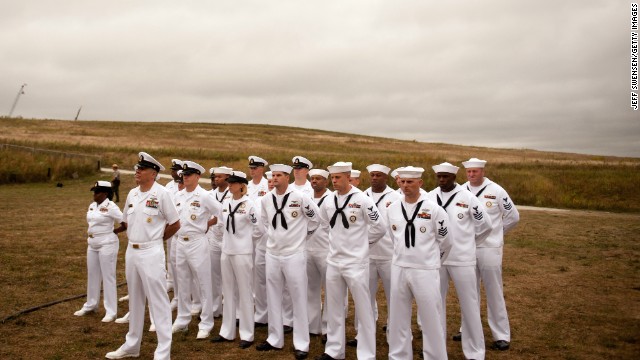
These are the stories forever linked with the September 11, 2001, terror attacks in New York, Washington and western Pennsylvania.
In some cases, they are tales of ordinary people caught in extraordinary circumstances -- people who became symbols of comfort and hope for a grieving nation.
Then there were those who were behind the attacks, people who have become the emblem of evil.
On the 13th anniversary of the attacks, here is a look at some of those people -- then and now:
Lisa Jefferson, the voice
Then:
Hers was the voice on the other end of the line for Todd Beamer, the passenger aboard United Flight 93 whose last purported words -- "let's roll" -- became a rallying cry for the nation in the days following the terror attacks.
It was 9:45 a.m., when Beamer placed a call to an operator at a Verizon Airfone call center in Chicago and relayed that the airplane bound for San Francisco had been hijacked. The operator turned the call over to Jefferson, the supervisor on duty.
Beamer was calm as he detailed how three men had taken over the flight. Two had knives and had locked themselves in the cockpit, and one had a bomb strapped to his waist.
He told Jefferson about his children and his wife, Lisa.
"I had asked him, did he want me to place his call through to his wife for him. He told me that he didn't want me to put him through to her in case he didn't have to. He had hoped on landing that plane safely. And he told me if I didn't make it, would I please call her and let her know how much he loved her and his family," she told CNN in 2002.
"... After we said 'The Lord's Prayer,' the plane took another dive. And Todd said they had a plan. The next thing he said, 'Are you ready? OK, let's roll,'" she told CNN in 2001.
"And that's the last I heard from him.''
In the days that followed, she relayed Beamer's message to his wife.
Now:
Jefferson, 57, no longer answers telephone calls at the call center. She's changed jobs.
Most of her colleagues now don't know that she was the calm, caring voice who prayed with Beamer in his final minutes.
Sure, she's talked about it in the years since. At the urging of others, she even told her story in the book "Called: Hello, My Name is Mrs. Jefferson, I Understand Your Plane is Being Hijacked?"
The story of that conversation has been told and retold -- in books and articles, in movies and television shows.
But during a recent interview, Jefferson asked that no details about her current job or employer be made public.
"Every time I tell the story, it's like the first time," she said. "... I'm not a hero. I was just doing my job."
That day, after she took over the call, she said she turned around to hand off the phone to someone else. But, she says, there was no one there.
"I had to stay on the line," she said. "I stayed with him until the end."
She has credited her faith with giving her the strength to offer comfort and care during that 15-minute call.
"God had a purpose for me with the Beamer family," she said.
Josephine Harris, the angel
Then:
Her story of survival is wrapped up with six firefighters who say they made it through the collapse of the World Trade Center's North Tower because they were trying to rescue her.
Harris, like so many, was trying to make her way down the stairwell of the North Tower.
Flight after flight, she descended. She stopped on the 20th floor, physically unable to take another step on her own.
The firefighters of Ladder Company 6 were on the 27th floor or so of the building and still climbing when then-Capt. Jay Jonas got a call on the radio that the South Tower had collapsed and he needed to get his men out of the North Tower.
"It was an almost empty feeling that we couldn't help anyone," Jonas, now a deputy chief, said this week.
As they were making their way down the stairwell, they found Harris. There she was, crying in the doorway, Jonas said.
"Hey Cap, what do you want us to do?" one of the firefighters asked. "Take her with us," Jonas said.
Half-carrying Harris, the firefighters continued to make their way down, slowly.
The clock was ticking.
By the time they made it to the fourth floor, Harris fell to the ground.
Leave me, she ordered the firefighters. They, of course, refused.
Then it happened. The 110-story building collapsed.
"It seemed like forever," Jonas said. It was only 13 seconds.
When it was over, Harris and the men of Ladder 6 were alive, entombed in the debris.
"There was only one time she lost her composure," Jonas said. "She said she was afraid, and she started to cry."
Without orders from the captain, the firefighters took turns caring for Harris until hours later when the thick dust settled and they were able to see a way to get out and get help.
"She was definitely alive because of us," Jonas said.
And they were alive because of her.
"She chose the fourth floor to stop, to fall to the floor," he said. "... Nobody survived above the fifth floor or on the first floor. If we hadn't stopped there, who knows? We probably wouldn't have survived."
Now:
In the years that followed, Harris became known at the "Angel of Ladder Company 6," and she and the firefighters stayed in contact.
Their story resonated with many people post-September 11, and they made appearances together at parades and dedications.
"If Josephine got a call to do an interview or an appearance, she would always call and make sure we were OK with it," Jonas said. "We would always tell her yes, and we'll be there with you."
On Jan. 12, 2011, Harris called 911 from her Brooklyn apartment.
By the time firefighters arrived, she had died of an apparent heart attack.
Jonas got the news in a telephone call from a firefighter. "It was like losing a member of your family, and she really was a member of the (Ladder 6) family," he said.
What neither he nor the other firefighters knew was that Harris was destitute. "She was an intensely private person," Jonas said.
For days, her body lay uncollected at the city morgue. Her family didn't have enough money to bury her.
"I thought 'Man, she's going to Potter's Field, if we don't do something," Jonas said.
So he got on the phone to the other firefighters, and they started to spread the word across the city.
They were soon contacted by the owner of Greenwich Village Funeral Home, who had heard of Harris' death. He remembered the story of the "guardian angel" of Ladder 6 and offered to pick up the entire cost of the service.
Jonas and the firefighters carried Harris one last time. They served as pallbearers, carrying her casket engraved with the words "guardian angel.''
http://www.cnn.com/video/data/2.0/video/bestoftv/2013/09/04/missing-911-flag-carroll-newday.cnn.html
George Johnson, Daniel McWilliams and William Eisengrein, the firefighters
Then:
It was late afternoon, hours after the attacks, and the three firefighters joined the rush to what would become known as ground zero.
Eisengrein was sitting on his truck when he saw McWilliams carrying an American flag, he told ABCNews.com in 2011. Walking alongside McWilliams was another firefighter, Johnson.
Eisengrein knew McWilliams but had never met Johnson.
It is believed McWilliams found the flag from a yacht, "Star of America," docked nearby on the Hudson River, according to the CNN documentary "The Flag."
Eisengrein told ABC News he just knew McWilliams was going to hang it somewhere, and shouted out to him: "Do you need help?"
The three men found a flagpole leaning against a construction trailer, he said.
"So we put a piece of tin on the ground up to the trailer and hiked up that, and raised it," Eisengrein said.
"... We stood there and looked at it for a second and went about our ways."
None of them knew that their picture had been taken by Tom Franklin, a photographer with The Record in Bergen County, New Jersey.
Soon the picture was picked up by The Associated Press and splashed across newspaper front pages, becoming one of the iconic images associated with September 11.
Now:
Much has been made about the flag, and its whereabouts.
Within hours of its raising, the flag disappeared from the World Trade Center site.
The makers of "The Flag" spoke with several photographers about going to ground zero and the heartbreaking scenes that awaited.
Among those interviewed was the couple who owned the yacht from which the flag was taken.
The couple wanted to donate the flag to the Smithsonian Institution and asked about a year after the attacks to borrow the signed flag briefly for a ceremony.
"When we got the flag, we were quite stunned that it was the wrong flag," said Shirley Dreifus. "... This wraps around the two of us, and we're not the thinnest people on Earth ... So we knew right away it was the wrong flag."
While the search for the flag continues, Johnson, McWilliams and Eisengrein rarely talk publicly about that day and the flag. They have routinely declined media requests for interviews over the years.
The firefighters "in question have repeatedly expressed no interest in interviews or additional media coverage," the FDNY said in an email response to a CNN request this week.
Maybe we know all we need to know about the three men: They did their job, and they reminded everyone by raising the flag that the country was still standing.
Rudy Giuliani, the mayor
Then:
Giuliani was in the final days of his second term as mayor when an airplane crashed into the World Trade Center's North Tower. Giuliani was at the World Trade Center, getting an update on the rescue effort, when a second plane struck the South Tower.
The mayor, like many that day, was forced to run for his life when the tower came down.
He was engulfed in a cloud of debris, but famously kept his composure.
"This is a vicious, unprovoked act, a horrible attack on innocent men, women and children. It's one of the most heinous acts, certainly, in world history," he told CNN that day.
As New York mourned the loss of thousands of lives and cleaned up the debris, Giuliani seemed to be everywhere -- holding news conferences, giving interviews and attending funerals and fundraisers.
In the aftermath of the attacks, he earned the moniker "America's mayor" for the comfort he offered not only to city of more than 8 million, but to a shell-shocked nation.
Now:
Giuliani's popularity soared, spurring him to make a bid for the Republican presidential nomination in 2008.
But his campaign stumbled, badly.
Giuliani skipped the early primary states, staking his bid on a win in Florida. He finished third and pulled out of the campaign.
He quickly reinvented himself as a political pundit, becoming a regular on television news programs.
These days, the former mayor balances running Giuliani Partners, a security consulting firm, and working as a managing partner in the Bracewell & Giuliani law firm.
He even did a stint as a pitchman for LifeLock, the identify theft protection company. The company was a client of Giuliani Partners, he has said.
Even now, more than a decade later, the events of September 11 are never far from his thoughts.
"I think the most difficult moment I had as mayor of New York City was when I arrived at the World Trade Center," Giuliani said during a 2013 interview on "Oprah: Where Are They Now."
"Not really knowing how bad it was, not really emotionally grasping all of that until I saw a man throw himself out of the 100th floor. And that's an image -- that's an image that stayed with me forever, almost every day it comes up in my mind somehow. And then, after that, I just decided well, it's part of me and I have to live with it."
Read more at CNN
Jul 29, 2014
Tree Rings Solve Mystery of World Trade Center Ship

At 22 feet (6.7 meters) below today's street level, in a pit that would become an underground security and parking complex, excavators found the mangled skeleton of a long-forgotten wooden ship.
Now, a new report finds that tree rings in those waterlogged ribs show the vessel was likely built in 1773, or soon after, in a small shipyard near Philadelphia. What's more, the ship was perhaps made from the same kind of white oak trees used to build parts of Independence Hall, where the Declaration of Independence and U.S. Constitution were signed, according to the study published this month in the journal Tree-Ring Research.
Archaeologists had been on-site throughout the excavation of the World Trade Center's Vehicular Security Center. They had found animal bones, ceramic dishes, bottles and dozens of shoes, but the excitement really kicked up when the 32-foot-long (9.75 m) partial hull of the ship emerged from the dirt.
The vessel was quickly excavated, to prevent damage from exposure to the air. Piece by piece, the delicate oak fragments were documented and taken out of the rotten-smelling mud. The timbers were sent to the Maryland Archaeological Conservation Laboratory, where they would be soaked in water to keep the wood from cracking and warping.
A few timbers were sent back to New York, just 20 miles (32 kilometers) north of the World Trade Center, to the Tree Ring Laboratory at Columbia University's Lamont-Doherty Earth Observatory in Palisades, New York. Researchers at the lab dried the fragments slowly in a cold room and cut thick slices of the wood to get a clear look at the tree rings.
The team established that the trees used to build the ship — some of which had lived to be more than 100 years old — were mostly cut down around 1773. Then, to determine where the wood came from, the researchers had to find a match between the ring pattern in the timbers and a ring pattern in live trees and archaeological samples from a specific region.

Martin-Benito and his colleagues at Columbia's Tree Ring Lab narrowed their search to trees in the eastern United States, thanks to the keel of the ship, which contained hickory, a tree found only in eastern North America and eastern Asia. Otherwise, the researchers would have had much more difficulty in limiting their search, as oak is found all over the world.
The ship's signature pattern most closely matched with the rings found in old living trees and historic wood samples from the Philadelphia area, including a sample taken during an earlier study from Independence Hall, which was built between 1732 and 1756.
"We could see that at that time in Philadelphia, there were still a lot of old-growth forests, and [they were] being logged for shipbuilding and building Independence Hall," Martin-Benito told Live Science. "Philadelphia was one of the most — if not the most — important shipbuilding cities in the U.S. at the time. And they had plenty of wood so it made lots of sense that the wood could come from there."
Historians still aren't certain whether the ship sank accidently or if it was purposely submerged to become part of a landfill used to bulk up Lower Manhattan's coastline. Oysters found fixed to the ship's hull suggest it at least languished in the water for some time before being buried by layers of trash and dirt.
Read more at Discovery News
Subscribe to:
Posts (Atom)