Showing posts with label Extrasolar Planets. Show all posts

Jan 21, 2023

Tumultuous migration on the edge of the Hot Neptune Desert

All kinds of exoplanets orbit very close to their star. Some look like the Earth, others like Jupiter. Very few, however, are similar to Neptune. Why this anomaly in the distribution of exoplanets? Researchers from the University of Geneva (UNIGE) and the National Centre of Competence in Research (NCCR) PlanetS have observed a sample of planets located at the edge of this Hot Neptune Desert to understand its creation. Using a technique combining the two main methods of studying exoplanets (radial velocities and transits), they were able to establish that a part of these exoplanets has migrated in a turbulent way near their star, which pushed them out of the orbital plane where they were formed. These results are published in the specialized journal Astronomy & Astrophysics.

Since the discovery of the first exoplanet in 1995, researchers have detected more than 5'000 planets in our galactic neighborhood, most of them orbiting very close to their star. If the diversity of these new worlds ranges from gas giants the size of Jupiter or Saturn to smaller planets the size of Mercury, including rocky planets larger than the Earth, gas planets the size of Neptune seem to be missing. Astronomers call this empty ''box'' in the distribution of close-in planets the Hot Neptune Desert.

''The distribution of planets close to their star is shaped by a complex interaction between atmospheric and dynamical processes, i.e. the motions of the planets over time,'' comments Vincent Bourrier, assistant professor in the Department of Astronomy at the UNIGE Faculty of Science. ''Today we have several hypotheses to explain this desert but nothing is certain yet and the mystery remains''. Did these planets lose their atmosphere entirely, eroded by the intense radiation of their star? Did they migrate from their birthplace to the outer parts of the system by a different mechanism than other types of planets, preventing them from reaching the same close orbits?

Disrupted migration

In a recent work, a team of scientists from the UNIGE brings some answers by looking at the orbital architecture of the planets located at the edge of this desert. By surveying fourteen planets around this area, ranging from small planets to gas giants, the astronomers were interested in the way their orbits are oriented with respect to the axis of rotation of their star. This information makes it possible to distinguish the processes of soft migration (the planets move in the equatorial plane of their star where they were formed) from the processes of disruptive migration (the planets migrate and are pushed out of the plane where they were formed).

The researchers were able to show that most of the planets in their sample have an orbit misaligned with the stellar equator. ''We found that three-quarters of these planets have a polar orbit (they rotate above the poles of their star), which is a larger fraction than for planets further away from the desert. This reflects the role of disruptive migration processes in the formation of the desert,'' summarizes Vincent Bourrier, first author.

Two methods combined


To achieve these results, the scientists used the radial velocity method and the transit method, which are employed to study exoplanets. ''Analyzing the radial velocities during the transit of a planet allows us to determine if it orbits around the stellar equator, around the poles, or if the system is in an intermediate configuration, because different architectures will produce different signatures,'' explains Omar Attia, a doctoral student in the Department of Astronomy at the UNIGE Faculty of Science and second author of the study. These two methods were combined with data obtained with the HARPS and HARPS-North spectrographs, created at UNIGE and located on the 3.6m telescope of ESO (European Southern Observatory) and TNG (Telescopio Nazionale Galileo).

The path to understand all of the mechanisms involved in the formation of the Hot Neptune Desert is still long. It will be necessary in particular to explore with this technique the smallest planets at the edge of the desert, today difficult to access even with instruments of last generation such as the spectrograph ESPRESSO, built by the UNIGE and installed on the largest European telescopes. It will be necessary to wait for the commissioning of the ELT, the 39-meter super telescope of ESO, planned for 2027.

Read more at Science Daily

Aug 24, 2022

An extrasolar world covered in water?

An international team of researchers led by Charles Cadieux, a Ph.D. student at the Université de Montréal and member of the Institute for Research on Exoplanets (iREx), has announced the discovery of TOI-1452 b, an exoplanet orbiting one of two small stars in a binary system located in the Draco constellation about 100 light-years from Earth.

The exoplanet is slightly greater in size and mass than Earth and is located at a distance from its star where its temperature would be neither too hot nor too cold for liquid water to exist on its surface. The astronomers believe it could be an "ocean planet," a planet completely covered by a thick layer of water, similar to some of Jupiter's and Saturn's moons.

In an article published today in The Astronomical Journal, Cadieux and his team describe the observations that elucidated the nature and characteristics of this unique exoplanet.

"I'm extremely proud of this discovery because it shows the high calibre of our researchers and instrumentation," said René Doyon, Université de Montréal Professor and Director of iREx and of the Observatoire du Mont-Mégantic (OMM). "It is thanks to the OMM, a special instrument designed in our labs called SPIRou, and an innovative analytic method developed by our research team that we were able to detect this one-of-a-kind exoplanet."

It was NASA's space telescope TESS, which surveys the entire sky in search of planetary systems close to our own, that put the researchers on the trail of this exoplanet. Based on the TESS signal, which showed a slight decrease in brightness every 11 days, astronomers predicted a planet about 70% larger than Earth.

Charles Cadieux belongs to a group of astronomers that does ground follow-up observations of candidates identified by TESS in order to confirm their planet type and characteristics. He uses PESTO, a camera installed on the OMM's telescope that was developed by Université de Montréal Professor David Lafrenière and his Ph.D. student François-René Lachapelle.

"The OMM played a crucial role in confirming the nature of this signal and estimating the planet's radius," explained Cadieux. "This was no routine check. We had to make sure the signal detected by TESS was really caused by an exoplanet circling TOI-1452, the largest of the two stars in that binary system."

The host star TOI-1452 is much smaller than our Sun and is one of two stars of similar size in the binary system. The two stars orbit each other and are separated by such a small distance -- 97 astronomical units, or about two and a half times the distance between the Sun and Pluto -- that the TESS telescope sees them as a single point of light. But PESTO's resolution is high enough to distinguish the two objects, and the images showed that the exoplanet does orbit TOI-1452, which was confirmed through subsequent observations by a Japanese team.

Ingenuity at work

To determine the planet's mass, the researchers then observed the system with SPIRou, an instrument installed on the Canada-France-Hawaii Telescope in Hawai'i. Designed in large part in Canada, SPIRou is ideal for studying low-mass stars such as TOI-1452 because it operates in the infrared spectrum, where these stars are brightest. Even then, it took more than 50 hours of observation to estimate the planet's mass, which is believed to be nearly five times that of Earth.

Researchers Étienne Artigau and Neil Cook, also with iREx at the Université de Montréal, played a key role in analysing the data. They developed a powerful analytic method capable of detecting the planet in the data collected with SPIRou. "The LBL method [for line-by-line] allows us to clean the data obtained with SPIRou of many parasite signals and to reveal the weak signature of planets such as the one discovered by our team," explained Artigau.

The team also includes Quebec researchers Farbod Jahandar and Thomas Vandal, two Ph.D. students at the Université de Montréal. Jahandar analysed the host star's composition, which is useful for constraining the planet's internal structure, while Vandal was involved in analysing the data collected with SPIRou.

A watery world

The exoplanet TOI-1452 b is probably rocky like Earth, but its radius, mass, and density suggest a world very different from our own. Earth is essentially a very dry planet; even though we sometimes call it the Blue Planet because about 70% of its surface is covered by ocean, water actually only makes up a negligible fraction of its mass -- less than 1%.

Water may be much more abundant on some exoplanets. In recent years, astronomers have identified and determined the radius and mass of many exoplanets with a size between that of Earth and Neptune (about 3.8 times larger than Earth). Some of these planets have a density that can only be explained if a large fraction of their mass is made up of lighter materials than those that make up the internal structure of the Earth such as water. These hypothetical worlds have been dubbed "ocean planets."

"TOI-1452 b is one of the best candidates for an ocean planet that we have found to date," said Cadieux. "Its radius and mass suggest a much lower density than what one would expect for a planet that is basically made up of metal and rock, like Earth."

The University of Toronto's Mykhaylo Plotnykov and Diana Valencia are specialists in exoplanet interior modeling. Their analysis of TOI-1452 b shows that water may make up as much as 30% of its mass, a proportion similar to that of some natural satellites in our Solar System, such as Jupiter's moons Ganymede and Callisto, and Saturn's moons Titan and Enceladus.

Read more at Science Daily

Apr 27, 2021

Astronomers detect hydroxyl molecule signature in an exoplanet atmosphere

 An international collaboration of astronomers led by a researcher from the Astrobiology Center and Queen's University Belfast, and including researchers from Trinity College Dublin, has detected a new chemical signature in the atmosphere of an extrasolar planet (a planet that orbits a star other than our Sun).

The hydroxyl radical (OH) was found on the dayside of the exoplanet WASP-33b. This planet is a so-called 'ultra-hot Jupiter', a gas-giant planet orbiting its host star much closer than Mercury orbits the Sun and therefore reaching atmospheric temperatures of more than 2,500° C (hot enough to melt most metals).

The lead researcher based at the Astrobiology Center and Queen's University Belfast, Dr Stevanus Nugroho, said: "This is the first direct evidence of OH in the atmosphere of a planet beyond the Solar System. It shows not only that astronomers can detect this molecule in exoplanet atmospheres, but also that they can begin to understand the detailed chemistry of this planetary population."

In the Earth's atmosphere, OH is mainly produced by the reaction of water vapour with atomic oxygen. It is a so-called 'atmospheric detergent' and plays a crucial role in the Earth's atmosphere to purge pollutant gasses that can be dangerous to life (e.g., methane, carbon monoxide).

In a much hotter and bigger planet like WASP-33b, where astronomers have previously detected signs of iron and titanium oxide gas) OH plays a key role in determining the chemistry of the atmosphere through interactions with water vapour and carbon monoxide. Most of the OH in the atmosphere of WASP-33b is thought to have been produced by the destruction of water vapour due to the extremely high temperature.

"We see only a tentative and weak signal from water vapour in our data, which would support the idea that water is being destroyed to form hydroxyl in this extreme environment," explained Dr Ernst de Mooij from Queen's University Belfast, a co-author on this study.

To make this discovery, the team used the InfraRed Doppler (IRD) instrument at the 8.2-meter diameter Subaru Telescope located in the summit area of Maunakea in Hawai`i (about 4,200 m above sea level). This new instrument can detect atoms and molecules through their 'spectral fingerprints,' unique sets of dark absorption features superimposed on the rainbow of colours (or spectrum) that are emitted by stars and planets.

As the planet orbits its host star, its velocity relative to the Earth changes with time. Just like the siren of an ambulance or the roar of a racing car's engine changes pitch while speeding past us, the frequencies of light (e.g., colour) of these spectral fingerprints change with the velocity of the planet. This allows us to separate the planet's signal from its bright host star, which normally overwhelms such observations, despite modern telescopes being nowhere near powerful enough to take direct images of such 'hot Jupiter' exoplanets.

Dr Neale Gibson, Assistant Professor at Trinity College Dublin and co-author of this work, said: "The science of extrasolar planets is relatively new, and a key goal of modern astronomy is to explore these planets' atmospheres in detail and eventually to search for 'Earth-like' exoplanets -- planets like our own. Every new atmospheric species discovered further improves our understanding of exoplanets and the techniques required to study their atmospheres, and takes us closer to this goal."

By taking advantage of the unique capabilities of IRD, the astronomers were able to detect the tiny signal from hydroxyl in the planet's atmosphere. "IRD is the best instrument to study the atmosphere of an exoplanet in the infrared," adds Professor Motohide Tamura, one of the principal investigators of IRD, Director of the Astrobiology Center, and co-author of this work.

"These techniques for atmospheric characterisation of exoplanets are still only applicable to very hot planets, but we would like to further develop instruments and techniques that enable us to apply these methods to cooler planets, and ultimately, to a second Earth," says Dr Hajime Kawahara, assistant professor at the University of Tokyo and co-author of this work.

Read more at Science Daily

May 22, 2019

18 Earth-sized exoplanets discovered

Extrasolar planet illustration.
Somewhat more than 4000 planets orbiting stars outside our solar system are known so far. Of these so-called exoplanets, about 96 percent are significantly larger than our Earth, most of them more comparable with the dimensions of the gas giants Neptune or Jupiter. This percentage likely does not reflect the real conditions in space, however, since small planets are much harder to track down than big ones. Moreover, small worlds are fascinating targets in the search for Earth-like, potentially habitable planets outside the solar system.

The 18 newly discovered worlds fall into the category of Earth-sized planets. The smallest of them is only 69 percent of the size of the Earth; the largest is barely more than twice the Earth's radius. And they have another thing in common: all 18 planets could not be detected in the data from the Kepler Space Telescope so far. Common search algorithms were not sensitive enough.

In their search for distant worlds, scientists often use the so-called transit method to look for stars with periodically recurring drops in brightness. If a star happens to have a planet whose orbital plane is aligned with the line of sight from Earth, the planet occults a small fraction of the stellar light as it passes in front of the star once per orbit.

"Standard search algorithms attempt to identify sudden drops in brightness," explains Dr. Rene Heller from MPS, first author of the current publications. "In reality, however, a stellar disk appears slightly darker at the edge than in the center. When a planet moves in front of a star, it therefore initially blocks less starlight than at the mid-time of the transit. The maximum dimming of the star occurs in the center of the transit just before the star becomes gradually brighter again," he explains.

Large planets tend to produce deep and clear brightness variations of their host stars so that the subtle center-to-limb brightness variation on the star hardly plays a role in their discovery. Small planets, however, present scientists with immense challenges. Their effect on the stellar brightness is so small that it is extremely hard to distinguish from the natural brightness fluctuations of the star and from the noise that necessarily comes with any kind of observation. René Heller's team has now been able to show that the sensitivity of the transit method can be significantly improved, if a more realistic light curve is assumed in the search algorithm.

"Our new algorithm helps to draw a more realistic picture of the exoplanet population in space," summarizes Michael Hippke of Sonneberg Observatory. "This method constitutes a significant step forward, especially in the search for Earth-like planets."

The researchers used data from NASA's Kepler space telescope as a test bed for their new algorithm. In the first mission phase from 2009 to 2013, Kepler recorded the light curves of more than 100,000 stars, resulting in the discovery of over 2300 planets. After a technical defect, the telescope had to be used in an alternative observing mode, called the K2 mission, but it nevertheless monitored more than another 100,000 stars by the end of the mission in 2018. As a first test sample for their new algorithm, the researchers decided to re-analyze all 517 stars from K2 that were already known to host at least one transiting planet.

In addition to the previously known planets, the researchers discovered 18 new objects that had previously been overlooked. "In most of the planetary systems that we studied, the new planets are the smallest," co-author Kai Rodenbeck of the University of Göttingen and MPS describes the results. What is more, most of the new planets orbit their star closer than their previously known planetary companions. The surfaces of these new planets therefore likely have temperatures well in excess of 100 degrees Celsius; some even have temperatures of up to 1000 degrees Celsius. Only one of the bodies is an exception: it likely orbits its red dwarf star within the so-called habitable zone. At this favorable distance from its star, this planet may offer conditions under which liquid water could occur on its surface -- one of the basic prerequisites for life as we know it on Earth.

Of course, the researchers cannot rule out that their method, too, is blind to other planets in the systems they investigated. In particular, small planets at large distances to their host stars are known to be problematic. They require more time to complete a full orbit than planets orbiting their stars closer in. As a consequence, the transits of planets in wide orbits occur less often, which makes their signals even harder to detect.

Read more at Science Daily

Aug 7, 2018

Largest haul of extrasolar planets

The 44 confirmed planets and their approximate size class, orbits and surface temperatures.
Forty-four planets in solar systems beyond our own have been unveiled in one go, dwarfing the usual number of confirmations from extrasolar surveys, which is typically a dozen or less. The findings will improve our models of solar systems and may help researchers investigate exoplanet atmospheres. Novel techniques developed to validate the find could hugely accelerate the confirmation of more extrasolar planet candidates.

An international team of astronomers pooled data from U.S. space agency NASA's Kepler and the European Space Agency (ESA)'s Gaia space telescopes, as well as ground-based telescopes in the U.S. Alongside John Livingston, lead author of the study and a graduate student at the University of Tokyo, the team's combined resources led to the confirmed existence of these 44 exoplanets and described various details about them.

A portion of the findings yield some surprising characteristics: "For example, four of the planets orbit their host stars in less than 24 hours," says Livingston. "In other words, a year on each of those planets is shorter than a day here on Earth." These contribute to a small but growing list of "ultrashort-period" planets, so it could turn out they're not as unusual as they might seem.

"It was also gratifying to verify so many small planets," continues Livingston. "Sixteen were in the same size class as Earth, one in particular turning out to be extremely small -- about the size of Venus -- which was a nice affirmation as it's close to the limit of what is possible to detect."

The source observations for this study were made by Kepler, and they would not have happened were it not for a fault in 2013, which prevented accurate control of the space telescope. "Two out of the four control-reaction wheels failed, which meant Kepler couldn't perform its original mission to stare at one specific patch of the sky," explains Professor Motohide Tamura of the University of Tokyo. "This led to its contingent mission, 'K2' -- our observations came from campaign 10 of this mission. We're lucky Kepler continues to function as well as it does."

The planets observed by K2 are known as transiting planets because their orbits bring them in front of their host stars, slightly reducing their brightness. However, other astrophysical phenomena can cause similar signals, so follow-up observations and detailed statistical analyses were performed to confirm the planetary nature of these signals. As part of his doctoral work, Livingston traveled to Kitt Peak observatory in the U.S. state of Arizona to obtain data from a special type of camera, known as a speckle interferometer installed on a large telescope there. These observations, along with follow-up observations from a telescope in the state of Texas, were necessary to characterize the host stars and rule out false positives. The combination of detailed analyses of data from these ground-based telescopes, K2 and Gaia enabled the precise determination of the planets' sizes and temperatures. The team's findings include 27 additional candidates that are likely to be real planets, which will be the subject of future research.

Read more at Science Daily

Nov 28, 2016

Timing the shadow of a potentially habitable extrasolar planet paves the way to search for alien life

By observing its transit precisely using the next generation of telescopes, scientists expect to be able to search the atmosphere of the planet for molecules related to life, such as oxygen.
A group of researchers from the National Astronomical Observatory of Japan (NAOJ), the University of Tokyo, and the Astrobiology Center among others has observed the transit of a potentially Earth-like extrasolar planet known as K2-3d using the MuSCAT instrument on the Okayama Astrophysical Observatory 188-cm telescope. A transit is a phenomenon in which a planet passes in front of its parent star, blocking a small amount of light from the star, like a shadow of the planet. While transits have previously been observed for thousands of other extrasolar planets, K2-3d is important because there is a possibility that it might harbor extraterrestrial life.

By observing its transit precisely using the next generation of telescopes, such as TMT, scientists expect to be able to search the atmosphere of the planet for molecules related to life, such as oxygen.

With only the previous space telescope observations, however, researchers can't calculate the orbital period of the planet precisely, which makes predicting the exact times of future transits more difficult. This research group has succeeded in measuring the orbital period of the planet with a high precision of about 18 seconds. This greatly improved the forecast accuracy for future transit times. So now researchers will know exactly when to watch for the transits using the next generation of telescopes. This research result is an important step towards the search for extraterrestrial life in the future.

K2-3d

K2-3d is an extrasolar planet about 150 light-years away that was discovered by the NASA K2 mission (the Kepler telescope's "second light") (Note 1). K2-3d's size is 1.5 times the size of the Earth. The planet orbits its host star, which is half the size of the Sun, with a period of about 45 days. Compared to the Earth, the planet orbits close to its host star (about 1/5 of the Earth-Sun distance). But, because the temperature of the host star is lower than that of the Sun, calculations show that this is the right distance for the planet to have a relatively warm climate like the Earth's. There is a possibility that liquid water could exist on the surface of the planet, raising the tantalizing possibility of extraterrestrial life.

K2-3d's orbit is aligned so that as seen from Earth, it transits (passes in front of) its host star. This causes, short, periodic decreases in the star's brightness, as the planet blocks some of the star's light. This alignment enables researchers to probe the atmospheric composition of these planets by precise measurement of the amount of blocked starlight at different wavelengths.

About 30 potentially habitable planets that also have transiting orbits were discovered by the NASA Kepler mission, but most of these planets orbit fainter, more distant stars. Because it is closer to Earth and its host star is brighter, K2-3d is a more interesting candidate for detailed follow-up studies. The brightness decrease of the host star caused by the transit of K2-3d is small, only 0.07%. However, it is expected that the next generation of large telescopes will be able to measure how this brightness decrease varies with wavelength, enabling investigations of the composition of the planet's atmosphere. If extraterrestrial life exists on K2-3d, scientists hope to be able to detect molecules related to it, such as oxygen, in the atmosphere.

MuSCAT Observations and Transit Ephemeris Improvements

The orbital period of K2-3d is about 45 days. Since the K2 mission's survey period is only 80 days for each area of sky, researchers could only measure two transits in the K2 data. This isn't sufficient to measure the planet's orbital period precisely, so when researchers attempt to predict the times of future transits, creating something called a "transit ephemeris," there are uncertainties in the predicted times. These uncertainties grow larger as they try to predict farther into the future. Therefore, early additional transit observations and adjustments to the ephemeris were required before researchers lost track of the transit. Because of the importance of K2-3d, the Spitzer Space Telescope observed two transits soon after the planet's discovery, bringing the total to four transit measurements. However, the addition of even a single transit measurement farther in the future can help to yield a significantly improved ephemeris.

Using the Okayama 188-cm Reflector Telescope and the latest observational instrument MuSCAT, the team observed a transit of K2-3d for the first time with a ground based telescope. Though a 0.07% brightness decrease is near the limit of what can be observed with ground based telescopes, MuSCAT's ability to observe three wavelength bands simultaneously enhanced its ability to detect the transit. By reanalyzing the data from K2 and Spitzer in combination with this new observation, researchers have greatly improved the precision of the ephemeris, determining the orbital period of the planet to within about 18 seconds (1/30 of the original uncertainty). This improved transit ephemeris ensures that when the next generation of large telescopes come online, they will know exactly when to watch for transits. Thus these research results help pave the way for future extraterrestrial life surveys.

Read more at Science Daily

Oct 24, 2016

Preferentially Earth-sized planets with lots of water

Artist’s impression of Earth-sized planets orbiting a red dwarf star.
Computer simulations by astrophysicists at the University of Bern of the formation of planets orbiting in the habitable zone of low mass stars such as Proxima Centauri show that these planets are most likely to be roughly the size of Earth and to contain large amounts of water.

In August 2016, the announcement of the discovery of a terrestrial exoplanet orbiting in the habitable zone of Proxima Centauri stimulated the imagination of the experts and the general public. After all this star is the nearest star to our sun even though it is ten times less massive and 500 times less luminous. This discovery together with the one in May 2016 of a similar planet orbiting an even lower mass star (Trappist-1) convinced astronomers that such red dwarfs (as these low mass stars are called) might be hosts to a large population of Earth-like planets.

How could these objects look like? What could they be made of? Yann Alibert and Willy Benz at the Swiss NCCR PlanetS and the Center of Space and Habitability (CSH) at the University of Bern carried out the first computer simulations of the formation of the population of planets expected to orbit stars ten times less massive than the sun.

"Our models succeed in reproducing planets that are similar in terms of mass and period to the ones observed recently," Yann Alibert explains the result of the study that has been accepted for publication as a Letter in the journal "Astronomy and Astrophysics." "Interestingly, we find that planets in close-in orbits around these type of stars are of small sizes. Typically, they range between 0.5 and 1.5 Earth radii with a peak at about 1.0 Earth radius. Future discoveries will tell if we are correct!" the researcher adds.

Ice at the bottom of the global ocean

In addition, the astrophysicists determined the water content of the planets orbiting their small host star in the habitable zone. They found that considering all the cases, around 90% of the planets are harbouring more than 10% of water. For comparison: Earth has a fraction of water of only about 0,02%. So most of these alien planets are literally water worlds in comparison! The situation could be even more extreme if the protoplanetary disks in which these planets form live longer than assumed in the models. In any case, these planets would be covered by very deep oceans at the bottom of which, owing to the huge pressure, water would be in form of ice.

Water is required for life as we know it. So could these planets be habitable indeed? "While liquid water is generally thought to be an essential ingredient, too much of a good thing may be bad," says Willy Benz. In previous studies the scientists in Bern showed that too much water may prevent the regulation of the surface temperature and destabilizes the climate. "But this is the case for Earth, here we deal with considerably more exotic planets which might be subjected to a much harsher radiation environment, and/or be in synchronous " he adds.

Following the growth of planetary embryos


To start their calculations, the scientists considered a series of a few hundreds to thousands of identical, low mass stars and around each of them a protoplanetary disk of dust and gas. Planets are formed by accretion of this material. Alibert and Benz assumed that at the beginning, in each disk there were 10 planetary embryos with an initial mass equal to the mass of the Moon. In a few day's computer time for each system the model calculated how these randomly located embryos grew and migrated. What kind of planets are formed depends on the structure and evolution of the protoplanetary disks.

Read more at Science Daily

Oct 7, 2016

Eyeballing Proxima b: Probably Not a Second Earth

In our profound quest to discover strange new worlds, we've inevitably been trying to find alien planets that possess any Earth-like similarities. Now, with the incredible find of an Earth-mass exoplanet orbiting a neighboring star at just the right distance for liquid water to persist on its surface, hopes are high that we may have discovered an "Earth 2.0" right on our galactic doorstep.

But in our rush to assign any terrestrial likeness to this small exoplanet, we often forget that just because it's in the right place and is (apparently) the right mass, it likely has very little resemblance to Earth. And even if it does possess water, it could still be a very strange world indeed.

In a new study headed by scientists at the French National Center for Scientific Research (CNRS) and Cornell University, computer simulations have been run to figure out the possible characteristics of the small rocky world that was discovered orbiting the red dwarf star Proxima Centauri. Located only 4.2 light-years from Earth, the so-called Proxima b was discovered by the ESO's La Silla observatory in Chile and astronomers of the Pale Red Dot campaign to much excitement in August.

By measuring the slight wobbles of Proxima Centauri, the telescope was able not only to decipher the mass of the exoplanet, it could also calculate its orbital period. With this information, the researchers realized that the world was orbiting the red dwarf within the star's "habitable zone." The habitable zone of any star is the distance at which a planet can orbit that is not too hot and not too cold for liquid water to persist on its surface.

The implications are clear: on Earth, where there's liquid water, there's life -- if there's liquid water on Proxima b, perhaps there's life there too. And, if we look for enough into the future, perhaps we might one day become an interstellar species and set up home there.

What We Know and What We Don't

But it's worth remembering that we currently have very little information about Proxima b. We know that it has an orbital period of a little over 11 days (yes, a "year" on Proxima b is only 11 days).* We know it orbits within the star's habitable zone. We also know its approximate mass. However, we don't know whether or not it has an atmosphere. Also, we don't know Proxima b's physical size. If we don't know its physical size, we can't calculate its average density and therefore there's ambiguity as to what materials it contains. So, in an effort to confront this ambiguity, the researchers ran some simulations of a 1.3 Earth-mass world (the approximate mass of Proxima b) in orbit around a red dwarf star to see what form it might take.

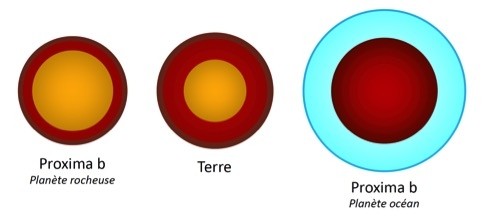
Compositions for a simulated Proxima b. Left: At 94% the diameter of Earth, Proxima b would be domiated by a massive metal core and smaller rocky mantle. Right: At 140% the diameter of Earth, Proxima b would be an ocean-covered world. Middle: Somewhere in between, Proxima b would approximate Earth.
Assuming the rocky world has the smallest physical size allowed for its mass (94% Earth's diameter), according to planetary formation models this would consist of a metal core, making up for 65% of the mass of the entire planet. The outer layers would consist of rocky mantle and very little water (if any). In this scenario, Proxima b would be a rocky, barren and dry world, resembling a massive Mercury. Last time we checked in on Mercury, it didn't appear very "habitable."

But this is just one possibility. The researchers then shifted the scale to the other extreme. What would happen if the physical size of the planet was pushed to the maximum? Well, the mass of Proxima b could support a world that is 40% bigger than Earth. Now things get interesting.

In this scenario, Proxima b would be a lot less dense, meaning there would be less rock and metal. A huge proportion of the planet's mass would consist of water. In fact, 50% of the entire planet's mass would be water. This would be a "water world" in the strongest possible sense.

Somewhere between these two scenarios -- either a dense and barren rock or bloated water world -- is the highly sought-after "Earth 2.0"; basically a world with a small metal core, rocky mantle and plentiful oceans flooding the surface. It's this exoplanetary compromise that you regularly see in artistic impressions of Proxima b, the temperate alien world that looks like Earth:

Alas, this version of Proxima b is just one possibility over a huge range of scenarios. So, yeah, from this study alone, Proxima b is probably not very Earth-like.

But wait, there's more.

Habitable Zones Not So Habitable?

Just because a planet orbits its star in the habitable zone, it doesn't mean it has the same life-giving qualities as Earth (keep in mind that both Mars and Venus also orbit the sun within our solar system's habitable zone).

Proxima b orbits very close to its star. It's the nature of the beast; red dwarf stars are small and therefore cooler than sun-like stars. Proxima Centauri's habitable zone is therefore one hell of a lot more compact than our sun's. The Proxima Centauri habitable zone is well within the orbit of Mercury. If a planet got that close to our hot sun, it would be burnt to a crisp; for a planet in orbit around Proxima Centauri, this location is an oasis.

But when you orbit so close to a red dwarf, a planet starts to succumb to some tidal difficulties. One face of an orbiting planet around a red dwarf will be constantly facing the star, meaning the planet's spin matches its orbital period. One hemisphere of the planet is in constant light while the other hemisphere is in constant darkness -- a situation called "tidal locking."

So, in this case, let's imagine the orbiting exoplanet really is a textbook "Earth-like" world with just the right composition. A world with an iron core, rocky mantle and enough water on the surface to create liquid water oceans that could support life. But this world is tidally locked with its star -- that's got to cause some problems, right?

Let's assume that this planet somehow possesses an atmosphere (more on that later), to have one hemisphere being constantly heated while the other hemisphere is constantly frozen certainly doesn't sound like a good time. Many simulations have been run in an attempt to model the complexities of the atmospheric conditions in this situation and most outcomes aren't good. Some scenarios predict planet-wide hurricanes that act like a blast oven, other scenarios predict a dry wasteland on the star-facing hemisphere and a frozen solid dark hemisphere.

Eyeball Earths?


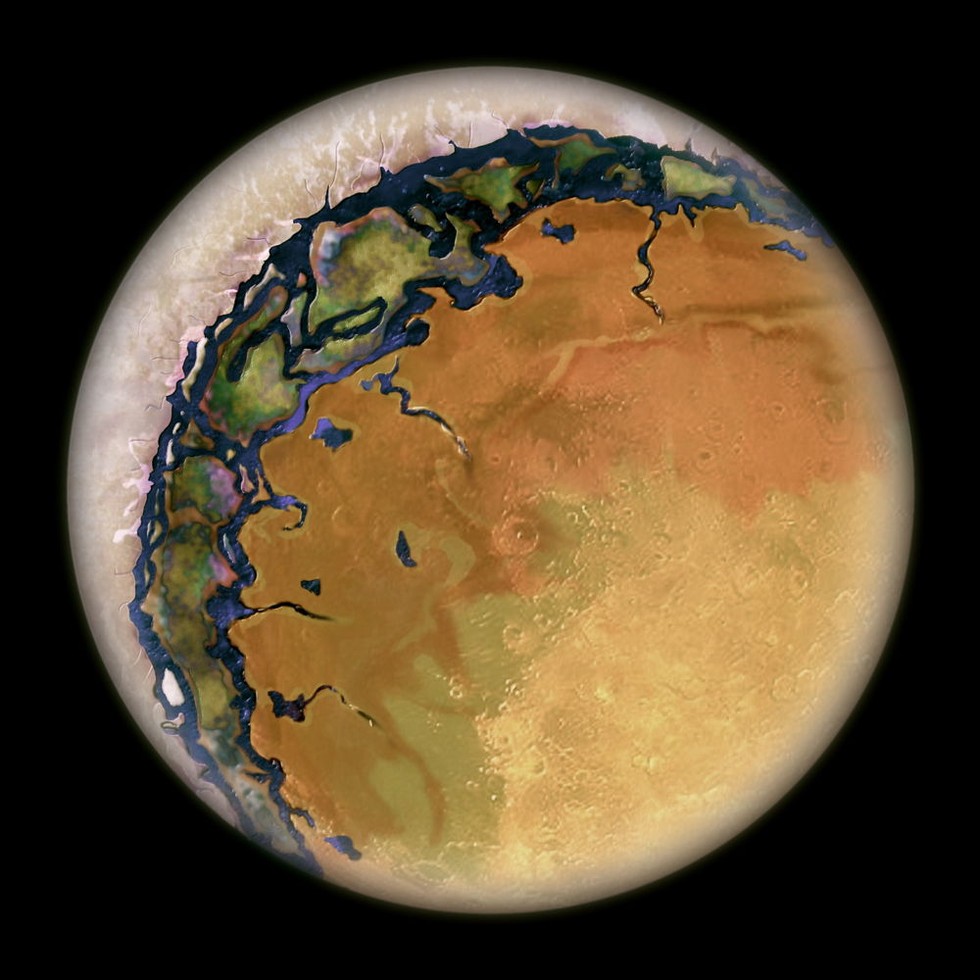
There are, however, some planetary models that could save the day for these unfortunate wannabe "second Earths". One fun prediction is the possible existence of "Eyeball Earths". These peculiar planets would still be tidally locked to their star, with one hemisphere a constantly baked desert and the other hemisphere in deep freeze, but there would be a region between day and night where the conditions are just right for a liquid water ocean to circle the world between the darkness and light. Oh, and it would look like an eyeball, seriously:

In other research around atmospheric dynamics of tidally locked exoplanets, there could be a situation where the world has efficient "air conditioning" -- hot air from one hemisphere is distributed about the planet in such a way to balance global temperatures. But this assumes a high degree of friction between the lower atmosphere and a craggy, rocky surface and efficient high-altitude air flow.

But the ultimate kicker when considering "Earth-like" exoplanets around red dwarf stars is that just because red dwarfs are small, it doesn't mean they are docile. In fact, red dwarf stars can be downright violent, frequently erupting with powerful flares, flooding any nearby planets with ionizing radiation. This radiation, plus inevitably powerful stellar winds, would likely blow any atmosphere away from our hypothetical burgeoning Earth 2.0. Without an atmosphere, the only vaguely habitable location on that planet would be under the surface, perhaps in a sub-surface ocean protected by an icy crust like Jupiter's moon Europa.

But, like Earth, if these planets have a powerful global magnetosphere, perhaps the worst of the stellar storm can be deflected and an atmosphere could form, who knows?

Read more at Discovery News

Sep 22, 2016

Exotic Star System Discovered via Spacetime Warp

For the vast majority of exoplanetary discoveries, one or more planets are found orbiting one star. However, there are a few exotic exoplanets orbiting two stars and the Hubble Space Telescope has helped confirm the discovery of a unique star system.

Way back in 2007, a ground-based system looking for transient brightenings -- called "microlensing" events -- detected a peculiar signal.

Microlensing events are caused when a massive object, like a planet or star, passes in front of a more distant background star. As predicted by Einstein's theory of general relativity, the lensing object will warp spacetime, causing any light passing by to slightly change its path. Should the alignment between distant star, lensing object and Earth be just right, the object can create a spacetime lens -- akin to passing a magnifying lens in front of a candle flame.

The result is a short-lived brightening of the background star. By studying the microlensing event light-curve (i.e. how the brightening fluctuates with time), we can learn many things about the object(s) creating the lens.

But in the case of the 2007 event, the ground-based Optical Gravitational Lensing Experiment (or "OGLE") detected something else in the light-curve that confused matters. This wasn't a single object, it was a whole star system -- with a twist.

"A detailed analysis revealed a third lensing body in addition to the star and planet that were quite obvious from the data," said astronomer David Bennett, of NASA's Goddard Space Flight Center, in a statement.

But what does this mean? Through analysis of the signal, called OGLE-2007-BLG-349, there were two explanations. According to Bennett, there was either "a Saturn-mass planet orbiting a close binary star pair or a Saturn-mass and an Earth-mass planet orbiting a single star."

As microlensing events are, by their nature, one-offs, astronomers needed another way to confirm the nature of OGLE-2007-BLG-349 and Hubble has been used to zoom in on the star system that triggered the 2007 brightening.

It turns out that OGLE-2007-BLG-349 was caused by a planet orbiting two stars, both tiny red dwarfs, drifting in front of a more distant bright star. This is the first time a binary system plus single exoplanet has been discovered through microlensing. "We were helped in the analysis by the almost perfect alignment of the foreground binary stars with the background star, which greatly magnified the light and allowed us to see the signal of the two stars," Bennett added.

Read more at Discovery News

Aug 30, 2016

'Interesting' SETI Signal Detected: Noise or... Aliens?

The RATAN-600 radio telescope in Zelenchukskaya, Russia.
First things first, it's probably not aliens.

But astronomers have identified an "interesting" signal emanating from a not-so-distant sun-like star and the mere fact that I've mentioned aliens will have you thinking about aliens and not the other things this signal could be. I'm not saying it's aliens, OK? I really shouldn't have mentioned aliens.

Anyhow, let's wind this back a bit without mentioning ET. What's actually been detected?

Astronomers using the Russian RATAN-600 radio telescope have recorded "a strong signal in the direction of HD164595," according to Centauri Dreams' Paul Gilster who has access to a document that is currently circulating behind the scenes. The research is not published yet, but according to Gilster, the signal will be discussed during a SETI meeting at the 67th International Astronautical Congress (IAC) in Guadalajara, Mexico, in September.

The signal in question appears to be a radio burst with a frequency of 11 GHz that was detected by the observatory on May 15, 2015, coming from HD164595, which is located 95 light-years away and is known to possess one exoplanet. This exoplanet is likely "Neptune-like," approximately 4% the mass of Jupiter, with a 40 day orbit. Though this planet is very un-habitable for life as we know it (as it's very close to its star), there could be other undiscovered planets in the system.

But the interesting thing is that HD164595 is very sun-like, only a little older. The 6.3 billion year-old star is 99% the size of the sun and contains an almost identical chemical makeup. When looking for habitable worlds, it helps to find a star that has similar qualities to our sun as it's the only star known to have a planet orbiting that's packed with life.

So it becomes really interesting when a signal with few natural explanations is detected and, according to astronomer Nick Suntzeff of Texas A&M University in an interview with Ars Technica, a radio signal at this frequency is, well, "strange."

"If this were a real astronomical source, it would be rather strange," said Suntzeff, adding that his guess would be that the signal is actually terrestrial and may be a 11 GHz burst from a military source. However, there's no known program that would be using such a frequency.

The upshot is that little is so far known about this event and we'll have to wait until SETI astronomers can deduce what may have caused it. But for now, an intelligent extraterrestrial civilization blasting radio transmissions into space is a very slight possibility... though the thought is intriguing.

Gilster points out that for this to be a SETI signal, the hypothetical civilization would need to be a "Kardashev Type II civilization" if it's blasting radio in all directions (an omnidirectional radio beacon) to get cosmic attention. But if they were aiming a narrow beam signal directly at Earth, which requires far less energy, they could be a Type I civilization. As a comparison, a Type I civilization has evolved with the technological ability to harness all the energy that reached their planet from their star; a Type II civilization is much more advanced, with the ability of harnessing all of the energy from their star. In the latter case, this could be achieved using a Dyson sphere or swarm.

Read more at Discovery News

Jul 20, 2016

Kepler Adds 100 to Galaxy's Planet Count

Astronomers have confirmed 104 planets beyond the solar system that were spotted by NASA's revamped Kepler space telescope.

Launched in March 2009, Kepler spent four years staring at small patch of the sky looking for slight dips in the amount of light coming from about 140,000 target stars. Scientists then used the information to determine which light dips are caused by planets passing across the face of their parent stars, relative to Kepler's line of sight, as opposed to, for example, stellar flares or eclipsing binary stars.

A pointing system problem sidelined Kepler in 2013, but engineers devised a new way to operate the telescope using its two remaining gyroscopes, its thrusters and the pressure of sunlight.

For stability, the telescope needs to be oriented nearly parallel to its orbital path around the sun, which is slightly offset from Earth's orbital plane, known as the ecliptic.

Kepler now observes a portion of the sky for up to 83 days and then rotates to prevent sunlight from coming into its field of view.

In its new mission, dubbed K-2, Kepler so far has found 458 candidate planets, 127 of which have been confirmed, NASA said.

The tally includes 104 extrasolar planets confirmed this week, which brings the total number of known planets beyond the solar system, found by Kepler and other telescopes, to 3,472.

The newest members of the planet list include four worlds, ranging in size from 20 percent to 50 percent bigger than Earth, orbiting the same star.

Two of the planets, K2-72c and 72e, are properly distanced from the host star for liquid water, if it exists. Because the star is about half the size of the sun and much dimmer, its so-called "habitable zone" is closer than where Mercury's orbits the sun in our solar system.

K2-72c, which has a 15-day orbit, is about 10 percent warmer than Earth. Sibling K2-72e, which is in a 24-day orbit, is about 6 percent colder than Earth.

Read more at Discovery News

Jun 23, 2016

SETI Eavesdrops on Nearby Star in Smart Alien Hunt

Astronomers seeking out extraterrestrial intelligence have used a powerful radio telescope to eavesdrop on a star system that is relatively close to Earth in the hope of hearing the faint radio whisper of an alien civilization.

Using the Allen Telescope Array (ATA) located in California (pictured top), members of the SETI Institute chose Trappist 1 as they know the red dwarf-type star plays host to at least 3 exoplanets. Traditional SETI searches have looked to random stars in the sky in the hope of detecting an artificial radio signal using luck and some educated guesses. But now we know certain stars play host to exoplanets, alien hunters can be a little more discerning with the selection of stellar targets.

Known as "targeted SETI", the ATA has been used to "listen in" on star systems that NASA's Kepler Space Telescope and other exoplanet-hunting missions have confirmed the presence of exoplanets. Even better than that, as Kepler can identify the physical size and orbit of a given exoplanet, astronomers can deduce whether that planet is located in the star's "habitable zone." The habitable zone around any star is the distance at which a hypothetical rocky planet can orbit that is not too hot or too cold for liquid water to exist. As we know from life on our planet, where there's water, there's life; could intelligent alien life be living on one of these potentially habitable worlds?

If so, they might be transmitting radio waves. However, for us to stand a chance of detecting their signals, they either need to be deliberately blasting a radio beacon in our direction with the explicit purpose of communication or they need to live in a relatively nearby star system for us to detect their accidental leakage of radio waves into space.

Earth has been leaking a faint radio signals into space for over 100 years since the advent of commercial radio transmissions around the globe at the beginning of the 20th century. More recently, we've been pinging asteroids and the planets with powerful radar. And let's not forget the controvercial Messaging Extraterrestrial Intelligence, or METI, a practice that has unsettled some scientists. Therefore, in theory, any intelligent aliens living within 100 light-years of Earth -- assuming they possess sensitive enough radio receivers -- could be aware of our presence.

And this is what SETI is doing: listening out for alien transmissions that, so far, have proven inconclusive.

However, last year, Kepler discovered a bizarre transit signal from the star KIC 8462852, otherwise known as Tabby's Star. Kepler detects exoplanets by detecting their faint shadows cross the faces of their host stars. When Kepler detected Tabby's Star transit, it was like nothing it had ever recorded; the brightness dip dimmed around 20 percent. Though the generally-accepted hypothesis is that a swarm of comets may have caused this strange transit signal, there's another idea that it could be evidence of an advanced alien civilization building a "megastructure" around their star.

Tabby's Star quickly became a target for SETI, but no transmissions were detected by the ATA.

According to a SETI Institute news release on Wednesday, even if there were transmitting aliens at Tabby's Star, the fact it's nearly 1,500 light-years away would make the detection of alien radio signals extremely unlikely, unless said aliens were deliberately beaming extremely powerful radio waves right at us.

This is why Trappist 1 was selected for a follow-up SETI investigation. Though there's no evidence of weird transit signals around this small star, it is an ancient compact planetary system that might, after some assumptions, be considered habitable. What's more, Trappist 1 is only 40 light-years away -- pretty much on our interstellar doorstep. Any signal transmitted from the Trappist 1 system would be a thousand times stronger than a signal of identical strength transmitted from Tabby's Star.

So, for 2 days in May, the ATA focused on Trappist 1, seeking out an artificial narrowband signal of around 1 Hz or less. As the headline of this article isn't "Aliens Found!" you can guess what the outcome was: no aliens were detected on this pass. But the ATA did put a valuable upper limit on the strength of a signal if there is a hypothetical alien civilization transmitting a signal at us.

Read more at Discovery News

Apr 19, 2016

Star's Wobble Could Reveal 'Earth-Like' Exoplanet

Starlight contains a lot of information.

By studying the electromagnetic spectrum of a star’s light, you can see what elements it contains. You can also deduce its age, mass, stability and spin. As astronomical techniques and technologies have become more sophisticated, alien planets that would have otherwise remained invisible can also be detected via their gravitational tug on their host star.

This mode of exoplanetary detection is known as the “radial velocity method” and it depends on the analysis of the periodic shift in the frequency of starlight to reveal the gravitational fingerprint of orbiting worlds. Basically, by watching a star’s light for a long enough period, astronomers can see a star’s “wobble,” a sure sign that a planet — or a system of planets — is in tow.

Now, a team of astronomers, led by Suman Satyal of the University of Texas at Arlington, has delved into the starlight of a nearby red dwarf star already known to possess two exoplanets, revealing there’s the potential for a third exoplanet, possibly as small and as rocky as Earth, sandwiched between the orbits of the two known worlds.

Gliese 832 is a well-known red dwarf. With a mass around half that of our sun, this diminutive star, located only 16 light-years away, has two exoplanets called Gliese 832b and Gliese 832c. Gliese 832b is the larger of the two and has the widest orbit, located 3.53 AU from its host star. It is also more massive, “weighing in” at around 60 percent the mass of Jupiter. Gliese 832c on the other hand is classified as a “super-Earth” of around five times more massive than Earth. It’s orbit is extremely compact, coming within 0.16 AU of its star. As a comparison, in our solar system, the innermost planet Mercury comes no closer than 0.3 AU to the sun.

Gliese 832c hit the headlines in 2014, lauded as a possible “Earth 2.0.” Though this is certainly a possibility, according to planetary scientists, it is more likely to be a hostile “Venus 2.0″ with a thick, life-choking atmosphere.

Both 832b and 832c were detected by astronomers watching the star’s light frequency slightly oscillate, an effect known as Doppler Shift. Much in the same way we hear a higher-pitch siren as a police car approaches compared to when the police car drives away, as a planet’s gravity pulls a star toward us, its wavelength will become more compressed (increasing in frequency). As the planet orbits away, the star will also be pulled away, increasing the light’s wavelength (decreasing the frequency). Through computer analysis of these oscillations, astronomers can “see” the orbits of planets around stars without actually seeing the planets themselves. Within these radial velocity measurements the companion planets’ masses, orbital periods and orbital distances can be deduced by using established Keplerian laws of planetary motion.

Now, by revisiting the Gliese 832 star system, Satyal’s team has taken a high-resolution look at the radial velocity data from the star and used computer modeling to see if another exoplanet “fits” between the orbits of 832b and 832c.

“We obtained several radial velocity curves for varying masses and distances for the middle planet,” they write in a paper published by the arXiv pre-print service.

Their analysis reveals that another exoplanet could indeed exist with an orbit between 0.25 to 2.0 AU from the star with a mass of 1 to 15 Earth masses. This range is pretty wide, but it provides an invaluable insight for future observations of the star system. An exoplanet within these orbital constraints would be in a stable orbit and would likely be another super-Earth, possibly a world occupying the star’s habitable zone.

The habitable zone around any star is the region that is neither too hot or too cold, where water could exist in a liquid state on the planetary surface. As we all know, this is one of the key conditions for life (as we know it) to evolve, hence all the excitement whenever any world is discovered orbiting its star within the habitable zone.

It’s worth remembering that Earth orbits the sun at 1 AU, pretty much in the middle of our star’s habitable zone. Red dwarfs are much smaller and therefore cooler, so have far more compact habitable zones. Therefore, to maintain water in a liquid state on a hypothetical “Earth-like” planet orbiting a red dwarf, its orbit would have to be far closer. Red dwarfs have often been sited as key locations for alien life to thrive as, by their nature, they are long-lived and may allow complex life to evolve. But red dwarfs are known to be extremely active, often erupting with powerful flares that would irradiate any planet that orbits too close, requiring that planet to have a very well developed natural shielding in the form of a strong magnetosphere.

Read more at Discovery News

Feb 16, 2016

Hubble Studies 'Super-Earth' Atmosphere for First Time

For the first time, a super-Earth’s atmosphere has been analyzed — but don’t make any vacation plans to visit. The planet is blisteringly close to its planet star (exhibiting temperatures of 3,600 Fahrenheit or 2,000 Celsius) and has an atmosphere mostly made up of hydrogen and helium, like a gas giant planet.

Hydrogen and helium are common elements in young solar systems as those are the elements that make up young stars. Typically, however, smaller planets tend to lose the hydrogen and helium over time into space because their gravity is so low; the light elements escape, especially if a star’s radiation pushes against the atmosphere. Gas giant planets can hold on to those elements due to their stronger gravity.

On small planets, sometimes the hydrogen/helium atmosphere is replaced by a secondary atmosphere, which was the case on Earth. Our current mix of nitrogen, oxygen and carbon dioxide likely came from internal processes (such as volcanism) and the evolution of plants.

“We did not expect 55 Cancri e to retain this much of its primordial gas atmosphere,” said Ingo Waldmann, a post-doctoral research assistant at University College London who participated in the research, in an e-mail to Discovery News. Waldmann pointed out that the planet is the only known super-Earth with such a high temperature, but the astronomers had thought it would lose most of its atmosphere due to the intense radiation of its parent star. Why it held on to the hydrogen and helium is poorly understood.

Astronomers have a few sample measurements of planetary atmospheres from outside our solar system, but these are from gas giants that are easier to spot in telescopes. As the large planet passes across the face of its planet star, the elements detected in a telescope change slightly. That change is believed to represent the atmosphere of the planet.

The team decided to try for a smaller planet, but one that was orbiting a bright star to make it easier to distinguish the atmosphere of the planet from the elements in its parent star. A strong candidate for this work was the Hubble Space Telescope’s Wide Field Camera 3, which was installed by astronauts in 2009 and usually is used to track star or galaxy formation.

“The WFC3 camera on Hubble is a very sensitive instrument, not initially designed to observe bright stars, and the instrument would overexpose like your cell-phone camera held towards the sun would,” Waldmann said. “In 2012, the scanning mode was introduced to address this. Essentially we now quickly move Hubble across the star and ‘smear’ the spectrum across the detector. This helps the overexposure issue, but makes the data analysis very difficult.”

An additional challenge came from 55 Cancri e’s close distance. It is orbiting a sun-like star that is only about 40 light-years away. Because the star is so bright, Waldmann said, the scan speed had to be much faster than what was used before. The team studied the situation and developed a method that can extract a viable signal from the data, a signal that was strong enough to detect elements in the small planet’s atmosphere.

Read more at Discovery News

Dec 30, 2015

ALMA Spies Baby Stars' Planetary Workshops

This artist's impression shows the formation of massive planets in the dust gap of a transitional disk surrounding a young star.
Planetary formation remains one of the biggest puzzles in modern astronomy. Although we know that the vast majority of stars possess systems of planets — from tiny Mercury-sized rocky worlds to massive gas giants that would dwarf Jupiter — mysteries remain as to how material accretes to form small planetoids and how long it takes for these planetary embryos to plump-up into what we would consider to be planets.

Now, with the help of the awesome Atacama Large Millimeter/submillimeter Array (ALMA), astronomers have zoomed-in on a selection of very young stars, revealing never-before-seen detail in the planet-forming regions surrounding them. And what they found were monster planets, several times more massive than Jupiter, hiding inside the dusty planetary workshops.

When a star is born, it will often be accompanied by a protoplanetary disk. As the star settles and disk matures, small dusty particles accrete (clump together), eventually creating gravitationally-dominant protoplanets that rapidly vacuum up more and more material, growing bigger and more massive. Of particular interest to astronomers are transitional disks that have a surprising lack of dust in their centers, in the region between the disk and star.

This may not seem surprising; astronomers have explained away these features as either a consequence of stellar radiation pressure (as the star matures, its radiation blasts any nearby dust away), or massive planets could be lurking in this zone, having cleared their orbits of dust through their gravitational dominance.

We’ve been stuck at this impasse for some time; how can we tell whether this dust gap is caused by radiation pressure or planetary formation?

This ALMA image combines a view of the dust around the young star HD 135344B (orange) with a view of the gaseous material (blue). The smaller hole in the inner gas is a telltale sign of the presence of a young planet clearing the disc. The bar at the bottom of the image indicates the diameter of the orbit of Neptune in the Solar System (60 AU).
This is where ALMA comes in. The array of radio antennae are sensitive to emissions from the gas these transitional disks contain and through studies of 4 young stars, astronomers have found that inside these dust gaps, there are also gas gaps, but they are 3 times thinner. Only with ALMA’s precision observations could these gas gaps be pinpointed and they can mean only one thing.

“Previous observations already hinted at the presence of gas inside the dust gaps,” said astronomer Nienke van der Marel, of Leiden Observatory in the Netherlands. “But as ALMA can image the material in the entire disc in much greater detail than other facilities, we could rule out the alternative scenario. The deep gap points clearly to the presence of planets with several times the mass of Jupiter, creating these caverns as they sweep through the disc.”

Although we are looking at very alien star systems, it’s studies such as these that will ultimately reveal how the planets in our own solar system formed, likely clearing up many mysteries surrounding our understanding of planetary evolution. And as observatories become more sophisticated answers are likely to come sooner rather than later.

Read more at Discovery News

Dec 28, 2015

Rocky Exoplanet Found Orbiting 'Most Anemic' Star

How low can you go? Astronomers have found a star with an incredibly low concentration of heavy elements that still has a sizable planet around it — the most metal-poor star ever discovered with an orbiting, rocky planet.

The planet found circling the unlikely star suggests that other Earths could be more common than once thought.

A team led by Annelies Mortier, an exoplanet researcher at the University of St. Andrews in the United Kingdom, found the star, called HD175607, and its Neptune-size planet about 147 light-years from Earth, using the High Accuracy Radial Velocity Planet Searcher (HARPS) spectrograph in Chile. The star is a yellowish dwarf, with about 0.74 times the mass of the sun, and it contains fewer heavy elements than any other star of its kind that has rocky planets. The ratio of iron to hydrogen, for example, is only 23 percent that of the sun's.

To make planets, you need elements heavier than hydrogen and helium. In astronomical parlance, these elements are known as metals, even though they include substances like oxygen, silicon and carbon. Astronomers can measure a star's metallicity, or the ratio of heavy elements to hydrogen, by looking at the wavelengths of light coming from the star and comparing its metal content to the surrounding regions of the galaxy. The metallicity of a star also tells you what was likely in the cloud of gas and dust that formed it in the first place.

Researchers generally expect stars with high metallicity to be more likely to have giant planets like Jupiter — in fact, astronomers target such stars in order to boost the odds of seeing a planet, Mortier told Space.com in an email. But for rocky, Neptune-size planets and those that are smaller, that correlation doesn't appear to hold. That's why the HARPS is looking at low-metallicity stars to see how low that ratio can go before the star no longer has planets at all.

"For Neptunes and Earthlike planets, it is not as clear yet what the role of metallicity is," Mortier said.

In this case, the star HD175607 appears to have a planet orbiting it at a distance that's about a third of Mercury's to the sun. It completes a "year" of orbit in 29 days and weighs between 7.88 and 10.08 times as much as Earth, putting it at about two-thirds the mass of Neptune — which has a mass that's about 17 times that of Earth's.

Planets are hard to see to begin with; finding the one around HD 175607 took months of observations spread out over nine years. The researchers had a much easier time measuring the star's metallicity.

Read more at Discovery News

Dec 10, 2015

Huge Jupiter-Like Storm Rages On Cool 'Failed Star'

Jupiter’s Big Red Spot is the largest example of a long-lived storm in the solar system, but now it has some pretty stiff competition in another star system. However, this “exo-storm” hasn’t been spied on another gas giant, it’s been spotted in the uppermost layers of a cool, small star.

L-dwarfs are a special subset of tiny stellar objects that possess both star-like and planet-like characteristics. Known colloquially as “failed stars,” brown dwarfs are too massive to be classified as planets, but they are too small to be clearly defined as stars. They form a bridge between planets and stars and can weigh-in at many times the mass of Jupiter (although their physical size is approximately that of Jupiter). They are celestial mongrels in a way; they have qualities of both stars and planets, but can be clearly defined as neither.

For example, although some of the more massive brown dwarfs (such as M- and L-dwarfs) can experience some low-level fusion in their cores (a star-like quality), it’s not enough to raise the object’s temperature beyond a couple of thousand degrees. Therefore, their atmospheres can become stratified (layered) and possess very planet-like phenomena such as clouds and, in this case, powerful storms.

NASA’s Wide-field Infrared Survey Explorer discovered W1906+40 in 2011 and astronomers realized that the object was within the field of view of NASA’s exoplanet-hunting Kepler Space Telescope. Usually, Kepler will look out for “transits” of exoplanets that orbit in front of their host stars — the slight dimming caused by the planet blocking star light causes a dip in brightness. But sometimes “starspots” can also be detected by Kepler — basically huge dark patches of magnetic activity in the uppermost stellar layers.

So, using Kepler, although the light generated by W1906+40 is faint, astronomers detected a huge dark patch rotate with the L-dwarf’s spin. Could it just be another star sporting a vast, dark cluster of star spots, like our sun does during periods of high magnetic activity?

To investigate, the researchers turned to another NASA mission for help: the Spitzer Space Telescope. And what they discovered may come as a surprise.

Viewing the brown dwarf in infrared light, Spitzer was able to determine that the large dark feature on W1906+40 isn’t driven by magnetism, so it isn’t a star spot, it’s actually an atmospheric phenomenon. It’s a big, dark storm near the north polar region.

“The star is the size of Jupiter, and its storm is the size of Jupiter’s Great Red Spot,” said John Gizis, of the University of Delaware, Newark, lead author of the study to be published in The Astrophysical Journal. “We know this newfound storm has lasted at least two years and probably longer.”

Read more at Discovery News

Nov 17, 2015

Strange Stellar Spirals Could Hide Baby Exoplanets

Artist's illustration of a protoplanetary disc and a young star. Can we spot giant planets from the patterns in spirals?
When planets are in the process of being born, they grow from clouds of gas and dust surrounding their young star. However, penetrating this dense region to see planets coming to be, or to understand if planets outside of the dust are influencing them, is a difficult task.

To face this challenge, new research has found that some spiral patterns in the dust could, however, be evidence of huge planets swimming in its midst.

Scientists observed a protoplanetary disc around star MWC 758, using the ground-based Very Large Telescope. They found a spiral pattern that could suggest a planet lurking nearby. It's about 1.7 times the mass of our sun and only 8 million years old, a youngster compared to the sun's 4.5 billion years. The planet is believed to be outside the arms at about five times Neptune's equivalent distance from the sun.

"Our model with a 10 Jupiter mass planet is the best (and I would say the only) model so far to be able to account for all the major aspects of the arms as seen in the observations," wrote lead author Ruobing Dong, a NASA Hubble Fellow at Lawrence Berkeley National Laboratory and the University of California, in an e-mail to Discovery News. "Also, in such a young system, it is quite reasonable to believe there are giant planets currently forming. 10 Jupiter mass planets have been found around other (much older) stars, for example HR 8799."

A protoplanetary disc around MWC 758, a young star, based on observations from the European Southern Observatory's Very Large Telescope. The spiral arms are each about 10 billion miles long, or more than three times the diameter of Neptune's orbit.
The challenge is these features are hard to spot. You need to be able to see extremely fine detail, which can only be achieved by the Hubble Space Telescope and a few 8-meter ground based telescopes, Dong said. Worse, the light from the star can wash out the details in the disc. Adaptive optics on Earth can help account for that, but such a system to reduce the star's glare does not exist on Hubble.

The James Webb Space Telescope, which launches in 2018, should "in principle" be able to block out the light of the star and perhaps be able to better see these features than Hubble. The challenge, however, is it observes at longer wavelengths of light than Hubble and ground-based telescope, which makes the resolution more blurry. "Without carrying out detailed simulations to examine the predicted performance of JWST in this sort of observations, I would just say it might (work), but not sure," he added.

But if we were to see better in these systems, it would complement all the Kepler space telescope observations of older stars that we already have in hand. We would understand more about the older stars' history by looking at the youngsters, Dong said, using the analogy of observing business mogul (and presidential candidate) Donald Trump today versus when he was a child.

This computer model attempts to duplicate the structure seen in MWC 758. The "X" marked in the picture is where a planet supposedly lurks, unseen among all the dust and creating the arms.
"You don’t know what kind of baby he was when he was two years old," Dong said. "Did he cry a lot? Was he friendly to his playmates in day care? What kind of fairy tales did he like? In one sentence, Kepler finds 70-year-old Trumps, while the significance of our research is that we want to find baby Trumps."

The shape of the arms tells us about the mass of the planet, which they estimate is about 10 times the size of Jupiter. A smaller planet would be too weak to make the arms the shape that we see, according to the simulations, while a larger planet should already have been spotted in the disc, dusty as it is. Dong allowed, however, that there is some uncertainty in the calculations and the planet could be a slightly different mass than predicted.

Read more at Discovery News

Nov 16, 2015

To Find Alien Worlds, First Look at Our Sun

One well-trusted method of finding an exoplanet is to see how much wobble it induces in its parent star. Right now, the state of the art precision for detecting planets a few dozen light-years away via this method is about one meter per second, which is produced by planets more massive than Earth. But if something disturbs the surface of the star — say, a sunspot — this can mess with the measurements and produce false positives.

A team of researchers is hoping to get around this by doing a test study on our own sun. If it works out, their project will allow them to detect Venus orbiting the sun using this “radial velocity” technique. This will be a proof of concept for finding Earth-size or smaller planets around other stars.

“We decided to build an instrument that was able to get radial velocity of the sun as if it was another star,” said Xavier Dumusque, an astrophysicist and data scientist at Geneva Observatory, in an e-mail to Discovery News. He co-led the study with David F. Phillips of the Harvard-Smithsonian Center for Astrophysics.

“The sun is extremely close,” he added, “so we can resolve its surface and therefore see the different sunspots on its surface. By comparing resolved images of the sun and the radial velocity obtained with this new instrument, we hope to understand better the effect of sunspots on radial velocity measurements, and find optimal correction techniques applicable to other stars.”

A test run over seven days, using the HARPS-N instrument on a 3.6-meter telescope in Chile, showed promising results. They rigged a solar telescope to pass the sunlight of the entire disc (just like a distant star) into the instrument, which is generally used to hunt exoplanets by night. They then calibrated the light with an “astro-comb”, a device used by spectrographs to detect star wobbles. They plan to repeat this technique during every clear day for the next two to three years.

“The first data obtained with this new instrument show that we reach a precision on the sun of 0.5 meters per second. We are therefore at the precision we wanted,” Dumusque wrote. “We also show that at first order, the radial velocity variation observed on the sun can be estimated using the full disc photometry (the total light emitted by the sun). This is not surprising because sunspots are darker than than the surface of the sun, and therefore induce a variation in photometry.”

To be sure, planets that are Earth’s size and smaller have been detected around small stars very far away from us, usually using the Kepler space telescope — a prolific planet-hunting device. However, this proves a challenge for planets that are much closer to us and orbiting bright stars. Kepler looks at how much the light dims as the planet passes in front of a star. A small planet going across a bright star could slip by unnoticed.

Read more at Discovery News

Nov 6, 2015

Alien Megastructure? SETI Spies No Intelligent Signals

After all the public excitement surrounding the star KIC 8462852 and its weird transit signal as spotted by NASA’s Kepler Space Telescope, the SETI Institute decided to expedite plans to point a powerful radio antennae at the nearby star in the hope of detecting any artificial transmissions emanating from that location. Sadly (or not, depending on how you view the discovery of an intelligent alien civilization living in our cosmic backyard), the first pass drew a blank.

So, is this “case closed” for the possibility of an alien megastructure around KIC 8462852? Well, not really, but it does make a vanishingly slim chance of aliens even more vanishingly slim.

But before we discuss what SETI has (or, indeed hasn’t) found, a quick recap.

Aliens! Or Not

In September, astronomers and citizen scientists published a paper describing a “bizarre” transit signal recorded by Kepler, outlining a few possible causes for the phenomenon around KIC 8462852 — also informally known as “Tabby’s Star.” On 2 occasions during Kepler’s prime observing run, huge transits were detected around the star.

Usually, Kepler will detect periodic dips in star brightness and the amount of dimming relates to the size of the exoplanet passing in front of the star. Typically, for a small exoplanet, this dip in brightness is of the order of a couple of percent. But the two transit signals detected around Tabby’s Star were dramatic. The first transit dipped by 15 percent, but the second transit (that consisted of several objects passing in front of the star over several weeks) dipped to as much as 22 percent. The strength of the transit and its multi-object nature was unprecedented.

Many natural phenomena were explored and the researchers eventually focused on the possibility of a swarm of comets as being the most likely culprit. A nearby star, they argued, may have destabilized comets in Tabby’s Star’s Oort cloud (a hypothetical region surrounding a star containing countless billions of icy bodies), nudging a huge number of comets toward the star, blocking its light from view.

This explanation certainly fits many of the transit’s characteristics, but during an interview with The Atlantic, astronomer Jason Wright, an astronomer from Penn State University, discussed an alternate avenue of study that he wanted to investigate. On many occasions since, Wright and other astronomers have cautioned against jumping to the alien conclusion — after all, there are other, more likely natural explanations — but when faced with an unprecedented transit signal, why not explore the most extreme possibilities?

As with any speculation about aliens, the slim possibility of this Kepler signal being artificial caused an eruption of interest. While many scientists vented frustration at the frenzy of interest surrounding an unlikely scenario, whether they liked it or not, suddenly everyone was interested in Kepler science and hypotheses of an advanced alien civilization living in our galaxy. In my personal view, so long as the discussion remained planted firmly in the science, and not conspiracy theories and nonsense, this was no bad thing — especially as professional scientists were planning on investigating the possibility themselves.

Allen Telescope Array

So, if not comets, what could be causing the bizarre transit signal? Taking the age of our galaxy into consideration, it’s not such a stretch to think that if life is common in the Milky Way, perhaps there’s a vastly more advanced civilization to our own out there that has the ability to build huge solar energy collectors, say, around their host star. This speculation would certainly fit a Type II Kardashev civilization that has the ability to build huge megastructures around a star (much like a Dyson Sphere) to collect huge quantities of energy. Perhaps Kepler’s transit signal was several vast solar collectors passing in front of the star?

While it’s fun to think up all the possible structures an intelligent alien race might build, seeing a star dim a couple of times is hardly proof that aliens are out there. It’s not even evidence, especially when Occam’s Razor reminds us that there are other explanations out there with far fewer assumptions (i.e. the exocomet explanation). But in the interest of using Tabby’s Star as a point of scientific interest and respond to the huge public interest in the star, SETI Institute scientists turned to the their Allen Telescope Array (ATA) to “listen in” on the location.

The ATA is located a few hundred miles north of San Francisco, Calif., in the Cascade Mountains, consisting of 42 6-meter diameter radio antennae. The ATA was aimed at Tabby’s Star for 2 weeks and listened out for 2 specific radio signals. The first signal, of a narrow-band 1 Hz bandwidth, might be used as a “hailing signal”, according to the SETI Institute, for advanced alien civilizations to announce their presence. The second signal may be of a more broad-band emission that could signify an alien presence through the leakage of beamed propulsion in the star system. Beamed propulsion is one hypothetical method that could be used to power spacecraft in the future, so if there’s an alien megastructure around that star, there would likely be spacecraft too, possibly sporting this propulsion method.

“This is the first time we’ve used the Allen Telescope Array to look for relatively wide-band signals, a type of emission that is generally not considered in SETI searches,” said SETI Institute scientist Gerry Harp in a news release.

But on this first 2 week pass, the ATA didn’t detect either type of signal emanating from Tabby’s Star:
Analysis of the Array data show no clear evidence for either type of signal between the frequencies of 1 and 10 GHz. This rules out omnidirectional transmitters of approximately 100 times today’s total terrestrial energy usage in the case of the narrow-band signals, and ten million times that usage for broad band emissions. — SETI Institute

Slim Possibilities

This finding provides an upper limit on our ability to detect these most powerful signals — if these hypothetical aliens possess the energy required to build vast structures around stars, they will certainly have the energy required to generate such powerful beacons. But say if they’re not deliberately transmitting? Well, that might explain why we’re not hearing the narrowband “hailing” signal. Say if there’s little activity around these structures? That might explain why there’s little radio “leakage” from the star. What if these are structures left in orbit by a bygone alien civilization? Perhaps they’re monuments of an empire that is long gone. A fascinating thought.

Once again, we’re speculating about what these hypothetical aliens are or are not, but the SETI investigation certainly rules out certain scenarios.

Read more at Discovery News