Apr 4, 2018

Great magma erup­tions had two sources

Lava layers of the Karoo magma province are found at the Victoria Falls, Africa.
Research at Finnish Museum of Natural History may explain controversies related to great magma eruptions.

The modern continents were formed when Pangea broke into pieces in the Mesozoic time. The splitting of Africa from Antarctica started with great magma eruptions that flooded over an area millions of square kilometres wide.

Remnants of the ancient ocean of lava, the so-called Karoo magma province, are still widespread in southern Africa and have been also discovered in Antarctica. Dr Arto Luttinen from the Finnish Museum of Natural History, University of Helsinki, has studied the lava formations on both continents with his group.

"This kind of eruptions are culmination events of planetary evolution and have caused mass extinctions of life. Yet their origin remains an outstanding question of Earth history" Luttinen explains.

The scientists disagree, for example, whether an enormous ascending plume of hot material caused the generation of magmas from the core-mantle boundary.

"Previous geophysical research has indicated features suggestive of mantle plumes, whereas geochemical studies have concluded based on lava compositions that there was no plume and that the magmas formed when the temperature of the upper mantle gradually got higher under Pangea. The supercontinent acted like a kettle lid" Luttinen summarises.

The previous studies of magma sources have mainly focused on a certain part of the widespread lava formation, however. The study published on March 27 in the international journal Scientific Reports scrutinised compositions of lava samples across the whole region of ancient magma eruptions. Their chemical signatures indicate that lavas in different areas had a different origin.

"The magmas had in fact two contrasting sources. One of them was the upper mantle, as suggested in previous research, whereas the other was most probably a deep mantle plume. Involvement of two different magma sources explains previous contradictory results and presents an interesting new framework for future studies," concludes Luttinen.

Read more at Science Daily

Ancient origins of viruses discovered

Rendering of viruses. A new study transforms our understanding of virus origins and evolution.
Research published today in Nature has found that many of the viruses infecting us today have ancient evolutionary histories that date back to the first vertebrates and perhaps the first animals in existence.

The study, a collaboration between the University of Sydney, the China Center for Disease Control and Prevention and the Shanghai Public Health Clinical Centre, looked for RNA viruses in 186 vertebrate species previously ignored when it came to viral infections.

The researchers discovered 214 novel RNA viruses (where the genomic material is RNA rather than DNA) in apparently healthy reptiles, amphibians, lungfish, ray-finned fish, cartilaginous fish and jawless fish.

"This study reveals some groups of virus have been in existence for the entire evolutionary history of the vertebrates -- it transforms our understanding of virus evolution," said Professor Eddie Holmes, of the Marie Bashir Institute for Infectious Diseases & Biosecurity at the University of Sydney.

"For the first time we can definitely show that RNA viruses are many millions of years old, and have been in existence since the first vertebrates existed.

"Fish, in particular, carry an amazing diversity of viruses, and virtually every type of virus family detected in mammals is now found in fish. We even found relatives of both Ebola and influenza viruses in fish."

However, Professor Holmes was also quick to emphasise that these fish viruses do not pose a risk to human health and should be viewed as a natural part of virus biodiversity.

"This study emphasises just how big the universe of viruses -- the virosphere -- really is. Viruses are everywhere.

"It is clear that there are still many millions more viruses still to be discovered," he said.

The newly discovered viruses appeared in every family or genus of RNA virus associated with vertebrate infection, including those containing human pathogens such as influenza virus.

Read more at Science Daily

Tens of thousands of black holes may exist in Milky Way's center

Artist's concept of black hole.
A Columbia University-led team of astrophysicists has discovered a dozen black holes gathered around Sagittarius A* (Sgr A*), the supermassive black hole in the center of the Milky Way Galaxy. The finding is the first to support a decades-old prediction, opening up myriad opportunities to better understand the universe.

"Everything you'd ever want to learn about the way big black holes interact with little black holes, you can learn by studying this distribution," said Columbia Astrophysicist Chuck Hailey, co-director of the Columbia Astrophysics Lab and lead author on the study. "The Milky Way is really the only galaxy we have where we can study how supermassive black holes interact with little ones because we simply can't see their interactions in other galaxies. In a sense, this is the only laboratory we have to study this phenomenon."

The study appears in the April 5 issue of Nature.

For more than two decades, researchers have searched unsuccessfully for evidence to support a theory that thousands of black holes surround supermassive black holes (SMBHs) at the center of large galaxies.

"There are only about five dozen known black holes in the entire galaxy -- 100,000 light years wide -- and there are supposed to be 10,000 to 20,000 of these things in a region just six light years wide that no one has been able to find," Hailey said, adding that extensive fruitless searches have been made for black holes around Sgr A*, the closest SMBH to Earth and therefore the easiest to study. "There hasn't been much credible evidence."

He explained that Sgr A* is surrounded by a halo of gas and dust that provides the perfect breeding ground for the birth of massive stars, which live, die and could turn into black holes there. Additionally, black holes from outside the halo are believed to fall under the influence of the SMBH as they lose their energy, causing them to be pulled into the vicinity of the SMBH, where they are held captive by its force.

While most of the trapped black holes remain isolated, some capture and bind to a passing star, forming a stellar binary. Researchers believe there is a heavy concentration of these isolated and mated black holes in the Galactic Center, forming a density cusp which gets more crowded as distance to the SMBH decreases.

In the past, failed attempts to find evidence of such a cusp have focused on looking for the bright burst of X-ray glow that sometimes occurs in black hole binaries

"It's an obvious way to want to look for black holes," Hailey said, "but the Galactic Center is so far away from Earth that those bursts are only strong and bright enough to see about once every 100 to 1,000 years." To detect black hole binaries then, Hailey and his colleagues realized they would need to look for the fainter, but steadier X-rays emitted when the binaries are in an inactive state.

"It would be so easy if black hole binaries routinely gave off big bursts like neutron star binaries do, but they don't, so we had to come up with another way to look for them," Hailey said. "Isolated, unmated black holes are just black -- they don't do anything. So looking for isolated black holes is not a smart way to find them either. But when black holes mate with a low mass star, the marriage emits X-ray bursts that are weaker, but consistent and detectable. If we could find black holes that are coupled with low mass stars and we know what fraction of black holes will mate with low mass stars, we could scientifically infer the population of isolated black holes out there."

Hailey and colleagues turned to archival data from the Chandra X-ray Observatory to test their technique. They searched for X-ray signatures of black hole-low mass binaries in their inactive state and were able to find 12 within three light years, of Sgr A*. The researchers then analyzed the properties and spatial distribution of the identified binary systems and extrapolated from their observations that there must be anywhere from 300 to 500 black hole-low mass binaries and about 10,000 isolated black holes in the area surrounding Sgr A*.

"This finding confirms a major theory and the implications are many," Hailey said. "It is going to significantly advance gravitational wave research because knowing the number of black holes in the center of a typical galaxy can help in better predicting how many gravitational wave events may be associated with them. All the information astrophysicists need is at the center of the galaxy."

Read more at Science Daily

Apr 3, 2018

Oldest Neanderthal wooden tools found in Spain

Neanderthal wooden tools.
Archaeological excavations at Aranbaltza site in the Basque Country coast (Northern Spain), have revealed several episodes of Neanderthal occupations with preserved wooden remains. The fieldwork is leaded by Joseba Rios-Garaizar, archaeologist from the Spanish Centro Nacional de Investigación sobre la Evolución Humana (CENIEH). In 2015, the excavation revealed two very well preserved wooden tools; one of them is a 15 cm long digging stick.

The detailed analysis of this tool and the Luminescence dating of the sediment that bares the wooden remains indicate that the objects were deposited around 90,000 years and thus, they were made by Neanderthals.

The Micro-CT analysis and a close examination of the surface developed at CENIEH laboratories have shown that a yew trunk was cut longitudinally into two halves. One of this halves was scraped with a stone-tool, and treated with fire to harden it and to facilitate the scraping to obtain a pointed morphology. Use-wear analysis revealed that it was used for digging in search of food, flint, or simply to make holes in the ground.

The preservation of wooden tools associated to Neanderthals is very rare because wood degrades very quickly. Only in very specific environments, like the waterlogged sediments from Aranbaltza, it has been possible to find evidence of wooden technology. As it was suggested by indirect evidence, this type of technology was relevant in Neanderthal daily life.

In the Iberian Peninsula wooden tools associated to Neanderthals have been found only in the travertine from Abric Romaní (Catalonia), and in the rest of Europe only four sites (Clacton on Sea, Schöningen, Lehringen and Poggeti Vechi) have provided wooden tools associated to Neanderthals or pre-Neanderthals. Therefore, findings like the one from Aranbaltza are crucial to investigate the Neanderthal technology and use of wood.

The archaeological project at Aranbaltza started in 2013 to investigate the last Neanderthals from Western Europe, who were responsible of the Chatelperronian culture. The ongoing excavations have revealed different Neanderthal occupation events spanning from 100 to 44,000 years. This makes of Aranbaltza an exceptional site to investigate Neanderthal evolution and behavioral variability.

Read more at Science Daily

First age-map of the heart of the Milky Way

This is an artist's impression showing the peanut shaped structure in the central bulge.
The first large-scale age-map of the Milky Way shows that a period of star formation lasting around 4 billion years created the complex structure at the heart of our galaxy. The results will be presented by Marina Rejkuba at the European Week of Astronomy and Space Science (EWASS) in Liverpool on Tuesday, 3rd April.

The Milky Way is a spiral galaxy with a bulge at the centre, thousands of light years in diameter, that contains about a quarter of the total mass of stars. Previous studies have shown that the bulge hosts two components: a population of metal-poor stars that have a spherical distribution, and a population of metal-rich stars that form an elongated bar with a "waist," like an x or a bi-lobed peanut. However, analyses of the ages of the stars to date have produced conflicting results. Now, an international team led by astronomers from the European Southern Observatory (ESO) have analysed the colour, brightness and spectral information on chemistry of individual stars to produce the age-map of the Milky Way.

The team have used simulated and observed data for millions of stars from the VISTA Variables in the Via Lactea (VVV) infrared survey of the inner Milky Way and compared them with measurements of the metal content of around 6000 stars across the inner bulge from a spectroscopic survey carried out with the GIRAFFE/FLAMES spectrograph on the ESO Very Large Telescope (GIBS).

Rejkuba says: "We analysed the colour and brightness of stars to find those that have just reached the point of exhausting their hydrogen fuel-burning in the core, which is a sensitive age indicator. Our findings were not consistent with a purely old Milky Way bulge, but require star formation lasting around 4 billion years and starting around 11 billion years ago. The youngest stars that we see are at least 7 billion years old, which is older than some previous studies had suggested."

The results presented are based on the analysis of three areas of the VVV infrared map, which, combined, make up the largest area studied so far in the Milky Way bulge. In all three areas, the findings on the age range of the stars are consistent.

Francisco Surot Madrid, the co-lead author of the study, says: "Previous studies have told us that the metal-rich stars in the bar are likely to be the youngest stars. Whilst we can't disentangle which star belongs to the bar/peanut or the spheroid component in the data we are using, our results tell us that the bar was already formed about 7 billion years ago and there were no large amounts of gas inflowing and forming stars along the bar after that."

The ultimate goal of this project is the construction of a map of the star formation history of the entire Milky Way bulge.

Read more at Science Daily

Earth's stable temperature past suggests other planets could also sustain life

The study significantly narrows the possible temperature of the early Earth to 0 to 50 degrees Celsius. It also finds the ocean's pH has remained fairly moderate, gradually increasing from a slightly acidic initial value of about 6.6, through the neutral value of 7.0, to today's slightly alkaline seawater of about 8.1.
Theories about the early days of our planet's history vary wildly. Some studies have painted the picture of a snowball Earth, when much of its surface was frozen. Other theories have included periods that would be inhospitably hot for most current lifeforms to survive.

New research from the University of Washington suggests a milder youth for our planet. An analysis of temperature through early Earth's history, published the week of April 2 in the Proceedings of the National Academy of Sciences, supports more moderate average temperatures throughout the billions of years when life slowly emerged on Earth.

"Ideas about the early Earth's environment are all over the place, from a very hot world, to one locked in a permanent ice age, from a world with acidic oceans to one with seawater so alkaline it would sting your eyes," said David Catling, a UW professor of Earth and space sciences. "These simulations show that our early world had about the same average temperature as today, and a seawater pH within roughly one unit of neutral."

Previous research studies have put average temperatures during the Archean era, 4 to 2.5 billion years ago, as low as minus 25 degrees Celsius. Other estimates, based on different interpretations of the evidence, have placed average temperatures as high as 85 degrees Celsius, under which only heat-loving microbes that now exist in hot springs could survive.

The new results put the outer range of possible temperatures at 0 to 50 C (32 to 122 F).

"Our results show that Earth has had a moderate temperature through virtually all of its history, and that is attributable to weathering feedbacks -- they do a good job at maintaining a habitable climate," said first author Joshua Krissansen-Totton, a UW doctoral student in Earth and space sciences.

To create their estimate, the researchers took the most recent understanding for how rocks, oceans, and air temperature interact, and put that into a computer simulation of Earth's temperature over the past 4 billion years. Their calculations included the most recent information for how seafloor weathering occurs on geologic timescales, and under different conditions.

Though we don't think of wind and rain wearing away at the seafloor, the seabed is eroded as seawater percolates through rock on the ocean's floor. Carbon-containing molecules settle out from the water, a process related to the temperature and acidity of the seawater, while other chemicals are dissolved from the rock.

"Seafloor weathering was more important for regulating temperature of the early Earth because there was less continental landmass at that time, the Earth's interior was even hotter, and the seafloor crust was spreading faster, so that was providing more crust to be weathered," Krissansen-Totton said.

The authors ran simulations for many possible scenarios for the size of the continents, the temperature sensitivity of chemical weathering and other factors to get the full range of possible scenarios for average air temperature and ocean pH through history.

"We got this initial answer that early Earth had moderate temperatures and slightly acidic ocean pH," Krissansen-Totton said. "I tried really hard to break that, looking for assumptions that could possibly change that answer. But I found that this is a really robust result. It's hard to imagine a realistic scenario where temperatures or pH were more extreme."

That is good news for the search for life on other planets. If Earth's temperature was pretty moderate throughout its history, other planets located in the habitable zone must also retain a fairly stable climate long enough for other lifeforms to evolve.

"There's nothing particularly remarkable about these processes," Krissansen-Totton said. "They can occur on any rocky planet with oceans. So other planets that are in the habitable zone are likely to have their climates stabilized to moderate values by these weathering feedbacks. And that's a good thing for the search for life, because you need moderate temperatures for billions of years to have a stable environment for life to evolve."

Read more at Science Daily

Spear point study offers new explanation of how early humans settled North America

Spear points with fluted edges prove that early inhabitants traveled all over North America.
Careful examination of numerous fluted spear points found in Alaska and western Canada prove that the Ice Age peopling of the Americas was much more complex than previously believed, according to a study done by two Texas A&M University researchers.

Heather Smith and Ted Goebel both were involved with the study that was associated with the Center for the Study of the First Americans, part of the Department of Anthropology at Texas A&M. Smith is now an assistant professor at Eastern New Mexico University.

Their work has been published in the current issue of PNAS (Proceedings of the National Academy of Sciences).

Smith, who worked on the study as part of her Ph.D. at Texas A&M, and Goebel, professor of anthropology at Texas A&M, believe the findings could change how we view the traveling patterns and routes of early humans from 14,000 to 12,000 years ago as they settled in numerous parts of North America.

Using new digital methods of analyses utilized for the first time in such a study of these artifacts, the researchers found that early settlers in the emerging ice-free corridor of interior western Canada "were travelling north to Alaska, not south from Alaska, as previously interpreted," says Goebel.

"Although during the late Ice Age there were two possible routes for the first Americans to follow on their migration from the Bering Land Bridge area southward to temperate North America, it now looks like only the Pacific coastal route was used, while the interior Canadian route may not have been fully explored until millennia later, and when it was, primarily from the south.

"The findings of these fluted spear points provide archaeological evidence supporting new genetic models explaining how humans colonized the New World."

Traditional interpretations of the peopling of the Americas have predicted that early inhabitants migrated from Siberia through Alaska, and then followed the ice-free corridor that gradually opened in western Canada to reach the Great Plains of the western U.S. But newer genetic studies of ancient Siberians, Alaskans, and Americans, as well as the discovery of new sites south of the Canadian ice sheets predating the opening of the ice-free corridor, suggest instead that the first Americans passed along the Pacific coast.

"The key is that the projectile points are related in their technology and morphology, and the way in which some of these characteristics vary forms the pattern of an ancestral-descendent relationship. This suggests that the people who carried the artifacts to these locations were related as well." adds Smith.

"It shows that these early people in western Canada and Alaska were descendent of Clovis (the first settlers of North America) and they used the same type of weapons to hunt for food, especially bison. These makers of fluted points were not just all over mid-continent North America but were also migrating northward back to the Arctic."

These artifacts can be used to document migration patterns of prehistoric peoples, she says.

"The spear points prove that the peopling of the Americas was much more complex than we had believed and that these early settlers went in a lot of different directions, not just south. We now have a better picture of what weapons they used to hunt and where their travels took them."

Read more at Science Daily

This Extinct Monitor Lizard Had Four Eyes

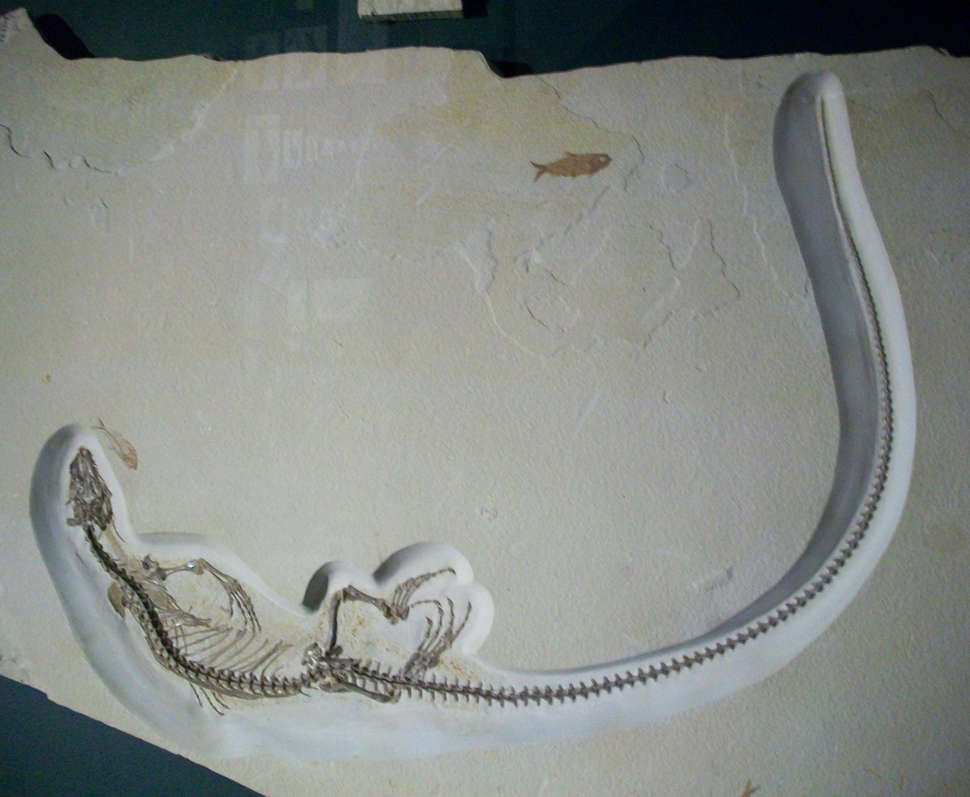
Fossil of Saniwa ensidens in the Field Museum of Natural History
Nearly all animals have two eyes, but there are rare exceptions. Crustaceans in the appropriately named family Cyclopidae, aka Cyclops, for example, see their world through a single large eye. On the other side of the spectrum are giant clams, which have hundreds of eyes. Among vertebrates, the record holder is the jawless lamprey. Part of a very ancient lineage, this eel-resembling fish possesses four eyes.

The extra two eyes are photosensory structures at the top of the head known as the pineal and parapineal organs. Scientists are still trying to determine all of the functions of these organs, but it is known that they play key roles in orientation and in circadian and annual cycles.

The pineal organ is found in a number of lower vertebrates, such as fishes and frogs, but the parapineal organ is less common. Krister Smith of the Senckenberg Research Institute, however, has long suspected that ancient lizards might have had both of the photosensory structures along with two more typical eyes.

"The idea first germinated when, as a graduate student, I was surveying the diversity of fossil lizards in the Yale collections," Smith said. "In one case, there were contradictory interpretations of the third eye in the parietal bone by different experts. It was clear that there were two large holes in the bone, one behind the other, and I recalled that there were two pineal organs."

Smith admits that it was a "wacky" idea to search for an ancient lizard with four eyes, but she and her team did just that.

They scoured museum specimens collected nearly 150 years ago at Grizzly Buttes, a site in the Bridger Basin of Wyoming. CT scans revealed that two different individuals from an extinct species of monitor lizard (Saniwa ensidens) had spaces where the extra two eyes would have been.

The discovery, reported in the journal Current Biology, documents the first known four-eyed jawed vertebrate.

"As a scientist, one has lots of ideas, but many — even most of them — don't pan out, and the more idiosyncratic an idea is, the more likely it is to fail," Smith said, adding that she was thrilled when her suspicions about fossilized lizards proved to be correct.

The discovery sheds light on the evolution of the extra eyes.
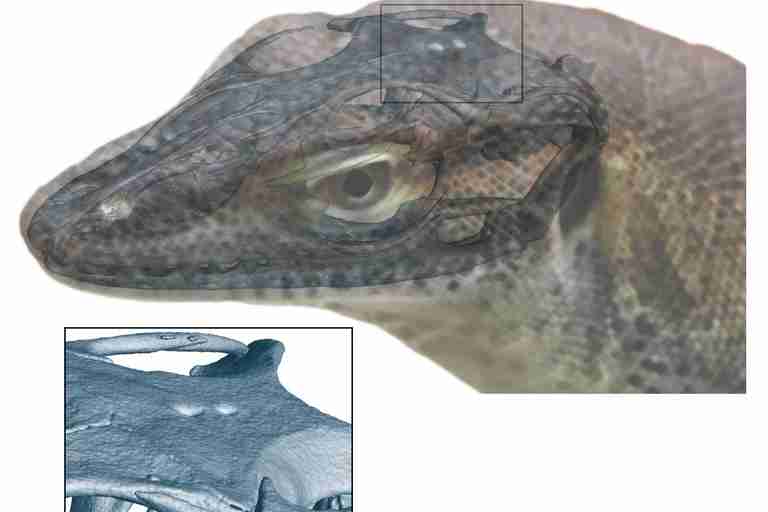
This image depicts a reconstruction of what the extinct monitor lizard might have looked like. The parietal and pineal foramina are visible on the overlaid skull.
Smith and her colleagues Bhart-Anjan Bhullar, Gunther Köhler, and Jörg Habersetzer suspect that lampreys evolved their four eyes simultaneously, but they say that more fossil finds will be needed to determine when each of the organs emerged.

What is known is that the earliest mammals — our distant ancestors — did not just have two eyes.

"Stem mammals had three eyes," Smith explained. "It has been proposed that the nocturnal phase of evolution in mammalian ancestors led to the disappearance of the third eye in that lineage, and perhaps something similar happened in other tetrapod groups."

Many tetrapods, or four-footed animals, therefore might have lost their third eye when some became active at night and presumably didn't need the additional photosensory organs.

Humans and most other mammals retain no lingering evidence of a third eye.

"In particular in humans, the cerebrum is so massively expanded that it thickly and completely covers the pineal organ, making it virtually impossible for any photons to reach it," Smith said. "Also, the parapineal organ is regarded as completely absent."

In rats, however, the pineal organ is close to the surface. Some photosensitive proteins are still expressed in the organ in embryonic rats, suggesting that the third eye didn't completely disappear in the rodent lineage.

Smith and her team are not sure which organ — the pineal or parapineal — led to the formation of the third eye in early mammals. When that mystery is solved, they should gain a better understanding of why the extra eye was lost over time in mammals.

What is clearer is that the third eye of today's lizards, the pineal organ, evolved independently from the third eye of other jawed vertebrates.

"We should stress that the idea that the lizard third eye is not the same as the third eye of frogs or fish was proposed before," Smith said. "But it has not been universally accepted. By finding a species in which both pineal organs were simultaneously developed as eyes, where the front one was clearly the typical lizard third eye, we could confirm this idea."

Although the extinct monitor's extra eyes were located close together, the researchers do not think that they functioned as a pair in the same way that typical eyes do.

"They are indeed closely spaced, but their central neural connections with the rest of the brain are different," Smith explained.

Saniwa ensidens lived in parts of Wyoming and Europe during the Eocene epoch around 48 million years ago. It holds the distinction of being the first fossil lizard ever known from North America. Now it has yet another claim to animal fame — at least for now.

The new finding "tells us how easy it is, in terms of evolution, to self-assemble a complex organ under certain circumstances,” said Bhullar, a paleontologist at Yale. “Eyes are classically thought of as these remarkably complex structures. In fact, the brain is just waiting to make eyes at all times.”

He added that eyes are "fundamentally a part of the brain" and that their formation "is part of the process of how the brain comes in contact with part of the skin."

Smith said that as an embryo develops, the central nervous system begins as an "infolding of the outermost layer of the embryo." This layer is called the neuroectoderm.

Read more at Seeker

Apr 2, 2018

Finding order in disorder demonstrates a new state of matter

This is Cristiano Nisoli.
Physicists have identified a new state of matter whose structural order operates by rules more aligned with quantum mechanics than standard thermodynamic theory. In a classical material called artificial spin ice, which in certain phases appears disordered, the material is actually ordered, but in a "topological" form.

"Our research shows for the first time that classical systems such as artificial spin ice can be designed to demonstrate topological ordered phases, which previously have been found only in quantum conditions," said Los Alamos National Laboratory physicist Cristiano Nisoli, leader of the theoretical group that collaborated with an experimental group at the University of Illinois at Urbana-Champaign, led by Peter Schiffer (now at Yale University).

Physicists generally classify the phases of matter as ordered, such as crystal, and disordered, such as gases, and they do so on the basis of the symmetry of such order, Nisoli said.

"The demonstration that these topological effects can be designed into an artificial spin ice system opens the door to a wide range of possible new studies," Schiffer said.

Specialized material maintained puzzling energy levels in experiments

In the new research, the team explored a particular artificial spin ice geometry, called Shakti spin ice. While these materials are theoretically designed, this time, the discovery of its exotic, out-of-equilibrium properties proceeded from experiments to theory.

Performing photoemission electron microscopy characterization at the U.S. Department of Energy's Advanced Light Source at Lawrence Berkeley National Laboratory, Schiffer's team revealed something puzzling: Unlike other artificial spin ices, which could reach their low-energy state as temperature was reduced in successive quenches, Shakti spin ice stubbornly remained at about the same energy level. "The system gets stuck in a way that it cannot rearrange itself, even though a large-scale rearrangement would allow it to fall to a lower energy state," Schiffer said.

Clearly, something was being conserved, but nothing appeared as an obvious candidate in a material artificially devised to provide a disordered spin picture.

Backing off to see the big picture

Moving away from a spin picture and concentrating on an emergent description of the excitations of the system, Nisoli described a low-energy state that could be mapped exactly into a celebrated theoretical model, the "dimer cover model," whose topological properties had been recognized before. Then, data from the experiment confirmed topological charge conservation and thus a long lifetime for the excitations.

"I find it most intriguing because usually theoretical frameworks move from classical physics to quantum physics. Not so with topological order," Nisoli said.

Read more at Science Daily

Cosmic lens helps Hubble capture image of most distant star ever seen

Icarus, whose official name is MACS J1149+2223 Lensed Star 1, is the farthest individual star ever seen. It is only visible because it is being magnified by the gravity of a massive galaxy cluster, located about 5 billion light-years from Earth. Called MACS J1149+2223, this cluster, shown at left, sits between the Earth and the galaxy that contains the distant star. The team had been using Hubble to monitor a supernova in the far-off spiral galaxy when, in 2016, they spotted a point of light near the supernova that began to brighten. Even though the object subsequently became three times brighter in one month, the colors of the light coming from the object did not change. Analysis of these colors showed it was a blue supergiant star in the background galaxy whose magnification grew for several weeks due to an intervening object, probably a star, in the galaxy cluster. The panels at the right show the view in 2011, without Icarus visible, compared with the star's brightening in 2016.
Thanks to a rare cosmic alignment, astronomers have captured the most distant normal star ever observed, some 9 billion light years from Earth.

While astronomers routinely study galaxies much farther away, they're visible only because they glow with the brightness of billions of stars. And a supernova, often brighter than the galaxy in which it sits, also can be visible across the entire universe.

Beyond a distance of about 100 million light years, however, the stars in these galaxies are impossible to make out individually.

But a phenomenon called gravitational lensing -- the bending of light by massive galaxy clusters in the line of sight -- can magnify the distant universe and make dim, far away objects visible. Typically, lensing magnifies galaxies by up to 50 times, but in this case, the star was magnified more than 2,000 times. It was discovered in NASA Hubble Space Telescope images taken in late April of 2016 and as recently as April 2017.

"You can see individual galaxies out there, but this star is at least 100 times farther away than the next individual star we can study, except for supernova explosions," said former UC Berkeley postdoctoral scholar Patrick Kelly, now on the faculty at the University of Minnesota, Twin Cities. Kelly is first author of a paper about the discovery appearing online this week in advance of publication in the journal Nature Astronomy.

The discovery of the star, which astronomers often refer to as Icarus rather than by its formal name, MACS J1149 Lensed Star 1 (LS1), kicks off a new technique for astronomers to study individual stars in galaxies formed during the earliest days of the universe. These observations can provide a rare look at how stars evolve, especially the most luminous ones.

"For the first time ever we're seeing an individual normal star -- not a supernova, not a gamma ray burst, but a single stable star -- at a distance of nine billion light years," said Alex Filippenko, a professor of astronomy at UC Berkeley and one of many co-authors of the report. "These lenses are amazing cosmic telescopes."

The astronomy team also used Icarus to test and reject one theory of dark matter -- that it consists of numerous primordial black holes lurking inside galaxy clusters -- and to probe the make-up of normal matter and dark matter in the galaxy cluster.

Einstein ring

Kelly noticed the star while monitoring a supernova he had discovered in 2014 while using Hubble to peer through a gravitational lens in the constellation Leo. That supernova, dubbed SN Refsdal in honor of the late Norwegian astrophysicist Sjur Refsdal, a pioneer of gravitational lensing studies, was split into four images by the lens, a massive galaxy cluster called MACS J1149+2223, located about 5 billion light years from Earth.

Suspecting that Icarus might be more highly magnified than SN Refsdal, Kelly and his team analyzed the colors of the light coming from it and discovered it was a single star, a blue supergiant. This B-type star is much larger, more massive, hotter and possibly hundreds of thousands of times intrinsically brighter than our Sun, though still much too far away to see without the amplification of gravitational lensing.

By modeling the lens, they concluded that the tremendous apparent brightening of Icarus was probably caused by a unique effect of gravitational lensing. While an extended lens, like a galaxy cluster, can only magnify a background object up to 50 times, smaller objects can magnify much more. A single star in a foreground lens, if precisely aligned with a background star, can magnify the background star thousands of times. In this case, a star about the size of our sun briefly passed directly through the line of sight between the distant star Icarus and Hubble, boosting its brightness more than 2,000 times.

In fact, if the alignment was perfect, that single star within the cluster turned the light from the distant star into an "Einstein ring": a halo of light created when light from the distant star bends around all sides of the lensing star. The ring is too small to discern from this distance, but the effect made the star easily visible by magnifying its apparent brightness.

Kelly saw a second star in the Hubble image, which could either be a mirror image of Icarus, or a different star being gravitationally lensed.

Read more at Science Daily