Mar 24, 2015

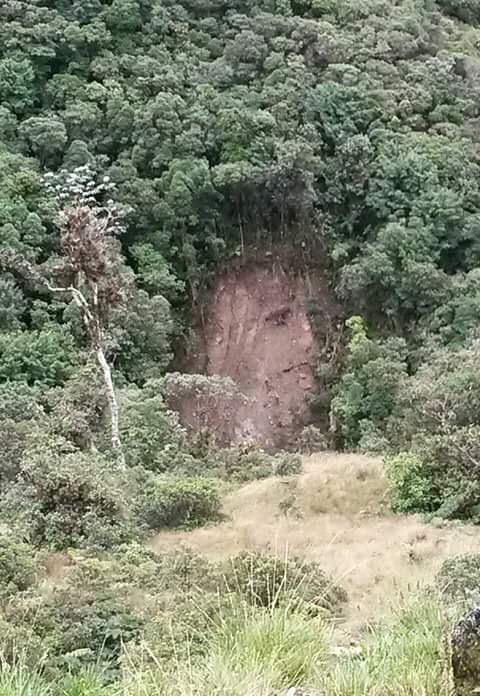
'Face of Jesus' Appears After Colombian Rockslide

The Colombian newspaper El Tiempo reports that after a landslide in the municipality of San Francisco in Putamayo province, an anthropomorphic scar appeared on a hillside that some are saying is the face of Jesus.

"If you believe in Jesus you will see your image,"  Ximena Rosero Arango, one of the many people who have come to the site to photograph the mountain, told the newspaper.

Some landowners are charging as much as 2,000 pesos -- 79 cents in U.S. currency -- for access to the supposedly miraculous phenomenon. It's also causing a sensation on Twitter and in the international media, with everyone from Time to the Irish Mirror and the Malaysia Chronicle picking up on the story.

The hillside joins a list of rock formations and other natural features around the world that at least vaguely resemble human faces. But the Colombian hillside has garnered more media connection because of its religious connection. There's also an underground rock formation in the Philippines that some think suggests the face on the Shroud of Turin. In 2010, the Telegraph, a British newspaper, and other publications reported that Jesus' likeness also could be seen in Google Maps overhead photo of a field on farmland near Puspokladany in Hungary.

Although some see these phenomena as miraculous, there's another possible explanation: Our minds are hard-wired by evolution to see them.

Read more at Discovery News

Costa Rica Is Running Only on Renewable Energy

Costa Rica has now powered the entire country for more than 75 days using only renewable energy. The country hasn't needed fossil fuel for all of 2015 thanks to hydropower and a heavy rainy season.

The nation of 5 million inhabitants also gets renewable energy contributions from a mix of solar, geothermal and wind power.

Because Costa Rica needs a steady flow of water to maintain such an impressive feat, the Central American nation has budgeted nearly $1 billion to tap into its many volcanoes, expanding its use of geothermal power.

Geothermal energy generated 10 percent of the nation's power last year.

The country tops an impressive list of nations producing much of their power from renewable sources. Reports Quartz, Sweden, Bulgaria and Estonia have already met their 2020 renewable energy goals.

Denmark creates 40 percent of its energy from wind. And the Dutch territory Bonaire is already producing nearly 100 percent of its energy from renewables and hopes to go over the top using algae as a biofuel.

Costa Rica aims to be entirely carbon neutral by 2021, reports inhabit.com.

From Discovery News

LHC Short Circuit Delays Awesome Physics Quest

After being shut down for 2 years for a significant power upgrade, the world’s biggest and most advanced particle collider was scheduled to restart this week. Unfortunately, an electrical glitch has put the breaks on the Large Hadron Collider’s grand reboot — but it’s not the end of the world.

According to a CERN news update today (March 24), the delay was triggered by an “intermittent short circuit” in one of the particle accelerator’s magnet circuits and an investigation is underway. “It is a well understood issue, but one that could take time to resolve since it is in a cold section of the machine and repair may therefore require warming up and re-cooling after repair,” writes CERN.

As discussed by Frédérick Bordry, CERN’s Director for Accelerators, any glitch impacting a cryogenic machine is a time amplifier, “so what would have taken hours in a warm machine could end up taking us weeks,” said Bordry in a statement.

Consisting of a main 27 kilometer (17 mile) circumference ring of supercooled electromagnets, the LHC has to undergo a long period of cooling down before the instrumentation is capable of maintaining the relativistic particles in a tightly-controlled and collimated “beam.” Operating at temperatures as close to absolute zero as possible, the ring of electromagnets take time (and lots of energy) to warm up and then cool back down should repairs be needed.

CERN estimates that the restart delay could be anything from a few days to several weeks, but as part of the LHC’s historic voyage to peel back the mysteries of space, time and quantum mechanics, this is only a minor bump in the road.

“All the signs are good for a great run 2,” said Rolf Heuer, Director General of CERN. “In the grand scheme of things, a few weeks delay in humankind’s quest to understand our universe is little more than the blink of an eye.”

Having already achieved its prime mission to identify the Higgs boson, anticipation for the LHC operating at a higher energy regime is nearing fever pitch. Run 2 will see proton beams being circulated around the LHC at an energy of 6.5 TeV — providing collision energies of 13 TeV, almost double the collision energy of the LHC’s first run. The prospects of discovering exotic physics phenomena is tantalizing.

Read more at Discovery News

Car-Sized Salamander Had 'Toilet Seat' Head

Today’s amphibians had much larger, formidable ancestors, according to a study that describes a newly found salamander-like animal that was the size of a car and had a head that looked like a toilet seat.

The predator, named Metoposaurus algarvensis, lived around 220 million years ago and likely ate mostly fish.

Project leader Steve Brusatte told Discovery News that the early amphibian “was a top predator during the time that dinosaurs were first evolving and beginning their march to dominance.”

“We think this ‘super salamander’ is a type of totally bizarre, otherworldly extinct animal,” added Brusatte, who is a paleontologist at the University of Edinburgh’s School of GeoSciences.

He and his team found the animal’s remains at the site of a former lake in southern Portugal. They believe Metoposaurus stomped around the region, living much like crocodiles do today.

It’s doubtful that many other predators dared to take on the big beast.

“This new amphibian looks like something out of a bad monster movie,” Brusatte said. “It was as long as a small car and had hundreds of sharp teeth in its big flat head, which kind of looks like a toilet seat when the jaws snap shut. It was the type of fierce predator that the very first dinosaurs had to put up with if they strayed too close to the water, long before the glory days of T. rex and Brachiosaurus.”

Metoposaurus appears to have been sensitive to changes in climate, however. The researchers think many died at the Portuguese site when the lake they inhabited dried up. This perhaps foreshadowed what was to come some 20 million years later.

At about 201 million years ago, there was a mass extinction event that wiped out most big amphibians like this. At this time, the supercontinent Pangea, which included all of the world’s present day continents, began to break apart.

The changes are significant for dinosaur fans, as the extinctions paved the way for dinosaurs to become the number one terrestrial predators.

Read more at Discovery News

Mar 23, 2015

Did a volcanic cataclysm 40,000 years ago trigger the final demise of the Neanderthals?

The Campanian Ignimbrite (CI) eruption in Italy 40,000 years ago was one of the largest volcanic cataclysms in Europe and injected a significant amount of sulfur-dioxide (SO2) into the stratosphere. Scientists have long debated whether this eruption contributed to the final extinction of the Neanderthals. This new study by Benjamin A. Black and colleagues tests this hypothesis with a sophisticated climate model.

Black and colleagues write that the CI eruption approximately coincided with the final decline of Neanderthals as well as with dramatic territorial and cultural advances among anatomically modern humans. Because of this, the roles of climate, hominin competition, and volcanic sulfur cooling and acid deposition have been vigorously debated as causes of Neanderthal extinction.

They point out, however, that the decline of Neanderthals in Europe began well before the CI eruption: "Radiocarbon dating has shown that at the time of the CI eruption, anatomically modern humans had already arrived in Europe, and the range of Neanderthals had steadily diminished. Work at five sites in the Mediterranean indicates that anatomically modern humans were established in these locations by then as well."

"While the precise implications of the CI eruption for cultures and livelihoods are best understood in the context of archaeological data sets," write Black and colleagues, the results of their study quantitatively describe the magnitude and distribution of the volcanic cooling and acid deposition that ancient hominin communities experienced coincident with the final decline of the Neanderthals.

In their climate simulations, Black and colleagues found that the largest temperature decreases after the eruption occurred in Eastern Europe and Asia and sidestepped the areas where the final Neanderthal populations were living (Western Europe). Therefore, the authors conclude that the eruption was probably insufficient to trigger Neanderthal extinction.

Read more at Science Daily

Fish Feeds on Land with a 'Water Tongue'

A fish that uses water as a sort of tongue to feed on land could shed light on how animals with backbones first invaded land, researchers say.

One of the most pivotal moments in evolution occurred when a few pioneering fish left the waterabout 350 million to 400 million years ago. These fish evolved into the first tetrapods (four-legged land animals), which ultimately gave rise to amphibians, reptiles, birds and mammals.

To figure out how ancient animals made this shift to land, scientists typically investigate how the limbs of the first tetrapods evolved over time. However, biomechanistKrijn Michel at the University of Antwerp in Belgium and his colleagues suggest that investigating how early tetrapods learned to eat on land is equally important to understanding this key point in evolution.

In the water, fish generate suction with their mouths to help draw in food with the help of a neck bone known as the hyoid. On land, sucking in air to swallow food proved impractical, so tetrapods instead evolved tongues supported by the hyoid that help guide food down their throats. However, much remains unknown about how tetrapod hyoids and tongues evolved.

To learn more about the evolution of tetrapod feeding, the scientists investigated modern amphibious fish known as mudskippers that dine on land. Mysteriously, these fish emerge onto land with their mouths filled with water.

Now, Michel and his colleagues have found that mudskippers use their mouthfuls of water "like a tongue to capture and swallow food on land, a finding that may give us a glimpse into how the very first land vertebrates evolved from fish 400 million to 350 million years ago," Michel told Live Science.

The researchers experimented with five mudskippers from Nigeria, using high-speed video cameras and X-ray scanners to record the fish feeding on shrimp.

Results showed that the mudskippers fed by first exuding water from their mouths and then quickly sucking it back up once it submerged the food. Essentially, the water acted like a tongue.

Read more at Discovery News

Jupiter May Have Killed Solar System's Baby Super-Earths

As the tally for planets beyond the solar system began climbing, a team of scientists noticed something strange. Most of the other systems in the galaxy had planets bigger than Earth orbiting closer to their parent stars than Mercury circles the sun.

“In our solar system planets are pretty widely spread out and there’s literally nothing inside of Mercury’s orbit,” astronomer Gregory Laughlin, with the University of California Santa Cruz, told Discovery News.

“The fact that the default mode of planet formation ... is leading to configurations that are totally unlike our own solar system is something I found really curious. The main feature of our solar system is that the inner part is just missing,” he said.

Enter the “Grand Tack” theory of our solar system’s formation, which suggests that in its infancy, giant Jupiter spiraled inward, swept by the gravitational wake of its own buildup. Like a cosmic bull in a celestial china shop, Jupiter’s gravity would have flung asteroids and proto-planets every which way, creating a shooting arcade that could have easily destroyed planets in the region, Laughlin said.

The story would have ended there were it not for Saturn, which evolved somewhat later and ended up with enough gravitational muscle to counteract Jupiter’s inward spiral, freeing the giant planet to shift back beyond Mars, or so the Grand Tack theory holds.

That left the inner solar system clear for a second-generation of planets to form, Earth among them.

Laughlin and colleagues were less interested in proving Jupiter’s navigational prowess than looking at what impacts the migration could have had.

“Anytime a theory says 'Well this happened and then this happened,' you need to be naturally suspicious. I think that is completely, absolutely valid and the right standpoint to take,” Laughlin said.

But looking at the consequences of the migration provides a very nice test, he added.

Read more at Discovery News

Ancient Doomsday Asteroid Impact Found in Australia

Two vast underground domes are buried under central Australia that researchers have realized are the scars of the biggest and most powerful asteroid impact yet found on Earth. They appear to have been caused by a massive asteroid that broke in two, serving our planet and all life on it with a devastatingly powerful double-punch.

Embedded in the crust 30 kilometers (19 miles) deep, in rock that is 300-600 million years old, the double impact crater has long gone, buried by geological processes, but its imprint in Earth’s crust remains. It covers a vast impact zone some 400 kilometers (250 miles) wide in the Warburton Basin in Central Australia.

“The two asteroids must each have been over 10 kilometers (6.2 miles) across — it would have been curtains for many life species on the planet at the time,” said Andrew Glikson from the Australian National University’s School of Archaeology and Anthropology.

Compared with the famous Chicxulub crater under the Yucatán Peninsula in Mexico, which is famous for causing the extinction of the dinosaurs some 66 million years ago, this Australian impact zone is a monster. The Chicxulub crater is 180 kilometers (110 miles) in diameter and was caused by a single 10 kilometer-wide asteroid; the Warburton Basin impact zone is over twice that size, caused by two Chicxulub-sized impactors.

The discovery came when a geothermal research project drilled out rock from South Australia and the Northern Territory that had been turned to glass; a tell-tail sign that an ancient impact had delivered a very energetic blow. But only on further investigation did the Glikson’s team realize the extent of the the impact.

Magnetic modeling of the crust throughout the region revealed bulges, rich in iron and magnesium, pushing upward into the Earth’s crust. These bulges originated from the Earth’s mantle — the tick layer of rock that separates the core from the crust — acting as ancient bruises left over by the cataclysmic impacts.

“There are two huge deep domes in the crust, formed by the Earth’s crust rebounding after the huge impacts, and bringing up rock from the mantle below,” Glikson said in a press release. The research was published in the journal Tectonophysics this month.

Although the evidence for a massive impact seems clear, some mysteries remain.

Read more at Discovery News

Mar 22, 2015

New transitory form of silica observed

A Carnegie-led team was able to discover five new forms of silica under extreme pressures at room temperature. Their findings are published by Nature Communications.

Silicon dioxide, commonly called silica, is one of the most-abundant natural compounds and a major component of the Earth's crust and mantle. It is well-known even to non-scientists in its quartz crystalline form, which is a major component of sand in many places. It is used in the manufacture of microchips, cement, glass, and even some toothpaste.

Silica's various high-pressure forms make it an often-used study subject for scientists interested in the transition between different chemical phases under extreme conditions, such as those mimicking the deep Earth.

The first-discovered high-pressure, high-temperature denser form, or phase, of silica is called coesite, which, like quartz, consists of building blocks of silicon atoms surrounded by four oxygen atoms. Under greater pressures and temperatures, it transforms into an even denser form called stishovite, with silicon atoms surrounded by six oxygen atoms. The transition between these phases was crucial for learning about the pressure gradient of the deep Earth and the four-to-six configuration shift has been of great interest to geoscientists. Experiments have revealed even higher-pressure phases of silica beyond these two, sometimes called post-stishovite.

A chemical phase is a distinctive and uniform configuration of the molecules that make up a substance. Changes in external conditions, such as temperature and pressure, can induce a transition from one phase to another, not unlike water freezing into ice or boiling into steam.

The team, including Carnegie's Qingyang Hu, Jinfu Shu, Yue Meng, Wenge Yang, and Ho-Kwang, "Dave" Mao, demonstrated that under a range from 257,000 to 523,000 times normal atmospheric pressure (26 to 53 gigapascals), a single crystal of coesite transforms into four new, co-existing crystalline phases before finally recombining into a single phase that is denser than stishovite, sometimes called post-stishovite, which is the team's fifth newly discovered phase. This transition takes place at room temperature, rather than the extreme temperatures found deep in the earth.

Scientists previously thought that this intermediate was amorphous, meaning that it lacked the long-range order of a crystalline structure. This new study uses superior x-ray analytical probes to show otherwise--they are four, distinct, well-crystalized phases of silica without amorphization. Advanced theoretical calculations performed by the team provided detailed explanations of the transition paths from coesite to the four crystalline phases to post-stishovite.

Read more at Science Daily

King Richard III's Reburial: Live at the Scene

First stop: Fenn Lane Farm. The cortege leaves the university and heads to Fenn Lane Farm. Around this area, the largest numbers of fired roundshots from the battle in which Richard lost his life have been found.

King Richard's begins his last voyage -- At the end of the ceremony, the coffin is placed in the hearse. A cortege now departs from the university to visit villages and places in Leicestershire associated with Richard, who died at Bosworth, some 14 miles from Leicester, in 1485.

Richard’s coffin emerges – King Richard III’s oak coffin emerged today from the Fielding Johnson Building at U.K.’s Leicester University, where researchers have studied the king’s mortal remains for the past two and half years.

This is the first time the 5-foot, 10-inch coffin, made of English oak from a Duchy of Cornwall plantation, has been seen.

Richard’s skeleton rests inside an inner lead casket, his bones packed with unbleached linen and laid out as if articulated. The linen cloths are embroidered with boars, roses and consecration crosses so that the remains are covered “in a dignified and honorable way,” the Richard III Society said in a statement.

“White boars are for the ‘blancs sanglier,’ the badge of Richard III; white roses for his House of York; and the crosses because he was an anointed Christian king,“ it added.

In front of a hushed crowd, the university bade farewell to the king with a short ceremony. All of those involved with the excavation were invited to lay a white rose on top of the coffin.

Leicester prepares for King Richard III’s day – It’s the beginning of a unique day for Leicester, a city in the center of England, some 100 miles north of London.

It was here, beneath a council car park, that in 2012 a twisted skeleton was unearthed. Mitochondrial DNA showed a match between Richard III and two of his living relatives, confirming that the bones were indeed those of the last Plantagenet king.

Read more at Discovery News