Mar 24, 2018

Hubble solves cosmic 'whodunit' with interstellar forensics

This is a photo mosaic of an edge-on view of the Milky Way galaxy, looking toward the central bulge. Superimposed on it are radio-telescope images, colored pink, of the stretched, arc-shaped Magellanic Stream below the plane of the galaxy and the shredded, fragmented Leading Arm crossing the galaxy’s plane and extending above it. These gas clouds are being gravitationally pulled apart like taffy from the Small and Large Magellanic Clouds—satellite galaxies to our Milky Way—which appear as bright clumps within the gas.
On the outskirts of our galaxy, a cosmic tug-of-war is unfolding-and only NASA's Hubble Space Telescope can see who's winning.

The players are two dwarf galaxies, the Large Magellanic Cloud and the Small Magellanic Cloud, both of which orbit our own Milky Way Galaxy. But as they go around the Milky Way, they are also orbiting each other. Each one tugs at the other, and one of them has pulled out a huge cloud of gas from its companion.

Called the Leading Arm, this arching collection of gas connects the Magellanic Clouds to the Milky Way. Roughly half the size of our galaxy, this structure is thought to be about 1 or 2 billion years old. Its name comes from the fact that it's leading the motion of the Magellanic Clouds.

The enormous concentration of gas is being devoured by the Milky Way and feeding new star birth in our galaxy. But which dwarf galaxy is doing the pulling, and whose gas is now being feasted upon? After years of debate, scientists now have the answer to this "whodunit" mystery.

"There's been a question: Did the gas come from the Large Magellanic Cloud or the Small Magellanic Cloud? At first glance, it looks like it tracks back to the Large Magellanic Cloud," explained lead researcher Andrew Fox of the Space Telescope Science Institute in Baltimore, Maryland. "But we've approached that question differently, by asking: What is the Leading Arm made of? Does it have the composition of the Large Magellanic Cloud or the composition of the Small Magellanic Cloud?"

Fox's research is a follow-up to his 2013 work, which focused on a trailing feature behind the Large and Small Magellanic Clouds. This gas in this ribbon-like structure, called the Magellanic Stream, was found to come from both dwarf galaxies. Now Fox wondered about its counterpart, the Leading Arm. Unlike the trailing Magellanic Stream, this tattered and shredded "arm" has already reached the Milky Way and survived its journey to the galactic disk.

The Leading Arm is a real-time example of gas accretion, the process of gas falling onto galaxies. This is very difficult to see in galaxies outside the Milky Way, because they are too far away and too faint. "As these two galaxies are in our backyard, we essentially have a front-row seat to view the action," said collaborator Kat Barger at Texas Christian University.

In a new kind of forensics, Fox and his team used Hubble's ultraviolet vision to chemically analyze the gas in the Leading Arm. They observed the light from seven quasars, the bright cores of active galaxies that reside billions of light-years beyond this gas cloud. Using Hubble's Cosmic Origins Spectrograph, the scientists measured how this light filters through the cloud.

In particular, they looked for the absorption of ultraviolet light by oxygen and sulfur in the cloud. These are good gauges of how many heavier elements reside in the gas. The team then compared Hubble's measurements to hydrogen measurements made by the National Science Foundation's Robert C. Byrd Green Bank Telescope at the Green Bank Observatory in West Virginia, as well as several other radio telescopes.

"With the combination of Hubble and Green Bank Telescope observations, we can measure the composition and velocity of the gas to determine which dwarf galaxy is the culprit," explained Barger.

After much analysis, the team finally had conclusive chemical "fingerprints" to match the origin of the Leading Arm's gas. "We've found that the gas matches the Small Magellanic Cloud," said Fox. "That indicates the Large Magellanic Cloud is winning the tug-of-war, because it has pulled so much gas out of its smaller neighbor."

This answer was possible only because of Hubble's unique ultraviolet capability. Because of the filtering effects of Earth's atmosphere, ultraviolet light cannot be studied from the ground. "Hubble is the only game in town," explained Fox. "All the lines of interest, including oxygen and sulfur, are in the ultraviolet. So if you work in the optical and infrared, you can't see them."

Gas from the Leading Arm is now crossing the disk of our galaxy. As it crosses, it interacts with the Milky Way's own gas, becoming shredded and fragmented.

Read more at Science Daily

Mysterious head of a pharaoh discovered by Swansea Egyptologist

This is the front aspect of the artifact.
Swansea University Egyptology lecturer Dr Ken Griffin has found a depiction of one of the most famous pharaoh's in history Hatshepsut (one of only a handful of female pharaohs) on an object in the Egypt Centre stores, which had been chosen for an object handling session.

The opportunity to handle genuine Egyptian artefacts is provided by the Egypt Centre to students studying Egyptology at Swansea University. During a recent handling session for an Egyptian Art and Architecture module Dr Kenneth Griffin, from the University's Department of Classics, Ancient History and Egyptology, noticed that one of the objects chosen was much more interesting than initially thought.

Consisting of two irregularly shaped limestone fragments that have been glued together, the object had been kept in storage for over twenty years and was requested for the handling session based only on an old black and white photograph.

The front side depicts the head of a figure whose face is unfortunately missing, with the remains of a fan directly behind. Traces of hieroglyphs are also present above the head. The iconography of the piece indicates that it represents a ruler of Egypt, particularly with the presence of the uraeus (cobra) on the forehead of the figure. Who is this mysterious pharaoh and where did the fragment originate from?

A search of the Egypt Centre records provides no information on the original provenance or find spot of the object. What is known is that it came to Swansea in 1971 as part of the distribution of objects belonging to Sir Henry Wellcome (1853-1936), the pharmaceutical entrepreneur based in London. The fragments are less than 5cm thick and had clearly been removed from the wall of a temple or tomb, as can be seen from the cut marks on the back.

Having visited Egypt on over fifty occasions, Dr Griffin quickly recognised the iconography as being similar to reliefs within the temple of Hatshepsut at Deir el-Bahri (Luxor), which was constructed during the height of the New Kingdom. In particular, the treatment of the hair, the fillet headband with twisted uraeus, and the decoration of the fan are all well-known at Deir el-Bahri.

Most importantly, the hieroglyphs above the head -- part of a formulaic text attested elsewhere at the temple -- use a feminine pronoun, a clear indication that the figure is female.

Hatshepsut was the fifth pharaoh of the Eighteenth Dynasty (c.1478-1458 BC) and one of only a handful of women to have held this position. Early in her reign she was represented as a female wearing a long dress, but she gradually took on more masculine traits, including being depicted with a beard. The reign of Hatshepsut was one of peace and prosperity, which allowed her to construct monuments throughout Egypt. Her memorial temple at Deir el-Bahri, built to celebrate and maintain her cult, is a masterpiece of Egyptian architecture.

Many fragments were taken from this site during the late nineteenth century, before the temple was excavated by the Egypt Exploration Fund (now Egypt Exploration Society) between 1902-1909. Since 1961 the Polish Archaeological Mission to Egypt has been excavating, restoring, and recording the temple.

Yet the mystery of the precious find doesn't end there. On the rear of the upper fragment, the head of a man with a short beard is depicted. Initially there was no explanation for this, but it is now clear that the upper fragment had been removed and recarved in more recent times in order to complete the face of the lower fragment. The replacement of the fragment below the figure would also explain the unusual cut of the upper fragment. This was probably done by an antiques dealer, auctioneer, or even the previous owner of the piece in order to increase its value and attractiveness. It was eventually decided at an unknown date to glue the fragments together in the original layout, which is how they now appear.

While Deir el-Bahri seems the most likely provenance for this artefact, further research is needed in order to confirm this and it may even be possible to one day determine the exact spot the fragments originated from.

Given the importance of the object, the head of Hatshepsut has now been placed on display in a prominent position within the House of Life at the Egypt Centre so that the relief can be appreciated by visitors to the Centre.

Dr Griffin said: "The Egypt Centre is a wonderful resource and is certainly one of the major factors in attracting students to study Egyptology at Swansea University."

Read more at Science Daily

Mar 23, 2018

Different neural strategies for junior high school male and female English learners

Adolescent male and female brains respond differently to English sentences. (left, boys; right, girls) (top, correct sentence; bottom, incorrect sentence) Colors represent correlation between test scores and neural activity. Warm colors show positive correlation, cool colors show negative correlation. Regions marked with * and + show statistically significant correlation. Points from the region of interest (circled) are used to plot neural activity vs. test scores. (Top) Boys show increased activation with proficiency in the front left of the brain, girls show increased activation in the back left. (Bottom) Boys show decreased activation with proficiency in the back right of the brain; girls show increased activation at the back left.
Researchers from Tokyo Metropolitan University studied the neural response of Japanese junior high school students learning English as a second language, while listening to English sentences. More proficient boys showed more activation in parts of the brain associated with grammatical rules (syntax); girls used a wider range of language information, including speech sounds (phonology) and meaning of words and sentences (semantics). These discoveries may help optimize how boys and girls are taught English.

Children learn their native language with enviable ease and speed, but learning a second language is a far more varied process; though there has been much research into how the brain deals with new languages, we still don't know how variations in gender, age etc. specifically affect how we learn a new tongue.

A team led by Prof. Fumitaka Homae studied a rarely targeted population for this subject: Japanese junior high school students learning English as a second language in a school environment. The majority of work into the neuroscience behind learning a second language is based on immigrant populations in the United States, and children in the multi-lingual environment of Europe.

The boys and girls were given a standardized English test and a test of "Working Memory," a temporary storage in the brain used to organize, manipulate and analyze newly arrived information. They then listened to English sentences, including some with grammatical errors; observations of brain activity were taken using functional near-infrared spectroscopy (fNIRS) and event-related potential (ERP) measurements. fNIRS tells us which parts of the brain are active; ERP gives us an idea of how brain activity varies with time.

The results revealed a surprising disparity in how boys and girls deal with sentences. The girls performed better on the tests, and had more working memory. However, boys showed no correlation between working memory and performance, while girls did. Looking at brain activity, fNIRS revealed that boys showed increased activation with proficiency in the front of the brain when they heard a correct sentence, while girls showed more at the back. The front is linked with "syntactic" processing i.e. rule-based understanding of sentences; the back is associated with a wider range of language processing. Interestingly, boys displayed an overall decreased response for incorrect sentences; girls showed the exact opposite.

ERPs also showed disparities, with boys exhibiting a strong response to incorrect sentences from an early time, a phase thought to be associated with "syntactic" processing. Girls only showed a difference between correct and incorrect sentences at later times.

The emerging picture is of two different strategies to cope with a second language. Boys leverage efficient processing and rule-based "implicit" thinking; girls draw on a wider range of linguistic information, achieving "explicit" comprehension of sentences. A cursory look at test scores may have simply pointed to girls being "better" at learning English, but the mechanisms tell a far more interesting story.

Read more at Science Daily

The brain learns completely differently than we've assumed since the 20th century

Image representing the old synaptic (red) and new dendritic (green) learning scenarios of the brain. In the center a neuron with two dendritic trees collects incoming signals via many thousands of tiny adjustable learning parameters, the synapses, represented by red valves. In the new dendritic learning scenario (right) only two adjustable red valves are located in close proximity to the computational element, the neuron. The scale is such that if a neuron collecting its incoming signals is represented by a person's faraway fingers, the length of its hands would be as tall as a skyscraper (left).
The brain is a complex network containing billions of neurons, where each of these neurons communicates simultaneously with thousands of other via their synapses (links). However, the neuron actually collects its many synaptic incoming signals through several extremely long ramified "arms" only, called dendritic trees.

In 1949 Donald Hebb's pioneering work suggested that learning occurs in the brain by modifying the strength of the synapses, whereas neurons function as the computational elements in the brain. This has remained the common assumption until today.

Using new theoretical results and experiments on neuronal cultures, a group of scientists, led by Prof. Ido Kanter, of the Department of Physics and the Gonda (Goldschmied) Multidisciplinary Brain Research Center at Bar-Ilan University, has demonstrated that the central assumption for nearly 70 years that learning occurs only in the synapses is mistaken.

In an article published today in the journal Scientific Reports, the researchers go against conventional wisdom to show that learning is actually done by several dendrites, similar to the slow learning mechanism currently attributed to the synapses.

"The newly discovered process of learning in the dendrites occurs at a much faster rate than in the old scenario suggesting that learning occurs solely in the synapses. In this new dendritic learning process, there are a few adaptive parameters per neuron, in comparison to thousands of tiny and sensitive ones in the synaptic learning scenario," said Prof. Kanter, whose research team includes Shira Sardi, Roni Vardi, Anton Sheinin, Amir Goldental and Herut Uzan.

The newly suggested learning scenario indicates that learning occurs in a few dendrites that are in much closer proximity to the neuron, as opposed to the previous notion. "Does it make sense to measure the quality of air we breathe via many tiny, distant satellite sensors at the elevation of a skyscraper, or by using one or several sensors in close proximity to the nose? Similarly, it is more efficient for the neuron to estimate its incoming signals close to its computational unit, the neuron," says Kanter. Hebb's theory has been so deeply rooted in the scientific world for 70 years that no one has ever proposed such a different approach. Moreover, synapses and dendrites are connected to the neuron in a series, so the exact localized site of the learning process seemed irrelevant.

Another important finding of the study is that weak synapses, previously assumed to be insignificant even though they comprise the majority of our brain, play an important role in the dynamics of our brain. They induce oscillations of the learning parameters rather than pushing them to unrealistic fixed extremes, as suggested in the current synaptic learning scenario.

Read more at Science Daily

Two-billion-year-old salt rock reveals rise of oxygen in ancient atmosphere

A sample of 2-billion-year-old salt (pink-white recrystallized halite) with embedded fragments of calcium sulfate from a geological drill core in Russian Karelia.
A 2-billion-year-old chunk of sea salt provides new evidence for the transformation of Earth's atmosphere into an oxygenated environment capable of supporting life as we know it.

The study by an international team of institutions including Princeton University found that the rise in oxygen that occurred about 2.3 billion years ago, known as the Great Oxidation Event, was much more substantial than previously indicated.

"Instead of a trickle, it was more like a firehose," said Clara Blättler, a postdoctoral research fellow in the Department of Geosciences at Princeton and first author on the study, which was published online by the journal Science on Thursday, March 22. "It was a major change in the production of oxygen."

The evidence for the profound upswing in oxygen comes from crystalized salt rocks extracted from a 1.2-mile-deep hole in the region of Karelia in northwest Russia. These salt crystals were left behind when ancient seawater evaporated, and they give geologists unprecedented clues to the composition of the oceans and atmosphere on Earth more than 2 billion years ago.

The key indication of the increase in oxygen production came from finding that the mineral deposits contained a surprisingly large amount of a component of seawater known as sulfate, which was created when sulfur reacted with oxygen.

"This is the strongest ever evidence that the ancient seawater from which those minerals precipitated had high sulfate concentrations reaching at least 30 percent of present-day oceanic sulfate as our estimations indicate," said Aivo Lepland, a researcher at the Geological Survey of Norway, a geology specialist at Tallinn University of Technology, and senior author on the study. "This is much higher than previously thought and will require considerable rethinking of the magnitude of oxygenation of Earth's 2-billion year old atmosphere-ocean system."

Oxygen makes up about 20 percent of air and is essential for life as we know it. According to geological evidence, oxygen began to show up in the Earth's atmosphere between 2.4 and 2.3 billion years ago.

Until the new study, however, geologists were uncertain whether this buildup in oxygen -- caused by the growth of cyanobacteria capable of photosynthesis, which involves taking in carbon dioxide and giving off oxygen -- was a slow event that took millions of years or a more rapid event.

"It has been hard to test these ideas because we didn't have evidence from that era to tell us about the composition of the atmosphere," Blättler said.

The recently discovered crystals provide that evidence. The salt crystals collected in Russia are over a billion years older than any previously discovered salt deposits. The deposits contain halite, which is called rock salt and is chemically identical to table salt or sodium chloride, as well as other salts of calcium, magnesium and potassium.

Normally these minerals dissolve easily and would be washed away over time, but in this case they were exceptionally well preserved deep within the Earth. Geologists from the Geological Survey of Norway in collaboration with the Karelian Research Center in Petrozavodsk, Russia, recovered the salts from a drilling site called the Onega Parametric Hole (OPH) on the western shores of Lake Onega.

The unique qualities of the sample make them very valuable in piecing together the history of what happened after the Great Oxidation Event, said John Higgins, assistant professor of geosciences at Princeton, who provided interpretation of the geochemical analysis along with other co-authors.

"This is a pretty special class of geologic deposits," Higgins said. "There has been a lot of debate as to whether the Great Oxidation Event, which is tied to increase and decrease in various chemical signals, represents a big change in oxygen production, or just a threshold that was crossed. The bottom line is that this paper provides evidence that the oxygenation of the Earth across this time period involved a lot of oxygen production."

Read more at Science Daily

Early life experiences influence DNA in the adult brain

Mothering style influences the degree to which DNA is mobilized in offspring's brains, with offspring of more attentive mothers experiencing less gene movement, and offspring of less attentive mothers experiencing more gene movement. Pictured are cells in the mouse hippocampus (whose nuclei are stained blue) that underwent mobilization of the L1 gene (green).
In the perennial question of nature versus nurture, a new study suggests an intriguing connection between the two. Salk Institute scientists report in the journal Science that the type of mothering a female mouse provides her pups actually changes their DNA. The work lends support to studies about how childhood environments affect brain development in humans and could provide insights into neuropsychiatric disorders such as depression and schizophrenia.

"We are taught that our DNA is something stable and unchanging which makes us who we are, but in reality it's much more dynamic," says Rusty Gage, a professor in Salk's Laboratory of Genetics. "It turns out there are genes in your cells that are capable of copying themselves and moving around, which means that, in some ways, your DNA does change."

For at least a decade, scientists have known that most cells in the mammalian brain undergo changes to their DNA that make each neuron, for example, slightly different from its neighbor. Some of these changes are caused by "jumping" genes -- officially known as long interspersed nuclear elements (LINEs) -- that move from one spot in the genome to another. In 2005, the Gage lab discovered that a jumping gene called L1, which was already known to copy and paste itself into new places in the genome, could jump in developing neuronal brain cells.

The team had hypothesized that such changes create potentially helpful diversity among brain cells, fine-tuning function, but might also contribute to neuropsychiatric conditions.

"While we've known for a while that cells can acquire changes to their DNA, it's been speculated that maybe it's not a random process," says Tracy Bedrosian, a former Salk research associate and first author of the study. "Maybe there are factors in the brain or in the environment that cause changes to happen more or less frequently."

To find out, Gage, Bedrosian and colleagues began by observing natural variations in maternal care between mice and their offspring. They then looked at DNA from the offspring's hippocampus, which is involved in emotion, memory and some involuntary functions. The team discovered a correlation between maternal care and L1 copy number: mice with attentive mothers had fewer copies of the jumping gene L1, and those with neglectful mothers had more L1 copies, and thus more genetic diversity in their brains.

To make sure the difference wasn't a coincidence, the team conducted a number of control experiments, including checking the DNA of both parents of each litter to make sure the offspring didn't just inherit their numbers of L1s from a parent, as well as verifying that the extra DNA was actually genomic DNA and not stray genetic material from outside the cell nucleus. Lastly, they cross-fostered offspring, so that mice born to neglectful mothers were raised by attentive ones, and vice versa. Initial results of the correlation between L1 numbers and mothering style held: mice born to neglectful mothers but raised by attentive ones had fewer copies of L1 than mice born to attentive mothers but raised by neglectful ones.

The researchers hypothesized that offspring whose mothers were neglectful were more stressed and that somehow this was causing genes to copy and move around more frequently. Interestingly, there was no similar correlation between maternal care and the numbers of other known jumping genes, which suggested a unique role for L1. So, next, the team looked at methylation -- the pattern of chemical marks on DNA that signals whether genes should or should not be copied and that can be influenced by environmental factors. In this case, methylation of the other known jumping genes was consistent for all offspring. But it was a different story with L1: mice with neglectful mothers had noticeably fewer methylated L1 genes than those with attentive mothers, suggesting that methylation is the mechanism responsible for the mobility of the L1 gene.

"This finding agrees with studies of childhood neglect that also show altered patterns of DNA methylation for other genes," says Gage, who holds the Vi and John Adler Chair for Research on Age-Related Neurodegenerative Diseases. "That's a hopeful thing, because once you understand a mechanism, you can begin to develop strategies for intervention"

The researchers emphasize that at this point it's unclear whether there are functional consequences of increased L1 elements. Future work will examine whether the mice's performance on cognitive tests, such as remembering which path in a maze leads to a treat, can be correlated with the number of L1 genes.

Other authors included Carolina Quayle and Nicole Novaresi of Salk.

Read more at Science Daily

Mysterious skeleton shows molecular complexity of bone diseases

The 6-inch skeleton, nicknamed Ata, was discovered more than a decade ago in an abandoned town in the Atacama Desert of Chile.
A bizarre human skeleton, once rumored to have extraterrestrial origins, has gotten a rather comprehensive genomic work-up, the results of which are now in, researchers from the Stanford University School of Medicine report.

The findings stamp out any remaining quandaries about the specimen's home planet -- it's without a doubt human -- but more than that, the analysis answers questions about remains that have long been a genetic enigma.

After five years of deep genomic analysis, Garry Nolan, PhD, professor of microbiology and immunology at Stanford, and Atul Butte, MD, PhD, director of the Institute for Computational Health Sciences at the University of California-San Francisco, have pinpointed the mutations responsible for the anomalous specimen. The researchers found mutations in not one but several genes known to govern bone development; what's more, some of these molecular oddities have never been described before.

"To me, it seems that when doctors perform analyses for patients and their families, we're often searching for one cause -- one super-rare or unusual mutation that can explain the child's ailment. But in this case, we're pretty confident that multiple things went wrong," said Butte. It's an indication, he said, that looking for a single mutation, or even mutations that are already known to cause a particular disease, can discourage researchers from looking for other potential genetic causes and, in turn, potential treatments for patients.

Nolan, who holds the Rachford and Carlota Harris Professorship, and Butte, a former Stanford faculty member who now holds the Priscilla Chan and Mark Zuckerberg Distinguished Professorship at UCSF, are senior authors of the study, which will be published online March 22 in Genome Research. Sanchita Bhattacharya, PhD, senior research specialist at UCSF, is the lead author.

A human? A primate? An alien?

The skeleton, nicknamed Ata, was discovered more than a decade ago in an abandoned town in the Atacama Desert of Chile. After trading hands and eventually finding a permanent home in Spain, the mummified specimen started to garner public attention. Standing just 6 inches tall -- about the length of a dollar bill -- with an angular, elongated skull and sunken, slanted eye sockets, the internet began to bubble with other-worldly hullabaloo and talk of ET.

"I had heard about this specimen through a friend of mine, and I managed to get a picture of it," Nolan said. "You can't look at this specimen and not think it's interesting; it's quite dramatic. So I told my friend, 'Look, whatever it is, if it's got DNA, I can do the analysis.'"

With the help of Ralph Lachman, MD, a professor of radiology at Stanford and an expert in a type of pediatric bone disease, Nolan set the record straight. Their analysis pointed to a decisive conclusion: This was the skeleton of a human female, likely a fetus, that had suffered severe genetic mutations. In addition, Nolan saw that Ata, though most likely a fetus, had the bone composition of a 6-year-old, an indication that she had a rare, bone-aging disorder.

To understand the genetic underpinnings of Ata's physicality, Nolan turned to Butte for help in genomic evaluation. He accepted the challenge, running a work-up so comprehensive it nearly rose to the level of patient care. Butte noted that some people might wonder about the point of such in-depth analyses.

"We thought this would be an interesting exercise in applying the tools that we have today to really see what we could find," he said. "The phenotype, the symptoms and size of this girl were extremely unusual, and analyzing these kinds of really puzzling, old samples teaches us better how to analyze the DNA of kids today under current conditions."

New insights through an old skeleton

To understand the genetic drivers at play, Butte and Nolan extracted a small DNA sample from Ata's ribs and sequenced the entire genome. The skeleton is approximately 40 years old, so its DNA is modern and still relatively intact. Moreover, data collected from whole-genome sequencing showed that Ata's molecular composition aligned with that of a human genome. Nolan noted that 8 percent of the DNA was unmatchable with human DNA, but that was due to a degraded sample, not extraterrestrial biology. (Later, a more sophisticated analysis was able to match up to 98 percent of the DNA, according to Nolan.)

The genomic results confirmed Ata's Chilean descent and turned up a slew of mutations in seven genes that separately or in combinations contribute to various bone deformities, facial malformations or skeletal dysplasia, more commonly known as dwarfism. Some of these mutations, though found in genes already known to cause disease, had never before been associated with bone growth or developmental disorders.

Knowing these new mutational variants could be useful, Nolan said, because they add to the repository of known mutations to look for in humans with these kinds of bone or physical disorders.

Read more at Science Daily

Mar 22, 2018

When the Mediteranean Sea flooded human settlements

Using the coccolithophore Emiliana huxleyi the researchers were able to determine the salinity of the Northern Aegean Sea some 11,000 to 5,000 years ago.
Around 7,600 years ago, the emergence of agricultural settlements in Southeastern Europe and subsequent progress of civilization suddenly came to a standstill. This was most likely caused by an abrupt sea level rise in the northern Aegean Sea. Researchers of the Senckenberg Biodiversity and Climate Research Centre, the Goethe University in Frankfurt and the University of Toronto have now detected evidence of this oceanographic event and an earlier sudden sea-level rise in the fossils of tiny calcifying marine algae preserved in seafloor sediments in the Aegean Sea. The impact of these events on historical societal development emphasizes the potential economic and social consequences of a future rise in sea levels due to global climate change, the researchers write in the study recently published in the journal Scientific Reports.

Originating in the Middle East, the Neolithic Age witnessed one of the most significant upheavals of civilization in human history: the transition from a culture of hunter-gatherers to an agricultural and sedentary lifestyle. During the Neolithic revolution, agricultural societies also began to spread toward Southeastern Europe. However, archeological digs show that the development of settlements temporarily declined about 7,600 years ago. Researchers from Frankfurt have now identified one of the likely causes for this.

"Approximately 7,600 years ago, the sea level must have risen abruptly in the Mediterranean regions bordering Southeastern Europe. The northern Aegean, the Marmara Sea and the Black Sea recorded an increase of more than one meter. This led to the flooding of low-lying coastal areas that would have been ideal areas for settlement," says lead author Professor Dr. Jens Herrle of the German Senckenberg Biodiversity and Climate Research Centre and Goethe University.

The new study is based on a sediment core from the ocean floor of the northern Aegean Sea, which allowed Herrle and his collaborators to reconstruct the level of salinity in this part of the Mediterranean between 11,000 and 5,000 years ago. The ocean floor is richly abundant in tiny fossils of the calcified algae species Emiliania huxleyi. Viewed up-close under a scanning electron microscope, size changes in these algae preserved a signal of the level of salinity in the surface water of the Aegean during their lifetime.

"These calcifying algae evidence two rapid decreases in the salt content, at approximately 8,400 and again 7,600 years ago, which can only be explained by the fact that a higher volume of low-saline surface water flowed from the Black Sea into the northern Aegean at these times. A prerequisite for this is a rapid rise in sea levels that would lead to an increased outflow of surface water in this direction. The source of this may have been Lake Agassiz in North America. This glacial meltwater lake was enclosed in ice and experienced a massive breach during this period, which emptied an enormous volume of water into the ocean," explains Herrle.

The new evidence supports a conclusion of extensive flooding along the edges of the northeastern Mediterranean, coinciding with two standstills in the Neolithic revolution. The earlier change in sea-level approximately 8,400 years ago highlighted by the new salinity record coincides with archeological dates suggesting that settlement on low-lying areas had already been significantly impeded by rising sea levels and the subsequent climatic changes. The renewed rise in sea levels 800 years later likely further hampered the transition to agricultural communities.

Read more at Science Daily

Scientists detect radio echoes of a black hole feeding on a star

Artist's impression of an inner accretion flow and a jet from a supermassive black hole when it is actively feeding, for example, from a star that it recent tore apart.
On Nov. 11, 2014, a global network of telescopes picked up signals from 300 million light years away that were created by a tidal disruption flare -- an explosion of electromagnetic energy that occurs when a black hole rips apart a passing star. Since this discovery, astronomers have trained other telescopes on this very rare event to learn more about how black holes devour matter and regulate the growth of galaxies.

Scientists from MIT and Johns Hopkins University have now detected radio signals from the event that match very closely with X-ray emissions produced from the same flare 13 days earlier. They believe these radio "echoes," which are more than 90 percent similar to the event's X-ray emissions, are more than a passing coincidence. Instead, they appear to be evidence of a giant jet of highly energetic particles streaming out from the black hole as stellar material is falling in.

Dheeraj Pasham, a postdoc in MIT's Kavli Institute for Astrophysics and Space Research, says the highly similar patterns suggest that the power of the jet shooting out from the black hole is somehow controlled by the rate at which the black hole is feeding on the obliterated star.

"This is telling us the black hole feeding rate is controlling the strength of the jet it produces," Pasham says. "A well-fed black hole produces a strong jet, while a malnourished black hole produces a weak jet or no jet at all. This is the first time we've seen a jet that's controlled by a feeding supermassive black hole."

Pasham says scientists have suspected that black hole jets are powered by their accretion rate, but they have never been able to observe this relationship from a single event.

"You can do this only with these special events where the black hole is just sitting there doing nothing, and then suddenly along comes a star, giving it a lot of fuel to power itself," Pasham says. "That's the perfect opportunity to study such things from scratch, essentially."

Pasham and his collaborator, Sjoert van Velzen of Johns Hopkins University, report their results in a paper published this week in the Astrophysical Journal.

Up for debate

Based on theoretical models of black hole evolution, combined with observations of distant galaxies, scientists have a general understanding for what transpires during a tidal disruption event: As a star passes close to a black hole, the black hole's gravitational pull generates tidal forces on the star, similar to the way in which the moon stirs up tides on Earth.

However, a black hole's gravitational forces are so immense that they can disrupt the star, stretching and flattening it like a pancake and eventually shredding the star to pieces. In the aftermath, a shower of stellar debris rains down and gets caught up in an accretion disk -- a swirl of cosmic material that eventually funnels into and feeds the black hole.

This entire process generates colossal bursts of energy across the electromagnetic spectrum. Scientists have observed these bursts in the optical, ultraviolet, and X-ray bands, and also occasionally in the radio end of the spectrum. The source of the X-ray emissions is thought to be ultrahot material in the innermost regions of the accretion disk, which is just about to fall into the black hole. Optical and ultraviolet emissions likely arise from material further out in the disk, which will eventually be pulled into the black hole.

However, what gives rise to radio emissions during a tidal disruption flare has been up for debate.

"We know that the radio waves are coming from really energetic electrons that are moving in a magnetic field -- that is a well-established process," Pasham says. "The debate has been, where are these really energetic electrons coming from?"

Some scientists propose that, in the moments after the stellar explosion, a shockwave propagates outward and energizes the plasma particles in the surrounding medium, in a process that in turn emits radio waves. In such a scenario, the pattern of emitted radio waves would look radically different from the pattern of X-rays produced from infalling stellar debris.

"What we found basically challenges this paradigm," Pasham says.

A shifting pattern

Pasham and van Velzen looked through data recorded from a tidal disruption flare discovered in 2014 by the global telescope network ASASSN (All-sky Automated Survey for Supernovae). Soon after the initial discovery, multiple electromagnetic telescopes focused on the event, which astronomers coined ASASSN-14li. Pasham and van Velzen perused radio data from three telescopes of the event over 180 days.

The researchers looked through the compiled radio data and discovered a clear resemblance to patterns they had previously observed in X-ray data from the same event. When they fit the radio data over the X-ray data, and shifted the two around to compare their similarities, they found the datasets were most similar, with a 90 percent resemblance, when shifted by 13 days. That is, the same fluctuations in the X-ray spectrum appeared 13 days later in the radio band.

"The only way that coupling can happen is if there is a physical process that is somehow connecting the X-ray-producing accretion flow with the radio-producing region," Pasham says.

From this same data, Pasham and van Velzen calculated the size of the X-ray-emitting region to be about 25 times the size of the sun, while the radio-emitting region was about 400,000 times the solar radius.

"It's not a coincidence that this is happening," Pasham says. "Clearly there's a causal connection between this small region producing X-rays, and this big region producing radio waves."

The team proposes that the radio waves were produced by a jet of high-energy particles that began to stream out from the black hole shortly after the black hole began absorbing material from the exploded star. Because the region of the jet where these radio waves first formed was incredibly dense (tightly packed with electrons), a majority of the radio waves were immediately absorbed by other electrons.

It was only when electrons traveled downstream of the jet that the radio waves could escape -- producing the signal that the researchers eventually detected. Thus, they say, the strength of the jet must be controlled by the accretion rate, or the speed at which the black hole is consuming X-ray-emitting stellar debris. Ultimately, the results may help scientists better characterize the physics of jet behavior -- an essential ingredient in modeling the evolution of galaxies. It's thought that galaxies grow by producing new stars, a process that requires very cold temperatures. When a black hole emits a jet of particles, it essentially heats up the surrounding galaxy, putting a temporary stop on stellar production. Pasham says the team's new insights into jet production and black hole accretion may help to simplify models of galaxy evolution.

Read more at Science Daily

This New Detector Technology Aims to ‘Scintillate’ Elusive Dark Matter Particles

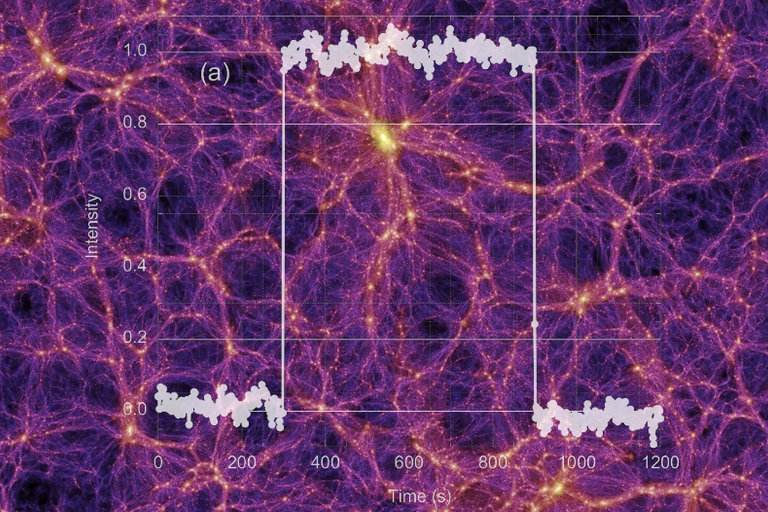
A computerized simulation of the large-scale distribution of dark matter in the universe. An overlay graph (in white) shows how a crystal sample intensely scintillates, or glows, when exposed to X-rays during a lab test. This and other properties could make it a good material for a dark matter detector.
A group of researchers say they may be able to look directly for dark matter in brand new way. By using a new combination of materials in the form of a so-called crystal “scintillator,” they should be able to detect dark matter that is smaller than any particles previously detected. This mass range, below the mass of WIMPS, or Weakly Interacting Massive Particles, has been largely unexplored, and researchers are hopeful that a search at a lower level of mass could produce a breakthrough in finding evidence of the elusive matter that makes up about one-quarter of the universe.

There are several different dark matter detector experiments underway, and most of them are cryogenic detectors that operate underground at extremely low temperatures. Theoretically, they would detect the heat produced when a dark matter particle collides with materials in the detector.  But so far all experiments have come up empty.

Researchers at the US Department of Energy’s Lawrence Berkeley National Laboratory, however, have proposed building a new dark matter experiment using an ultrasensitive detector that incorporates crystals of gallium arsenide (GaAs), along with silicon and boron. This combination of elements would cause the crystals to scintillate, or light up, during particle interactions.

“The dark matter interactions would be detected as infrared photons (light) collected by external transition-edge sensors (TES) rather than phonons (heat),” said the lab’s Stephen Derenzo in an email to Seeker. He is the lead author of a study published this week in the Journal of Applied Physics.

A crystal of gallium arsenide
Derenzo said the new detector would be similar in construction to another experiment, called the Super Cryogenic Dark Matter Search (SuperCDMS) which uses low-temperature solid state detectors the size of hockey pucks. The original experiment was done in the Soudan Underground Laboratory, a former iron mine in Minnesota, and a larger experiment is being built in the deeper SNOLAB in Sudbury, Canada. It looks for dark matter in a type of interaction known as a nuclear recoil.

But the proposed new detector would be able to look for much smaller than WIMPs.

“SuperCDMS is sensitive to nuclear recoils from dark matter in the energy range above the mass of the proton,” Derenzon  said. “Gallium arsenide is sensitive to electron recoils in the range below the mass of the proton. These approaches are complementary since there may be dark matter particles of different masses.”

While astronomers and physicist don’t know what dark matter is, they can measure the effect of its gravity on stars and galaxies. In the 1930s, astronomer Fritz Zwicky first noticed that the motion of galaxies he was studying in the Coma cluster couldn’t be accounted for by the gravity from visible matter of stars, gas, and dust. Then in the 1970s, Vera Rubin and her colleagues determined there wasn't enough "normal" mass present in the galaxies they were studying to explain their rate of rotation. This presented a problem, as either our understanding of gravity was flawed, or there was about five times more mass in the galaxies than astronomers could see.

Normal matter accounts for only about 5 percent of matter in the universe, whereas dark matter constitutes more than 25 percent. The remaining 70 percent is known as dark energy, which, like dark matter, has not been directly observed by researchers.

Astronomers are convinced, however, that dark matter — as well as dark energy — exists and have tried to observe them in several ways, including in underground laboratories and supercolliders such as CERN in Switzerland.

To build any type of dark matter detector, researchers have had to make some assumptions about the nature of the dark matter. Based on a number of theoretical studies, WIMPs were thought to be the likely main constituent of dark matter.

Therefore, most detectors have been built to detect particles the size of WIMPs, thought to weigh more than 100 times the mass of a proton.

Derenzo and his colleague wrote that despite overwhelming evidence for dark matter, recent large-scale experiments designed to detect nuclear recoils from dark matter particles with masses of WIMPs have not yet seen a definitive signal. This has motivated designs for experiments that search for dark matter particles in a different size range.

The GaAs crystal detector would operate near absolute zero, or nearly minus 460 degrees Fahrenheit. This new design iS the first time gallium arsenide would be used as a cryogenic scintillation detector.  The detector will be combined with a cryogenic photodetector, which can detect light at very low temperatures. Derenzo said the new detector could be “a workhorse useful in the search for dark matter in a largely unexplored mass range.”

Work toward constructing the detector is ongoing, Derenzo said.

Read more at Seeker