Mar 5, 2018

127-million-year-old baby bird fossil sheds light on avian evolution

Phosphorous mapping image and photo of fossil.
The tiny fossil of a prehistoric baby bird is helping scientists understand how early avians came into the world in the Age of Dinosaurs.

The fossil, which dates back to the Mesozoic Era (250-65 million years ago), is a chick from a group of prehistoric birds called, Enantiornithes. Made up of a nearly complete skeleton, the specimen is amongst the smallest known Mesozoic avian fossils ever discovered.

It measures less than five centimetres -- smaller than the little finger on an average human hand -- and would have weighed just three ounces when it was alive. What makes this fossil so important and unique is the fact it died not long after its birth. This is a critical stage in a bird's skeletal formation. That means this bird's extremely short life has given researchers a rare chance to analyse the species' bone structure and development.

Studying and analysing ossification -- the process of bone development -- can explain a lot about a young bird's life the researchers say. It can help them understand everything from whether it could fly or if it needed to stay with its parents after hatching or could survive on its own.

The lead author of the study, Fabien Knoll, from The University of Manchester's Interdisciplinary Centre for Ancient Life (ICAL), School of Earth and Environmental Sciences, and the ARAID -- Dinopolis in Spain explains: 'The evolutionary diversification of birds has resulted in a wide range of hatchling developmental strategies and important differences in their growth rates. By analysing bone development we can look at a whole host of evolutionary traits.'

With the fossil being so small the team used synchrotron radiation to picture the tiny specimen at a 'submicron' level, observing the bones' microstructures in extreme detail.

Knoll said: 'New technologies are offering palaeontologists unprecedented capacities to investigate provocative fossils. Here we made the most of state-of-the-art facilities worldwide including three different synchrotrons in France, the UK and the United States.'

The researchers found the baby bird's sternum (breastplate bone) was still largely made of cartilage and had not yet developed into hard, solid bone when it died, meaning it wouldn't have been able to fly.

The patterns of ossification observed in this and the other few very young enantiornithine birds known to date also suggest that the developmental strategies of this particular group of ancient avians may have been more diverse than previously thought.

However, the team say that its lack of bone development doesn't necessarily mean the hatchling was over reliant on its parents for care and feeding, a trait known as being 'altricial'. Modern day species like love birds are highly dependent on their parents when born. Others, like chickens, are highly independent, which is known as 'precocial'. Although, this is not a black-and-white issue, but rather a spectrum, hence the difficulty in clarifying the developmental strategies of long gone bird species.

Read more at Science Daily

Mar 4, 2018

Tiny bubbles of oxygen got trapped 1.6 billion years ago

Fossilized bubbles and cyanobacterial fabric from 1.6 billion-year-old phosphatized microbial mats from Vindhyan Supergroup, central India. Credit: Stefan Bengtson.
Take a good look at this photo: It shows you 1.6 billion years old fossilized oxygen bubbles, created by tiny microbes in what was once a shallow sea somewhere on young Earth.

The bubbles were photographed and analyzed by researchers studying early life on Earth.

Microbes are of special interest: They were not only the first life forms on Earth. They also turned our planet into a tolerable environment for plants and animals and thus their activity paved the way for life as we know it today.

Some of these early microbes were cyanobacteria that thrived in early shallow waters. They produced oxygen by photosynthesis, and sometimes the oxygen got trapped as bubbles within sticky microbial mats.

Fossilized bubbles and cyanobacterial fabric from 1.6 billion-year-old phosphatized microbial mats from Vindhyan Supergroup, central India. Credit Stefan Bengtson.

The bubbles in the photo were preserved, and today they can be seen as a signature for life.

Ph.D. Therese Sallstedt and colleagues from University of Southern Denmark, Swedish Museum of Natural History and Stockholm University studied fossilized sediments from India, and they found round spheres in the microbial mats.

We interpret them as oxygen bubbles created in cyanobacterial biomats in shallow waters 1,6 billion years ago, said Therese Sallstedt.

Cyanobacteria changed the face of the Earth irreversibly since they were responsible for oxygenating the atmosphere. Simultaneously they constructed sedimentary structures called stromatolites, which still exist on Earth today.

The researchers now think that cyanobacteria played a larger role than previously believed in creating phosphorites in shallow waters, thereby allowing today's scientists a unique window into ancient ecosystems. They published their findings in the journal Geobiology.

From Science Daily

Virtual predator is 'self-aware', behaves like living counterpart

Cyberslug was modeled on Pleurobranchaea californica, a sea slug with a simple nervous system.
Scientists report in the journal eNeuro that they've built an artificially intelligent ocean predator that behaves a lot like the original flesh-and-blood organism on which it was modeled. The virtual creature, "Cyberslug," reacts to food and responds to members of its own kind much like the actual animal, the sea slug Pleurobranchaea californica, does.

Unlike most other AI entities, Cyberslug has a simple self-awareness, said University of Illinois molecular and integrative physiology professor Rhanor Gillette, who led the work with software engineer Mikhail Voloshin.

"That is, it relates its motivation and memories to its perception of the external world, and it reacts to information on the basis of how that information makes it feel," Gillette said.

Cyberslug knows when it's hungry, for example. It also has learned which other kinds of virtual sea slugs are yummy to eat and which are less desirable.

Sea slugs typically choose one of three responses when encountering another creature in the wild, Gillette said. "Do I eat it? Do I mate with it? Or do I flee?"

To make the right choice, they must be able sense their own internal state (Am I hungry?), get cues from their environment (How does it smell?) and remember past encounters (Did this thing sting me last time?).

"Their default response is avoidance, but hunger, sensation and learning together form their 'appetitive state,' and if that is high enough the sea slug will attack," Gillette said.

"When P. californica is super hungry, it will even attack a painful stimulus," he said. "And when the animal is not hungry, it usually will avoid even an appetitive stimulus. This is a cost-benefit decision." Cyberslug behaves the same way.

In previous work, Gillette and his colleagues worked out the brain circuitry that allows sea slugs to operate in the wild, "down to individual neurons," he said. To test the accuracy of their models, the researchers experimented with simple computer simulations. One of the first circuitry boards Voloshin built to represent the sea slug brain was housed in a plastic foam food takeout container.

The new model uses more sophisticated algorithms to simulate Cyberslug's competing goals and decision-making, Gillette said. Over time it learns what is good -- and not so good -- to bite. Just like P. californica, the more it eats, the more satiated it becomes and the more likely it is to avoid other creatures. But as hunger returns, Cyberslug becomes a less picky eater.

Read more at Science Daily

Mar 3, 2018

Scientists observe a new quantum particle with properties of ball lightning

This is an artistic impression of a quantum ball lighting.
Scientists at Amherst College and Aalto University have created, for the first time a three-dimensional skyrmion in a quantum gas. The skyrmion was predicted theoretically over 40 years ago, but only now has it been observed experimentally.

In an extremely sparse and cold quantum gas, the physicists have created knots made of the magnetic moments, or spins, of the constituent atoms. The knots exhibit many of the characteristics of ball lightning, which some scientists believe to consist of tangled streams of electric currents. The persistence of such knots could be the reason why ball lightning, a ball of plasma, lives for a surprisingly long time in comparison to a lightning strike. The new results could inspire new ways of keeping plasma intact in a stable ball in fusion reactors.

'It is remarkable that we could create the synthetic electromagnetic knot, that is, quantum ball lightning, essentially with just two counter-circulating electric currents. Thus, it may be possible that a natural ball lighting could arise in a normal lightning strike,' says Dr Mikko Möttönen, leader of the theoretical effort at Aalto University.

Möttönen also recalls having witnessed a ball lightning briefly glaring in his grandparents' house. Observations of ball lightning have been reported throughout history, but physical evidence is rare.

The dynamics of the quantum gas matches that of a charged particle responding to the electromagnetic fields of a ball lightning.

'The quantum gas is cooled down to a very low temperature where it forms a Bose-Einstein condensate: all atoms in the gas end up in the state of minimum energy. The state does not behave like an ordinary gas anymore but like a single giant atom,' explains Professor David Hall, leader of the experimental effort at Amherst College.

The skyrmion is created first by polarizing the spin of each atom to point upward along an applied natural magnetic field. Then, the applied field is suddenly changed in such a way that a point where the field vanishes appears in the middle of the condensate. Consequently, the spins of the atoms start to rotate in the new direction of the applied field at their respective locations. Since the magnetic field points in all possible directions near the field zero, the spins wind into a knot.

The knotted structure of the skyrmion consists of linked loops, at each of which all the spins point to a certain fixed direction. The knot can be loosened or moved, but not untied.

'What makes this a skyrmion rather than a quantum knot is that not only does the spin twist but the quantum phase of the condensate winds repeatedly,' says Hall.

If the direction of the spin is changing in space, the velocity of the condensate responds just as would happen for a charged particle in a magnetic field. The knotted spin structure thus gives rise to a knotted artificial magnetic field that exactly matches the magnetic field in a model of ball lightning.

Read more at Science Daily

Unprecedentedly wide and sharp dark matter map

Hyper Suprime-Cam image of a location with a highly significant dark matter halo detected through the weak gravitational lensing technique. This halo is so massive that some of the background (blue) galaxies are stretched tangentially around the center of the halo. This is called strong lensing.
A research team of multiple institutes, including the National Astronomical Observatory of Japan and University of Tokyo, released an unprecedentedly wide and sharp dark matter map based on the newly obtained imaging data by Hyper Suprime-Cam on the Subaru Telescope. The dark matter distribution is estimated by the weak gravitational lensing technique. The team located the positions and lensing signals of the dark matter halos and found indications that the number of halos could be inconsistent with what the simplest cosmological model suggests. This could be a new clue to understanding why the expansion of the Universe is accelerating.

Mystery of the accelerated Universe

In the 1930's, Edwin Hubble and his colleagues discovered the expansion of the Universe. This was a big surprise to most of the people who believed that the Universe stayed the same throughout eternity. A formula relating matter and the geometry of space-time was required in order to express the expansion of the Universe mathematically. Coincidentally, Einstein had already developed just such a formula. Modern cosmology is based on Einstein's theory for gravity.

It had been thought that the expansion is decelerating over time because the contents of the Universe (matter) attract each other. But in the late 1990's, it was found that the expansion has been accelerating since about 8 Giga years ago. This was another big surprise which earned the astronomers who found the expansion a Nobel Prize in 2011. To explain the acceleration, we have to consider something new in the Universe which repels the space.

The simplest resolution is to put the cosmological constant back into Einstein's equation. The cosmological constant was originally introduced by Einstein to realize a static universe, but was abandoned after the discovery of the expansion of the Universe. The standard cosmological model (called LCDM) incorporates the cosmological constant. LCDM is supported by many observations, but the question of what causes the acceleration still remains. This is one of the biggest problems in modern cosmology.

Wide and deep imaging survey using Hyper Suprime-Cam

The team is leading a large scale imaging survey using Hyper Suprime-Cam (HSC) to probe the mystery of the accelerating Universe. The key here is to examine the expansion history of the Universe very carefully.

In the early Universe, matter was distributed almost but not quite uniformly. There were slight fluctuations in the density which can now be observed through the temperature fluctuations of the cosmic microwave background. These slight matter fluctuations evolved over cosmic time because of the mutual gravitational attraction of matter, and eventually the large scale structure of the present day Universe become visible. It is known that the growth rate of the structure strongly depends on how the Universe expands. For example, if the expansion rate is high, it is hard for matter to contract and the growth rate is suppressed. This means that the expansion history can be probed inversely through the observation of the growth rate.

It is important to note that growth rate cannot be probed well if we only observe visible matter (stars and galaxies). This is because we now know that nearly 80 % of the matter is an invisible substance called dark matter. The team adopted the 'weak gravitation lensing technique.' The images of distant galaxies are slightly distorted by the gravitational field generated by the foreground dark matter distribution. Analysis of the systematic distortion enables us to reconstruct the foreground dark matter distribution.

This technique is observationally very demanding because the distortion of each galaxy is generally very subtle. Precise shape measurements of faint and apparently small galaxies are required. This motivated the team to develop Hyper Suprime-Cam. They have been carrying out a wide field imaging survey using Hyper Suprime-Cam since March 2014. At this writing in February 2018, 60 % of the survey has been completed.

Unprecedentedly wide and sharp dark matter map

The team is now presenting the dark matter map based on the imaging data taken by April 2016. This is only 11 % of the planned final map, but it is already unprecedentedly wide. There has never been such a sharp dark matter map covering such a wide area.

Imaging observations are made through five different color filters. By combining these color data, it is possible to make a crude estimate of the distances to the faint background galaxies (called photometric redshift). At the same time, the lensing efficiency becomes most prominent when the lens is located directly between the distant galaxy and the observer. Using the photometric redshift information, galaxies are grouped into redshift bins. Using this grouped galaxy sample, dark matter distribution is reconstructed using tomographic methods and thus the 3D distribution can be obtained. Data for 30 square degrees are used to reconstruct the redshift range between 0.1 (~1.3 G light-years) and 1.0 (~8 G light-years). At the redshift of 1.0, the angular span corresponds to 1.0 G x 0.25 G light-years. This 3D dark matter mass map is also quite new. This is the first time the increase in the number of dark matter halos over time can be seen observationally.

What the dark matter halo count suggests and future prospects

The team counted the number of dark matter halos whose lensing signal is above a certain threshold. This is one of the simplest measurements of the growth rate. It is suggested that the number count of the dark matter halos is less than what is expected from LCDM. This could indicate there is a flaw in LCDM and that we might have to consider an alternative rather than the simple cosmological constant.

The statistical significance is, however, still limited as the large error bars suggest. There has been no conclusive evidence to reject LCDM, but many astronomers are interested in testing LCDM because discrepancies can be a useful probe to unlock the mystery of the accelerating Universe. Further observation and analysis are needed to confirm the discrepancy with higher significance. There are some other probes of the growth rate and such analysis are also underway (e.g. angular correlation of galaxy shapes) in the team to check the validity of standard LCDM.

Read more at Science Daily

Mar 2, 2018

Previously unknown 'supercolony' of Adélie penguins discovered in Antarctica

The researchers found that the Danger Islands have 751,527 pairs of Adélie penguins--more than the rest of the entire Antarctic Peninsula region combined. They include the third and fourth largest Adélie penguin colonies in the world.
For the past 40 years, the total number of Adélie Penguins, one of the most common on the Antarctic Peninsula, has been steadily declining -- or so biologists have thought. A new study led by researchers from the Woods Hole Oceanographic Institution (WHOI), however, is providing new insights on of this species of penguin. In a paper released on March 2nd in the journal Scientific Reports, the scientists announced the discovery of a previously unknown "supercolony" of more than 1,500,000 Adélie Penguins in the Danger Islands, a chain of remote, rocky islands off of the Antarctic Peninsula's northern tip.

"Until recently, the Danger Islands weren't known to be an important penguin habitat," says co-PI Heather Lynch, Associate Professor of Ecology & Evolution at Stony Brook University. These supercolonies have gone undetected for decades, she notes, partly because of the remoteness of the islands themselves, and partly the treacherous waters that surround them. Even in the austral summer, the nearby ocean is filled with thick sea ice, making it extremely difficult to access.

Yet in 2014, Lynch and colleague Mathew Schwaller from NASA discovered telltale guano stains in existing NASA satellite imagery of the islands, hinting at a mysteriously large number of penguins. To find out for sure, Lynch teamed with Stephanie Jenouvrier, a seabird ecologist at WHOI, Mike Polito at LSU and Tom Hart at Oxford University to arrange an expedition to the islands with the goal of counting the birds firsthand.

When the group arrived in December 2015, they found hundreds of thousands of birds nesting in the rocky soil, and immediately started to tally up their numbers by hand. The team also used a modified commercial quadcopter drone to take images of the entire island from above.

"The drone lets you fly in a grid over the island, taking pictures once per second. You can then stitch them together into a huge collage that shows the entire landmass in 2D and 3D," says co-PI Hanumant Singh, Professor of Mechanical and Industrial Engineering at Northeastern University, who developed the drone's imaging and navigation system. Once those massive images are available, he says, his team can use neural network software to analyze them, pixel by pixel, searching for penguin nests autonomously.

The accuracy that the drone enabled was key, says Michael Polito, coauthor from Louisiana State University and a guest investigator at WHOI. The number of penguins in the Danger Islands could provide insight not just on penguin population dynamics, but also on the effects of changing temperature and sea ice on the region's ecology.

"Not only do the Danger Islands hold the largest population of Adélie penguins on the Antarctic Peninsula, they also appear to have not suffered the population declines found along the western side of Antarctic Peninsula that are associated with recent climate change," says Polito.

Being able to get an accurate count of the birds in this supercolony offers a valuable benchmark for future change, as well, notes Jenouvrier. "The population of Adélies on the east side of the Antarctic Peninsula is different from what we see on the west side, for example. We want to understand why. Is it linked to the extended sea ice condition over there? Food availability? That's something we don't know," she says.

Read more at Science Daily

Permian carbo-loading: How starchy treats helped build an ancient world

Figure 2. Transmitted-light, cross-polarized-light, and scanning electron microscopy (SEM) image of starch-bearing Lagenicula-type megaspore from the Baode section, north China. AL Details of the starch grain in D (rectangle) in transmitted light. Note the hilum (small depression) in center, and Y-shaped fissures. B: Another detail of the same grain under cross-polarized light. Note the Maltese-cross extinction in the center. C: Detail of compound starch grains under cross-polarized light. D: SEM image showing a complete starch-bearing Lagenicula-type megaspore. E: Detail of D, showing starch grains on the gula surface. Black arrow indicates the hilum appearing as a small depression.
Everyone loves a nice plate of pasta. After all, starch is the ultimate energy food. Now, we have proof that carbo-loading has been a thing for at least 280 million years.

A team of Chinese and German scientists has discovered the oldest unequivocal fossilized starch ever found, in the form of granular caps on the megaspores of a Permian-age plant called a lycopsid. They also found evidence that these high energy treats may have been the power bars of early spore spreading.

"We suggest that these starch caps were used to attract and reward animals for megaspore dispersal," explains lead author Feng Liu, of the Nanjing Institute of Geology and Palaeontology, in Nanjing, China. The study, published online ahead of print for the journal Geology, also provides early evidence for mutualism between plants and animals.

Lycopsids were vascular plants, ancestors of modern club mosses. They thrived in the teeming swamp forests of the Permian, about 280 million years ago. The fossil megaspores of lycopsids, with remarkably well-preserved starch granule toppings, were found in Permian-age coal in northern China.

Plant seeds store starch internally to nourish seedlings. But after analyzing the starch masses in the fossil megaspores using scanning electron microscopy and transmission electron microscopy, and comparing them to modern seeds, the scientists concluded that the starch caps were only outside, not inside, the megaspore. That means the starch wasn't part of the lycopsids' embryo nutrient system. Instead, the granules likely existed specifically as a spore-spreading device.

Ants, birds, and mammals weren't around 280 million years ago, so the authors speculate that snails, along with arthropods like millipedes and cockroaches, may have been the main consumers of the scrumptious starch snacks. In turn, they dispersed the lycopsid megaspores. While starch certainly existed long before the Permian, this discovery dishes up new insights into its ecological role, says Feng Liu. "It can help us better understand the terrestrial animal food habit and the complexity of biotic interactions in deep geological time." Plus, it shows that starchy food was a creature comfort long before the days of fettucine.

From Science Daily

Crowdsourced family tree yields new insights about humanity

In the above 6,000 person family tree cleaned and organized using graph theory, individuals spanning seven generations are represented in green, with their marital links in red.
Thanksgiving gatherings could get bigger -- a lot bigger -- as science uncovers the familial bonds that bind us. From millions of interconnected online genealogy profiles, researchers have amassed the largest, scientifically-vetted family tree to date, which at 13 million people, is slightly bigger than a nation the size of Cuba or Belgium. Published in the journal Science, the new dataset offers fresh insights into the last 500 years of marriage and migration in Europe and North America, and the role of genes in longevity.

"Through the hard work of many genealogists curious about their family history, we crowdsourced an enormous family tree and boom, came up with something unique," said the study's senior author, Yaniv Erlich, a computer scientist at Columbia University and Chief Science Officer at MyHeritage, a genealogy and DNA testing company that owns Geni.com, the platform that hosts the data used in the study. "We hope that this dataset can be useful to scientists researching a range of other topics."

The researchers downloaded 86 million public profiles from Geni.com, one of the world's largest collaborative genealogy websites, and used mathematical graph theory to clean and organize the data. What emerged among other smaller family trees was a single tree of 13 million people spanning an average of 11 generations. Theoretically, they'd need to go back another 65 generations to converge on one common ancestor and complete the tree. Still, the dataset represents a milestone by moving family-history searches from newspaper obituaries and church archives into the digital era, making population-level investigations possible. The researchers also make it easy to overlay other datasets to study a range of socioeconomic trends at scale.

"It's an exciting moment for citizen science," said Melinda Mills, a demographer at University of Oxford who was not involved in the study "It demonstrates how millions of regular people in the form of genealogy enthusiasts can make a difference to science. Power to the people!"

The dataset details when and where each individual was born and died, and mirrors the demographics of Geni.com individuals, with 85 percent of profiles originating from Europe and North America. The researchers verified that the dataset was representative of the general U.S. population's education level by cross-checking a subset of Vermont Geni.com profiles against the state's detailed death registry.

"The reconstructed pedigrees show that we are all related to each other," said Peter Visscher, a quantitative geneticist at University of Queensland who was not involved in the study. "This fact is known from basic population history principles, but what the authors have achieved is still very impressive."

Marriage, Migration and Genetic Relatedness Industrialization profoundly altered work and family life, and these trends coincide with shifting marriage choices in the data. Before 1750, most Americans found a spouse within six miles (10 kilometers) of where they were born, but for those born in 1950, that distance had stretched to about 60 miles (100 kilometers), the researchers found. "It became harder to find the love of your life," Erlich jokes.

Before 1850, marrying in the family was common -- to someone who was, on average, a fourth cousin, compared to seventh cousins today, the researchers found. Curiously, the researchers found that between 1800 and 1850, people traveled farther than ever to find a mate -- nearly 12 miles (19 kilometers) on average -- but were more likely to marry a fourth cousin or closer. Changing social norms, rather than rising mobility, may have led people to shun close kin as marriage partners, they hypothesize.

In a related observation, they found that women in Europe and North America have migrated more than men over the last 300 years, but when men did migrate, they traveled significantly farther on average.

Genes and Longevity To try and untangle the role of nature and nurture in longevity, the researchers built a model and trained it on a dataset of 3 million relatives born between 1600 and 1910 who had lived past the age of 30. They excluded twins, individuals who died in the U.S. Civil War, World War I and II, or in a natural disaster (inferred if relatives died within 10 days of each other).

They compared each individual's lifespan to that of their relatives and their degree of separation and found that genes explained about 16 percent of the longevity variation seen in their data -- on the low end of previous estimates which have ranged from about 15 percent to 30 percent.

The results indicate that good longevity genes can extend someone's life by an average of five years, said Erlich. "That's not a lot," he adds. "Previous studies have shown that smoking takes 10 years off of your life. That means some life choices could matter a lot more than genetics."

Significantly, the study also shows that the genes that influence longevity act independently rather than interacting with each other, a phenomenon called epistasis. Some scientists have used epistasis to explain why large-scale genomic studies have so far failed to find the genes that encode complex traits like intelligence or longevity.

If some genetic variants act together to influence longevity, the researchers would have seen a greater correlation among closely related individuals who share more DNA, and thus more genetic interactions. However, they found a linear link between longevity and genetic relatedness, ruling out widespread epistasis.

"This is important in the field because epistasis has been proposed as a source of 'missing heritability,'" said the study's lead author, Joanna Thornycroft, a former graduate student at the Whitehead Institute for Biomedical Research, now at Wellcome Sanger Institute.

Adds Visscher: "This is entirely in line with theory and previous inference from SNP [variant] data, yet for some reason many researchers in human genetics and epidemiology continue to believe that there is a lot of non-additive genetic variation for common diseases and quantitative traits."

The dataset is available for academic research via FamiLinx.org, a website created by Erlich and his colleagues. Though FamiLinx data is anonymized, curious readers can check Geni.com to see if a family member may have added them there. If so, there is a good chance that they may have made it into the 13 million-person family tree.

In addition to his position at MyHeritage, a company that allows consumers to discover their family history through genetic tests and its genealogy platform, Erlich is a computer science professor at Columbia Engineering, a member of Columbia's Data Science Institute, and an adjunct core member of the New York Genome Center (NYGC).

Read more at Science Daily

Chimps and Bonobos Use the Same Body Language to Communicate

A chimpanzee in Uganda's Kibale National Park
Gestures are a form of visual communication that humans often use with seemingly little thought. For example, if a person wants someone to go away, the individual might fling their hand to shoo them off.

Similarly, if a person desires something, he or she might hold out a hand flat, with the palm up. These gestures connect us to other primates, since the moves are exactly the same in bonobos and chimpanzees.

"We don't have to learn them; they are part of the shared ape inheritance," Richard Byrne, an emeritus professor in the school of psychology and neuroscience at the University of St. Andrews in Scotland, told Seeker.

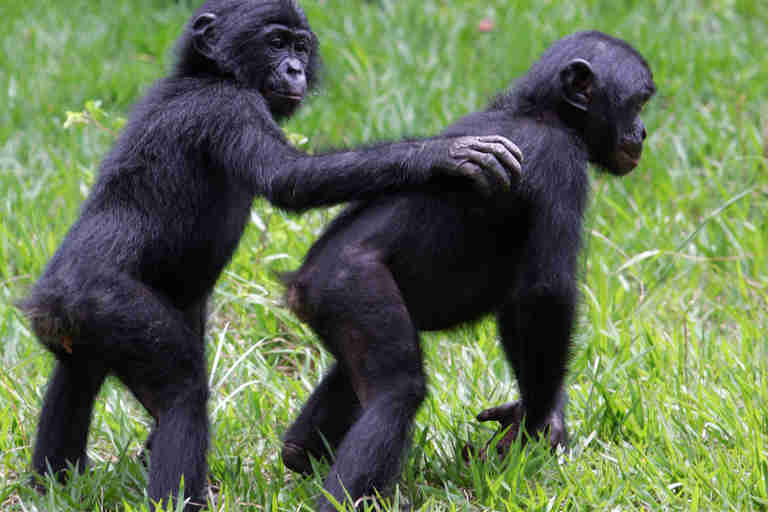
Evidence for the shared forms of visual communication is presented in a new study by Byrne and his team. The research, reported in the journal PLOS Biology, focused on bonobo and chimpanzee gestures, and found that approximately 90 percent of them overlap. This suggests that the cognitive ability underlying such visual communication skills was inherited from their common ancestor.

Lead author Kirsty Graham of the University of York’s department of psychology told Seeker that bonobos and chimps are closely related. They are thought to have diverged around one million years ago along the Congo River.

For decades it was believed that chimpanzees were the closest living relatives of humans. Recent genetic studies, however, show that bonobos also have about 99 percent of our DNA, which means they are now thought to be as closely related to us as chimps.

Bonobos in the Democratic Republic of Congo
For the new study, Graham collected data on two neighboring communities of wild bonobos in the Luo Scientific Reserve in the Democratic Republic of the Congo. Co-author Catherine Hobaiter of the University of St. Andrews traveled to another part of Africa, the Budongo Conservation Field Station in Uganda, to gather data on a community of wild chimpanzees. Both researchers filmed interactions that took place between the primates.

The scientists next analyzed the 2,321 instances of intentional gestures that they recorded. Such gestures included movements of the body, limbs, and head that are directed to a recipient and do not achieve a goal through force.

Most, but not all, of the gestures mirror the physical form of the corresponding behaviors.

"Humans can often guess the meanings correctly, but that is likely to be because we too have inherited the potential to use and understand many or most of the gestures found in chimpanzees, bonobos and gorillas, from the shared common ancestor," Byrne said.

Videos showing these and other non-human primate gestures are at The Great Ape Dictionary.

Big Loud Scratch: In nearly all cases, this gesture among bonobos and chimps communicated that the signaler wished to initiate grooming.
Graham added that she does not think the gestures are iconic.

"To be really iconic, a bonobo would have to know that their gesture looked like the thing that they're communicating about and know that the other bonobo would understand them because it looks like that thing," she said. "That would be a lot to unpack, and we don't have any evidence suggesting that that's how their gestures work. ... If the gestures resemble the actions, it's maybe for different reasons."

Humans often create symbols that bear little resemblance to their corresponding behaviors or meanings. Examples include giving a thumbs up for approval and lifting the middle and index fingers to form the v-shaped "peace sign."

"Sign languages and symbolic gestures like 'thumbs up' or the 'peace sign' are quite different because they are acquired culturally by social learning, not from genetic hard-wiring, and are therefore culturally specific," Byrne said.

"In some cultures," he noted, "the peace sign is not understood, and thumbs up is an insult."

Bonobos, chimps, and humans all raise their arms as a gesture, but in humans this usually is a non-vocal way to draw attention to oneself. Students in class might raise their hand, for example, signaling a desire to be called upon. Byrne said that this gesture was taught to him and to others.

"It did not come naturally," he explained.

Some human gestures were therefore inherited from our primate ancestors, but others were not, the research suggests.

Rocking: In chimps, this move initiated either copulation or genital rubbing.
Graham said that while she and her colleagues are always careful to keep their distance from the wild primates they are studying, sometimes their inquisitive subjects break that intended barrier.

She recalls a young bonobo named Natsuko who would teasingly run up to the researchers, shake branches, and then run away. Bonobos appear to do this amongst themselves to get attention.

"'Object shake' is a somewhat ambiguous gesture, so I don't know what she wanted from us, but it definitely wasn't for us to ignore her," Graham said.

Robert Seyfarth is one of the world's leading experts on primate communication and other primate social behaviors. He and his wife Dorothy Cheney have conducted decades of fieldwork on various non-human primates. The pair were mentored by Robert Hinde (1923–2016), the noted animal behaviorist who supervised Jane Goodall's dissertation on the behavior of chimpanzees in the mid-1960s.

Seyfarth told Seeker that he was not surprised by the discovery that bonobos and chimps share many gestures, and that physically similar gestures in the two species have roughly the same meaning.

"Chimps and bonobos, after all, share many things: They live in similar habitats and have similar anatomy, social organizations, and social relationships," Seyfarth explained.

Read more at Seeker

The Global Virome Project Is Hunting Hundreds of Thousands of Deadly Viruses

A researcher displays Aedes aegypti mosquitoes.
In virology, as in sports, sometimes the best defense is a good offense.

This week, an international team of scientists and front-line physicians launched a major new global initiative to prevent the next viral pandemic. The strategy: to hunt down potentially deadly viruses in animal populations before they jump species and infect humans.

It's an ambitious plan, but researchers backing the Global Virome Project believe it can be done — and can pay additional research benefits along the way. In a report published last month in the journal Science, the authors drop some crazy numbers.

An estimated 1.6 million viral species are yet to be discovered in mammal and bird populations. Of those, an estimated 600,000 to 800,000 may have the capacity to jump species and cause diseases in humans. That's a lot of viral trouble.

But by studying the disease vectors of previous outbreaks like Ebola, SARS, and Zika, scientists believe they can eventually track down all potentially dangerous viruses before they spill over into human populations. Ideally, the GVP's aggressive approach will essentially stop outbreaks before they even start.

“I think what's important and exciting is that we now have the tools and the ability to know as much about viruses as we do about bacteria and other disease-causing organisms,” said Jonna Mazet, an author of the report and executive director of the One Health Institute at the University of California, Davis. “They were just a little bit tougher problem to crack than other pathogens that cause death and destruction.”

For the last eight years, Mazet has served as director of the PREDICT program, a similar but smaller-scale initiative operated by the United States Agency for International Development. The PREDICT program has found more than 1,000 unique viruses in animals and humans.

“PREDICT showed us that we are ready to do this on a much larger scale,” Mazet told Seeker. “It served as a proof of concept.”

A core concept of both the PREDICT program and the Global Virome Project, Mazet said, is that scientists must broaden their approach to disease prevention.

“The idea is to think about people, animals, and the environment all at once,” she said. “That approach helps us to find viruses in the first place and understand their potential for spilling over. Then we can design interventions.”

The GVP program is already being compared to another ambitious global research effort — the Human Genome Project. Mazet believes that the GVP, like HGP, is a chance for the world's scientists to join together and make a great leap forward.

“It's just the right time,” she said. “We can know, and we should know this. The HGP was also a big audacious goal that looked to be financially and technologically insurmountable to outside observers. But form the inside the science community, we knew we could do this.”

The first stage of GVP research is dedicated to identifying and cataloging unknown viruses, which will then be used, ideally, to develop vaccines, pharmaceuticals, or other. The GVP will work with the United Nations, dozens of international health organizations, local governments, and industry partners such as Merck.

“And then, of course, individual scientists are pitching in from all over the world —Asia, Africa, the US, Canada, and Europe ” Mazet said.

Latin America, in particular, has contributed a good deal of resources following the 2015-2016 Zika epidemic.

“Brazil has been a major player in all this effort,” Mazet said. “They've been very sensitized after their experiences with Zika.”

Read more at Seeker