A searing summer heat wave in Europe, sunny day flooding in Miami, one of Alaska's worst wildfire seasons and heavy rainfall in China — these were just some of the extreme weather events of 2015 for which climate change provided a discernable push, according to the Bulletin of the American Meteorological Society's annual attribution report, released Thursday.
Over the last five years, the BAMS report has examined more than 100 events as part of a burgeoning sub-field of climate science that uses observations and climate models to show how human-caused warming has already affected the odds or severity of many of the weather extremes we experience now.
Of those, the fingerprints of climate change have been found on about two-thirds, particularly for heat events, where the warming influence has been almost universal. Others, though, such as precipitation extremes, have been more of a mixed bag.
This year's report featured more types of events scattered over a wider area of the world than before. For the first time, researchers also had to consider the possible influence of an exceptionally strong El Niño, and tried to take attribution a step further by examining how climate change actually affected people, for example by impacting human health.
"If we can better understand why these events are happening, we can better predict and prepare for them in the future," lead editor of the report, Stephanie Herring, said during a press conference at the annual meeting of the American Geophysical Union, where the report was presented.
Clear Heat Connection
Ten of the heat events examined, including the global record-hot year, had a clear climate change influence, researchers found. An increase in heat extremes is one of the clearest outcomes of global warming.
One study found that summer heat waves, like the one that sent temperatures in central Europe to record highs, are occurring more frequently, while another found that record-breaking heat in Northwest China (where July temperatures soared above 110°F) was made three times more likely.
Two studies went beyond mere temperatures to look at the collective impact of heat and humidity — when both are high, that increases heat stress, with implications for human health. The deadly heat stress associated with an August 2015 heat wave in Egypt was found to be 70 percent more likely, underscoring the heavy toll of climate change on humans. Another study in the report found that high heat indices in separate heat waves in India and Pakistan were made at least 800 percent more likely by climate change.
Climate science isn't quite at the point where all extreme heat events can be assumed to have the imprint of climate change, Adam Sobel, a Columbia University climate scientists who wasn't involved in the report, said, but it is getting close.
Manmade warming was also found to play a role in other types of events where heat was a factor: Alaska's 2015 fire season, the second worst on record in terms of area burned, was found to be about 30 to 60 percent more likely because of climate change. Similarly, the "snowpack drought" in Washington state that resulted from high temperatures making precipitation fall as rain instead of snow was found to be more likely to occur in the future because of warming.
"The five years of this report from BAMS has shown that we've made enormous progress in attributing meteorological events," Friederike Otto, an author on several of the studies in the report, said during the AGU press conference. Otto, a climate scientist at the University of Oxford, also works with Climate Central's World Weather Attribution program, which attempts to conduct rapid attribution assessments in the days and weeks after an event.
No Climate Change Signal
Other events for which a climate change role was discernable included some types of events never before featured in the report. The nearly 2 feet of water that flooded the Miami area on Sept. 27, 2015, despite no storm in sight — a phenomenon called sunny-day flooding — has become 500 percent more likely, purely from the sea level rise that has occurred since the mid-90s, researchers found.
For other events, though, no clear influence from climate change could be detected. The extreme cold that kept the eastern U.S. in a deep freeze in the winter of 2014-15 was actually less likely to occur with warming, two studies found, despite other research that has suggested that declining Arctic sea ice could be causing more excursions of Arctic air over North America.
No climate change signal emerged for the delayed rainy season onset in Nigeria or for a heavy rainfall event in Chennai, India, either. In the latter case, increased aerosols might be masking any global warming-related trend, the authors say.
About 35 percent of the studies in all five BAMS reports haven't found a climate change influence, but Herring notes that may not mean that such an influence isn't there.
"There's lots of reasons why a paper may not find a role for climate change," she said. Any climate change trend may not yet be discernable or today's methods may not yet be sophisticated enough to tease it out. Or a study may not have looked at the right factors, "so we don't actually have the complete story yet," she said.
An El Niño Twist
The report editors also note that the studies don't cover an unbiased sample of events, as they are picked by the authors, who often choose weather extremes from their own backyard.
"One thing [the 2015 report] doesn't do is cover all of the extremes that occurred in 2015," co-editor Martin Hoerling, a NOAA climate scientist, said during the press conference. (The events to be included in the report are also picked before the analyses are completed, so what they find isn't known in advance.)
An added twist for 2015 was the major El Niño event that also altered weather patterns around the world, leaving the possibility that both El Niño and climate change might have influenced the same event.
"We didn't know if we'd be able to differentiate the two," Herring said. But several of the studies were able to tease apart their relative contributions.
Read more at Discovery News
Dec 17, 2016
If an Asteroid Hits the Ocean, Does It Make a Tsunami? (Probably Not)
Fifteen years ago, Galen Gisler had a gut feeling that something wasn't right about the Hollywood portrayal of asteroid impacts in the world's oceans.
"Movies like 'Deep Impact' and 'Armageddon' suggested that an ocean impact would produce a devastating tsunami that would affect everything along the shorelines surrounding an ocean basin ... but I was skeptical," Gisler, a scientist at Los Alamos National Laboratory in New Mexico, told Seeker.
Generally speaking, getting hit by an asteroid is a bad day for life on Earth, even if it is a part of the natural cycle of living in the dynamic and evolving solar system. Marauding space rocks fly around interplanetary space with no regard for Earth's precious biosphere. If they have our planet in their sights, they're going to hit us. And depending on their mass and speed, they could hit us hard.
But depending on where an asteroid hits, the fallout will vary greatly. If an asteroid was predicted to hit land near a major city, we might be able to evacuate in time (and disaster response agencies have carried out drills that focus on this possibility), but the damage to society, infrastructure and economy would be terrible, obviously. But if an asteroid hits one of our oceans — water makes up for 70 percent of our planet's surface and is therefore a more likely scenario — the scope of the impact is poorly understood.
Gisler is determined to better understand the realities of a massive impact in the ocean and presented his team's findings at the American Geophysical Union's Fall Meeting in San Francisco last week, showcasing the dramatic 3-D modeling results of an ocean-impacting asteroid. Never before has an impact scenario like this been studied in such detail and the simulation revealed that Gisler's original instincts had merit: devastating post-impact tsunamis we see in the movies are as fictional as the science fiction plot lines they are a part of.
"An asteroid impact is a point source and it only affects the immediate region around the impact point and moreover, to create a tsunami, you need something that disturbs the entire water column," said Gisler.
He likens an asteroid ocean impact to throwing a rock into a pond. Sure, the energy of the rock hitting the water will produce waves, but the ripples are very dispersive. In other words, they lose their energy very quickly. These dispersive waves in an ocean will be very localized and won't have the energy that a tsunami does. "It's very different physics," he added.
Tsunamis occur when there's large scale shifts of mass in the seabed, such during a submarine earthquake or landslide. These shifts cause a huge movement in a massive column of water, from the seabed to the surface, that can create wavelengths of a hundred kilometers or more, said Gisler, which is many times longer than the depth of the ocean (of a few kilometers). Tsunamis aren't very dispersive and therefore don't lose energy as they travel through the ocean basin, hitting coastlines hundreds or maybe thousands of kilometers away, often with devastating results.
But that's not to say an asteroid impact in the middle of an ocean wouldn't be dramatic.
"They're spectacular to be sure; they would produce splashes that go up tens of kilometers," he added. According to the model, a jet of water would also protrude from the ocean's surface by a few kilometers, producing rim waves surrounding the transient water crater reaching 400 meters in height. "That's awfully high! But unless it's very close to a shore, it's not going to be very dangerous."
In addition, a significant fraction of the kinetic energy of the impacting asteroid will go into vaporizing huge quantities of water, according to the team's award-winning video explaining the research findings. Water vapor is a potent greenhouse gas, so the injection of vapor into the stratosphere could linger for months or years, altering global climates.
Intense shock waves and violent winds will also wreak havoc on the surface, so the further the impact is from any populated coastal regions, the better.
Read more at Discovery News
Dec 16, 2016
A super flash from a star and a supermassive black hole
![]() |
| In just the right conditions, the destruction of a star in a black hole's gravitational tide should produce an unusual flash of light. |
For one thing, the intensity of the light was double that of the brightest supernova recorded up to that point. So astrophysicists were already asking what process could have caused it. And there were other anomalies, as well: Rather than gradually cooling, which is what happens in the average supernova, the temperature of the material emitting radiation went down -- and then up again, remaining at the higher level for quite a while. And the site of the flash was a puzzle, as well: Supernovae tend to occur in young, "blue" galaxies, but this one took place in an old "red" galaxy, in which the stars were not really candidates for exploding.
Postdoctoral fellow Giorgos Leloudas and Prof. Avishay Gal-Yam of the Particle Physics and Astrophysics Department of the Weizmann Institute of Science investigated. Together with colleagues at the Institute, Drs. Paul Vreeswijk, Ofer Yaron and Steve Schulze, Joel Johannson, and Ira Bar, as well as researchers around the world, they closely observed, measured and recorded the event. This led them to the discovery that the spectrum of the light had changed several times, and the hypothesis they formed based on this finding was that they had observed an extremely rare event: the destruction of a star by the gravitational tides of a black hole at the center of its galaxy.
The flash had, in fact, come from the middle of that distant galaxy, and further analysis suggested that the observations fit what is known about stars being caught in a black hole's gravitational tide.
The reason such an event, producing such a bright flash, is so rare is that two conditions must be met for it to occur: The star must stray close enough to the black hole to cross its "event horizon" -- the point at which it cannot escape the pull of the giant mass -- but the light produced in its destruction must somehow escape the black hole's all-consuming gravity. And for these conditions to occur, the galaxy's central black hole, which is immense even by black-hole standards, must be rotating at a relativistic speed -- close to the speed of light.
Read more at Science Daily
Mysterious Metallic Sound in the Mariana Trench Finally Identified
An otherworldly noise that was recorded near the Mariana Trench could be a never-before-heard whale call.
Dubbed the "Western Pacific Biotwang," this newly discovered call might be from a minke whale — a type of baleen whale — according to the researchers who documented the vocalization.
Regardless of what species it is, this whale has range: The call includes sounds that span frequencies that reach as low as 38 hertz and as high as 8,000 hertz. Humans can hear sounds between 20 and 20,000 Hz.
"It's very distinct, with all these crazy parts," Sharon Nieukirk, senior faculty research assistant in marine bioacoustics at Oregon State University, said in a statement. "The low-frequency moaning part is typical of baleen whales, and it's that kind of twangy sound that makes it really unique. We don't find many new baleen whale calls."
The call was recorded with autonomous seafaring robots, known as "passive acoustic ocean gliders," which can dive up to 3,280 feet (1,000 meters) below the surface. Scientists can send these devices out on solo missions to eavesdrop on whale conversations. Nieukirk and her colleagues collected their acoustic data in the fall of 2014 and the spring of 2015, in an area in the Pacific Ocean east of Guam around the Mariana Trench, the deepest part of the ocean.
The twangy, five-part call, which lasts up to 3.5 seconds, was recorded regularly during both the fall and spring. The researchers hope that other scientists will identify the call in other data sets so that they can confirm the source. But in their description of the whale call in the Journal of the Acoustical Society of America, Nieukirk and her colleagues wrote that they suspect a minke whale is responsible for the new call.
Because of the call's complex structure, frequencies and metallic-sounding conclusion, the researchers think that it most closely resembles the regionally specific calls that are produced by a group of dwarf minke whales off the northeast coast of Australia. (Those calls sound a bit like "Star Wars" sound effects.) They added that there are several types of minke whales in the survey area, but not much is known about their behavior — especially their vocal behavior.
"We don't really know that much about minke whale distribution at low latitudes," Nieukirk said. "The species is the smallest of the baleen whales, doesn't spend much time at the surface, has an inconspicuous blow, and often lives in areas where high seas make sighting difficult. But they call frequently, making them good candidates for acoustic studies."
The call still needs to be translated. Most baleen whales use specific vocalizations for seasonal breeding and feeding, but this call — since it seems to occur all year — may have a complex function, the researchers said.
Read more at Discovery News
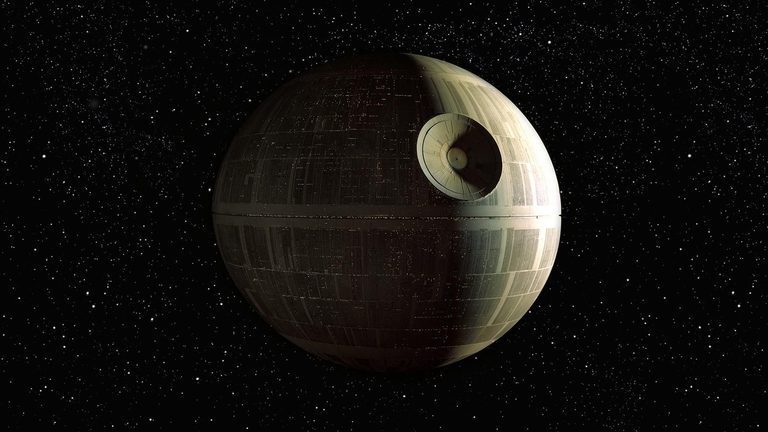
That's No Moon... Actually, It Is. That's Saturn's 'Death Star' Moon Mimas
Saturn's moon Mimas looks suspiciously similar to the Death Star, a colossal planet-destroying space weapon that terrorizes a galaxy far, far away…
But there's no need to worry; there is no Death Star anywhere in this solar system. Mimas is just a harmless, and apparently lifeless, space rock. However, the mere sight of this Death Star look-alike would send shivers down the spines of the trillions of fictional characters in "Star Wars."
So why do Mimas and the Death Star look like distant relatives? Did Mimas' eerie appearance inspire the creators of "Star Wars," or is this Saturnian moon up to something seriously spooky?
"The appearance of Mimas was not seen in detail until the Voyager spacecraft flew through the Saturn system in 1980, so the design of the Death Star was not influenced by Mimas," a spokesperson at NASA's Jet Propulsion Laboratory told Space.com. The answer is neither. Believe it or not, the striking resemblance between these two objects is a complete coincidence.
"Star Wars" creator George Lucas started dreaming up his concept for the Death Star in the 1970s, before the release of "Star Wars: Episode IV - A New Hope," the first movie of the saga, in 1977. In the film, the Death Star is dubbed the "ultimate weapon" for its outrageously powerful laser that can wipe out entire planets in just one shot. Its mobility and moon-like disguise are ideal for sneaking through space undetected.
Though George Lucas couldn't possibly have known what Mimas looked like when he created the concept of the Death Star, he certainly intended for the spacecraft to look like some type of moon. As Obi-Wan Kenobi famously said while approaching the Death Star in Episode IV, "That's no moon. … It's a space station!"
The two objects' similar shapes can be largely attributed to a giant basin on Mimas called the Herschel crater. This crater formed when an impactor collided with Mimas near the little moon's equator about 4.1 billion years ago. It measures 86 miles (139 kilometers) across, which is nearly one-third the diameter of Mimas. The impact was so huge that some scientists are surprised it didn't destroy the moon entirely.
A large, round indentation is also present on the Death Star. However, this one wasn't created by a collision. This concave feature of the otherwise spherical Death Star is a part of the station's "superlaser" emitter, or the epic space weapon capable of destroying entire worlds.
DS-1, the original Death Star design, is a central point in the plot of "Rogue One: A Star Wars Story" (which hits theaters on Friday, Dec. 16). The spacecraft measures 75 miles (120 km) in diameter. Mimas is actually about three times larger than the Death Star. Another rendition of the Death Star, DS-2, featured in "Return of the Jedi," is a bit larger, at 100 miles (160 km) across, which is larger than the first version but still smaller than Mimas.
Read more at Discovery News
Oddball Ceres Hides Huge Reservoirs of Water Ice
Ceres and Vesta, the two largest bodies in the main asteroid belt, may be contemporaries and neighbors, but the similarities stop there. Ceres, which is about as wide as Texas, is filled with frozen water and hydrated minerals, making it more like an icy moon of Jupiter or Saturn than Vesta, its dry, rocky sibling, new research shows.
Scientists aren't sure why Ceres and Vesta followed such different evolutionary paths, but they expect more answers as analysis of data collected by NASA's Dawn spacecraft continues. Dawn spent 14 months visiting Vesta before firing up its ion engine and settling into orbit around Ceres in March 2015.
Research published in this week's issues of Science and Nature Astronomy confirms a 30-year-old theory that Ceres is an ice-rich world.
"In Ceres' crust today we think we see about 10 percent (by weight) water ice," Dawn scientist Thomas Prettyman, with the Planetary Science Institute in Tucson, Arizona, told Seeker.
But water in the crust is just the beginning of the story. Ceres is replete with minerals and clays that can only form in the presence of water. Extrapolating from measurements made by Dawn, Prettyman estimates that the dwarf planet as a whole is 30 percent water.
Vesta had a different history, one that did not involve much water.
"What happened to Vesta is that it completely melted," Prettyman said.
Once its radioactive elements decayed, Vesta, made mostly of silicates, cooled and formed a basaltic crust, a mantle and an iron-rich core.
"This would have had to happen close to the sun, where you couldn't condense volatiles like water because it was too hot," Prettyman added.
Perhaps because Ceres was bigger than Vesta, or positioned farther from the sun, but it was able to accrete water into its body, setting the stage for a cascade of chemical alterations. Some models show that the separation of water and rock caused Ceres to form a frozen shell over a briny liquid layer that may still exist today.
"The Dawn mission is trying to look back in time to the very earliest stage of the solar system," deputy principal investigator Carol Raymond, with NASA's Jet Propulsion Laboratory in Pasadena, Calif., told reporters at the American Geophysical Union conference in San Francisco.
Of particular interest, she added, is if Ceres' water and rock interacted in such a way that the dwarf planet became chemically suited for life.
Read more at Discovery News
Dec 15, 2016
Exciting new creatures discovered on ocean floor
![]() |
| Chimney Jabberwocky. |
The unique marine life was discovered around hydrothermal vents at a place called Longqi ('Dragon's Breath'), 2000 kilometres southeast of Madagascar and is described in the journal Scientific Reports.
A research team, led by Dr Jon Copley, explored an area the size of a football stadium on the ocean floor, pinpointing the locations of more than a dozen mineral spires known as 'vent chimneys'. These spires, many of which rise more than two storeys above the seabed, are rich in copper and gold that is now attracting interest for future seafloor mining. However, the spires are also festooned with deep-sea animals, nourished by hot fluids gushing out of the vent chimneys.
The team, which includes colleagues at the Natural History Museum in London and Newcastle University, carried out genetic comparisons with other species and populations elsewhere to show that several species at Longqi are not yet recorded from anywhere else in the world's oceans.
The expedition, which took place in November 2011, provides a record of what lives on the ocean floor in the area, which is licensed for mineral exploration by the International Seabed Authority of the United Nations, before any mining surveys are carried out.
The Longqi vents are the first known in the region and the expedition was the first to explore them using a deep-diving remotely operated vehicle (ROV).
The deep-sea animals that are so far only known from Longqi include: a species of hairy-chested 'Hoff' crab, closely related to 'Hoff' crabs at Antarctic vents; two species of snail and a species of limpet; a species of scaleworm; and another species of deep-sea worm. Apart from one species of snail, which has been given the scientific name Gigantopelta aegis, most have not yet been formally described.
"We can be certain that the new species we've found also live elsewhere in the southwest Indian Ocean, as they will have migrated here from other sites, but at the moment no-one really knows where, or how well-connected their populations are with those at Longqi," said Dr Copley. "Our results highlight the need to explore other hydrothermal vents in the southwest Indian Ocean and investigate the connectivity of their populations, before any impacts from mineral exploration activities and future deep-sea mining can be assessed."
Read more at Science Daily
Scientists studying dolphins find Bay of Bengal a realm of evolutionary change
![]() |
| An adult humpback dolphin displays its characteristic pink coloration. |
In the comparative study using DNA collected from both Indo-Pacific humpback dolphins (Sousa chinensis) and Indo-Pacific bottlenose dolphins (Tursiops aduncus) and data from previous genetic studies, the authors of a newly published paper in Conservation Genetics have found that both populations of both species are distinct from populations in other parts of the Indian Ocean and western Pacific. This discovery follows the recent description of a possible new species of "river shark" in the same waters.
The authors of the study titled "Oceanic drivers of population differentiation in Indo-Pacific bottlenose (Tursiops aduncus) and humpback (Sousa spp.) dolphins of the northern Bay of Bengal" are: Dr. Ana R. Amaral of cE3c, Universidade de Lisboa, Portugal and AMNH's Sackler Institute of Comparative Genomics; Brian D. Smith and Rubaiyat M. Mansur of WCS; and Dr. Howard C. Rosenbaum of WCS and affiliated with AMNH.
"Our findings indicate that there is a connection between the presence of these distinct populations of dolphins and the unique oceanic habitat that is found in the Bay of Bengal," said Amaral, the lead author of the study. "The combination of a biologically rich yet isolated seascape could be driving speciation, or the emergence of new species."
Located in the northern Indian Ocean, the Bay of Bengal receives vast amounts of freshwater and organic matter from the Meghna, Brahmaputra, and Ganges Rivers; the confluence also supports the world's largest mangrove forest. In deeper waters, a submarine canyon called the Swatch-of-No-Ground (SoNG) recycles nutrients through upwelling, all of which creates a biologically productive coastal region with a complex interchange of currents that creates conditions for species to become isolated from other parts of the Indian Ocean.
During the study, researchers collected skin samples from 32 coastal Indo-Pacific and humpback dolphins. Genetic sequences were then extracted from the samples for comparison with previously published sequences for both species. The researchers found both dolphins to be genetically discrete from nearby populations, a tantalizing result that the authors say merits further investigation.
"The discovery of genetically distinct dolphin populations helps us to expand the body of knowledge of how these dolphin species have changed over time," said Howard Rosenbaum, Director of WCS's Ocean Giants Program who added that "these results have significant implications for identifying unique marine mammal populations, which in turn have important conservation implications for safeguarding the long-term biodiversity in this region."
"This is great news for Bangladesh," said Rubaiyat Mansur, Principal Researcher for WCS's Bangladesh Program. "Despite the challenges of wildlife conservation in our country, we take great pride in protecting our wildlife as evidenced by the recent declaration of Bangladesh's first marine protected area in the Swatch-of-No-Ground submarine canyon and adjacent estuarine waters."
The Indo-Pacific bottlenose dolphin that ranges between the Indian and western Pacific Oceans is a smaller version of the better-known common bottlenose dolphin (Tursiops truncatus). The waters of the Bay of Bengal's SoNG canyon are home to one of the world's largest populations of Indo-Pacific bottlenose dolphins.
Humpback dolphins in particular have been a topic of much debate among taxonomists due to the variations in appearance and genetics of animals that inhabit coastal waters from western Africa to the western Pacific. The genus Sousa now contains four species, one of which -- the Australian humpback dolphin (Sousa sahulensis) -- was recently designated as a separate species after a number of comparative studies combining morphology and genetic markers.
While the humpback dolphins in the Bay of Bengal are currently considered as a population of Indo-Pacific humpback dolphins (Sousa chinensis), the population occurs right in between the known ranges of the Indo-Pacific species and the Indian Ocean humpback dolphin (Sousa plumbea). This study's comparison of mitochondrial DNA across populations reveals a closer connection between the Bay of Bengal's humpback dolphins and the more distantly located Australian humpback dolphin.
Read more at Science Daily
Einstein's Theory Just Put the Brakes on the Sun's Spin
Although the sun is our nearest star, it still hides many secrets. But it seems that one solar conundrum may have been solved and a theory originally proposed in 1905 by Albert Einstein could be at the root of it all.
Twenty years ago, solar astronomers realized that the uppermost layer of the sun rotates slower than the rest of the sun's interior. This is odd. It is well known the sun rotates faster at its equator than at its poles — a phenomenon known as "differential rotation" that drives the sun's 11-year solar cycle — but the fact that the sun has a sluggish upper layer has been hard to understand. It's as if there's some kind of force trying to hold it in place while the lower layers churn below it.
Now, researchers from University of Hawaii Institute for Astronomy (IfA), Brazil, and Stanford University may have stumbled on an answer and it could all be down to fundamental physics. It seems that the light our sun generates has a braking effect on the sun's surface layers.
"The sun won't stop spinning anytime soon, but we've discovered that the same solar radiation that heats the Earth is 'braking' the sun because of Einstein's Special Relativity, causing it to gradually slow down, starting from its surface," said Jeff Kuhn, of IfA Maui, in a statement.
Special relativity predicts that photons, which carry the electromagnetic force (i.e. light), also carry a tiny amount of momentum. If you have enough photons travelling away from an object, they will carry away a large amount of momentum. In the case of the sun's 4 billion year lifetime, the surface has lost a lot of momentum to photons, causing a slowdown of the uppermost 5 percent of the sun. This mechanism, called the Poynting-Robertson effect, has been observed in interplanetary dust, which feels the drag of the sun's radiation, causing it to fall from the asteroid belt into the inner solar system.
What affects dust inevitably affects the soup of super-heated gas in the sun's upper layers and, over its 5 billion year lifetime, the drag caused by photons being emitted from the sun has created a measurable and, until now, mysterious effect.
Using several years of data from NASA's Solar Dynamics Observatory (SDO), the researchers were able to measure waves traveling through the sun to precisely measure the size of the layer that is experiencing this slowdown. The technique, known as "helioseismology," is very similar to measuring the seismic waves travelling through the Earth to measure the strength of an earthquake. The material these seismic waves travel through changes the waves so seismologists can "see" underground.
Though the sun isn't a solid planet made from rock and metal, its dense plasma interior also allows waves to travel, creating oscillations on the surface that can be measured. Helioseismology therefore allows astronomers to "see" into our nearest star, revealing many details about its interior that may not be obvious on the surface. And in this case, by using helioseismology and studying the sun's magnetic field passing from space into the sun's interior, we can gauge how much of a drag Einstein's special relativity has had on the sun's surface.
"This is a gentle torque that is slowing it down, but over the Sun's 5 billion year lifetime it has had a very noticeable influence on its outer 35,000 kilometers [22,000 miles]," said Kuhn. These findings have accepted for publication in the journal Physical Review Letters and can be previewed on the arXiv pre-print service.
Read more at Discovery News
Breakthrough Surgery Restores Sight to People With Hemorrhaging in the Eye
It's been ten years or so, but Dr. Rajendra Apte remembers the patient vividly: a young man who'd gone blind after being struck by a car while jogging. The 20-year-old graduate school student had suffered multiple injuries, brain trauma and had undergone numerous surgeries to get to a point where he could finally walk again, if only with assistance.
Somewhere along the way, a medical professional had made the assumption that the young man's blindness was the result of his brain injury, and so he'd never been examined by an ophthalmologist — that is, until his family brought him to see Dr. Apte at Washington University.
"This patient, when I first saw him, he didn't speak anything. He was very quiet. The dad did most of the talking," Dr. Apte told Seeker. "Emotionally, he'd become a different person because of everything that had happened."
During the examination, Dr. Apte saw that in both eyes, the vitreous fluid, the gel that fills the space between the lens and the retina, had hemorrhaged and that blood had gotten into the space. He wondered if the man was blind, not because of damage to his brain's visual cortex, but because of a medical condition called Terson syndrome.
This syndrome sometimes afflicts people who have blood in their brain from a ruptured aneurysm. The blood and pressure that builds up in the brain can cause blood vessels around the eye's optic nerve to also burst, filling the eye with blood and preventing light from reaching photoreceptor cells in the retina. The same thing can happen to victims of severe trauma like car accidents.
Dr. Apte suggested doing a vitrectomy, a type of surgery that typically replaces the vitreous gel with saline solution. But in this case, the doctor would clean out the blood, which had coagulated in the six months since the accident, and replace it with saline solution. There was no guarantee it would work, he told family. And six months was a long time. They agreed.
A day after the surgery, the man could read Dr. Apte's eye chart — not just the top line, but down toward the bottom.
"It was pretty incredible," Dr. Apte said. "He just wouldn't stop talking. He was very animated and very excited. As soon as I saw him, the first thing he asked me was, 'When are we going to do surgery on the other eye?'"
He ended up seeing perfectly well in both eyes.
It was the first time Dr. Apte had thought that he should look more closely at the success rates of surgeries done on patients with Terson syndrome secondary to trauma. The idea stayed with him in the intervening years and when he had the opportunity to conduct an assessment, he did it.
This week, Dr. Apte, now a distinguished professor of ophthalmology and visual sciences at Washington University School of Medicine and his colleagues from Wayne State University in Detroit and the L.V. Prasad Eye Institute in India, report in the journal Ophthalmology on 20 different patients with Terson syndrome from three different medical institutions.
In some cases, both eyes had experienced hemorrhaging and in other cases, only one eye had. In total, the researchers looked at 28 eyes. They also divided the patients into two groups: those who'd had the vitrectomy within three months and those who'd had surgery after three months.
Some were legally blind prior to the surgery as a result of their injuries, but within a month of the procedure, had regained their vision. After a few months later, almost everyone had 20/20 vision. Dr. Apte stressed that the surgery won't return vision to patients who had vision loss from unrelated reasons before an accident.
Overall, the analysis was reassuring, Dr. Apte said. "Even if you have to wait for the surgery for several months, the outcomes were still good."
Read more at Discovery News
Subscribe to:
Posts (Atom)