Oct 8, 2016

How gecko feet got sticky

This image shows G. humeralis in Trinidad.
How do key innovations in the animal kingdom arise? To explore this question, gecko expert Timothy Higham, an associate professor of biology at the University of California, Riverside, led a team of evolutionary biologists to study Gonatodes, a genus of dwarf geckos. In the process, the researchers found a gecko, Gonatodes humeralis, that they posit offers a "snapshot" into the evolution of adhesion in geckos.

"The gecko adhesive apparatus, one of the most spectacular innovations displayed by vertebrates, has been intensively studied for the last 16 years and is of considerable interest to nanotechnologists and biomimeticists," Higham said. "But almost nothing is known about the origin of this adhesive capability. G. humeralis, found in South America, shows how the adhesive capabilities of geckos may have come about. Our integrative analysis of this gecko shows that unexpectedly it has microscopic hairs, called setae, underneath its toes, which allow it to do something dramatically different than all other geckos in the Gonatodes genus: cling to smooth surfaces such as leaves. It does this without all of the complex structure of the toes that typify the geckos that we are more familiar with. In the lab, this gecko can climb smooth vertical surfaces using its incipient adhesive system."

Higham explained that the setae interact with surfaces through attractive van der Waals forces. The relatively simple expression of setae on the digits of G. humeralis thus provide an enormous advantage in sectors of the habitat typified by smooth, low-friction, inclined surfaces, such as leaves and slippery stems, allowing G. humeralis to avoid predators by occupying habitat that other members of the genus cannot. While it can securely attach to vertical bamboo shoots, for example, other species in the Gonatodes genus generally scale rough tree trunks, rocks, fallen palm trees and move on the ground -- areas where their predators abound.

"The relatively simple adhesive system of the G. humeralis is indicative that slight modifications in form can dramatically influence functional outcomes and the ecological niches that can be exploited," Higham said. "This ostensibly padless gecko offers us a snapshot -- a crucial intermediate stage -- of the evolution of the adhesion apparatus. It's telling us, 'Look, this is how pad-bearing geckos started to acquire adhesion.'"

Further, the findings indicate that the origin of adhesion in geckos was gradual and led to major shifts in ecology and function. They suggest, too, that subtle morphological changes are able to trigger rapid evolution.

Study results appear Sept. 29 in the Biological Journal of the Linnean Society.

The setae of G. humeralis are short and simple compared to those of pad-bearing geckos, such as tokay geckos. The setae are located adjacent to friction-enhancing "spinules" -- small projections, which play no role in adhesion, that are found underneath the feet of many lizards and geckos. The authors argue that the setae of G. humeralis result from a transformation of the spinules.

"Until now, we had not seen a gecko showing the beginnings of the adhesive system," Higham said. "In all the innovations seen in the animal kingdom, we rarely get to see their beginnings. Our findings serve as good evidence against intelligent design ideas. Evolution takes place in incremental steps, as the 'snapshot' we report on shows. Complexity does not start with complexity. Small modifications can, however, lead to complexity. Key innovations can come about in small incremental steps and lead to feedback processes that result in the more complex renditions of such systems. Our research offers more experimental evidence to show this is true."

Higham and his colleagues found G. humeralis specimens in Trinidad and French Guiana. They first used scanning electron microscopy to examine the microanatomy underneath the geckos' toes and morphometrics to compare them to close relatives. After these initial observations, the team studied this species and others in the laboratory using a combination of high-speed video to measure locomotion and force transducers to quantify clinging ability, finding that only G. humeralis could generate clinging force and climb vertical smooth acrylic.

Read more at Science Daily

Hubble detects giant 'cannonballs' shooting from star

This four-panel graphic illustrates how the binary-star system V Hydrae is launching balls of plasma into space.
Great balls of fire! NASA's Hubble Space Telescope has detected superhot blobs of gas, each twice as massive as the planet Mars, being ejected near a dying star. The plasma balls are zooming so fast through space it would take only 30 minutes for them to travel from Earth to the moon. This stellar "cannon fire" has continued once every 8.5 years for at least the past 400 years, astronomers estimate.

The fireballs present a puzzle to astronomers, because the ejected material could not have been shot out by the host star, called V Hydrae. The star is a bloated red giant, residing 1,200 light-years away, which has probably shed at least half of its mass into space during its death throes. Red giants are dying stars in the late stages of life that are exhausting the nuclear fuel that makes them shine. They have expanded in size and are shedding their outer layers into space.

The current best explanation suggests the plasma balls were launched by an unseen companion star. According to this theory, the companion would have to be in an elliptical orbit that carries it close to the red giant's puffed-up atmosphere every 8.5 years. As the companion enters the bloated star's outer atmosphere, it gobbles up material. This material then settles into a disk around the companion, and serves as the launching pad for blobs of plasma, which travel at roughly a half-million miles per hour.

This star system could be the archetype to explain a dazzling variety of glowing shapes uncovered by Hubble that are seen around dying stars, called planetary nebulae, researchers say. A planetary nebula is an expanding shell of glowing gas expelled by a star late in its life.

"We knew this object had a high-speed outflow from previous data, but this is the first time we are seeing this process in action," said Raghvendra Sahai of NASA's Jet Propulsion Laboratory in Pasadena, California, lead author of the study. "We suggest that these gaseous blobs produced during this late phase of a star's life help make the structures seen in planetary nebulae."

Hubble observations over the past two decades have revealed an enormous complexity and diversity of structure in planetary nebulae. The telescope's high resolution captured knots of material in the glowing gas clouds surrounding the dying stars. Astronomers speculated that these knots were actually jets ejected by disks of material around companion stars that were not visible in the Hubble images. Most stars in our Milky Way galaxy are members of binary systems. But the details of how these jets were produced remained a mystery.

"We want to identify the process that causes these amazing transformations from a puffed-up red giant to a beautiful, glowing planetary nebula," Sahai said. "These dramatic changes occur over roughly 200 to 1,000 years, which is the blink of an eye in cosmic time."

Sahai's team used Hubble's Space Telescope Imaging Spectrograph (STIS) to conduct observations of V Hydrae and its surrounding region over an 11-year period, first from 2002 to 2004, and then from 2011 to 2013. Spectroscopy decodes light from an object, revealing information on its velocity, temperature, location and motion.

The data showed a string of monstrous, superhot blobs, each with a temperature of more than 17,000 degrees Fahrenheit (9,400 degrees Celsius) -- almost twice as hot as the surface of the sun. The researchers compiled a detailed map of the blobs' locations, allowing them to trace the first behemoth clumps back to 1986. "The observations show the blobs moving over time," Sahai said. "The STIS data show blobs that have just been ejected, blobs that have moved a little farther away, and blobs that are even farther away." STIS detected the giant structures as far away as 37 billion miles (60 million kilometers) away from V Hydrae, more than eight times farther away than the Kuiper Belt of icy debris at the edge of our solar system is from the sun.

The blobs expand and cool as they move farther away, and are then not detectable in visible light. But observations taken at longer, sub-millimeter wavelengths in 2004, by the Submillimeter Array in Hawaii, revealed fuzzy, knotty structures that may be blobs launched 400 years ago, the researchers said.

Based on the observations, Sahai and his colleagues Mark Morris of the University of California, Los Angeles, and Samantha Scibelli of the State University of New York at Stony Brook developed a model of a companion star with an accretion disk to explain the ejection process.

"This model provides the most plausible explanation because we know that the engines that produce jets are accretion disks," Sahai explained. "Red giants don't have accretion disks, but many most likely have companion stars, which presumably have lower masses because they are evolving more slowly. The model we propose can help explain the presence of bipolar planetary nebulae, the presence of knotty jet-like structures in many of these objects, and even multipolar planetary nebulae. We think this model has very wide applicability."

A surprise from the STIS observation was that the disk does not fire the monster clumps in exactly the same direction every 8.5 years. The direction flip-flops slightly, from side-to-side to back-and-forth, due to a possible wobble in the accretion disk. "This discovery was quite surprising, but it is very pleasing as well because it helped explain some other mysterious things that had been observed about this star by others," Sahai said.

Astronomers have noted that V Hydrae is obscured every 17 years, as if something is blocking its light. Sahai and his colleagues suggest that due to the back-and-forth wobble of the jet direction, the blobs alternate between passing behind and in front of V Hydrae. When a blob passes in front of V Hydrae, it shields the red giant from view.

"This accretion disk engine is very stable because it has been able to launch these structures for hundreds of years without falling apart," Sahai said. "In many of these systems, the gravitational attraction can cause the companion to actually spiral into the core of the red giant star. Eventually, though, the orbit of V Hydrae's companion will continue to decay because it is losing energy in this frictional interaction. However, we do not know the ultimate fate of this companion."

The team hopes to use Hubble to conduct further observations of the V Hydrae system, including the most recent blob ejected in 2011. The astronomers also plan to use the Atacama Large Millimeter/submillimeter Array (ALMA) in Chile to study blobs launched over the past few hundred years that are now too cool to be detected with Hubble.

Read more at Science Daily

Oct 7, 2016

Using oxygen as a tracer of galactic evolution

Stock image. A new study presents the first measurements of the changing strengths of oxygen emission lines from the present day and back to 12.5 billion years ago.
A new study led by University of California, Riverside astronomers casts light on how young, hot stars ionize oxygen in the early universe and the effects on the evolution of galaxies through time.

The study presents the first measurements of the changing strengths of oxygen emission lines from the present day and back to 12.5 billion years ago.

The main conclusions are that the strength of doubly ionized oxygen increases going back in time, while the strength of singly ionized oxygen increases up to 11 billion years ago and then decreases for the remaining one to two billion years.

The cause of the two different evolutions is due to the changing physical conditions inside star-forming galaxies. The amount of ionizing energy inputted into the gas by newly formed stars is much higher in the early universe.

The results, recently published in the Monthly Notices of the Royal Astronomical Society, help set the framework for future surveys using next-generation telescopes, such as the upcoming James Webb Space Telescope, that will allow researchers to study the conditions inside star-forming galaxies to the era of the first galaxies.

A galaxy can be thought of as a factory that produces stars from cold gas, with some galaxies being more productive than others. Therefore, what roughly defines the evolutionary parameters of a galaxy is the rate of star formation, stellar mass, and gas content.

The rate at which stars form in galaxies has not always been the same. The typical star formation rate in galaxies rose for the first two to three billion years after the Big Bang and has steadily decreased for the past 10 to 11 billion years.

In other words, the universe is in a production crisis as galaxies are becoming less active in creating new stars. Because cold gas is the fuel of star formation, it is imperative to understand how the physical conditions of the gas are changing throughout the universe's history.

"One way to study the conditions of gas in star-forming regions of galaxies is to observe the spectral emission lines," said Ali Ahmad Khostovan, lead author of the paper and a graduate student in the Department of Physics and Astronomy at UC Riverside. "These lines are produced when light from bright, massive, short-lived stars interact with the surrounding medium resulting in regions where atoms are broken up or ionized."

The emission lines are only visible while the most massive stars shine, therefore the timescales traced by these lines are dependent on the lifespan of these stars (about 10 to 50 million years). Therefore, emission lines can be used to trace the instantaneous activity and conditions in star-forming regions of galaxies.

In the study, the researchers used a sample of emission line selected galaxies from the High-z Emission Line Survey (HiZELS) to trace the evolution in the strengths of emission lines associated with singly ionized and doubly ionized oxygen.

The importance of these two lines is that they provide information regarding the energetic excitation (ionized) state of the gas since the main difference between the two lines is the energy needed to go from singly to doubly ionized oxygen.

This is accomplished because of the unique design of HiZELS. The survey uses four narrowband filters, one installed on the Subaru Telescope in Hawaii and the other three on the United Kingdom InfraRed Telescope (UKIRT), also in Hawaii. These filters are narrow enough that the light from an emission line would dominate the detector of the telescope. As emission lines are narrow and redshifted, they act as testifiers of four different time slices (one for each filter) of the universe's history.

Read more at Science Daily

Do you really need eight glasses a day?

A new study showed that a 'swallowing inhibition' is activated by the brain after excess liquid is consumed, helping maintain tightly calibrated volumes of water in the body.
A multi-institute study led by Monash University has revealed for the first time the mechanism that regulates fluid intake in the human body and stops us from over-drinking, which can cause potentially fatal water intoxication. The study challenges the popular idea that we should drink eight glasses of water a day for health.

The study showed that a 'swallowing inhibition' is activated by the brain after excess liquid is consumed, helping maintain tightly calibrated volumes of water in the body.

Associate Professor Michael Farrell from the Monash Biomedicine Discovery Institute oversaw the work by University of Melbourne PhD student Pascal Saker as part of a collaboration with several Melbourne institutes.

"If we just do what our body demands us to we'll probably get it right - just drink according to thirst rather than an elaborate schedule," Associate Professor Farrell said.

Building on a previous study, the researchers asked participants to rate the amount of effort required to swallow water under two conditions; following exercise when they were thirsty and later after they were persuaded to drink an excess amount of water.

The results showed a three-fold increase in effort after over-drinking.

"Here for the first time we found effort-full swallowing after drinking excess water which meant they were having to overcome some sort of resistance," Associate Professor Farrell said.

"This was compatible with our notion that the swallowing reflex becomes inhibited once enough water has been drunk."

Associate Professor Farrell, who works in the Monash University Department of Medical Imaging and Radiation Sciences, used functional magnetic resonance imaging (fMRI) to measure activity in various parts of the brain, focusing on the brief period just before swallowing.

The fMRI showed the right prefrontal areas of the brain were much more active when participants were trying to swallow with much effort, suggesting the frontal cortex steps in to override the swallowing inhibition so drinking could occur according to the researchers' instructions.

"There have been cases when athletes in marathons were told to load up with water and died, in certain circumstances, because they slavishly followed these recommendations and drank far in excess of need," he said.

Drinking too much water in the body puts it in danger of water intoxication or hyponatremia, when vital levels of sodium in the blood become abnormally low potentially causing symptoms ranging from lethargy and nausea to convulsions and coma.

Associate Professor Farrell said elderly people, however, often didn't drink enough and should watch their intake of fluids.

Read more at Science Daily

Eyeballing Proxima b: Probably Not a Second Earth

In our profound quest to discover strange new worlds, we've inevitably been trying to find alien planets that possess any Earth-like similarities. Now, with the incredible find of an Earth-mass exoplanet orbiting a neighboring star at just the right distance for liquid water to persist on its surface, hopes are high that we may have discovered an "Earth 2.0" right on our galactic doorstep.

But in our rush to assign any terrestrial likeness to this small exoplanet, we often forget that just because it's in the right place and is (apparently) the right mass, it likely has very little resemblance to Earth. And even if it does possess water, it could still be a very strange world indeed.

In a new study headed by scientists at the French National Center for Scientific Research (CNRS) and Cornell University, computer simulations have been run to figure out the possible characteristics of the small rocky world that was discovered orbiting the red dwarf star Proxima Centauri. Located only 4.2 light-years from Earth, the so-called Proxima b was discovered by the ESO's La Silla observatory in Chile and astronomers of the Pale Red Dot campaign to much excitement in August.

By measuring the slight wobbles of Proxima Centauri, the telescope was able not only to decipher the mass of the exoplanet, it could also calculate its orbital period. With this information, the researchers realized that the world was orbiting the red dwarf within the star's "habitable zone." The habitable zone of any star is the distance at which a planet can orbit that is not too hot and not too cold for liquid water to persist on its surface.

The implications are clear: on Earth, where there's liquid water, there's life -- if there's liquid water on Proxima b, perhaps there's life there too. And, if we look for enough into the future, perhaps we might one day become an interstellar species and set up home there.

What We Know and What We Don't

But it's worth remembering that we currently have very little information about Proxima b. We know that it has an orbital period of a little over 11 days (yes, a "year" on Proxima b is only 11 days).* We know it orbits within the star's habitable zone. We also know its approximate mass. However, we don't know whether or not it has an atmosphere. Also, we don't know Proxima b's physical size. If we don't know its physical size, we can't calculate its average density and therefore there's ambiguity as to what materials it contains. So, in an effort to confront this ambiguity, the researchers ran some simulations of a 1.3 Earth-mass world (the approximate mass of Proxima b) in orbit around a red dwarf star to see what form it might take.
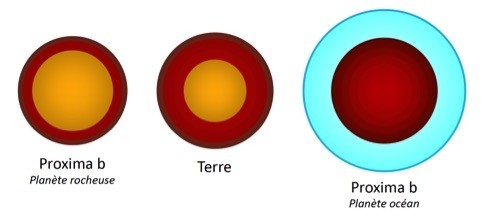
Compositions for a simulated Proxima b. Left: At 94% the diameter of Earth, Proxima b would be domiated by a massive metal core and smaller rocky mantle. Right: At 140% the diameter of Earth, Proxima b would be an ocean-covered world. Middle: Somewhere in between, Proxima b would approximate Earth.
Assuming the rocky world has the smallest physical size allowed for its mass (94% Earth's diameter), according to planetary formation models this would consist of a metal core, making up for 65% of the mass of the entire planet. The outer layers would consist of rocky mantle and very little water (if any). In this scenario, Proxima b would be a rocky, barren and dry world, resembling a massive Mercury. Last time we checked in on Mercury, it didn't appear very "habitable."

But this is just one possibility. The researchers then shifted the scale to the other extreme. What would happen if the physical size of the planet was pushed to the maximum? Well, the mass of Proxima b could support a world that is 40% bigger than Earth. Now things get interesting.

In this scenario, Proxima b would be a lot less dense, meaning there would be less rock and metal. A huge proportion of the planet's mass would consist of water. In fact, 50% of the entire planet's mass would be water. This would be a "water world" in the strongest possible sense.

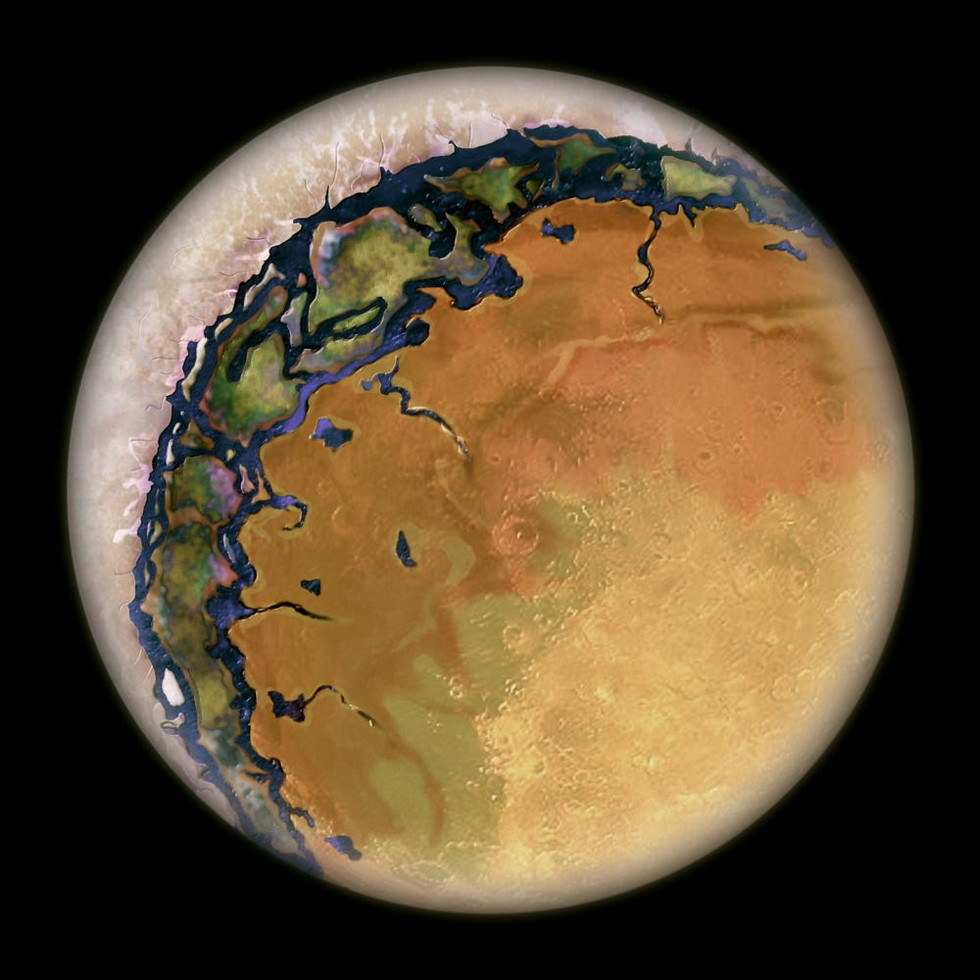
Somewhere between these two scenarios -- either a dense and barren rock or bloated water world -- is the highly sought-after "Earth 2.0"; basically a world with a small metal core, rocky mantle and plentiful oceans flooding the surface. It's this exoplanetary compromise that you regularly see in artistic impressions of Proxima b, the temperate alien world that looks like Earth:

Alas, this version of Proxima b is just one possibility over a huge range of scenarios. So, yeah, from this study alone, Proxima b is probably not very Earth-like.

But wait, there's more.

Habitable Zones Not So Habitable?

Just because a planet orbits its star in the habitable zone, it doesn't mean it has the same life-giving qualities as Earth (keep in mind that both Mars and Venus also orbit the sun within our solar system's habitable zone).

Proxima b orbits very close to its star. It's the nature of the beast; red dwarf stars are small and therefore cooler than sun-like stars. Proxima Centauri's habitable zone is therefore one hell of a lot more compact than our sun's. The Proxima Centauri habitable zone is well within the orbit of Mercury. If a planet got that close to our hot sun, it would be burnt to a crisp; for a planet in orbit around Proxima Centauri, this location is an oasis.

But when you orbit so close to a red dwarf, a planet starts to succumb to some tidal difficulties. One face of an orbiting planet around a red dwarf will be constantly facing the star, meaning the planet's spin matches its orbital period. One hemisphere of the planet is in constant light while the other hemisphere is in constant darkness -- a situation called "tidal locking."

So, in this case, let's imagine the orbiting exoplanet really is a textbook "Earth-like" world with just the right composition. A world with an iron core, rocky mantle and enough water on the surface to create liquid water oceans that could support life. But this world is tidally locked with its star -- that's got to cause some problems, right?

Let's assume that this planet somehow possesses an atmosphere (more on that later), to have one hemisphere being constantly heated while the other hemisphere is constantly frozen certainly doesn't sound like a good time. Many simulations have been run in an attempt to model the complexities of the atmospheric conditions in this situation and most outcomes aren't good. Some scenarios predict planet-wide hurricanes that act like a blast oven, other scenarios predict a dry wasteland on the star-facing hemisphere and a frozen solid dark hemisphere.

Eyeball Earths?


There are, however, some planetary models that could save the day for these unfortunate wannabe "second Earths". One fun prediction is the possible existence of "Eyeball Earths". These peculiar planets would still be tidally locked to their star, with one hemisphere a constantly baked desert and the other hemisphere in deep freeze, but there would be a region between day and night where the conditions are just right for a liquid water ocean to circle the world between the darkness and light. Oh, and it would look like an eyeball, seriously:

In other research around atmospheric dynamics of tidally locked exoplanets, there could be a situation where the world has efficient "air conditioning" -- hot air from one hemisphere is distributed about the planet in such a way to balance global temperatures. But this assumes a high degree of friction between the lower atmosphere and a craggy, rocky surface and efficient high-altitude air flow.

But the ultimate kicker when considering "Earth-like" exoplanets around red dwarf stars is that just because red dwarfs are small, it doesn't mean they are docile. In fact, red dwarf stars can be downright violent, frequently erupting with powerful flares, flooding any nearby planets with ionizing radiation. This radiation, plus inevitably powerful stellar winds, would likely blow any atmosphere away from our hypothetical burgeoning Earth 2.0. Without an atmosphere, the only vaguely habitable location on that planet would be under the surface, perhaps in a sub-surface ocean protected by an icy crust like Jupiter's moon Europa.

But, like Earth, if these planets have a powerful global magnetosphere, perhaps the worst of the stellar storm can be deflected and an atmosphere could form, who knows?

Read more at Discovery News

'Hoppy' Beer May Be Better for Your Liver

The hops found in beer not only add flavor, but also may lessen the damaging effects of alcohol on the liver, a new study in mice suggests.

In the study, the researchers gave mice regular beer with hops, a special beer without hops, or plain ethanol (alcohol). After 12 hours, the mice that were given the beer with hops showed less buildup of fat in their livers than the mice that were given ethanol. In contrast, the mice that were given beer without hops had about the same level of fat accumulation in their livers as the mice that were given ethanol.

"Our data suggest that hops content in beer is at least in part responsible for the less damaging effects of beer on the liver," over the short-term in mice, the researchers from Friedrich Schiller University Jena in Germany wrote in their study, published online Sept. 22 in the journal Alcohol and Alcoholism.

The researchers said their new findings may help explain why some earlier studies in people suggested that drinking hard liquor is more strongly associated with death from liver disease than drinking beer. Also, the researchers who worked on the new study had found in earlier work that mice accumulated less fat in their livers when they were given beer versus ethanol.

Hops refers to the flowers of the hops plant, Humulus lupulus. They are a main ingredient in beer, and are used to add flavor and act as a preservative.

 The new study also suggested that hops may lower the formation of compounds called reactive oxygen species, which are highly reactive and can cause damage to cells in the liver.

However, future studies are needed to see if the same effects are found in people, and if these effects last for long periods, the researchers said. They noted that their study received funding from the German brewing industry.

William Kerr, a senior scientist at the Alcohol Research Group, part of the nonprofit Public Health Institute in Emeryville, California, said that, in some countries, consumption of hard liquor is more strongly linked to death from liver disease, compared to beer consumption.

Read more at Discovery News

Oct 6, 2016

2,500-Year-Old Skeleton Found Wrapped in Marijuana

Archaeologists in northwestern China have unearthed a 2,500-year-old skeleton wrapped in a "shroud" made up of well-preserved marijuana.

Found during an investigation of the Jiayi Cemetery in Turpan, which houses 240 ancient tombs, the burial contained "an extraordinary cache" of 13 Cannabis plants.

The three-foot long, locally produced plants, were arranged across the chest of a man who died at around age 35.

"The Cannabis plants were placed above the body trimly, in a way that suggests ritual-medicinal purposes," Hongen Jiang of the Department of Archaeology and Anthropology at the University of Chinese Academy of Sciences in Beijing, told Discovery News.

The man was laid down on a wooden bed with a reed pillow under the head, while 13 nearly whole female Cannabis plants were deposited diagonally across his body, with the roots and lower parts of the plants grouped together and placed below the pelvis.

"The stems and foliage were arranged in a parallel alignment extending upwards to just under the chin and along the left side of the face," Jiang and colleagues wrote in the journal Economic Botany.

Radiocarbon dating of the tomb's contents, including the cannabis plants, indicates the burial occurred sometime between 2,400 and 2,800 years ago.

While all of the plants had roots attached, most of the flowering heads had been cut off. The few flowers that remained were nearly ripe and contained some immature fruit, suggesting the plants were collected—and that the man was buried -- in late summer, around the end of August or early September.

The plants offer rare insight into ancient cultivation practices.

"Due to the extremely dry climate, the stems and foliage retained their characteristic natural shape although they had turned yellowish brown," the researchers said.

They noted this is the first case of cannabis plants used a as a covering for a human body.

Examining the way the plants were lying on the man's body, basically pressed flat, the researchers concluded they had been fresh and harvested just before the funeral.

"Therefore, the plants were most likely growing locally," they said.

Jiang and colleagues suspect the plants were just harvested for their psychoactive resin. The Cannabis plants were all females with nearly ripe seed, and the flower heads contained the psychoactive resin of Cannabis.

Read more at Discovery News

Apes Can Follow Video Plots

It turns out if you dress an actor in a gorilla suit and put him in a video, real-life apes take notice. Not only that, they follow the plot closely enough to anticipate the thoughts and actions of the video's characters.

Before, it was thought that only humans were capable of such guesswork. We can think about others' thoughts and emotions, such as their goals, perceptions and beliefs. According to new research, published in Science, some other primates do this too, even while watching videos starring actors dressed in shaggy King Kong suits.

This means that the ability to read others' perceptions likely evolved in our primate past -- possibly as a wily way to score more sexual partners.

Orangutan "Dokana" who participated in the study.
Apes "seem to understand the story of videos," Fumihiro Kano of Kyoto University said, comparing the furry primates' ability with that of children. Kano jointly led the study with Christopher Krupenye of Duke University.

"Apes have never confused the videos with real events," Kano said. "They all seem to know that the video events are fake. They were never scared with the events in the monitor."

Chimpanzee "Kara" who participated in the study.
The new research was inspired, in part, by prior studies on kids. Researchers were curious to know when children could pass what's known as the "false belief test." The traditional version of the test involved showing the kid a named character. (Let's say she's called "Sally.") Sally would be seen hiding an item and then leaving a room. Another character would appear and would quickly re-hide the item in a different place.

The children would then be asked a question like: "Where will Sally look for the item when she returns?" Very young kids tend to pick the spot where they themselves know the item is, but children starting at about age four understand that Sally does not know what they know. They anticipate that she will look in the wrong spot based on her "false belief" of where the item is.

We take such perceptiveness for granted, but it takes sophisticated brain power.

For the new study, Kano, Krupenye and their team created videotaped dramas with variations on the "Sally" plot for chimpanzees, bonobos and orangutans. The actor in the King Kong outfit played a sneaky character who came in and moved an object while the "human" in the drama was either present or absent.

Eye-tracking revealed that 17 out of 22 apes correctly anticipated that the human would go to the incorrect location to search for the object when this person did not see "King Kong" hide it in a new spot. They essentially read the human actor's mind.

This skill, known as "theory of mind," refers to the fact that we can theorize about what others are thinking and what they might do next. The false belief detection skill takes this ability to a whole new level.

Krupenye explained, "There will always be some changes in the environment that we do not witness, for example, leading us to have a false belief. Most animals probably have true and false beliefs themselves; however, the ability to understand others' false beliefs is much more restricted. Until now, there was no evidence that this skill might be shared with any nonhuman animals."

Scientists who conducted the more traditional "Sally" test on kids in the past thought that language was key to the ability, since the study involved verbally asking the children questions. More recent studies on children using eye-tracking, as for the apes, find that some 1.5–2-year-olds can pass the test.

This all means that the ability to understand the thoughts of others, even when those thoughts include false beliefs, evolved way back in our primate past.

Krupenye said the skills might have developed "in response to the demands of living in complex social groups." He explained since males competed with others in their group for access to females, evolution likely favored the males who could outwit their competitors. In this way, the genes for social intelligence were passed on to the next generation.

"Theory of mind," he added, "allows individuals to interpret, predict, and even manipulate others' behavior."

Read more at Discovery News

This Flower Stinks Like a Stressed-Out Bee

Flowers of the popular ornamental parachute plant Giant Ceropegia can make you grimace if you take a whiff, and now new research reveals what the smell mimics: stressed out honeybees being attacked by a spider or other predator.

This smell of stress would seem to be a turnoff, but the odor attracts honeybee-craving flies to the sci-fi-looking plant Ceropegia sandersonii, according to a paper published in the journal Current Biology.

As if the plant is not creepy enough, it also has "trap flowers" that keep the duped flies in their clutches until the plant gets what it wants: pollination.

"We show that trap flowers of this plant mimic alarm substances of western honeybees to lure food-stealing freeloader flies as pollinators," co-author Stefan Dötterl of the University of Salzburg said in a press release. "Flies are attracted to the flowers, expecting a meal, but instead of finding an attacked honeybee they are temporarily trapped in the non-rewarding flowers and misused as pollinators."

A honeybee eaten by a spider with food-stealing flies. A drop of venom is visible at the tip of the stinger.
Dötterl and colleagues Annemarie Heiduk and Ulrich Meve from the University of Bayreuth got the idea to investigate the flower's stinky scent after realizing that the plant was pollinated by flies from the genus Desmometopa. These flies typically feed on the drippings of honeybees that are in the clutches of a predator.

While observing a honeybee caught by a spider, they noticed that the bee extruded its sting and released a drop of venom. The bees' venom is known to contain volatile alarm pheromones, which serve to call and attract nest mates for help. The researchers began to wonder if the plant could be taking advantage of this line of communication among honeybees.

Sure enough, chemical analysis found that the flower's scent is comparable to volatiles released from honeybees when they are being attacked. The scientists also found that some of the shared compounds elicit a response in the antennae of the freeloader flies, showing the scent lures these insects.

Read more at Discovery News

Another Saturn Moon May Hide Subsurface Ocean

NASA's Cassini spacecraft has spotted many watery delights while orbiting Saturn's system. There's Enceladus' 101 geysers, spewing fountains up from the ice and giving strong evidence of an ocean below. And there's Titan, a strange, soupy, orange world that may also have an ocean somewhere under the surface.

Over the last few years, another strong candidate has emerged: Dione. It's a tiny moon whose radius is about the same distance as a drive between San Francisco and Los Angeles (about 380 miles).

In 2013, images from Cassini showed the crust bend under the mountain Janiculum Dorsa was best explained if there was an ocean underneath; magnetometer measurements also showed a faint particle stream. Now a new study suggests that there is an ocean still underneath the ice, but far down: some 60 miles below the surface.

The authors of the new study modeled the ice shells of both moons Enceladus and Dione. While this approach has been done in the past -- showing that Dione likely had no ocean -- the authors made a change.

"As an additional principle, we assumed that the icy crust can stand only the minimum amount of tension or compression necessary to maintain surface landforms," said Mikael Beuthe, of the Royal Observatory of Belgium and lead author of the new study, in a statement. "More stress would break the crust down to pieces."

Topography of Dione's mountain Janiculum Dorsa, as captured by the Cassini spacecraft.
The new results suggest that Dione would have a "deep ocean" underneath the crust, but it couldn't be picked up by Cassini. This is because the moon's back-and-forth movements suggested in the study are too small for the spacecraft to detect. It will take a future spacecraft to confirm this.

For Enceladus, the study suggests the ocean is quite close to the surface; its back-and-forth oscillations (which have been seen by Cassini) would be smaller if there was a large layer of ice.

Read more at Discovery News