Sep 17, 2016

Freshwater stingrays chew their food just like a goat

A bizarre-looking fish from the Amazon evolved chewing behaviors separately from mammals, but chews its food just like a goat, according to researchers.
A new University of Toronto study has found that some freshwater stingrays from the Amazon chew their food in a similar fashion as mammals.

Using a combination of high-speed video and CT scans Matthew Kolmann, a recently graduated PhD in the lab of U of T Scarborough's Nathan Lovejoy found that as the freshwater stingray Potamotrygon motoro eats it protrudes its jaws away from its skull, shearing from side to side in the process.

"It's pretty extraordinary when you think about it -- here's this bizarre-looking fish from the Amazon that evolved these behaviors separately from mammals, but chews its food just like a cow or a goat," he says.

Kolmann was first drawn to the question of how P. motoro and its close relative, Potamotrygon orbignyi, eat their prey after finding out both species feed on aquatic insects, unique for a family that also includes sharks, skates and other stingrays.

Stingrays have fins that encircle their head called a disk. They catch prey by lifting up the front part of their disk, which draws water and prey underneath, much like a suction cup. Once rays have trapped their prey, they grab it by rapidly protruding their jaws, shredding and tearing it apart.

"They don't actually use their mouth to catch their prey, which suggests that parts of the mouth can evolve away from that specific purpose and may be driving the novelty of this chewing behaviour," Kolmann says.

Chewing was thought to be unique to mammals -- including humans -- and one of the key innovations for their success over the past 65 million years, notes Kolmann. Chewing allowed mammals to fuel their warm-blooded (endothermic) metabolism with tough or robust prey that would otherwise be too costly to ingest without breaking it down first.

"Both mammals and these stingrays -- two groups that have little to do with each other -- developed a similar solution to tackling a bio-materials problem, and that is how to break down tough prey," he says.

Freshwater stingrays evolved to eat insects and chew because they had little choice, says Kolmann. Once they invaded the Amazon 20-40 million years ago, aquatic insect larvae were not only abundant but also nutritious, and since insects are difficult to break down, chewing is necessary for digestion. Insect-feeding may have helped rays avoid competition with other fish when they moved from saltwater to the crowded Amazonian freshwater. He adds only a few other groups of animals have been able to do that successfully.

Both species of freshwater stingrays from the study are found in the lakes and rivers throughout the Amazon, from the mouth of the river near the eastern Brazil coast all the way to the foothills of the Andes in Peru. While P. motoro's diet consists of other fish, crustaceans like crabs and prawns as well as insects, P. orbignyi only eats insects.

The study highlights interesting aspects in the diversity of life found in nature, but as Kolmann points out there's plenty of undiscovered biodiversity in the Amazon that is under threat from human activity.

"Mining and dams are threatening stingray habitat in the Amazon. It's displacing Indigenous peoples and also destroying wildlife habitat in the process," he says.

"There's a backlog of interesting and bizarre animals we haven't even described yet and in many ways museums are becoming a time capsule for biodiversity that is disappearing at a faster rate than we can study it."

Read more at Science Daily

Bats use second sense to hunt prey in noisy environments

Bats
Like many predators, the fringe-lipped bat primarily uses its hearing to find its prey, but with human-generated noise on the rise, scientists are examining how bats and other animals might adapt to find their next meal. According to a new study, when noise masks the mating calls of the bat's prey, túngara frogs, the bat shifts to another sensory mode -- echolocation.

Echolocation is a way of sensing objects and movement by scanning the environment with high frequency sounds and evaluating the reflections. Studying the ability or inability of animals to shift sensory modes could be important in understanding how to protect threatened or endangered species.

The work appears this week in the journal Science.

Mike Ryan, a professor of integrative biology at The University of Texas at Austin and co-author of the study, says the bats are doing something similar to what we do at a noisy party. Amid all the conversations, we can turn our attention to one speaker and tune out the rest.

"If there's just one person talking and it's quiet, all we have to do is listen with our ears," says Ryan. "But if there are more and more people talking, we have to be looking at them to figure out what each person is saying. So we have to recruit this other sensory channel we have, our eyes, to help us figure out what we're hearing."

In this case, the bats are shifting from detecting one kind of sound -- the low frequency mating calls produced by the frogs -- to the high frequency sounds emitted by the bat to navigate and hunt with echolocation. Unfortunately for the frogs, when they produce mating calls, they're really sending two signals: the sound intended to attract females and the movement of their vocal sacs, which inflate quickly like a balloon.

The researchers speculate that predators that can shift their sensory mode will do better in noisy environments, and this in turn might alter the long-term success of specific predator and prey species.

"Our study ties together behavior, sensory ecology and conservation," says Dylan Gomes, the lead author who conducted the research during an internship at the Smithsonian Tropical Research Institute (STRI) in Panama. "As sources of anthropogenic noise continue to expand, animals will ultimately have to face noise in one way or another."

Research into the effects of human-generated noise on animal behavior has primarily focused on birds and whales, says Gomes, who is now a Fulbright scholar at the Max Planck Institute for Ornithology. The impact of noise on bats, however, is a relatively new field of study.

The team used two robotic frogs that precisely mimic the calls and vocal sac expansion of the túngara frog. The robofrogs were placed inside a flight cage with the fringe-lipped bat. One robofrog played the frog's distinct mating call, with the other playing the call and expanding its robotic vocal sac. When the researchers played a masking noise over the call, the hunting bat's echolocation activity increased and it more often attacked the frog emitting both signals than the frog emitting just mating calls. Without the masking sound, the bat attacked both frogs equally.

"We show how animals can adapt to increased noise levels by making use of their other senses, which has important implications for other species that try to find prey, avoid predators or attract mates in human-impacted environments," says Wouter Halfwerk, a professor at VU University Amsterdam and a former postdoctoral researcher in Ryan's lab.

Read more at Science Daily

Sep 16, 2016

Hubble Watches Comet Die a Slow Spinning Death

It's a comet that has survived 4.5 billion years pottering around the solar system. But through a series of gravitational misfortunes, Comet 332P/Ikeya-Murakami was nudged to a new orbit closer to the sun that ultimately doomed it to a lingering, spinning death. And the Hubble Space Telescope was there to capture the aftermath in a very lucky series of images of one very unlucky comet.

For the most part, being a comet is an uneventful existence.

Formed from the ice, dust and chunks of space rocks left over from the birth of the planets, comets will hang out for billions of years in the outer solar system doing, well, nothing. Many of these primordial chunks of icy material sit in the Kuiper Belt, beyond the orbit of Neptune, feeling the weak gravity from our sun.

But should Neptune's chaotic gravitational perturbations jostle them from their previously stable perches, the sun's gravity may win out, causing these icy bodies to make the long fall into the inner solar system. Many comets will end up in stable orbits around the sun, perhaps periodically visiting the inner solar system, while others will vaporize quickly as they play chicken with the sun and lose.

Others, like Comet 332P, may have their orbits modified by the gravity of the planets, causing them to end up in new orbits that that are far enough away from the sun to avoid being blow-torched, but close enough to die a slow solar-powered death.

After surging in brightness, Comet 332P was discovered in 2010 by two Japanese amateur astronomers Kaoru Ikeya and Shigeki Murakami. When a comet's brightness suddenly increases it can mean only one thing: It's being heated. The brightness increase was caused by jets of sublimating ices blasting vapor and dust into space, scattering sunlight.

In January this year, Hubble took a closer look at this fascinating object to see that not only is it generating a lot of vapor and dust, this comet is in the throes of death, ejecting huge building-sized chunks of material. It is currently located in an orbit beyond Mars.

"We know that comets sometimes disintegrate, but we don't know much about why or how they come apart," said David Jewitt, of the University of California at Los Angeles, in a statement. "The trouble is that it happens quickly and without warning, and so we don't have much chance to get useful data. With Hubble's fantastic resolution, not only do we see really tiny, faint bits of the comet, but we can watch them change from day to day. And that has allowed us to make the best measurements ever obtained on such an object."

Although the comet is pretty small as far as comets go, measuring approximately 500 meters wide, its debris field is huge, with a trail extending over 3,000 miles long. But what's causing this comet to break apart?

"In the past, astronomers thought that comets die when they are warmed by sunlight, causing their ices to simply vaporize away," said Jewitt. "Either nothing would be left over or there would be a dead hulk of material where an active comet used to be. But it's starting to look like fragmentation may be more important. In Comet 332P we may be seeing a comet fragmenting itself into oblivion."

Comet 332P is disintegrating as it has been "spun up" by solar heating. As sunlight gradually heats the comet's surface, ices turn from a solid into a vapor without passing through a liquid phase. This process is known as sublimation and causes the comet to fire jets of vapor and dust into space. As this happens, pressure from the jets cause the comet to spin, like a very slow-moving Catherine wheel firework. As comets are composed mostly of loosely-packed material and not solid lumps, this spinning can cause chunks of comet to break away.

This NASA Hubble Space Telescope image reveals the ancient Comet 332P/Ikeya-Murakami disintegrating as it approaches the sun. The observations represent one of the sharpest views of an icy comet breaking apart.
In the case of Comet 332P, that's exactly what Hubble is seeing -- around 25 large chunks are slowly moving away from the main comet after being broken free by the spinning (centrifugal) force. This is how a comet dies in the inner solar system. And it's beautiful.

As Comet 332P has a six-year orbit around the sun, it's going to endure this kind of outburst every six years, allowing astronomers to estimate how long it has until it's completely disintegrated. "If the comet has an episode every six years, the equivalent of one orbit around the sun, then it will be gone in 150 years," added Jewitt. "It's the blink of an eye, astronomically speaking. The trip to the inner solar system has doomed it."

Read more at Discovery News

Did Ancient Planet Collision Allow Life to Thrive?

Artist's impression of a Mercury-sized body that smashed into Earth early in the solar system's history.
When a Mercury-sized body smacked into the young Earth 4.4 billion years ago, the cosmic collision likely made carbon more available for life to thrive today, a new study suggests.

The finding would explain a paradox puzzling scientists, which is how our planet still has carbon on the surface when it should have disappeared long ago. Theories suggest that early carbon on the surface would have boiled into space, or would have been stuck in the planet's core.

"The challenge is to explain the origin of the volatile elements like carbon that remain outside the core in the mantle portion of our planet," said Rajdeep Dasgupta, who co-authored the study with lead author and former Rice postdoctoral researcher Yuan Li, in a statement.

Previously, some studies suggested the carbon could have come from meteorites, which are small rocks that whiz around the solar system and occasionally crash into Earth. But further study revealed some problems with the theory.

"The problem with that idea is that while it can account for the abundance of many of these elements, there are no known meteorites that would produce the ratio of volatile elements in the silicate portion of our planet," said Li, who is now a staff scientist at the Guangzhou Institute of Geochemistry, Chinese Academy of Sciences.

The key was imagining a different type of core composition from the Earth, based on updated studies of Mercury and Mars in past decades. These other planets suggested that perhaps our core may be more complex than just iron and nickel and carbon.

How a young Earth could have merged with a Mercury-sized object when the two collided about 4.4 billion years ago. "Magma ocean processes could lead planetary embryos to develop silicon- or sulfur-rich metallic cores and carbon-rich outer layers," Rice University wrote in a statement.
Mars is believed to have a lot of sulfur in its core, and Mercury likely contains a lot of silicon. The research team tested different elements in a lab that squeezes rocks in hydraulic presses, mimicking the high-pressure and high-temperature conditions below Earth's surface.

Read more at Discovery News

Harvest Full Moon Rises Tonight

The full moon known as this year's Harvest Moon will rise tonight (Sept.16) and will be shaded by a subtle type of lunar eclipse for some skywatchers in Africa, Asia and Australia.

The Harvest Moon (as with all full moons) officially turns full when it reaches the spot in the sky opposite to (180 degrees from) the sun. In 2016, the Harvest Moon's moment will occur tonight at 3:05 p.m. EDT (12:05 p.m. PDT).

A minor penumbral lunar eclipse will accompany the full moon tonight, and will be visible from Europe, Africa, Asia, Australia and the Western Pacific. The Slooh Community Observatory will offer a live webcast of the eclipse at Slooh.com beginning at 12:45 p.m. EDT (1645 GMT). You can also watch the lunar eclipse webcast on Space.com, courtesy of Slooh.

The Harvest Moon is the one that comes the closest to the autumnal equinox, so this year it falls in September, although occasionally this title can be bestowed upon the October full moon. That will happen 12 times from 1970 to 2020, occurring next in 2017. The 2016 version of the Harvest Moon comes six days prior to the autumnal equinox, although it can occur as early as Sept. 8 (as it did in 2014) or as late as Oct. 7 (as happened in 1987).

Many think that the Harvest Moon remains in the night sky longer than any of the other full moons seen during the year, but that is not so. What sets the Harvest Moon apart from other full moons is that it occurs at the climax of the harvest season, so farmers can work late into the night by the moon's light. This moon rises at about the time the sun sets, and — more importantly — at this time of year, instead of rising its normal average of 50 minutes later each day, the moon seems to rise at somewhat the same time each night.

In actuality, from midnorthern latitudes (+40 degrees), the rising of the moon over a three-night span centered on full phase (Sept. 15, 16 and 17) comes, on average, 38 minutes later each night. The night-to-night difference is greatest for the more southerly locations (Miami, located at latitude +25.8 degrees, sees moonrise come an average of 45 minutes later). Meanwhile, the difference is less at more northerly locations (at Edmonton, Canada, located at latitude 53.5 degrees N, the average difference is only 28 minutes).

The reason for this seasonal circumstance is that the moon appears to move along the ecliptic, and at this time of year, when rising, the ecliptic makes its smallest angle with respect to the horizon for those living in the Northern Hemisphere.

In contrast, for those living in the Southern Hemisphere, the ecliptic at this time of year appears to stand almost perpendicular (at nearly a right angle) to the eastern horizon. As such, the difference for the time of moonrise exceeds the average of 50 minutes per night. At Sydney, Australia (latitude -33.9), for instance, the night-to-night difference amounts to 67 minutes.

Interestingly, for those who live near 70 degrees north latitude, the moon does indeed appear to rise at about the same time each night around the period of the Harvest Moon. And for those who live even farther to the north, a paradox occurs: The moon appears to rise earlier each night! At Barrow, Alaska (latitude +71.3 degrees), for instance, the times of moonrise on Sept. 15, 16 and 17 will be, respectively, 9:05 p.m., 9:02 p.m. and 8:59 p.m. Alaska Daylight Time. So from Barrow, Alaska, the moon will seem to rise an average of 3 minutes earlier each night!

Read more at Discovery News

Black Hole 'Engine' Cloaks Itself in Exhaust Fumes

A supermassive black hole in the core of a galaxy churns up hot gas from its own accretion disk to create a cloaking torus.

Many supermassive black holes in the centers of galaxies possess a thick ring of material known as a torus. Appearing like a supersized doughnut, astronomers have long thought that these features were created by churned-up material from the galactic core itself, falling into the black hole's gravitational well.

However, according to powerful new observations by the the Atacama Large Millimeter/submillimeter Array (ALMA) in Chile, this conventional model is, apparently, far too simple.

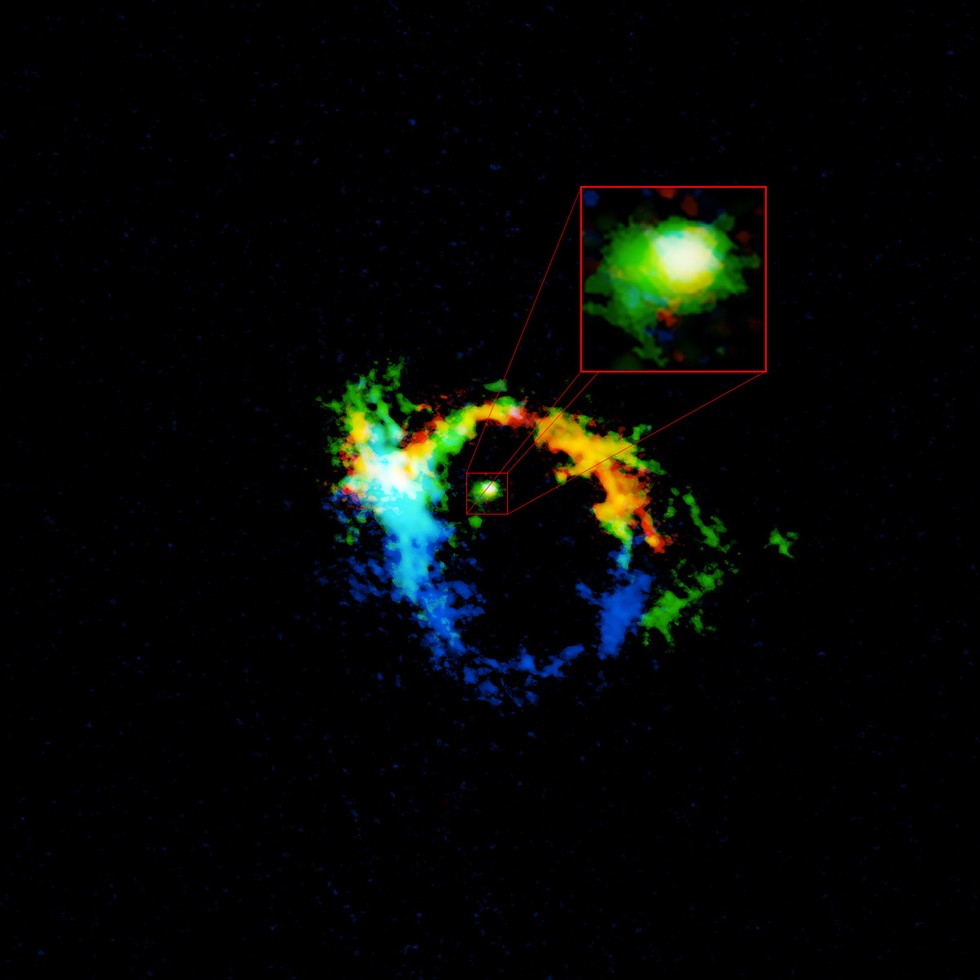
While studying the environment surrounding the supermassive black hole in the core of the barred spiral galaxy NGC 1068 47 million light-years away, ALMA was able to track clouds of material being flung outwards by the black hole, creating its own torus rather than material falling in.

"Think of a black hole as an engine," said astronomer Jack Gallimore, of Bucknell University in Lewisburg, Pennsylvania, in a statement. "It's fueled by material falling in on it from a flattened disk of dust and gas. But like any engine, a black hole can also emit exhaust."

Black holes consuming matter possess accretion disks, which are basically flat and hot features that swirl around the black hole's event horizon. The innermost section of the accretion disk is so hot that it generates X-ray and ultraviolet radiation, but further out, the disk is cooler and emits infrared and millimeter wavelength radiation. ALMA is very sensitive to the latter, allowing the observatory to track the motion of the gases in the outermost portion of NGC 1068's accretion disk.

ALMA image of the central region of galaxy NGC 1068. The torus of material harboring the supermassive black hole is highlighted in the pullout box. This region, which is approximately 40 light-years across, is the result of material flung out of the black hole's accretion disk.
While following cool clouds of carbon monoxide gas inside this cooler accretion disk region, Gallimore's team saw the clouds lift off the disk. As they become ionized by the superheated portion of the accretion disk, the clouds started to interact with the black hole's powerful magnetic field. The gas was then flung away from the accretion disk at high speed, far faster than the rotational speed of the disk itself.

"These clouds are traveling so fast that they reach 'escape velocity' and are jettisoned in a cone-like spray from both sides of the disk," said Gallimore. "With ALMA, we can for the first time see that it is the gas that is thrown out that hides the black hole, not the gas falling in."

Read more at Discovery News

Sep 15, 2016

For 20 million years, the diversity of large terrestrial mammals depended on plant growth

Skull of an extinct cave bear, Ursus spelaeus, from the Pleistocene [locality unknown].
For more than 20 million years, the ups and downs of diversity in terrestrial large mammals were determined by primary production, i.e. net production of plant biomass. This pattern changed with the onset of the ice ages. The reason for this is likely the beginning of human impact on nature, according to a team led by Dr. Susanne Fritz at Senckenberg. The findings were published recently in the scientific journal “Proceedings of the National Academy of Science.” Based on 14,000 fossils, the scientists reconstructed the diversity of terrestrial large mammals and compared it with data on the biomass production of plants during the same time period.

Whether used as food, fire wood or fodder for domestic animals – mankind would not be able to survive without plants, and we use them in manifold ways. But what impact does this use have on the evolution of mammals? The answer can be found in a recent study that correlates the biomass of plant resources with the diversity of large mammals, i.e., the number of genera of ungulates, carnivores, apes and elephants. “For 20 million years, from the early Neogene approximately 23 million years ago until the Pleistocene started around 2 million years ago, this rule applied: The larger the amount of biomass produced by plants, the higher the diversity of terrestrial mammals that evolved. And of course, the reverse is true as well: A decrease in biomass production was accompanied by a decrease in the number of different mammals,” explains the study’s lead author, Dr. Susanne Fritz of the Senckenberg Biodiversity and Climate Research Centre.

Fritz and her team are the first to confirm this correlation on such a large spatial and temporal scale – for North America as well as for Europe. The onset of the ice ages (Pleistocene) put an end to this, as since then the species diversity in North America and Europe is correlated to other environmental conditions. This is the exact point in time when humans appeared on the scene in these regions and presumably began to extract biomass from the nutrient cycle. But the abrupt change in pattern also concurred with another event: Large mammals such as mammoths, cave bears and Saiga antelopes underwent a mass extinction in the study areas. Whether humans or climatic changes were responsible for this remains a controversial question to date.

“The diversity of mammal species in Europe and North America today is much lower than in the past. For example, Europe now hosts a mere 51 species of large mammals in 27 genera; 10 million years ago, there were 130 to 200 genera. As documented by our study, humans at least contributed to the fact that the diversity of species and genera was never able to recover after the mass extinction. Today, only Africa and Asia still host any significant numbers of large mammal species,” says Dr. Christian Hof, also a scientist at Senckenberg and the study’s co-author. Nowadays, humans extract up to 30 percent of the biomass from the global nutrient cycle – and the trend is rising. However, it is difficult to ultimately evaluate what this means for the future of speciation in large mammals.

“The farther back we travel back in the past, the fewer traces we find of the animals that lived in those days, which makes it difficult to directly compare correlations between the rather extensive time period we examined and the situation today. However, it is clear that in the world dominated by humans certain ecological ‘rules,’ such as the correlation between large mammal diversity and plant biomass, no longer apply in the same way as they used to do for millions of years. The consequences of the ever increasing human impact are therefore unique in geological history and difficult to predict,” Fritz sums up.

For the study, the scientists evaluated more than 14,000 fossils from North America and Europe. These fossils represent over 1,600 different species of large mammals from approximately 1,500 sites. They cover the period between 23 and 1.8 million years ago. The results were subsequently compared with data on the primary production of plants from the same time period, which could be deduced from fossilized plant remains. In terms of temporal extent, this constitutes the largest set of data analyzed in this context to date.

Read more at Science Daily

Hawaii's Feral Pig Ancestors Predate Captain Cook

The family tree of Hawaii's feral pigs (Sus scrofa) looks a bit different today, after a new DNA analysis resets their arrival on the islands to several hundred years earlier than previously thought. More than just an interesting genealogy rewrite, the news could also be relevant to efforts to control the animals.

Writing in the journal Royal Society Open Science, an international team of researchers argues that Hawaii's hogs, previously thought to have arrived on the islands with English explorer James Cook in 1778, were brought there hundreds of years earlier by Polynesian settlers who would come to live there.

The scientists reached that conclusion after studying the DNA of more than four-dozen feral pigs, an analysis that told them the pigs arrived on the islands as much as 800 years earlier.

English explorer Captain James Cook stewarded the first European expedition to come upon the Hawaiin Islands in 1778. His mission has been credited with bringing pigs to the islands, but new research argues otherwise.
Researchers from more than half a dozen research facilities contributed to the study, among them lead author Anna Linderholm, Texas A&M assistant professor of anthropology.

"[Cook] almost certainly brought pigs, chickens and other animals with him," said Linderholm in a statement. "But our findings show that the wild hogs there today were introduced much earlier than his arrival, by hundreds of years at least. They likely came from European or Asian descent."

That conclusion could end up helping the hogs.

Hawaii has a sizable wild pig problem at present. The islands are overrun with thousands of up-to-400-pound feral hogs, which have been called "the most prolific large mammal on the face of the Earth" and ruin native plants as well as planted crops. Owning a home or farm in their path can be costly, and this has brought about talk of methods to get the problem under control.

However, the researchers note, pigs hold a special place in Hawaiian culture, with its Polynesian roots, and they urge caution moving forward.

Read more at Discovery News

Oldest Indigo-Dyed Fabric Ever Is Discovered in Peru

The oldest indigo-dyed fabric ever found has been discovered in Peru, pushing back the use of this blue coloring to at least 6,200 years ago.

Previously, the oldest sample of blue-dyed fabric dated to around 4,400 years ago in Egypt, with the oldest written references to blue dye going back to around 5,000 years ago in the Middle East. The discovery in Peru, however, shines a spotlight on the Americas, which are less-discussed in terms of firsts, said study researcher Jeffrey Splitstoser, an archaeologist and textile expert at The George Washington University.

"The people of the Americas were making scientific and technological contributions as early and in this case even earlier than people were in other parts of the world," Splitstoser told Live Science. "We always leave them out. I think this finding just shows that that's a mistake."

The dyed fabric pieces are small scraps made of woven cotton. They were excavated by archaeologists Tom Dillehay and Duccio Bonavia between 2007 and 2008 from a prehistoric site called Huaca Prieta, which is north of the city of Trujillo in coastal Peru. Huaca Prieta was a prehistoric dwelling that was covered by a mound and turned into a temple, Splitstoser said. The temple was made of a sort of concrete mixed from ash, shells and sand; over the years, many layers of this material had been applied to the structure as local people renovated and rebuilt the temple. The fabric scraps were found in bundles lining the ramp that led up to the top of the temple, embedded in the concrete-like layers. They all date to between 4,000 and 6,200 years ago.

"They were literally sealed under these new layers of building, but because the building material had so much ash in it, it leached into the textiles, making them a very dirty, sooty color," Splitstoser said.

The blue color didn't appear until conservationists washed the textiles. Almost all blue dye in nature comes from the compound indigoid, Splitstoser said, which can be made by many plants. But the first tests on the fabric yielded no sign of indigoid. Splitstoser was stumped.

He persevered, finding another chemist -- Jan Wouters of University College London -- with more sensitive equipment. Wouters, using a sensitive technique called high-performance liquid chromatography, was able to tease out the chemical makeup of the dye to discover that it was, in fact, indigo. He tested eight tiny samples of the blue cotton and confirmed indigo in five of them.

"That's when we realized then that we had the world's oldest indigo, by far," Splitstoser said.

The fabric pieces were all cut or torn before they were deposited on the temple ramp, which probably represented a ritual "killing," by peoples who viewed objects as living, Splitstoser said.

"We see that all over the Andes. They not only ritually killed textiles, but they ritually killed ceramics. Anything that was buried was broken," he said.

Some of the fabrics showed signs of being wetted and then squeezed out, possibly as part of the ritual, Splitstoser said. The fabrics weren't just blue — they were woven in patterns made of blue-dyed yarn, natural off-white cotton and bright-white thread made from milkweed, a very rare textile in South America, Splitstoser said. The yarn had also been dipped in red and yellow ochre, an iron pigment often used in rock art. Unlike the indigo, the ochre would have run when wetted.

"If you were to pour water on those and then squeeze it, you'd get colored water pouring out of the textiles, which might have been part of the show," Splitstoser said. No one knows what these rituals might have represented to the people who invented them; the era in which the textiles were made was one of a drying climate, Splitstoser said, so perhaps the rituals had to do with rain or water.

The discovery of indigo dye more than 6,000 years ago couldn't have been mere happenstance. Indigo dye is quite complicated to make, Splistoser said. Many dyes are made from flowers and require simply boiling the blossoms in water to extract the color, he said.

"Indigo does not work that way," he said. "If you put the leaves — and it's leaves, not flowers — in water, nothing will happen."

Instead, the leaves have to be fermented. Then, the fermented mixture must be aerated so that a solid compound falls out of the mixture to the bottom of the tub. This mixture can be taken, dried and stored. To reconstitute it requires an alkaline substance, often urine, which makes white indigo, a water-soluble compound. Yarn dipped in white indigo will turn yellow, green and finally blue, "like magic," Splitstoser said.

Read more at Discovery News

Optical Illusion Made Tiny Dinos Invisible

A recreation shows the dinosaur Psittacosaurus in a setting where it would be more visible to onlookers.
A small dinosaur used an optical illusion to become invisible in dense forests, helping to protect it from larger meat-eating dinos and other predators, a new study shows.

Well-preserved remains of the long-lost species, Psittacosaurus aka "Parrot Lizard," reveal that its body countershading created the camouflage. The findings are presented in the journal Current Biology.

Psittacosaurus fossil
"The fossil preserves clear countershading, which has been shown to function by counter-illuminating shadows on a body, thus making an animal appear optically flat to the eye of the beholder," co-author Jakob Vinther of the University of Bristol said in a press release.

Vinther's University of Bristol colleague, Innes Cuthill, added: "By reconstructing a life-size 3D model, we were able to not only see how the patterns of shading changed over the body, but also that it matched the sort of camouflage which would work best in a forested environment."

Humans and other animals to this day analyze patterns of shadow on an object to help identify what it is. We're usually unaware of this phenomenon. It just happens automatically as part of our visual processing.

The origins of the new study go back to Vinther's work as a Yale graduate student, when he first realized that structures previously thought to be artifacts or dead bacteria in fossilized feathers were actually melanosomes. These are small structures that carry melanin pigments found in the feathers and skin of many animals.

A Psittacosaurus specimen is so well preserved that it shows preserved melanin patterns, which can be seen with the naked eye. Figuring out the distribution of countershading proved to be tricky, though, as the extinct animal had been crushed flat and fossilized.

Read more at Discovery News