Sometimes the distortions are obvious, like in the Hubble image of a distant galaxy cluster above. But sometimes they’re too subtle to be picked out by human eyes, and can even be confused with noise from the telescope used to take the galaxies’ picture. So cosmologists have turned to machine learning algorithms that teach computers to recognize patterns.
“We’re trying to teach computers to pick out the correct shape given all sorts of other noise around the galaxy’s shape,” said NASA cosmologist Jason Rhodes, who is helping to organize the challenge. “We have our ideas as a community about how to do this, but we realized a few years ago that it was quite possible there were ideas we weren’t familiar with.”
The competition is designed to bring fresh ideas from machine learning and computer science experts. But the challenge is open to anyone.
Full details at Wired
Dec 9, 2010
Worshipping Baby
This interesting video is doing the rounds and is being described as a clear case of embedded cultural behaviour. We think it’s just a bit weird and at the same time funny.
Dec 8, 2010
The science of Christmas: Santa Claus, his sleigh, and presents
Sure, Santa Claus delivers presents to all the good children in the world. But how? And why? We take a look at the science of Christmas gifts.
How fast does Santa travel?
If we assume that Santa has to travel 510,000,000km on Christmas Eve, and that he has 32 hours to do it (see here for the reasoning behind those numbers), then Santa will be travelling at 10,703,437.5km/hr, or about 1,800 miles per second, all night (assuming he never stops: some sort of sleigh-mounted present-launcher will be required to shoot gifts down chimneys while moving. The guidance system will have to be quite impressive, to avoid accidentally showering Afghan wedding parties with extra presents). It will probably also be advisable to have Santa catheterised to obviate the need for toilet breaks.
How much will his sleigh weigh?
Last year, we calculated Santa’s sleigh (carrying 700,000,000 Optimus Primes and dragged by three million reindeer) to weigh 1,232,300 metric tonnes. However, this year, thanks to the success of Toy Story 3, he will have to be carrying Buzz Lightyears, which have a boxed weight of 1.2kg compared to Optimus’s comparatively puny 659g. So that’s 840,000 tonnes of toys, which will require 5,600,000 reindeer to pull. Given each reindeer weighs around 272kg (600lb), the whole procession (assuming a weightless sleigh) will have a mass of 2,363,200 tonnes when standing still. Last year, however, we failed to take into account the relativistic increase in mass caused by the speed of the sleigh. Travelling at 10,703,437.5km/hr, or 0.97 per cent of light speed, the whole thing will have an apparent weight to a stationary observer of 2,363,310.33 tonnes.
Can reindeer fly?
We feel we should leave this to the Telegraph’s former science editor Dr Roger Highfield, who has written an entire book of that name. “Somewhere in the North Pole, or perhaps buried in a vast complex under Gemiler, there must be an army of scientists experimenting with the latest in high-temperature materials, genetic computing technologies and warped spacetime geometries, all united by a single purpose: making millions of children happy each and every Christmas”, he says. He takes a look at a few of the possibilities.
A rocket-powered sleigh is out of the question: the fuel costs would be prohibitive (not that that has stopped people drawing up possibilities). But if Santa’s elves - “undoubtedly the most spectacular research and development outfit this planet has ever seen” - have worked a way of warping space-time, allowing the sleigh to sit in a small bubble of space that itself moves, it could travel faster than light. Alternatively, wormhole technology could provide cosmic short-cuts, and would have the benefit of permitting time-travel, removing the constraint of having to get all the work done in one night.
But this all involves a powered sleigh. The reindeer themselves still need to be able to fly. This could be achieved by genetic engineering, altering the reindeer so their lungs are huge and filled with helium; they could even be born with wings and stabiliser fins. Or, as Professor Ian Stewart, Warwick University maths professor and occasional Telegraph contributor, points out: “Reindeer have a curious arrangement of gadgetry on top of their heads which we call antlers and naively assume exist for the males to do battle and to win females. This is absolute nonsense. The antlers are actually fractal vortex-shedding devices. We are talking not aerodynamics here, but antlaerodynamics.” At the speeds the reindeer have to travel to deliver gifts, their antler-tips would, apparently, create enough lift to allow them to fly.
Check out Can Reindeer Fly?: The Science of Christmas, by Dr Roger Highfield, for more information.
Read more at The Telegraph
The Science of Christmas: the First Noel
Virgin birth, the star over Bethlehem - you know the story. But does it have a basis in scientific fact? We take a look.
The Star of Bethlehem
Upon Christ’s birth, legend has it, a star appeared in the sky over Bethlehem, leading the three magi to the manger where Jesus lay. The question of whether it had a non-miraculous astronomical explanation - was there really an extra bright star that night? - has been debated for some time.
Two possible explanations are: a conjunction of Jupiter and Venus, which would have taken place about 2BC, and would have appeared as a single bright star; and a supernova, which was recorded by Chinese astronomers in 5BC. Since it turns out that King Herod, in whose reign Christ was supposed to have been born, died in the spring of 4BC, we can probably rule out the planetary conjunction theory.
So, you heard it here first: the Star of Bethlehem, if it really happened, was, probably, a supernova. Or a divine miracle, obviously.
Jesus's birthday
If the planetary-conjunction hypothesis is correct (we know we're suggesting it's not, but bear with us), we can put an exact date on Jesus's birth - 17 June, 2BC. Which would make Jesus a Gemini. Unfortunately, as we've seen, King Herod, who plays a significant part in the story, was almost certainly dead by then.
The more plausible supernova hypothesis places Christ's birth in March or April 5BC, making Jesus either Pisces, Aries or Taurus.
Virgin birth (parthenogenesis)
The thing that needs explaining here is not a virgin giving birth. It’s the fact that it doesn’t happen more often. It’s the whole strange sexual reproduction business that’s confusing: various theories have been put forward to explain it, but none has been fully accepted. The most widely held seems to be that it is an advantage in the evolutionary arms race against parasites.
But parthenogenesis does happen in the animal world. Insects do it all the time, notably some species of bees and wasps, as do various crustaceans and molluscs. Further up the complexity scale, sharks and some reptiles - including the mighty Komodo dragon and boa constrictor - have been known to give birth without the input of a male. At least one species of lizards, the New Mexico whiptail, has no males at all.
Among our fellow mammals, alas, it doesn’t happen, at least not in nature, although it has been induced in the laboratory. But if the Virgin Mary was a Komodo dragon - which the New Testament at no stage denies - the story is entirely plausible.
Read more at The Telegraph
Spanish Woman Claims to Own the Sun
“Would you want to own a property that’s older than the dinosaurs? Along the lines of billions of years old? Well, a woman in Spain has laid claim to the sun.
Yes, you read that correctly: THE sun in the sky — the 4.5-billion-year-old celestial giver of light and heat and well, life to all things on Earth, is now owned by Angeles Duran, or so she asserts after legally registering our closest star with a notary public, the global news agency Agence France-Presse reports.
Duran told the Spanish newspaper El Mundo that she decided to try to become the sole owner of the sun when she heard about how Nevada entrepreneur Dennis Hope posted a similar claim in 1980 with the United Nations for ownership of the moon and proceeded to sell acres of lunar real estate — not exactly a traditional holiday stocking stuffer.
Hope has so far sold more than 2 million 1-acre slabs of the moon, which he offers for $22.49 on his Lunar Embassy website. He’s even expanded his available properties to include prime areas of Mercury, Venus and Mars.
In her quest to own the sun, Duran has used the same loophole as Hope by getting around the United Nations Outer Space Treaty, adopted in 1967, that stipulates “outer space is not subject to national appropriation by claim of sovereignty, by means of use or occupation, or by any other means.”"
Read more at AOL News
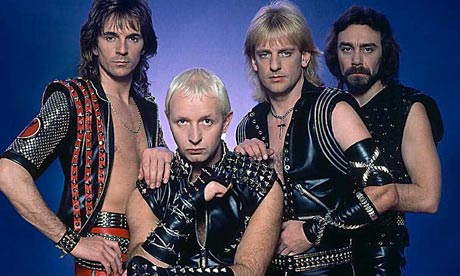
Judas Priest announce farewell tour
After 40 years of screaming for vengeance, the ageing metal gods are to take on the world with one final tour
With typical elegance and restraint, Judas Priest have announced their farewell tour. After 40 years of screaming for vengeance, the British metal band are ready to rest their voices, retiring from the road after a final worldwide romp.
Starting next year, the Epitaph tour will offer fans a last chance to see the ageing metal gods. Judas Priest will "be going out strong", "rocking the planet", and "hitting all the major cities throughout the world ... with all guns blazing and amps cranked to 11", according to a press release. The only dates revealed so far are a string of European summer festivals, including London's High Voltage in July.
Judas Priest have worked tirelessly throughout a four-decade career. Singer Rob Halford has not always been with them, but at 59 he still has one of the most vital voices in vintage metal. It is not clear whether the band will continue recording after they have ceased touring.
For those who are unable to catch Judas Priest live, there is some consolation: farewell tours are often followed by comeback gigs. Acts such as the Who, Kiss, Barbra Streisand and Ozzy Osbourne have all bade us adieu only to return for one last hurrah, or, er, several.
Judas Priest have sold more than 40m albums worldwide.
From The Guardian
Dec 7, 2010
Mimicking a foreign accent helps you communicate
Britons abroad really should imitate the person they are talking to if they are struggling to understand a very strong foreign accent, psychologists have found.
Just by employing the same pronunciations will help them understand and be understood by the person they are speaking with, the researchers found.
However, it does not mean going over the top with a comedy impression, such as a French accent in the style of 'Allo 'Allo, the Second World War sitcom famous for the catchphrase "listen very carefully I shall say this only once" uttered by Michelle "of the Resistance" Dubois.
The findings could explain the notorious clip of ex-England manager Steve McClaren giving a press conference in English but with a strong Dutch accent when managing local side FC Twente.
According to research published in the journal Psychological Science, it turns out he may have been doing exactly the right thing, no matter how ridiculous others thought he looked.
The study, conducted jointly by researchers from the University of Manchester and Holland's Radboud University, suggest a natural tendency to mimic another's accent.
In particular, when talking to a person with a very strong regional or foreign accent, the one with a less pronounced accent will adopt a style and tone of the other.
The researchers set up a series of experiments with Dutch students, putting them into conversational situations with strangers adopting a variety of accents.
Some would speak Dutch with a strong regional accent.
Others would do so but in a made up accent where the vowels would be switched round to make it totally unfamiliar.
The volunteers were told to either respond normally or do so trying to mimic the accent they heard and then transcribe what was being said to them.
Read more at The Telegraph
Last meals: weird requests on death row
Prisoners on America's death row are traditionally allowed anything they would like to eat for their last meal before they are executed. Here are some of the more unusual requests submitted to prison staff.
Thomas J Grasso: mussels and SpaghettiOs
Grasso was executed in 1995 for using Christmas tree lights to strangle an 85-year-old woman. His bizarre last meal request was for two dozen steamed mussels, two dozen steamed clams, a Burger King double cheeseburger, six barbecued spare ribs, two large milkshakes, a tin of SpaghettiOs with meatballs, half a pumpkin pie and strawberries and cream.
Unfortunately for him, the length or complexity of his list seemed to confuse kitchen staff who made one crucial mistake. Grasso's last words were: "I did not get my SpaghettiOs, I got spaghetti. I want the press to know this.”
Robert Buell: a single black olive
Buell was sentenced to death for the murder and sexual assault of an 11-year-old, Krista Harrison, in 1982. Buell insisted he was innocent despite being sentenced to 121 years in prison for other rape charges.
His last meal request was for a single black olive with the seed removed.
Gerald Lee Mitchell: a bag of Jolly Ranchers
Mitchell was convicted of murdering a man who would not hand over a necklace he wanted, and was also accused of robbing and shooting two men in a drug deal.
His last meal may not have been nutritious but was certainly colourful: a bag of Jolly Rancher sweets in assorted flavours.
Read more at The Telegraph
What Would Happen If Every Element On The Periodic Table Came Into Contact Simultaneously?
“There are two ways to go about testing this, neither of which are practical. One requires the energy of dozens of Large Hadron Colliders. The other could yield a cauldron-full of flaming plutonium. Both, however, would probably create carbon monoxide and a pile of rust and salts rather than a cool Frankenstein element.
If you toss single atoms of each element into a box, they won’t form a super-molecule containing one of everything, explains Mark Tuckerman, a theoretical chemist at New York University. Atoms consist of a nucleus of neutrons and protons with a set number of electrons zooming around them. Molecules form when atoms’ electron orbitals overlap and effectively hold the atoms together. What you get when you mix all your atoms, Tuckerman says, will be influenced by what’s close to what.
Oxygen, for example, is very reactive, and if it is closest to hydrogen, it will make hydroxide. If it is nearest to carbon, it will make carbon monoxide. “That random reactive nature applies to pretty much all elements,” Tuckerman says. “You could run this experiment 100 times and get 100 different combinations.” Certain elements, such as the noble gases, wouldn’t react with anything, so you’d be left with those and a few commonly found two- and three-atom molecules.
Ramming the atoms together at 99.999 percent the speed of light—the top speed of particles in the Large Hadron Collider, at the CERN particlephysics lab near Geneva—might fuse a few nuclei, but it won’t make that cool Frankenstein element. More likely, they would meld into a quark-gluon plasma, the theoretical matter that existed right after the universe formed. “But they would last for a fraction of a second before degrading,” Tuckerman says. “Plus, you’d need 118 LHCs—one to accelerate each element—to get it done.””
Read more at Pop Sci
Dec 6, 2010
Magicians, it seems, have an advantage over neuroscientists
“There is a place for magic in science. Five years ago, on a trip to Las Vegas, neuroscientists Stephen Macknik and Susana Martinez-Conde realized that a partnership was in order with a profession that has an older and more intuitive understanding of how the human brain works. Magicians, it seems, have an advantage over neuroscientists.
“Scientists have only studied cognitive illusions for a few decades. Magicians have studied them for hundreds, if not thousands, of years,” Martinez-Conde told the audience during a recent presentation here at the New York Academy of Sciences. [Video: Your Brain on Magic]
She and Macknik, her husband, use illusions as a tool to study how the brain works. Illusions are revealing, because they separate perception from reality. Magicians take advantage of how our nervous systems — our eyes, sense of touch, minds and so on — are wired to create seemingly impossible illusions.
After their epiphany in Las Vegas, where they were preparing for a conference on consciousness, the duo, who both direct laboratories at the Barrow Neurological Institute in Arizona, teamed up with magicians to learn just how they harness the foibles of our brains. Their discoveries are detailed in their new book, “Sleight of Mind: What the Neuroscience of Magic Reveals about Our Everyday Deceptions” (Henry Holt and Company, 2010).
The psychological concepts behind illusions are generally better understood, but they treat the brain as something of a black box, without the insight into brain activity or anatomy that neuroscience can offer, they write.”
Read more at Live Science
Subscribe to:
Posts (Atom)