Nov 13, 2010

Phineas Gage and the effect of an iron bar through the head on personality

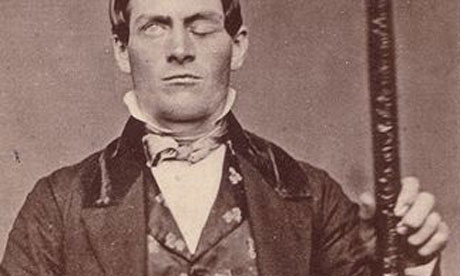
“The photograph above, which was uncovered earlier this year, is one of only two known images of an otherwise unremarkable man named Phineas Gage who attained near-legendary status in the history of neuroscience and psychology one fateful day in 1848 at the age of 25.

Gage earned his place in the neurological hall of fame in a most unusual – and extremely unfortunate – way. A railroad construction foreman in the US, he was in charge of a crew of men who were working on the construction of the Rutland and Burlington Railroad near Cavendish, Vermont. On 18 September, he and his crew were excavating rocks to make way for the railroad. Gage was preparing for an explosion, using the tamping iron he holds in the photograph to compact explosive charge in a borehole. As he was doing so, the iron produced a spark that ignited the powder, and the resulting blast propelled the tamping iron straight through his head.

John Harlow, the physician who attended to Gage at the scene, noted that the tamping iron was found some 10 metres away, “where it was afterward picked up by his men, smeared with blood and brain”. He provides a detailed description of the “hitherto unparalleled case” in a letter to the editor of the Boston Medical and Surgical Journal, entitled “Passage of an Iron Rod Through the Head”:

“[The tamping iron] entered the cranium, passing through the anterior left lobe of the cerebrum, and made its exit in the medial line, at the junction of the coronal and sagittal sutures, lacerating the longitudinal sinus, fracturing the parietal and frontal bones extensively, breaking up considerable portions of the brain, and protruding the globe of the left eye from its socket, by nearly half its diameter. ”

Remarkably, Gage survived this horrific ordeal, and by all accounts was conscious and walking within minutes. Back at Gage’s nearby lodgings, Harlow removed small bone fragments from the wounds, replaced larger fragments that had been displaced by the passage of the tamping iron, and closed the large wound at the top of Gage’s head with adhesive straps.

Several days later, one of the wounds became infected and he fell into a semi-comatose state. Fearing the worst, his family prepared a coffin, but Gage soon recovered and by January 1849 was leading an apparently normal life. But those closest to him began to notice dramatic changes in his behaviour.”

Read more at The Guardian

Fear doctors (mad scientists?) use tarantulas to terrify

“What’s scarier than bats in the belfry? Easy: tarantulas in an MRI tube.

To observe the brain’s panic-response network in full freak, British researchers asked 20 volunteers to lie inside a functional magnetic resonance imaging machine. One by one, the scientists then had each person view a screen that showed a tarantula crawling closer … and … closer to the subject’s feet. As the spider advanced, MRI scans allowed researchers to see flashes of activity switch from the volunteer’s prefrontal cortex – a region associated with anxiety – to a spot in the midbrain known to involve intense fear. But the neural terror waned when the tarantula retreated, “regardless of the spider’s absolute proximity,” wrote the study’s authors. In other words, as long as the spider was moving away, no matter how close it still was, the volunteers relaxed.

Titled “Neural Activity associated with monitoring the oscillating threat value of a Tarantula,” the study was published today by the National Academy of Sciences. They could simply have dubbed their paper: “Watching the Willies.” What the researchers glimpsed, they say, was the brain’s danger-tracking system at work.”

Read more at Body Odd

Nov 12, 2010

Science finds the plane truth about in-flight meals

“The inexplicable blandness of airline food has been pondered at 30,000 feet by generations of travellers. Now an explanation has been offered in the form of research showing that people lose their sense of taste when listening to the sort of “white noise” heard inside an aircraft’s cabin.

White noise consists of random collections of sounds at different frequencies – such as the muffled noise of aircraft engines – and scientists have demonstrated that it is capable of diminishing the taste of salt and sugar.

The findings could explain a phenomenon well known to airline companies: passengers tend to lose their sense of taste when they are in the air. For this reason, airline meals are often “improved” with extra salt, sugar and other flavourings.

The study also lends further support to the idea that sound plays an important role in the perception of taste. Heston Blumenthal, the celebrity chef, has exploited the trait in a specially designed seafood dish which is served while diners hooked up to iPods listen to the sound of surf crashing on a beach.

Ellen Poliakoff of Manchester University said the study investigated how background noise influenced a person’s perception of food.

The scientists found that certain sounds not only affected people’s sense of saltiness or sweetness, they also influenced how crunchy some types of food sounded to the diners – which in turn affected their perceptions of freshness and palatability.”

Read more at The Independent

Access denied. I don’t like the way you look at me!

“A small security company has developed a system which can identify people by the way they look at the world. The system, created by the firm ID-U based in Israel, is said to be both simple and reliable. It asks the user to follow a target on a display while tracking the movement of his eyes with a low-resolution camera, reports Technology Review.

The eye movement pattern is as unique as fingerprints. At the moment the system is 97 per cent accurate, says ID-U CEO Palti-Wasserman, who holds a PhD from the faculty of biomedical engineering from the Technion Israel Institute of Technology. A potential impostor would have trouble fooling the system. With a fingerprint or retina scanner it is possible to make an accurate copy of the biometrical feature and pass identification. But ID-U does a different test every time, so having a record of the rightful owner passing a test will not help.

As a bonus, the system only needs a display and a regular digital camera, both of which are already in many potential hosts like laptops or ATMs. Once the software is installed, it is ready to be used. The company is working on an iStore app using their algorithms. However ID-U is yet to demonstrate its scalability. What works well for a small group may drop in performance significantly when hundreds or thousands of individuals are involved.”

Read more at RT

Nov 11, 2010

World's Oldest Dinosaur Embryos Found

Paleontologists have just identified the world's oldest known dinosaur embryos, according to a paper in the current Journal of Vertebrate Paleontology.

The embryos, found in their still well-preserved eggs, date to the early Jurassic Period 190 million years ago. The researchers say they are the oldest known embryos for any land-dwelling vertebrate.

They belong to Massospondylus, a member of a group of dinosaurs called prosauropods that were ancestors to the giant, plant-eating sauropods. Sauropods are the iconic four-legged dinosaurs known for their long necks and long tails.

Professor Robert Reisz of the University of Toronto Mississauga and his colleagues made the discovery while analyzing the fossilized eggs, originally found in South Africa. Reisz’s research assistant, Diane Scott, prepared the delicate fossils under high-powered microscopes and compiled the illustrations.

“I don’t think anybody else could have done this job,” Reisz said.

The embryos are so remarkably well preserved that they permitted a complete reconstruction of the skeleton and detailed interpretations of the anatomy.

Read more at Discovery News

Cancer Breakthrough in New Blood Cell Source?

In a neat bit of cellular wizardry, human skin cells have been turned into blood cells.

The research could have huge implications for blood-related diseases such as leukemia and lymphoma, and could also eventually lead to new treatments for other types of tissues inside the human body.

"There is an incredible need clinically to generate red blood cells," said Mick Bhatia, a scientist at McMaster University in Canada and co-author of the study in the journal Nature. "But I think it will also expand the idea that skin cells could be directly turned into other cell types."

The experiment was straightforward: The Canadian scientists first harvested skin cells from several human volunteers. The researchers then exposed those cells to a virus. The virus injected a gene, known as OCT4, into the skin cells. OCT4 encodes a protein that acts as a kind of switchboard to activate other genes in order to make different kinds of cells.

Bathed in a solution filled with cytokines, molecules that stimulate the immune system, the skin cells then transformed into blood cells.

By itself this accomplishment is impressive. What makes it even more important is that the new blood cells persisted; they never reverted into an embryonic-like state, as has been the case with other research.

The skin-derived blood also contained all three classes of blood cells: white blood cells, red blood cells and platelets. Furthermore, all three classes seemed to function like normal adult blood cells.

This development could have huge implications in a number of fields, such as cancer research, said Christine Williams, Director of Research at the Canadian Cancer Society Research Institute.

Read more at Discovery News

Breakthrough could lead to vaccine against diseases that kill more than a million people a year

Described as a "dramatic advance in understanding" of how the immune system responds to infection caused by Streptococcus pneumoniae, it could lead to new drugs that trigger the same response without the full blown disease.
At present vaccines against the bacteria protect against seven different strains but this new approach should be universal being effective against all 92.
The teams from the University of Leicester and Trinity College, Dublin, say they have shown for the first time that a toxin in the bacteria not only causes symptoms but also benefits the body by triggering its natural defences.

Pneumolysin triggers a group of immune system proteins called inflammasomes which provide protection against infection.

The research has been published in the journal PLoS Pathogens.

Dr Aras Kadioglu of Leicester and Trinity's Dr Ed Lavelle believe this new knowledge of how the toxin interacts with the immune system will mean that new vaccines can be developed and targeted more effectively.

Dr Kadioglu said: "This is a very exciting discovery and offers a whole new approach to protecting against the bacteria.

"The holy grail would be to find a vaccine against all the strains."

Read more at The Telegraph

The difference between us and Neanderthals is our creativity

The modern human brain and the Neanderthal brain began at about the same size at birth, but their skulls show that they began developing very differently within the first year of life, scientists say.

Neanderthals evolved more than 400,000 years ago, lived as hunter-gatherers in Europe and Asia, and went extinct about 30,000 years ago.

Judging by the archaeological record, Neanderthals were well-adapted to their particular environment, but they were not as creative in terms of hunting strategies or artwork – for example, they apparently did not make cave paintings the way their human contemporaries did.

Scientists at the Max Planck Institute for Evolutionary Anthropology scanned Neanderthals skulls and compared them with modern human skulls. Their results are published in the journal Current Biology.

Subtle changes in the early phases of brain development can have a huge impact on social cognition, communication, and how creative members of a species are, said study author Philipp Gunz of the  Planck Institute.

The pattern of brain development described in the study may point to a diminished inclination to communicate through art, and possibly also help explain why modern humans had advantages over Neanderthals, he said.
“If you are an artist you have to understand symbols, you have to understand meaning, you have to look at the world in the certain way, and it seems that Neanderthals, for 200,000 years, didn’t feel like it,” Gunz said.

Nov 10, 2010

Enough Oxygen for Life Found Millions of Years Too Early

Earth’s atmosphere contained enough oxygen for complex life to develop nearly 1.2 billion years ago — 400 million years earlier than scientists previously believed.

The findings, reported in the Nov. 11 Nature, could lead scientists to reconsider the prerequisites for animal life, on Earth and other planets.

“It means that the conditions were in place for complex life to arise,” said geologist John Parnell of the University of Aberdeen in Scotland, lead author of the new study. “There might be animals in that earlier window that we have not yet found.”

Geological records show there was one major increase in the amount of oxygen in Earth’s atmosphere around 2.3 billion years ago, and another around 800 million years ago.

That second spike in oxygen levels was thought to be connected to the Cambrian explosion, the swift development of most of the major animal groups that came around 550 million years ago.

Parnell’s results suggest oxygen can’t be the whole story.

“It may have been that something else gave evolution the kick-start which caused animals to evolve,” he said. “Oxygen in the atmosphere was already there for quite a long time.”

To figure out how much oxygen was in the early atmosphere, Parnell and his colleagues searched 1.2 billion-year-old rocks from what was once a lakebed in Scotland for the chemical signatures of ancient bacteria.

Before there was a useful amount of free oxygen around, these bacteria used to get energy by converting sulfate, a molecule with one sulfur atom and four oxygens, to sulfide, a sulfur atom that is missing two electrons.

Read more at Wired

Stem cells bulk up muscle and stop them ageing

Researchers have discovered that transplanting specially treated repair stem cells into damaged muscle makes them twice as big and strong – and also stops them from ageing.
The results have stunned scientists who still have no real clue as to why the muscles are so miraculously transformed but hope that discovering the mechanism could provide a treatment for muscle wasting in the elderly.
"This was a very exciting and unexpected result," said Professor Bradley Olwin, the lead author at the University of Colorado.

Muscle stem cells are found between muscle fibres and surrounding connective tissue and are responsible for the repair and maintenance, said Prof Olwin.

The researchers transplanted between 10 and 50 stem cells from a donor mice into the host mice.

"We found that the transplanted stem cells are permanently altered and reduce the ageing of the transplanted muscle, maintaining strength and mass," said Prof Olwin.

"With further research we may one day be able to greatly resist the loss of muscle mass, size and strength in humans that accompanies ageing, as well as chronic degenerative diseases like muscular dystrophy."

A paper on the subject was published in the journal Science Translational Medicine.

In the experiments, stem cells and muscle fibres were removed from three-month-old mice, briefly cultured and then transplanted into another three-month-old mice that had temporarily induced leg muscle injuries produced by barium chloride injections

The transplanted material seemed to kick the stem cells to a high gear for self-renewal, essentially taking over the production of muscle cells.

Read more at The Telegraph