Apr 20, 2018

Mammal Mass Shrank as Hungry Humans Learned to Hunt

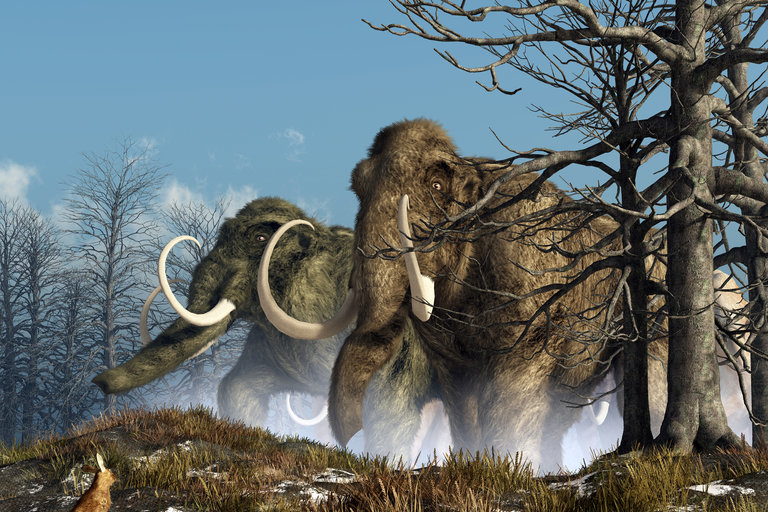
An illustration of a rabbit observing mastodons
In our defense, we were hungry.

Scientists examining the disappearance of large prehistoric mammals have found evidence that humans and their ancestors drove a sharp reduction in the size of land mammals as hunting skills and weaponry advanced. As a result, the average mammal mass has shrunk more than tenfold over the last 125,000 years, University of New Mexico paleoecologist Felisa Smith told Seeker.

That’s not because species are getting smaller — it’s because the biggest ones went extinct, most likely because they provided the most meat. And that trend has continued into the modern era: Earth’s largest land animal soon may be the domesticated cow, Smith said.

“We used to have animals on the Earth that weighed over 10 tons,” she said. “Now the biggest thing is an elephant that on average is only about three and a half-ish … and if they go extinct, then we’re talking about things no bigger than 900 kilos (2,000 pounds). And that’s maximum size. If you look at mean size, it’s much, much different.”

Smith has studied megafauna extinctions for about 15 years. She and a team from the University of California San Diego, the University of Nebraska, and Stanford University looked back at global fossil records dating back to the start of the Cenozoic Era, after the dinosaurs became extinct. Their findings, published Thursday in the research journal Science lay out a connection between the rise of humans and the shrinking of other mammals over the past 65 million years.

Megafauna like the mastodon, wooly rhinoceros, or the saber-toothed tiger lived on every continent until the Pleistocene epoch, about 125,000 years back, when the human branch of the evolutionary tree spread from Africa to other continents.

North America was rich in large animals, including giant sloths, a bear species that stood as tall as 12 feet, or the glyptodon, an armadillo-like creature “about the size of a Volkswagen Bug,” Smith said.

One finding Smith called surprising was that those trends didn’t appear to be affected by shifts in climate during that period. Animal species tended to adapt by changing their body size, or moving.  Meanwhile, it seems people were killers even before we were technically human.

“The only time we see a spike in extinction rates and this huge size bias, where large-bodied things are disproportionately at risk, was where hominids are involved,” she said. “From that, we conclude that it’s probably related to human exploitation of large-bodied animals.”

Evidence of large mammal extinctions appeared as early as the beginning of the Pleistocene in Africa, where human ancestors were evolving alongside them, Smith said. By 40,000 years ago, when today’s Homo sapiens edged out Neanderthals in Eurasia, mammalian body mass dropped about 50 percent. By the end of the Pleistocene, when the last great ice age ebbed, other human ancestors were gone, humans had settled the Americas and long-range weapons like spears and arrows were common — and the average mass of mammals had fallen from nearly 100 kg (220 pounds) to less than eight.

While Smith said climate did not appear to play a role in that process in the past, today may be a different story. With biodiversity facing threats from human encroachment and fossil fuel-driven climate change, the evolutionary escape routes that saved earlier mammal species have been largely closed off, she said.

“Now we’re in a situation where a lot of us are a lot more prosperous than we ever were before, and we have the luxury to say, ‘Oh, we don’t have to use everything to live, now we need to transition to being stewards of the land,’ ” she said.

Read more at Seeker

Apr 19, 2018

Overcoming bias about music takes work

Expectations and biases play a large role in our experiences. This has been demonstrated in studies involving art, wine and even soda. In 2007, Joshua Bell, an internationally acclaimed musician, illustrated the role context plays in our enjoyment of music when he played his Stradivarius violin in a Washington, D.C., subway, and commuters passed by without a second glance.

Researchers at University of Arkansas, Arizona State University and the University of Connecticut studied this phenomenon and recently published their results in Scientific Reports. They found that simply being told that a performer is a professional or a student changes the way the brain responds to music. They also found that overcoming this bias took a deliberate effort.

The study involved 20 participants without formal training in music. Inside a functional magnetic imaging, or fMRI, machine in the newly founded Brain Imaging Research Center at the University of Connecticut, the participants listened to eight pairs of 70-second musical excerpts, presented in a random order. Each pair consisted of two different performances of the same excerpt. The participants were told that one of the pairs was played by a "conservatory student of piano" and the other was a "world-renowned professional pianist." Although participants were actually listening to a student and professional performance, they heard each pair twice during the experiment with the labels reversed, ensuring that the researchers could investigate the effect of the label independent of the qualities of the performance itself.

Participants rated their enjoyment of each excerpt on a scale of one to 10, and they indicated which of the two excerpts in each pair they preferred. The researchers used the fMRI scans to examine regions of the brain that are associated with auditory processing, pleasure and reward, and cognitive control.

In order to study the brain activity associated with bias, the researchers compared brain images of the participants who preferred the "professional" excerpts with images of participants who preferred the "student" excerpts. They found that when a participant preferred the piece attributed to a professional player, there was significantly more activity in the primary auditory cortex, as well as a region of the brain associated with pleasure and reward.

This activity started when the participant was informed that the player was a professional -- before the music even began -- and remained consistent during the excerpt, suggesting that the belief that a musician is a professional caused these participants to pay more attention to the music and biased their listening experience not just at the start, but throughout the excerpt.

The researchers also examined the brain activity of participants who preferred the "student" recordings over the "professional" recordings. While these participants were listening to the recordings attributed to the professional, researchers saw higher activity in a region of the brain related to cognitive control and deliberative thinking throughout the course of the excerpt. They also found that these participants had more connectivity between the parts of their brain related to cognitive control and reward.

"It was different when people listened carefully enough to realize we were fooling them -- that is, when they realized they liked the performance labeled 'student' better," said Edward Large, a theoretical neuroscientist at UConn who made the fMRI available for the study.

"The participants who could resist the bias (who decided they liked the performance primed as student or disliked the one primed as professional) had to recruit regions devoted to executive control -- it looked like work for them to suppress the bias," said Elizabeth Margulis, distinguished professor of music theory and music cognition at the University of Arkansas. "These data demonstrate how critical factors outside the notes themselves, like the information you have about a performer (explicitly in the form of a prime or implicitly in the form of positioning on stage at Carnegie Hall or on a subway platform) can transform what you are able to hear and how you evaluate a musical performance."

Read more at Science Daily

Study reveals new Antarctic process contributing to sea level rise and climate change

This is the Mertz Glacier in January 2017.
A new IMAS-led study has revealed a previously undocumented process where melting glacial ice sheets change the ocean in a way that further accelerates the rate of ice melt and sea level rise.

Led by IMAS PhD student Alessandro Silvano and published in the journal Science Advances, the research found that glacial meltwater makes the ocean's surface layer less salty and more buoyant, preventing deep mixing in winter and allowing warm water at depth to retain its heat and further melt glaciers from below.

"This process is similar to what happens when you put oil and water in a container, with the oil floating on top because it's lighter and less dense," Mr Silvano said.

"The same happens near Antarctica with fresh glacial meltwater, which stays above the warmer and saltier ocean water, insulating the warm water from the cold Antarctic atmosphere and allowing it to cause further glacial melting.

"We found that in this way increased glacial meltwater can cause a positive feedback, driving further melt of ice shelves and hence an increase in sea level rise."

The study found that fresh meltwater also reduces the formation and sinking of dense water in some regions around Antarctica, slowing ocean circulation which takes up and stores heat and carbon dioxide.

"The cold glacial meltwaters flowing from the Antarctic cause a slowing of the currents which enable the ocean to draw down carbon dioxide and heat from the atmosphere.

"In combination, the two processes we identified feed off each other to further accelerate climate change."

Mr Silvano said a similar mechanism has been proposed to explain rapid sea level rise of up to five metres per century at the end of the last glacial period around 15,000 years ago.

"Our study shows that this feedback process is not only possible but is in fact already underway, and may drive further acceleration of the rate of sea level rise in the future.

"Currently the ice shelves resist the flow of ice to the ocean, acting like a buttress to hold the ice sheet on the Antarctic continent.

"Where warm ocean waters flow under the ice shelves they can drive rapid melting from below, causing ice shelves to thin or break up and reducing the buttressing effect.

"This process leads to rising sea levels as more ice flows to the ocean.

"Our results suggest that a further increase in the supply of glacial meltwater to the waters around the Antarctic shelf may trigger a transition from a cold regime to a warm regime, characterised by high rates of melting from the base of ice shelves and reduced formation of cold bottom waters that support ocean uptake of atmospheric heat and carbon dioxide," Mr Silvano said.

From Science Daily

New ancestor of modern sea turtles found in Alabama

This is a reconstruction of the new species (Peritresius martini).
A sea turtle discovered in Alabama is a new species from the Late Cretaceous epoch, according to a study published April 18, 2018 in the open-access journal PLOS ONE by Drew Gentry from the University of Alabama at Birmingham, Alabama, USA, and colleagues.

Modern day sea turtles were previously thought to have had a single ancestor of the of the Peritresius clade during the Late Cretaceous epoch, from about 100 to 66 million years ago. This ancestral species, Peritresius ornatus, lived exclusively in North America, but few Peritresius fossils from this epoch had been found in what is now the southeastern U.S., an area known for producing large numbers of Late Cretaceous marine turtle fossils. In this study, the research team analyzed sea turtle fossils collected from marine sediments in Alabama and Mississippi, dating from about 83 to 66 million years ago.

The researchers identified some of the Alabama fossils as representing a new Peritresius species, which they named Peritresius martini after Mr. George Martin who discovered the fossils. Their identification was based on anatomical features including the shape of the turtle's shell. Comparing P. martini and P. ornatus, the researchers noted that the shell of P. ornatus is unusual amongst Cretaceous sea turtles in having sculptured skin elements which are well-supplied with blood vessels. This unique feature may suggest that P. ornatus was capable of thermoregulation, which could have enabled Peritresius to keep warm and survive during the cooling period of the Cretaceous, unlike many other marine turtles that went extinct.

These findings extend the known evolutionary history for thePeritresius clade to include two anatomically distinct species from the Late Cretaceous epoch, and also reveal that Peritresius was distributed across a wider region than previously thought.

Drew Gentry says: "This discovery not only answers several important questions about the distribution and diversity of sea turtles during this period but also provides further evidence that Alabama is one of the best places in the world to study some of the earliest ancestors of modern sea turtles."

From Science Daily

Martian moons model indicates formation following large impact

This composite image compares how big the moons of Mars appear, as seen from the surface of the Red Planet, in relation to the size that our Moon appears from Earth’s surface. While Earth’s Moon is 100 times bigger than the larger Martian moon Phobos, the Martian moons orbit much closer to their planet, making them appear relatively larger in the sky. Deimos, at far left, and Phobos, beside it, are shown together as photographed by NASA’s Mars rover Curiosity on Aug. 1, 2013.
Southwest Research Institute scientists posit a violent birth of the tiny Martian moons Phobos and Deimos, but on a much smaller scale than the giant impact thought to have resulted in the Earth-Moon system. Their work shows that an impact between proto-Mars and a dwarf-planet-sized object likely produced the two moons, as detailed in a paper published today in Science Advances.

The origin of the Red Planet's small moons has been debated for decades. The question is whether the bodies were asteroids captured intact by Mars gravity or whether the tiny satellites formed from an equatorial disk of debris, as is most consistent with their nearly circular and co-planar orbits. The production of a disk by an impact with Mars seemed promising, but prior models of this process were limited by low numerical resolution and overly simplified modeling techniques.

"Ours is the first self-consistent model to identify the type of impact needed to lead to the formation of Mars' two small moons," said lead author Dr. Robin Canup, an associate vice president in the SwRI Space Science and Engineering Division. Canup is one of the leading scientists using large-scale hydrodynamical simulations to model planet-scale collisions, including the prevailing Earth-Moon formation model.

"A key result of the new work is the size of the impactor; we find that a large impactor -- similar in size to the largest asteroids Vesta and Ceres -- is needed, rather than a giant impactor," Canup said. "The model also predicts that the two moons are derived primarily from material originating in Mars, so their bulk compositions should be similar to that of Mars for most elements. However, heating of the ejecta and the low escape velocity from Mars suggests that water vapor would have been lost, implying that the moons will be dry if they formed by impact."

The new Mars model invokes a much smaller impactor than considered previously. Our Moon may have formed when a Mars-sized object crashed into the nascent Earth 4.5 billion years ago, and the resulting debris coalesced into the Earth-Moon system. The Earth's diameter is about 8,000 miles, while Mars' diameter is just over 4,200 miles. The Moon is just over 2,100 miles in diameter, about one-fourth the size of Earth.

While they formed in the same timeframe, Deimos and Phobos are very small, with diameters of only 7.5 miles and 14 miles respectively, and orbit very close to Mars. The proposed Phobos-Deimos forming impactor would be between the size of the asteroid Vesta, which has a diameter of 326 miles, and the dwarf planet Ceres, which is 587 miles wide.

"We used state-of-the-art models to show that a Vesta-to-Ceres-sized impactor can produce a disk consistent with the formation of Mars' small moons," said the paper's second author, Dr. Julien Salmon, an SwRI research scientist. "The outer portions of the disk accumulate into Phobos and Deimos, while the inner portions of the disk accumulate into larger moons that eventually spiral inward and are assimilated into Mars. Larger impacts advocated in prior works produce massive disks and more massive inner moons that prevent the survival of tiny moons like Phobos and Deimos."

These findings are important for the Japan Aerospace Exploration Agency (JAXA) Mars Moons eXploration (MMX) mission, which is planned to launch in 2024 and will include a NASA-provided instrument. The MMX spacecraft will visit the two Martian moons, land on the surface of Phobos and collect a surface sample to be returned to Earth in 2029.

Read more at Science Daily

Natural selection gave a freediving people in Southeast Asia bigger spleens

This image shows a Bajau diver hunting fish underwater using a traditional spear.
The Bajau people of Southeast Asia, known as Sea Nomads, spend their whole lives at sea, working eight-hour diving shifts with traditional equipment and short breaks to catch fish and shellfish for their families. In a study published April 19 in the journal Cell, researchers report that the extraordinary diving abilities of the Bajau may be thanks in part to their unusually large spleens. The adaptation, the researchers say, is a rare example of natural selection in modern humans -- and one that could provide medically relevant insight into how humans manage acute hypoxia.

"Humans are pretty plastic beings. We can adapt to a number of different extreme environments just through our lifestyle changes or our behavioral changes, so it wasn't necessarily likely that we would find an actual genetic adaptation to diving," says first author Melissa Ilardo, a doctoral student at the University of Copenhagen working with co-senior researchers Rasmus Nielsen (@ras_nielsen) of the University of California, Berkeley, and Eske Willerslev of the University of Copenhagen and the University of Cambridge. "The first sign that we were maybe onto something was when we saw that both the Bajau divers and non-divers had larger spleens than the Saluan, a nearby, non-diving population."

Spleen size is significant because of the organ's role in the human dive response, which occurs when our faces are submerged in water and we hold our breath. As our heart rate slows and blood vessels in our extremities constrict, the spleen contracts, releasing oxygenated red blood cells and making more oxygen available in the bloodstream. A larger spleen means that more oxygen gets released. Perhaps for this reason, large spleens have also been documented in diving seals.

The Bajau having larger spleens than their non-diving neighbors suggested that their diving culture had shaped their physiology. But the fact that non-divers and divers both had larger spleens suggested that it wasn't just a plastic response to spending so much time under water. There was likely something different about the Sea Nomads' DNA.

When the researchers scanned the genomes of the Bajau, they identified 25 sites that differed significantly from two comparison populations, the Saluan and the Han Chinese. Of these, one site on a gene known as PDE10A was found to be correlated with the Bajau's larger spleen size, even after accounting for confounding factors like age, sex, and height. In mice, PDE10A is known for regulating a thyroid hormone that controls spleen size, lending support for the idea that the Bajau might have evolved the spleen size necessary to sustain their long and frequent dives.

"The chance of finding evidence of population-specific natural selection, even in a population as extreme as the Bajau, was pretty slim. It was very exciting to find, and it just opens up so many possibilities," says Ilardo.

Understanding how the human body responds to a lack of oxygen, for instance, is important in a lot of medical contexts, from chronic obstructive pulmonary disease to surgery. Hypoxia has been well studied in populations living at high altitudes, where the lack of oxygen is much more chronic. But not as much research has been done on diving populations. "Here it's more of an acute hypoxia, almost similar to what's experienced with sleep apnea," she says. By making their data freely available to other researchers, she and her co-authors hope that some of what they've learned from the Bajau can be applied in medical contexts.

For the Bajau, Ilardo believes that the decision to participate in this research is about better understanding themselves. "I basically just showed up at the house of the chief of the village, this bizarre, foreign girl with an ultrasound machine asking about spleens," she says. "They're the most welcoming people I've ever met, but I wanted to make sure that they understood the science behind what I was doing, so that it wasn't just me taking measurements from them without giving back. And we do have a trip planned to return to the community to explain the results to them."

"They're explorers, so I think they're inherently curious and want to know more about the world, including about their own biology," she says.

Read more at Science Daily

Apr 18, 2018

Marine fish won an evolutionary lottery 66 million years ago

An evolutionary history of major groups of acanthomorphs, an extremely diverse group of fish.
Why do our oceans contain such a staggering diversity of fish of so many different sizes, shapes and colors? A UCLA-led team of biologists reports that the answer dates back 66 million years, when a six-mile-wide asteroid crashed to Earth, wiping out the dinosaurs and approximately 75 percent of the world's animal and plant species.

Slightly more than half of today's fish are "marine fish," meaning they live in oceans. And most marine fish, including tuna, halibut, grouper, sea horses and mahi-mahi, belong to an extraordinarily diverse group called acanthomorphs. (The study did not analyze the large numbers of other fish that live in lakes, rivers, streams, ponds and tropical rainforests.)

The aftermath of the asteroid crash created an enormous evolutionary void, providing an opportunity for the marine fish that survived it to greatly diversify.

"Today's rich biodiversity among marine fish shows the fingerprints of the mass extinction at the end of the Cretaceous period," said Michael Alfaro, a professor of ecology and evolutionary biology in the UCLA College and lead author of the study.

To analyze those fingerprints, the "evolutionary detectives" employed a new genomics research technique developed by one of the authors. Their work is published in the journal Nature Ecology and Evolution.

When they studied the timing of the acanthomorphs' diversification, Alfaro and his colleagues discovered an intriguing pattern: Although there were many other surviving lineages of acanthomorphs, the six most species-rich groups of acanthomorphs today all showed evidence of substantial evolutionary change and proliferation around the time of the mass extinction. Those six groups have gone on to produce almost all of the marine fish diversity that we see today, Alfaro said.

He added that it's unclear why the other acanthomorph lineages failed to diversify as much after the mass extinction.

"The mass extinction, we argue, provided an evolutionary opportunity for a select few of the surviving acanthomorphs to greatly diversify, and it left a large imprint on the biodiversity of marine fishes today," Alfaro said. "It's like there was a lottery 66 million years ago, and these six major acanthomorph groups were the winners."

The findings also closely match fossil evidence of acanthomorphs' evolution, which also shows a sharp rise in their anatomical diversity after the extinction.

The genomic technique used in the study, called sequence capture of DNA ultra-conserved elements, was developed at UCLA by Brant Faircloth, who is now an assistant professor of biological sciences at Louisiana State University. Where previous methods used just 10 to 20 genes to create an evolutionary history, Faircloth's approach creates a more complete and accurate picture by using more than 1,000 genetic markers. (The markers include genes and other DNA components, such as parts of the DNA that turn proteins on or off, and cellular components that play a role in regulating genes.)

The researchers also extracted DNA from 118 species of marine fish and conducted a computational analysis to determine the relationships among them. Among their findings: It's not possible to tell which species are genetically related simply by looking at them. Seahorses, for example, look nothing like goatfish, but the two species are evolutionary cousins -- a finding that surprised the scientists.

Read more at Science Daily

340,000 stars' DNA interrogated in search for sun's lost siblings

A schematic of the HERMES instrument showing the light path of how star light from the telescope AAT is split into four different channels.
An Australian-led group of astronomers working with European collaborators has revealed the "DNA" of more than 340,000 stars in the Milky Way, which should help them find the siblings of the Sun, now scattered across the sky.

This is a major announcement from an ambitious Galactic Archaeology survey, called GALAH, launched in late 2013 as part of a quest to uncover the formulation and evolution of galaxies. When complete, GALAH will investigate more than a million stars.

The GALAH survey used the HERMES spectrograph at the Australian Astronomical Observatory's (AAO) 3.9-metre Anglo-Australian Telescope near Coonabarabran, NSW, to collect spectra for the 340,000 stars.

The GALAH Survey today makes its first major public data release.

The 'DNA' collected traces the ancestry of stars, showing astronomers how the Universe went from having only hydrogen and helium -- just after the Big Bang -- to being filled today with all the elements we have here on Earth that are necessary for life.

"No other survey has been able to measure as many elements for as many stars as GALAH," said Dr Gayandhi De Silva, of the University of Sydney and AAO, the HERMES instrument scientist who oversaw the groups working on today's major data release.

"This data will enable such discoveries as the original star clusters of the Galaxy, including the Sun's birth cluster and solar siblings -- there is no other dataset like this ever collected anywhere else in the world," Dr De Silva said.

Dr. Sarah Martell from the UNSW Sydney, who leads GALAH survey observations, explained that the Sun, like all stars, was born in a group or cluster of thousands of stars.

"Every star in that cluster will have the same chemical composition, or DNA -- these clusters are quickly pulled apart by our Milky Way Galaxy and are now scattered across the sky," Dr Martell said.

"The GALAH team's aim is to make DNA matches between stars to find their long-lost sisters and brothers."

For each star, this DNA is the amount they contain of each of nearly two dozen chemical elements such as oxygen, aluminium, and iron.

Unfortunately, astronomers cannot collect the DNA of a star with a mouth swab but instead use the starlight, with a technique called spectroscopy.

The light from the star is collected by the telescope and then passed through an instrument called a spectrograph, which splits the light into detailed rainbows, or spectra.

Associate Professor Daniel Zucker, from Macquarie University and the AAO, said astronomers measured the locations and sizes of dark lines in the spectra to work out the amount of each element in a star.

"Each chemical element leaves a unique pattern of dark bands at specific wavelengths in these spectra, like fingerprints," he said.

Dr Jeffrey Simpson of the AAO said it takes about an hour to collect enough photons of light for each star, but "Thankfully, we can observe 360 stars at the same time using fibre optics," he added.

The GALAH team has spent more than 280 nights at the telescope since 2014 to collect all the data.

The GALAH survey is the brainchild of Professor Joss Bland-Hawthorn from the University of Sydney and the ARC Centre of Excellence for All Sky Astrophysics in 3 Dimensions (ASTRO 3D) and Professor Ken Freeman of the Australian National University (ANU). It was conceived more than a decade ago as a way to unravel the history of our Milky Way galaxy; the HERMES instrument was designed and built by the AAO specifically for the GALAH survey.

Measuring the abundance of each chemical in so many stars is an enormous challenge. To do this, GALAH has developed sophisticated analysis techniques.

PhD student Sven Buder of the Max Planck Institute for Astronomy, Germany, who is lead author of the scientific article describing the GALAH data release, is part of the analysis effort of the project, working with PhD student Ly Duong and Professor Martin Asplund of ANU and ASTRO 3D.

Mr. Buder said: "We train [our computer code] The Cannon to recognize patterns in the spectra of a subset of stars that we have analysed very carefully, and then use The Cannon's machine learning algorithms to determine the amount of each element for all of the 340,000 stars." Ms. Duong noted that "The Cannon is named for Annie Jump Cannon, a pioneering American astronomer who classified the spectra of around 340,000 stars by eye over several decades a century ago -- our code analyses that many stars in far greater detail in less than a day."

The GALAH survey's data release is timed to coincide with the huge release of data on 25 April from the European Gaia satellite, which has mapped more than 1.6 billion stars in the Milky Way -- making it by far the biggest and most accurate atlas of the night sky to date.

In combination with velocities from GALAH, Gaia data will give not just the positions and distances of the stars, but also their motions within the Galaxy.

Professor Tomaz Zwitter (University of Ljubljana, Slovenia) said today's results from the GALAH survey would be crucial to interpreting the results from Gaia: "The accuracy of the velocities that we are achieving with GALAH is unprecedented for such a large survey."

Dr Sanjib Sharma from the University of Sydney concluded: "For the first time we'll be able to get a detailed understanding of the history of the Galaxy."

Read more at Science Daily

Black hole and stellar winds form giant butterfly, shut down star formation in galaxy

Researchers at the University of Colorado Boulder have completed an unprecedented "dissection" of twin galaxies in the final stages of merging.

The new study, led by CU Boulder research associate Francisco Müller-Sánchez, explores a galaxy called NGC 6240. While most galaxies in the universe hold only one supermassive black hole at their center, NGC 6240 contains two -- and they're circling each other in the last steps before crashing together.

The research reveals how gases ejected by those spiraling black holes, in combination with gases ejected by stars in the galaxy, may have begun to power down NGC 6240's production of new stars. Müller-Sánchez's team also shows how these "winds" have helped to create the galaxy's most tell-tale feature: a massive cloud of gas in the shape of a butterfly.

"We dissected the butterfly," said Müller-Sánchez of CU Boulder's Department of Astrophysical and Planetary Sciences (APS). "This is the first galaxy in which we can see both the wind from the two supermassive black holes and the outflow of low ionization gas from star formation at the same time."

The team zeroed in on NGC 6240, in part, because galaxies with two supermassive black holes at their centers are relatively rare. Some experts also suspect that those twin hearts have given rise to the galaxy's unusual appearance. Unlike the Milky Way, which forms a relatively tidy disk, bubbles and jets of gas shoot off from NGC 6240, extending more than 30,000 light years into space and resembling a butterfly in flight.

"Galaxies with a single supermassive black hole never show such a phenomenal structure," Müller-Sánchez said.

In research that will be published April 18 in Nature, the team discovered that two different forces have given rise to the nebula. The butterfly's northwest corner, for example, is the product of stellar winds, or gases that stars emit through various processes. The northeast corner, on the other hand, is dominated by a single cone of gas that was ejected by the pair of black holes -- the result of those black holes gobbling up large amounts of galactic dust and gas during their merger.

Those two winds combined evict about 100 times the mass of Earth's sun in gases from the galaxy every year. That's a "very large number, comparable to the rate at which the galaxy is creating stars in the nuclear region," Müller-Sánchez said.

Such an outflow can have big implications for the galaxy itself. He explained that when two galaxies merge, they begin a feverish burst of new star formation. Black hole and stellar winds, however, can slow down that process by clearing away the gases that make up fresh stars -- much like how a gust of wind can blow away the pile of leaves you just raked.

Read more at Science Daily

New new genus and species of extinct baleen whale identified

Burial in the ancient sea of Zealandia: a Toipahautea whale skeleton is slowly covered by sand 27-28 million years ago, on its path to become a fossil.
University of Otago palaeontologists are rewriting the history of New Zealand's ancient whales by describing a previously unknown genus of baleen whale, alive more than 27.5 million years ago and found in the Hakataramea Valley.

The new genus and species of extinct baleen whale is based on a skull and associated bones unearthed from the Kokoamu Greensand, a noted fossil-bearing rock unit in the South Canterbury and Waitaki district from the Oligocene period, which extends from about 33.9 million to 23 million years ago. At this time, New Zealand was an archipelago surrounded by shallow, richly productive seas.

Former PhD student in the University of Otago's Department of Geology, Cheng-Hsiu Tsai and his supervisor, Professor Ewan Fordyce, have named the new genus Toipahautea waitaki, which translates in Māori as a baleen-origin whale from the Waitaki region.

Professor Fordyce says the discovery is significant in New Zealand's fossil history.

"This is a pretty old whale that goes almost half-way back to the age of the dinosaurs. We are tracking whale history back through time," Professor Fordyce explains.

"This newly-named whale lived about 27.5 million years ago. It's about as old a common ancestor as we have for the living baleen whales like the minke whales and the right whales."

Baleen whales are a group of Mysticeti, large whales usually from colder waters that lack teeth but have baleen plates in the upper jaw which are used to filter food such as krill out of large quantities of seawater.

The fossil was actually recovered from the Hakataramea Valley in South Canterbury 30 years ago in January 1988. However, it was only worked up in recent years with Dr Tsai -- who is now currently working at the National Taiwan University -- beginning his thesis only a few years ago. The thesis provided the analytical framework to identify and name the new whale.

The research paper announcing the new archaic baleen whale was published today in the scientific journal Royal Society Open Science.

While the skeleton of the whale was disarticulated when it was excavated, the bones were closely associated, which gave the palaeontologists plenty of material to work with. In particular, the highly diagnostic earbones were preserved, helping with identification.

The skull was about one metre long and the body about five metres, which means it was a reasonably small species, Professor Fordyce says. "That's about half the size of an adult minke whale."

It was previously known that the baleen whales can take on board thousands of litres of water in the lower jaws which they scoop open to get great mouthfuls of water and food. Toipahautea waitaki's jaws were toothless, long and narrow, Professor Fordyce says, suggesting that it fed in a similar way to the modern-day minke whales.

The researchers were not able to determine how this whale died. Professor Fordyce says it could have been attacked by a shark, stranded on a beach or died of disease. When it died, it sank to the bottom of the sea floor with its skeleton falling apart and becoming a hub for coral and other organisms to grow on.

Professor Fordyce expects the ancient whales' history books may keep being rewritten in years to come.

"We are pretty sure there are some species [of baleen whale] that will be older than these. But right now it anchors the modern baleen whale lineage to at least 27.5 million years."

Read more at Science Daily