Sep 27, 2016

Biggest, Baddest Dinos Had Fanciest Head Bling

A recreation of Spinosaurus, one of the largest carnivorous dinosaurs. It was eye-catching from head to tail.
Carnivorous dinosaurs that rapidly evolved large bodies also tended to evolve bony skull ornaments, according to a new study.

An open habitat likely favored both big bodies and conspicuous head features on meat-eating dinosaurs, helping to explain why these two seemingly disconnected characteristics so often appeared in tandem. The findings are reported in a paper published this week in the journal Nature Communications.

"Head ornaments are very effective because they are on the major communication center of the dinosaurs," lead author Terry Gates of North Carolina State University's Department of Biological Sciences, told Discovery News.

Gates and colleagues Chris Organ and Lindsay Zanno investigated the relationship between body size and skull ornamentation across theropod dinosaurs, meaning dinos like T. rex that had short forelimbs, two larger hind limbs for walking or running and a hunger for meat.

The researchers show that evolution of large body size in dinosaurs was accelerated in lineages with bony skull structures known as ornaments.

"Ornaments we defined as any structure that was extraneous," Gates said, explaining that they "came in varieties of crests, knobs, rugosites (wrinkled thick skin), and horns."

Crests are thin sheets of bone that rise above the skull. In many dinosaurs, such as Dilophosaurus, they probably looked a bit like an elaborate hairdo from a distance.

As for hairdos on humans, the ornaments probably served as unique identifiers. During displays, these features might have communicated information about the individual's sex, age, health and other factors.

"Animals today use signals other than size to communicate with one another," Gates explained, offering the rhinoceros as a living example. "Rhinos are large, but use their horns for maintaining social structure."

He and his colleagues are not sure when ornaments first evolved on carnivorous dinosaurs, and what initial function they might have held. They suspect that the features started out small before becoming larger and more varied across different dinosaur species.

Oviraptors -- a type of theropod that had claws, a toothless muscular jaw, slender limbs and other bird-like characteristics -- might have initially used their head ornaments for heat control. Later they were probably co-opted for visual communication, which is critical for today's birds.

Read more at Discovery News

Mystery Over Face-Down Skeleton Partly Solved

Swiss researchers may have solved the mystery over the identity of a 17th-century man who was buried face-down with a knife and purse filled with coins.

X-ray computer tomography of the coins has revealed the man was likely a merchant, but the reason for his prone burial continues to puzzle the archaeologists.

Unearthed in 2013 in the Bernese Lakeland region of Switzerland during the construction on a new underground garage, the skeleton was found along 342 bodies laid to rest between the 8th and 17th centuries. The individual was among the last 15 bodies to be buried at the ancient cemetery.

The face-down skeleton stood out from all the other graves.

"It is certainly a deviant burial, in the sense that the burial practices here seem to be very unusual for the time," Christian Weiss, a numismatic expert with the Archaeological Services of Canton Bern, told Discovery News. "The individual was facing to the ground; moreover, a knife and a purse were found within the burial where we normally don't find any grave goods in this time," Weiss said.

Under the individual's chest, the archaeologists found what remained of a leather purse. Over time, the leather had decomposed and the coins it contained had corroded together to form a solid block of metal.

Unable to separate the coins, the researchers turned to a powerful X-ray computer tomograph, a new instrument called µDETECT. Used in conjunction with a high resolution detector, the µDETECT revealed the presence of 24 coins.

"The astonishing fact about these coins is that they belong to three different coin circulation areas, the Fribourg-Bern-Solothurn, Basel-Freiburg in Breisgau and Luzern-Schwyz regions," Weiss said.

The finding suggests the individual was moving in these three areas, which had their own coins in local circulation at that time.

"It is possible he was a traveling merchant," Weiss said.

With one exception, a heavily worn silver coin from France, all the coins in the purse are of rather low value.

"They are really just small change," Weiss said. "The most interesting to me isn't really one particular coin, but the ensemble all together. We rarely get such a big ensemble of small value coins from this time."

Read more at Discovery News

Neanderthals Made 'Jewelry' from Animal Teeth, Shells

Shown are the Châtelperronian body ornaments and bone points archaeologists discovered at the Grotte du Renne in Arcy-sur-Cure, France.
About 42,000 years ago, the Neanderthals -- the stocky cousins of modern humans -- fashioned tiny jewelry beads from animal teeth, shells and ivory, a new study finds.

The finding is momentous, as it suggests that Neanderthals could engage in symbolic expression -- the ability to make art -- before they went extinct about 30,000 years ago, the researchers said.

"We now know that some of the last Neanderthals in Europe made artifacts that we do not see in Neanderthal material culture before that time," said Frido Welker, the study's lead researcher and a doctoral student of human evolution at the Max Planck Institute for Evolutionary Anthropology in Germany.

The discovery is based on the artifacts and bony remains found in the Grotte du Renne cave in Arcy-sur-Cure, an area located about 125 miles (200 kilometers) southeast of Paris. After the cave was discovered in 1949, its contents were dated to about 40,000 to 50,000 years ago, a period during which modern humans were sweeping across Europe and displacing the Neanderthals, the researchers said.

At first, anthropologists credited the beads to the Neanderthals, but the prevailing view of Neanderthals was that they didn't have the brainpower to craft such items. That prompted many experts to wonder whether the excavation team had made a mistake in attributing the beads to Neanderthals, when perhaps modern humans had made the ornaments, according to Phys.org.

The researchers on the new study set out to answer that question once and for all.

"We wanted to know whether an archaeological culture called the Châtelperronian was made by Neanderthals or modern humans," Welker told Live Science in an email. "If they were modern humans, they would be some of the earliest modern humans on the European continent, and might have played a role in Neanderthal extinction."

The ancient bone fragments in the cave did not have enough preserved DNA for a thorough analysis, so the researchers turned to another identifying factor: proteins.

They used several mass-spectrometry techniques to study the proteins preserved in about 200 ancient bone specimens from the cave, Welker said. The mass-spectrometry methods were key to the experiment, he added. That's because proteins are made out of amino acids, which are joined together on a string.

Each amino acid has a different weight, or mass. "By using mass-spectrometry, we can establish the different sequences of amino acids in our sample and compare that with existing protein databases," Welker said.

They found that, although the majority of the bone fragments belonged to horses or aurochs (wild cattle), some were clearly hominin, a group consisting of modern and extinct human species, Welker said. Moreover, the researchers identified an amino-acid sequence that was unique to Neanderthals, proving that the bones did not belong to modern humans or the Denisovans, an extinct human relative, he said.

Results from additional testing methods, such as direct radiocarbon dating and ancient mitochondrial DNA analysis, also hinted that the bones belonged to Neanderthals, he said.

One of the proteins found in the Neanderthal bones was a type of collagen found only in growing bones. In addition, the specimen had a high proportion of a certain kind of nitrogen isotope (a variation of an element, but with a different number of neutrons) that is associated with breast-fed infants.

"We identified ancient proteins in these Neanderthal bone specimens that indicated they belong to a very young infant, probably around the age of 1 year old," Welker said.

The baby likely lived around the same time when the Neanderthals crafted the 1.2- to 2.4-inch-long (3 to 6 centimeters) beads, the researchers said. However, they added that they "don't know if they [the beads] belong to a single 'necklace' or were worn in different ways, and they were found in different areas of the Grotte du Renne," Welker said.

Read more at Discovery News

World's Largest Single-Dish 'Alien Hunter' Is Online

The world's largest radio telescope began operating in southwestern China Sunday, a project Beijing says will help humanity search for alien life.

The Five-hundred-meter Aperture Spherical Radio Telescope (FAST), nestled between hills in the mountainous region of Guizhou, began working around noon, the official Xinhua news agency reported.

Built at a cost of 1.2 billion yuan ($180 million), the telescope dwarfs the Arecibo Observatory in Puerto Rico as the world's largest single-dish radio telescope, with twice the sensitivity and a reflector as large as 30 football fields, it said.

FAST will use its vast dish, made up of 4,450 panels, to search for signs of intelligent life, and to observe distant pulsars -- tiny, rapidly spinning neutron stars that are left over after supernova explosions.

China sees its ambitious military-run, multi-billion-dollar space program as symbolizing the country's progress. It plans a permanent orbiting space station by 2020 and eventually a manned mission to the moon.

Chinese President Xi Jinping celebrated the launch, with reports Sunday that he had sent a congratulatory letter to the scientists and engineers who contributed to its creation.

The telescope represents a leap forward for China's astronomical capabilities and will be one of several "world-class" telescope projects launched in the next decade, said Yan Jun, head of China's National Astronomical Observation (NAO), according to Xinhua.

In a test run before the launch, FAST detected electromagnetic waves emitted by a pulsar more than 1,300 light-years away, state media reported an NAO researcher as saying.

Earlier Xinhua cited Wu Xiangping, director-general of the Chinese Astronomical Society, as saying that the telescope's high degree of sensitivity "will help us to search for intelligent life outside of the galaxy".

Experts have been hunting for alien intelligence for six decades, pointing radio telescopes at stars in the hope of discovering signals from other civilizations, but have not yet found any evidence.

'Wildest Imagination'

Last month a "strong signal" detected by a Russian telescope searching for extraterrestrial signals stirred interest among scientists, but experts said it was far too early to make conclusions about its origin. It is now thought to have been a stray signal from a defunct Soviet-era military satellite.

But the new FAST telescope could "lead to discoveries beyond our wildest imagination," Douglas Vakoch, president of METI, a group seeking to send messages to space in search of alien life, told Xinhua.

Construction of FAST began in 2011, and local officials relocated nearly 10,000 people living within five kilometers (three miles) to create a quieter environment for monitoring. Cell phones in the area must be powered off to maintain radio silence.

Read more at Discovery News

Sep 26, 2016

Greenland Is Melting Faster Than Expected

Using new measurements, scientists have discovered that Greenland's ice sheet is losing more mass than previously thought.
Bad news keeps flowing for the icy landscapes of the world.

Rising temperatures are melting ice and sending it to the ocean, a process that is pushing sea levels higher and altering the landscape at both poles. The latest news comes from Greenland, where researchers have used high-tech satellite and GPS measurements to see how much mass the ice sheet is losing.

Their results, published this week in Science Advances, indicate that it's melting faster than previous estimates, particularly in areas where the ice sheet comes in direct contact with the ocean. It's a troubling finding for the future of coastal areas around the world.

The Greenland ice sheet contains enough water that, if melted, would raise sea levels up to 23 feet. Rising temperatures have already eaten away at it, and Greenland's ice sheet is responsible for about 30 percent of the observed foot of sea level rise since the start of the 20th century. While the rest of the ice sheet isn't going to disappear overnight, it's fate is intimately tied to the fate of communities along the coast.

"Greenland is one of the more pronounced contributors to sea level rise," Michael Willis, a remote sensing expert at the Cooperative Institute for Research in Environmental Sciences and co-author of the study, said. "In order to know how Greenland's ice may change in the future, we need to focus on the areas where the changes have occurred over both short and long time periods."

Because of Greenland's remoteness and sheer mass, measuring changes is a challenge. The land under the ice sheet also adds another wrinkle. Ice started receding due to natural forces 20,000 years ago, and the land underneath has been slowly rising in response.

The Gravity Recovery and Climate Experiment (GRACE), the satellites tasked with measuring the mass changes in Greenland and other icy landscapes around the world, has a hard time time seeing the difference between rising land and ice.

"GRACE can only measure mass change," Willis said. "It cannot tell you what is changing mass."

To get that end of the equation, Willis and his colleagues turned to GPS sensors set up across Greenland. Comparing them to satellite data, they found that the Greenland ice sheet was losing mass 8 percent faster than previous estimates.

The areas losing mass the fastest are spots where the ice sheet has a direct connection to the ocean. Rising ocean waters and air temperatures are essentially putting ice in a vise grip of warming and speeding up melt. Geology is also compounding the rapid loss of ice in those regions.

"The ice sheet in these basins is also steeper than the average for the ice sheet, therefore the ice flows, on average, faster there, too," Willis said. "Simply put, the shape of the ice sheet and the contact with the ocean makes it likely that these areas respond more pronouncedly to changes in climate boundary conditions — be they atmospheric, oceanic or glaciological."

Read more at Discovery News

Shrinking Mercury Is Tectonically Active

If you view the solar system's innermost planet as a static and barren husk, you're only half correct. It turns out that Mercury may not be static at all and actually joins Earth in a very exclusive tectonic club.

In 2015, NASA's MErcury Surface, Space ENvironment, GEochemistry, and Ranging (MESSENGER) mission ended in spectacular style, smashing into the planet's surface after being in orbit since 2011. The spacecraft revolutionized our understanding about Mercury, revealing new facts about the world's magnetic field, composition, the existence of ice in its shady caraters and that the world had physically shrunk since formation.

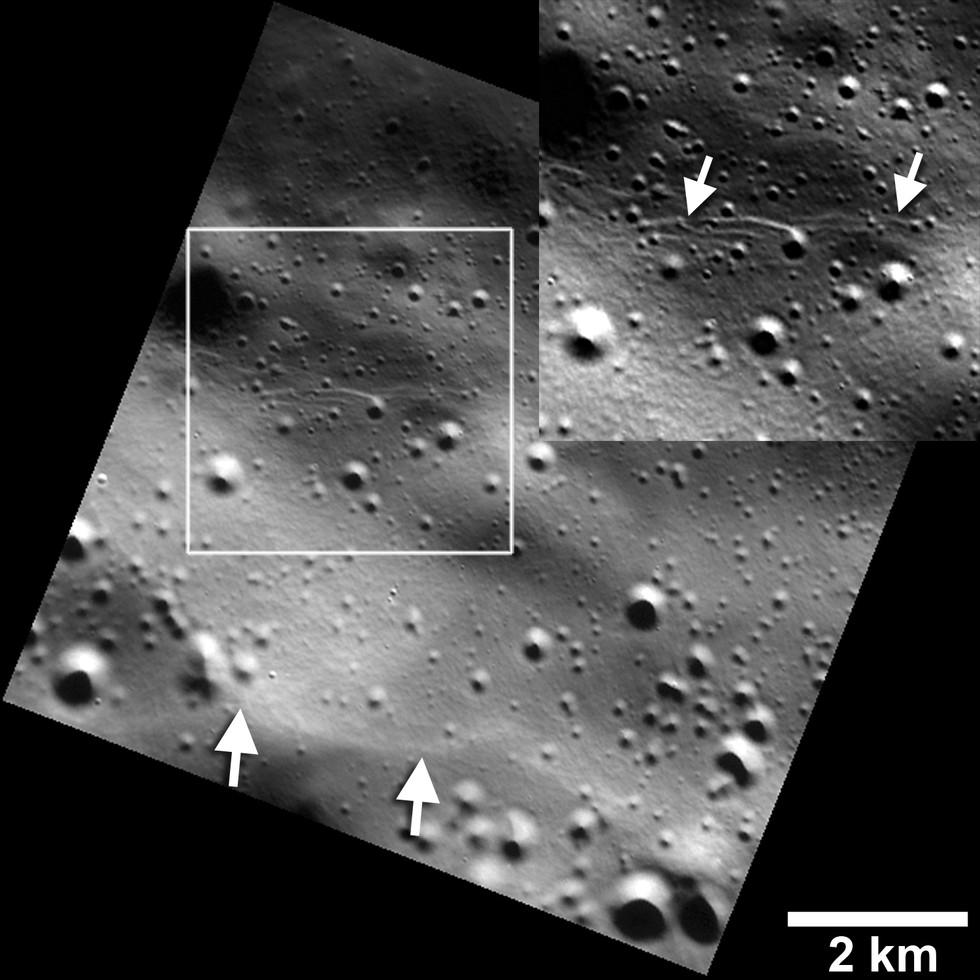
Now, planetary scientists have used observations from MESSENGER during its final months in a low-Mercury orbit to see small geological features called scarps that could have only been formed if Mercury's geology is currently active. In other words, Mercury continues to shrink today.

Small graben, or narrow linear troughs, have been found associated with small fault scarps (lower white arrows) on Mercury, and on Earth's moon.
"The young age of the small scarps means that Mercury joins Earth as a tectonically active planet, with new faults likely forming today as Mercury's interior continues to cool and the planet contracts," said senior scientist Tom Watters, of the Smithsonian National Air and Space Museum in Washington, D.C.

Scarps are a well known feature on Mercury's surface, some of which are known to create steep cliffs extending hundreds of miles long and, in some places, reach over a mile high. These geological features were first documented by the flybys of NASA's Mariner 10 spacecraft in the 1970's and later confirmed by MESSENGER. These observations helped planetary scientists reveal that, as the planet cooled over hundreds of millions of years, the entire mass contracted, creating these scarps as the surface buckled under the pressure.

But as MESSENGER made its final orbits around Mercury, it noticed far smaller scarp-like features. If these small scarps were ancient, they should have been eroded away long ago by the continuous erosion of meteoroids and comets, which led Watters and his team to realize these were young features. So, far from being a static world Mercury could be a hothouse of "Mercury-quakes" as the entire planet contracts, further crushing its crust today.

Read more at Discovery News

Restored: Alan Turing's 1951 Computerized Music

Alan Turing (right) at the console of the Mark II computer.
New Zealand researchers said Monday they have restored the first recording of computer-generated music, created in 1951 on a gigantic contraption built by British genius Alan Turing.

The aural artefact, which paved the way for everything from synthesizers to modern electronica, opens with a staunchly conservative tune -- the British national anthem "God Save the King."

Researchers at the University of Canterbury (UC) in Christchurch said it showed Turing -- best known as the father of computing who broke the WWII Enigma code -- was also a musical innovator.

"Alan Turing's pioneering work in the late 1940s on transforming the computer into a musical instrument has been largely overlooked," they said.

The recording was made 65 years ago by a BBC outside-broadcast unit at the Computing Machine Laboratory in Manchester, northern England.

The machine, which filled much of the lab's ground floor, was used to generate three melodies; "God Save the King," "Baa Baa Black Sheep" and Glenn Miller's swing classic "In the Mood."

But when UC professor Jack Copeland and composer Jason Long examined the 12-inch (30.5 centimeter) acetate disc containing the music, they found the audio was distorted.

"The frequencies in the recording were not accurate. The recording gave at best only a rough impression of how the computer sounded," they said.

They fixed it with electronic detective work, tweaking the speed of the audio, compensating for a "wobble" in the recording and filtering out extraneous noise.

"It was a beautiful moment when we first heard the true sound of Turing's computer," Copeland and Long said in a blog post on the British Library website.

The two-minute recording can be heard here.

Read more at Discovery News

Cats Traveled with Vikings and Farmers

The early origins of domesticated cats are shrouded in mystery, but a new genetic analysis suggests that felines traveled the world with farmers and Vikings.

The News section of Nature reports that the broadest genetic analysis to date of ancient cats reveals two waves of cat expansion. In the first wave, cats spread from the Middle East into the eastern Mediterranean, alongside human farmers. The second wave of expansion started in Egypt — where cats had religious significance and were often mummified — and spread by sea to Eurasia and Africa.

These discoveries come courtesy a study of the mitochondrial DNA of 209 ancient cats whose remains were preserved at archaeological sites. Mitochondrial DNA is passed down through the maternal line and is separate from the nuclear DNA that comes from both parents. The research was presented at the 7th International Symposium on Biomolecular Archaeology, which took place between Sept. 14 and Sept. 16 at the Oxford University Museum of Natural History.

A lack of funding has caused research on cat domestication to lag behind research on dog domestication, study researcher Eva-Maria Geigl, an evolutionary geneticist at the Institut Jacques Monod in France, told Nature. Archaeological evidence suggests that cats and humans started to interact around the dawn of agriculture. In 2004, researchers reported in the journal Science that they'd discovered a human and a cat buried together on the island of Cyprus. The burial dated back 9,500 years. Prior to that discovery, researchers had thought that cats had been domesticated in Egypt about 4,000 years ago — though the discovery of two cats and four kittens in an animal burial ground in the Upper Egypt city of Hierakonpolis in 2014 suggests the existence of some sort of cat husbandry in Egypt 2,000 years before that.

Villagers in China may have domesticated cats about 5,300 years ago, researchers reported in 2013 in the journal Proceedings of the National Academy of Sciences. Based on a few bones, the scientists found that the cats ate a diet that was heavy in millet — or, more likely, that they ate a diet heavy in rodents that ate a lot of millet. This dietary information meshes with the theory that cats were drawn to early agricultural settlements by a plethora of prey. Humans would have encouraged the feline infiltration because cats got rid of rodent pests.

Read more at Discovery News

Sep 25, 2016

ALMA Explores the Hubble Ultra Deep Field: Deepest ever millimeter observations of early Universe

A trove of galaxies, rich in carbon monoxide (indicating star-forming potential) were imaged by ALMA (orange) in the Hubble Ultra Deep Field. The blue features are galaxies imaged by Hubble. This image is based on the very deep ALMA survey by Manuel Aravena, Fabian Walter and colleagues, covering about one sixth of the full HUDF area.
International teams of astronomers have used the Atacama Large Millimeter/submillimeter Array (ALMA) to explore the distant corner of the Universe first revealed in the iconic images of the Hubble Ultra Deep Field (HUDF). These new ALMA observations are significantly deeper and sharper than previous surveys at millimetre wavelengths. They clearly show how the rate of star formation in young galaxies is closely related to their total mass in stars. They also trace the previously unknown abundance of star-forming gas at different points in time, providing new insights into the "Golden Age" of galaxy formation approximately 10 billion years ago.

The new ALMA results will be published in a series of papers appearing in the Astrophysical Journal and Monthly Notices of the Royal Astronomical Society. These results are also among those being presented this week at the Half a Decade of ALMA conference in Palm Springs, California, USA.

In 2004 the Hubble Ultra Deep Field images, pioneering deep-field observations with the NASA/ESA Hubble Space Telescope, were published. These spectacular pictures probed more deeply than ever before and revealed a menagerie of galaxies stretching back to less than a billion years after the Big Bang. The area was observed several times by Hubble and many other telescopes, resulting in the deepest view of the Universe to date.

Astronomers using ALMA have now surveyed this seemingly unremarkable, but heavily studied, window into the distant Universe for the first time both deeply and sharply in the millimetre range of wavelengths. This allows them to see the faint glow from gas clouds and also the emission from warm dust in galaxies in the early Universe.

ALMA has observed the HUDF for a total of around 50 hours up to now. This is the largest amount of ALMA observing time spent on one area of the sky so far.

One team led by Jim Dunlop (University of Edinburgh, United Kingdom) used ALMA to obtain the first deep, homogeneous ALMA image of a region as large as the HUDF. This data allowed them to clearly match up the galaxies that they detected with objects already seen with Hubble and other facilities.

This study showed clearly for the first time that the stellar mass of a galaxy is the best predictor of star formation rate in the high redshift Universe. They detected essentially all of the high-mass galaxies and virtually nothing else.

Jim Dunlop, lead author on the deep imaging paper sums up its importance: "This is a breakthrough result. For the first time we are properly connecting the visible and ultraviolet light view of the distant Universe from Hubble and far-infrared/millimetre views of the Universe from ALMA."

The second team, led by Manuel Aravena of the Núcleo de Astronomía, Universidad Diego Portales, Santiago, Chile, and Fabian Walter of the Max Planck Institute for Astronomy in Heidelberg, Germany, conducted a deeper search across about one sixth of the total HUDF.

"We conducted the first fully blind, three-dimensional search for cool gas in the early Universe," said Chris Carilli, an astronomer with the National Radio Astronomy Observatory (NRAO) in Socorro, New Mexico, USA and member of the research team. "Through this, we discovered a population of galaxies that is not clearly evident in any other deep surveys of the sky."

Some of the new ALMA observations were specifically tailored to detect galaxies that are rich in carbon monoxide, indicating regions primed for star formation. Even though these molecular gas reservoirs give rise to the star formation activity in galaxies, they are often very hard to see with Hubble. ALMA can therefore reveal the "missing half" of the galaxy formation and evolution process.

"The new ALMA results imply a rapidly rising gas content in galaxies as we look back further in time," adds lead author of two of the papers, Manuel Aravena (Núcleo de Astronomía, Universidad Diego Portales, Santiago, Chile). "This increasing gas content is likely the root cause for the remarkable increase in star formation rates during the peak epoch of galaxy formation, some 10 billion years ago."

The results presented today are just the start of a series of future observations to probe the distant Universe with ALMA. For example, a planned 150-hour observing campaign of the HUDF will further illuminate the star-forming potential history of the Universe.

"By supplementing our understanding of this missing star-forming material, the forthcoming ALMA Large Program will complete our view of the galaxies in the iconic Hubble Ultra Deep Field," concludes Fabian Walter.
Astronomers specifically selected the area of study in the HUDF, a region of space in the faint southern constellation of Fornax (The Furnace), so ground-based telescopes in the southern hemisphere, like ALMA, could probe the region, expanding our knowledge about the very distant Universe. Probing the deep, but optically invisible, Universe was one of the primary science goals for ALMA.

In this context "high mass" means galaxies with stellarmasses greater than 20 billion times that of the Sun ( 2 × 10^10 solar masses). For comparison, the Milky Way is a large galaxy and has a mass of around 100 billion solar masses.

This region of sky is about seven hundred times smaller than the area of the disc of the full Moon as seen from Earth. One of the most startling aspects of the HUDF was the vast number of galaxies found in such a tiny fraction of the sky.

Read more at Science Daily

Ice Man, Ötzi: A treacherous murder with links to Central Italy

Ötzi's axe.
The copper used to make Ötzi's axe blade did not come from the Alpine region as had previously been supposed, but from ore mined in southern Tuscany. Ötzi was probably not involved in working the metal himself, as the high levels of arsenic and copper found in his hair had, until now, led us to assume. His murder over 5,000 years ago seems to have been brought about due to a personal conflict a few days before his demise, and the man from the ice, despite his normal weight and active life-style, suffered from extensive vascular calcification. Scientists from all over the world presented these and other new insights, at the recent International Mummy Congress in Bozen-Bolzano. To celebrate the 25th anniversary of Ötzi's discovery, the three days of the Congress, from 19th to 21st September, are all dedicated to the man from the ice.

Since the man from the ice came on the scene on 19th September 1991, he has not ceased to fascinate scientists from all over the world. No corpse has been more thoroughly investigated. "In terms of his significance for science, Ötzi is not simply an isolated mummy discovery. He could be seen as a typical European from earlier times and is precious for this reason alone," explained the anthropologist Albert Zink from EURAC Research, the scientific leader of the congress. "Ötzi is so well preserved as a glacier mummy and through this alone, he serves us researchers as a model for developing scientific methods which can then be used on other mummies," said Zink. "What concerns us most these days is to know who the man from the ice was, what role he played in society and what happened to him in the last days of his life. Sophisticated procedures, now available to scientists, are continually supplying us with new evidence," said Angelika Fleckinger, Director of the South Tyrol Museum of Archaeology which helped to organise the Congress.

Links to Central Italy

One surprising new fact has been unearthed which concerns the most extraordinary item amongst Ötzi's equipment -- the valuable copper axe. In contrast to what had previously been presumed, the copper used in the blade does not derive from the Alpine region (researchers had suggested East or North Tyrol as the most likely provenance) but from Central Italy. Professor Gilberto Artioli's archaeometallurgy research group at the University of Padua has discovered that the metal had been obtained from ore mined in South Tuscany. In order to determine its origin, Italian scientists took a tiny sample from the blade and compared the proportion of lead isotope -- a kind of "finger print" of the ore deposits which remains unchanged in any objects subsequently made from the ore -- with the corresponding data from numerous mineral deposits in Europe and the entire Mediterranean region.

The result pointed unequivocally to South Tuscany. "No one was prepared for this finding. We will commission further analyses in order to double-check these first results" stressed Angelika Fleckinger. If the original results are confirmed, this new evidence will give researchers some interesting food for thought. Was Ötzi as a trader travelling possibly as far as the area around today's Florence? What was the nature of the trading and cultural links with the south in those days? Did the exchange of goods also involve movements of the population? That is to say, did people from the south venture into the Alpine region and vice versa? "This is a particularly exciting insight especially with respect to questions about population development," explained Albert Zink.

Was he or was he not involved in smelting copper?

Another question long debated amongst the scientific community, is whether Ötzi was perhaps involved himself in the process of copper smelting. Scientists have advocated this thesis because raised arsenic and copper levels have been measured in the mummy's hair, a fact which might possibly be explained, for example, by breathing in the smoke which is released when melting and pouring metal. Geochemist Wolfgang Müller of Royal Holloway, University of London, who had already used isotope analysis to establish Ötzi's South Tyrol origins, has now turned to this question once more.

Using highly developed methods of analysis such as laser mass spectrometry and speciation analysis, Müller's team examined not just hairs but also samples from Ötzi's nails, skin and organs for possible heavy metal contamination. His, so far still provisional, findings suggest that the hypothesis that Ötzi was involved in processing metal was premature. Müller did indeed find slightly raised arsenic values in the nail sample, but not in other tissue samples. Raised copper levels were only present at the extremities and this correlates with other change indicators, and thus it is doubtful if one can establish a heavy metal contamination for Ötzi's actual life time: raised values might also be due to environmental influences over the 5,000 years since his death.

Radiological investigations with the latest CT equipment

A new computer tomography (CT) scan of the man from the ice was undertaken by radiologists Paul Gostner and Patrizia Pernter in January 2013 in the Department of Radiology of Bozen-Bolzano Hospital. To do this they used a CT-scanner of the latest generation which, thanks to its large opening, allowed the doctors to run Ötzi rapidly through the machine from head to toe despite the way his arm is angled. In addition to the vascular calcification in the arteries of his stomach and legs which had already been known about, the superior image allowed doctors to spot three small areas of calcification near to the outflow tracts of the heart which had hitherto escaped their notice. This substantiates the earlier finding made by molecular biologists in EURAC that Ötzi had a strong genetic predisposition to cardiovascular diseases and that this was probably also the main reason for his general arteriosclerosis.

Read more at Science Daily