Five of the main Dead Sea scrolls, containing some of the oldest-known surviving biblical texts, were put online as part of a joint project between the Israel Museum and Google.
The project gives the public access to ultra high-resolution images of the ancient scrolls in a format which is easily searchable, with the magnified text revealing details previously invisible to the naked eye, a museum statement said.
So far, five of the scrolls have been digitised as part of the $3.5-million project which uses space-age technology to produce the clearest renderings yet of the ancient texts: the Great Isaiah scroll, the Community Rule scroll, the commentary on Habbakuk, the Temple scroll and the War scroll.
By visiting http://dss.collections.imj.org.il/ web users can view all of the text, as well as a translation tool and other background information on the documents, the museum said.
"We are privileged to house in the Israel Museum's Shrine of the Book the best preserved and most complete Dead Sea Scrolls ever discovered," Israel Museum director James Snyder said in a statement, describing them as of "paramount importance" for the world's monotheistic religions.
"Now, through our partnership with Google, we are able to bring these treasures to the broadest possible public."
The 900 biblical and other manuscripts, comprising some 30,000 fragments, were discovered between 1947 and 1956 in the Qumran caves above the Dead Sea and photographed in their entirety with infra-red technology in the 1950s.
The parchment and papyrus scrolls contain Hebrew, Greek and Aramaic writing, and include several of the earliest-known texts from the Bible, including the oldest surviving copy of the Ten Commandments.
Read more at Discovery News
Sep 28, 2011
Earth's Two Moons
Our Moon. It lights up our nights, governs our tides and has inspired millions -- perhaps billions -– of people throughout history to contemplate its nature, its influence on our lives (if any) and, of course, where it may have come from.
The currently accepted theory is that over four and a half billion years ago our newly-formed planet was impacted by a Mars-sized body, a catastrophic collision that flung molten bits of Earth's mantle into space and created a ring of debris.
This ring gradually coalesced into the moon, which cooled and moved further and further away from Earth into its current position. This theory is widely accepted, and research on the composition of lunar samples seems to coordinate with an Earthly origin of the moon. But one thing never quite lined up perfectly with the whole scenario: the moon's far side.
The lunar far side has a very different appearance from the face we see from Earth. It is much more heavily cratered, for one thing, in fact featuring one of the largest impact basins in our solar system. It lacks the mare features that create the "man-in-the-moon" patterns we are familiar with, and while the near side is relatively flat and consistent in elevation, the far side is much more mountainous and raised.
These "lunar highlands" have been an enigma to scientists since they were discovered at the beginning of the Space Age... and thanks to some recent computer models by researchers at UC Santa Cruz we may be a step closer to solving the mystery.
Earth may have once had two moons.
Erik Asphaug, professor of Earth an planetary sciences, along with postdoctoral researcher Martin Jutzi, have developed a model that fits in with the giant impact theory but also explains the disparity of the lunar far side.
In this model, the remnants of the collision coalesced into two moons, one larger than the other. These primordial moons settled into orbit around Earth within the Lagrange points -- that is, until the smaller one became dislodged and migrated toward its larger sibling, eventually colliding with it in a low-speed impact.
Read more at Discovery News
Sep 27, 2011
‘Earth-Shattering’ Science Is Relatively Rare
What began last week as whispered rumors posted on the physics blog Resonaances grew to a roar of articles around the world about an experiment that has seen neutrinos traveling faster than the speed of light.
The findings from the Oscillation Project with Emulsion-tRacking Apparatus (OPERA) collaboration at Gran Sasso National Laboratory in Italy show neutrinos arriving 60 nanoseconds sooner than expected, and have many eager sources suggesting the possibility of overturning Einstein’s well-known theory of relativity. While the prospect is exciting, can just one result really upend a century of physics?
“It really depends on what happens next,” said Mordecai-Mark Mac Low, curator of the Division of Physical Sciences at the American Museum of Natural History in New York.
Taking the historical view, Mac Low compares the result to other earth-shattering experiments from recent decades. In 1986, physicists announced the miraculous discovery of a superconducting material that worked at temperatures higher than were thought possible. But it wasn’t until many other experiments confirmed the finding that the original work could be seen as credible.
On the other hand, when an experiment in 1989 seemed to have created the astonishing feat of cold fusion, the findings were ultimately dismissed because no other team could corroborate the results.
“In general, things aren’t turned over by one experiment,” said Rob Plunkett, a physicist at Fermilab National Laboratory in Batavia, Illinois. “The whole process of science is by its nature self checking; one experiment always has to be checked with another.”
Plunkett is in a good position to speak on this, as he is co-spokesperson for the Main Injector Neutrino Oscillation Search (MINOS) experiment, which is one of only a few that can independently verify the original OPERA results. MINOS did in fact see several neutrinos back in 2007 that seemed to be moving faster than light, but dismissed the findings because the margin of error was too high. Still, Plunkett remains skeptical of the OPERA claims and said it would take six to nine months before his collaboration will be able to verify or contradict the findings.
But even if the faster-than-light neutrinos are found to be valid, that doesn’t mean scientists have to toss out their old theories. “Relativity and quantum mechanics didn’t throw away Newton and Maxwell,” said Lawrence Krauss, a physicist at Arizona State University in Tempe, Arizona.
New data can expand our view of the universe, Krauss explained, but it doesn’t automatically invalidate well-tested theories from the past. For instance, when data in 1998 revealed the existence of dark energy and showed that the expansion of the universe was accelerating — a very unexpected result — it merely modified, not destroyed, the theories that came before.
Read more at Wired
The findings from the Oscillation Project with Emulsion-tRacking Apparatus (OPERA) collaboration at Gran Sasso National Laboratory in Italy show neutrinos arriving 60 nanoseconds sooner than expected, and have many eager sources suggesting the possibility of overturning Einstein’s well-known theory of relativity. While the prospect is exciting, can just one result really upend a century of physics?
“It really depends on what happens next,” said Mordecai-Mark Mac Low, curator of the Division of Physical Sciences at the American Museum of Natural History in New York.
Taking the historical view, Mac Low compares the result to other earth-shattering experiments from recent decades. In 1986, physicists announced the miraculous discovery of a superconducting material that worked at temperatures higher than were thought possible. But it wasn’t until many other experiments confirmed the finding that the original work could be seen as credible.
On the other hand, when an experiment in 1989 seemed to have created the astonishing feat of cold fusion, the findings were ultimately dismissed because no other team could corroborate the results.
“In general, things aren’t turned over by one experiment,” said Rob Plunkett, a physicist at Fermilab National Laboratory in Batavia, Illinois. “The whole process of science is by its nature self checking; one experiment always has to be checked with another.”
Plunkett is in a good position to speak on this, as he is co-spokesperson for the Main Injector Neutrino Oscillation Search (MINOS) experiment, which is one of only a few that can independently verify the original OPERA results. MINOS did in fact see several neutrinos back in 2007 that seemed to be moving faster than light, but dismissed the findings because the margin of error was too high. Still, Plunkett remains skeptical of the OPERA claims and said it would take six to nine months before his collaboration will be able to verify or contradict the findings.
But even if the faster-than-light neutrinos are found to be valid, that doesn’t mean scientists have to toss out their old theories. “Relativity and quantum mechanics didn’t throw away Newton and Maxwell,” said Lawrence Krauss, a physicist at Arizona State University in Tempe, Arizona.
New data can expand our view of the universe, Krauss explained, but it doesn’t automatically invalidate well-tested theories from the past. For instance, when data in 1998 revealed the existence of dark energy and showed that the expansion of the universe was accelerating — a very unexpected result — it merely modified, not destroyed, the theories that came before.
Read more at Wired
Miracle Fruit's Trippy Effects Explained
Pop the red, cranberry-sized miracle fruit in your mouth and chew it for a while, allowing its juices to coat your mouth. It doesn't taste like much.
But what follows "is just a miracle or a kind of magic" according to Keiko Abe, of the University of Tokyo, as you sample other foods. "Beer tastes like sweet juice. Lemon tastes like sweet orange."
Sour foods are perceived as trippily sweet when tasted for up to an hour after consuming the berry. This effect has led curious folks in the U.S. and elsewhere to seek the miracle fruit for "flavor-tripping" parties: pop the fruit with friends, then sample a smorgasbord of sour-leaning snacks: limes, goat cheese, beer, grapefruit, vinegar, pickles and more.
"To me it was very exhilarating. It really is a very joyous experience," said writer Adam Gollner of trying the fruit. Gollner is author of The Fruit Hunters, which includes a chapter on the miracle fruit. "It's almost like this thing that you can't understand that is happening to you. That sense of incomprehensibility is a great feeling."
Abe and his colleagues report this week exactly how the wacky effect of the miracle fruit works. The team used a novel system of cultured cells that allowed them to test human taste receptors at various pHs to uncover the mechanism.
The key ingredient in the fruit, a protein known as miraculin, binds strongly to the sweet taste receptors on our tongues, Abe reported, but it does not activate the receptors at neutral pH.
When acid is introduced, the miraculin protein changes shape in such a way that it turns on the sweet receptors it is bound to, creating a sensation of ultra-sweet without affecting the other flavors in the food.
After the acidic food is swallowed, miraculin returns to the inactive shape, but it remains bound to the sweet receptor for up to an hour, ready to receive a new acid trigger. The strong binding explains the molecule's lasting effect.
While flavor-tripping has driven demand for the miracle fruit, which grows natively in West Africa, its ability to make things taste sweet without the calories that accompany sugar, makes it an intriguing candidate for a non-calorie sweetener.
The new findings show "the sweetness of miraculin at acidic pH in the mouth is the strongest of almost all the known sweeteners," Abe noted. "This will lead to industrial use of this non-calorie sweetener."
Miracle fruit is bred for sale in Japan, where it is served in some restaurants, and production of the purified miraculin protein is being pursued, Abe said.
Meanwhile, its status in the U.S. is murky. Sale of purified miraculin was disallowed in 1974 by a Food and Drug Administration ruling. But Gollner's numerous efforts to clarify the legal status of the whole fruit ended in frustration.
Read more at Discovery News
But what follows "is just a miracle or a kind of magic" according to Keiko Abe, of the University of Tokyo, as you sample other foods. "Beer tastes like sweet juice. Lemon tastes like sweet orange."
Sour foods are perceived as trippily sweet when tasted for up to an hour after consuming the berry. This effect has led curious folks in the U.S. and elsewhere to seek the miracle fruit for "flavor-tripping" parties: pop the fruit with friends, then sample a smorgasbord of sour-leaning snacks: limes, goat cheese, beer, grapefruit, vinegar, pickles and more.
"To me it was very exhilarating. It really is a very joyous experience," said writer Adam Gollner of trying the fruit. Gollner is author of The Fruit Hunters, which includes a chapter on the miracle fruit. "It's almost like this thing that you can't understand that is happening to you. That sense of incomprehensibility is a great feeling."
Abe and his colleagues report this week exactly how the wacky effect of the miracle fruit works. The team used a novel system of cultured cells that allowed them to test human taste receptors at various pHs to uncover the mechanism.
The key ingredient in the fruit, a protein known as miraculin, binds strongly to the sweet taste receptors on our tongues, Abe reported, but it does not activate the receptors at neutral pH.
When acid is introduced, the miraculin protein changes shape in such a way that it turns on the sweet receptors it is bound to, creating a sensation of ultra-sweet without affecting the other flavors in the food.
After the acidic food is swallowed, miraculin returns to the inactive shape, but it remains bound to the sweet receptor for up to an hour, ready to receive a new acid trigger. The strong binding explains the molecule's lasting effect.
While flavor-tripping has driven demand for the miracle fruit, which grows natively in West Africa, its ability to make things taste sweet without the calories that accompany sugar, makes it an intriguing candidate for a non-calorie sweetener.
The new findings show "the sweetness of miraculin at acidic pH in the mouth is the strongest of almost all the known sweeteners," Abe noted. "This will lead to industrial use of this non-calorie sweetener."
Miracle fruit is bred for sale in Japan, where it is served in some restaurants, and production of the purified miraculin protein is being pursued, Abe said.
Meanwhile, its status in the U.S. is murky. Sale of purified miraculin was disallowed in 1974 by a Food and Drug Administration ruling. But Gollner's numerous efforts to clarify the legal status of the whole fruit ended in frustration.
Read more at Discovery News
Monkeys at typewriters 'close to reproducing Shakespeare'
The virtual monkeys, created by an American programmer, have already typed up the whole of the poem A Lover's Complaint and are 99.99 per cent of the way through the Bard's complete works.
The experiment attempts to prove the theory that an infinite number of monkeys sitting at an infinite number of typewriters would eventually reproduce the works of Shakespeare by chance.
Jesse Anderson, the programmer behind the project, said he was inspired by an episode of The Simpsons which spoofs the famous problem.
Mr Anderson set up millions of small computer programmes, or virtual monkeys, using Amazon's SC2 cloud computing system, and programmed them to churn out random sequences of nine characters.
If the nine-letter sequence appears anywhere in one of Shakespeare's writings, it is matched against the relevant passage in a copy of the Bard's complete works, and is checked off the list.
The monkeys, which started typing on August 21, have already completed more than five trillion of the 5.5 trillion possible nine-letter combinations, but have so far only finished one whole work.
But the experiment is an imperfect reproduction of the infinite monkey theorem because it saves correct sections of text while discarding future wrong guesses, experts said.
Dr Ian Steward, emeritus professor of mathematics at Warwick University, said that for the monkeys to type up the complete works in the correct order without mistakes would take much longer than the age of the universe.
He told the BBC: "Along the way there would be untold numbers of attempts with one character wrong; even more with two wrong, and so on.
"Almost all other books, being shorter, would appear (countless times) before Shakespeare did."
Writing on his blog, Mr Anderson said: "This is the largest work ever randomly reproduced. It is one small step for a monkey, one giant leap for virtual primates everywhere.
"I understand the definition of infinite and infinite monkey theorem and I realise that this project does not have infinite resources.
"No monkeys were harmed during the making of this code. This project is my attempt to find a creative way to attain an answer without infinite resources."
In 2003 the Arts Council for England paid £2,000 for a real-life test of the theorem involving six Sulawesi crested macaques, but the trial was abandoned after a month.
Read more at The Telegraph
The experiment attempts to prove the theory that an infinite number of monkeys sitting at an infinite number of typewriters would eventually reproduce the works of Shakespeare by chance.
Jesse Anderson, the programmer behind the project, said he was inspired by an episode of The Simpsons which spoofs the famous problem.
Mr Anderson set up millions of small computer programmes, or virtual monkeys, using Amazon's SC2 cloud computing system, and programmed them to churn out random sequences of nine characters.
If the nine-letter sequence appears anywhere in one of Shakespeare's writings, it is matched against the relevant passage in a copy of the Bard's complete works, and is checked off the list.
The monkeys, which started typing on August 21, have already completed more than five trillion of the 5.5 trillion possible nine-letter combinations, but have so far only finished one whole work.
But the experiment is an imperfect reproduction of the infinite monkey theorem because it saves correct sections of text while discarding future wrong guesses, experts said.
Dr Ian Steward, emeritus professor of mathematics at Warwick University, said that for the monkeys to type up the complete works in the correct order without mistakes would take much longer than the age of the universe.
He told the BBC: "Along the way there would be untold numbers of attempts with one character wrong; even more with two wrong, and so on.
"Almost all other books, being shorter, would appear (countless times) before Shakespeare did."
Writing on his blog, Mr Anderson said: "This is the largest work ever randomly reproduced. It is one small step for a monkey, one giant leap for virtual primates everywhere.
"I understand the definition of infinite and infinite monkey theorem and I realise that this project does not have infinite resources.
"No monkeys were harmed during the making of this code. This project is my attempt to find a creative way to attain an answer without infinite resources."
In 2003 the Arts Council for England paid £2,000 for a real-life test of the theorem involving six Sulawesi crested macaques, but the trial was abandoned after a month.
Read more at The Telegraph
Sep 26, 2011
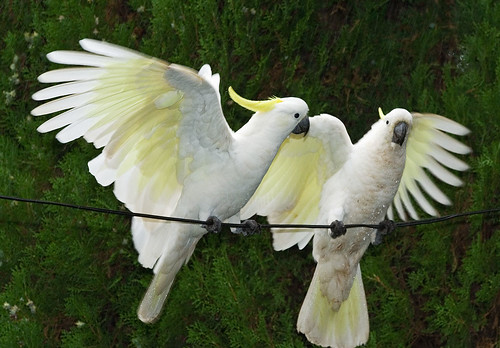
Escaped Pet Birds Are Teaching Wild Birds to Speak English
“Across parts of Australia, reports have been pouring in of strange
voices chattering high in the treetops — mysterious, non-sensical
conversations in English. But while this phenomenon is certainly quite
odd, its explanation isn’t paranormal. It turns out that escaped pet
birds, namely parrots and cockatoos, have begun teaching their wild bird
counterparts a bit of the language they picked up from their time in
captivity — and, according to witnesses, that includes more than a few
expletives.
Jaynia Sladek, an ornithologist from the Australian Museum, says that some birds are just natural mimickers, able to acquire new sounds based on things they hear around them. For birds kept as pets, these sounds tend to mirror human language — but that influence doesn’t cease even after said birds escape or are released back into the wild.
Once back in their natural environments, these chatty ex-pets eventually join with wild birds who, in turn, start picking up the new words and sounds. The remnants of that language also eventually gets passed along to the escaped birds’ offspring, much like it does for humans.
“There’s no reason why, if one comes into the flock with words, [then] another member of the flock wouldn’t pick it up as well,” Sladek said in an interview with Australian Geographic.
According to the report, ‘Hello cockie’ is one of the most commonly heard phrases feral birds are teaching in the wild, along with a host of expletives — perhaps the last words those escapees heard after their frantic owners realized they were making a break for freedom.”
Via Treehugger.com
Jaynia Sladek, an ornithologist from the Australian Museum, says that some birds are just natural mimickers, able to acquire new sounds based on things they hear around them. For birds kept as pets, these sounds tend to mirror human language — but that influence doesn’t cease even after said birds escape or are released back into the wild.
Once back in their natural environments, these chatty ex-pets eventually join with wild birds who, in turn, start picking up the new words and sounds. The remnants of that language also eventually gets passed along to the escaped birds’ offspring, much like it does for humans.
“There’s no reason why, if one comes into the flock with words, [then] another member of the flock wouldn’t pick it up as well,” Sladek said in an interview with Australian Geographic.
According to the report, ‘Hello cockie’ is one of the most commonly heard phrases feral birds are teaching in the wild, along with a host of expletives — perhaps the last words those escapees heard after their frantic owners realized they were making a break for freedom.”
Via Treehugger.com
Five easy mutations to make bird flu a lethal pandemic
H5N1 bird flu can kill humans, but has not gone pandemic because it cannot spread easily among us. That might change: five mutations in just two genes have allowed the virus to spread between mammals in the lab. What's more, the virus is just as lethal despite the mutations.
"The virus is transmitted as efficiently as seasonal flu," says Ron Fouchier of the Erasmus Medical Centre in Rotterdam, the Netherlands, who reported the work at a scientific meeting on flu last week in Malta.
"This shows clearly that H5 can change in a way that allows transmission and still cause severe disease in humans. It's scary," says Peter Doherty, a 1996 Nobel prizewinner for work in viral immunology.
H5N1 evolved in poultry in east Asia and has spread across Eurasia since 2004. In that time 565 people are known to have caught it; 331 died. No strain that spreads readily among mammals has emerged in that time, despite millions of infected birds, and infections in people, cats and pigs. Efforts to create such a virus in the lab have failed, and some virologists think H5N1 simply cannot do it.
The work by Fouchier's team suggests otherwise. They first gave H5N1 three mutations known to adapt bird flu to mammals. This version of the virus killed ferrets, which react to flu viruses in a similar way to humans. The virus did not transmit between them, though.
Then the researchers gave the virus from the sick ferrets to more ferrets - a standard technique for making pathogens adapt to an animal. They repeated this 10 times, using stringent containment. The tenth round of ferrets shed an H5N1 strain that spread to ferrets in separate cages - and killed them.
The process yielded viruses with many new mutations, but two were in all of them. Those plus the three added deliberately "suggest that as few as five are required to make the virus airborne", says Fouchier. He will now test H5N1 made with only those five.
All the mutations have been seen separately in H5N1 from birds. "If they occur separately, they can occur together," says Fouchier. Malik Peiris of the University of Hong Kong, a flu virologist, says this means H5N1 transmissible between humans can evolve in birds, where it is circulating already, without needing to spend time in mammals such as pigs.
Read more at New Scientist
"The virus is transmitted as efficiently as seasonal flu," says Ron Fouchier of the Erasmus Medical Centre in Rotterdam, the Netherlands, who reported the work at a scientific meeting on flu last week in Malta.
"This shows clearly that H5 can change in a way that allows transmission and still cause severe disease in humans. It's scary," says Peter Doherty, a 1996 Nobel prizewinner for work in viral immunology.
H5N1 evolved in poultry in east Asia and has spread across Eurasia since 2004. In that time 565 people are known to have caught it; 331 died. No strain that spreads readily among mammals has emerged in that time, despite millions of infected birds, and infections in people, cats and pigs. Efforts to create such a virus in the lab have failed, and some virologists think H5N1 simply cannot do it.
The work by Fouchier's team suggests otherwise. They first gave H5N1 three mutations known to adapt bird flu to mammals. This version of the virus killed ferrets, which react to flu viruses in a similar way to humans. The virus did not transmit between them, though.
Then the researchers gave the virus from the sick ferrets to more ferrets - a standard technique for making pathogens adapt to an animal. They repeated this 10 times, using stringent containment. The tenth round of ferrets shed an H5N1 strain that spread to ferrets in separate cages - and killed them.
The process yielded viruses with many new mutations, but two were in all of them. Those plus the three added deliberately "suggest that as few as five are required to make the virus airborne", says Fouchier. He will now test H5N1 made with only those five.
All the mutations have been seen separately in H5N1 from birds. "If they occur separately, they can occur together," says Fouchier. Malik Peiris of the University of Hong Kong, a flu virologist, says this means H5N1 transmissible between humans can evolve in birds, where it is circulating already, without needing to spend time in mammals such as pigs.
Read more at New Scientist
Coming Soon: Live 3D TV Without the Glasses
For the relatively few 3D TV owners out there, content is limited. In Europe, 3D TV is catching on but because of the post-production work needed, live 3D broadcasts are extremely rare and viewers still need to don goofy glasses for it. But that may soon change
German researchers have found a way to make glasses-free live 3D TV production not only possible but affordable.
The technology for glasses-free 3D television, known as autostereoscopy already exists, although it's still developing. The display works by using special optical foil which show different images to each eye, tricking viewers' brains into seeing pop-out images. To generate a high-quality effect, numerous camera angles of each shot are needed, making the production process extremely daunting. The higher the number of grayscale images, the better the 3D quality.
"It's not very practical to put eight or nine or 20 cameras on the set," said Frederik Zilly, manager for the Fraunhofer Heinrich Hertz Institute’s 3D analyzer project in Berlin. The cost, weight, power consumption, and bandwidth requirements for autostereoscopic videos are incredible, he added. "That's where we thought, OK, we need to create something."
Zilly's team already developed a stereoscopic analyzer dubbed STAN that corrects standard 3D images in real-time to make live broadcasts possible. Their new system is an extension of STAN that can generate up to 25 views of the same scene from slightly different viewpoints, which is needed for effective glasses-free 3D. This virtual view rendering is fairly fast in the lab but not quite at the speed needed for transmitting in real-time for live broadcasting, Zilly said.
The Fraunhofer project team recently presented its autostereoscopic technology at the International Broadcasting Convention in Amsterdam. Their current version works offline, but Zilly hopes to present a real-time version of the broadcast technology at next year's convention.
The researchers are working with a European consortium called MUSCADE, which loosely stands for "multimedia scalable 3D for Europe." The consortium, funded by the European Commission, aims to create a standard, scalable format and advance 3D technology in general. The project includes several satellite providers that Zilly says could broadcast live autostereoscopic TV shows if the Fraunhofer system is successful.
"It's more of a test case or a proof-of-concept to demonstrate that it works," Zilly said of the system. "Once the production tools become mass-market products, then it will be affordable for all kinds of production."
Markus Aha is a 3D TV producer as well as the founder and CEO of Aha International Media in Berlin. He knows Zilly and the Fraunhofer work well, in part because they are both part of a group that is collaborating on a new 3D innovation center in Berlin.
"The sooner the productions are glasses-free, the sooner the market will open up for 3D content," he said. At the moment, however, consumer electronics companies are still developing autostereoscopic displays. Aha points out that Toshiba presented a high-definition LCD prototype earlier this year, but that’s not on the market yet.
Read more at Discovery News
German researchers have found a way to make glasses-free live 3D TV production not only possible but affordable.
The technology for glasses-free 3D television, known as autostereoscopy already exists, although it's still developing. The display works by using special optical foil which show different images to each eye, tricking viewers' brains into seeing pop-out images. To generate a high-quality effect, numerous camera angles of each shot are needed, making the production process extremely daunting. The higher the number of grayscale images, the better the 3D quality.
"It's not very practical to put eight or nine or 20 cameras on the set," said Frederik Zilly, manager for the Fraunhofer Heinrich Hertz Institute’s 3D analyzer project in Berlin. The cost, weight, power consumption, and bandwidth requirements for autostereoscopic videos are incredible, he added. "That's where we thought, OK, we need to create something."
Zilly's team already developed a stereoscopic analyzer dubbed STAN that corrects standard 3D images in real-time to make live broadcasts possible. Their new system is an extension of STAN that can generate up to 25 views of the same scene from slightly different viewpoints, which is needed for effective glasses-free 3D. This virtual view rendering is fairly fast in the lab but not quite at the speed needed for transmitting in real-time for live broadcasting, Zilly said.
The Fraunhofer project team recently presented its autostereoscopic technology at the International Broadcasting Convention in Amsterdam. Their current version works offline, but Zilly hopes to present a real-time version of the broadcast technology at next year's convention.
The researchers are working with a European consortium called MUSCADE, which loosely stands for "multimedia scalable 3D for Europe." The consortium, funded by the European Commission, aims to create a standard, scalable format and advance 3D technology in general. The project includes several satellite providers that Zilly says could broadcast live autostereoscopic TV shows if the Fraunhofer system is successful.
"It's more of a test case or a proof-of-concept to demonstrate that it works," Zilly said of the system. "Once the production tools become mass-market products, then it will be affordable for all kinds of production."
Markus Aha is a 3D TV producer as well as the founder and CEO of Aha International Media in Berlin. He knows Zilly and the Fraunhofer work well, in part because they are both part of a group that is collaborating on a new 3D innovation center in Berlin.
"The sooner the productions are glasses-free, the sooner the market will open up for 3D content," he said. At the moment, however, consumer electronics companies are still developing autostereoscopic displays. Aha points out that Toshiba presented a high-definition LCD prototype earlier this year, but that’s not on the market yet.
Read more at Discovery News
Sep 25, 2011
From the Comfort of Home, Web Users May Have Found New Planets
Since the online citizen science project Planet Hunters launched last December, 40,000 web users from around the world have been helping professional astronomers analyze the light from 150,000 stars in the hopes of discovering Earth-like planets orbiting around them.
Users analyze real scientific data collected by NASA's Kepler mission, which has been searching for planets beyond our own solar system -- called exoplanets -- since its launch in March 2009.
Now astronomers at Yale University have announced the discovery of the first two potential exoplanets discovered by Planet Hunters users in a new study to be published in the Monthly Notices of the Royal Astronomical Society.
"This is the first time that the public has used data from a NASA space mission to detect possible planets orbiting other stars," said Yale astronomer and exoplanet expert Debra Fischer, who helped launch the Planet Hunters project.
The candidate planets orbit their host stars with periods ranging from 10 to 50 days -- much shorter than the 365 days it takes Earth to orbit the Sun -- and have radii that range in size from two-and-a-half to eight times Earth's radius. Despite those differences, one of the two candidates could be a rocky planet similar to the size of Earth (as opposed to a giant gas planet like Jupiter), although they aren't in the so-called "habitable zone" where liquid water, and therefore life as we know it, could exist.
Next, the Planet Hunters team -- a collaboration between astronomers at Yale, the University of Oxford and the Adler Planetarium in Chicago -- used the Keck Observatory in Hawaii to analyze the host stars. "I think there's a 95 percent chance or greater that these are bona fide planets," Fischer said.
The Kepler team has already announced the discovery of 1200 exoplanet candidates and will follow up on the highest potential ones with further analysis, but they had discarded the two found by Planet Hunters users for various technical reasons that led them to believe they weren't promising candidates.
"These three candidates might have gone undetected without Planet Hunters and its citizen scientists," said Meg Schwamb, a Yale researcher and Planet Hunters co-founder. "Obviously Planet Hunters doesn't replace the analysis being done by the Kepler team. But it has proven itself to be a valuable tool in the search for other worlds."
Users found the two candidates in the first month of Planet Hunters operations using data the Kepler mission made publicly available. The Planet Hunters team sent the top 10 candidates found by the citizen scientists to the Kepler team, who analyzed the data and determined that two of the 10 met their criteria for being classified as planet candidates. The two candidates were flagged as potential planets by several dozen different Planet Hunters users, as the same data are analyzed by more than one user.
"Scientists on the Kepler team obtained the data, but the public helped finance the project with their tax dollars," Fischer said. "It's only right that this data has been pushed back into the public domain, not just as scientifically digested results but in a form where the public can actively participate in the hunt. The space program is a national treasure -- a monument to America's curiosity about the Universe. It is such an exciting time to be alive and to see these incredible discoveries being made."
Read more at Science Daily
Users analyze real scientific data collected by NASA's Kepler mission, which has been searching for planets beyond our own solar system -- called exoplanets -- since its launch in March 2009.
Now astronomers at Yale University have announced the discovery of the first two potential exoplanets discovered by Planet Hunters users in a new study to be published in the Monthly Notices of the Royal Astronomical Society.
"This is the first time that the public has used data from a NASA space mission to detect possible planets orbiting other stars," said Yale astronomer and exoplanet expert Debra Fischer, who helped launch the Planet Hunters project.
The candidate planets orbit their host stars with periods ranging from 10 to 50 days -- much shorter than the 365 days it takes Earth to orbit the Sun -- and have radii that range in size from two-and-a-half to eight times Earth's radius. Despite those differences, one of the two candidates could be a rocky planet similar to the size of Earth (as opposed to a giant gas planet like Jupiter), although they aren't in the so-called "habitable zone" where liquid water, and therefore life as we know it, could exist.
Next, the Planet Hunters team -- a collaboration between astronomers at Yale, the University of Oxford and the Adler Planetarium in Chicago -- used the Keck Observatory in Hawaii to analyze the host stars. "I think there's a 95 percent chance or greater that these are bona fide planets," Fischer said.
The Kepler team has already announced the discovery of 1200 exoplanet candidates and will follow up on the highest potential ones with further analysis, but they had discarded the two found by Planet Hunters users for various technical reasons that led them to believe they weren't promising candidates.
"These three candidates might have gone undetected without Planet Hunters and its citizen scientists," said Meg Schwamb, a Yale researcher and Planet Hunters co-founder. "Obviously Planet Hunters doesn't replace the analysis being done by the Kepler team. But it has proven itself to be a valuable tool in the search for other worlds."
Users found the two candidates in the first month of Planet Hunters operations using data the Kepler mission made publicly available. The Planet Hunters team sent the top 10 candidates found by the citizen scientists to the Kepler team, who analyzed the data and determined that two of the 10 met their criteria for being classified as planet candidates. The two candidates were flagged as potential planets by several dozen different Planet Hunters users, as the same data are analyzed by more than one user.
"Scientists on the Kepler team obtained the data, but the public helped finance the project with their tax dollars," Fischer said. "It's only right that this data has been pushed back into the public domain, not just as scientifically digested results but in a form where the public can actively participate in the hunt. The space program is a national treasure -- a monument to America's curiosity about the Universe. It is such an exciting time to be alive and to see these incredible discoveries being made."
Read more at Science Daily
Archaeologists Uncover Evidence of Large Ancient Shipyard Near Rome
University of Southampton and British School at Rome (BSR) archaeologists, leading an international excavation of Portus -- the ancient port of Rome, believe they have discovered a large Roman shipyard.
The team, working with the Italian Archaeological Superintendancy of Rome, has uncovered the remains of a massive building close to the distinctive hexagonal basin or 'harbour', at the centre of the port complex.
University of Southampton Professor and Portus Project Director, Simon Keay comments, "At first we thought this large rectangular building was used as a warehouse, but our latest excavation has uncovered evidence that there may have been another, earlier use, connected to the building and maintenance of ships.
"Few Roman Imperial shipyards have been discovered and, if our identification is correct, this would be the largest of its kind in Italy or the Mediterranean."
It has long been known that Portus was a crucial trade gateway linking Rome to the Mediterranean throughout the Imperial period and the Portus Project1 team has been investigating the port's significance over a number of years. Until now, no major shipyard building for Rome has been identified, apart from the possibility of one on the Tiber near Monte Testaccio, and a smaller one recently claimed for the neighbouring river port at Ostia.
A recent new grant of £640,000 from the Arts and Humanities Research Council (AHRC) has made this latest phase of excavation possible. These AHRC funds, together with financial support from the Archaeological Superintendancy of Rome, the University of Southampton and the British School at Rome have allowed extensive excavation to be undertaken at the site this year.
The huge building the team has discovered dates from the 2nd century AD and would have stood c. 145 metres long and 60 metres wide -- an area larger than a football pitch. In places, its roof was up to 15 metres high, or more than three times the height of a double-decker bus. Large brick-faced concrete piers or pillars, some three metres wide and still visible in part, supported at least eight parallel bays with wooden roofs.
"This was a vast structure which could easily have housed wood, canvas and other supplies and certainly would have been large enough to build or shelter ships in. The scale, position and unique nature of the building lead us to believe it played a key role in shipbuilding activities," comments Southampton's Professor Keay, who also leads the archaeological activity of the BSR.
Investigations by his team in 2009 concentrated on the remains of an 'Imperial palace' and amphitheatre-shaped building, which lie adjacent to this building. He argues that together these formed a key complex where an imperial official was charged with coordinating the movement of ships and cargoes within the port. Furthermore he believes that the shipyard was an integral part of this.
Additional supporting evidence comes in the form of inscriptions discovered at Portus referring to the existence of a guild of shipbuilders or corpus fabrum navalium portensium in the port. Also, a mosaic, which is now in the Vatican Museum, but once adorned the floor of a villa on the ancient Via Labicana (a road leading south east of Rome), depicts the façade of a building similar to the one at Portus, clearly showing a ship in each bay.
"The discovery of this building has major implications for our understanding of the significance of the hexagonal basin or harbour at Portus and its role within the overall scheme of the port complex," says Professor Keay.
He continues, "We need to stress there is no evidence yet of ramps which may have been needed to launch newly constructed ships into the waters of the hexagonal basin. These may lie beneath the early 20th century embankment, which now forms this side of the basin. Discovering these would prove our hypothesis beyond reasonable doubt, although they may no longer exist," says Professor Keay.
Geophysicists from the Archaeological Prospection Services of Southampton and from the British School at Rome have been making geophysical surveys of the area around the building to gain additional information about its still partially buried structure. Members of Southampton's Archaeological Computing Research Group, led by Dr Graeme Earl, have also created a computer graphic simulation, to provide both valuable visual data on its layout and construction and an impression of how it appeared and may have been used.
Professor Keay's team is also working with Angelo Pellegrino from the Archaeological Superintendency of Rome to extend earlier excavations by the Portus Project, and the restoration of standing structures, relating to 'the Imperial palace', to better understand key issues about its layout and development.
The international team is planning further investigations at Portus to find out more about this fascinating, significant site, which holds an enormous amount of information about the activities and trade of Rome.
Read more at Science Daily
The team, working with the Italian Archaeological Superintendancy of Rome, has uncovered the remains of a massive building close to the distinctive hexagonal basin or 'harbour', at the centre of the port complex.
University of Southampton Professor and Portus Project Director, Simon Keay comments, "At first we thought this large rectangular building was used as a warehouse, but our latest excavation has uncovered evidence that there may have been another, earlier use, connected to the building and maintenance of ships.
"Few Roman Imperial shipyards have been discovered and, if our identification is correct, this would be the largest of its kind in Italy or the Mediterranean."
It has long been known that Portus was a crucial trade gateway linking Rome to the Mediterranean throughout the Imperial period and the Portus Project1 team has been investigating the port's significance over a number of years. Until now, no major shipyard building for Rome has been identified, apart from the possibility of one on the Tiber near Monte Testaccio, and a smaller one recently claimed for the neighbouring river port at Ostia.
A recent new grant of £640,000 from the Arts and Humanities Research Council (AHRC) has made this latest phase of excavation possible. These AHRC funds, together with financial support from the Archaeological Superintendancy of Rome, the University of Southampton and the British School at Rome have allowed extensive excavation to be undertaken at the site this year.
The huge building the team has discovered dates from the 2nd century AD and would have stood c. 145 metres long and 60 metres wide -- an area larger than a football pitch. In places, its roof was up to 15 metres high, or more than three times the height of a double-decker bus. Large brick-faced concrete piers or pillars, some three metres wide and still visible in part, supported at least eight parallel bays with wooden roofs.
"This was a vast structure which could easily have housed wood, canvas and other supplies and certainly would have been large enough to build or shelter ships in. The scale, position and unique nature of the building lead us to believe it played a key role in shipbuilding activities," comments Southampton's Professor Keay, who also leads the archaeological activity of the BSR.
Investigations by his team in 2009 concentrated on the remains of an 'Imperial palace' and amphitheatre-shaped building, which lie adjacent to this building. He argues that together these formed a key complex where an imperial official was charged with coordinating the movement of ships and cargoes within the port. Furthermore he believes that the shipyard was an integral part of this.
Additional supporting evidence comes in the form of inscriptions discovered at Portus referring to the existence of a guild of shipbuilders or corpus fabrum navalium portensium in the port. Also, a mosaic, which is now in the Vatican Museum, but once adorned the floor of a villa on the ancient Via Labicana (a road leading south east of Rome), depicts the façade of a building similar to the one at Portus, clearly showing a ship in each bay.
"The discovery of this building has major implications for our understanding of the significance of the hexagonal basin or harbour at Portus and its role within the overall scheme of the port complex," says Professor Keay.
He continues, "We need to stress there is no evidence yet of ramps which may have been needed to launch newly constructed ships into the waters of the hexagonal basin. These may lie beneath the early 20th century embankment, which now forms this side of the basin. Discovering these would prove our hypothesis beyond reasonable doubt, although they may no longer exist," says Professor Keay.
Geophysicists from the Archaeological Prospection Services of Southampton and from the British School at Rome have been making geophysical surveys of the area around the building to gain additional information about its still partially buried structure. Members of Southampton's Archaeological Computing Research Group, led by Dr Graeme Earl, have also created a computer graphic simulation, to provide both valuable visual data on its layout and construction and an impression of how it appeared and may have been used.
Professor Keay's team is also working with Angelo Pellegrino from the Archaeological Superintendency of Rome to extend earlier excavations by the Portus Project, and the restoration of standing structures, relating to 'the Imperial palace', to better understand key issues about its layout and development.
The international team is planning further investigations at Portus to find out more about this fascinating, significant site, which holds an enormous amount of information about the activities and trade of Rome.
Read more at Science Daily
Subscribe to:
Posts (Atom)