Norwegian archaeologists have unearthed a Neolithic “mini Pompeii” at a campsite near the North Sea, they announced this week.
Discovered at Hamresanden, not far from Kristiansand’s airport at Kjevik in southern Norway, the settlement has remained undisturbed for 5,500 years, buried under three feet of sand.
“We expected to find an 'ordinary' Scandinavian Stone Age site, badly preserved and small. Instead, we discovered a unique site, buried under a thick sand layer,” lead archaeologist Lars Sundström, of the Museum of Cultural History at the University in Oslo, told Discovery News.
Digging about 80 meters (262 feet) from the shoreline, in the headland formed by the river Topdalselva and the North Sea, Sundström’s team first unearthed what appears to be the remains of a walled structure.
“So far, we have evidence of a 30-meter (98.5-foot) bank made from sand mixed with clay and silt. We believe that this bank has been shoveled up against a wooden wall in order to support it," Sundström said.
The structure, whose length continues beyond the limits of the excavation trenches, is made of large stones.
"They must have been carried from some distance, since the area is devoid of stone naturally," Sundström said.
Most likely a seasonal aggregation site conveniently located between a river and the sea, the settlement is filled with shards of beaker-shaped vessels, many of which could be restored to the original state.
Read more at Discovery News
Oct 7, 2010
Oct 6, 2010
Chief scientist who questioned evolution theory fired
“The Education Ministry’s chief scientist, Dr. Gavriel Avital, was dismissed on Monday following a scandal-filled trial period of less than a year.
Sources familiar with the affair said Avital was fired over past statements he had made, in which he questioned evolution and the global warming theory.
Avital, who was named chief scientist in December 2009, said Darwinism should be analyzed critically along with biblical creationism.
“If textbooks state explicitly that human beings’ origins are to be found with monkeys, I would want students to pursue and grapple with other opinions. There are many people who don’t believe the evolutionary account is correct,” he said.
“There are those for whom evolution is a religion and are unwilling to hear about anything else. Part of my responsibility, in light of my position with the Education Ministry, is to examine textbooks and curricula,”
Avital added, “If they keep writing in textbooks that the Earth is growing warmer because of carbon dioxide emissions, I’ll insist that isn’t the case.”"
Read more at Y Net News
Sources familiar with the affair said Avital was fired over past statements he had made, in which he questioned evolution and the global warming theory.
Avital, who was named chief scientist in December 2009, said Darwinism should be analyzed critically along with biblical creationism.
“If textbooks state explicitly that human beings’ origins are to be found with monkeys, I would want students to pursue and grapple with other opinions. There are many people who don’t believe the evolutionary account is correct,” he said.
“There are those for whom evolution is a religion and are unwilling to hear about anything else. Part of my responsibility, in light of my position with the Education Ministry, is to examine textbooks and curricula,”
Avital added, “If they keep writing in textbooks that the Earth is growing warmer because of carbon dioxide emissions, I’ll insist that isn’t the case.”"
Read more at Y Net News
The World’s First Artificial Heart
“This is the world’s first total artificial heart.
Surgeons Domingo Liotta and Denton Cooley placed it into Haskell Carp’s chest on April 4, 1969 in Houston. They removed it 64 hours later when a donor heart became available.
But the heart did what it was supposed to do, explained Judy Chelnick, an associate curator at the Smithsonian’s National Museum of American History. The patient did not live long, but not because the manmade heart malfunctioned. It worked just fine, laying the stage for many later variations.
The piece of medical history is now stored in a formaldehyde solution in a cabinet behind the scenes at the museum. The NMAH had kindly invited us over to look at their patent medicine collection, and we just happened to stumble upon Chelnick going about her business.
She pulled the heart from a cabinet and set it on a cart for us to look at. ”
Read more at The Atlantic
Surgeons Domingo Liotta and Denton Cooley placed it into Haskell Carp’s chest on April 4, 1969 in Houston. They removed it 64 hours later when a donor heart became available.
But the heart did what it was supposed to do, explained Judy Chelnick, an associate curator at the Smithsonian’s National Museum of American History. The patient did not live long, but not because the manmade heart malfunctioned. It worked just fine, laying the stage for many later variations.
The piece of medical history is now stored in a formaldehyde solution in a cabinet behind the scenes at the museum. The NMAH had kindly invited us over to look at their patent medicine collection, and we just happened to stumble upon Chelnick going about her business.
She pulled the heart from a cabinet and set it on a cart for us to look at. ”
Read more at The Atlantic
Oct 5, 2010
Neanderthals had deep sense of compassion, new study suggests
Researchers found that groups living in Europe between 500,000 and 40,000 years ago took care of sick or wounded individuals over a period of many years.
The interdependence of early communities, who would hunt and eat together, let to an emerging commitment to the welfare of others.
The University of York study, published in the journal Time and Mind, examined archaeological remains to see how emotions emerged from our ancestors.
The researchers' evidence showed how a child with a congenital brain abnormality was not abandoned but lived until five or six years old.
It also showed how a Neanderthal with a withered arm, deformed feet and blindness in one eye was taken care of for up to two decades.
A four-stage model, developed scientists from the university's Department of Archaeology, charts the beginnings of human empathy from six million years ago when the common ancestor of humans and chimpanzees began to "help" others.
They concluded that compassion in Homo erectus 1.8 million years ago began to be regulated as an emotion integrated with rational thought.
Care of sick individuals showed compassion towards others while special treatment of the dead suggested grief at the loss of a loved one and a desire to soothe individuals.
In modern humans, starting 120,000 years ago, compassion was extended to strangers, animals, objects and abstract concepts.
Read more at The Telegraph
The University of York study, published in the journal Time and Mind, examined archaeological remains to see how emotions emerged from our ancestors.
The researchers' evidence showed how a child with a congenital brain abnormality was not abandoned but lived until five or six years old.
It also showed how a Neanderthal with a withered arm, deformed feet and blindness in one eye was taken care of for up to two decades.
A four-stage model, developed scientists from the university's Department of Archaeology, charts the beginnings of human empathy from six million years ago when the common ancestor of humans and chimpanzees began to "help" others.
They concluded that compassion in Homo erectus 1.8 million years ago began to be regulated as an emotion integrated with rational thought.
Care of sick individuals showed compassion towards others while special treatment of the dead suggested grief at the loss of a loved one and a desire to soothe individuals.
In modern humans, starting 120,000 years ago, compassion was extended to strangers, animals, objects and abstract concepts.
Read more at The Telegraph
Instant Expert: Rebuilding Human Minds
“Age-related memory loss—the kind where you remember friends from decades ago but can’t remember your grandchildren—is largely a mystery, but a class of com-pounds used to treat cancer has given neuroscientists clues to its molecular underpinnings. Scientists also suspect that the compounds responsible for this insight, called histone deacetylase inhibitors, could significantly slow memory loss—perhaps for years. (Two drugs used now to treat memory loss and Alzheimer’s disease work only for a short time.) A study on aging mice by scientists at the European Neuroscience Institute in Germany published this May in Science showed that histone deacetylase inhibitors helped mice perform more than 50 percent better on a memory test than controls did. Study co-author André Fischer says these drugs would be used together with others to treat Alzheimer’s patients.
HOW WE MAKE MEMORIES
The process of forming long-term memories—those that persist for more than a few dozen seconds—is poorly understood, but here’s what we know: Neuroscientists have evidence that the brain’s hippocampus is central to the process. To consolidate a memory, a cascade of electrical pulses fire across the gaps between neurons, called synapses. This triggers the release of neurotransmitters, which form new connections between neighboring neurons. But neurotransmitters can’t be synthesized without each cell tapping into its DNA.”
Read more at Pop Sci
HOW WE MAKE MEMORIES
The process of forming long-term memories—those that persist for more than a few dozen seconds—is poorly understood, but here’s what we know: Neuroscientists have evidence that the brain’s hippocampus is central to the process. To consolidate a memory, a cascade of electrical pulses fire across the gaps between neurons, called synapses. This triggers the release of neurotransmitters, which form new connections between neighboring neurons. But neurotransmitters can’t be synthesized without each cell tapping into its DNA.”
Read more at Pop Sci
Oct 4, 2010
Details of 18th-Century 'Ground Zero Ship' Revealed
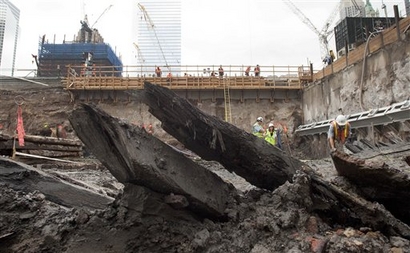
NEW YORK - Since the remains of a wooden ship were unearthed at the World Trade Center construction site in mid-July, a horde of researchers has been putting the vessel under the microscope - sometimes literally - in a quest to piece together the true story of the resurrected ship, and save it from decay.
On Thursday, three of the experts most intimately involved with the 18th-century mystery ship - Michael Pappalardo, an archeologist, Norman Brouwer, a maritime historian, and Nichole Doub, a conservator - convened on a tiny stage here at the New York Academy of Sciences (NYAS) in front of a packed house, to discuss what science and history detectives have uncovered about the ship so far.
The 32-foot- (9.7 meters) long timber structure is the back end and bottom quarter of what researchers believe was a two-masted trade vessel, a workhorse of its day. The area where it was found was part of the Hudson River in the late 18th century, and it's not clear if the ship sank, or if it was stuck in the river bottom on purpose to act as fill to make more "land" for Manhattan.
Brouwer is calling the boat a Hudson River sloop, and says it was probably between 60 and 70 feet (18 and 21 m) - about the size of an articulated, extra-long New York City bus.
The vessel may have traveled up and down the Hudson River and perhaps the Atlantic seaboard, ferrying goods like sugar, molasses, salt and rum between the warm Caribbean and the uniting colonies to the north.
"We found seeds, pits and nuts," said Pappalardo, of the firm AKRF, a consulting company working with the Lower Manhattan Development Corporation (LMDC), operators of the WTC site. "They might have been what the ship was used to transport, or they might have been eaten by the people on the boat. We're working our way through different scenarios."
Read more at Yahoo News
On Thursday, three of the experts most intimately involved with the 18th-century mystery ship - Michael Pappalardo, an archeologist, Norman Brouwer, a maritime historian, and Nichole Doub, a conservator - convened on a tiny stage here at the New York Academy of Sciences (NYAS) in front of a packed house, to discuss what science and history detectives have uncovered about the ship so far.
The 32-foot- (9.7 meters) long timber structure is the back end and bottom quarter of what researchers believe was a two-masted trade vessel, a workhorse of its day. The area where it was found was part of the Hudson River in the late 18th century, and it's not clear if the ship sank, or if it was stuck in the river bottom on purpose to act as fill to make more "land" for Manhattan.
Brouwer is calling the boat a Hudson River sloop, and says it was probably between 60 and 70 feet (18 and 21 m) - about the size of an articulated, extra-long New York City bus.
The vessel may have traveled up and down the Hudson River and perhaps the Atlantic seaboard, ferrying goods like sugar, molasses, salt and rum between the warm Caribbean and the uniting colonies to the north.
"We found seeds, pits and nuts," said Pappalardo, of the firm AKRF, a consulting company working with the Lower Manhattan Development Corporation (LMDC), operators of the WTC site. "They might have been what the ship was used to transport, or they might have been eaten by the people on the boat. We're working our way through different scenarios."
Read more at Yahoo News
Gigantic Spider Webs Made of Silk Tougher Than Kevlar
“A spider discovered deep in the jungles of Madagascar spins the largest webs in the world, using silk that’s tougher than any known biological substance.
Named Caerostris darwini, or Darwin’s bark spider, the inch-wide arachnid’s webs can cover 30-square-foot areas, hanging in midair from 80-foot-long anchor lines.
The webs’ size generates enormous structural stresses, magnified by the struggles of trapped prey. Strands must “absorb massive kinetic energy before breaking,” and are “10 times better than Kevlar,” wrote University of Puerto Rico zoologist Igni Agnarsson in Public Library of Science One.
Agnarsson and Slovenian Academy of Sciences biologist Matjaž Kuntner discovered C. darwini in 2008. It’s similar in many ways to Caerostris species found in Africa, but those spiders live at the edges of forest clearings. In Madagascar, where animals have taken kaleidoscopic forms since the island split from mainland Africa 165 million years ago, C. darwini evolved to exploit the airspace above streams and rivers.”
Read more at Wired
Named Caerostris darwini, or Darwin’s bark spider, the inch-wide arachnid’s webs can cover 30-square-foot areas, hanging in midair from 80-foot-long anchor lines.
The webs’ size generates enormous structural stresses, magnified by the struggles of trapped prey. Strands must “absorb massive kinetic energy before breaking,” and are “10 times better than Kevlar,” wrote University of Puerto Rico zoologist Igni Agnarsson in Public Library of Science One.
Agnarsson and Slovenian Academy of Sciences biologist Matjaž Kuntner discovered C. darwini in 2008. It’s similar in many ways to Caerostris species found in Africa, but those spiders live at the edges of forest clearings. In Madagascar, where animals have taken kaleidoscopic forms since the island split from mainland Africa 165 million years ago, C. darwini evolved to exploit the airspace above streams and rivers.”
Read more at Wired
Oct 3, 2010
Stonehenge Drew Prehistoric Tourists
Stonehenge’s circle of large standing stones was a top international tourist attraction already in prehistoric times, according to chemical analysis of the teeth of individuals found buried near the mysterious megaliths. Presented this week at a science symposium in London to mark the 175th anniversary of the British Geological Survey (BGS), the study involved a technique known as isotope analysis, which measures the ratio of strontium and oxygen isotopes in tooth enamel.
Strontium isotopes provide information on the geological setting of a person’s childhood, while the oxygen isotopes can pinpoint the climate in which the subject was raised.
The researchers tested the teeth from two males. One, known as the “Amesbury Archer,” was found in 2002, buried three miles from Stonehenge.
The other, dubbed “the Boy with the Amber necklace,” was found more recently on Boscombe Down, some three miles south-east of Stonehenge.
Read more at Discovery News
Strontium isotopes provide information on the geological setting of a person’s childhood, while the oxygen isotopes can pinpoint the climate in which the subject was raised.
The researchers tested the teeth from two males. One, known as the “Amesbury Archer,” was found in 2002, buried three miles from Stonehenge.
The other, dubbed “the Boy with the Amber necklace,” was found more recently on Boscombe Down, some three miles south-east of Stonehenge.
Read more at Discovery News
Oldest High-Altitude Settlements Discovered
The world's oldest known high-altitude human settlements, dating back up to 49,000 years, have been found sealed in volcanic ash in Papua New Guinea mountains, archaeologists said Friday.
Researchers have unearthed the remains of about six camps, including fragments of stone tools and food, in an area near the town of Kokoda, said an archaeologist on the team, Andrew Fairbairn.
"What we've got there are basically a series of campsites, that's what they look like anyway. The remains of fires, stone tools, that kind of thing, on ridgetops," the University of Queensland academic told AFP. "It's not like a village or anything like that, they are these campsite areas that have been repeatedly used."
Fairbairn said the settlements are at about 2,000 meters (6,600 feet) and believed to be the oldest evidence of our human ancestors, Homo sapiens, inhabiting a high-altitude environment.
"For Homo sapiens, this is the earliest for us, for modern humans," he said. "The nearest after this is round about 30,000 years ago in Tibet, and there's some in the Ethiopian highlands at around about the same type of age."
Fairbairn said he had been shocked to discover the age of the finds, using radio carbon dating, because this suggested humans had been living in the cold, wet and inhospitable highlands at the height of the last Ice Age.
"We didn't expect to find anything of that early age," he said.
The findings, published in the journal Science, suggest that the prehistoric highlanders of Papua New Guinea's Ivane Valley in the Owen Stanley Range Mountain made stone tools, hunted small animals and ate yams and nuts.
But why they chose to dwell in the harsh conditions of the highlands, where temperatures would have dipped below freezing, rather than remain in the warmer coastal areas, remains a mystery.
Read more at Discovery News
Researchers have unearthed the remains of about six camps, including fragments of stone tools and food, in an area near the town of Kokoda, said an archaeologist on the team, Andrew Fairbairn.
"What we've got there are basically a series of campsites, that's what they look like anyway. The remains of fires, stone tools, that kind of thing, on ridgetops," the University of Queensland academic told AFP. "It's not like a village or anything like that, they are these campsite areas that have been repeatedly used."
Fairbairn said the settlements are at about 2,000 meters (6,600 feet) and believed to be the oldest evidence of our human ancestors, Homo sapiens, inhabiting a high-altitude environment.
"For Homo sapiens, this is the earliest for us, for modern humans," he said. "The nearest after this is round about 30,000 years ago in Tibet, and there's some in the Ethiopian highlands at around about the same type of age."
Fairbairn said he had been shocked to discover the age of the finds, using radio carbon dating, because this suggested humans had been living in the cold, wet and inhospitable highlands at the height of the last Ice Age.
"We didn't expect to find anything of that early age," he said.
The findings, published in the journal Science, suggest that the prehistoric highlanders of Papua New Guinea's Ivane Valley in the Owen Stanley Range Mountain made stone tools, hunted small animals and ate yams and nuts.
But why they chose to dwell in the harsh conditions of the highlands, where temperatures would have dipped below freezing, rather than remain in the warmer coastal areas, remains a mystery.
Read more at Discovery News
Oct 2, 2010
Survey: Americans don’t know much about religion?
“A new survey of Americans’ knowledge of religion found that atheists, agnostics, Jews and Mormons outperformed Protestants and Roman Catholics in answering questions about major religions, while many respondents could not correctly give the most basic tenets of their own faiths. Forty-five percent of Roman Catholics who participated in the study didn’t know that, according to church teaching, the bread and wine used in Holy Communion is not just a symbol, but becomes the body and blood of Christ. More than half of Protestants could not identify Martin Luther as the person who inspired the Protestant Reformation. And about four in 10 Jews did not know that Maimonides, one of the greatest rabbis and intellectuals in history, was Jewish.
The survey released Tuesday by the Pew Forum on Religion & Public Life aimed to test a broad range of religious knowledge, including understanding of the Bible, core teachings of different faiths and major figures in religious history. The U.S. is one of the most religious countries in the developed world, especially compared to largely secular Western Europe, but faith leaders and educators have long lamented that Americans still know relatively little about religion.
Respondents to the survey were asked 32 questions with a range of difficulty, including whether they could name the Islamic holy book and the first book of the Bible, or say what century the Mormon religion was founded. On average, participants in the survey answered correctly overall for half of the survey questions.
Atheists and agnostics scored highest, with an average of 21 correct answers, while Jews and Mormons followed with about 20 accurate responses. Protestants overall averaged 16 correct answers, while Catholics followed with a score of about 15.”
Read more at Yahoo News
The survey released Tuesday by the Pew Forum on Religion & Public Life aimed to test a broad range of religious knowledge, including understanding of the Bible, core teachings of different faiths and major figures in religious history. The U.S. is one of the most religious countries in the developed world, especially compared to largely secular Western Europe, but faith leaders and educators have long lamented that Americans still know relatively little about religion.
Respondents to the survey were asked 32 questions with a range of difficulty, including whether they could name the Islamic holy book and the first book of the Bible, or say what century the Mormon religion was founded. On average, participants in the survey answered correctly overall for half of the survey questions.
Atheists and agnostics scored highest, with an average of 21 correct answers, while Jews and Mormons followed with about 20 accurate responses. Protestants overall averaged 16 correct answers, while Catholics followed with a score of about 15.”
Read more at Yahoo News
Subscribe to:
Posts (Atom)