Archaeologists in northwestern China have unearthed a 2,500-year-old skeleton wrapped in a "shroud" made up of well-preserved marijuana.
Found during an investigation of the Jiayi Cemetery in Turpan, which houses 240 ancient tombs, the burial contained "an extraordinary cache" of 13 Cannabis plants.
The three-foot long, locally produced plants, were arranged across the chest of a man who died at around age 35.
"The Cannabis plants were placed above the body trimly, in a way that suggests ritual-medicinal purposes," Hongen Jiang of the Department of Archaeology and Anthropology at the University of Chinese Academy of Sciences in Beijing, told Discovery News.
The man was laid down on a wooden bed with a reed pillow under the head, while 13 nearly whole female Cannabis plants were deposited diagonally across his body, with the roots and lower parts of the plants grouped together and placed below the pelvis.
"The stems and foliage were arranged in a parallel alignment extending upwards to just under the chin and along the left side of the face," Jiang and colleagues wrote in the journal Economic Botany.
Radiocarbon dating of the tomb's contents, including the cannabis plants, indicates the burial occurred sometime between 2,400 and 2,800 years ago.
While all of the plants had roots attached, most of the flowering heads had been cut off. The few flowers that remained were nearly ripe and contained some immature fruit, suggesting the plants were collected—and that the man was buried -- in late summer, around the end of August or early September.
The plants offer rare insight into ancient cultivation practices.
"Due to the extremely dry climate, the stems and foliage retained their characteristic natural shape although they had turned yellowish brown," the researchers said.
They noted this is the first case of cannabis plants used a as a covering for a human body.
Examining the way the plants were lying on the man's body, basically pressed flat, the researchers concluded they had been fresh and harvested just before the funeral.
"Therefore, the plants were most likely growing locally," they said.
Jiang and colleagues suspect the plants were just harvested for their psychoactive resin. The Cannabis plants were all females with nearly ripe seed, and the flower heads contained the psychoactive resin of Cannabis.
Read more at Discovery News
Oct 6, 2016
Apes Can Follow Video Plots
It turns out if you dress an actor in a gorilla suit and put him in a video, real-life apes take notice. Not only that, they follow the plot closely enough to anticipate the thoughts and actions of the video's characters.
Before, it was thought that only humans were capable of such guesswork. We can think about others' thoughts and emotions, such as their goals, perceptions and beliefs. According to new research, published in Science, some other primates do this too, even while watching videos starring actors dressed in shaggy King Kong suits.
This means that the ability to read others' perceptions likely evolved in our primate past -- possibly as a wily way to score more sexual partners.
Apes "seem to understand the story of videos," Fumihiro Kano of Kyoto University said, comparing the furry primates' ability with that of children. Kano jointly led the study with Christopher Krupenye of Duke University.
"Apes have never confused the videos with real events," Kano said. "They all seem to know that the video events are fake. They were never scared with the events in the monitor."
The new research was inspired, in part, by prior studies on kids. Researchers were curious to know when children could pass what's known as the "false belief test." The traditional version of the test involved showing the kid a named character. (Let's say she's called "Sally.") Sally would be seen hiding an item and then leaving a room. Another character would appear and would quickly re-hide the item in a different place.
The children would then be asked a question like: "Where will Sally look for the item when she returns?" Very young kids tend to pick the spot where they themselves know the item is, but children starting at about age four understand that Sally does not know what they know. They anticipate that she will look in the wrong spot based on her "false belief" of where the item is.
We take such perceptiveness for granted, but it takes sophisticated brain power.
For the new study, Kano, Krupenye and their team created videotaped dramas with variations on the "Sally" plot for chimpanzees, bonobos and orangutans. The actor in the King Kong outfit played a sneaky character who came in and moved an object while the "human" in the drama was either present or absent.
Eye-tracking revealed that 17 out of 22 apes correctly anticipated that the human would go to the incorrect location to search for the object when this person did not see "King Kong" hide it in a new spot. They essentially read the human actor's mind.
This skill, known as "theory of mind," refers to the fact that we can theorize about what others are thinking and what they might do next. The false belief detection skill takes this ability to a whole new level.
Krupenye explained, "There will always be some changes in the environment that we do not witness, for example, leading us to have a false belief. Most animals probably have true and false beliefs themselves; however, the ability to understand others' false beliefs is much more restricted. Until now, there was no evidence that this skill might be shared with any nonhuman animals."
Scientists who conducted the more traditional "Sally" test on kids in the past thought that language was key to the ability, since the study involved verbally asking the children questions. More recent studies on children using eye-tracking, as for the apes, find that some 1.5–2-year-olds can pass the test.
This all means that the ability to understand the thoughts of others, even when those thoughts include false beliefs, evolved way back in our primate past.
Krupenye said the skills might have developed "in response to the demands of living in complex social groups." He explained since males competed with others in their group for access to females, evolution likely favored the males who could outwit their competitors. In this way, the genes for social intelligence were passed on to the next generation.
"Theory of mind," he added, "allows individuals to interpret, predict, and even manipulate others' behavior."
Read more at Discovery News
Before, it was thought that only humans were capable of such guesswork. We can think about others' thoughts and emotions, such as their goals, perceptions and beliefs. According to new research, published in Science, some other primates do this too, even while watching videos starring actors dressed in shaggy King Kong suits.
This means that the ability to read others' perceptions likely evolved in our primate past -- possibly as a wily way to score more sexual partners.
![]() |
| Orangutan "Dokana" who participated in the study. |
"Apes have never confused the videos with real events," Kano said. "They all seem to know that the video events are fake. They were never scared with the events in the monitor."
![]() |
| Chimpanzee "Kara" who participated in the study. |
The children would then be asked a question like: "Where will Sally look for the item when she returns?" Very young kids tend to pick the spot where they themselves know the item is, but children starting at about age four understand that Sally does not know what they know. They anticipate that she will look in the wrong spot based on her "false belief" of where the item is.
We take such perceptiveness for granted, but it takes sophisticated brain power.
For the new study, Kano, Krupenye and their team created videotaped dramas with variations on the "Sally" plot for chimpanzees, bonobos and orangutans. The actor in the King Kong outfit played a sneaky character who came in and moved an object while the "human" in the drama was either present or absent.
This skill, known as "theory of mind," refers to the fact that we can theorize about what others are thinking and what they might do next. The false belief detection skill takes this ability to a whole new level.
Scientists who conducted the more traditional "Sally" test on kids in the past thought that language was key to the ability, since the study involved verbally asking the children questions. More recent studies on children using eye-tracking, as for the apes, find that some 1.5–2-year-olds can pass the test.
This all means that the ability to understand the thoughts of others, even when those thoughts include false beliefs, evolved way back in our primate past.
Krupenye said the skills might have developed "in response to the demands of living in complex social groups." He explained since males competed with others in their group for access to females, evolution likely favored the males who could outwit their competitors. In this way, the genes for social intelligence were passed on to the next generation.
"Theory of mind," he added, "allows individuals to interpret, predict, and even manipulate others' behavior."
Read more at Discovery News
This Flower Stinks Like a Stressed-Out Bee
Flowers of the popular ornamental parachute plant Giant Ceropegia can make you grimace if you take a whiff, and now new research reveals what the smell mimics: stressed out honeybees being attacked by a spider or other predator.
This smell of stress would seem to be a turnoff, but the odor attracts honeybee-craving flies to the sci-fi-looking plant Ceropegia sandersonii, according to a paper published in the journal Current Biology.
As if the plant is not creepy enough, it also has "trap flowers" that keep the duped flies in their clutches until the plant gets what it wants: pollination.
"We show that trap flowers of this plant mimic alarm substances of western honeybees to lure food-stealing freeloader flies as pollinators," co-author Stefan Dötterl of the University of Salzburg said in a press release. "Flies are attracted to the flowers, expecting a meal, but instead of finding an attacked honeybee they are temporarily trapped in the non-rewarding flowers and misused as pollinators."
Dötterl and colleagues Annemarie Heiduk and Ulrich Meve from the University of Bayreuth got the idea to investigate the flower's stinky scent after realizing that the plant was pollinated by flies from the genus Desmometopa. These flies typically feed on the drippings of honeybees that are in the clutches of a predator.
While observing a honeybee caught by a spider, they noticed that the bee extruded its sting and released a drop of venom. The bees' venom is known to contain volatile alarm pheromones, which serve to call and attract nest mates for help. The researchers began to wonder if the plant could be taking advantage of this line of communication among honeybees.
Sure enough, chemical analysis found that the flower's scent is comparable to volatiles released from honeybees when they are being attacked. The scientists also found that some of the shared compounds elicit a response in the antennae of the freeloader flies, showing the scent lures these insects.
Read more at Discovery News
This smell of stress would seem to be a turnoff, but the odor attracts honeybee-craving flies to the sci-fi-looking plant Ceropegia sandersonii, according to a paper published in the journal Current Biology.
As if the plant is not creepy enough, it also has "trap flowers" that keep the duped flies in their clutches until the plant gets what it wants: pollination.
"We show that trap flowers of this plant mimic alarm substances of western honeybees to lure food-stealing freeloader flies as pollinators," co-author Stefan Dötterl of the University of Salzburg said in a press release. "Flies are attracted to the flowers, expecting a meal, but instead of finding an attacked honeybee they are temporarily trapped in the non-rewarding flowers and misused as pollinators."
![]() |
| A honeybee eaten by a spider with food-stealing flies. A drop of venom is visible at the tip of the stinger. |
While observing a honeybee caught by a spider, they noticed that the bee extruded its sting and released a drop of venom. The bees' venom is known to contain volatile alarm pheromones, which serve to call and attract nest mates for help. The researchers began to wonder if the plant could be taking advantage of this line of communication among honeybees.
Sure enough, chemical analysis found that the flower's scent is comparable to volatiles released from honeybees when they are being attacked. The scientists also found that some of the shared compounds elicit a response in the antennae of the freeloader flies, showing the scent lures these insects.
Read more at Discovery News
Another Saturn Moon May Hide Subsurface Ocean
NASA's Cassini spacecraft has spotted many watery delights while orbiting Saturn's system. There's Enceladus' 101 geysers, spewing fountains up from the ice and giving strong evidence of an ocean below. And there's Titan, a strange, soupy, orange world that may also have an ocean somewhere under the surface.
Over the last few years, another strong candidate has emerged: Dione. It's a tiny moon whose radius is about the same distance as a drive between San Francisco and Los Angeles (about 380 miles).
In 2013, images from Cassini showed the crust bend under the mountain Janiculum Dorsa was best explained if there was an ocean underneath; magnetometer measurements also showed a faint particle stream. Now a new study suggests that there is an ocean still underneath the ice, but far down: some 60 miles below the surface.
The authors of the new study modeled the ice shells of both moons Enceladus and Dione. While this approach has been done in the past -- showing that Dione likely had no ocean -- the authors made a change.
"As an additional principle, we assumed that the icy crust can stand only the minimum amount of tension or compression necessary to maintain surface landforms," said Mikael Beuthe, of the Royal Observatory of Belgium and lead author of the new study, in a statement. "More stress would break the crust down to pieces."
The new results suggest that Dione would have a "deep ocean" underneath the crust, but it couldn't be picked up by Cassini. This is because the moon's back-and-forth movements suggested in the study are too small for the spacecraft to detect. It will take a future spacecraft to confirm this.
For Enceladus, the study suggests the ocean is quite close to the surface; its back-and-forth oscillations (which have been seen by Cassini) would be smaller if there was a large layer of ice.
Read more at Discovery News
Over the last few years, another strong candidate has emerged: Dione. It's a tiny moon whose radius is about the same distance as a drive between San Francisco and Los Angeles (about 380 miles).
In 2013, images from Cassini showed the crust bend under the mountain Janiculum Dorsa was best explained if there was an ocean underneath; magnetometer measurements also showed a faint particle stream. Now a new study suggests that there is an ocean still underneath the ice, but far down: some 60 miles below the surface.
The authors of the new study modeled the ice shells of both moons Enceladus and Dione. While this approach has been done in the past -- showing that Dione likely had no ocean -- the authors made a change.
"As an additional principle, we assumed that the icy crust can stand only the minimum amount of tension or compression necessary to maintain surface landforms," said Mikael Beuthe, of the Royal Observatory of Belgium and lead author of the new study, in a statement. "More stress would break the crust down to pieces."
![]() |
| Topography of Dione's mountain Janiculum Dorsa, as captured by the Cassini spacecraft. |
For Enceladus, the study suggests the ocean is quite close to the surface; its back-and-forth oscillations (which have been seen by Cassini) would be smaller if there was a large layer of ice.
Read more at Discovery News
Oct 5, 2016
Planet formation: The death of a planet nursery?
![]() |
| Planetary disk around the star known as TW Hydrae. |
Now an international team led by Professor Barbara Ercolano at LMU's Astronomical Observatory has compared the new observations with theoretical models of planet formation. The study indicates that the prominent gap in the TW Hydrae system is unlikely to be due to the action of an actively accreting protoplanet. Instead, the team attributes the feature to a process known as photoevaporation. Photoevaporation occurs when the intense radiation emitted by the parent star heats the gas, allowing it to fly away from the disk. But although hopes of a new exo-Earth orbiting in the inner gap of TW Hydrae may themselves have evaporated, the system nevertheless provides the opportunity to observe the dissipation of a circumstellar disk in unprecedented detail. The new findings appear in the journal Monthly Notices of the Royal Astronomical Society (MNRAS).
Only 175 light-years from Earth
The dusty disk that girdles TW Hydrae has long been a favored object of observation. The star lies only 175 light-years from Earth, and is it relatively young (around 106 years old). Moreover, the disk is oriented almost perpendicular to our line of sight, affording a well-nigh ideal view of its structure. The spectacular images released in March were made with the Atacama Large Millimeter/submillimeter Array (ALMA), an array of detectors in the desert of Northern Chile. Together, they form a radiotelescope with unparalleled resolving power that can detect the radiation from dust grains in the millimeter size range.
Photoevaporation is one of the major forces that shape the fate of circumstellar disks. Not only can it destroy such disks -- which typically have a life expectancy of around 10 million years -- it can also stop young planets being drawn by gravity and by the interaction with the surrounding disc gas into their parent star. The gaps caused by the action of photoevaporation on the disk, park the planets at their location by removing the gas, allowing the small dusty clumps to grow into fully fledged planets and steering them into stable orbits. However, in the case of the TW Hydrae system, Barbara Ercolano believes that the inner gap revealed by the ALMA maps is not caused by a planet, but represents an early stage in the dissipation of the disk. This view is based on the fact that many characteristic features of the disk around TW Hydrae, such as the distance between the gap and the star, the overall mass accretion rate, and the size and density distributions of the particles, are in very good agreement with the predictions of her photoevaporation model.
From Science Daily
Hidden stars revealed by dustbuster
![]() |
| VISTA views Messier 78. |
Messier 78, or M78, is a well-studied example of a reflection nebula. It is located approximately 1600 light-years away in the constellation of Orion (The Hunter), just to the upper left of the three stars that make up the belt of this familiar landmark in the sky. In this image, Messier 78 is the central, bluish haze in the centre; the other reflection nebula towards the right goes by the name of NGC 2071. The French astronomer Pierre Méchain is credited with discovering Messier 78 in 1780. However, it is today more commonly known as the 78th entry in French astronomer Charles Messier's catalogue, added to it in December of 1780.
When observed with visible light instruments, like ESO's Wide Field Imager at the La Silla Observatory, Messier 78 appears as a glowing, azure expanse surrounded by dark ribbons (see eso1105). Cosmic dust reflects and scatters the light streaming from the young, bluish stars in Messier 78's heart, the reason it is known as a reflection nebula.
The dark ribbons are thick clouds of dust that block the visible light originating behind them. These dense, cold regions are prime locations for the formation of new stars. When Messier 78 and its neighbours are observed in the submillimetre light between radio waves and infrared light, for example with the Atacama Pathfinder Experiment (APEX) telescope, they reveal the glow of dust grains in pockets just barely warmer than their extremely cold surroundings (see eso1219). Eventually new stars will form out of these pockets as gravity causes them to shrink and heat up.
In between visible and submillimetre light lies the near-infrared part of the spectrum, where the Visible and Infrared Survey Telescope for Astronomy (VISTA) provides astronomers with crucial information. Beyond dusty reflections and through thinner portions of obscuring material, the luminous stellar sources within Messier 78 are visible to VISTA's eyes. In the centre of this image, two blue supergiant stars, called HD 38563A and HD 38563B, shine brightly. Towards the right of the image, the supergiant star illuminating NGC 2071, called HD 290861, is also seen.
Read more at Science Daily
Alien Life Model Found in Deep Earth
An unusual microbe that lives off of radioactive rocks nearly 2 miles below Earth's surface suggests what at least some extraterrestrial life could be like.
The creature is a bacterium, Desulforudis audaxviator, discovered in the world's deepest mine: the Mponeng Gold Mine of South Africa's North West Province. Since the organism's energy source, radiation, is also generated by Galactic Cosmic Rays (GCRs), it's possible that life outside of Earth thrives on this energy too, according to new research in the Journal of the Royal Society Interface.
GCRs are high energy particles originating outside the solar system.
Author Dimitra Atri, a research scientist at the Blue Marble Space Institute of Science, told DNews that D. audaxviator is the only organism known so far to live as a result of radiolysis, which refers to decomposition of a substance as a result of radiation. The bacterium – called an "extremophile" because of its existence under such extreme conditions -- eats radioactive rocks by extracting carbon and other essential chemicals from them.
This type of life, Atri said, "is so rare on Earth because we have an abundant supply of photons (particles of light) on the surface, and other extremophiles that use chemical energy or heat are relatively easier to find in places like hydrothermal vents."
Using computerized simulations, Atri showed that GCRs deposit the same amount of energy below a surface as do radioactive rocks. He explained that when the high-energy particles strike a planet's surface, they produce secondary particles. They then interact below the ground and start a chain reaction that keeps producing new particles until all of the energy is used up.
"This energy from secondary particles produced from GCRs is similar to the energy produced from radioactive substances, so it should be able to power radiolysis (outside of Earth) too," Atri said.
GCRs come flying toward Earth all of the time, but most of them are blocked by our atmosphere. Only a very small number of them are able to penetrate below Earth's surface.
On planetary bodies such as Mars, Europa, the moon, Enceladus, Pluto and more, however, GCRs are thought to have greater impact because these places in space are not encased with such a thick atmosphere.
In fact, Atri said, "If an organism powers itself from radiolysis, it would benefit from a negligible or no atmosphere at all because more energy would be available in such cases. This mechanism could potentially work on rogue planets. These are planets that are not tied to any stellar system. They can be powered from GCRs penetrating below their surfaces."
D. audaxviator does have access to a tiny bit of water in its mine shaft home. Recent results from the Rosetta space probe mission have shown that water and other essential organic compounds are available on comets, further boosting the possibility that all of the known essential needs for life exist outside of Earth.
Since the mechanism for life analyzed by Atri only works in subsurface environments, he said that "we will have to drill below the surface of places where we think traces of water and other chemicals might exist. Plenty of such locations exist on Mars and Europa, and it would be useful to dig below the surface and see if anything is out there."
If his theories hold true, then "there would be pockets below the surface of these planetary objects where radiolysis-powered organisms could exist."
NASA is already planning to look for life in subsurface environments. Atri hopes that other space agencies around the world follow suit.
Andrew Karam, a New York Police Department counterterrorism radiation safety officer and renowned expert in radiobiology, says it's intriguing to think of sources of energy for living organisms on planets that are far from a star or are even floating in interstellar space.
"Let's face it, he said. "Anything that provides a source of energy makes it easier for life to be present. And since cosmic rays are everything -- even if heavy elements might be lacking -- this means that our thoughts as to where life might exist might need to expand."
D. audaxviator proves that an organism can live on Earth in spite of high radiation levels, he said, adding, "What's interesting is to speculate that some organisms might exist because of radiation."
Astrobiologist Jacob Haqq-Misra told DNews that our solar system has an abundance of energy from the sun as well as geothermal energy from our planet's own internal heat, so cosmic ray power might have only played a small role in the early emergence of life on Earth.
Read more at Discovery News

The creature is a bacterium, Desulforudis audaxviator, discovered in the world's deepest mine: the Mponeng Gold Mine of South Africa's North West Province. Since the organism's energy source, radiation, is also generated by Galactic Cosmic Rays (GCRs), it's possible that life outside of Earth thrives on this energy too, according to new research in the Journal of the Royal Society Interface.
![]() |
| View from the top of an abandoned mine shaft. Such an environment, miles below the earth, is where D. audaxviator lives off of radioactive rocks. |
Author Dimitra Atri, a research scientist at the Blue Marble Space Institute of Science, told DNews that D. audaxviator is the only organism known so far to live as a result of radiolysis, which refers to decomposition of a substance as a result of radiation. The bacterium – called an "extremophile" because of its existence under such extreme conditions -- eats radioactive rocks by extracting carbon and other essential chemicals from them.
This type of life, Atri said, "is so rare on Earth because we have an abundant supply of photons (particles of light) on the surface, and other extremophiles that use chemical energy or heat are relatively easier to find in places like hydrothermal vents."
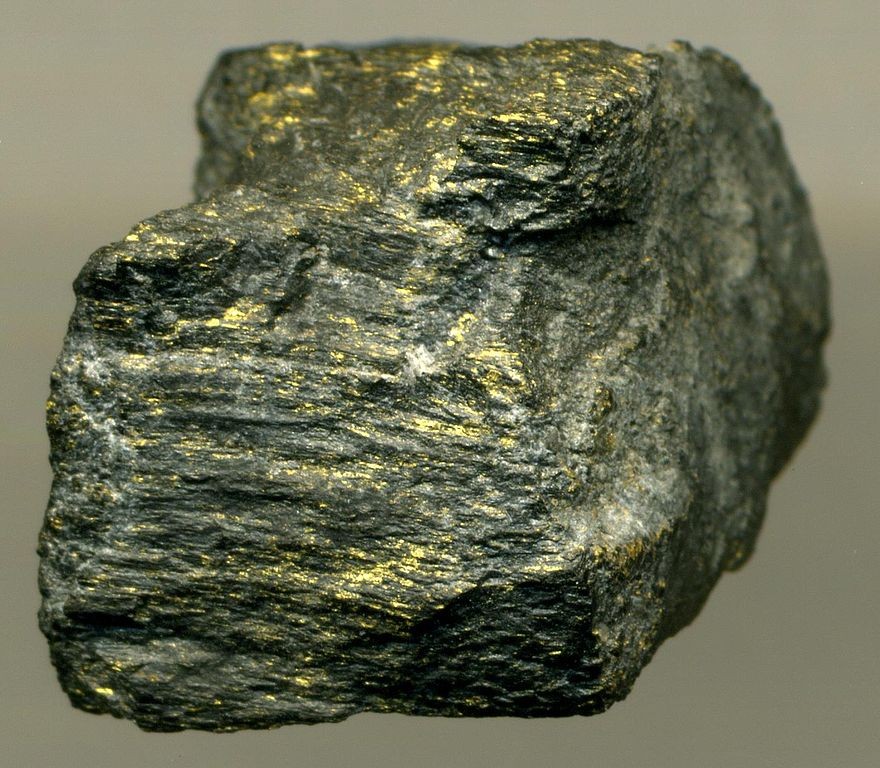
| Radioactive gold-containing rock from South Africa. |
"This energy from secondary particles produced from GCRs is similar to the energy produced from radioactive substances, so it should be able to power radiolysis (outside of Earth) too," Atri said.
GCRs come flying toward Earth all of the time, but most of them are blocked by our atmosphere. Only a very small number of them are able to penetrate below Earth's surface.
On planetary bodies such as Mars, Europa, the moon, Enceladus, Pluto and more, however, GCRs are thought to have greater impact because these places in space are not encased with such a thick atmosphere.
| Mars as imaged by the Hubble Space Telescope. |
D. audaxviator does have access to a tiny bit of water in its mine shaft home. Recent results from the Rosetta space probe mission have shown that water and other essential organic compounds are available on comets, further boosting the possibility that all of the known essential needs for life exist outside of Earth.
Since the mechanism for life analyzed by Atri only works in subsurface environments, he said that "we will have to drill below the surface of places where we think traces of water and other chemicals might exist. Plenty of such locations exist on Mars and Europa, and it would be useful to dig below the surface and see if anything is out there."
If his theories hold true, then "there would be pockets below the surface of these planetary objects where radiolysis-powered organisms could exist."
NASA is already planning to look for life in subsurface environments. Atri hopes that other space agencies around the world follow suit.
Andrew Karam, a New York Police Department counterterrorism radiation safety officer and renowned expert in radiobiology, says it's intriguing to think of sources of energy for living organisms on planets that are far from a star or are even floating in interstellar space.
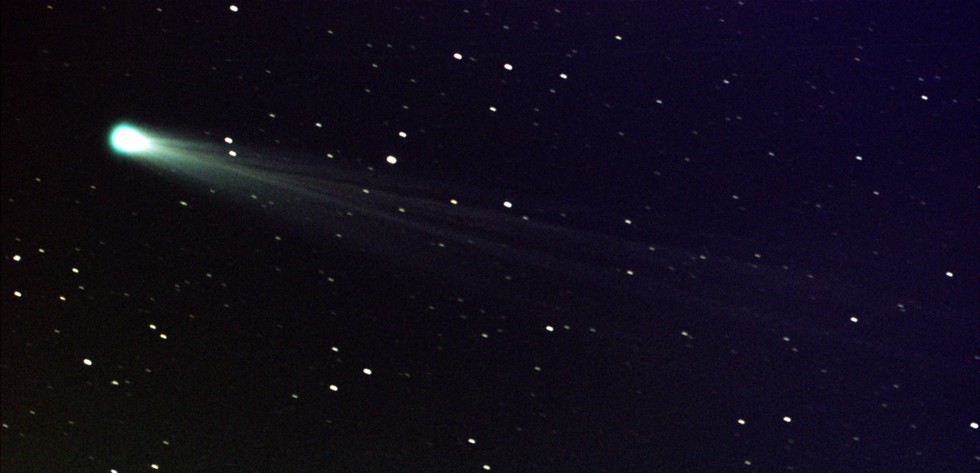
| Comet ISON streaks through space. |
D. audaxviator proves that an organism can live on Earth in spite of high radiation levels, he said, adding, "What's interesting is to speculate that some organisms might exist because of radiation."
Astrobiologist Jacob Haqq-Misra told DNews that our solar system has an abundance of energy from the sun as well as geothermal energy from our planet's own internal heat, so cosmic ray power might have only played a small role in the early emergence of life on Earth.
Read more at Discovery News
This Is How Black Holes Die
Paul Sutter is an astrophysicist at The Ohio State University and the chief scientist at COSI Science Center. Sutter is also host of Ask a Spaceman, RealSpace, and COSI Science Now.
There are some things in the universe that you simply can't escape. Death. Taxes. Black holes. If you time it right, you can even experience all three at once.
Black holes are made out to be uncompromising monsters, roaming the galaxies, voraciously consuming anything in their path. And their name is rightly deserved: once you fall in, once you cross the terminator line of the event horizon, you don't come out. Not even light can escape their clutches.
But in movies, the scary monster has a weakness, and if black holes are the galactic monsters, then surely they have a vulnerability. Right?
Hawking to the rescue
In the 1970s, theoretical physicist Stephen Hawking made a remarkable discovery buried under the complex mathematical intersection of gravity and quantum mechanics: Black holes glow, ever so slightly, and, given enough time, they eventually dissolve.
Wow! Fantastic news! The monster can be slain! But how? How does this so-called Hawking Radiation work?
Well, general relativity is a super-complicated mathematical theory. Quantum mechanics is just as complicated. It's a little unsatisfying to respond to "How?" with "A bunch of math," so here's the standard explanation: the vacuum of space is filled with virtual particles, little effervescent pairs of particles that pop into and out of existence, stealing some energy from the vacuum to exist for the briefest of moments, only to collide with each other and return to nothingness.
Every once in a while, a pair of these particles pops into existence near an event horizon, with one partner falling in and the other free to escape. Unable to collide and evaporate, the escapee goes on its merry way as a normal non-virtual particle.
Voila: The black hole appears to glow, and in doing so — in doing the work to separate a virtual particle pair and promote one of them into normal status — the black hole gives up some of its own mass. Subtly, slowly, over the eons, black holes dissolve. Not so black anymore, huh?
Here's the thing: I don't find that answer especially satisfying, either. For one, it has absolutely nothing to do with Hawking's original 1974 paper, and for another, it's just a bunch of jargon words that fill up a couple of paragraphs but don't really go a long way to explaining this behavior. It's not necessarily wrong, just…incomplete.
Let's dig into it. It'll be fun.
The way of the field
First things first: "Virtual particles" are neither virtual nor particles. In quantum field theory — our modern conception of the way particles and forces work — every kind of particle is associated with a field that permeates all of space-time. These fields aren't just simple bookkeeping devices. They are active and alive. In fact, they're more important than particles themselves. You can think of particles as simply excitations — or "vibrations" or "pinched-off bits," depending on your mood — of the underlying field.
Sometimes the fields start wiggling, and those wiggles travel from one place to another. That's what we call a "particle." When the electron field wiggles, we get an electron. When the electromagnetic field wiggles, we get a photon. You get the idea.
Sometimes, however, those wiggles don't really go anywhere. They fizzle out before they get to do something interesting. Space-time is full of the constantly fizzling fields.
What does this have to do with black holes? Well, when one forms, some of the fizzling quantum fields can get trapped — some permanently, appearing unfortunately within the newfound event horizon. Fields that fizzled near the event horizon end up surviving and escaping. But due to the intense gravitational time dilation near the black hole, thy appear to come out much, much later in the future.
In their complex interaction and partial entrapment with the newly forming black hole, the temporary fizzling fields get "promoted" to become normal everyday ripples — in other words, particles.
So, Hawking Radiation isn't so much about particles opposing into existence near a present-day black hole, but the result of a complex interaction at the birth of a black hole that persists until today.
Read more at Discovery News
There are some things in the universe that you simply can't escape. Death. Taxes. Black holes. If you time it right, you can even experience all three at once.
Black holes are made out to be uncompromising monsters, roaming the galaxies, voraciously consuming anything in their path. And their name is rightly deserved: once you fall in, once you cross the terminator line of the event horizon, you don't come out. Not even light can escape their clutches.
But in movies, the scary monster has a weakness, and if black holes are the galactic monsters, then surely they have a vulnerability. Right?
Hawking to the rescue
In the 1970s, theoretical physicist Stephen Hawking made a remarkable discovery buried under the complex mathematical intersection of gravity and quantum mechanics: Black holes glow, ever so slightly, and, given enough time, they eventually dissolve.
Wow! Fantastic news! The monster can be slain! But how? How does this so-called Hawking Radiation work?
Well, general relativity is a super-complicated mathematical theory. Quantum mechanics is just as complicated. It's a little unsatisfying to respond to "How?" with "A bunch of math," so here's the standard explanation: the vacuum of space is filled with virtual particles, little effervescent pairs of particles that pop into and out of existence, stealing some energy from the vacuum to exist for the briefest of moments, only to collide with each other and return to nothingness.
Every once in a while, a pair of these particles pops into existence near an event horizon, with one partner falling in and the other free to escape. Unable to collide and evaporate, the escapee goes on its merry way as a normal non-virtual particle.
Voila: The black hole appears to glow, and in doing so — in doing the work to separate a virtual particle pair and promote one of them into normal status — the black hole gives up some of its own mass. Subtly, slowly, over the eons, black holes dissolve. Not so black anymore, huh?
Here's the thing: I don't find that answer especially satisfying, either. For one, it has absolutely nothing to do with Hawking's original 1974 paper, and for another, it's just a bunch of jargon words that fill up a couple of paragraphs but don't really go a long way to explaining this behavior. It's not necessarily wrong, just…incomplete.
Let's dig into it. It'll be fun.
The way of the field
First things first: "Virtual particles" are neither virtual nor particles. In quantum field theory — our modern conception of the way particles and forces work — every kind of particle is associated with a field that permeates all of space-time. These fields aren't just simple bookkeeping devices. They are active and alive. In fact, they're more important than particles themselves. You can think of particles as simply excitations — or "vibrations" or "pinched-off bits," depending on your mood — of the underlying field.
Sometimes the fields start wiggling, and those wiggles travel from one place to another. That's what we call a "particle." When the electron field wiggles, we get an electron. When the electromagnetic field wiggles, we get a photon. You get the idea.
Sometimes, however, those wiggles don't really go anywhere. They fizzle out before they get to do something interesting. Space-time is full of the constantly fizzling fields.
What does this have to do with black holes? Well, when one forms, some of the fizzling quantum fields can get trapped — some permanently, appearing unfortunately within the newfound event horizon. Fields that fizzled near the event horizon end up surviving and escaping. But due to the intense gravitational time dilation near the black hole, thy appear to come out much, much later in the future.
In their complex interaction and partial entrapment with the newly forming black hole, the temporary fizzling fields get "promoted" to become normal everyday ripples — in other words, particles.
So, Hawking Radiation isn't so much about particles opposing into existence near a present-day black hole, but the result of a complex interaction at the birth of a black hole that persists until today.
Read more at Discovery News
Oct 2, 2016
Physicists develop a more sensitive microscope
![]() |
| Stanford graduate student Brannon Klopfer helped develop the multi-pass microscope described in the current edition of Nature Communications. |
The effect that causes grainy images of either your meal or a biological sample is called shot noise. Stanford researchers may have come up with an elegant solution to this problem, which they refer to as "multi-pass microscopy." This technique, detailed in a Sept. 27 paper in Nature Communications, could make it possible to view proteins and living cells in greater clarity than ever before.
"If you work at low-light intensities, shot noise limits the maximum amount of information you can get from your image," said Thomas Juffmann, co-author of the research and a postdoctoral research fellow in Stanford Professor Mark Kasevich's research group. "But there's a way around that; the shot-noise limit is not fundamental."
Recycled photons
In optical microscopy, individual units of light, called photons, strike a detector to make the image. The researchers have found they get better results if each photon interacts with the sample multiple times, even in low light. To implement this in a microscope, instead of sending light through a specimen and then directly capturing the resulting image, the Stanford team repeatedly reflects the image back onto the specimen.
"In a sense, it's like you're taking a picture of multiple times your object," said co-author Brannon Klopfer, a graduate student in the Kasevich group. "You first take an image of the specimen, you then illuminate it with an image of itself, and the image you get, you again send back to illuminate the sample. This leads to contrast enhancement."
Multi-pass microscopy is not the only approach to overcoming the shot-noise limit. Another method, called quantum microscopy, uses entangled photons to achieve the same result, but it is more challenging to carry out.
Entangled photons are photons that show quantum correlations. This means that performing an action on one of two entangled photons can have an effect on the other one, even if they are far apart from each other. It is what Albert Einstein referred to as "spooky action at a distance."
The ability of entangled photons to give information about each other means that quantum microscopy can produce higher-quality images compared to standard microscopy. At present, multi-pass microscopy has the potential to create comparably enhanced results with the added benefit of requiring less arduous preparation than quantum microscopy.
"The advantage you gain when entangling two photons is what we gain when we go through the sample twice," Juffmann said. "Currently, it is technologically easier to make a photon pass through a sample 10 times than to create a state in which 10 photons are entangled with each other."
A general technique
Multi-pass microscopy could boost more than just low-light imaging because it acts as a general signal-enhancing technique. The method can increase the sensitivity of various microscopy techniques, so long as a source of image noise doesn't build up with the recycling of photons.
"While multi-passing builds up the signal in your image, the noise is hardly affected," Klopfer said.
Read more at Science Daily
Scientists pair up two stars from the world of chemistry
![]() |
| Prof. Wilhelm Auwärter with a porphin-model. |
Hardly any material is currently receiving as much attention in research as graphene. It is flexible, extremely thin and transparent, while at the same time it has very high tensile strength and conducts electricity, ideal prerequisites for a wide variety of application areas. However, using graphene to capture solar energy or as a gas sensor requires other specific properties as well. These properties can be achieved by fusing functional molecules with the carbon layer.
In previous research, scientists were primarily concerned with wet-chemical methods for attaching the molecules to the surface of the material. Together with his colleagues, Molecular Engineering at Functional Interfaces Professor Wilhelm Auwärter decided to take a different approach: They were able to link porphyrin molecules to graphene in a controlled manner in an ultra-high vacuum using the catalytic properties of a silver surface on which the graphene layer rested. When heated, the porphyrin molecules lose hydrogen atoms at their periphery and can thus form new bonds with the graphene edges.
Clean and controllable
"This method creates a clean and controllable environment," explains Professor Auwärter. "We can see exactly how the molecules bond and what types of bonds occur." Here the researchers use the latest in modern atomic force microscopy to depict the chemical structure of individual molecules, the atomic "skeletons," so to speak.
For the first time the scientists have succeeded in attaching functional molecules to the edges of graphene covalently, i.e. with a stable chemical bond. "We want to modify only the edges of the material; this way the graphene's positive properties are not destroyed," says Auwärter.
The researchers chose the porphyrin molecules as the partner for graphene because of their special properties. "For example, porphyrins are responsible for transporting oxygen in hemoglobin," he continues. The molecules change their properties depending on which metals are at their center and can take on various different tasks, e.g. specifically bonding with gas molecules such as oxygen and carbon dioxide.
Read more at Science Daily
Subscribe to:
Posts (Atom)


