Nov 13, 2016
Catching a tumor in a spider's web
Proteins in boiled eggs, beer foam and spider silk all share a similar structural element: amyloid. These structures are active in humans as well, playing a role in processes such as melanin production and cellular hormone storage. However, amyloids are also associated with diseases like cataracts, Alzheimer's and blood clotting disorders. The Switch Laboratory, led by professors Frederic Rousseau and Joost Schymkowitz, has now invented a design principle that could be used to destroy the function of virtually any protein based on the properties of amyloids.
Catching tumors
The first validated result of this new technology is called vascin, a designer amyloid that targets a well-known cancer target. In short, vascin penetrates a cell, and induces the formation of protein aggregates of its target protein, VEGFR2. These 'clumps' are the result of VEGFR2 protein that started sticking together, making it nonfunctional. Because VEGFR2 is crucial to the survival of certain cancer types, its inactivation kills the cancer cells and stops the tumor's growth.
Prof. Frederic Rousseau (VIB-KU Leuven): "One could compare it to 'catching tumors in a spider's web'. By artificially imitating the formation of protein clumps, we can inhibit molecules that play a central role in several diseases. Because these principles apply to virtually any protein, our approach may not only be useful in developing future cancer therapies, but also in treating drug-resistant infections."
Validated technology
The invention of the Pept-in™ technology dates back several years and is subject to broad patent protection. Meanwhile, the Switch Lab, in collaboration with several other research groups, has shown that this technology could have many applications, from treating superbug and fungal infections to engineering improved crops.
Prof. Joost Schymkowitz (VIB-KU Leuven): "Although we don't yet know if functional amyloids could be used in humans for therapeutic applications, the potential for novel drugs is huge. Our team will now spend the coming years trying to turn this into direct benefits for patients."
Read more at Science Daily
Traumatic stress changes brains of boys, girls differently
![]() |
| Adolescent girls with PTSD appear to undergo accelerated maturation in a region of the brain that integrates emotions and actions. |
Among youth with post-traumatic stress disorder, the study found structural differences between the sexes in one part of the insula, a brain region that detects cues from the body and processes emotions and empathy. The insula helps to integrate one's feelings, actions and several other brain functions.
The findings will be published online Nov. 11 in Depression and Anxiety. The study is the first to show differences between male and female PTSD patients in a part of the insula involved in emotion and empathy.
"The insula appears to play a key role in the development of PTSD," said the study's senior author, Victor Carrion, MD, professor of psychiatry and behavioral sciences at Stanford. "The difference we saw between the brains of boys and girls who have experienced psychological trauma is important because it may help explain differences in trauma symptoms between sexes."
Smaller insula in traumatized girls
Among young people who are exposed to traumatic stress, some develop PTSD while others do not. People with PTSD may experience flashbacks of traumatic events; may avoid places, people and things that remind them of the trauma; and may suffer a variety of other problems, including social withdrawal and difficulty sleeping or concentrating. Prior research has shown that girls who experienced trauma are more likely to develop PTSD than boys who experience trauma, but scientists have been unable to determine why.
The research team conducted MRI scans of the brains of 59 study participants ages 9-17. Thirty of them -- 14 girls and 16 boys -- had trauma symptoms, and 29 others -- the control group of 15 girls and 14 boys -- did not. The traumatized and nontraumatized participants had similar ages and IQs. Of the traumatized participants, five had experienced one episode of trauma, while the remaining 25 had experienced two or more episodes or had been exposed to chronic trauma.
The researchers saw no differences in brain structure between boys and girls in the control group. However, among the traumatized boys and girls, they saw differences in a portion of the insula called the anterior circular sulcus. This brain region had larger volume and surface area in traumatized boys than in boys in the control group. In addition, the region's volume and surface area were smaller in girls with trauma than among girls in the control group.
Findings could help clinicians
"It is important that people who work with traumatized youth consider the sex differences," said Megan Klabunde, PhD, the study's lead author and an instructor of psychiatry and behavioral sciences. "Our findings suggest it is possible that boys and girls could exhibit different trauma symptoms and that they might benefit from different approaches to treatment."
The insula normally changes during childhood and adolescence, with smaller insula volume typically seen as children and teenagers grow older. Thus, the findings imply that traumatic stress could contribute to accelerated cortical aging of the insula in girls who develop PTSD, Klabunde said.
"There are some studies suggesting that high levels of stress could contribute to early puberty in girls," she said.
The researchers also noted that their work may help scientists understand how experiencing trauma could play into differences between the sexes in regulating emotions. "By better understanding sex differences in a region of the brain involved in emotion processing, clinicians and scientists may be able to develop sex-specific trauma and emotion dysregulation treatments," the authors write in the study.
Read more at Science Daily
Nov 12, 2016
Breakthrough in the quantum transfer of information between matter and light
![]() |
| New research is paving the way to producing quantum communications networks. |
A paper titled "High-Fidelity and Ultrafast Initialization of a Hole-Spin Bound to a Te Isoelectronic Centre in ZnSe" was recently published in the journal Physical Review Letters. The creation of a qubit in zinc selenide, a well-known semi-conductor material, made it possible to produce an interface between quantum physics that governs the behaviour of matter on a nanometre scale and the transfer of information at the speed of light, thereby paving the way to producing quantum communications networks.
Classical physics vs. quantum physics
In today's computers, classical physics rules. Billions of electrons work together to make up an information bit: 0, electrons are absent and 1, electrons are present. In quantum physics, single electrons are instead preferred since they express an amazing attribute: the electron can take the value of 0, 1 or any superposition of these two states. This is the qubit, the quantum equivalent of the classical bit. Qubits provide stunning possibilities for researchers.
An electron revolves around itself, somewhat like a spinning top. That's the spin. By applying a magnetic field, this spin points up, down, or simultaneously points both up and down to form a qubit. Better still, instead of using an electron, we can use the absence of an electron; this is what physicists call a "hole." Like its electron cousin, the hole has a spin from which a qubit can be formed. Qubits are intrinsically fragile quantum creature, they therefore need a special environment.
Zinc selenide, tellurium impurities: a world first
Zinc selenide, or ZnSe, is a crystal in which atoms are precisely organized. It is also a semi-conductor into which it is easy to intentionally introduce tellurium impurities, a close relative of selenium in the periodic table, on which holes are trapped, rather like air bubbles in a glass.
This environment protects the hole's spin -- our qubit -- and helps maintaining its quantum information accurately for longer periods; it's the coherence time, the time that physicists the world over are trying to extend by all possible means. The choice of zinc selenide is purposeful, since it may provide the quietest environment of all semiconductor materials.
Polytechnique Montréal and CNRS of France, a team effort
Philippe St-Jean, a doctoral student on Professor Sébastien Francoeur's team, uses photons generated by a laser to initialize the hole and record quantum information on it. To read it, he excites the hole again with a laser and then collects the emitted photons. The result is a quantum transfer of information between the stationary qubit, encoded in the spin of the hole held captive in the crystal, and the flying qubit -- the photon, which of course travels at the speed of light.
This new technique shows that it is possible to create a qubit faster than with all the methods that have been used until now. Indeed, a mere hundred or so picoseconds, or less than a billionth of a second, are sufficient to go from a flying qubit to a static qubit, and vice-versa.
Read more at Science Daily
Dinosaurs' rise was 'more gradual,' new fossil evidence suggests
![]() |
| The skull of Buriolestes. |
The new lagerpetid (Ixalerpeton) and saurischian dinosaur (Buriolestes) were unearthed from the ~230-million-year-old Carnian Santa Maria Formation -- one of the oldest known rock units including dinosaur fossils anywhere in the world.
"We now know for sure that dinosaurs and dinosaur precursors lived alongside one another and that the rise of dinosaurs was more gradual, not a fast overtaking of other animals of the time," says Max Langer of Brazil's Universidade de São Paulo.
The discovery clearly shows that these animals were contemporaries of each other during the earliest stages of dinosaurs' evolution. The new lagerpetid specimen also preserves the first skull, scapular, and forelimb elements, plus associated vertebrae, known for the group, the researchers report. Tooth evidence also shows that the first dinosaurs most likely fed on "all kinds of small animals, but most probably not plants," Langer says.
Those details help to reveal how dinosaurs acquired some of their characteristic anatomical traits. Their analysis also suggests that Buriolestes is one of the oldest known Sauropodomorpha, the group of long-necked dinosaurs that includes sauropods.
The two new animals have already helped to fill important gaps in the evolution of the key anatomical features of dinosaurs. But Langer and his colleagues aren't done with them yet. They are using CT scans to characterize and describe the animals' anatomy in even greater detail. They also hope to get an even more precise radioisotopic date on the oldest dinosaur-bearing rocks, and the search for more Triassic fossils continues.
From Science Daily
Australian Telescope Joins Hunt for Intelligent Aliens
A radio telescope near the town of Parkes, Australia, this week joined the privately funded Breakthrough Listen project in hopes of discovering evidence that a technically advanced civilization exists beyond Earth.
The Parkes telescope's first target was Proxima Centauri, a red dwarf star that is the sun's nearest neighbor. In August, astronomers announced that an Earth-size planet circles the star at the right distance for water, if any exists, to pool on its surface — a condition believed to be necessary for life.
Chances are slim the planet, known as Proxima b, is home to a technically advanced civilization, says Andrew Siemion, director of the University of California-Berkeley's SETI Research Center.
"But once we knew there was a planet right next door, we had to ask the question," said Siemion, who heads the Breakthrough Listen science program.
"It was a fitting first observation for Parkes," he said in a statement.
Breakthrough Listen also uses two U.S. telescopes — the Green Bank Telescope in West Virginia and the Automated Planet Finder at the Lick Observatory in California — but neither are positioned to observe Proxima Centauri and other targets in the Southern Hemisphere.
Breakthrough Listen is a 10-year, $100-million search for extraterrestrial intelligence, or SETI, project funded by internet entrepreneur Yuri Milner and backed by British physicist Stephen Hawking and other well-known astronomers.
The project, announced last year, began searching for non-naturally occurring radio signals in January. It is the most comprehensive search for ET to date.
From Discovery News
The Parkes telescope's first target was Proxima Centauri, a red dwarf star that is the sun's nearest neighbor. In August, astronomers announced that an Earth-size planet circles the star at the right distance for water, if any exists, to pool on its surface — a condition believed to be necessary for life.
Chances are slim the planet, known as Proxima b, is home to a technically advanced civilization, says Andrew Siemion, director of the University of California-Berkeley's SETI Research Center.
"But once we knew there was a planet right next door, we had to ask the question," said Siemion, who heads the Breakthrough Listen science program.
"It was a fitting first observation for Parkes," he said in a statement.
Breakthrough Listen also uses two U.S. telescopes — the Green Bank Telescope in West Virginia and the Automated Planet Finder at the Lick Observatory in California — but neither are positioned to observe Proxima Centauri and other targets in the Southern Hemisphere.
Breakthrough Listen is a 10-year, $100-million search for extraterrestrial intelligence, or SETI, project funded by internet entrepreneur Yuri Milner and backed by British physicist Stephen Hawking and other well-known astronomers.
The project, announced last year, began searching for non-naturally occurring radio signals in January. It is the most comprehensive search for ET to date.
From Discovery News
Nov 11, 2016
Neanderthal inheritance helped humans adapt to life outside of Africa
![]() |
| We owe our long-lost hominid relatives for various traits, and especially those related to our immune systems and skin, the evidence shows. |
All told, the new study identifies 126 different places in the genome where genes inherited from those archaic humans remain at unusually high frequency in the genomes of modern humans around the world. We owe our long-lost hominid relatives for various traits, and especially those related to our immune systems and skin, the evidence shows.
"Our work shows that hybridization was not just some curious side note to human history, but had important consequences and contributed to our ancestors' ability to adapt to different environments as they dispersed throughout the world," says Joshua Akey of University of Washington School of Medicine in Seattle.
Akey says it's relatively straightforward today to identify sequences that were inherited from archaic ancestors. Studies show that non-African individuals inherited about 2% of their genomes from Neanderthals. People of Melanesian ancestry inherited another 2% to 4% of their genomes from Denisovan ancestors. But it hasn't been clear what influence those DNA sequences have had on our biology, traits, and evolutionary history.
In the new study, the researchers took advantage of recently constructed genome-scale maps of Neanderthal and Denisovan sequences identified in more than 1,500 geographically diverse people. Their sample included close to 500 individuals each from East Asia, Europe, and South Asia. They also analyzed the genomes of 27 individuals from Island Melanesia, an area including Indonesia, New Guinea, Fiji, and Vanuatu. The researchers were searching for archaic DNA sequences in those human genomes at frequencies much higher than would be expected if those genes weren't doing people any good.
While the vast majority of surviving Neanderthal and Denisovan sequences are found at relatively low frequencies (typically less than 5%), the new analyses turned up 126 places in our genomes where these archaic sequences exist at much higher frequencies, reaching up to about 65%. Seven of those regions were found in parts of the genome known to play a role in characteristics of our skin. Another 31 are involved in immunity.
"The ability to increase to such high population frequencies was most likely facilitated because these sequences were advantageous," Akey explains. "In addition, many of the high-frequency sequences span genes involved in the immune system, which is a frequent target of adaptive evolution."
Generally speaking, the genes humans got from Neanderthals or Denisovans are important for our interactions with the environment. The evidence suggests that hybridization with archaic humans as our ancient ancestors made their way out of Africa "was an efficient way for modern humans to quickly adapt to the new environments they were encountering."
Read more at Science Daily
Mars' Mega-Drought Revealed in Meteorite Rust
As the world looks toward Mars as the first destination for humanity's foray into the solar system, it's time for a reality check.
We already know the Red Planet is bathed in radiation, has a thin atmosphere and is, for the most part, inhospitable for life (as we know it), but astrobiologists think there might be just enough water below the surface to support microbial life and there was likely a lot more water on the surface in the Red Planet's past. The mere hint of water on Mars is enough for us to hope we can use it to sustain a future Mars settlement.
Now, in new research published in the journal Nature Communications, researchers report on the results of analysis of Mars meteors by NASA's Opportunity rover that has been exploring Mars for over 12 years.
Iron-rich meteorites weather very quickly when exposed to a wet environment. On Earth, these space rocks rust. And though meteorites also rust on Mars, Opportunity has found that they rust at a much, much slower rate and has revealed that the planet has been extremely dry for millions of years.
"Evidence shows that more than 3 billion years ago Mars was wet and habitable. However, this latest research reaffirms just how dry the environment is today," said Christian Schröder, of the University of Stirling and Science Team Collaborator for the Mars Exploration Rover Opportunity, in a statement. "For life to exist in the areas we investigated, it would need to find pockets far beneath the surface, located away from the dryness and radiation present on the ground."
Although recent discoveries by NASA's Curiosity rover suggest liquid water infused with toxic perchlorate salts might condense on the surface, the reality is that the Martian atmosphere is still extremely arid. "(T)his moisture is much less than the moisture present even in the driest places on Earth," added Schröder.
After studying a cluster of meteorites in the equatorial Meridiani Planum region of Mars, Opportunity found that their rust rate is 10-10,000 times less than how long it would take iron-rich meteorites to rust in the driest deserts on Earth. This suggests Mars has been incredibly dry for millions of years, only adding more mystery to how the Red Planet transitioned from a wet planet to a very dry one.
This is obviously pretty bad news for the hope of finding any basic forms of Martian life remotely near the surface, but it adds another layer of uncertainty for future Mars missions. For any Mars mission plan, tapping into Mars' meager water supply is essential to keep astronauts alive and, in some cases, provide fuel for a sustained presence. This most recent finding will no doubt force mission planners to carefully consider where a future human presence on Mars should touch down, and it probably won't be anywhere near the equator.
From Discovery News
We already know the Red Planet is bathed in radiation, has a thin atmosphere and is, for the most part, inhospitable for life (as we know it), but astrobiologists think there might be just enough water below the surface to support microbial life and there was likely a lot more water on the surface in the Red Planet's past. The mere hint of water on Mars is enough for us to hope we can use it to sustain a future Mars settlement.
Now, in new research published in the journal Nature Communications, researchers report on the results of analysis of Mars meteors by NASA's Opportunity rover that has been exploring Mars for over 12 years.
Iron-rich meteorites weather very quickly when exposed to a wet environment. On Earth, these space rocks rust. And though meteorites also rust on Mars, Opportunity has found that they rust at a much, much slower rate and has revealed that the planet has been extremely dry for millions of years.
"Evidence shows that more than 3 billion years ago Mars was wet and habitable. However, this latest research reaffirms just how dry the environment is today," said Christian Schröder, of the University of Stirling and Science Team Collaborator for the Mars Exploration Rover Opportunity, in a statement. "For life to exist in the areas we investigated, it would need to find pockets far beneath the surface, located away from the dryness and radiation present on the ground."
Although recent discoveries by NASA's Curiosity rover suggest liquid water infused with toxic perchlorate salts might condense on the surface, the reality is that the Martian atmosphere is still extremely arid. "(T)his moisture is much less than the moisture present even in the driest places on Earth," added Schröder.
After studying a cluster of meteorites in the equatorial Meridiani Planum region of Mars, Opportunity found that their rust rate is 10-10,000 times less than how long it would take iron-rich meteorites to rust in the driest deserts on Earth. This suggests Mars has been incredibly dry for millions of years, only adding more mystery to how the Red Planet transitioned from a wet planet to a very dry one.
This is obviously pretty bad news for the hope of finding any basic forms of Martian life remotely near the surface, but it adds another layer of uncertainty for future Mars missions. For any Mars mission plan, tapping into Mars' meager water supply is essential to keep astronauts alive and, in some cases, provide fuel for a sustained presence. This most recent finding will no doubt force mission planners to carefully consider where a future human presence on Mars should touch down, and it probably won't be anywhere near the equator.
From Discovery News
Fly Spit Could Be the Key to Skin Infection Vaccine
The saliva of a sand fly may help to prevent a horrific skin infection that now affects millions of people in the tropics, subtropics and southern Europe.
Ironically, the infection, cutaneous leishmaniasis, develops when a sand fly infected with Leishmania parasites bites a person. The bite can turn into a raised red lesion that, in some cases, may form an open ulcer that can then become infected with bacteria. Sores in the nose and mouth may cause further complications.
"People get this disease if they visit areas where the sand fly occurs, like parts of Brazil, India and Iran," Camil de Oliveira of the Instituto Gonçalo Moniz, Fundação Oswaldo Cruz in Brazil told Seeker. "The name sand fly is not related to the insect being found on the beach."
In Brazil, one of 10 countries where 75 percent of cutaneous leishmaniasis cases are concentrated, the infection is generally caused by the parasite Leishmania braziliesis, and is transmitted in the spit of the biting sand flies Lutzomyia intermedia and Lutzomyia whitmani. Prior research found that immunity to proteins in Lutzomyia intermedia's saliva exacerbated leishmaniasis, resulting in an increased immune response to the bites of infected sand flies.
For the new study, published in the journal PLOS Neglected Tropical Diseases, de Oliveira, Aldina Barral and their team tested the effect of immunity to the other major sand fly, Lutzomyia whitmani, on leishmaniasis. As you might imagine, the small insects produce a tiny amount of spit, making the research quite a challenge.
The flies "produce very little of it, and we need to obtain the flies, separate the females — the ones that have the salivary molecules we are interested in — and then dissect the salivary glands," de Oliveira said. "It is all very small and we need the use of lab equipment to do the dissection."
The scientists next immunized mice with the fly spit. They then injected the mice with some of the infection-causing parasites. The mice that were previously immunized with the fly saliva did not develop lesions, but other mice that had no such treatment did. The researchers also noted that the immunized mice had lower levels of parasites at the injection sites and higher levels of certain immune molecules.
The scientists next tested 300 people from Corte de Pedra, Brazil. Some of them had the infection, others had a lesser version of it without the lesions, and still others had no history of the disease. De Oliveira and colleagues detected the antibodies in all three groups of people, but patients with lesions had the lowest levels.
Together, the experiments strongly suggest that immunity against the infection is possible, and that the fly saliva helps to boost an individual's ability to fight off leishmaniasis. Why this happens remains a mystery, since insects do not even have antibodies.
"Nevertheless," de Oliveira said, "they can recognize invaders and trigger different mechanisms of defense … For sand flies, little is known about how they may fight off Leishmania parasites, however, they can survive Leishmania presence and thrive."
Read more at Discovery News
Ironically, the infection, cutaneous leishmaniasis, develops when a sand fly infected with Leishmania parasites bites a person. The bite can turn into a raised red lesion that, in some cases, may form an open ulcer that can then become infected with bacteria. Sores in the nose and mouth may cause further complications.
"People get this disease if they visit areas where the sand fly occurs, like parts of Brazil, India and Iran," Camil de Oliveira of the Instituto Gonçalo Moniz, Fundação Oswaldo Cruz in Brazil told Seeker. "The name sand fly is not related to the insect being found on the beach."
In Brazil, one of 10 countries where 75 percent of cutaneous leishmaniasis cases are concentrated, the infection is generally caused by the parasite Leishmania braziliesis, and is transmitted in the spit of the biting sand flies Lutzomyia intermedia and Lutzomyia whitmani. Prior research found that immunity to proteins in Lutzomyia intermedia's saliva exacerbated leishmaniasis, resulting in an increased immune response to the bites of infected sand flies.
For the new study, published in the journal PLOS Neglected Tropical Diseases, de Oliveira, Aldina Barral and their team tested the effect of immunity to the other major sand fly, Lutzomyia whitmani, on leishmaniasis. As you might imagine, the small insects produce a tiny amount of spit, making the research quite a challenge.
The flies "produce very little of it, and we need to obtain the flies, separate the females — the ones that have the salivary molecules we are interested in — and then dissect the salivary glands," de Oliveira said. "It is all very small and we need the use of lab equipment to do the dissection."
The scientists next immunized mice with the fly spit. They then injected the mice with some of the infection-causing parasites. The mice that were previously immunized with the fly saliva did not develop lesions, but other mice that had no such treatment did. The researchers also noted that the immunized mice had lower levels of parasites at the injection sites and higher levels of certain immune molecules.
The scientists next tested 300 people from Corte de Pedra, Brazil. Some of them had the infection, others had a lesser version of it without the lesions, and still others had no history of the disease. De Oliveira and colleagues detected the antibodies in all three groups of people, but patients with lesions had the lowest levels.
Together, the experiments strongly suggest that immunity against the infection is possible, and that the fly saliva helps to boost an individual's ability to fight off leishmaniasis. Why this happens remains a mystery, since insects do not even have antibodies.
"Nevertheless," de Oliveira said, "they can recognize invaders and trigger different mechanisms of defense … For sand flies, little is known about how they may fight off Leishmania parasites, however, they can survive Leishmania presence and thrive."
Read more at Discovery News
Long-Lost Tropical Bed Bugs Are Back in the US
After a suspected 60-year absence from the U.S., a bed bug known for its ability to spread rapidly has just invaded Florida and Hawaii, according to experts who study the parasitic pest.
The tropical bed bug Cimex hemipterus is raising concern because traditional eradication methods might not keep its numbers in check.
"To the naked eye, the common bed bug (Cimex lectularius) and the tropical bed bug would look the same, as would signs of their presence: bites, blood spots on linens and shed skin from the bugs," University of Florida entomologist Brittany Campbell told Seeker. She added that the parasites can cause everything from small bite marks to serious allergic reactions that require immediate medical attention.
"Under a microscope, the two species look different," continued Campbell, who recently authored a report on tropical bed bugs for Entomology Today. "The tropical bed bug has a different-shaped pronotum, or neck-like structure, that doesn't have the 'U-shape' characteristic of common bed bugs."
The bed bug's existence in Hawaii is anecdotal, she said, but more is known about its presence in Florida, thanks to an observant homeowner from Merritt Island near the Ulumay Wildlife Sanctuary in Brevard County, Fla. In 2015 the family reported an infestation, and a sample was sent to Campbell. She and her team discovered the bed bug was from the long-lost tropical species.
From the late 1930s to the early 1940s, the bug was found in several Florida counties. But it hadn't been reported again until the Merritt Island incident. As its name suggest, it's often found in tropical environments including Africa, parts of Australia, Asia and South America.
The parasite favors warm, humid environments, so Campbell said that it potentially could spread to other southern states, parts of California and additional places in the U.S. In fact, because of indoor heating, it might be able to establish itself nearly anywhere, she and other bed bug authorities speculate.
The Merritt Island residence is now free of bed bugs, but how the home became infested in the first place is a mystery that has Campbell concerned. The family hadn't traveled outside of the state, so it's likely the insects became established in Florida before arriving in Brevard County — possibly hitching a ride with tourists or on a cargo shop.
"We have probably encountered the tropical bed bug and not even known it," John Cooksey told Seeker. He works at McCall Service, a family-owned pest control company that's operates in Florida and Georgia. "Our bed bug business is up 12 percent over last year."
Read more at Discovery News
The tropical bed bug Cimex hemipterus is raising concern because traditional eradication methods might not keep its numbers in check.
"To the naked eye, the common bed bug (Cimex lectularius) and the tropical bed bug would look the same, as would signs of their presence: bites, blood spots on linens and shed skin from the bugs," University of Florida entomologist Brittany Campbell told Seeker. She added that the parasites can cause everything from small bite marks to serious allergic reactions that require immediate medical attention.
"Under a microscope, the two species look different," continued Campbell, who recently authored a report on tropical bed bugs for Entomology Today. "The tropical bed bug has a different-shaped pronotum, or neck-like structure, that doesn't have the 'U-shape' characteristic of common bed bugs."
The bed bug's existence in Hawaii is anecdotal, she said, but more is known about its presence in Florida, thanks to an observant homeowner from Merritt Island near the Ulumay Wildlife Sanctuary in Brevard County, Fla. In 2015 the family reported an infestation, and a sample was sent to Campbell. She and her team discovered the bed bug was from the long-lost tropical species.
From the late 1930s to the early 1940s, the bug was found in several Florida counties. But it hadn't been reported again until the Merritt Island incident. As its name suggest, it's often found in tropical environments including Africa, parts of Australia, Asia and South America.
The parasite favors warm, humid environments, so Campbell said that it potentially could spread to other southern states, parts of California and additional places in the U.S. In fact, because of indoor heating, it might be able to establish itself nearly anywhere, she and other bed bug authorities speculate.
The Merritt Island residence is now free of bed bugs, but how the home became infested in the first place is a mystery that has Campbell concerned. The family hadn't traveled outside of the state, so it's likely the insects became established in Florida before arriving in Brevard County — possibly hitching a ride with tourists or on a cargo shop.
"We have probably encountered the tropical bed bug and not even known it," John Cooksey told Seeker. He works at McCall Service, a family-owned pest control company that's operates in Florida and Georgia. "Our bed bug business is up 12 percent over last year."
Read more at Discovery News
Mystery Stellar Swirls Are Baby Planets' First Steps
The cosmos is often viewed as constant and unchanging, but in these wonderfully detailed observations of the protoplanetary disks surrounding young stars, some rather rapid changes are being witnessed.
While zooming in on young stars surrounded by the dusty debris from star formation, the SPHERE instrument, which is attached to the ESO's powerful Very Large Telescope (VLT) at the Paranal Observatory in Chile, was able to resolve details in the early evolution of planetary systems. During the formation of our solar system over 4 billion yours ago, the components of all the planets would have resembled the rippled tracks as seen in these observations. As with many fields of astronomy, we often look out into the galaxy to learn more about our own origins.
Though astronomers have a pretty good idea about how planets are formed, many mysteries remain. This is particularly the case when planets take their "first steps," gaining the gravitational fortitude to attract more material and carving out intricate tracks and swirls in stars' surrounding disks.
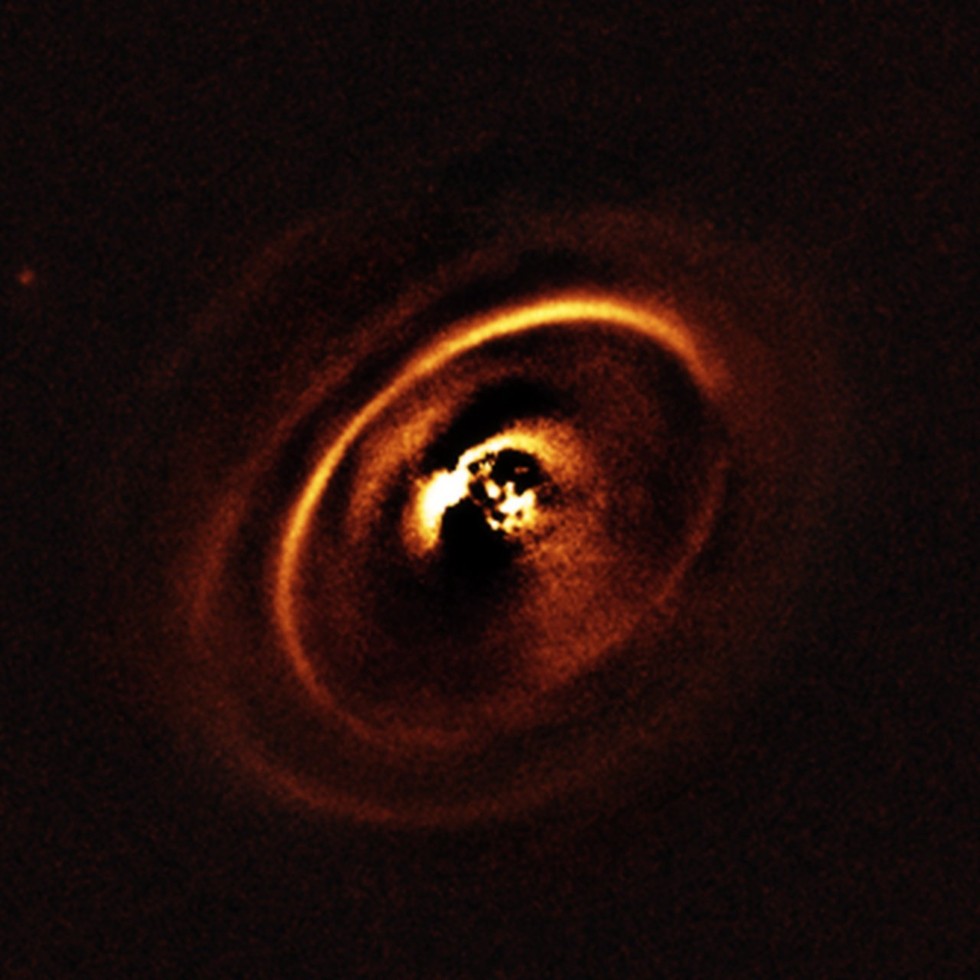
Of the recent observations, one remarkably young star system called RX J1615 (pictured below), located around 600 light-years from Earth and only 1.8 million years old, shows amazingly intricate symmetrical rings around the central star. "The disc shows hints of being shaped by planets still in the process of formation," the ESO writes in a statement.
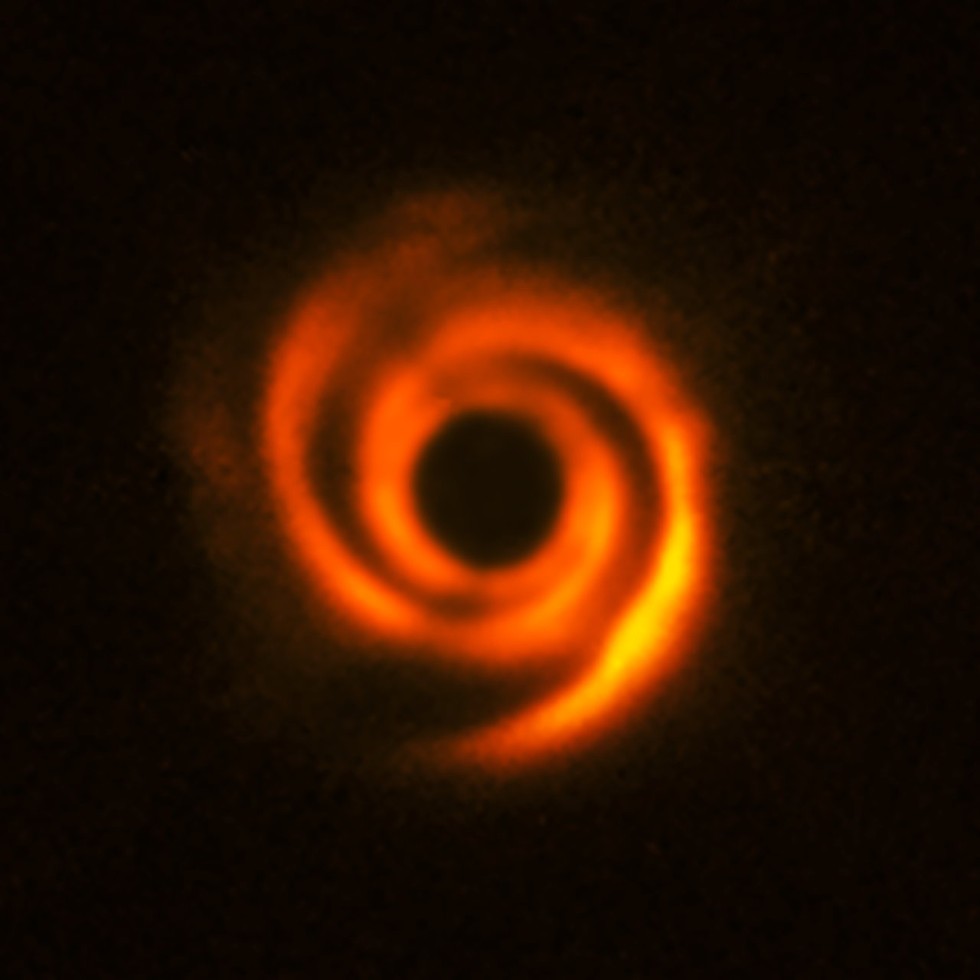
But not all planet "baby steps" form these symmetrical Saturn-like rings. One burgeoning star system called HD 135344B, located around 450 light-years away, exhibits an asymmetrical whirlpool-like ring of debris and tracks in the protoplanetary disk (below). And the interesting thing about this particular star system is that astronomers have seen changes in the disk structure morph over a period of only a few months. This is a star system forming in real time and SPHERE is providing astronomers with a powerful new tool to track wisps of dusty material get swept up by the motion of baby planets.
"By building an impressive body of knowledge about these protoplanetary discs, these teams are stepping closer to understanding how planets shape the discs that form them — and therefore understanding planet formation itself," the ESO added.
From Discovery News
While zooming in on young stars surrounded by the dusty debris from star formation, the SPHERE instrument, which is attached to the ESO's powerful Very Large Telescope (VLT) at the Paranal Observatory in Chile, was able to resolve details in the early evolution of planetary systems. During the formation of our solar system over 4 billion yours ago, the components of all the planets would have resembled the rippled tracks as seen in these observations. As with many fields of astronomy, we often look out into the galaxy to learn more about our own origins.
Though astronomers have a pretty good idea about how planets are formed, many mysteries remain. This is particularly the case when planets take their "first steps," gaining the gravitational fortitude to attract more material and carving out intricate tracks and swirls in stars' surrounding disks.
Of the recent observations, one remarkably young star system called RX J1615 (pictured below), located around 600 light-years from Earth and only 1.8 million years old, shows amazingly intricate symmetrical rings around the central star. "The disc shows hints of being shaped by planets still in the process of formation," the ESO writes in a statement.
But not all planet "baby steps" form these symmetrical Saturn-like rings. One burgeoning star system called HD 135344B, located around 450 light-years away, exhibits an asymmetrical whirlpool-like ring of debris and tracks in the protoplanetary disk (below). And the interesting thing about this particular star system is that astronomers have seen changes in the disk structure morph over a period of only a few months. This is a star system forming in real time and SPHERE is providing astronomers with a powerful new tool to track wisps of dusty material get swept up by the motion of baby planets.
"By building an impressive body of knowledge about these protoplanetary discs, these teams are stepping closer to understanding how planets shape the discs that form them — and therefore understanding planet formation itself," the ESO added.
From Discovery News
Subscribe to:
Posts (Atom)