Oct 15, 2016

Female chimpanzees don't fight for 'queen bee' status

A low-ranking young female chimpanzee was wounded in a fight when she attempted to enter the female social hierarchy.
For wild chimpanzees, social status is more than just a matter of pride. High-ranking chimpanzees of both sexes usually have better access to food and mates, boosting chances of survival for themselves and their offspring.

But male and female chimpanzees achieve social status in dramatically different ways, says a new study by primatologists at Duke University. While males actively challenge their superiors to win higher rank, females accept their position in the social pecking order, waiting until more senior group members die before moving up the ladder.

The study, which appeared online Oct. 14 in the journal Scientific Reports, provides the first detailed look at how social status among wild chimpanzees changes throughout their lifetimes.

"We found that, after entering the adult hierarchy, there was a complete absence of successful challenges for rank increases among females," said Steffen Foerster, senior research scientist at Duke University and lead author on the study. "It's like a formal queue."

Unlike the more gregarious males, female chimpanzees tend to be loners, spending much time by themselves or with their own children. One-on-one encounters between females are generally rare, giving researchers few opportunities to observe signs that would clue them in to each chimpanzee's relative rank.

"For a long time we've been aware that there really are differences in rank between females, but being able to quantify that has been hard because they really don't interact very often," said Duke evolutionary anthropology professor Anne Pusey, who is a senior author on the paper.

To explore how female chimpanzees maneuver up and down the social ladder, Foerster, Pusey and their colleagues plumbed more than 40 years of daily records documenting the behaviors of 100 or so wild chimpanzees residing in Gombe National Park in Tanzania, where Pusey first began working alongside Jane Goodall in 1970.

Chimpanzees signal dominance and submission to each other through acts of aggression, such as chases and attacks, and through making a sound called a "pant-grunt," which is a clear sign of subordination to a superior. The team used a new rating system to document these interactions, allowing them to determine the rank orders of male and female chimpanzees and watch how they shifted over time.

Their results showed that, unlike males, whose rank usually peaks when they reach their prime in their early 20s before declining again, female rank gradually increases as they age, and their rank order remains stable throughout their lifetimes. In addition, though males almost always start their adulthoods at the bottom of the pecking order, the female starting rank varies with each individual.

"That seems to be a crucial moment for them, because after they enter the hierarchy at about 12 years of age, they can't really change anything about their position unless something happens at the top and individuals die," Foerster said.

The team is still investigating how these initial rankings are established, but preliminary evidence indicates that females with mothers in the group seem to have an edge.

Despite the benefits of social status on their reproductive success -- higher-ranking females appear to have access to better food and higher infant survival than their low-ranking counterparts -- the tendency of female chimpanzees to "wait their turn" rather than fighting for rank reveals the competing priorities males and females face when ensuring the success of their offspring.

"If a male has a high rank even for a short time but manages to fertilize a lot of females, he achieves high reproductive success," Pusey said. "Whereas a female is only able to raise one offspring at a time, so her reproductive success depends largely on how long she lives."

Read more at Science Daily

Extinct Wingless Wasp Was Unlike Any Other Insect

A wingless wasp stuck in amber about 100 million years ago is a family unto itself, with no other family like it in insect history. So say Russian, English and American researchers who have written about the evolutionary last-stop insect in a study in the journal Cretaceous Research.

The curious bug, found in Myanmar's Hukawng Valley, had hind legs reminiscent of a grasshopper, antennae like ants, and the abdomen of a cockroach and gave the researchers quite a challenge in determining its taxonomic place.

Finally, though, they decided the insect's face looked closest to a wasp, so they created for it a new family of one, Aptenoperissidae, within the larger Hymenoptera insect order containing wasps and modern bees.

Study co-author George Poinar, Jr., an Oregon State University professor emeritus and expert on amber-encased animals, said he had no idea what kind of bug he was looking at, on first glance.

"You could see it's tough and robust, and could give a painful sting," Poinar, Jr. said in a statement. "We ultimately had to create a new family for it, because it just didn't fit anywhere else."

The amber-entombed insect was a female. Being parasitic, the researchers say she would have spent her time on the ground burrowing into cavities in search of the pupae of other insects in which she could deposit her eggs.

Her long legs, the scientists say, would have helped her climb back out of those burrows.

Such life habits likely played a role in the insect's lack of wings: Going in and out of those tight spaces would have made wings cumbersome.

The wasp was also likely a strong jumper, thanks again to the "grasshopper" legs. Her stinger, meanwhile, was sharp enough for attacking beetles.

For all of those skills, though, the unusual wasp went extinct. The researchers can't say for sure why it did, suggesting disease, loss of habitable living space, and the inability to fly as potential factors.

Whatever the reason, it was literally the end of the line. "When it died out, this created an evolutionary dead end for that family," said Poinar, Jr.

Read more at Discovery News

Oct 14, 2016

T-rays will 'speed up' computer memory by a factor of 1000

The figure shows the spin and lattice structure of thulium orthoferrite (TmFeO?) on the left and the T-ray-induced transitions between the energy levels of thulium ions (Tm³?), which trigger coherent spin dynamics (memory switching), on the right.
Together with their colleagues from Germany and the Netherlands, scientists at the Moscow Institute of Physics and Technology (MIPT) have found a way to significantly improve computer performance. In their paper published in Nature Photonics, they propose the use of the so-called T-waves, or terahertz radiation as a means of resetting computer memory cells. This process is several thousand times faster than magnetic-field-induced switching.

"We have demonstrated an entirely new way of controlling magnetization, which relies on short electromagnetic pulses at terahertz frequencies. This is an important step towards terahertz electronics. As far as we know, our study is the first to make use of this mechanism to trigger the oscillations of magnetic subsystems," says Anatoly Zvezdin of Prokhorov General Physics Institute and MIPT, a coauthor of the paper and a USSR State Prize-winning scientist heading MIPT's Laboratory of Physics of Magnetic Heterostructures and Spintronics for Energy-Saving Information Technologies.

The rapidly increasing amounts of digital data that have to be manipulated, along with the growing complexity of the computation tasks at hand, compel hardware designers to achieve ever higher computational speeds. Many experts believe that classical computation is currently approaching a limit, beyond which no further increase in data processing speed will be practicable. This is motivating scientists all over the world to investigate possibilities of entirely different computer technologies. One of the weak spots in modern computers holding back their evolution is memory: it takes time to complete every set/reset operation for a magnetic memory cell, and reducing the duration of this cycle is a very challenging task.

A group of scientists including Sebastian Baierl of the University of Regensburg, Anatoly Zvezdin, and Alexey Kimel of Radboud University Nijmegen (the Netherlands) and Moscow Technological University (MIREA) proposed that electromagnetic pulses at terahertz frequencies (with wavelengths of about 0.1 millimeters, i.e., between those of microwaves and infrared light) could be used in memory switching instead of external magnetic fields. A more familiar device that makes use of terahertz radiation is the airport body scanner. T-rays can expose weapons or explosives concealed under a person's clothing, without causing any harm to live tissues.

To find out whether T-rays could be used for convenient memory states switching (storing "magnetic bits" of information), the researchers performed an experiment with thulium orthoferrite (TmFeO?). As a weak ferromagnet, it generates a magnetic field by virtue of the ordered alignment of the magnetic moments, or spins of atoms in the microcrystals (magnetic domains). In order to induce a reorientation of spins, an external magnetic field is necessary.

However, the experiment has shown that it is also possible to control magnetization directly by using terahertz radiation, which excites electronic transitions in thulium ions and alters the magnetic properties of both iron and thulium ions. Furthermore, the effect of T-rays proved to be almost ten times greater than that of the external magnetic field. In other words, the researchers have devised a fast and highly efficient remagnetization technique -- a solid foundation for developing ultrafast memory.

Read more at Science Daily

Dense molecular gas disks drive the growth of supermassive black holes: Are supernova explosions the key?

A conceptual rendition of gas being driven into a supermassive black hole following a supernova explosion Strong turbulence caused by supernova explosions inside a dense molecular gas disk in the central region of a galaxy disturbs the stable motion of gas. This causes the gas to flow further inward toward the supermassive black hole at the center.
A joint team of University of Tokyo researchers and their collaborators, using ALMA and other telescopes that utilize radio waves for space observation, revealed that dense molecular gas disks a few hundred light years in scale located at the centers of galaxies supply gas to supermassive black holes situated within them. This finding provides important insights on the growth of supermassive black holes over cosmic time.

Supermassive black holes more than a million times the mass of our sun exist at the centers of many galaxies, but how they came to be is unclear. Meanwhile, a correlation between the rate at which stars form in the central regions of galaxies and the amount of gas that falls into supermassive black holes (mass accretion rate) was known to exist, leading some scientists to suggest that the activity involved in star formation fuels the growth of black holes.

The joint research team led by graduate student and JSPS fellow Takuma Izumi at the Graduate School of Science at the University of Tokyo revealed for the first time -- with observational data collected by ALMA (Atacama Large Millimeter/submillimeter Array), in Chile, and other telescopes -- that dense molecular gas disks occupying regions as large as a few light years at the centers of galaxies are supplying gas directly to the supermassive black holes. The team also succeeded in explaining, with a theoretical model, that the actual changes (balance of inflow and outflow) in gas levels they observed were the result of the increasing amount of gas falling into the supermassive black holes within the gas disks enhanced by strong turbulence generated by supernova explosions (an activity associated with star formation) when a star inside the dense gas disks dies.

Read more at Science Daily

Proxima Centauri Is Like Our Sun... on Steroids

Imagine stepping outside on a clear day and looking up at the sun. However, that isn't our sun; it appears much closer in the sky and, wait, if you squint, you can see there's something not quite right about the light it's emitting. This star appears to have vast, ominous dark patches shimmering against the bright solar disk. That's because this star is Proxima Centauri and, though it sounds like it has a horrible case of rot, these black spots actually make this tiny red dwarf more "sun-like" than we ever imagined.

"If intelligent aliens were living on Proxima b, they would have a very dramatic view," said Brad Wargelin, of the Harvard-Smithsonian Center for Astrophysics (CfA) and lead author of research to be published in the journal Monthly Notices of the Royal Astronomical Society.

Proxima Centauri shot to fame in recent months as the location of the nearest Earth-mass exoplanet to the solar system. Astronomers of the ESO's La Silla Observatory in Chile made the discovery of the Earth-mass world by measuring the "wobble" of the star as the small exoplanet's gravity tugged during its short 11-day orbit. This orbit places Proxima b smack-bang in the middle of Proxima Centauri's "habitable zone" — the distance from a star that is neither too hot or too cold for liquid water to exist on a rocky planet's surface. On Earth, where there's liquid water, there's life.

Exciting as this may sound for the prospect of Proxima b hosting aliens, or even a possible destination for future human colonists, there are some serious problems with assuming Proxima b is even remotely "Earth-like". For starters, we have no clue if the planet has an atmosphere. We also have zero idea as to whether or not the exoplanet possesses water. But another problem for Proxima b is the fact it orbits very close to a star that is known to generate powerful flares, likely drenching any surrounding planets in powerful radiation. Radiation, as we all know, is generally a bad thing for life.

So it may come as a surprise to hear that Proxima Centauri does, actually, have some sun-like qualities. But these qualities probably wouldn't make Proxima b any more "habitable" and actually creates a mystery for solar physicists.

Magnetic Stress

Using ground-based observatories including the All Sky Automated Survey and space telescopes (including NASA's Swift and Chandra missions and the European XMM-Newton observatory) measuring the X-ray emissions from Proxima Centauri, Wargelin's team was able to detect a regular 7-year cycle, which is a little strange.

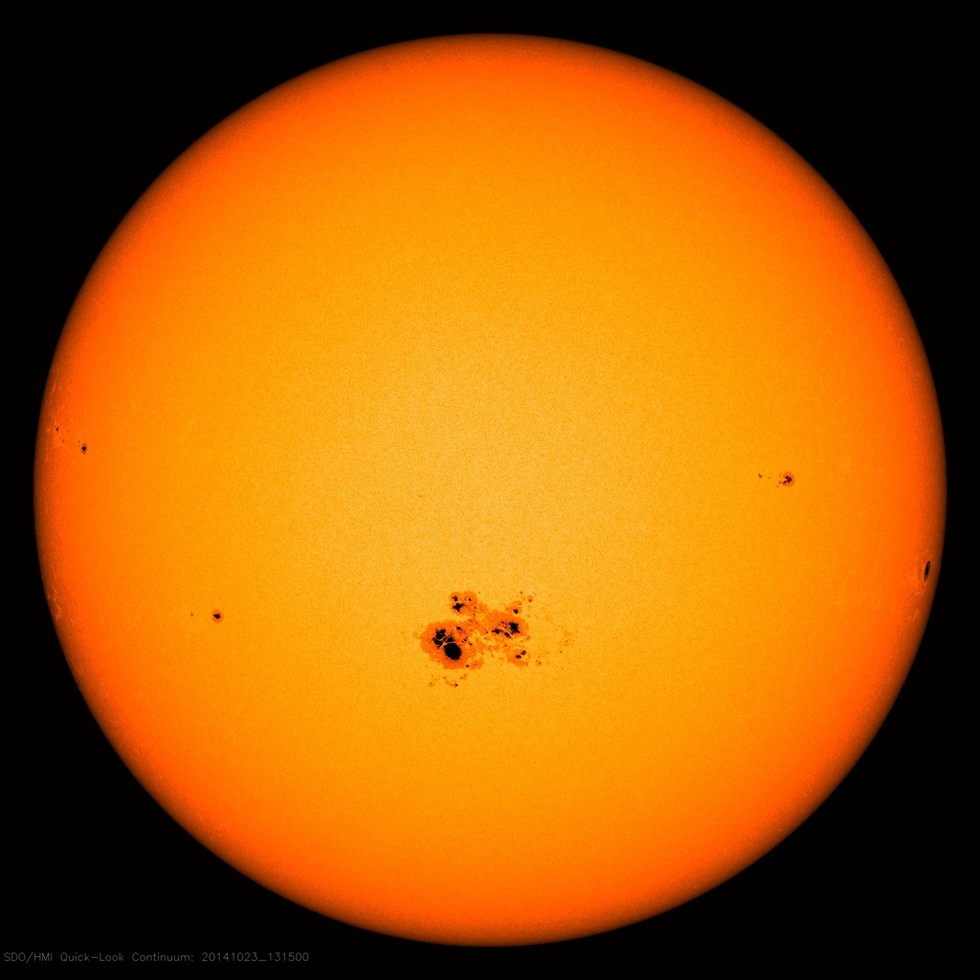
Proxima Centauri is a tiny, cool star one-tenth the size of our sun. Our sun has a regular "solar cycle" lasting approximately 11 years where magnetic activity will wax and wane. During periods of intense magnetic activity (called solar maximum) in the sun's lower atmosphere (known as the corona), we can expect frequent flares and coronal mass ejections. At this time, the sun's surface can become peppered with dark sunspots, highlighting regions where the sun's inner magnetic field is erupting through the surface (pictured above). Though dramatic, at solar maximum only around 1 percent of the sun's surface will be covered with these blemishes.

After studying Proxima Centauri, however, measurements show that a whopping 20 percent of the tiny star's surface may be covered with very dramatic-looking star spots.

This is interesting on many levels, but it may have exposed a gap in our knowledge of how our own sun works.

The key theory that drives our sun's 11-year cycle is differential rotation. Basically, the sun's upper layer rotates faster at its equator than at the poles. As its magnetic field travels from north to south, it is thought the internal magnetic field at the equator becomes "wrapped" around the sun, like an elastic band being wrapped around a ball. At a certain point, when the magnetic field is at its most stressed (solar max), the pressure is released when the magnetic polarity flips. The sun's magnetic "north" replaces the "south" and vice versa and the cycle begins again.

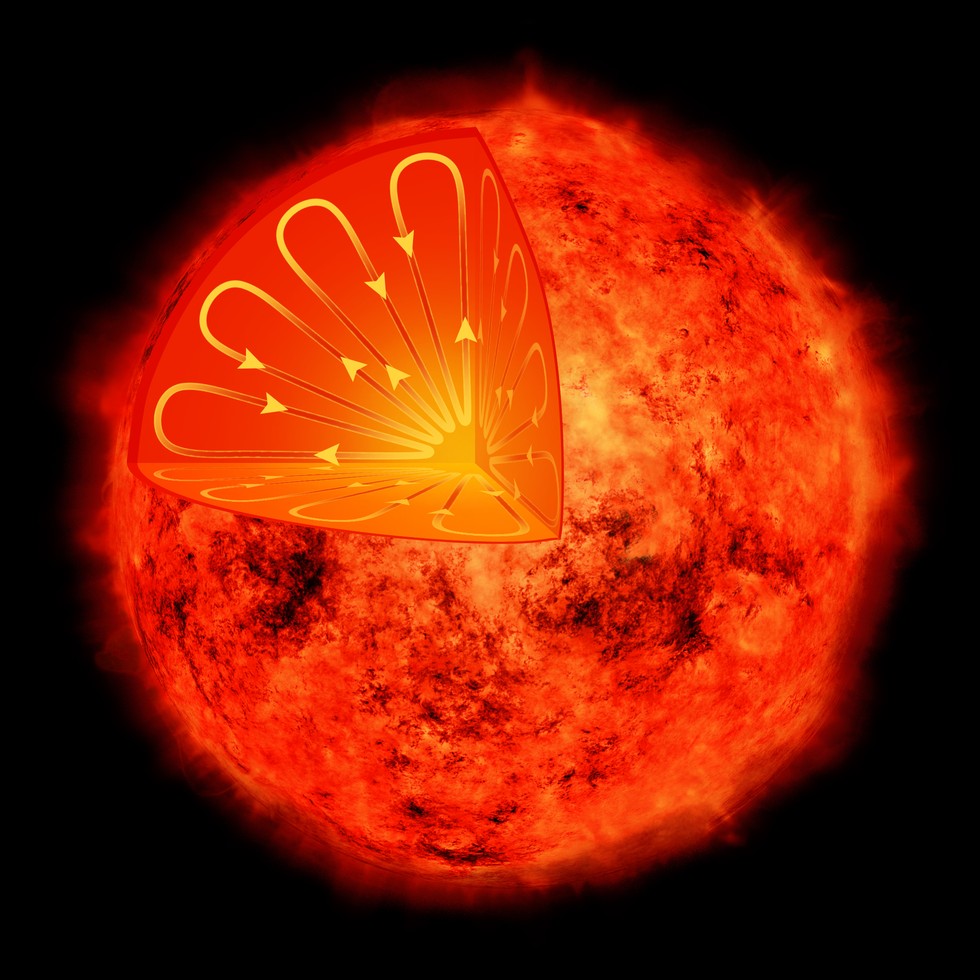
But red dwarfs like Proxima Centauri aren't thought to possess this uppermost differential rotation layer as they are too small; instead it is thought they experience convection from the core to the uppermost layer (pictured above). Without differential rotation, it's a mystery how Proxima Centauri can have a cycle, let alone a regular 7-year stellar cycle.

Read more at Discovery News

Skin Impression From Europe's 'Last Dinosaur' Found

Some 66 million years ago, a large sauropod dinosaur rested in a patch of mud along a river bank in what is now Spain, leaving behind fossil skin impressions recently found by scientists.

The impressions in the mud were later covered by sand that ultimately petrified into sandstone, forming a relief of the creature's skin as it was at the moment of its rest along the river.

Researchers from the Universitat Autònoma de Barcelona (UAB) and the Institut Catala de Paleontologia Miquel Crusafont (ICP) made the find during a geology expedition in the village of Vallcebre, close to Barcelona. The discovery is unique, they say, thanks to the age of the impressions, which date to the Late Cretaceous, just before dinosaurs went extinct.

UAB researcher Victor Fondevilla, lead author of a study on the find, said in a statement that while other fossilized skin samples of similar vintage have been found, they have only turned up in the United States and Asia. That makes the new skin impressions the vestiges of some of Europe's last dinosaurs.

"This is the only registry of dinosaur skin from this period in all of Europe," Fondevilla said, "and it corresponds to one of the most recent specimens — closer to the extinction event — in all of the world."

The researchers think the scales are too large to have belonged to the typical carnivores or herbivorous hadrosaurs of the day. Instead, they surmise the skin belonged to a large, plant-eating sauropod — "maybe a titanosaurus," said Fondevilla — due to footprints they found from such an animal near the skin impression fossils.

All told, the team found two skin impressions — one 5 centimeters (2 inches) wide, the other 20 centimeters (8 inches) — likely made by the same dinosaur.

"The fact that they are impression fossils is evidence that the animal is from the sedimentary rock period, one of the last dinosaurs to live on the planet," said Fondevilla.

"When bones are discovered," he explained, "dating is more complicated because they could have moved from the original sediment during all these millions of years."

Looking ahead, the skin impressions "represent a valuable tool for analyzing the last occurrences of the sauropod clade before the [mass] extinction," the scientists wrote.

The researchers' findings have been published in Geological Magazine.

From Discovery News

Oct 13, 2016

Our Universe Has 10-20 Times More Galaxies Than Thought

A new headcount of galaxies in the observable universe turned up 10- to 20 times more galaxies than previous estimates, bringing the tally up to as many as 2 trillion, a new study shows.

The missing members of the galactic family tree are most small, dim collections of stars that formed during the universe's early days. Space took up less space back then and the galaxies were crammed together, compared to today's expanded universe.

The Hubble Space Telescope peered long and deep into a small patch of the sky in the mid-1990s, revealing thousands of galaxies stretching back into time. Extrapolating from the analysis, scientists estimated the observable universe is filled with 100 billion- to 200 billion galaxies, said astronomer Christopher Conselice, with the United Kingdom's University of Nottingham.

Now, a new analysis of the Hubble Deep-Field images, combined with other data, shows that estimate is just 10- to 20 percent of the total number of galaxies, most of which are too faint to be seen by present-day telescopes, Conselice and colleagues wrote in a paper to be published in The Astrophysical Journal.

The scientists converted Hubble and other telescopes' images into three-dimensional maps so they could calculate the density of galaxies and estimate the volumes of each successive region of space.

"This painstaking research enabled the team to establish how many galaxies we have missed — much like an intergalactic archaeological dig … The results of this study are based on the measurements of the number of observed galaxies at different epochs — different instances in time — through the universe's history," the University of Nottingham wrote in a press release

Conselice and colleagues found that there were significantly more galaxies at earlier times.

Read more at Discovery News

Jumping Spiders Hear You from Across the Room

At this moment you are probably in a room with a spider that can hear everything from your phone ringing to your conversations, according to new research on spiders that don't even have proper ears.

This discovery, detailed in Current Biology, was triggered by a completely unplanned event: a researcher's chair squeaked.

Paul Shamble was in a lab at Cornell University with colleague Gil Menda and others making neural recordings from the brains of jumping spiders. Shamble, who has since moved to Harvard, and the others were exploring how jumping spiders process visual information. While setting up an experiment, Menda's chair squeaked across the floor.

It was then that a speaker, set up to record the sounds of spider brain neurons firing, started to blast out multiple "pops." Whenever the chair squeaked, the popping followed.

"That was a really exciting moment for all of us in the lab," Shamble said.

Jumping spider.
He added that when he and his team did behavioral experiments later, "the response was really clear -- the jumping spiders would be wandering along and just stop instantly when the sound came on."

In short, if you have a squeaky chair in your room, you're probably driving the resident jumping spiders nuts. And the sounds aren't limited to squeaks, either.

"Jumping spider hearing is almost certainly sensitive enough to hear you talking," Shamble said, but added that such spiders are "really only sensitive to low frequency tones, so lots of human speech is too high for them to hear."

It's likely, he says, that spiders tune into lower frequency sounds as a sort of warning system. In the same way a shout might catch your attention and make you stop what you're doing, a low noise puts the spiders on alert.

Female Phidippus audax.
Spiders hear noises using sensory hairs, but it was thought that these hairs could only pick up very close sounds. This finding shows that jumping spiders actually have an acute sense of hearing.

"Their sensory hairs are basically everywhere, but especially on their legs and their head -- and there are lots of them, not just one or two," Shamble said. "That said, these are the only things they have for hearing sound; spiders don't seem to have proper ears at all."

As for why jumping spiders evolved such great hearing, the researchers suspect that they use the sense to listen for predators, such as parasitoid wasps. The ability could have a role in attracting and impressing mates. The spiders may also be listening for prey.

Since, as their name suggests, the spiders like to jump, they are known to pounce on people. Some are even black and red in color, causing some to think they are being attacked by a black widow, but Shamble said that these spiders hardly consider us to be prey.

Read more at Discovery News

Thirsty Concrete Reduces Runoff at Yellowstone Park

The iconic Old Faithful geyser at Yellowstone National Park spouts an impressive 3,700 to 8,400 gallons of water every hour. Perhaps more striking is the geothermal network below it, which supports nearly two-thirds of the entire Earth's geysers.

To preserve that network for as long as possible, the park is replacing thousands of square feet of crumbling, petroleum-based asphalt sidewalks with a semi-porous material called Flexi-Pave. Conventional sidewalks promote rivers of runoff that not only wash away soil and cause erosion, but also leach toxins into the ground.

Flexi-Pave is different. It absorbs 3,000 gallons of water per hour, which reduces runoff and returns the rainwater to the ground in a natural pattern, where it can replenish the geyser basin below.

Wait, it gets better. The material is made from a mix of used tires as well as bits of stone. The aggregate is held together with a polymer binder invented by Flexi-Pave manufacturer KBI, a partner along with Michelin on the project. And because the material becomes inert after its manufactured, no toxins leach into the soil as the rainwater flows through it.

KBI just paved a 4,160-square-foot path near Old Faithful, the second phase of the Old Faithful Walkway Project. For this section, they ground up more than 1,500 used Michelin tires. Back in Sept. 2015, KBI repurposed 900 end-of-life tires.

"Helping to create a next-generation trail system in Yellowstone National Park is very gratifying," Kevin Bagnall, CEO and founder of KBI said in a press statement. "Flexi-Pave not only provides an environmentally friendly solution for the Old Faithful area, it prevents thousands of old tires from ending up in a landfill or being burned for fuel."

Watch the video to see KBI's crew laying down the Flexi-Pave in America's oldest national park.

From Discovery News

Moon Craters Appearing Faster Than Thought

New craters are forming on the surface of the moon more frequently than scientists had predicted, a new study has found. The discovery raises concerns about future moon missions, which may face an increased risk of being hit by falling space rocks.

The moon is dotted with a vast number of craters, some billions of years old. Because the moon has no atmosphere, falling space rocks don't burn up like they do on Earth, which leaves the moon's surface vulnerable to a constant stream of cosmic impacts that gradually churn the top layer of material on its surface. You can see a before-and-after video of a new moon crater here.

Previous studies of lunar craters shed light on how they formed and on the past rate of cratering, which in turn yielded insights on the age of various features of the moon's surface. However, less was known about the contemporary rate of lunar crater formation, which could give insight on the risk of bombardment that any missions to the moon might face.

To find out more about the present lunar crater formation rate, a group of scientists analyzed more than 14,000 pairs of before-and-after images of the moon's surface, taken by NASA's Lunar Reconnaissance Orbiter (LRO). These images covered 6.6 percent of the lunar surface — about 960,000 square miles (2.49 million square kilometers) — and could reveal when a spot was crater-free and when it later had a crater. The time gaps between observations spanned between 176 and 1,241 Earth days.

A 39-foot (12 meter) diameter impact crater formed between Oct. 25, 2012, and April 21, 2013, and was discovered in a before-and-after image created from two Narrow Angle Camera (NAC) images. The image covers an area 1,200 m wide.
"When looking at just a single image, many of the newly formed features are indistinguishable from their surroundings," said study lead author Emerson Speyerer, a planetary scientist at the Arizona State University at Tempe. "It's only with these detailed comparisons with previous images that we can separate out these small surface changes.

The researchers discovered 222 craters on the moon that appeared on the surface after the first LRO images were taken — that is 33 percent more than predicted by current models. These were at least 32 feet (10 meters) across, and ranged up to about 140 feet (43 m) wide.

The top image shows a low-reflectance splotch, while the bottom image shows a high-reflectance splotch that was created by a small impactor or secondary ejecta from a larger impact. In either case, the top few centimeters of the regolith (soil) was churned.
The scientists also found broad zones around these new craters that they interpreted as the remains of jets of debris following impacts. They estimated this secondary cratering process is churning the top 0.8 inches (2 centimeters) of lunar dirt, or regolith, across the entire lunar surface more than 100 times faster than thought.

"I'm excited by the fact that we can see the regolith evolve and churn — a process that was believed to take hundreds of thousands to millions of years to occur — in images acquired over the past several years," Speyerer told Space.com.

These new findings also suggest that a number of young features on the moon's surface, such as recent volcanic deposits, "may in fact be even a bit younger than previously thought," Speyerer said.

Read more at Discovery News