Jul 3, 2018

Marine mammals most at risk from increased Arctic ship traffic

Beluga whales in the pack ice in West Greenland. Ships using the Northwest Passage would travel through Baffin Bay off Greenland’s west coast.
In August 2016, the first large cruise ship traveled through the Northwest Passage, the northern waterway linking the Atlantic and Pacific oceans. The following year, the first ship without an icebreaker plied the Northern Sea Route, a path along Russia's Arctic coast that was, until recently, impassable by unescorted commercial vessels.

In recent decades parts of the Arctic seas have become increasingly ice-free in late summer and early fall. As sea ice is expected to continue to recede due to climate change, seasonal ship traffic from tourism and freight is projected to rise. A study from the University of Washington and the University of Alaska Fairbanks is the first to consider potential impacts on the marine mammals that use this region during fall and identify which will be most vulnerable.

The study is published the week of July 2 in the Proceedings of the National Academy of Sciences. "We know from more temperate regions that vessels and whales don't always mix well, and yet vessels are poised to expand into this sensitive region," said lead author Donna Hauser, who did the research as a postdoctoral researcher at the UW and is now a research assistant professor at the University of Alaska Fairbanks. "Even going right over the North Pole may be passable within a matter of decades. It raises questions of how to allow economic development while also protecting Arctic marine species."

The study looked at 80 subpopulations of the seven marine mammals that live in the Arctic and identified their risks on or near major shipping routes in September, a month when the Arctic Ocean has the most open water.

Forty-two of these subpopulations would be exposed to vessel traffic, and the degree of exposure plus the particular characteristics of each species determine which are most sensitive.

The most vulnerable marine mammals were found to be narwhals, or tusked whales. These animals migrate through parts of the Northwest Passage to and from their summertime habitats.

"Narwhals have all the traits that make them vulnerable to vessel disturbances -- they stick to really specific areas, they're pretty inflexible in where they spend the summer, they live in only about a quarter of the Arctic, and they're smack dab in the middle of shipping routes," said co-author Kristin Laidre, a polar scientist at UW Applied Physics Laboratory's Polar Science Center. "They also rely on sound, and are notoriously skittish and sensitive to any kind of disturbance."

Other mammals found to be vulnerable were beluga and bowhead whales. Walruses also were vulnerable because some populations are relatively small and known to live along shipping routes, compared to generally large and widely distributed populations of ringed and bearded seals, which were shown to be less vulnerable.

The study found the least vulnerable animals were polar bears, which are largely on land during September, and don't rely on underwater sound for communication or navigation. Shipping in other seasons may have a greater impact.

The paper also identified two "pinch points," narrow passageways where ships and animals are most likely to intersect. These are the Bering Strait that separates the U.S. and Russia, and Lancaster Sound in the northern Canadian territory of Nunavut. These regions had a risk of conflicts two to three times higher than on other parts of the shipping route.

"These obligatory pinch points are used by migratory species to get in and out of the Arctic, but they are also necessary passageways for vessels using these sea routes," Hauser said. "Identifying the relative risks in Arctic regions and among marine mammals can be helpful when establishing strategies to deal with potential effects."

Travel through the Arctic Ocean is already beginning, with the Russian route having the most potential for commercial ships. The Northern Sea Route had more than 200 ships from 2011 to 2016, all of which were large vessels. More than 100 vessels passed through the Northwest Passage during that time, with more than half being small, private vessels like personal yachts.

The International Maritime Organization in May established the first international guidelines for vessel traffic in the Arctic Ocean. The voluntary code was proposed by the U.S. and Russia to identify safe routes through the Bering Strait.

The new study could help to create future guidelines, prioritize different measures to protect marine mammals and identify areas needing further study, the authors said.

Read more at Science Daily

Oldest evidence of horse veterinary care discovered in Mongolia

Horses congregate near a deer stone site in Bayankhongor, in central Mongolia's Khangai mountains.
A team of scholars, led by William Taylor of the Max Planck Institute for the Science of Human History, analyzed horse remains from an ancient Mongolian pastoral culture known as the Deer Stone-Khirigsuur Culture (ca. 1300-700 BC). Deer stones, with their beautiful deer carvings, and their accompanying stone mounds (khirigsuurs) are famous for the impressive horse burials that are found alongside them in the dozens, hundreds, or even thousands. Through careful study of skeletal remains from these burials, published in Proceedings of the National Academy of Sciences and funded in part by a grant from the National Geographic Society, Taylor and colleagues found that Deer Stone-Khirigsuur people began using veterinary dental procedures to remove baby teeth that would have caused young horses pain or difficulty with feeding -- the world's oldest known evidence for veterinary dental care.

Previous research has shown that these early herders were the first in eastern Eurasia to rely heavily on horses as livestock for food products, and may have been among the first to use horses for mounted riding. Drawing on insights from his Mongolian colleagues, Jamsranjav Bayarsaikhan and Tumurbaatar Tuvshinjargal of the National Museum of Mongolia, Taylor argues that the development of horseback riding and a horse-based pastoral economy was a key driver for the invention of equine veterinary care. "We may think of veterinary care as kind of a Western science," he says, "but herders in Mongolia today practice relatively sophisticated procedures using very simple equipment. This results of our study show that a careful understanding of horse anatomy and a tradition of care was first developed, not in the sedentary civilizations of China or the Mediterranean, but centuries earlier, among the nomadic people whose livelihood depended on the well-being of their horses."

Additionally, Taylor and his team discovered that changes in horse dentistry accompanied major developments in horse control technology, including the incorporation of bronze and metal mouthpieces into bridles used for riding. This equipment, which spread into eastern Eurasia during the early first millennium BC, gave riders more nuanced control over horses, and allowed them to be used for new purposes -- especially warfare. However, using metal to control horses also introduced new oral problems, including painful interactions with a vestigial tooth that develops in some animals, known as a "wolf tooth." Taylor and his team discovered that, as herders began to use metal bits, they also developed a method for extracting this problematic tooth -- similar to the way most veterinary dentists would remove it today.

Read more at Science Daily

'Cataclysmic' collision shaped Uranus' evolution

The collision with Uranus of a massive object twice the size of Earth that caused the planet's unusual spin, from a high-resolution simulation using over ten million particles, coloured by their internal energy.
Uranus was hit by a massive object roughly twice the size of Earth that caused the planet to tilt and could explain its freezing temperatures, according to new research.

Astronomers at Durham University, UK, led an international team of experts to investigate how Uranus came to be tilted on its side and what consequences a giant impact would have had on the planet's evolution.

The team ran the first high-resolution computer simulations of different massive collisions with the ice giant to try to work out how the planet evolved.

The research confirms a previous study which said that Uranus' tilted position was caused by a collision with a massive object -- most likely a young proto-planet made of rock and ice -- during the formation of the solar system about 4 billion years ago.

The simulations also suggested that debris from the impactor could form a thin shell near the edge of the planet's ice layer and trap the heat emanating from Uranus' core. The trapping of this internal heat could in part help explain Uranus' extremely cold temperature of the planet's outer atmosphere (-216 degrees Celsius, -357 degrees Fahrenheit), the researchers said.

The findings are published in The Astrophysical Journal.

Lead author Jacob Kegerreis, PhD researcher in Durham University's Institute for Computational Cosmology, said: "Uranus spins on its side, with its axis pointing almost at right angles to those of all the other planets in the solar system. This was almost certainly caused by a giant impact, but we know very little about how this actually happened and how else such a violent event affected the planet.

"We ran more than 50 different impact scenarios using a high-powered super computer to see if we could recreate the conditions that shaped the planet's evolution.

"Our findings confirm that the most likely outcome was that the young Uranus was involved in a cataclysmic collision with an object twice the mass of Earth, if not larger, knocking it on to its side and setting in process the events that helped create the planet we see today."

There has been a question mark over how Uranus managed to retain its atmosphere when a violent collision might have been expected to send it hurtling into space.

According to the simulations, this can most likely be explained by the impact object striking a grazing blow on the planet. The collision was strong enough to affect Uranus' tilt, but the planet was able to retain the majority of its atmosphere.

The research could also help explain the formation of Uranus' rings and moons, with the simulations suggesting the impact could jettison rock and ice into orbit around the planet. This rock and ice could have then clumped together to form the planet's inner satellites and perhaps altered the rotation of any pre-existing moons already orbiting Uranus.

The simulations show that the impact could have created molten ice and lopsided lumps of rock inside the planet. This could help explain Uranus' tilted and off-centre magnetic field.

Uranus is similar to the most common type of exoplanets -- planets found outside of our solar system -- and the researchers hope their findings will help explain how these planets evolved and understand more about their chemical composition.

Co-author Dr Luis Teodoro, of the BAER/NASA Ames Research Center, said: "All the evidence points to giant impacts being frequent during planet formation, and with this kind of research we are now gaining more insight into their effect on potentially habitable exoplanets."

Read more at Science Daily

Jul 2, 2018

Cracking the genetic code of koalas

Mother koala with baby on her back.
A team of Australian and international scientists, led by Professor Rebecca Johnson, Director of the Australian Museum Research Institute and Professor Katherine Belov, University of Sydney, have made a significant break-through successfully sequencing the full koala genome, with the findings published today in Nature Genetics.

Considered to be the most complete marsupial genome sequenced to date, it is in terms of quality, on par with the human genome. The highly accurate genomic data will provide scientists with new information that will inform conservation efforts, aid in the treatment of diseases, and help to ensure the koala's long-term survival.

"The Koala Genome Consortium has been an ambitious journey affording us great insights into the genetic building blocks that make up a koala -- one of Australia's, as well as the world's, most charismatic and iconic mammals," Professor Johnson said.

"This milestone has come from our vision to use genomics to conserve this species. The genetic blueprint has not only unearthed a wealth of data regarding the koalas unusual and highly specialised diet of eucalyptus leaves, but also provides important insights into their immune system, population diversity and the evolution of koalas," she said.

Co-lead author at the University of Sydney, Professor of Comparative Genomics, Katherine Belov said:

"The genome provides a springboard for the conservation of this biologically unique species."

The Australian led consortium of scientists comprised 54 scientists from 29 different institutions across seven countries. They have sequenced over 3.4 billion base pairs and more than 26,000 genes in the Koala genome -- which makes it slightly larger than the human genome. Unlocking the genomic sequence gives scientists unprecedented insights into the unique biology of the koala.

Professor Johnson said the uneven response of koala populations throughout their range was one of the major challenges facing broad scale management of the species.

"The genome enables a holistic and scientifically grounded approach to koala conservation," she said. "Australia has the highest mammal extinction record of any country during the Anthropocene.

"Koala numbers have plummeted in northern parts of its range since European settlement, but have increased in some southern parts, notably in Victoria and South Australia."

Director and CEO, Australian Museum, Kim McKay, AO congratulated Professor Johnson and the team on this achievement.

"Today we celebrate the completion of the highest quality, marsupial genome sequencing undertaken to date. This work was brought about through the meticulous efforts not only of Professor Johnson and Professor Belov, but also the contributions from many other Australian Museum scientists, as well as scientists from around the nation and the world. It will usher in a new era in our understanding and conservation of the iconic koala," she said.

Professor Jennifer Graves, AO, Distinguished Professor of Genetics, La Trobe University and winner of the 2017 PM's Prize for Science, said: "We could never have imagined, when we were pioneering koala genetics in the 1980s, that one day we'd have the entire koala genome sequence. This opens up all sorts of ways we can monitor the genetic health of koala populations."

The Koala Genome Consortium announced the establishment of the project in 2013 with its first unassembled draft genome. The collective aim was to steer their research towards ensuring the long-term survival of this important marsupial while simultaneously increasing Australia's genomics capability.

Since then, researchers have worked tirelessly to assemble this genome into the most complete and accurate marsupial genome to date and annotate its 26,000 genes for analysis. The koala genome has been sequenced to an accuracy of 95.1%, which is comparable to that of the human genome.

The 3.4 billion base pairs of the published Koala genome were sequenced at the Ramaciotti Centre for Genomics, at the University of New South Wales, using new sequencing technology.

"We then assembled the genome with supercomputers, allowing the Consortium to then study the >20,000 genes of this unique species," said Professor Marc Wilkins, Director, Ramaciotti Centre for Genomics, UNSW.

Consortium members from the Earlham Institute (EI), (Norwich, UK) identified that koalas have two large expansions in a gene family known to be integral to detoxification, the Cytochrome P450 gene family of metabolic enzymes. They found these genes to be expressed in many koala tissues, particularly in the liver; indicating they have a very important function in detoxification and likely allowed koalas to become dietary specialists.

As Professor Johnson explains, "this probably helped them to find their niche to survive, as they could rely on a food source that would have less competition from other species who were not able to detoxify as effectively."

Dr Will Nash in the Haerty Group at Earlham Institute, said: "Gene duplication can lead to copies of genes associated with specific functions being retained in the genome. In the Koala, the largest group of retained copies make an enzyme that breaks down toxins. This means the Koala has evolved an excellent toolkit to deal with eating highly toxic eucalypts, one made up of lots of copies of the same (or very similar) tools."

According to Professor Belov, another important discovery was the characterisation of the composition of koala milk. Like all marsupials, koalas do the majority of their development in the pouch. They are born without an immune system after 34-36 days gestation and spend ~6 months developing in the pouch.

"We characterised the main components of the mothers' milk -- which is crucial for koala joeys -- born the size of a kidney bean and weighing half of one gram," Professor Belov said.

"We identified genes that allow the koala to finetune milk protein composition across the stages of lactation, to meet the changing needs of their young."

"Thanks to the high-quality genome, the team was able to analyse and discover koala-specific milk proteins that are critical for various stages of development. It also appears these proteins may have an antimicrobial role, showing activity against a range of bacterial and fungal species, including Chlamydia pecorum, the strain known to cause ocular and reproductive disease in koalas," she said.

Chlamydia causes infertility and blindness and has severely impacted koala populations in New South Wales and Queensland. Using information gained from the koala genome, scientists hope to develop a vaccine to fight diseases like Chlamydia.

Professor Peter Timms, University of the Sunshine Coast said: "In addition to Chlamydia, the other major infection that is threatening the species is koala retrovirus (KoRV), however very little is presently known about it. The complete koala genome has been instrumental in showing that an individual koala can have many (more than a hundred) insertions of KoRV into its genome, including many versions of KoRV.

"This information will enable to determine which strains of KoRV are more dangerous and to assist with our development of a KoRV vaccine," he said.

One of the most threatening processes to koala survival is loss of habitat through land clearing and urbanisation which results in a reduction of habitat connectivity, reduced genetic diversity and puts koalas at high risk of inbreeding. The results of inbreeding can be highly detrimental to survival of those koala populations as it leads to reduced genetic diversity.

Professor Johnson added: "For the first time, using over 1000 genome linked markers, we are able to show that NSW and QLD populations show significant levels of genetic diversity and long-term connectivity across regions.

"Ensuring this genetic diversity is conserved in concert with other conservation measures to protect habitat, reduce vehicle strikes, dog attacks and disease, are the keys to the long-term survival of the koala."

Dr Graham Etherington in the Di Palma Group at the Earlham Institute, said: "With its puppy-dog looks, the Koala is an internationally recognised species. But this iconic Australian marsupial is not just a pretty face.

"The Koala genome assembly is by far the most comprehensive marsupial genomic resource to date, which allows us an insight into how this unique animal came to be and provides us with information about potential threats to its survival. It also provides us with an excellent platform to launch further marsupial genome projects that could look into potential genetic reservoirs of previously unknown anti-microbial genes that could be leveraged for human health.

"Additionally, it provides us with an incredible amount of information about genetic diversity across different populations of koalas that can be used as a benchmark for further studies on other endangered marsupial species."

This genomic sequencing represents the new generation of science-based conservation policy as it has already been integrated as an important pillar into the NSW Koala Strategy 2018.

All of the sequence data generated by The Koala Genome Consortium has been deposited into public databases and made freely available to scientists around the world.

"Not only does open data promote the best interests of science, it also maximises the benefits that the koala populations, and the public, receive from such research," Professor Johnson said.

The koala (Phascolarctos cinereus) is a native tree-dwelling Australian marsupial that is one of the world's most fascinating and iconic mammals. Not only is the koala synonymous with Australia it is also a powerful international symbol for the preservation and conservation of our natural world.

Wild koalas are currently found in eucalypt forest and woodlands across Eastern Australia (Victoria, New South Wales and Queensland) and have been translocated to other sites, such as south eastern South Australia and onto some islands such as Kangaroo Island, South Australia and French Island,Victoria.

Their unique and highly specific diet of eucalyptus (gum) tree leaves, has resulted in koalas being especially vulnerable to habitat loss due to the clearing of native vegetation for agriculture and urban development. The Australian Federal government lists koala populations in Queensland, New South Wales and Australian Capital Territory as 'Vulnerable' under national environment law.

Read more at Science Daily

Stability of Earth: Scientists propose solution to 'Gaia puzzle'

Earth.
Scientists may have solved a long-standing puzzle over why conditions on Earth have remained stable enough for life to evolve over billions of years. The 'Gaia' hypothesis proposed that living things interacting with inorganic processes somehow keep the planet in a state where life can persist -- despite threats such as a brightening sun, volcanoes and meteorite strikes.

The puzzle of how this might work has divided experts for decades, but a team led by scientists from the University of Exeter have proposed a solution. They say stability could come from "sequential selection" in which situations where life destabilises the environment tend to be short-lived and result in further change until a stable situation emerges, which then tends to persist.

Once this happens, the system has more time to acquire further traits that help to stabilise and maintain it -- a process known as "selection by survival alone."

"We can now explain how the Earth has accumulated stabilising mechanisms over the past 3.5 billion years of life on the planet," said Professor Tim Lenton, of the University of Exeter.

"The central problem with the original Gaia hypothesis was that evolution via natural selection cannot explain how the whole planet came to have stabilising properties over geologic timescales."

"Instead, we show that at least two simpler mechanisms work together to give our planet with life self-stabilising properties."

He added: "Our findings can help explain how we came to be here to wonder about this question in the first place."

Professor Dave Wilkinson, of the University of Lincoln, who was also involved in the research, added: "I have been involved in trying to figure out how

Gaia might work for over 20 years -- finally it looks like a series of promising ideas are all coming together to provide the understanding I have been searching for."

Dr James Dyke, of the University of Southampton, also an author on the paper, said: "As well as being important for helping to estimate the probability of complex life elsewhere in the universe, the mechanisms we identify may prove crucial in understanding how our home planet may respond to drivers such as human-produced climate change and extinction events."

Creating transformative solutions to the global changes that humans are now causing is a key focus of the University of Exeter's new Global Systems Institute, directed by Professor Lenton, who said: "We can learn some lessons from Gaia on how to create a flourishing, sustainable, stable future for 9-11 billion people this century."

Read more at Science Daily

Loss of lemurs might endanger many of Madagascar's largest tree species

This is a Black-and-white ruffed lemur.
Widespread logging and hunting have endangered virtually all of Madagascar's 100-plus species of iconic lemurs, and a new study by Rice University ecologists illustrates how saving the animals may also be key to saving the island's largest trees.

"Forest loss is a huge problem in Madagascar right now, but our study suggests that just saving the trees is not enough," said Amy Dunham, associate professor of biosciences at Rice and co-author of a paper appearing online today in a special issue of the International Journal of Primatology. "Not only are we facing the loss of these unique, charismatic animals, we're also losing their role in the ecosystem. Without lemurs, the rainforests themselves will change because the lemurs alone disperse the seeds of many of the forests' largest hardwoods."

The study builds upon nearly a decade of collaborative work by Dunham and lead author Onja Razafindratsima at the island nation's Ranomafana National Park.

Lemurs mostly eat fruit, and for many of the largest trees in Madagascar, lemurs are the only animals large enough to ingest the seeds of their fruit. By dispersing seeds throughout the forest in their scat, lemurs serve as the unwitting gardeners of these large canopy trees.

In earlier work, Razafindratsima meticulously tracked 24 groups of lemurs for three years and showed that the seeds of one species of canopy tree had a 300 percent greater chance of sprouting and becoming a sapling when they were dispersed by lemurs as opposed to simply falling to the ground.

"That work and other studies have suggested that lemur loss is likely to reduce regeneration of trees that rely on lemurs for seed dispersal," Dunham said. "In the latest study, we wanted to take a broader approach to understanding how the forest might change with lemur loss."

In 2016, Rice undergraduate Anecia Gentles joined Dunham's research group and spent a year examining characteristics of rainforest trees and programming computational models to estimate how the forest would change if lemurs disappeared. Rice graduate student Andrea Drager also joined the effort, and the team showed that lemurs are not only important as gardeners of the forest but also likely play an important role in forest carbon sequestration.

"We found that lemurs are the primary seed dispersers of the largest canopy trees," said Gentles, who graduated from Rice in May. "The models suggested that the loss of lemurs and the trees they disperse could lead to increasing abundances of smaller, fast-growing tree species with lighter wood."

Dunham said, "The biggest trees in Madagascar are dense hardwoods that grow more slowly but also store more carbon. They also tend to have the biggest seeds."

The team used trait measurements from more than 7,000 trees of nearly 300 species. The data were collected as part of the Tropical Ecology Assessment and Monitoring (TEAM) Network, a yearslong effort led by study co-authors Jean-Claude Razafimahaimodison and Claude Ralazampirenena, Malagasy scientists from the Centre ValBio, a research station at Ranomafana National Park.

"We used TEAM Network data, new data and previously published data on animal seed dispersal in the park to make models that show what would happen if lemur-dispersed trees started disappearing and were replaced by trees whose seeds are dispersed by birds, the wind or other methods less affected by human activities," Dunham said.

The models explored how the makeup of the forests might change in different scenarios ranging from one in which lemur-dispersed trees declined by 25 percent to an extreme case where all lemur-dispersed trees were wiped out.

"There still would be a forest, but the makeup of trees would be quite different, and the forest's ability to sequester carbon would be greatly diminished," Dunham said. "For example, in the case where all lemur-dispersed trees disappear from just one hectare of forest, a patch of 2 1/2 acres, the average loss of above-ground biomass is 24 metric tons -- or almost 53,000 pounds."

She said the findings have implications for initiatives like the United Nations' REDD program, which incentivizes carbon sequestration through forest conservation.

"The goal of such programs is to preserve forests, because there's a lot of carbon in the biomass of trees," Dunham said. "At the same time, tropical forest ecosystems globally are threatened by the loss of large fruit-eating animals, and there's growing evidence that we need to think more holistically about conserving functioning ecosystems in order to save forests.

"For Malagasy forests, our study connects the dots and shows that integrated forest protection and lemur conservation are required in order to maximize carbon-storage potential," she said.

Read more at Science Daily

Neanderthals practiced close-range hunting 120,000 years ago

Estimated impact angle shown in relation to a standing fallow deer for the hunting lesion observed in the pelvis of an extinct fallow deer killed by Neanderthals 120,000 years ago on a lakeshore close to current-day Halle in Germany.
An international team of scientists reports the oldest unambiguous hunting lesions documented in the history of humankind. The lesions were found on skeletons of two large-sized extinct fallow deer killed by Neandertals about 120,000 years ago around the shores of a small lake (Neumark-Nord 1) near present-day Halle in the eastern part of Germany. The study was led by Professor Sabine Gaudzinski-Windheuser of the Department of Ancient Studies at Johannes Gutenberg University Mainz (JGU) and was now published in the journal Nature Ecology and Evolution.

The study constitutes a significant step forward in our knowledge of the Neandertal niche. It demonstrates how Neandertals obtained their prey, first and foremost in terms of their much debated hunting equipment while also shedding light on their hunting skills.

With an innovative experimental ballistic setup including state-of-the-art motion-sensor technology, the researchers were able to reproduce the specific form of one of the lesions. The results prove the use of a wooden thrusting spear that was impacted with low velocity. This suggests that Neandertals approached animals very closely and thrusted rather than threw their spears at the animals, most likely from an underhand thrusting angle. Such a confrontational way of hunting required careful planning and concealment as well as close cooperation between individual hunters.

The lake where the hunts took place was surrounded by a close canopy forest, a type of environment deemed particularly challenging for hunter-gatherers, even modern human ones. Interestingly, the excavations in the Neumark-Nord area have yielded tens of thousands of bones of large mammals, including red and fallow deer, horses, and bovids, as well as thousands of lithic artefacts from this uniquely rich Last Interglacial lake landscape, attesting to the success of Neandertal survival in forested environments.

"Although hominins most likely started hunting with weapons more than 500,000 years ago, actual evidence on how wooden spear-like objects like those found at Clacton-on-Sea in England as well as in Schöningen and Lehringen in German were used was absent prior to the identification of the Neumark-Nord hunting lesions," stated Gaudzinski-Windheuser. "As far as spear use is concerned, we now finally have the crime scene fitting to the proverbial smoking gun."

From Science Daily

Astronomers Capture the First Image of a Planet Being Born

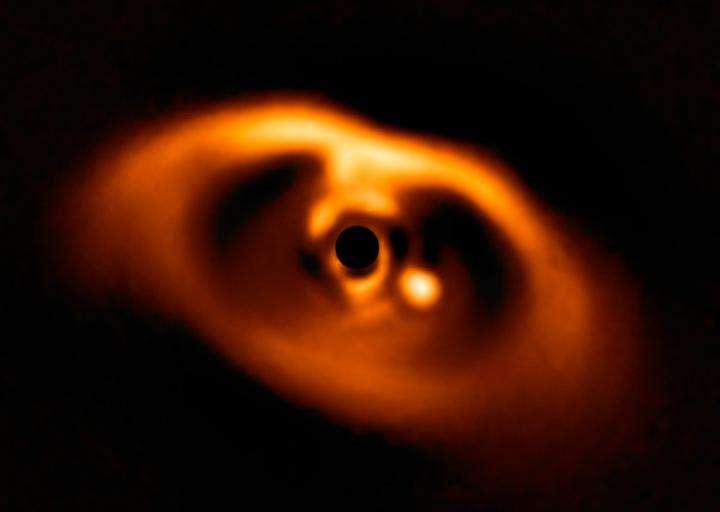
This image from the SPHERE instrument on ESO's Very Large Telescope is the first clear image of a planet caught in the act of formation around the dwarf star PDS 70. The planet stands clearly out, visible as a bright point to the right of the center of the image, which is blacked out by the coronagraph mask used to block the blinding light of the central star.
An international team of astronomers has released the first image ever captured of a planet being born in deep space.

The image, captured with advanced, surface-based telescopes, shows the new planet developing around the dwarf star PDS 70, which is located around 370 light-years from Earth.

The new planet — named PDS 70b — is orbiting roughly three billion miles from the central star, around the same distance between Uranus and the sun. Further analysis shows that the new planet is a giant gas planet with a total mass several times that of Jupiter. The planet is much hotter than anything in our solar system, too, with a surface temperature of around 1,000 degrees Celsius.

The image was produced by an advanced piece of equipment within the Very Large Telescope array at the European Southern Observatory's facility in northern Chile. The SPHERE device — which stands for Spectro-Polarimetric High-contrast Exoplanet REsearch instrument — studies exoplanets and discs around nearby stars using a technique known as high-contrast imaging.

The astronomy team that captured the new image was led a group from the Max Planck Institute for Astronomy in Heidelberg, Germany.

To even be able to see the new planet, the telescope had to first block out the bright light of the central star itself. To that end, the SPHERE system incorporates a coronagraph, which obscures the blinding light of the central star and allows astronomers to detect the much fainter light bouncing off the planet and the spinning disk of coronal materials.

“These disks around young stars are the birthplaces of planets, but so far only a handful of observations have detected hints of baby planets in them,” lead researcher Miriam Keppler said in a statement released with the new image. “The problem is that until now, most of these planet candidates could just have been features in the disk.”

The discovery of PDS 70b is a significant event for astronomers, and subsequent teams of researchers are already following up on the initial research. In fact, it was a secondary team that captured the remarkable image.

The image isn't just pretty, either. By carefully parsing the data underlying the new imagery, astronomers are able to determine some of the planet's chemical and physical properties. This, in turn, enables scientists to test theoretical models of planet formation.

Read more at Seeker

Jul 1, 2018

New coatings make natural fabrics waterproof

Repellency of different liquids on polyester fabric coated with H1F7Ma-co-DVB: soy sauce (black drop), coffee (brown drop), HCl acid (top left transparent drop), NaOH (bottom right transparent drop) and water (remaining transparent drops).
Fabrics that resist water are essential for everything from rainwear to military tents, but conventional water-repellent coatings have been shown to persist in the environment and accumulate in our bodies, and so are likely to be phased out for safety reasons. That leaves a big gap to be filled if researchers can find safe substitutes.

Now, a team at MIT has come up with a promising solution: a coating that not only adds water-repellency to natural fabrics such as cotton and silk, but is also more effective than the existing coatings. The new findings are described in the journal Advanced Functional Materials, in a paper by MIT professors Kripa Varanasi and Karen Gleason, former MIT postdoc Dan Soto, and two others.

"The challenge has been driven by the environmental regulators" because of the phaseout of the existing waterproofing chemicals, Varanasi explains. But it turns out his team's alternative actually outperforms the conventional materials.

"Most fabrics that say 'water-repellent' are actually water-resistant," says Varanasi, who is an associate professor of mechanical engineering. "If you're standing out in the rain, eventually water will get through." Ultimately, "the goal is to be repellent -- to have the drops just bounce back." The new coating comes closer to that goal, he says.

Because of the way they accumulate in the environment and in body tissue, the EPA is in the process of revising regulations on the long-chain polymers that have been the industry standard for decades. "They're everywhere, and they don't degrade easily," Varanasi says.

The coatings currently used to make fabrics water repellent generally consist of long polymers with perfluorinated side-chains. The trouble is, shorter-chain polymers that have been studied do not have as much of a water-repelling (or hydrophobic) effect as the longer-chain versions. Another problem with existing coatings is that they are liquid-based, so the fabric has to be immersed in the liquid and then dried out. This tends to clog all the pores in the fabric, Varanasi says, so the fabrics no longer can breathe as they otherwise would. That requires a second manufacturing step in which air is blown through the fabric to reopen those pores, adding to the manufacturing cost and undoing some of the water protection.

Research has shown that polymers with fewer than eight perfluorinated carbon groups do not persist and bioaccumulate nearly as much as those with eight or more -- the ones most in use. What this MIT team did, Varanasi explains, is to combine two things: a shorter-chain polymer that, by itself, confers some hydrophobic properties and has been enhanced with some extra chemical processing; and a different coating process, called initiated chemical vapor deposition (iCVD), which was developed in recent years by co-author Karen Gleason and her co-workers. Gleason is the Alexander and I. Michael Kasser Professor of Chemical Engineering and associate provost at MIT. Credit for coming up with the best short-chain polymer and making it possible to deposit the polymer with iCVD, Varanasi says, goes primarily to Soto, who is the paper's lead author.

Using the iCVD coating process, which does not involve any liquids and can be done at low temperature, produces a very thin, uniform coating that follows the contours of the fibers and does not lead to any clogging of the pores, thus eliminating the need for the second processing stage to reopen the pores. Then, an additional step, a kind of sandblasting of the surface, can be added as an optional process to increase the water repellency even more. "The biggest challenge was finding the sweet spot where performance, durability, and iCVD compatibility could work together and deliver the best performance," says Soto.

The process works on many different kinds of fabrics, Varanasi says, including cotton, nylon, and linen, and even on nonfabric materials such as paper, opening up a variety of potential applications. The system has been tested on different types of fabric, as well as on different weave patterns of those fabrics. "Many fabrics can benefit from this technology," he says. "There's a lot of potential here."

The coated fabrics have been subjected to a barrage of tests in the lab, including a standard rain test used by industry. The materials have been bombarded not only with water but with various other liquids including coffee, ketchup, sodium hydroxide, and various acids and bases -- and have repelled all of them well.

The coated materials have been subjected to repeated washings with no degradation of the coatings, and also have passed severe abrasion tests, with no damage to the coatings after 10,000 repetitions. Eventually, under severe abrasion, "the fiber will be damaged, but the coating won't," he says.

Read more at Science Daily

Novel hybrid catalyst to split water discovered

Screenshot of video showing hybrid catalyst for water splitting (see video at: https://youtu.be/nkouqCFaqAk).
Researchers from the University of Houston and the California Institute of Technology have reported an inexpensive hybrid catalyst capable of splitting water to produce hydrogen, suitable for large-scale commercialization.

Most systems to split water into its components -- hydrogen and oxygen -- require two catalysts, one to spur a reaction to separate the hydrogen and a second to produce oxygen. The new catalyst, made of iron and dinickel phosphides on commercially available nickel foam, performs both functions.

Researchers said it has the potential to dramatically lower the amount of energy required to produce hydrogen from water while generating a high current density, a measure of hydrogen production. Lower energy requirements means the hydrogen could be produced at a lower cost.

"It puts us closer to commercialization," said Zhifeng Ren, M.D. Anderson Chair Professor of physics at UH and lead author of a paper describing the new catalyst published Friday in Nature Communications.

Hydrogen is considered a desirable source of clean energy, in the form of fuel cells to power electric motors or burned in internal combustion engines, along with a number of industrial uses. Because it can be compressed or converted to liquid, it is more easily stored than some other forms of energy, said Ren, who also is a researcher at the Texas Center for Superconductivity at UH.

But finding a practical, inexpensive and environmentally friendly way to produce large amounts of hydrogen gas -- especially by splitting water into its component parts -- has been a challenge.

Most hydrogen is currently produced through steam methane reforming and coal gasification; those methods raise the fuel's carbon footprint despite the fact that it burns cleanly.

And while traditional catalysts can produce hydrogen from water, co-author Shuo Chen, assistant professor of physics at UH, said they generally rely on expensive platinum group elements. That raises the cost, making large-scale water splitting impractical.

"In contrast, our materials are based on earth abundant elements and exhibit comparable performance with those of platinum group materials," she said. "It can be potentially scaled-up at low cost, which makes it very attractive and promising for the commercialization of water splitting."

Researchers said the catalyst remained stable and effective through more than 40 hours of testing.

The new catalyst, they wrote, "proves to be an outstanding bifunctional catalyst for overall water splitting, exhibiting both extremely high OER (oxygen evolution reaction) and HER (hydrogen evolution reaction) activities in the same alkaline electrolyte. Indeed, it sets a new record in alkaline water electrolyzers (1.42 V to afford 10 mA cm-2), while at the commercially practical current density of 500 mA cm-2."

Previous catalysts have used different materials to spur a reaction to produce the hydrogen than those that are used to produce the oxygen. Ren said the interaction between the iron phosphide particles and the dinickel phosphide particles boosted both reactions. "Somehow a joint effort of the two materials is better than any individual material," he said.

Read more at Science Daily