Japanese scientists say that silicon is likely the mystery element in the Earth's inner core, claiming progress on solving one of the planet's deepest secrets.
Consensus has long been that the center of the planet is composed of about 85 percent iron and 10 percent nickel, with sulphur, oxygen and silicon prime candidates for the other five percent.
But geophysicist Eiji Ohtani at Tohoku University in northern Japan and his research team suggest that silicon is the most likely answer.
Ohtani's team conducted experiments on iron-nickel alloys mixed with silicon, subjecting them in the lab to the kinds of high temperatures and pressure found in the inner core.
The team discovered that the data for the mixed material observed with X-rays matched seismic data — namely, sound velocity, or seismic waves — obtained for the inner core.
"Our latest experiments suggest that the remaining five percent of the inner core is composed mostly of silicon," Ohtani told AFP.
He said that the finding helps understand whether the Earth's surface was rich in oxygen in its early formation before photosynthesis began as oxygen has been another potential candidate for the mystery element in the Earth's inner core.
Ohtani cautioned that more work needs to be done to confirm his findings on silicon.
Some scientists say that if the Earth's inner core contains silicon then it means the rest of the planet must have been relatively oxygen rich at the time of its formation, because oxygen that they believe existed when the planet was formed was not confined to the inner core.
But if the mystery element in the core is oxygen then the rest of the Earth was oxygen-poor in the beginning.
Ohtani said he does not think oxygen now exists in the inner core, citing the difficulty for silicon and oxygen to co-exist in the same place.
"But it doesn't necessarily mean the rest of the planet was oxygen rich because there is a possibility that oxygen did not exist as an element of the Earth at its formation in the first place."
The Earth is believed to be made up of three main layers: the solid outer layer where creatures including humans live, the mantle which is made up of hot magma and other semi-solid materials, and the core at the centre.
The core comprises an outer layer of liquid iron and nickel, and an inner layer — a hot dense ball of mostly iron.
Read more at Discovery News
Jan 12, 2017
Mice Have a Predatory Kill Switch in the Brain
Mice have a switch in the brain that turns on their killer instincts, and researchers from Yale University have found it – smack in the rodent's amygdala, an area associated with emotion and motivation.
So says a new study in the January 12 issue of the journal Cell.
Thanks to its use of optogenetics – a way to stimulate specific neurons with laser light – the Yale team was able to isolate one set of neurons that controls the pursuit of prey and another that signals the use of the jaw and neck muscles to bite down and deliver the kill to prey.
"We'd turn the laser on and they'd jump on an object, hold it with their paws and intensively bite it as if they were trying to capture and kill it," said study lead Ivan de Araujo in a statement.
By "object," the researcher meant pretty much anything – even bottle caps and wooden sticks were not safe from the pounce, if a mouse's hunting neurons were lit by the laser.
de Araujo pointed out that the aggression he and his team were able to stimulate in the rodent was not an all-purpose emotion. "The system is not just generalized aggression," he said. "It seems to be related to the animal's interest in obtaining food." The scientists observed that mice that were hungrier went harder after prey objects – sometimes live crickets, sometimes the bottles and sticks – than did mice that were less in the mood for food.
de Araujo had been interested in gaining a better understanding of the neural mechanisms at work when animals engage in feeding behavior, and poring over other research he zeroed in on a brain area that dealt almost singularly with hunting but not eating: the central nucleus of the amygdala, which was also linked to control over hunting muscles like such as the neck and jaw.
Predatory behavior among jawed vertebrates like mice – and humans – de Araujo said, is "a major evolutionary player in shaping the brain." So, he thought: "There must be some primordial sub-cortical pathway that connects sensory input to the movement of the jaw and the biting."
The authors write that the mechanisms in the vertebrate brain that control hunting are not well known. Now, though, they say they have documented a critical player in the process. Their findings, they say, "suggest that central amygdala neurons instruct predatory hunting across jawed vertebrates."
From Discovery News
So says a new study in the January 12 issue of the journal Cell.
Thanks to its use of optogenetics – a way to stimulate specific neurons with laser light – the Yale team was able to isolate one set of neurons that controls the pursuit of prey and another that signals the use of the jaw and neck muscles to bite down and deliver the kill to prey.
"We'd turn the laser on and they'd jump on an object, hold it with their paws and intensively bite it as if they were trying to capture and kill it," said study lead Ivan de Araujo in a statement.
By "object," the researcher meant pretty much anything – even bottle caps and wooden sticks were not safe from the pounce, if a mouse's hunting neurons were lit by the laser.
de Araujo pointed out that the aggression he and his team were able to stimulate in the rodent was not an all-purpose emotion. "The system is not just generalized aggression," he said. "It seems to be related to the animal's interest in obtaining food." The scientists observed that mice that were hungrier went harder after prey objects – sometimes live crickets, sometimes the bottles and sticks – than did mice that were less in the mood for food.
de Araujo had been interested in gaining a better understanding of the neural mechanisms at work when animals engage in feeding behavior, and poring over other research he zeroed in on a brain area that dealt almost singularly with hunting but not eating: the central nucleus of the amygdala, which was also linked to control over hunting muscles like such as the neck and jaw.
Predatory behavior among jawed vertebrates like mice – and humans – de Araujo said, is "a major evolutionary player in shaping the brain." So, he thought: "There must be some primordial sub-cortical pathway that connects sensory input to the movement of the jaw and the biting."
The authors write that the mechanisms in the vertebrate brain that control hunting are not well known. Now, though, they say they have documented a critical player in the process. Their findings, they say, "suggest that central amygdala neurons instruct predatory hunting across jawed vertebrates."
From Discovery News
Charon Is Pluto's First Line of Defense Against Solar Wind Onslaught
Space weather can be a nightmare for planetary atmospheres, particularly for ones that don't have a magnetic field to protect them — unlike Earth's, which has a powerful magnetosphere acting as a shield. It might therefore be strange to hear that dwarf planet Pluto, which isn't known for its powerful global magnetic field, is able to possess an atmosphere at all. But like other planets in the solar system, the sun erodes Pluto's atmosphere — albeit at a slower rate than expected.
Although astronomical measurements detected the presence of an atmosphere at Pluto long before the NASA New Horizons flyby in July 2015, very little was known about how much was being eroded into space by the continuous stream of solar wind particles. New Horizons measurements, however, proved that the rate of atmospheric loss was 100 times less than expected and, in new research published this week in the journal Icarus, researchers think they know what might be protecting Pluto's tenuous atmospheric gases.
Researchers from Georgia Institute of Technology have shown that when Charon orbits between Pluto and the sun, its presence can modify the dwarf planet's bow shock — a standing shock wave that appears "upstream" of Pluto as the solar wind particles encounter Pluto's thin atmosphere, like the wave that roils in front of a boat's bow when it powers through water — thereby shielding Pluto's atmosphere for a short time. Charon maximizes this protection should it also have an atmosphere, but its protective impact is minimal when it either doesn't have an atmosphere or when it is positioned "downstream" of Pluto.
As Pluto and Charon orbit so close to one another, the pair are believed to share atmospheric gases and when Charon passes behind Pluto particles originating from Pluto are deposited at the moon's poles, appearing as a dark brown deposit in New Horizons observations.
As Pluto is located so far away from the sun in the Kuiper Belt, the impact of the solar wind is much lower than its impact on planets closer to the sun. The space weather impact has been reduced even further with the help of Charon.
"As a result, Pluto still has more of its volatile elements, which have long since been blown off the inner planets by solar wind," said Georgia Tech student John Hale. "Even at its great distance from the sun, Pluto is slowly losing its atmosphere. Knowing the rate at which Pluto's atmosphere is being lost can tell us how much atmosphere it had to begin with, and therefore what it looked like originally. From there, we can get an idea of what the solar system was made of during its formation."
As Pluto and Charon orbit so close, and Charon is roughly half the size of its dwarf planet buddy, the pair orbit a common point in space known as the "barycenter." This orbital oddity added fuel to the debate as to whether Pluto should be called a dwarf planet, or whether Pluto and Charon should be designated a "binary planet." Now, with more findings about the pair's atmospheric interactions, it could be argued that the case for calling Pluto a binary planet is as valid as ever.
From Discovery News
Although astronomical measurements detected the presence of an atmosphere at Pluto long before the NASA New Horizons flyby in July 2015, very little was known about how much was being eroded into space by the continuous stream of solar wind particles. New Horizons measurements, however, proved that the rate of atmospheric loss was 100 times less than expected and, in new research published this week in the journal Icarus, researchers think they know what might be protecting Pluto's tenuous atmospheric gases.
Researchers from Georgia Institute of Technology have shown that when Charon orbits between Pluto and the sun, its presence can modify the dwarf planet's bow shock — a standing shock wave that appears "upstream" of Pluto as the solar wind particles encounter Pluto's thin atmosphere, like the wave that roils in front of a boat's bow when it powers through water — thereby shielding Pluto's atmosphere for a short time. Charon maximizes this protection should it also have an atmosphere, but its protective impact is minimal when it either doesn't have an atmosphere or when it is positioned "downstream" of Pluto.
As Pluto and Charon orbit so close to one another, the pair are believed to share atmospheric gases and when Charon passes behind Pluto particles originating from Pluto are deposited at the moon's poles, appearing as a dark brown deposit in New Horizons observations.
As Pluto is located so far away from the sun in the Kuiper Belt, the impact of the solar wind is much lower than its impact on planets closer to the sun. The space weather impact has been reduced even further with the help of Charon.
"As a result, Pluto still has more of its volatile elements, which have long since been blown off the inner planets by solar wind," said Georgia Tech student John Hale. "Even at its great distance from the sun, Pluto is slowly losing its atmosphere. Knowing the rate at which Pluto's atmosphere is being lost can tell us how much atmosphere it had to begin with, and therefore what it looked like originally. From there, we can get an idea of what the solar system was made of during its formation."
As Pluto and Charon orbit so close, and Charon is roughly half the size of its dwarf planet buddy, the pair orbit a common point in space known as the "barycenter." This orbital oddity added fuel to the debate as to whether Pluto should be called a dwarf planet, or whether Pluto and Charon should be designated a "binary planet." Now, with more findings about the pair's atmospheric interactions, it could be argued that the case for calling Pluto a binary planet is as valid as ever.
From Discovery News
A Peat Swamp as Big as England Has Been Found in Africa
A swampy forest in central Africa the size of England covers previously unknown carbon stocks equivalent to three years' worth of global CO2 emissions, scientists revealed Wednesday.
Draining these peatlands for agriculture, or reduced rainfall due to climate change, would release massive amounts of planet-warming greenhouse gases, they warned in a study published in Nature magazine.
"We found 30 billion tonnes of carbon that nobody knew was there," said Simon Lewis, co-lead author of the study and a professor at the University of Leeds.
"If the Congo Basin peatlands were to be destroyed, it would release billions of tonnes of CO2 into the atmosphere," he told AFP. "Keeping that carbon locked up" should be a priority."
Peatlands are carbon-rich ecosystems that cover three percent of Earth's land surface, but store about a third of all soil carbon.
Most peat — dense, dark-brown muck composed of decaying plants — is located in Canada, Scandinavia and Siberia, but the tropics hold large stores as well.
Until the mid-20th century, it was often cut into bricks, dried and burned as a fuel.
More recently, however, scientists have understood that peatlands, which are at least a food (30 centimeters) thick, harbor vast stores of carbon in the form of the greenhouse gases that are driving global warming.
The Congo Basin peatland averages about six feet (2 meters) in thickness.
Most climate change in caused by burning oil, gas and coal to power our economies, but a 10th of global emissions come from land use, mainly deforestation and agriculture.
In Southeast Asia — notably in Indonesia — vast expanses of peatland have been stripped of wetland forests and drained to make way for commercial crops, especially palm oil.
That process not only releases CO2 and nitrous oxide — another potent greenhouse gas — into the atmosphere, it also creates health-wrecking pollution when forests are burned.
Haven for Gorillas
The Congo Basin's Cuvette Centrale peatlands — astride the Republic of Congo and the Democratic Republic of Congo — "are currently relatively undisturbed," said Emma Stokes, director of the Wildlife Conservation Society's Central Africa program.
"But palm oil is starting to happen in Africa," she said by phone, referring to the possibility of peatlands being sacrificed to make the way for plantations.
"It is not an immediate risk, but we can't all sit back and not worry about it," she said.
And while there is some concern among climate scientists that global warming many be decreasing the area's rainfall, there is not enough evidence so far to know.
Simon, who discovered the massive peatlands and helped map its contours, explained how a 56,000-square-mile (145,500-square-kilometer) patch could escape notice for so long.
To start with, the buried organic matter does not form near rivers, which are often the only transport arteries in sparsely populated tropical forests.
Read more at Discovery News
Draining these peatlands for agriculture, or reduced rainfall due to climate change, would release massive amounts of planet-warming greenhouse gases, they warned in a study published in Nature magazine.
"We found 30 billion tonnes of carbon that nobody knew was there," said Simon Lewis, co-lead author of the study and a professor at the University of Leeds.
"If the Congo Basin peatlands were to be destroyed, it would release billions of tonnes of CO2 into the atmosphere," he told AFP. "Keeping that carbon locked up" should be a priority."
Peatlands are carbon-rich ecosystems that cover three percent of Earth's land surface, but store about a third of all soil carbon.
Most peat — dense, dark-brown muck composed of decaying plants — is located in Canada, Scandinavia and Siberia, but the tropics hold large stores as well.
Until the mid-20th century, it was often cut into bricks, dried and burned as a fuel.
More recently, however, scientists have understood that peatlands, which are at least a food (30 centimeters) thick, harbor vast stores of carbon in the form of the greenhouse gases that are driving global warming.
The Congo Basin peatland averages about six feet (2 meters) in thickness.
Most climate change in caused by burning oil, gas and coal to power our economies, but a 10th of global emissions come from land use, mainly deforestation and agriculture.
In Southeast Asia — notably in Indonesia — vast expanses of peatland have been stripped of wetland forests and drained to make way for commercial crops, especially palm oil.
That process not only releases CO2 and nitrous oxide — another potent greenhouse gas — into the atmosphere, it also creates health-wrecking pollution when forests are burned.
Haven for Gorillas
The Congo Basin's Cuvette Centrale peatlands — astride the Republic of Congo and the Democratic Republic of Congo — "are currently relatively undisturbed," said Emma Stokes, director of the Wildlife Conservation Society's Central Africa program.
"But palm oil is starting to happen in Africa," she said by phone, referring to the possibility of peatlands being sacrificed to make the way for plantations.
"It is not an immediate risk, but we can't all sit back and not worry about it," she said.
And while there is some concern among climate scientists that global warming many be decreasing the area's rainfall, there is not enough evidence so far to know.
Simon, who discovered the massive peatlands and helped map its contours, explained how a 56,000-square-mile (145,500-square-kilometer) patch could escape notice for so long.
To start with, the buried organic matter does not form near rivers, which are often the only transport arteries in sparsely populated tropical forests.
Read more at Discovery News
'Star Wars Gibbon' Is Discovered, Expanding Our Family Tree
When an international team of primatologists first set eyes on some noisy, rambunctious gibbons in eastern Myanmar and southwestern China, they knew something was different. The thick, white grandfatherly eyebrows of these primates was unique, and the males had fluffy tufts of white fur covering their genitals.
What's more, the movements of these gibbons were dazzling, with their seemingly effortless ability to leap high in the treetops. The name "Skywalker" from "Star Wars" came to the minds of the sci-fi fan scientists.
DNA and other analysis determined that the gibbons represent a new species, Hoolock tianxing sp. nov., which has been nicknamed "Skywalker." It is described in the latest issue of the American Journal of Primatology.
Hoolocks are the second-largest of the gibbons, after the siamang.
"We wish to see the 'Return of the Jedi,' the Skywalker hoolock gibbons, to the forests," co-author Kai He of the Chinese Academy of Science's Kumming Institute of Zoology, told Seeker, referring to how so few of these primates appear to still exist.
He and his team already believe that the gibbon should be categorized as "endangered" under IUCN criteria.
Kai He, lead author Peng-Fei Fan and their colleagues found that different species of gibbons evolved around large rivers, which are barriers to the movements of these animals.
Primate keeper Dannielle Stith at the Oakland Zoo in California explained that gibbons have very little body fat, and can't swim.
"Our exhibit is surrounded by a mote, which they avoid because they don't like water," Stith said.
She added that they have "super dense hair," having hundreds of additional hairs per inch than humans do. The thick coat helps to keep their skin dry in moist rainforest habitats, but is another impediment to swimming, Stith explained.
Researchers in Asia have struck species gold of late by exploring remote rivers. Kai He, for example, said that a recently discovered species of Myanmar snub-nosed monkey, Rhinopithecus strykeri, was found to be isolated from its sister species, Rhinopithecus bieti, by the Salween River.
"Rivers in southwestern China and northern Myanmar have played an important role in shaping speciations, not only in primates, but also other terrestrial species," he said.
It remains to be seen how our own species might have been shaped by barriers like large rivers, particularly early in human evolution when our ancestors had more body hair and were better adapted to life in the trees.
Gibbons are not too far down on the human family tree either, given that they are closely related to chimpanzees, gorillas and orangutans. They actually share many features with us, according to the Tree of Life web project, since they have no tail, maintain a semi-erect posture, have an adaptation that allows them to turn their hands palm-side upwards, have a big brain and more.
Some might even say that gibbons connect too well with us, which could explain why they are so coveted in the illegal pet trade. In some U.S. states, it is even still legal to own a pet primate.
"They're very cute," Stith admitted, admiring her own vocal charges at the zoo.
Read more at Discovery News
What's more, the movements of these gibbons were dazzling, with their seemingly effortless ability to leap high in the treetops. The name "Skywalker" from "Star Wars" came to the minds of the sci-fi fan scientists.
DNA and other analysis determined that the gibbons represent a new species, Hoolock tianxing sp. nov., which has been nicknamed "Skywalker." It is described in the latest issue of the American Journal of Primatology.
Hoolocks are the second-largest of the gibbons, after the siamang.
"We wish to see the 'Return of the Jedi,' the Skywalker hoolock gibbons, to the forests," co-author Kai He of the Chinese Academy of Science's Kumming Institute of Zoology, told Seeker, referring to how so few of these primates appear to still exist.
He and his team already believe that the gibbon should be categorized as "endangered" under IUCN criteria.
Kai He, lead author Peng-Fei Fan and their colleagues found that different species of gibbons evolved around large rivers, which are barriers to the movements of these animals.
![]() |
| 'Skywalker' gibbon (Hoolock tianxing sp. nov.) moving from tree to tree. |
"Our exhibit is surrounded by a mote, which they avoid because they don't like water," Stith said.
She added that they have "super dense hair," having hundreds of additional hairs per inch than humans do. The thick coat helps to keep their skin dry in moist rainforest habitats, but is another impediment to swimming, Stith explained.
Researchers in Asia have struck species gold of late by exploring remote rivers. Kai He, for example, said that a recently discovered species of Myanmar snub-nosed monkey, Rhinopithecus strykeri, was found to be isolated from its sister species, Rhinopithecus bieti, by the Salween River.
"Rivers in southwestern China and northern Myanmar have played an important role in shaping speciations, not only in primates, but also other terrestrial species," he said.
It remains to be seen how our own species might have been shaped by barriers like large rivers, particularly early in human evolution when our ancestors had more body hair and were better adapted to life in the trees.
Gibbons are not too far down on the human family tree either, given that they are closely related to chimpanzees, gorillas and orangutans. They actually share many features with us, according to the Tree of Life web project, since they have no tail, maintain a semi-erect posture, have an adaptation that allows them to turn their hands palm-side upwards, have a big brain and more.
Some might even say that gibbons connect too well with us, which could explain why they are so coveted in the illegal pet trade. In some U.S. states, it is even still legal to own a pet primate.
"They're very cute," Stith admitted, admiring her own vocal charges at the zoo.
Read more at Discovery News
Jan 11, 2017
Dozens of Tombs and Mysterious Crocodile Remains Found in Egypt
Archaeologists excavating an ancient quarry site in Egypt have unearthed dozens of tombs cut out of rock, child burials, goat and sheep remains and, mysteriously, the full skeleton of a crocodile on the floor of a courtyard.
Announced by Mahmoud Afifi, head of Ancient Egyptian Antiquities Department at the Ministry of Antiquities, the remains were discovered in a 3,400-year-old necropolis which was uncovered in 2015 at Gebel el Sisila, a site north of Aswan known for its stone quarries on both sides of the Nile. Blocks used in building almost all of ancient Egypt's great temples were cut from the site.
The burials date from the reign of Pharaohs Amenhotep II and Thutmose III of the famous 18th Dynasty, which includes some of Egypt's most famous kings, including King Tut.
"So far we have excavated 26 rock-cut tombs dating back to 3,400 years ago. From these burials we have recovered more than 80 individuals of varying ages and sex," Lund University archaeologist Maria Nilsson, director of the Gebel el Silsila Survey Project, told Seeker.
The findings include three crypts also cut into the rock, two niches possibly used for offerings, one tomb containing multiple animal burials, and three individual child burials.
Nilsson and associate director John Ward worked in cooperation with the Ministry of Antiquities as well as Kom Ombo and Aswan Inspectorates under General Directors Abd el Menum and Nasr Salama respectively.
Intriguingly, three children were buried in different styles. One child was resting in a crypt cut into the rock, another in shallow grave covered with stone, while a third infant was wrapped in textile and placed within a wooden coffin with a necklace of beads and an amulet of the god Bes, protector of children.
Two of the three infant burials were located some distance from any other tomb, and so were isolated from their parents or sibling burials, if any.
"The accompanying grave goods and the protective amulet suggest that great care was taken with the burial. However, the question arises as to why these children are separated from the main tombs within the necropolis," Ward told Seeker.
In another single chamber room, Nilsson's team found a crypt with a dozen of sheep and goats, and a couple of Nile perch. While the fish remains could easily have been brought in with a Nile inundation, it is not clear yet why there were so many sheep and goat remains secreted within the crypt.
"One possibility is that sheep and goat were used in sacrificial offerings in the necropolis," Nilsson said.
More puzzlingly, an almost complete adult crocodile was discovered resting on the floor in the courtyard immediately outside the crypt.
"Its tail was orientated towards the south while its head, which was missing, would have been in the north," Ward said.
It's unknown why the animal was laying there. It may have something to do with the fact that the main deity of Gebel el-Silsila was Sobek, the god of crocodiles who controlled the waters.
Moreover, Nilsson and Ward discovered another crocodile a little further north laying in a similar position, although this time the tail was pointing north and the head, again missing, lay toward the south.
"We can not verify that these crocs were deliberately placed within the necropolis, or whether they died of natural causes. But to find two in similar circumstances is worthy of further research and analysis," Ward said.
Read more at Discovery News
Announced by Mahmoud Afifi, head of Ancient Egyptian Antiquities Department at the Ministry of Antiquities, the remains were discovered in a 3,400-year-old necropolis which was uncovered in 2015 at Gebel el Sisila, a site north of Aswan known for its stone quarries on both sides of the Nile. Blocks used in building almost all of ancient Egypt's great temples were cut from the site.
The burials date from the reign of Pharaohs Amenhotep II and Thutmose III of the famous 18th Dynasty, which includes some of Egypt's most famous kings, including King Tut.
"So far we have excavated 26 rock-cut tombs dating back to 3,400 years ago. From these burials we have recovered more than 80 individuals of varying ages and sex," Lund University archaeologist Maria Nilsson, director of the Gebel el Silsila Survey Project, told Seeker.
The findings include three crypts also cut into the rock, two niches possibly used for offerings, one tomb containing multiple animal burials, and three individual child burials.
Nilsson and associate director John Ward worked in cooperation with the Ministry of Antiquities as well as Kom Ombo and Aswan Inspectorates under General Directors Abd el Menum and Nasr Salama respectively.
![]() |
| Some of the rock-cut tombs found at Gebel el Sisila. |
Two of the three infant burials were located some distance from any other tomb, and so were isolated from their parents or sibling burials, if any.
"The accompanying grave goods and the protective amulet suggest that great care was taken with the burial. However, the question arises as to why these children are separated from the main tombs within the necropolis," Ward told Seeker.
In another single chamber room, Nilsson's team found a crypt with a dozen of sheep and goats, and a couple of Nile perch. While the fish remains could easily have been brought in with a Nile inundation, it is not clear yet why there were so many sheep and goat remains secreted within the crypt.
"One possibility is that sheep and goat were used in sacrificial offerings in the necropolis," Nilsson said.
More puzzlingly, an almost complete adult crocodile was discovered resting on the floor in the courtyard immediately outside the crypt.
"Its tail was orientated towards the south while its head, which was missing, would have been in the north," Ward said.
![]() |
| 3D reconstruction of the crocodile found in the necropolis. |
Moreover, Nilsson and Ward discovered another crocodile a little further north laying in a similar position, although this time the tail was pointing north and the head, again missing, lay toward the south.
"We can not verify that these crocs were deliberately placed within the necropolis, or whether they died of natural causes. But to find two in similar circumstances is worthy of further research and analysis," Ward said.
Read more at Discovery News
The Milky Way's Most Distant Stars May Be Stolen Goods
Some of the most distant stars in the Milky Way may have been lifted from another galaxy, research released Wednesday shows.
The unintended donor, known as the Sagittarius dwarf, is one of dozens of miniature galaxies that loop around the Milky Way. The Sagittarius dwarf is located about 3.4 million light-years away from Earth.
Computer simulations show that Sagittarius paid a price each time it flew by its bigger neighbor. The Milky Way's heftier gravitational tug has stripped away about one-third of the dwarf galaxy's stars and 90 percent of its dark matter, a paper to be published in The Astrophysical Journal shows.
"This resulted in three distinct streams of stars that reach as far as one million light-years from the Milky Way's center. They stretch all the way out to the edge of the Milky Way halo and display one of the largest structures observable on the sky," the Harvard-Smithsonian Center for Astrophysics wrote in a press release.
The finding stems from research showing that five of the Milky Way's 11 most distant stars are located about 300,000 light-years from Earth, well outside the Milky Way's spiral disk.
Graduate student Marion Dierickx and Harvard theorist Avi Loeb ran computer simulations to map out the dwarf galaxy's travel itinerary for the last 8 billion years, adjusting its initial velocity and angle of approach to the Milky Way to match current observations of the straggler stars.
"The starting speed and approach angle have a big effect on the orbit, just like the speed and angle of a missile launch affects its trajectory," Loeb said in the press release.
The research shows that the five stars have positions and velocities indicating they were stripped from the Sagittarius dwarf billions of years ago.
The other six distant Milky Way residents do not appear to be from Sagittarius, but they might have emigrated from a different dwarf galaxy, the research shows.
Meanwhile, Dierickx and colleagues remain on the hunt for other Sagittarius transplants.
From Discovery News
The unintended donor, known as the Sagittarius dwarf, is one of dozens of miniature galaxies that loop around the Milky Way. The Sagittarius dwarf is located about 3.4 million light-years away from Earth.
Computer simulations show that Sagittarius paid a price each time it flew by its bigger neighbor. The Milky Way's heftier gravitational tug has stripped away about one-third of the dwarf galaxy's stars and 90 percent of its dark matter, a paper to be published in The Astrophysical Journal shows.
"This resulted in three distinct streams of stars that reach as far as one million light-years from the Milky Way's center. They stretch all the way out to the edge of the Milky Way halo and display one of the largest structures observable on the sky," the Harvard-Smithsonian Center for Astrophysics wrote in a press release.
The finding stems from research showing that five of the Milky Way's 11 most distant stars are located about 300,000 light-years from Earth, well outside the Milky Way's spiral disk.
Graduate student Marion Dierickx and Harvard theorist Avi Loeb ran computer simulations to map out the dwarf galaxy's travel itinerary for the last 8 billion years, adjusting its initial velocity and angle of approach to the Milky Way to match current observations of the straggler stars.
"The starting speed and approach angle have a big effect on the orbit, just like the speed and angle of a missile launch affects its trajectory," Loeb said in the press release.
The research shows that the five stars have positions and velocities indicating they were stripped from the Sagittarius dwarf billions of years ago.
The other six distant Milky Way residents do not appear to be from Sagittarius, but they might have emigrated from a different dwarf galaxy, the research shows.
Meanwhile, Dierickx and colleagues remain on the hunt for other Sagittarius transplants.
From Discovery News
The Moon Is Probably Older Than We Thought — and Life Could Be Too
The moon is older than previously thought, pushing back the clock for when conditions on Earth were suitable for life, research published on Wednesday shows.
A new analysis of zircon fragments trapped in rock samples retrieved by the Apollo 14 astronauts shows that the moon is 4.51 billion years old, meaning it formed within 60 million years of the birth of the solar system.
A previous study based on the same samples also showed the moon formed early, within 68 million years of the solar system's birth. Other estimates of the moon's age range from 100 million to 200 million years after the solar system's formation.
The discovery, published in this week's Science Advances, means Earth may have emerged from its battered youth years sooner than thought, setting an early stage for life.
"If we believe that the moon was formed by one giant impact — or several smaller impacts during a short period, as proposed in the Nature Geoscience paper published on Monday — then whatever the proto-Earth looked like before was wiped out," University of California Los Angeles geologist Melanie Barboni wrote in an email to Seeker.
Today's Earth, with atmosphere, liquid surface water and other life-friendly conditions, only started to develop after the impact or impacts that formed the moon, so if that occurred late then life could only have developed late as well, she added.
"Our age places the impact(s) really early, which allow an hospitable Earth to develop much earlier as well," Barboni said.
The finding dovetails with related research showing early Earth was habitable earlier than previously thought, with the potential for life as far back as 4.1 billion years ago.
Having a moon-forming impact or impacts 4.3 billion years ago would leave relatively little time for life to evolve.
"At 4.51 billion years, you have much more time to transform the Earth from hellish to nice," Barboni said. "The age of the moon is indeed critical."
To determine the moon's age, Barboni and colleagues used a new technique to examine eight zircon fragments left over from a previous study. Their uranium-lead dating method, used for the first time on lunar samples, corrects for cosmic ray exposure. The researchers also analyzed isotopes of the element hafnium, a silvery grey metal.
Like on Earth, the zircon fragments originated in magma rocks that were later weathered into sand and small pebbles. These were then incorporated into new rock.
Read more at Discovery News
A new analysis of zircon fragments trapped in rock samples retrieved by the Apollo 14 astronauts shows that the moon is 4.51 billion years old, meaning it formed within 60 million years of the birth of the solar system.
A previous study based on the same samples also showed the moon formed early, within 68 million years of the solar system's birth. Other estimates of the moon's age range from 100 million to 200 million years after the solar system's formation.
The discovery, published in this week's Science Advances, means Earth may have emerged from its battered youth years sooner than thought, setting an early stage for life.
"If we believe that the moon was formed by one giant impact — or several smaller impacts during a short period, as proposed in the Nature Geoscience paper published on Monday — then whatever the proto-Earth looked like before was wiped out," University of California Los Angeles geologist Melanie Barboni wrote in an email to Seeker.
Today's Earth, with atmosphere, liquid surface water and other life-friendly conditions, only started to develop after the impact or impacts that formed the moon, so if that occurred late then life could only have developed late as well, she added.
"Our age places the impact(s) really early, which allow an hospitable Earth to develop much earlier as well," Barboni said.
The finding dovetails with related research showing early Earth was habitable earlier than previously thought, with the potential for life as far back as 4.1 billion years ago.
Having a moon-forming impact or impacts 4.3 billion years ago would leave relatively little time for life to evolve.
"At 4.51 billion years, you have much more time to transform the Earth from hellish to nice," Barboni said. "The age of the moon is indeed critical."
To determine the moon's age, Barboni and colleagues used a new technique to examine eight zircon fragments left over from a previous study. Their uranium-lead dating method, used for the first time on lunar samples, corrects for cosmic ray exposure. The researchers also analyzed isotopes of the element hafnium, a silvery grey metal.
Like on Earth, the zircon fragments originated in magma rocks that were later weathered into sand and small pebbles. These were then incorporated into new rock.
Read more at Discovery News
An Ancient Cone-Shaped Creature Finally Gets a Branch on the Tree of Life
An extinct, cone-shaped creature of the deep that lived some 540 million years ago now has a definitive place on the tree of life, 175 years after it was first discovered.
Researchers from the University of Toronto (UT), in a new study in the journal Nature, say they have found a taxonomic home for the hyolith, a cone-shaped marine animal that had stubbornly resisted definitive classification.
Hyoliths were part of the "Cambrian Explosion" of animals that took place more than 500 million years ago. They diversified and spread themselves out to marine ecosystems everywhere, holding on until about 252 million years ago, when they went extinct.
The animals had long, conical shells and a smaller shell that functioned as a kind of cap to cover the long shell's opening.
The creature was commonly considered to be within the same family as squid and snails, until more than 1,500 specimens from the famed Burgess Shale fossil site in British Columbia showed otherwise.
The specimens examined by the UT researchers had something in their favor that allowed the animal to finally be classified, something characteristic of Burgess Shale fossils: well-preserved soft tissue.
The tissue allowed the scientists to identify a feeding structure on the animal that featured a group of tentacles protruding out from the mouth. The feeding apparatus is called a lophophore, and the scientists say it is found in only one other place today: brachiopods, small marine animals – 0.04 to just under 4 inches long – with hard shells (valves) top and bottom and a hinged opening for feeding time.
"Only one group of living animals - the brachiopods - has a comparable feeding structure enclosed by a pair of valves. This finding demonstrates that brachiopods, and not mollusks, are the closest surviving relatives of hyoliths," said study lead Joseph Moysiuk in a statement.
The find also told the scientists how the creature ate its meals. "It suggests that these hyoliths fed on organic material suspended in water as living brachiopods do today, sweeping food into their mouths with their tentacles," Moysiuk said.
Now, a marine animal that was once "an orphaned branch on the tree of life," according to co-author Jean-Bernard Caron, has found its place.
Read more at Discovery News
Researchers from the University of Toronto (UT), in a new study in the journal Nature, say they have found a taxonomic home for the hyolith, a cone-shaped marine animal that had stubbornly resisted definitive classification.
Hyoliths were part of the "Cambrian Explosion" of animals that took place more than 500 million years ago. They diversified and spread themselves out to marine ecosystems everywhere, holding on until about 252 million years ago, when they went extinct.
The animals had long, conical shells and a smaller shell that functioned as a kind of cap to cover the long shell's opening.
The creature was commonly considered to be within the same family as squid and snails, until more than 1,500 specimens from the famed Burgess Shale fossil site in British Columbia showed otherwise.
The specimens examined by the UT researchers had something in their favor that allowed the animal to finally be classified, something characteristic of Burgess Shale fossils: well-preserved soft tissue.
The tissue allowed the scientists to identify a feeding structure on the animal that featured a group of tentacles protruding out from the mouth. The feeding apparatus is called a lophophore, and the scientists say it is found in only one other place today: brachiopods, small marine animals – 0.04 to just under 4 inches long – with hard shells (valves) top and bottom and a hinged opening for feeding time.
"Only one group of living animals - the brachiopods - has a comparable feeding structure enclosed by a pair of valves. This finding demonstrates that brachiopods, and not mollusks, are the closest surviving relatives of hyoliths," said study lead Joseph Moysiuk in a statement.
The find also told the scientists how the creature ate its meals. "It suggests that these hyoliths fed on organic material suspended in water as living brachiopods do today, sweeping food into their mouths with their tentacles," Moysiuk said.
Now, a marine animal that was once "an orphaned branch on the tree of life," according to co-author Jean-Bernard Caron, has found its place.
Read more at Discovery News
Strange Shadow in Star's Disk May Reveal a Hidden World
A bizarre shadow cast on the disk of dust and gas surrounding the young star TW Hydrae is likely evidence of an unseen exoplanet orbiting within the disk, astronomers report in a new study.
The research team noticed the shadow after analyzing 18 years' worth of observations of TW Hydrae, which is about 8 million years old and lies 192 light-years from Earth, in the constellation Hydra. The images, taken by NASA's Hubble Space Telescope, showed that the shadow rotates around the 41-billion-mile-wide (66 billion kilometers) disk once every 16 years.
"This is the very first disk where we have so many images over such a long period of time, therefore allowing us to see this interesting effect," study lead author John Debes, of the Space Telescope Science Institute in Baltimore, said in a statement. "That gives us hope that this shadow phenomenon may be fairly common in young stellar systems."
An unseen exoplanet is the best explanation for the shadow, Debes and his colleagues said. If they're right, the alien world itself isn't casting the shadow; rather, the planet's gravity has twisted and tilted the inner portion of the dust-and-gas disk, blocking starlight headed toward the outer reaches.
The team's calculations suggest that the planet lies about 100 million miles (160 million km) from TW Hydrae — about the distance from Earth to the sun. That's way too close to the star for Hubble or any other telescope now in operation to photograph it directly. (Planets that orbit so tightly are drowned out by their parent stars' overwhelming glare.)
The putative planet must be about five times more massive than Jupiter to sculpt the inner disk in this manner, the researchers added.
The results — which Debes presented Saturday (Jan. 7) at the 229th meeting of the American Astronomical Society in Grapevine, Texas — map out a promising new way to hunt for infant planets in the inner portions of the disks surrounding young stars, study team members said.
Read more at Discovery News
The research team noticed the shadow after analyzing 18 years' worth of observations of TW Hydrae, which is about 8 million years old and lies 192 light-years from Earth, in the constellation Hydra. The images, taken by NASA's Hubble Space Telescope, showed that the shadow rotates around the 41-billion-mile-wide (66 billion kilometers) disk once every 16 years.
"This is the very first disk where we have so many images over such a long period of time, therefore allowing us to see this interesting effect," study lead author John Debes, of the Space Telescope Science Institute in Baltimore, said in a statement. "That gives us hope that this shadow phenomenon may be fairly common in young stellar systems."
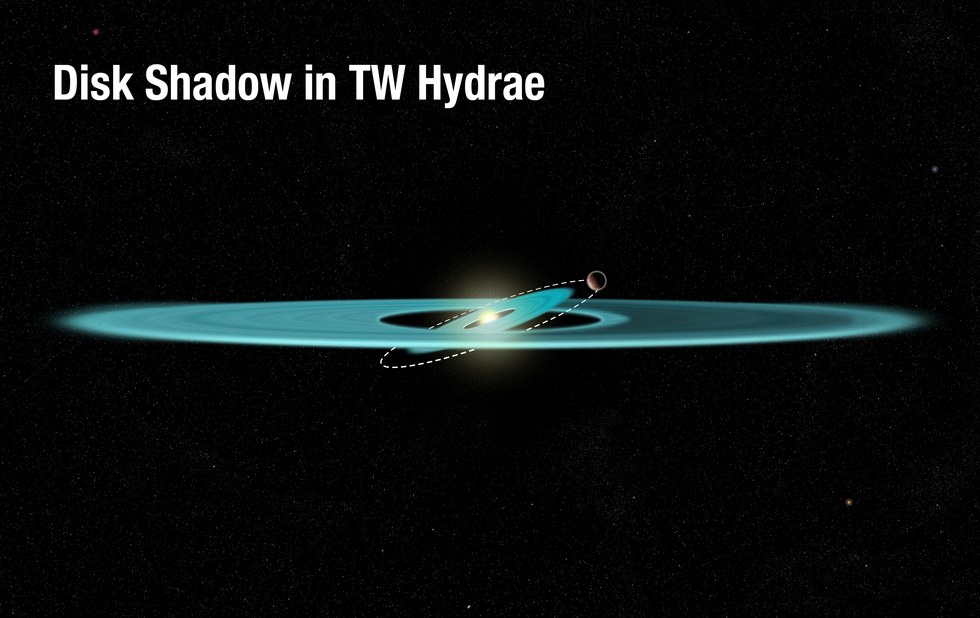
An unseen exoplanet is the best explanation for the shadow, Debes and his colleagues said. If they're right, the alien world itself isn't casting the shadow; rather, the planet's gravity has twisted and tilted the inner portion of the dust-and-gas disk, blocking starlight headed toward the outer reaches.
![]() |
| This diagram reveals the proposed structure of a gas-and-dust disk surrounding the nearby young star TW Hydrae |
The putative planet must be about five times more massive than Jupiter to sculpt the inner disk in this manner, the researchers added.
The results — which Debes presented Saturday (Jan. 7) at the 229th meeting of the American Astronomical Society in Grapevine, Texas — map out a promising new way to hunt for infant planets in the inner portions of the disks surrounding young stars, study team members said.
Read more at Discovery News
Subscribe to:
Posts (Atom)


