Nov 30, 2010

Journey to the edge of the universe

National Geographic presents the first accurate non-stop voyage from Earth to the edge of the Universe using a single, unbroken shot through the use of spectacular CGI (Computer-Generated Imagery) technology. Building on images taken from the Hubble telescope, Journey to the Edge of the Universe explores the science and history behind the distant celestial bodies in the solar system.

This spectacular, epic voyage across the cosmos, takes us from the Earth, past the Moon and our neighboring planets, out of our Solar System, to the nearest stars, nebulae and galaxies and beyond – right to the edge of the Universe itself. When you finish this video, you will walk away from it with an awareness that you never had before, of the unseen astronomically massive universe that we float around on like a spec of dust in the ocean.

This video takes you on a journey through the universe as if you are watching a Sci Fi adventure. Yet you constantly have to remind yourself that what you’re seeing is really out there.

Here’s the full documentary below:


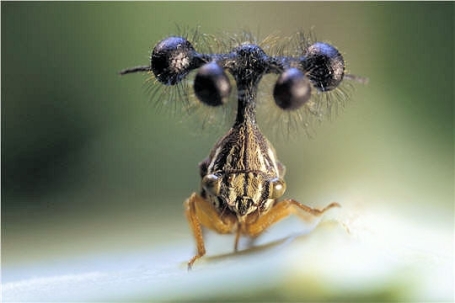
The surreal treehoppers

Martin Kemp describes Keller’s work:

“Keller was trained as a kunstschmied, an ‘art blacksmith’. From 1930 until his early death he was employed by the Berlin Museum für Naturkunde (Museum of Natural History), painstakingly labouring over his recreations of insects and their larvae. Each took a year to complete. Keller worked first in plasticine, from which he cast a model in plaster. This plaster reference model he then recast in papier maché. Some details he added, cast in wax, with wings and bristles in celluloid and galalith (an early plastic material used in jewellery). Finally he coloured the surfaces, sometimes with additional gilding. The levels of patience and manual control Keller exercised were incredible. His fly, for example, boasts 2,653 bristles.

. . . Keller was a sculptor of monumental one-off portraits. Each model is a masterpiece, with no effort spared. It is difficult to see how such a skilled artisan could survive in today’s museums, with their emphasis on cost analysis. Keller’s exacting models may be things of the past, yet they are far from obsolete. Like the great habitat dioramas, they exercise a magnetic attraction.

The first thing a biologist does on seeing a model like this is think, “This can’t be real,” and resorts to some Googling. Sure enough, it’s a real insect. Here are two photos:”

Read more at Why Evolution Is True

3D printing offers ability to print physical objects

“As Christmas fast approaches, millions will opt to spare themselves the crowded high street and instead settle down in front of the computer and do their shopping there. Yet buying online has always had one key disadvantage: you have to wait. Not only that, but the inability to touch a product, try it on, feel how heavy it is or do anything else you would do on your typical high street excursion prevents online shopping being the perfect experience. But technology is now coming online that could allow you to receive your goods straight away. As the cost of 3D printing hardware begins to drop, bespoke, printable products may be about to hit the market.

Freedom of Creation is a design and research company exploring the capabilities of what, in the industry, is known as rapid prototyping. Janne Kyttanen is the company’s founder and creative director. “Imagine the potential of this for the fashion industry,” he told Digital Planet on the BBC World Service. “I can measure your body, in 3D, and I can make you perfectly fitting garments in the future without any sewing and stitching, making the needle and the thread obsolete.” His company is now producing products for companies including Asics, Tommy Hilfiger and Hyundai.

Away from the fashion world, 3D printing has many applications for the developing world. The ability to produce specially designed objects from a computer offers exciting possibilities for making vital tools in poorer, hard to reach areas. One scheme that is looking to capitalise in the technology is RepRap, short for Replicating Rapid Prototyping, which offers a cheap way of replicating objects – including the printer itself. “It’s a 3D printer that prints out a kit of parts for another 3D printer,” explained Dr Adrian Bowyer from the University of Bath.”

Read more at BBC News

100 Recycled Bicycles = 1 Weird Christmas Tree

“Most Christmas trees are already green, but this environmentally friendly holiday display in Sydney takes the concept to a new level: It’s made of bicycles that were destined for the recycling yard.

The bicycle tree, dubbed the “Tree-Cycle,” is made of 100 old bikes donated by a local recycling company. The bike frames were spray-painted tree green, while the tires were given a multi-colored makeover to make them look like holiday lights.

And if you thought you spent a lot of time putting up your tree, consider this: It took eight weeks to build the 23-foot-tall Tree-Cycle, which is on display at The Rocks, one of the city’s prime tourist and shopping districts.

Even the “star” at the top of the tree is made of bicycle parts — look closely, and you’ll see it’s really just a series of front forks and tires sticking out in each direction.

It’s at least the third year in a row that the Rocks has featured a tree made of recycled or recyclable objects.

Last year’s Christmas centerpiece was made of bottles, while the 2008 effort was a tree-shaped pile of chairs.”

Read more at AOL News

Nov 29, 2010

Same Face May Look Male or Female, Depending on Where It Appears in a Person’s Field of View

“Neuroscientists at MIT and Harvard have made the surprising discovery that the brain sees some faces as male when they appear in one area of a person’s field of view, but female when they appear in a different location.

The findings challenge a longstanding tenet of neuroscience — that how the brain sees an object should not depend on where the object is located relative to the observer, says Arash Afraz, a postdoctoral associate at MIT’s McGovern Institute for Brain Research and lead author of a new paper on the work. “It’s the kind of thing you would not predict — that you would look at two identical faces and think they look different,” says Afraz. He and two colleagues from Harvard, Patrick Cavanagh and Maryam Vaziri Pashkam, described their findings in the Nov. 24 online edition of the journal Current Biology.

In the real world, the brain’s inconsistency in assigning gender to faces isn’t noticeable, because there are so many other clues: hair and clothing, for example. But when people view computer-generated faces, stripped of all other gender-identifying features, a pattern of biases, based on location of the face, emerges. The researchers showed subjects a random series of faces, ranging along a spectrum of very male to very female, and asked them to classify the faces by gender. For the more androgynous faces, subjects rated the same faces as male or female, depending on where they appeared.

Study participants were told to fix their gaze at the center of the screen, as faces were flashed elsewhere on the screen for 50 milliseconds each. Assuming that the subjects sat about 22 inches from the monitor, the faces appeared to be about three-quarters of an inch tall. The patterns of male and female biases were different for different people. That is, some people judged androgynous faces as female every time they appeared in the upper right corner, while others judged faces in that same location as male. Subjects also showed biases when judging the age of faces, but the pattern for age bias was independent from the pattern for gender bias in each individual.”

Read more at Science Daily

Stealing the Mystic Lamb – The story of the world’s most coveted masterpiece

Many of you may be forgiven for thinking that the above image is actually a sculpture, well you’d be wrong. It’s painted by an artist known as Jan van Eyck and is considered by many to be one of the most important paintings in history. The awe inspiring lighting, composition and photorealism of this piece isn’t just incredible for it’s life like qualities. It is in fact because it was painted nearly 600 years ago and since then has had a dark history that can’t be rivalled by many other works.

So other than the craftsmanship and age of the piece – why is this painting so important? Well, The Ghent Altarpiece is the most frequently stolen artwork of all time. Since its completion in 1432, this twelve-panel oil painting has disappeared, been looted in three different wars, been burned, dismembered, copied, forged, smuggled, illegally sold, censored, attacked by iconoclasts, hidden castle vaults and secret salt mines, hunted by Nazis and Napoleon, prized by The Louvre and a Prussian king, damaged by conservators, returned as war reparations, used as a diplomatic tool, ransomed, rescued by Austrian double-agents, and stolen a total of thirteen times.

Stealing the Mystic Lamb is the incredible tale behind the deception, fraud and scammers who throughout history have done whatever they feel necessary to obtain it.

Available at Amazon now.

Nov 28, 2010

A Card Trick Leads To A New Mathematical Bound On Data Compression

“A complicated card trick that deals with the colors of the cards and a binary De Bruijn cycle has helped a mathematician reach a new bound on data compression. Magic and math, more friendly than you’d think!

Here’s how the trick works: You hand your friend a deck of cards and ask them to draw six cards (in order) and name the colors. With that sequence of colors, you can immediately name the exact cards that have been drawn. How? Because each color sequence is unique and appears only once throughout the deck (after pre-arranging it to be so), so if you have an insane memory, you’ll know which cards correspond to the sequence.

According to Travis Gagie from the University of Chile in Santiago, the trick is closely related to data compression:

“Gagie achieves this new [mathematical] bound by considering a related trick. Instead of pre-arranging the cards, you shuffle the pack and then ask your friend to draw seven cards. He or she then lists the cards’ colours, replaces them in the pack and cuts the deck. You then examine the deck and say which cards were drawn. This time you’re relying on probability to get the right answer. “It is not hard to show that the probability of two septuples of cards having the same colours in the same order is at most 1/128,”
This turns out to be closely related to various problems of data compression and leads to a lower bound than has been found by any other means.”"

Read more at Gizmodo

Gold Nanoparticles Could Transform Trees Into Street Lights

“Street lights are an important part of our urban infrastructure — they light our way home and make the roads safe at night. But what if we could create natural street lights that don’t need electricity to power them? A group of scientists in Taiwan recently discovered that placing gold nanoparticles within the leaves of trees, causes them to give off a luminous reddish glow. The idea of using trees to replace street lights is an ingenious one – not only would it save on electricity costs and cut CO2 emissions, but it could also greatly reduce light pollution in major cities.

The discovery came about accidentally after the scientists were looking for a way to create high-efficiency lighting similar to LED technology, but without using toxic chemicals such as phosphor powder. Speaking about the development, Professor Shih-Hui Chang said, “Light emitting diode (LED) has replaced traditional light source in many display panels and street lights on the road. A lot of light emitting diode, especially white light emitting diode, uses phosphor powder to stimulate light of different wavelengths. However, phosphor powder is highly toxic and its price is expensive. As a result, Dr. Yen-Hsun Wu had the idea to discover a method that is less toxic to replace phosphor powder. This is a major motivation for him to engage in the research at the first place.”

By implanting the gold nanoparticles into the leaves of the Bacopa caroliniana plants, the scientists were able to induce the chlorophyll in the leaves to produce a red emission. Under a high wavelength of ultraviolet light, the gold nanoparticles were able to produce a blue-violet fluorescence to trigger a red emission in the surrounding chlorophyll.”

Read more at Inhabitat

The cloned animals that caused controversy

Dolly the sheep

The arrival of Dolly signalled a landmark in genetic technology, demonstrating that scientists could reverse cellular time by converting an adult sheep's cell into an embryo, which was then grown into a new sheep.

Her birth prompted a raging debate about the ethics and ramifications of cloning, with one writer claiming that Dolly "looks at you with those intense red eyes – eyes full of hate".

The ethical arguments against animal cloning were strengthened when she was put down in 2003 after contracting lung disease. She had been plagued by health problems and was also suffering from premature arthritis.

Cumulina the mouse
 
Cumulina was the first of more than 50 identical mice, spanning three generations, which were created at the University of Hawaii in 1998.

She was named Cumulina because she was created from the DNA of cumulus cells, which surround developing eggs in female mice's ovaries.

Cumulina was the first animal cloned from adult cells that survived to adulthood, and produced two healthy litters.

Noah the gaur
 
Noah the gaur – a southeast Asian species of wild cattle similar to bison – represented the first attempt by scientists to clone an endangered animal.

Scientists in America hoped to take a huge step in the fight to protect endangered species by having a cloned gaur born to an ordinary cow on a farm in Iowa.

However, Noah died soon after he was born in 2001.

CC the cat
 
CC, or Carbon Copy, was born in 2001, making her the first domestic pet to be cloned.

Scientists hoped that creating a carbon copy of the cat could offer millions of pet owners the chance to resurrect beloved family pets.

However, while Rainbow – the original cat – was a heavily built white cat with brown, tan and gold spots, CC was slender with a white coat and stripes of grey. in addition, the cats had wildly differing personalities – while Rainbow was reserved, CC was playful.

Read more at The Telegraph

34 minutes - the time it takes for new shoes to pinch

Researchers have found that once they have stepped out of the taxi and into a pub or club, they survive just over half an hour before their feet start to

Four in ten said they take a spare pair of pumps 'out of habit' to change into because they know their shoes will rub.
And more than half have ended up walking home bare-foot, while one in ten have abandoned their shoes altogether or borrowed someone else's.

But a survey of 4,000 women revealed a determined one fifth said the prospect of aching feet would not put them off wearing a pair of killer heels.

Erika Gibbins, podiatrist for shoe insert Insolia, said: ''So many women will be able to relate to these findings, as they've been victims of painful shoes, but persevere with them in the name of fashion.

''It's ridiculous that so many nights out are spoilt so quickly by painful shoes and it doesn't have to be this way.
''The fact the nation's women are resorting to taking a second pair of shoes, and walking home barefoot means they need to do something so they can get to enjoy nights out and not worry about their feet.''

The average woman has suffered from foot pain on at least six occasions in the last 12 months.

One in ten have been carried home, while a third have deliberately chosen bars with stools to keep the weight off their feet.

Yet half said they own a pair of killer heels which hurt to wear but put up with the pain because they look great, and three in ten have worn an uncomfortable pair to prove a point to their partner.

The nationwide poll of women aged 18 to 65 found the average woman currently owns 18 pairs, typically spent £35 on each purchase and has a hoard totalling £630.

But eight in ten said they have nine pairs of shoes in their cupboard they have never worn or donned just once or twice

They also have another four pairs they deem 'too uncomfortable to wear'.

That means shoe-addicts have at least £315 worth that have never seen the light of day.

Read more at The Telegraph