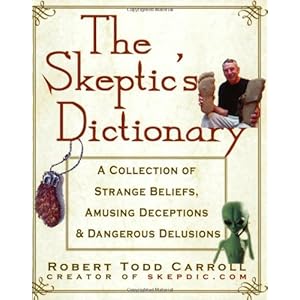
Some of the definitions in the Skeptic’s Dictionary will bring a smile to anyone’s face. I (Phillis) own a copy and whilst it reads a little like a joke book of debunking, it’s always interesting. Not to be taken too seriously it’s a lot of fun and if you want a nice little taster the website is featuring it’s favourites. Here’s a few of ours:
Angel therapy: pretending to get messages from angels to guide patients; good way to avoid liability.
Dolphin-assisted therapy: swimming with animals that may be diseased and may bite in order to enhance one’s sense of wellbeing.
Mozart effect: marketing strategy for a number of devices, including music CDs: claim listening to Mozart’s music while in the womb will make your child smarter; recommended by 9 out of 10 politicians ignorant of science and basic human development.
More at Skepdic
Dictionary available from Amazon here
Nov 10, 2010
Nov 9, 2010
Alaskan Bird Deformities Are Puzzling, Creepy
In a possible symptom of environmental decline, Alaska’s birds have experienced a sudden and inexplicable rash of beak deformities.
About one in 16 crows and black-capped chickadees suffer from a condition called avian keratin disorder, which causes their beaks to become morbidly elongated and crossed.
Rates of the debilitating disorder are 10 times higher than usual. That’s higher than has ever been recorded in any wild-bird population, and most of this rise happened over the last decade. Dozens of other bird species are afflicted. Nobody knows why, but it’s probably not a good sign.
“The sudden appearance of a large cluster of animals with gross abnormalities may signal a significant change in an ecosystem,” wrote U.S. government biologists Colleen Handel and Kimberly Trust in paper published in October in The Auk.
Many possible culprits have been identified. One is environmental contamination; toxins and heavy metals have caused past beak-deformity epidemics in the Great Lakes and California. But those outbreaks occurred in clusters, while Alaska’s deformities are widespread and affect species living in different habitats, with different diets.
Read more at Wired
About one in 16 crows and black-capped chickadees suffer from a condition called avian keratin disorder, which causes their beaks to become morbidly elongated and crossed.
Rates of the debilitating disorder are 10 times higher than usual. That’s higher than has ever been recorded in any wild-bird population, and most of this rise happened over the last decade. Dozens of other bird species are afflicted. Nobody knows why, but it’s probably not a good sign.
“The sudden appearance of a large cluster of animals with gross abnormalities may signal a significant change in an ecosystem,” wrote U.S. government biologists Colleen Handel and Kimberly Trust in paper published in October in The Auk.
Many possible culprits have been identified. One is environmental contamination; toxins and heavy metals have caused past beak-deformity epidemics in the Great Lakes and California. But those outbreaks occurred in clusters, while Alaska’s deformities are widespread and affect species living in different habitats, with different diets.
Read more at Wired
Milky Way May Fizzle Out Sooner Than Expected
A thick bar of stars, gas and dust spanning across the Milky Way’s center could be speeding star formation and, as supplies run out, our host galaxy’s eventual death.
A new study, the first to trickle out of Galaxy Zoo’s second crowd-sourced scientific effort, buoys the idea that bars somehow encourage galaxies to form big, blue and short-lived stars, as well as funnel gas and dust to supermassive black holes lurking at their cores. In the process, bars may quickly consume star-making materials to leave behind only a “dead” galaxy of red and fading stars.
“Basically, as you go from the really youthful galaxies to the dead ones, more and more frequently we see bars in them,” said Kevin Schawinski, an astronomer at Yale University and co-author of the study, set to appear in an upcoming edition of the Monthly Notices of the Royal Astronomical Society. “Our immediate suspicion is that bars are involved in speeding galaxy evolution.”
Schawinski said the work isn’t proof that bars shorten galaxies’ star-forming lifespans — it could be the other way around, with bars being a product of dying galaxies. But he said the data backs the first idea, which is shared among many astronomers.
“Bars seem to help exhaust supplies of gas, pushing galaxies to a passive state and no longer forming any stars. This is inline with our results and what others are saying,” Schawinski said. “The Milky Way, which is more or less agreed to be a barred spiral, may be an example of a galaxy in transition from an active state to something anemic and passive.”
George Djorgovski, an astronomer at Caltech who described his team as “in a friendly competition of sorts” with Galaxy Zoo, said the new research is interesting and does support existing ideas in the field.
“More than anything it illustrates how citizen science approach can be used very effectively, both in research and outreach,” Djorgovski said. “It’s a pretty exciting way of doing science, and Galaxy Zoo is certainly the most successful to date.”
Read more at Wired
A new study, the first to trickle out of Galaxy Zoo’s second crowd-sourced scientific effort, buoys the idea that bars somehow encourage galaxies to form big, blue and short-lived stars, as well as funnel gas and dust to supermassive black holes lurking at their cores. In the process, bars may quickly consume star-making materials to leave behind only a “dead” galaxy of red and fading stars.
“Basically, as you go from the really youthful galaxies to the dead ones, more and more frequently we see bars in them,” said Kevin Schawinski, an astronomer at Yale University and co-author of the study, set to appear in an upcoming edition of the Monthly Notices of the Royal Astronomical Society. “Our immediate suspicion is that bars are involved in speeding galaxy evolution.”
Schawinski said the work isn’t proof that bars shorten galaxies’ star-forming lifespans — it could be the other way around, with bars being a product of dying galaxies. But he said the data backs the first idea, which is shared among many astronomers.
“Bars seem to help exhaust supplies of gas, pushing galaxies to a passive state and no longer forming any stars. This is inline with our results and what others are saying,” Schawinski said. “The Milky Way, which is more or less agreed to be a barred spiral, may be an example of a galaxy in transition from an active state to something anemic and passive.”
George Djorgovski, an astronomer at Caltech who described his team as “in a friendly competition of sorts” with Galaxy Zoo, said the new research is interesting and does support existing ideas in the field.
“More than anything it illustrates how citizen science approach can be used very effectively, both in research and outreach,” Djorgovski said. “It’s a pretty exciting way of doing science, and Galaxy Zoo is certainly the most successful to date.”
Read more at Wired
Earliest Burrow of Four-Legged Animal Found
The fossilized remains of a groundhog's kind of quarters has now been tracked back to an amphibian that lived a whopping 350 million years ago.
Researchers have found the earliest burrow of what had to be a four-legged critter at a time before many reptiles and long, long before mammals were around. The burrow was likely home to a hefty creature that also left its footprints in related rocks, but no bones.
The discovery of the burrow came when a professor and his students were out looking for signs of ancient animals in the rocks exposed by road cuts in Pennsylvania.
"We were all prospecting for tracks," said Ed Simpson, a paleontologist at Kutztown University in Pennsylvania. "We came upon this structure and said, 'This is weird.'"
The borrow is, of course, now filled with sediments which have turned to stone. But it retains the gently funnel-shaped opening which leads to a downward dropping tunnel, which rises again to the main borrow. There are also features on the outside of the burrow that make a strong case for it having once been open to the surface, near a river.
Simpson asked his students to come up with ideas of what the structure was, and then justify their ideas. The two basic lines of reasoning were that it was either formed by water wind or other physical processes, or it was formed by an organism. Students Lauren Storm and Mattathias D. Needle studied the possibilities, Simpson said, and their names are now the first two on the paper reporting the discovery in the journal Palaeo.
"It's very difficult to get an erosive feature like this," Simpson explained. The only thing that comes close is a pothole, which is formed in a river by rocks, but the hole was too deep and the upward arc of the tunnel can't be easily explained as a pothole.
Another possibility is that a buried log could have rotted away, said geologist David Loope of the University of Nebraska in Lincoln. But doesn't seem likely to have produced this structure either, he said.
Read more at Discovery News
Researchers have found the earliest burrow of what had to be a four-legged critter at a time before many reptiles and long, long before mammals were around. The burrow was likely home to a hefty creature that also left its footprints in related rocks, but no bones.
The discovery of the burrow came when a professor and his students were out looking for signs of ancient animals in the rocks exposed by road cuts in Pennsylvania.
"We were all prospecting for tracks," said Ed Simpson, a paleontologist at Kutztown University in Pennsylvania. "We came upon this structure and said, 'This is weird.'"
The borrow is, of course, now filled with sediments which have turned to stone. But it retains the gently funnel-shaped opening which leads to a downward dropping tunnel, which rises again to the main borrow. There are also features on the outside of the burrow that make a strong case for it having once been open to the surface, near a river.
Simpson asked his students to come up with ideas of what the structure was, and then justify their ideas. The two basic lines of reasoning were that it was either formed by water wind or other physical processes, or it was formed by an organism. Students Lauren Storm and Mattathias D. Needle studied the possibilities, Simpson said, and their names are now the first two on the paper reporting the discovery in the journal Palaeo.
"It's very difficult to get an erosive feature like this," Simpson explained. The only thing that comes close is a pothole, which is formed in a river by rocks, but the hole was too deep and the upward arc of the tunnel can't be easily explained as a pothole.
Another possibility is that a buried log could have rotted away, said geologist David Loope of the University of Nebraska in Lincoln. But doesn't seem likely to have produced this structure either, he said.
Read more at Discovery News
Nov 8, 2010
Warm Laptop? Beware 'Toasted Leg Syndrome'
Laptop computers, by nature, can go anywhere. And when users log on, they often rest the laptop in their lap.
This may even be how you are reading this article right now. If so, you may want to consider moving the laptop off your skin.
The November issue of Pediatrics explores a case study involving a 12-year-old boy whose laptop is thought to have caused erythema ab igne, a skin affliction known as "toasted leg syndrome."
Erythema ab igne is a skin disorder in which affected skin turns brown. It is typically caused by prolonged exposure to heat or an infrared source such as a heating pad or hot water bottle.
In the past, erythema ab igne was most commonly observed on patients who worked near open fires and coal stoves. Incidence has gone down since the introduction of central heating.
However, researchers are noticing new cases caused by laptop computers.
To be clear, laptop-induced cases are still rare. The researchers know of only 10 laptop-induced cases since 2004.
These patients are unique in that the skin discoloration occurs on patients' thighs and is asymmetrical.
The 12-year-old boy highlighted in the article is thought to be the youngest laptop-induced patient. He reported playing computer games for several hours per day with his laptop computer being located on his upper legs. This continued for months. He noticed the heat on his left side, but did not change the laptop's position.
His erythema ab igne was only on his left leg. The authors believe it was probably caused by heat emanating from the optical drive. A laptop's battery and ventilation fan are two other suspected common culprits.
In rare cases, chronic erythema ab igne can lead to squamous cell carcinoma, a form of cancer.
Read more at Discovery News
This may even be how you are reading this article right now. If so, you may want to consider moving the laptop off your skin.
The November issue of Pediatrics explores a case study involving a 12-year-old boy whose laptop is thought to have caused erythema ab igne, a skin affliction known as "toasted leg syndrome."
Erythema ab igne is a skin disorder in which affected skin turns brown. It is typically caused by prolonged exposure to heat or an infrared source such as a heating pad or hot water bottle.
In the past, erythema ab igne was most commonly observed on patients who worked near open fires and coal stoves. Incidence has gone down since the introduction of central heating.
However, researchers are noticing new cases caused by laptop computers.
To be clear, laptop-induced cases are still rare. The researchers know of only 10 laptop-induced cases since 2004.
These patients are unique in that the skin discoloration occurs on patients' thighs and is asymmetrical.
The 12-year-old boy highlighted in the article is thought to be the youngest laptop-induced patient. He reported playing computer games for several hours per day with his laptop computer being located on his upper legs. This continued for months. He noticed the heat on his left side, but did not change the laptop's position.
His erythema ab igne was only on his left leg. The authors believe it was probably caused by heat emanating from the optical drive. A laptop's battery and ventilation fan are two other suspected common culprits.
In rare cases, chronic erythema ab igne can lead to squamous cell carcinoma, a form of cancer.
Read more at Discovery News
Scientists Look to Recreate Big Bang
“Talk about a trip back in time. Scientists have always wondered what it was like at the moment of and immediately after the creation of the universe, generally known as the Big Bang. Soon, they may find out.
By using the world’s biggest and most powerful particle accelerator — the Large Hadron Collider, or LHC — researchers will attempt to create, essentially, mini-Big Bangs that will help them study matter that once existed almost 14 billion years ago.
OK, if this all sounds a bit heady — especially for those of us who wonder how we’re going to get by until the next paycheck comes around — let’s break this down a bit.
First — and we might as well start at the beginning — the Big Bang theory (apart from being a very funny TV sitcom) suggests that the universe was created 13.7 billion years ago when extremely high energy caused a rapid expansion of what is theorized was a very hot and dense state, and it continues to expand outward.
The LHC was built by the European Organization for Nuclear Research, or CERN at its laboratory near the French-Swiss border.
The machine sits in a 17-mile-in-circumference underground tunnel near Geneva and is used to study what the known universe is made of and why it works the way it does. Fundamental particles are made to collide inside the accelerators, and this helps scientists understand more about the laws of nature.
Researchers hope that by colliding lead ions inside the huge LHC “Big Bang machine,” they’ll be able to recreate what the young universe looked like.”
Read more at AOL News
By using the world’s biggest and most powerful particle accelerator — the Large Hadron Collider, or LHC — researchers will attempt to create, essentially, mini-Big Bangs that will help them study matter that once existed almost 14 billion years ago.
OK, if this all sounds a bit heady — especially for those of us who wonder how we’re going to get by until the next paycheck comes around — let’s break this down a bit.
First — and we might as well start at the beginning — the Big Bang theory (apart from being a very funny TV sitcom) suggests that the universe was created 13.7 billion years ago when extremely high energy caused a rapid expansion of what is theorized was a very hot and dense state, and it continues to expand outward.
The LHC was built by the European Organization for Nuclear Research, or CERN at its laboratory near the French-Swiss border.
The machine sits in a 17-mile-in-circumference underground tunnel near Geneva and is used to study what the known universe is made of and why it works the way it does. Fundamental particles are made to collide inside the accelerators, and this helps scientists understand more about the laws of nature.
Researchers hope that by colliding lead ions inside the huge LHC “Big Bang machine,” they’ll be able to recreate what the young universe looked like.”
Read more at AOL News
Nov 7, 2010
Isaac Newton, World's Most Famous Alchemist
Lawrence Principe was sorting through a collection of old chemistry books at the Chemical Heritage Foundation in Philadelphia when he stumbled upon a forgotten manuscript handwritten by Sir Isaac Newton. Any Newton manuscript is of interest, but this one was worth its weight in gold, literally—as Principe, a chemist and historian of science at Johns Hopkins University, recognized immediately. Holding the yellowed manuscript in his hands and studying the scribbled words, he understood that he was looking at one of the best-kept secrets in the history of science. Today revered as the father of modern physics and the inventor of calculus, Newton was describing a recipe for the Philosophers’ Stone, a legendary substance that reputedly could turn base metals like iron and lead into gold. Newton’s dabblings in alchemy are well known, but his belief that he had found the closely guarded blueprint for the Philosophers’ Stone was astonishing indeed.
Newton was not the only intellectual heavyweight from his era trying to make gold. The recipe for the Philosophers’ Stone had come from his older contemporary, the famed British chemist Robert Boyle. As it turns out, Boyle was a devotee of alchemy too.
Read more at Discover
Newton was not the only intellectual heavyweight from his era trying to make gold. The recipe for the Philosophers’ Stone had come from his older contemporary, the famed British chemist Robert Boyle. As it turns out, Boyle was a devotee of alchemy too.
Read more at Discover
Bionic implants: 'We have the technology'
For the first time in more than a decade, Miikka Terho was able to glance at a clock and read the time. It was a simple task, but one he had been unable to do since he was robbed of his sight by disease. Mr Terho, 46, a financial consultant from Finland, was one of three patients who had their sight temporarily restored using artificial light sensors and microchips placed on the retina at the back of their eyes by doctors in Germany.
This extraordinary melding of man and machine proves that we finally have the technology to create real-life bionic humans. In the 1970s TV series, The Six Million Dollar Man, Lee Major’s character had his body rebuilt using bionic technology, leaving him “better, stronger, faster”. Now, cutting-edge research is producing synthetic body parts to replace damaged tissues, limbs, organs and senses. In most cases it is used to improve a patient’s quality of life, but in others it is saving lives.
Here we examine how science can potentially kit out a human being from head to toe to create a real bionic man.
Brain
By far the most important, and also the most complex, organ in the body is the brain. It controls our movements and our breathing, makes sense of the world and stores the memories that help form our personalities. Damage to the brain from accidents or illnesses such as strokes can be catastrophic, ranging from paralysis to memory loss. But some scientists believe they may have found a way to repair this damage – a prosthetic brain.
Dr Theodore Berger, from the University of Southern California, has been developing a device that can be implanted into the brain to restore memory functions, modelling the complex neural activity that takes place in the hippocampus, which is responsible for forming new memories.
The device – a microchip that encodes memories for storing elsewhere in the brain – has been tested using tissue from rats’ brains, and researchers are planning trials on live animals. They hope it will provide a way of restoring memory function in patients who have suffered damage to their hippocampus from a stroke, an accident or from Alzheimer’s disease.
Eyes
Around one million people in Britain suffer from two of the most common forms of blindness: macular degeneration and retinitis pigmentosa. But doctors in Germany last week restored sight to three blind patients by implanting chips lined with electronic sensors – similar to those found in digital cameras – into the back of their eyes. When light hits these sensors, they produce electrical impulses that pass into the optical nerve behind the eye and into the brain. The patients reported being able to distinguish objects such as fruit and cutlery, and even read their own name.
Miikka Terho was one of the first to have the implant and saw his life transformed over the three-month trial, before the implant was removed. He went from being completely blind to being able to make out fuzzy black-and-white shapes that allowed him to read the time.
“When I first got the implant I could tell I was seeing something, but I couldn’t really make out what it was – it was like my sight was a muscle that I hadn’t used in a long time and it needed training to get used to recognising things again,” he says.
“Later I was able to see people and tell if someone lifted their arm or if someone was taller than someone else. They were too fuzzy to distinguish faces, but being able to see like that would help me to be more independent and walk in unfamiliar surroundings – to live a more normal life.”
Professor Eberhart Zrenner, who led the research at the University of Tuebingen, has already begun work on improving the detail that the patients can see by changing the power supply – currently the chip has an external supply that must be transmitted through the skin via a magnetic link.
Read more at The Telegraph
Here we examine how science can potentially kit out a human being from head to toe to create a real bionic man.
Brain
By far the most important, and also the most complex, organ in the body is the brain. It controls our movements and our breathing, makes sense of the world and stores the memories that help form our personalities. Damage to the brain from accidents or illnesses such as strokes can be catastrophic, ranging from paralysis to memory loss. But some scientists believe they may have found a way to repair this damage – a prosthetic brain.
Dr Theodore Berger, from the University of Southern California, has been developing a device that can be implanted into the brain to restore memory functions, modelling the complex neural activity that takes place in the hippocampus, which is responsible for forming new memories.
The device – a microchip that encodes memories for storing elsewhere in the brain – has been tested using tissue from rats’ brains, and researchers are planning trials on live animals. They hope it will provide a way of restoring memory function in patients who have suffered damage to their hippocampus from a stroke, an accident or from Alzheimer’s disease.
Eyes
Around one million people in Britain suffer from two of the most common forms of blindness: macular degeneration and retinitis pigmentosa. But doctors in Germany last week restored sight to three blind patients by implanting chips lined with electronic sensors – similar to those found in digital cameras – into the back of their eyes. When light hits these sensors, they produce electrical impulses that pass into the optical nerve behind the eye and into the brain. The patients reported being able to distinguish objects such as fruit and cutlery, and even read their own name.
Miikka Terho was one of the first to have the implant and saw his life transformed over the three-month trial, before the implant was removed. He went from being completely blind to being able to make out fuzzy black-and-white shapes that allowed him to read the time.
“When I first got the implant I could tell I was seeing something, but I couldn’t really make out what it was – it was like my sight was a muscle that I hadn’t used in a long time and it needed training to get used to recognising things again,” he says.
“Later I was able to see people and tell if someone lifted their arm or if someone was taller than someone else. They were too fuzzy to distinguish faces, but being able to see like that would help me to be more independent and walk in unfamiliar surroundings – to live a more normal life.”
Professor Eberhart Zrenner, who led the research at the University of Tuebingen, has already begun work on improving the detail that the patients can see by changing the power supply – currently the chip has an external supply that must be transmitted through the skin via a magnetic link.
Read more at The Telegraph
Family's fridge is still going after 63 years
Six decades on, as the country enters another era of austerity, the fridge is still working as well as ever.
The English Electric appliance which George and Ivy Ashley bought in 1947 is now thought to be the oldest continuously-working fridge in the country.
It has served the family so well that, apart from the occasional replacement bulbs for the internal light, it has never needed repairs.
Over the years, three generations of Ashleys have relied on the fridge. Food fashions may have changed, but its temperature-controlled chamber has proved a constant in their lives.
The fridge's current owner, Don Ashley, 68, the son of George and Ivy, said: "The fridge is now in an outbuilding at the home because it had a noisy motor but otherwise I've no complaints."
For Mr Ashley, a retired farmer of Cockshutt, Shropshire, the fridge harks back to a forgotten era when Britain manufactured its own consumer durables, and built them to last.
Back in 1947 his mother and father would no doubt have been astonished at the thought that Japanese or German imports would soon become ubiquitous in British households.
Read more at The Telegraph
It has served the family so well that, apart from the occasional replacement bulbs for the internal light, it has never needed repairs.
Over the years, three generations of Ashleys have relied on the fridge. Food fashions may have changed, but its temperature-controlled chamber has proved a constant in their lives.
The fridge's current owner, Don Ashley, 68, the son of George and Ivy, said: "The fridge is now in an outbuilding at the home because it had a noisy motor but otherwise I've no complaints."
For Mr Ashley, a retired farmer of Cockshutt, Shropshire, the fridge harks back to a forgotten era when Britain manufactured its own consumer durables, and built them to last.
Back in 1947 his mother and father would no doubt have been astonished at the thought that Japanese or German imports would soon become ubiquitous in British households.
Read more at The Telegraph
Fish species stay alive on land with special skin
“A new study shows how an amphibious fish stays alive for up to two months on land. It’s all in the skin. Mangrove killifish are small fish, only about an inch or two long, that live in temporary pools in the coastal mangrove forests of Central and South America and Florida. During dry seasons when their pools disappear, the fish hole up in leaf litter or hollow logs. As long as they stay moist, they can survive for extended periods out of water by breathing air through their skin. But oxygen isn’t the only thing a fish out of water needs to worry about, according to Professor Patricia Wright, a biologist from the University of Guelph, Ontario, who has studied these fish for years. “All cells in the body need the right combination of ions and water for an animal to stay alive,” Wright explains. “Normally, the gills are responsible for these processes in fish. We knew that in mangrove killifish the gills are likely useless on land, so how these fish maintain ion balance out of water was a mystery.”
Wright’s latest research, published in the November/December 2010 issue of the journal Physiological and Biochemical Zoology, shows that the skin of the mangrove killifish picks up the slack for the gills. Through a series of laboratory experiments, Wright and her team found special cells called ionocytes clustered on the skin of the fish. Ionocytes, normally found on the gills of other fish, are the cells responsible for maintaining the right balance of water and salt in a fish’s cells. “We found the mangrove killifish have roughly as many ionocytes on their skin as on their gills,” Wright said. Other fish species have skin ionocytes in larval stages of development, but usually these cells disappear in the skin as the fish develops.”
Read more at Physorg
Wright’s latest research, published in the November/December 2010 issue of the journal Physiological and Biochemical Zoology, shows that the skin of the mangrove killifish picks up the slack for the gills. Through a series of laboratory experiments, Wright and her team found special cells called ionocytes clustered on the skin of the fish. Ionocytes, normally found on the gills of other fish, are the cells responsible for maintaining the right balance of water and salt in a fish’s cells. “We found the mangrove killifish have roughly as many ionocytes on their skin as on their gills,” Wright said. Other fish species have skin ionocytes in larval stages of development, but usually these cells disappear in the skin as the fish develops.”
Read more at Physorg
Subscribe to:
Posts (Atom)


